J Korean Soc Coloproctol Vol. 21, No. 4, 2005
241
대장암에서 Methylenetetrahydrofolate Reductase C677T와 A1298C 유전자 다형성
원광대학교 의과대학 외과학교실
박 원 철․이 정 균
접수: 2005년 4월 12일, 승인: 2005년 8월 2일 책임저자: 이정균, 570-711, 전북 익산시 신용동 344-2
원광대학교 의과대학 외과학교실 Tel: 063-850-1205, Fax: 063-855-2386 E-mail: [email protected]
이 논문은 2004년도 원광대학교 교비지원에 의해서 연구되었음.
Received April 12, 2005, Accepted August 2, 2005
Correspondence to: Jeong Kyun Lee, Department of Surgery, College of Medicine, Wonkwang University, 344-2 Sinyong-dong, Iksan 570-711, Korea.
Tel: +82-63-850-1205, Fax: +82-63-855-2386 E-mail: [email protected]
Methylenetetrahydrofolate Reductase C677T and A1298C Polymorphisms in Colorectal Cancer
Won Cheol Park, M.D., Jeong Kyun Lee, M.D.
Department of Surgery, College of Medicine, Wonkwang Univer- sity, Iksan, Korea
Purpose: Recently, the role of vitamins, folate in particular,
has been emphasized in the maintenance of health. Folate deficiency is known to give rise to developmental delay, pre-mature vascular disease, neural tube defects, acute leukemia, atherosclerotic vascular disease, delivery defects, breast cancers and gastrointestinal neoplasia. Methylenetet- rahydrofolate reductase (MTHFR) is an essential enzyme in folate metabolism, and influences DNA synthesis and DNA methylation. Generally, a low folate level is known to be associated with gastrointestinal neoplasms. Also, the amino- acid-changing and enzyme-activity-reducing nucleotide poly- morphism (677C→T/Ala222Val) has been described in the MTHFR polymorphism and it brings about low enzyme activity, which may reduce DNA methylation and uracil misincorporation into DNA. These processes may be critical for the oncogenic transformation of human cells.
Two common single nucleotide polymorphisms (SNPs) re- sulting in amino-acid changes (677C T/Ala222Val and 1298A C/Glu428Ala) have been described in MTHFR. We investi- gated the relation between the MTHFR C677T and A1298C polymorphisms derived from colorectal cancers and from controls in the Korean population. Methods:
One hundred forty-eight (148) individuals with colorectal cancer and 288 healthy persons were analyzed. Blood sampling of each group was performed by using a PCR- RFLP analysis, and MTHFR polymorphism genotypes of 677C/C, 677C/T, 677T/T, 1298AA, 1298AC, and 1298CC were obtained. Results: The genotype frequencies of MTHFR C677T polymorphisms were 25.0% (CC), 48.0%
(CT), 27.0% (TT), and 75.0% (CT+TT), respectively, in case patients and 39.2% (CC), 36.8% (CT), 24.0% (TT), and 60.8% (CT+TT) in controls. The genotype frequencies of MTHFR A1298C polymorphisms were 56.1% (AA), 37.2% (AC), 6.8% (CC), and 43.9% (AC+
CC), respectively, in case patients and 55.6% (AA), 40.3%
(AC), 4.2% (CC), and 44.4% (AC+CC) in controls. The 677TT and the 677CT genotypes were associated with significantly increased risks for colorectal cancer (adjusted OR=1.77 and 95% CI=1.02~3.04 in TT; adjusted OR=2.07 and 95% CI=1.28~3.35 in CT) than was the 677CC, genotype but the the 1298CC and 1298 AC geno- types were not associated with significantly increased risks for colorectal cancer (adjusted OR=1.75 and 95% CI=
0.71~4.26 in CC; adjusted OR=0.95 and 95% CI=0.62~
1.45 in AC). Conclusions: The MTHFR C677T polymor- phism may be influenced by colorectal cancer, but the role of the MTHFR A1298C polymorphism needs careful inter- pretation and confirmation in larger studies. J Korean Soc
Coloproctol 2005;21:241-246Key Words: MTHFR C677T, MTHFR A1298C, Polymorphism, Colorectal cancer
MTHFR C677T, MTHFR A1298C, 유전자 다 형성, 대장암
서 론
건강을 유지하는데 비타민, 특히 엽산의 중요성이 근래에 강조되고 있다. 엽산의 결핍은 발달 지연을 일 으켜 신생아에서 미성숙 혈관 질환이나 신경관 결손 등의 중추 신경계 질환 등을 일으킬 수 있고,1,2 급성 백혈병 같은 혈액학적 질환과도 연관된다.3 또한 과호
T/T M C/T C/C
198 175
Fig. 1. MTHFR C677T genotyping RFLP result. The polymor- phism affects HinfI digestion of the MTHFR C677T. Lane M
= ladder; Lane C/C = homozygous wild type; Lane C/T = hete- rozygotes; Lane T/T = homozygote mutant type. The amplified alleles were analyzed on 3.5% agarose gel. HinfI digests the 198 bp DNA segment from C/C homozygous indivuduals into 175 and 23 bp fragments. DNA from C/T heterozygous individuals shows the expected fragments at 198, 175, and 23 bp.
M A/C C/C A/A
84 bp
56 bp 31, 30, 28 bp
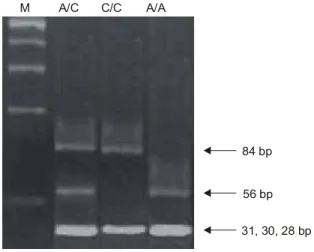
Fig. 2. MTHFR A1298C genotyping RFLP result. The polymor- phism affects MboII digestion of the MTHFR A1298C. Lane M
= ladder; Lane A/A = homozygous wild type; Lane A/C = heterozygotes; Lane C/C = homozygote mutant type. The ampli- fied alleles were analyzed on 3.5% agarose gel. The 1298AA wild-type homozygote: 56, 31, 30, 28, and 18 bp, 1298AC heterozygote: 84, 56, 31, 30, 28 and 18 bp and 1298CC mutant homozygous: 84, 31, 30 and 18 bp.
모시스테인 혈증과 연관되어 여러 폐색성 혈관성 질 환 등을 유발하고,4,5 출산 결손이나 다른 임신성 합병 증을 유발하기도 한다.6 최근에는 위장관계 신생 종양 의 발생과도 연관된다고 보고되고 있다.7 엽산의 결핍 은 과다 흡연이나 음주, 커피 등 식생활 습관과도 연관 되는데,7 이 때, MTHFR 유전자 다형성과도 연관된다.8 MTHFR 유전자 다형성은 MTHFR 자체의 효소 활성을 감소시켜 DNA의 생합성 과정에 영향을 주고, DNA의 메 틸화 정도를 감소시켜 결국 DNA의 손상과 저메틸화를 일으켜 생체 내에서 발암성 변이를 일으키게 되는데,9,10 특히 대장, 직장암과 연관이 있다고 알려져 있다.11 MTHFR의 다형성은 아미노산 변화와 single nucleo- tide polymorphisms (SNPs)의 변화(677C→T/Ala222Val, 1298A→C/Glu428Ala)로 정의되는데, 이는 열에 의한 비활성에 민감한 것으로 알려져 있다.12 이 때, 효소 활 성이 감소되고, 열성 불안정성이 증가되어 대장, 직장 의 신생 종양의 위험도를 증가시킨다고 알려져 있다.13 본 연구에서는 대장암 환자에서 MTHFR 유전자 다형 성을 대조군과 비교하여 대장암 발생 위험을 비교 분 석하였다.
방 법
1) 대상 환자2003년 8월부터 2004년 7월까지 본원 외과에서 대장
암으로 진단받은 148명의 환자와 일반인 288명의 말 초 혈액을 추출해서 PCR-RFLP 방법을 통하여 MTHFR C677T와 MTHFR A1298C 유전자 다형성 분석하였다.
대조군은 건강검진을 받으러 내원한 사람 중 대장암 의 가족력이 없는 사람을 대상으로 하였다. 환자군은 남자 83명(56.1%), 여자 65명(43.9%)이었고 평균 나이 는 60.3세였다. 대조군에서 남자 169명(58.7%), 여자 119명(41.3%)이었고 평균 나이는 52.8세였다. 통계적 으로 두 군간 차이는 없었다.
2) Genotyping (PCR-RFLP method)
각각의 혈액 샘플에서 추출한 DNA를 100 ng으로 정 량화하여 2 pmol의 프라이머와 0.5 mM의 dNTPs, 1.5 mM의 MgCl2, Taq DNA polymerase 1단위를 20μl 반응 성 용액에 같이 섞어 PCR (polymerase chain reaction) 을 시행하였다.
MTHFR C677T 프라이머 염기 서열은 Forward가 5'-TGA AGG AGA AGG TGT CTG CGG GA-3'이고, Backward가 5'-AGG ACG GTG CGG TGA GAG TG-3' 이었다.
MTHFR A1298C 프라이머 염기 서열은 Forward가 5'-AGG ACG GTG CGG TGA GAG TG-3'이고, Back- ward가 5'-CAC TTT GTG ACC ATT CCG GTT TG-3이 었다.
PCR cycling condition은 95oC에서 5분 동안 1 cycle
Table 1. Genotype frequency of MTHFR 677 and 1298 polymorphism among colorectal cancer case and control and their contributions to the risk of colorectal cancer
Case (N=148) Control (N=288)
MTHFR genotype OR* (95% CI†) P-value
N (%) N (%)
677C/C 37 (25.0) 113 (39.2)
677C/T 71 (48.0) 106 (36.8) 2.07 (1.28~3.35) 0.003
677T/T 40 (27.0) 69 (24.0) 1.77 (1.02~3.04) 0.041
677C/T+T/T 111 (75.0) 175 (60.8) 1.94 (1.25~3.01) 0.002
1298AA 83 (56.1) 160 (55.6)
1298AC 55 (37.2) 116 (40.3) 0.95 (0.62~1.45) 0.814
1298CC 10 (6.8) 12 (4.2) 1.75 (0.71~4.26) 0.222
1298AC+CC 65 (43.9) 128 (44.4) 0.98 (0.66~1.46) 0.499
*OR = odds ratio; †CI = confidence interval. The data were analyzed by multivariate logistic regression analysis and χ2 test.
(predenaturation)후, 94oC에서 30초 동안(DNA denatura- tion), 62oC에서 30초 동안(annealing), 72oC에서 30초 동 안(extension) 35 cycle 반복 후에 마지막으로 72oC에서 10분 동안 1 cycle (end filling)을 시행하였다.
PCR cycling 후에 PCR 산물 C677T와 A1298C를 각 각 제한 효소인 Hinf I 과 MboII로 반응성 완충액을 같 이 섞어 37oC에서 5시간 동안 자른 후 3.5% 아가로스 겔에 전기영동시켜 ethidium bromide로 염색 후 확인한 결과, C677T에서의 C/C 유전자형은 198 bp 절편으로 남게 하고, T/T 유전자형을175 bp와 23 bp 절편, C/T 유전자형은 175, 23, 198 bp 절편으로 나뉘게 된다(Fig.
1). A1298C에서의 A/A 유전자형은 56 bp, 31 bp, 30 bp, 28 bp 그리고 18 bp 절편, A/C 유전자형은 84 bp, 56 bp, 31 bp, 30 bp, 28 bp 그리고 18 bp 절편, C/C 유전자 형은 84 bp, 31 bp, 30 bp 그리고 18 bp 절편으로 나뉘게 된다(Fig. 2).
3) 통계 분석
대장암 발생 비교위험도를 로지스틱 회귀분석을 하 였고, 다변량분석을 하였다. 통계처리는 SPSS 통계프 로그램(version 10.0. SPSS Inc.)을 이용하였다.
결 과
1) MTHFR 677과 1298 유전자 다형성과 대장암 발생 비교위험도 및 다변량 분석
MTHFR C677T 유전자 다형성 빈도는 대장암 환자군 에서 CC 25.0%, CT 48.0%, TT 27.0%, CT+TT 75.0%였 고, 대조군에서 CC 39.2%, CT 36.8%, TT 24.0%, CT+
TT 60.8%였다. MTHFR A1298C 유전자 다형성 빈도는 대장암 환자군에서 AA 56.1%, AC 37.2%, CC 6.8%, AC+CC 43.9%였고, 대조군에서 AA 55.6%, AC 40.3%, CC 4.2%, AC+CC 44.4%였다. 677TT과 677CT 유전자 형은 677CC와 비교할 때 통계적으로 유의하게 대장암 의 발생 비교위험도(adjusted OR=1.77, 95% confidence interval 1.02~3.04 in TT, adjusted OR=2.07, 95% CI 1.28~3.35 in CT)가 증가하였다. 1298CC과 1298 AC는 1298AA와 비교할 때 통계적으로 유의하게 대장암의 발생 비교위험도(adjusted OR=1.75, 95% CI 0.71~4.26 in CC, adjusted OR=0.95, 95% CI 0.62~1.45 in AC)가 증가하지 않았다(Table 1).
2) MTHFR 1298에 따른 MTHFR 677 유전자 다 형성의 대장암 발생 비교위험도 및 다변량 분 석
MTHFR 1298에 따른 MTHFR 677 유전자 다형성 빈 도 및 대장암 발생 비교 위험도는 CC와 AA가 14.9%
(환자군) 및 18.1% (대조군)였고, CC와 AC는 0.52, CC 와 CC는 1.18, CT와 AA는 1.55, CT와 AC는 1.80, CT와 CC는 0.39, TT와 AA는 1.09, TT와 AC는 1.37이었다.
이 중 통계적으로 의의 있는 경우는 없었다(Table 2).
3) 대장암 발생 부위 및 조직학적 특성에 따른 MTHFR 유전자 다형성
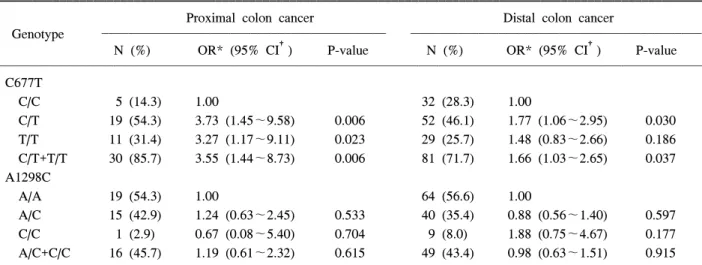
환자군 내에서 종양 발생 부위에 따라 MTHFR 다형 성의 분포를 비교한 결과, 677TT와 677CT 유전자형에 서 근위부 대장암의 발생 위험도가 높았으며 A1298C 유전자 다형성은 대장암의 발생 위치와 관련이 없었
Table 2. Risk of colorectal cancer associated with the MTHFR 677 genotype by 1298 genotypes
Case (N=148) Control (N=288)
MTHFR 677 MTHFR 1298 OR* (95% CI†) P-value
N (%) N (%)
CC AA 22 (14.9) 52 (18.1)
CC AC 12 (8.1) 55 (19.1) 0.52 (0.23~1.15) 0.104
CC CC 3 (2.0) 6 (2.1) 1.18 (0.27~5.16) 0.824
CT AA 38 (25.7) 58 (20.1) 1.55 (0.81~2.95) 0.184
CT AC 32 (21.6) 42 (14.6) 1.80 (0.91~3.55) 0.089
CT CC 1 (0.7) 6 (2.1) 0.39 (0.05~3.47) 0.401
TT AA 23 (15.5) 50 (17.4) 1.09 (0.54~2.19) 0.815
TT AC 11 (7.4) 19 (6.6) 1.37 (0.56~3.35) 0.492
TT CC 6 (4.1) 0
*OR = odds ratio; †CI = confidence interval. The data were analyzed by multivariate logistic regression analysis and χ2 test.
Table 3. Risk of colorectal cancer according to tumor location and MTHFR polymorphism
Proximal colon cancer Distal colon cancer
Genotype
N (%) OR* (95% CI†) P-value N (%) OR* (95% CI†) P-value
C677T
C/C 5 (14.3) 1.00 32 (28.3) 1.00
C/T 19 (54.3) 3.73 (1.45~9.58) 0.006 52 (46.1) 1.77 (1.06~2.95) 0.030
T/T 11 (31.4) 3.27 (1.17~9.11) 0.023 29 (25.7) 1.48 (0.83~2.66) 0.186
C/T+T/T 30 (85.7) 3.55 (1.44~8.73) 0.006 81 (71.7) 1.66 (1.03~2.65) 0.037 A1298C
A/A 19 (54.3) 1.00 64 (56.6) 1.00
A/C 15 (42.9) 1.24 (0.63~2.45) 0.533 40 (35.4) 0.88 (0.56~1.40) 0.597
C/C 1 (2.9) 0.67 (0.08~5.40) 0.704 9 (8.0) 1.88 (0.75~4.67) 0.177
A/C+C/C 16 (45.7) 1.19 (0.61~2.32) 0.615 49 (43.4) 0.98 (0.63~1.51) 0.915
*OR = odds ratio; †CI = confidence interval. The data were analyzed by multivariate logistic regression analysis and χ2 test.
다(Table 3). 환자군 내에서 조직학적 분화도 및 TNM 병기와 MTHFR 유전자 다형성은 통계적으로 유의한 상관관계는 없었다.
고 찰
인간의 methylenetetrahydrofolate reductase (MTHFR) 유전자는 엽산 대사에서 필수 효소로서 염색체 1p36.3 에 위치하는데,14 MTHFR은 호모시스테인을 메티오닌 으로 메틸화시키는 5-methyltetrahydrofolate에 methyl- donor형성에 관여한다.15
호모시스테인은 methionine synthase의 촉매 작용으 로 S-adenosyl-homocysteine (SAH)이 메티오닌으로 메
틸화되어 형성되는데, 이 때, 코발라민(B12)이 보조 인 자로 작용하고, 5-methyltetrahydrofolate (CH3THF)가 기 질로 쓰인다. CH3THF는 flavine adenine dinucleotide (FAD)에 의존 효소인 5,10-methylenetetrahydrofolate re- ductase (MTHFR)의 작용에 의해 형성되는데, 이는 엽 산이 DNA와 RNA 생합성에 사용될 때와 호모시스테 인이 메틸화하여 단백질 생산에 이용될 때, 엽산의 공 급원으로 쓰이는 중요한 대사산물이다. 이 때, 5,10- methylenetetrahydrofolate reductase (MTHFR)의 C677T 다형성(polymorphism)은 DNA와 RNA의 합성과 호모 시스테인의 메틸화로 인한 단백질합성에 필요한 엽산 대사 과정에 영향을 미친다.16
서양인의 평균 MTHFR C677T 유전자 다형성의 발
현 정도는 CC형이 약 50%, CT형이 약 40%, TT형이 약 10% 정도로 보고하였는데,17 본 연구의 정상인의 발현 정도는 CC형이 39.2%, CT형이 36.8%, TT형이 24.0%로 CC형 및 CT형은 적은 반면 TT형이 증가한 것으로 나타났다. 정상인 677CC형인 경우에 효소 활 성도가 100%, CT형인 경우에 약 65%, TT형인 경우에 약 35%를 보인다.18 MTHFR의 유전자 다형성 변이가 일어나면, 효소 활성도가 감소되어 methylenetetra- hydrofolate를 증가시켜, 우라실을 감소시킨다. 이는 DNA 생합성중에 우라실의 mis-incorporation을 일으켜 DNA double strand breaks를 일으키고, S-adenosylme- thionine (SAM)을 감소시켜 DNA 메틸화의 정도가 감 소되어 DNA 손상과 저메틸화에 영향을 주고 생체 내 에서 발암성 변형을 일으키게 된다고 보고되고 있 다.8,9
Sharp 등19은 위장관 종양과 유방암에서 MTHFR 유 전자 다형성이 암 발생에 영향을 준다고 보고하였고, Ryan 등20은 특히 대장, 직장에서의 신생 종양 발생에 영향을 준다고 보고하였다. Shannon 등21은 677TT형에 서 암의 발생이 더 증가한다고 보고하였는데, 본 연구 의 결과에 의하면 TT형보다 CT형에서 통계적으로 대 장암의 비교위험도(adjusted OR=1.77, 95% confidence interval 1.02~3.04 in TT, adjusted OR=2.07, 95% CI 1.28~3.35 in CT)가 높았다.
MTHFR A1298C 변형은 이형접합체(AC)보다 동형 접합체(CC)에서 MTHFR 활성의 감소가 더 심하다고 보고되었다.22 대장암에서는 MTHFR A1298C 유전자 다형성이 C677T과 독립적으로 위험도를 증가시킨다 고 보고되었는데 본 연구에서도 1298CC형이 대장암 의 비교위험도(adjusted OR=1.75, 95% CI=0.71~4.26) 를 증가시킨 것으로 나타났다.23
대장암 발생 위치와 MTHFR 유전자 다형성의 관련 은 677TT 유전자형이 근위부 대장암의 발생 위험을 감소시킨다는 보고가 있었는데24 본 연구에서는 677TT 와 677CT 유전자형에서 근위부 대장암의 발생 위험도 가 높았으며 A1298C 유전자 다형성은 대장암의 발생 위치와 관련이 없었다. 향후 더 많은 증례를 대상으로 연구하여야 할 것으로 생각한다.
결 론
결론적으로 MTHFR C677T유전자 다형성은 대장암 발생위험과 관련이 있고, MTHFR A1298C 유전자 다 형성은 대장암 발생위험과 통계적으로 관련이 적은
것으로 나타났다. 677TT와 677CT 유전자형에서 근위 부 대장암의 발생 위험도가 높았지만 향후 더 많은 증 례를 대상으로 연구하여야 할 것으로 생각한다.
REFERENCES
1. Guerra-Shinohara EM, Paiva AA, Rondo PH, Yamasaki K, Terzi CA, D'Almeida V. Relationship between total homo- cysteine and folate levels in pregnant women and their new- born babies according to maternal serum levels of vitamin B12. BJOG 2002;109:784-91.
2. Finnell RH, Greer KA, Barber RC, Piedrahita JA. Neural tube and craniofacial defects with special emphasis on folate pathway genes. Crit Rev Oral Biol Med 1998;9:38-53.
3. Skibola CF, Smith MT, Kane E, Roman E, Rollinson S, Cartwright RA, et al. Polymorphisms in the methylenetetra- hydrofolate reductase gene are associated with susceptibility to acute leukemia in adults. Proc Natl Acad Sci USA 1999;
96:12810-5.
4. Kang SS, Passen EL, Ruggie N, Wong PW, Sora H.
Thermolabile defect of methylenetetrahydrofolate reductase in coronary artery disease. Circulation 1993;88:1463-9.
5. Refsum H, Ueland PM, Nygard O, Vollset SE. Homocyste- ine and cardiovascular disease. Annu Rev Med 1998;49:31- 62.
6. Ray JG, Laskin CA. Folic acid and homocysteine metabolic defects and the risk of placental abruption, pre-eclampsia and spontaneous pregnancy loss: a systematic review. Pla- centa 1999;20:519-29.
7. Gescher AJ, Sharma RA, Steward WP. Cancer chemo- prevention by dietary constituents: a tale of failure and promise. Lancet Oncol 2001;2:371-9.
8. Guttormsen AB, Ueland PM, Nesthus I, Nygard O, Schneede J, Vollset SE, et al. Determinants and vitamin respon- siveness of intermediate hyperhomo cysteinemia (≥40μmol l−1). The Hordaland homocysteine study. J Clin Invest 1996;98:2174-83.
9. Blount BC, Mack MM, Wehr CM, MacGregor JT, Hiatt RA, Wang G, et al. Folate deficiency causes uracil misincorpo- ration into human DNA and chromosome breakage: impli- cations for cancer and neuronal damage. Proc Natl Acad Sci USA 1997;94:3290-5.
10. Stern LL, Mason JB, Selhub J, Choi SW. Genomic DNA hypomethylation, a characteristic of most cancers, is present in peripheral leukocytes of individuals who are homozygous for the C677T polymorphism in the methylenete trahydro- folate reductase gene. Cancer Epidemiol Biomarkers Prev 2000;9:849-53.
11. Marugame T, Tsuji E, Inoue H, Shinomiya S, Kiyohara C, Onuma K, et al. Methylenetetrahydrofolate reductase poly- morphism and risk of colorectal adenomas. Cancer Lett
2000;151:181-6.
12. Kang SS, Zhou J, Wong PW, Kowalisyn J, Strokosch G.
Intermediate homocysteinemia: a thermolabile variant of methylenetetrahydrofolate reductase. Am J Hum Genet 1988;43:414-21.
13. Chen J, Giovannucci E, Kelsey K, Rimm EB, Stampfer MJ, Colditz GA, et al. A methylenetetrahydrofolate reductase polymorphism and the risk of colorectal cancer. Cancer Res 1996;56:4862-4.
14. Goyette P, Sumner JS, Milos R, Duncan AM, Rosenblatt DS, Matthews RG, et al. Human methylenetetrahydrofolate reductase: isolation of cDNA, mapping and mutation identi- fication. Nat Genet 1994;7:195-200.
15. Bailey LB, Gregory JF 3rd. Polymorphisms of methylenete- trahydrofolate reductase and other enzymes: metabolic sig- nificance, risks and impact on folate requirement. J Nutr 1999;129:919-22.
16. Ueland PM, Hustad S, Schneede J, Refsum H, Vollset SE.
Biological and clinical implications of the MTHFR C677T polymorphism. Trends Pharmacol Sci 2001;22:195-201.
17. Ueland PM, Refsum H, Beresford SA, Vollset SE. The controversy over homocysteine and cardiovascular risk. Am J Clin Nutr 2000;72:324-32.
18. Frosst P, Blom HJ, Milos R, Goyette P, Sheppard CA, Mat- thews RG, et al. A candidate genetic risk factor for vascular disease: a common mutation in methylenetetrahrofolate re-
ductase. Nat Genet 1995;10:111-3.
19. Sharp L, Little J, Schofield AC, Pavlidou E, Cotton SC, Miedzybrodzka Z, et al. Folate and breast cancer: the role of polymorphisms in methylenetetrahydrofolate reductase (MTHFR). Cancer Lett 2002;181:65-71.
20. Ryan BM, Weir DG. Relevance of folate metabolism in the pathogenesis of colorectal cancer. J Lab Clin Med 2001;
138:164-76.
21. Shannon B, Gnanasampanthan S, Beilby J, Iacopetta B. A polymorphism in the methylenetetrahydrofolate reductase gene predispose to colorectal cancers with microsatellite instability. Gut 2002;50:520-4.
22. van der Put NM, Gabreels F, Stevens EM, Smeitink JA, Trijbels FJ, Eskes TK, et al. A second common mutation in the methylenetetrahydrofolate reductase gene: an addi- tional risk factor for neural-tube defects? Am J Hum Genet 1998;62:1044-51.
23. Chen J, Ma J, Stampfer MJ, Palomeque C, Selhub J, Hunter DJ. Linkage disequilibrium between the 677>T and 1298A
>C polymorphism in human methylenetetrahydrofolate re- ductase gene and their contributions to risk of colorectal cancer. Pharmacogenetics 2002;12:339-42.
24. Toffoli G, Gafa R, Russo A, Lanza G, Dolcetti R, Sartor F, et al. Methylenetetrahydrofolate reductase 677 C-->T polymorphism and risk of proximal colon cancer in north Italy. Clin Cancer Res 2003;9:743-8.