https://doi.org/10.4174/astr.2021.100.5.253 Annals of Surgical Treatment and Research
Efficacy of erector spinae plane block with opioid-sparing analgesic technique in breast-conserving surgery
Won-Joong Kim1, Woosung Lim2
1Department of Anesthesiology and Pain Medicine, Ewha Womans University Mokdong Hospital, Ewha Womans University School of Medicine, Seoul, Korea
2Department of Surgery, Ewha Womans University Mokdong Hospital, Ewha Womans University School of Medicine, Seoul, Korea
INTRODUCTION
Breast-conserving surgery (BCS) is a surgical method applied to minimize intraoperative tissue injury and remove tumors while leaving the breast intact as much as possible. Because long-term survival rates are similar in patients undergoing BCS and radical mastectomy [1], BCS has become the standard treatment for patients with early-stage breast cancer [2].
Although BCS is a minimally invasive technique, it could result significant postoperative pain [3] and may be a risk factor for
persistent pain after breast cancer surgery [4].
Multimodal analgesia is a strategy that aims to reduce dependence on opioids and involves the use of 2 or more drugs that have different mechanisms of action to provide adequate analgesia [5]. Although definitive evidence is lacking, it seems that regional anesthesia techniques can play a crucial role in multimodal analgesia. Specific to breast cancer surgery, there is some evidence that regional anesthesia techniques may help attenuate the surgical stress response and indirectly contribute to tumor inhibition by reducing opioid usage, which has been
Received September 18, 2020, Revised December 11, 2020, Accepted January 15, 2021
Corresponding Author: Won-Joong Kim
Department of Anesthesiology and Pain Medicine, Ewha Womans University Mokdong Hospital, Ewha Womans University School of Medicine, 1071 Anyangcheon-ro, Yangcheon-gu, Seoul 07985, Korea Tel: +82-2-2650-5391, Fax: +82-2-2655-2924
E-mail: [email protected]
ORCID: https://orcid.org/0000-0003-2046-8690
Copyright ⓒ 2021, the Korean Surgical Society
cc Annals of Surgical Treatment and Research is an Open Access Journal. All articles are distributed under the terms of the Creative Commons Attribution Non- Commercial License (http://creativecommons.org/licenses/by-nc/4.0/) which permits unrestricted non-commercial use, distribution, and reproduction in any medium, provided the original work is properly cited.
Purpose: Breast-conserving surgery (BCS) is a surgical method designed to minimize intraoperative tissue injury. Although this technique is minimally invasive, it can cause significant postoperative pain and may be a risk factor for persistent pain.
Erector spinae plane block (ESPB) is an easy interfascial plane block for analgesia in patients undergoing breast surgery.
The primary outcome was the numeric rating scale scores measured separately on the breast and axilla. Secondary outcomes included correlation between pain score and skin sensitivity test.
Methods: Forty patients were divided into 2 groups (ESPB group and control group). Patients in the ESPB group received an ESPB 30 minutes before the induction of general anesthesia, whereas patients in the control group did not receive any regional analgesia during the perioperative period.
Results: Median pain scores of the breast were significantly lower in the ESPB group than that in the control group at 12, 24, and 48 hours after surgery. However, the median pain scores of the axilla were not significantly different between the groups, and the pain score was unrelated to skin sensitivity.
Conclusion: ESPB can effectively alleviate acute postoperative pain with an opioid-sparing analgesic technique in patients undergoing BCS, and a strong correlation is lacking between pain scores and skin sensitivity test.
[Ann Surg Treat Res 2021;100(5):253-259]
Key Words: Local anesthesia, Non-narcotic analgesics, Segmental mastectomy
implicated in immunosuppression and cancer progression [6].
Forero et al. [7] were the first to describe erector spinae plane block (ESPB) for the treatment of chronic thoracic neuropathic pain as well as for management of postoperative pain associated with thoracic surgery. ESPB is a novel, easy-to-use technique with a good safety profile that has attracted much attention in recent years [8]. ESPB is performed by administering a local anesthetic (LA) in the fascial plane, deeper than erector spinae muscles at the tip of the transverse process of the vertebra [7], which then blocks a wide range of the ventral and dorsal rami from T1–2 to T8–12 [9].
Most studies on the analgesic efficacy of ESPB have been conducted in patients undergoing modified radical mastectomies [10], but there are no reports of its use in BCS.
We hypothesized that ESPB with an opioid-sparing analgesic technique effectively alleviates acute postoperative pain in patients undergoing BCS. Here, we evaluated pain scores for the breast and axilla; moreover, we assessed the correlation between pain scores and skin sensitivity test findings.
METHODS
Design and patients
The present study protocol was reviewed and approved by the Institutional Review Board of Ewha Womans University Mokdong Hospital (No. EUMC 2017-11-028-004), and was conducted in compliance with the Helsinki Declaration.
Informed consent was submitted by all subjects when they were enrolled. The trial was registered at CRIS (KCT0002744).
This study enrolled patients with early breast cancer who were scheduled to undergo BCS between July 2018 and May 2019. The inclusion criteria were (a) age 20–70 years and American Society of Anesthesiologists (ASA) physical status (PS) classification I or II, (b) unilateral surgery, (c) no previous breast surgery, and (d) sentinel lymph node biopsy. The exclusion criteria were (a) axillary clearance, (b) chronic opioid treatment, (c) pregnancy or breastfeeding, (d) serious neurological or psychiatric disorders, (e) use of any anti-coagulant, (f) allergy to LAs, (g) local infection at the block site, and (h) patient’s refusal.
Patients were divided into 2 groups (ESPB group and control group). Patients in the ESPB group received an ESPB 30 minutes before the induction of general anesthesia, whereas patients in the control group did not receive any regional analgesia during the perioperative period.
The primary outcome was the numeric rating scale (NRS) score ranging from 0 (no pain) to 10 (worst imaginable pain) for the breast and axilla. Secondary outcomes included correlation between pain scores and skin sensitivity test as well as ESPB- related complications.
Erector spinae plane block procedure
After standard monitoring, ultrasound-guided ESPB was performed by an experienced anesthesiologist using a sterile technique with the patient in a lateral position. The high- frequency (6–13 MHz) linear array probe (Sonosite, Bothell, WA, USA) is positioned in a transversal orientation to identify the spinous process. Once the level of T4 is identified, the probe is moved 3 cm laterally until the transverse process is identified.
The probe was rotated 90° on the transverse process by placing it on a parasagittal plane. Three muscles were identified to be superficial to the hyperechoic transverse process shadow;
trapezius, rhomboid major, and erector spinae muscles. The target is the transverse process. Hydrodissection was performed using saline solution; 20 mL of 0.375% ropivacaine should be injected into the fascial plane, deeper than erector spinae muscles at the tip of the transverse process of the vertebra.
Anesthetic procedure
In the operating room, all patients were subjected to a standardized monitoring, which included SpO2, electrocardiogram, noninvasive blood pressure monitoring, and bispectral index module (GE Healthcare, Helsinki, Finland). General anesthesia induction and muscle relaxation for intubation were performed via intravenous administration of propofol (2 mg/kg), esmolol (100 mg), and rocuronium (0.6 mg/kg). Sevoflurane was controlled in an oxygen and air mixture (inspired fraction of oxygen = 0.5) to maintain blood pressure and heart rate within 80%–120%
of baseline values during the surgery. The anesthesiologists discontinued the inhalation of anesthetic agents by the end of skin closure and administered intravenous atropine 0.1 mg/kg and neostigmine 0.5 mg/kg to reverse neuromuscular blockage.
After successful extubation, the patient was transferred to the postanesthetic care unit. During the postoperative period, all patients were given an intravenous infusion of nefopam (80 mg during 24 hours), and 30 mg of ketorolac was intravenously administered to patients whose NRS score for pain was 5 or more with a 4-hour window.
Measurement
We recorded the age, height, weight, ASA PS classification, surgery and anesthesia duration, and tumor location of all patients. During the hospitalization period, a doctor who was blinded to the study recorded pain intensity (breast and axilla) at postoperative 2, 4, 12, 24, and 48 hours. Postoperative pain was assessed using NRS. The frequency of rescue NSAIDs at each time frame, total amount of rescue NSAIDs, and time of the first rescue NSAIDs were recorded. To evaluate the correlation between pain score and skin sensitivity, sensory change was evaluated based on pinprick and cold sensations in the expected incision area of breast and axilla immediately before the induction of general anesthesia (defined
as the percentage of sensory in the ipsilateral side relative to the contralateral side). The occurrence of block-related complications, such as pneumothorax, hematoma, and motor weakness, was recorded 24 hours after surgery.
Statistical analysis
We performed a power analysis for sample size estimation to test the feasibility of the study. We based our calculation on data from a previous study [11]. A total of 48 patients (22 per group, dropout rate: 10%) were determined to be necessary for detecting a 30% decrease in the NRS score between the groups with a power of 0.95 and α-value of 0.05.
The Shapiro-Wilk test was used to check the normal distribution of continuous variables. Continuous variables are represented as mean ± standard deviation or medians (interquartile ranges), and categorical variables are displayed as numbers. Demographic data and pain scores were compared between the groups using t-test, chi-square test, or Mann- Whitney U-test. The correlation between pain score and skin sensitivity test were analyzed on the basis of Kendall tau-b and Spearman correlations. The P-values of <0.05 were considered
to be statistically significant. All statistical analyses were performed using PASW Statistics ver. 18.0 (IBM Corp., Armonk, NY, USA).
RESULTS
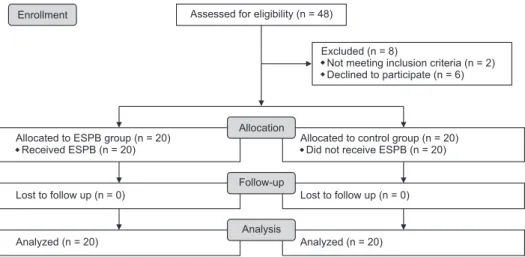
Forty-eight patients were enrolled and 8 patients dropped out of the study. Both the ESPB and control groups finally included 20 patients, respectively (Fig. 1). The baseline demographics and clinical characteristics of each group are shown in Table 1, which were comparable between the groups.
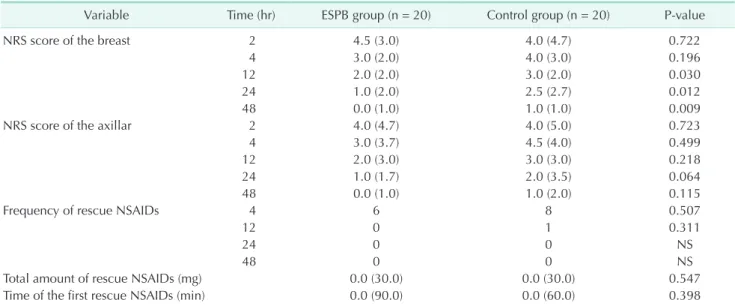
The median pain scores of the breast were significantly lower in the ESPB group than in the control group at 12, 24, and 48 hours after the surgery. However, the median pain scores of the axilla were not significantly different between the groups at all time points after surgery. The frequency of rescue NSAID, total amount of rescue NSAIDs, and the time of the first rescue NSAIDs did not differ between the groups (Table 2).
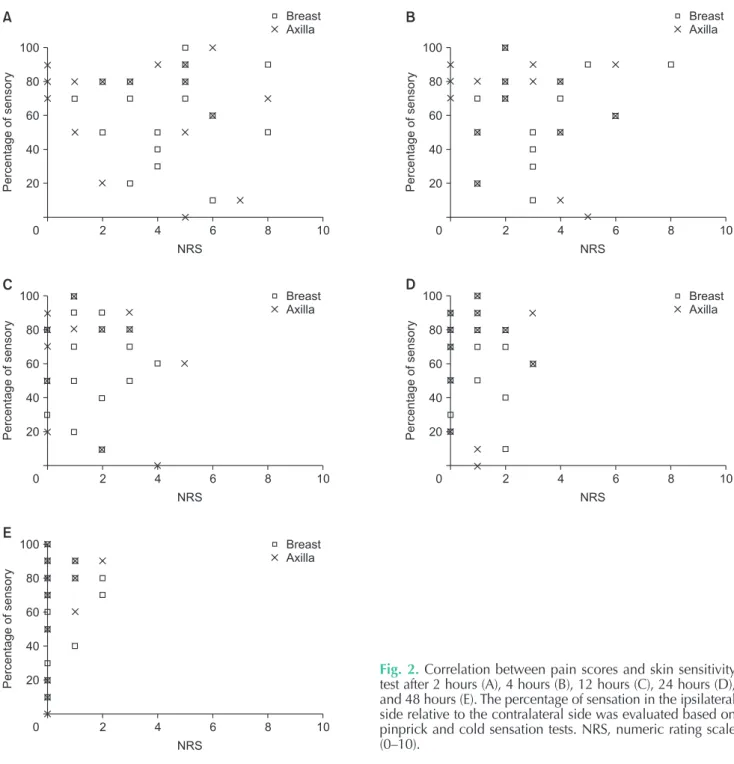
Analysis of patients in the ESPB group revealed that the pain score was unrelated to skin sensitivity (Fig. 2), and none of these patients reported ESPB-associated complications.
Table 1. Demographic data
Variable ESPB group Control group P-value
No. of patients 20 20
Age (yr) 54.1 ± 10.3 51.7 ± 8.9 0.454
Height (cm) 156.9 ± 6.0 157.9 ± 5.5 0.623
Weight (kg) 57.3 ± 6.7 62.6 ± 10.7 0.065
Operation time (min) 84.2 ± 16.1 88.7 ± 17.6 0.404
Anesthesia time (min) 116.9 ± 17.1 117.2 ± 23.9 0.964
ASA PS classification (I/II) 7/13 8/12 0.744
Location (left/right) 10/10 9/11 0.752
Tumor location (SL/IL/SM/IM/S/I/L/M) 8/3/3/4/1/0/1 8/0/5/3/2/2/0 0.323
Values are expressed as number or mean ± standard deviation.
ESPB, erector spinae plane block; ASA, American Society of Anesthesiologists; PS, physical status; SL, superolateral; IL, inferolateral;
SM, superomedial; IM, inferomedial; S, superior; I, inferior; L, lateral; M, medial.
Excluded (n = 8)
Not meeting inclusion criteria (n = 2) Declined to participate (n = 6) Assessed for eligibility (n = 48)
Lost to follow up (n = 0) Allocated to ESPB (n = 20)
Received ESPB (n = 20) group
Analyzed (n = 20)
Lost to follow up (n = 0) Allocated to control (n = 20)
Did not receive ESPB (n = 20) group
Analyzed (n = 20) Enrollment
Allocation
Follow-up
Analysis
Fig. 1. CONSORT (Consolidated Standards of Reporting Trials) flow diagram. ESPB, erector spinae plane block.
DISCUSSION
Here, ESPB had a significantly greater effect in reducing breast pain at 12, 24, and 48 hours, postoperatively, but not axillar pain. Moreover, pain score and skin sensitivity showed no correlation.
The breast is a subcutaneous organ that is mainly innervated by multiple anterior and lateral cutaneous branches of the intercostal nerves from T1/2–T6/7 [12]. In ESPB, LA is distributed in the craniocaudal fascial plane one dermatome a median of each 3.4 mL of injected volume [13], and diffuses anterior to the paravertebral and epidural spaces and laterally to the intercostal space across several levels [14,15]. LA exerts an effect on the ventral and dorsal ramus of the spinal nerve, and the ventral ramus is responsible for the sensitivity of the entire anterolateral wall. Additionally, diffusion of LA to the paravertebral space provides both visceral and somatic analgesia. Diffusion into the epidural space and the neural foramina has been reported in anatomical studies between the vertebral levels 2 and 5, centered on the injection level [16].
Two systematic reviews demonstrated that the ESPB group showed more effective acute pain control than the non-block group following breast surgery. ESPB preoperatively led to a significant decrease in pain scores up to 24 hours and was associated with a corresponding decrease in 24-hour opioid consumption [10,17]. There were a few differences between previous studies and our present study. First, our study was limited to BCS, and we assessed pain scores for the breast and axilla, respectively. Second, previous studies compared opioid consumption, but the pain score was the primary outcome in
our study, and we used an opioid-sparing method. In recent times, there have been concerns that opioid consumption may not necessarily be a reliable surrogate measurement for pain [18].
Our results revealed that there was no difference in pain scores in the axilla between the 2 groups, consistent with the results of previous studies. The axilla region is innervated by the lateral cutaneous branch of T2 that forms the intercostobrachial nerve. A single ESPB performed at the T4 or T5 level may not be sufficient to extend pain control during axilla dissection [19]. Additionally, axillae are innervated not only by the intercostal nerves but also by the brachial plexus. It remains unclear whether an ESPB is able to consistently provide anesthesia for branches of the brachial plexus. Forero et al. [20]
demonstrated that an ESPB executed at T2–3 level provides anesthesia to rami of the brachial plexus, but the spread of a LA during ESPB remains unpredictable [13].
Our study revealed that pain score was unrelated to skin sensitivity. This result is consistent with that of previous studies. Muñoz-Leyva et al. [21] observed good analgesia with ESPB, albeit only to a modest extent, and cutaneous sensory loss, and found that pain score and skin sensitivity test did not show a strong correlation. The lack of correlation between analgesia and sensory loss, even between different modalities of sensory assessment, was also shown in a study of the serratus plane block [22]. Similarly, Curatolo et al. [23]
reported that the efficacy of epidural analgesia, as assessed by pinprick and cold test, poorly correlates with the intensity of postoperative pain, and that the value of these methods as clinical indicators of postoperative pain control efficacy is limited.
Table 2. Pain scores and frequency of rescue NSAIDs
Variable Time (hr) ESPB group (n = 20) Control group (n = 20) P-value
NRS score of the breast 2 4.5 (3.0) 4.0 (4.7) 0.722
4 3.0 (2.0) 4.0 (3.0) 0.196
12 2.0 (2.0) 3.0 (2.0) 0.030
24 1.0 (2.0) 2.5 (2.7) 0.012
48 0.0 (1.0) 1.0 (1.0) 0.009
NRS score of the axillar 2 4.0 (4.7) 4.0 (5.0) 0.723
4 3.0 (3.7) 4.5 (4.0) 0.499
12 2.0 (3.0) 3.0 (3.0) 0.218
24 1.0 (1.7) 2.0 (3.5) 0.064
48 0.0 (1.0) 1.0 (2.0) 0.115
Frequency of rescue NSAIDs 4 6 8 0.507
12 0 1 0.311
24 0 0 NS
48 0 0 NS
Total amount of rescue NSAIDs (mg) 0.0 (30.0) 0.0 (30.0) 0.547
Time of the first rescue NSAIDs (min) 0.0 (90.0) 0.0 (60.0) 0.398
Continuous variables are represented as medians (interquartile ranges) and categorical variables are displayed as numbers only.
ESPB, erector spinae plane block; NRS, numeric rating scale (0–10); NS, not significant.
Clarke et al. [24] reported that among the opioid-native patients who were prescribed opioids in the perioperative period, nearly 50% of patients continued to use opioids during the early postoperative period, with >3% patients using these medications beyond 3 months. Thus, modification of surgical practices that prescribe acute opioid use for even minor procedures is truly impactful and can contribute toward reducing the national opioid epidemic. Moreover, Lee et al.
[25] demonstrated that opioid-prescribing practices are not related to patient satisfaction scores, allaying the concern that minimizing the frequency of opioid prescriptions might
negatively impact the reputation of clinical practice. Because BCS is a surgical method designed to minimize intraoperative tissue injury and because postoperative pain was moderate, we judged that the non-opioid analgesic technique would have an effective analgesic effect. Multimodal therapy is more effective than single-agent therapy with regard to opioid-sparing methods in perioperative pain management [26,27]; we also used multimodal therapy, including regional anesthesia (ESPB) and nefopam.
Nefopam is a centrally acting non-opioid analgesic that inhibits the reuptake of serotonin, norepinephrine, and
10
Percentageofsensory
NRS 100
80 60 40 20
0 2 4 6 8
Breast Axilla
10
Percentageofsensory
NRS 100
80 60 40 20
0 2 4 6 8
Breast Axilla
A B
10
Percentageofsensory
NRS 100
80 60 40 20
0 2 4 6 8
10
Percentageofsensory
NRS 100
80 60 40 20
0 2 4 6 8
Breast Axilla Breast
Axilla
C D
10
Percentageofsensory
NRS 100
80 60 40 20
0 2 4 6 8
Breast Axilla
E
Fig. 2. Correlation between pain scores and skin sensitivity test after 2 hours (A), 4 hours (B), 12 hours (C), 24 hours (D), and 48 hours (E). The percentage of sensation in the ipsilateral side relative to the contralateral side was evaluated based on pinprick and cold sensation tests. NRS, numeric rating scale (0–10).
dopamine. A systematic review analyzed the impact of intravenous administration of 20-mg nefopam every 4 hours over a 24-hour period in patients undergoing hepatic resection or hip arthroplasty and of continuous infusion of nefopam (80 mg over 24 hours) for 2 days in patients undergoing abdominal laparotomy. When the data were combined, average pain intensity was significantly decreased in patients receiving nefopam [28]. Nefopam is generally considered to be safe and well-tolerated. Reported adverse effects are mostly minor and include drowsiness, nausea and vomiting, and sweating.
Potentially more serious adverse effects include confusion and tachycardia [28].
Our study had some limitations. First, the duration of postoperative pain assessment was short. Intensity of acute postoperative pain is a risk factor for the development of chronic postsurgical pain (CPSP) [3]; hence, our result of ESPB being able to lower acute postoperative pain may help reduce the incidence of CPSP after BCS. Further research on chronic pain is warranted. Second, the sample size might have been too small to determine the effectiveness of ESPB. Third, additional outcome studies are needed to validate the beneficial effects of non-opioid therapeutic approaches with respect to important recovery variables (e.g., resumption of normal activities, dietary intake, bowel function, resumption of work). Fourth, we did not investigate the side effects of nefopam (nausea, vomiting [or retching], sinus tachycardia, sweating, and urticarial). However, nefopam was administered in both the groups, and the purpose of this study did not include comparison of the analgesic effects of nefopam.
In conclusion, ESPB can effectively alleviate acute post- operative pain when applied together with opioid-sparing analgesic technique in patients undergoing BCS, and a strong correlation is lacking between analgesia and skin sensitivity test.
ACKNOWLEDGEMENTS
We thank Lee HA (Clinical Trial Center, Ewha Womans University Mokdong Hospital) for statistical consultation.
Fund/Grant Support
This work was supported by the National Research Foundation of Korea (NRF) grant funded by the Korean government (MSIT) (NRF-2019R1G1A1100523).
Conflict of Interest
No potential conflict of interest relevant to this article was reported.
ORCID iD
Won-Joong Kim: https://orcid.org/0000-0003-2046-8690 Woosung Lim: https://orcid.org/0000-0002-2863-9346
Author Contribution
Conceptualization, Formal Analysis, Methodology: WJK Investigation, Project Administration: WJK, WL Writing – Original Draft: WJK
Writing – Review & Editing: WJK, WL
REFERENCES
1. Veronesi U, Cascinelli N, Mariani L, Greco M, Saccozzi R, Luini A, et al. Twenty- year follow-up of a randomized study comparing breast-conserving surgery with radical mastectomy for early breast cancer. N Engl J Med 2002;347:1227-32.
2. Kashiwagi S, Asano Y, Watanabe M, Takii M, Morisaki T, Aomatsu N, et al. Day surgery of early breast cancer treated with breast-conserving operation following sentinel lymph node navigation biopsy under local anesthesia. Gan To Kagaku Ryoho 2012;39:1914-6.
3. Kehlet H, Jensen TS, Woolf CJ. Persistent postsurgical pain: risk factors and prevention. Lancet 2006;367:1618-25.
4. Andersen KG, Duriaud HM, Jensen HE, Kroman N, Kehlet H. Predictive factors for the development of persistent pain after breast cancer surgery. Pain 2015;156:2413- 22.
5. Janis JE, Joshi GP. Introduction to “current concepts in pain management in plastic surgery”. Plast Reconstr Surg 2014;134(4 Suppl 2):6S-7S.
6. Sekandarzad MW, van Zundert AA, Lirk PB, Doornebal CW, Hollmann MW.
Perioperative anesthesia care and tumor progression. Anesth Analg 2017;124:1697- 708.
7. Forero M, Adhikary SD, Lopez H, Tsui C, Chin KJ. The erector spinae plane block:
a novel analgesic technique in thoracic neuropathic pain. Reg Anesth Pain Med 2016;41:621-7.
8. Veiga M, Costa D, Brazão I. Erector spinae plane block for radical mastectomy: a new indication? Rev Esp Anestesiol Reanim 2018;65:112-5.
9. Altıparmak B, Korkmaz Toker M, Uysal Aİ, Turan M, Gümüş Demirbilek S.
Comparison of the effects of modified pectoral nerve block and erector spinae plane block on postoperative opioid consumption and pain scores of patients after radical mastectomy surgery: a prospective, randomized, controlled trial.
J Clin Anesth 2019;54:61-5.
10. Leong RW, Tan ES, Wong SN, Tan KH, Liu CW. Efficacy of erector spinae plane block for analgesia in breast surgery: a systematic review and meta-analysis.
Anaesthesia 2021;76:404-13.
11. Na HS, Oh AY, Koo BW, Lim DJ, Ryu JH, Han JW. Preventive analgesic efficacy of nefopam in acute and chronic pain after breast cancer surgery: a prospective, double-blind, and randomized trial.
Medicine (Baltimore) 2016;95:e3705.
12. Woodworth GE, Ivie RM, Nelson SM, Walker CM, Maniker RB. Perioperative breast analgesia: a qualitative review of anatomy and regional techniques. Reg Anesth Pain Med 2017;42:609-31.
13. De Cassai A, Tonetti T. Local anesthetic spread during erector spinae plane block.
J Clin Anesth 2018;48:60-1.
14. Ueshima H, Hiroshi O. Spread of local anesthetic solution in the erector spinae plane block. J Clin Anesth 2018;45:23.
15. Vidal E, Giménez H, Forero M, Fajardo M. Erector spinae plane block: a cadaver study to determine its mechanism of action. Rev Esp Anestesiol Reanim 2018;65:514-9.
16. Kot P, Rodriguez P, Granell M, Cano B, Rovira L, Morales J, et al. The erector spinae plane block: a narrative review.
Korean J Anesthesiol 2019;72:209-20.
17. Huang W, Wang W, Xie W, Chen Z, Liu Y. Erector spinae plane block for postoperative analgesia in breast and thoracic surgery: a systematic review and meta-analysis. J Clin Anesth 2020;
66:109900.
18. Moore RA, Mhuircheartaigh RJ, Derry S, McQuay HJ. Mean analgesic consumption is inappropriate for testing analgesic efficacy in post-operative pain: analysis and alternative sug gestion. Eur J Anaesthesiol 2011;28:427-32.
19. Ueshima H, Otake H. Limitations of the Erector Spinae Plane (ESP) block for radical mastectomy. J Clin Anesth 2018;51:97.
20. Forero M, Rajarathinam M, Adhikary SD, Chin KJ. Erector spinae plane block for the management of chronic shoulder pain: a case report. Can J Anaesth 2018;65:288- 93.
21. Muñoz-Leyva F, Mendiola WE, Bonilla AJ, Cubillos J, Moreno DA, Chin KJ. In reply to “Continuous Erector Spinae Plane (ESP) block: optimizing the analgesia technique”. J Cardiothorac Vasc Anesth 2018;32:e3-4.
22. Kunigo T, Murouchi T, Yamamoto S, Yamakage M. Injection volume and
anesthetic effect in serratus plane block.
Reg Anesth Pain Med 2017;42:737-40.
23. Curatolo M, Kaufmann R, Petersen-Felix S, Arendt-Nielsen L, Scaramozzino P, Zbinden AM. Block of pinprick and cold sensation poorly correlate with relief of postoperative pain during epidural analgesia. Clin J Pain 1999;15:6-12.
24. Clarke H, Soneji N, Ko DT, Yun L, Wijeysundera DN. Rates and risk factors for prolonged opioid use after major surgery: population based cohort study.
BMJ 2014;348:g1251.
25. Lee JS, Hu HM, Brummett CM, Syrjamaki JD, Dupree JM, Englesbe MJ, et al.
Postoperative opioid prescribing and the pain scores on hospital consumer assessment of healthcare providers and systems survey. JAMA 2017;317:2013-5.
26. K i s si n I . P re e mp t i ve a n a l g e si a.
Anesthesiology 2000;93:1138-43.
27. Gottschalk A, Smith DS. New concepts in acute pain therapy: preemptive analgesia.
Am Fam Physician 2001;63:1979-84.
28. Evans MS, Lysakowski C, Tramèr MR. Nefopam for the prevention of postoperative pain: quantitative systematic review. Br J Anaesth 2008;101:610-7.