I. Introduction
With the shift of educational environments from traditional teacher-oriented learning to individual self-directed learn- ing—reflecting the constructivist paradigm—contemporary nursing education has become increasingly digitized. Rapid advances in information and communication technology (ICT) and various applications have led to the advancement of interactive learning environments with immediate con- tent-related feedback.
Discussion is a representative teaching and learning method in nursing education. Learners who have different thoughts
Effects of Mobile Phone-Based App Learning Compared to Computer-Based Web Learning on Nursing Students: Pilot Randomized Controlled Trial
Myung Kyung Lee, RN, PhD
College of Nursing, Research Institute of Nursing Science, Kyungpook National University, Daegu, Korea
Objectives: This study aimed to determine the effect of mobile-based discussion versus computer-based discussion on self- directed learning readiness, academic motivation, learner–interface interaction, and flow state. Methods: This randomized controlled trial was conducted at one university. Eighty-six nursing students who were able to use a computer, had home Internet access, and used a mobile phone were recruited. Participants were randomly assigned to either the mobile phone app-based discussion group (n = 45) or a computer web-based discussion group (n = 41). The effect was measured at before and after an online discussion via self-reported surveys that addressed academic motivation, self-directed learning readiness, time distortion, learner–learner interaction, learner–interface interaction, and flow state. Results: The change in extrinsic motivation on identified regulation in the academic motivation (p = 0.011) as well as independence and ability to use basic study (p = 0.047) and positive orientation to the future in self-directed learning readiness (p = 0.021) from pre-intervention to post-intervention was significantly more positive in the mobile phone app-based group compared to the computer web- based discussion group. Interaction between learner and interface (p = 0.002), having clear goals (p = 0.012), and giving and receiving unambiguous feedback (p = 0.049) in flow state was significantly higher in the mobile phone app-based discussion group than it was in the computer web-based discussion group at post-test. Conclusions: The mobile phone might offer more valuable learning opportunities for discussion teaching and learning methods in terms of self-directed learning readiness, academic motivation, learner–interface interaction, and the flow state of the learning process compared to the computer.
Keywords: Learning, Mobile Applications, Computers, Web, Randomized Controlled Trial
Healthc Inform Res. 2015 April;21(2):125-133.
http://dx.doi.org/10.4258/hir.2015.21.2.125 pISSN 2093-3681 • eISSN 2093-369X
Submitted: March 30, 2015 Accepted: April 22, 2015 Corresponding Author Myung Kyung Lee, RN, PhD
Research Institute of Nursing Science, College of Nursing, Kyung- pook National University, 680 Gukchabosangro, Jung-gu, Daegu 700-842, Korea. Tel: +82-53-200-4792, Fax: +82-53-425-1258, E-mail: [email protected]
This is an Open Access article distributed under the terms of the Creative Com- mons Attribution Non-Commercial License (http://creativecommons.org/licenses/by- nc/4.0/) which permits unrestricted non-commercial use, distribution, and reproduc- tion in any medium, provided the original work is properly cited.
ⓒ 2015 The Korean Society of Medical Informatics
experience cognitive conflicts through comprehensive dis- cussion, expand their cognitive capacity through negotiation with others, recognize the existence of others, and experience collaborative learning through interaction with others [1].
The strengths of discussion might be obtained in a virtual space created on a computer network or the Internet with worldwide access independent of time and place [2].
With their popularity, mobile phones are expected to play a role in collaborative learning, as mobile phones have made it easy for users to stay connected, and this increases interac- tive learning. Thus, mobile phones may have educational po- tential for discussing teaching and learning methods. On the other hand, computer-based web learning has been utilized longer than has mobile learning, and it has been supported as a successful learning tool in nursing education [3,4]. In addition, during text-based communication through com- puters or mobile phones, learners can search for various in- formation on a discussion topic, thus allowing for discussion that is more in-depth than typical face-to-face discussion [5].
Both general and open universities in Korea have oper- ated online discussion programs as a part of computer based e-learning programs. The discussion programs are imple- mented simply by the addition of replies rather than by pro- viding a more optimized online environment for discussion that can maximize learning effects and facilitate educational potentiality. To implement an optimized online environment for discussion as part of an e-learning program, it was first necessary to explore whether mobile phone-based online discussion or computer-based online discussion is more ef- fective for a certain teaching and learning method. If either stood out or seemed to be stronger in a certain aspect, that strength should have been considered in designing the inter- face and functionality of an e-learning program for discus- sion. An online discussion course is conducted by utilizing interactivity among learners and sharing information on a given discussion subject. We investigated whether the two methods have different effects on academic motivation, self- directed learning readiness, and flow state, which construct the basis for self-directed learning in a constructivist para- digm.
Thus, to fulfill the educational potential of online discussion according to the type of e-learning tool and provide optimized e-learning environments for online discussion, this study aimed to determine the effect of mobile-based discussion ver- sus computer-based discussion on self-directed learning read- iness, academic motivation, learner–interface interaction, and flow state. The Information and Communication Technology Acceptance Model guided the basis of our study [6].
II. Methods
1. Study Design and Participants
This study was a two-arm parallel design randomized con- trolled trial [7]. The study period—including pre-interven- tion, intervention, and post-intervention—was conducted from October 1 to November 22, 2013, at one university. Par- ticipants were 86 nursing students from a health education theory class. To be eligible for inclusion in the assessment, nursing students had to be able to use a computer, have home Internet access, and use a mobile phone. The 86 students were all eligible, and they all provided written informed consent.
The relevant Institutional Review Board approved this study.
2. Randomization
An independent statistician who was blind to the identities of the students carried out the randomization using a com- puter-generated random number system. A random num- ber was assigned to each participant. The participants were aligned in numerical order by the numbers given. An inde- pendent statistician generated a random allocation sequence to allocate the participants to either the mobile phone app- based discussion group (i.e., Kakao Talk) or a computer web- based discussion group (i.e., Cyber College of the university’s e-learning program) (SAS ver. 9.4, PROC PLAN; SAS Insti- tute Inc., Cary, NC, USA). The 86 students were randomly assigned (1:1) to either of the two groups. The randomiza- tion took place after written consent had been obtained and the baseline assessment had been completed. The par- ticipants were unaware of the allocation until immediately before the start of the mobile phone app-based discussion or computer web-based discussion. Participants were grouped into 17 small groups, each consisting of five to six students.
There were nine mobile phone app-based discussion groups and eight computer web-based discussion groups.
3. Intervention
The discussion subject was to understand and compare the advantages and disadvantages of health education meth- ods, including discussion methods (i.e., group discussion, panel discussion, symposium, forum, seminar, buzz session, brainstorming), demonstrations, problem-based learning, projects, simulations, and field studies, and to discuss opti- mal health education methods for a given target, topic, and situation of health education. The online discussion period was 7 weeks. The mobile phone app-based group used the group chat application Kakao Talk. The computer web-based group approach used the main Cyber College on the univer- sity homepage, and in Cyber College, we used the Toron Bang
(discussion room) function. Teacher feedback was not pro- vided to either group.
4. Main Outcomes
Self-reported surveys were conducted before and after the online discussion.
1) Academic motivation
Academic motivation measures students’ intrinsic and extrin- sic motivations as well as amotivation. Academic motivation was measured using the 28-item Academic Motivation Scale (AMS), which is divided into seven subscales, reflecting amo- tivation, extrinsic motivation (i.e., external, introjected, and identified regulation), and intrinsic motivation (i.e., intrinsic motivation to know, to accomplish things, and to experience stimulation) [8]. Each subscale consists of four items. The AMS contains 25 positive items and three negative items, and it is scored on a 7-point Likert scale from 1 (does not cor- respond at all) to 7 (corresponds exactly), with higher scores indicating higher endorsement of amotivation, extrinsic motivation, and intrinsic motivation. Previous studies have reported that Cronbach’s alpha ranges from 0.63 to 0.86 for the different subscales [8], and in this study, it was 0.74.
2) Self-directed learning readiness
The Self-Directed Learning Readiness Scale measures the complex of attitudes, skills, and characteristics that comprise an individual’s current level of readiness to manage his or her own learning. The original Self-Directed Learning Readiness Scale is a 58-item, 5-point Likert scale (1 ‘strongly disagree’
to 5 ‘strongly agree’), with higher scores indicating higher self-directed learning readiness, and it measures eight con- structs reflecting openness to learning opportunities, self- concept as an effective learner, initiative and independence in learning, informed acceptance of responsibility for one’s own learning, love of learning, creativity, positive orientation to the future, and ability to use basic study and problem- solving skills [9]. The original instrument was reported to have a Pearson split-half reliability estimate of 0.94 and a Cronbach’s alpha of 0.87.
The Korean version of the Self-Directed Learning Readi- ness Scale is modified and reduced to a 28-item scale that measures openness to learning, initiative and problem-solv- ing, independence and ability to use basic study, creativity, informed acceptance of responsibility, love of learning, and positive orientation to the future [10]. The Korean version has a Cronbach’s alpha of 0.83, and in this study, it was esti- mated to be 0.77.
3) Time distortion
Time distortion indicates the degree to which a student loses the sense of time during a learning activity [11,12]. Example items are the following: 1) “Time seems to go by very quickly when I do the online discussion” and 2) “When I do online discussion, I tend to lose track of time”. Participants indi- cated their answers on a 7-point Likert scale ranging from 1 (strongly disagree) to 7 (strongly agree), with higher scores indicating higher loss of the sense of time. In this study, Cronbach’s alpha was estimated to be 0.94.
4) Learner–learner interaction
The items concerning perception of learner-to-learner in- teraction focus on the learner’s impressions of involvement between learners [13]. Example items are the following: 1)
“The students seldom ask each other questions”, 2) “There is little interaction between students”, 3) “In online discussion, students seldom state their opinions to each other”, and 4)
“Students seldom answer each other’s questions”. Partici- pants indicated their answers on a Likert scale ranging from 1 (strongly disagree) to 7 (strongly agree), with higher scores indicating lower learner–learner interaction. In this study, Cronbach’s alpha was estimated to be 0.89.
5) Learner–interface interaction
Learner–interface interaction is the process of manipulating tools to complete a task, where learners must interact with the technological medium interact with the content, instruc- tor, or other learners [11,14]. Example items are the follow- ing: 1) “When I use the distance learning system, there is very little waiting time between my action and the response from the computer”, 2) “Interacting with the system is slow and tedious”, and 3) “Interacting with the system is intuitive”.
Two items had a negative meaning and were reverse coded.
Participants indicated their answers on a Likert scale ranging from 1 (strongly disagree) to 7 (strongly agree), with higher scores indicating higher learner–interface interaction. The original study reported a Cronbach’s alpha of 0.83, and in this study, it was estimated to be 0.78.
6) Flow state
Flow state refers to an optimal psychological experience that involves complete absorption in the task at hand. The Flow State Scale is a 36-item questionnaire that assesses the extent to which participants experience a flow state [15]. It has nine subscales of four items each, reflecting challenge–skill bal- ance (e.g., “I was challenged, but I believed my skills would allow me to meet the challenge”), action–awareness merg- ing (e.g., “I made the correct movements without thinking
about trying to do so”), clear goals (e.g., “I knew clearly what I wanted to do”), unambiguous feedback (e.g., “It was really clear to me that I was doing well”), concentration on the task at hand (e.g., “My attention was focused entirely on what I was doing”), sense of control (e.g., “I felt in total control of what I was doing”), loss of self-consciousness (e.g., “I was not concerned with what others may have been thinking of me”), transformation of time (e.g., “It felt like time stopped while I was performing”), and autotelic experience (e.g., “I found the experience extremely rewarding”). Respondents indicate the extent to which they agree with each statement on a 5-point Likert scale from 1 (strongly disagree) to 5 (strongly agree), with higher scores indicating higher flow state. The original study reported a Cronbach’s alpha of 0.93, and in this study, it was estimated to be 0.88.
5. Statistical Analyses
The characteristics of the mobile-based learning group and computer-based learning group were described using fre- quencies, means, and standard deviations for all variables.
The t-test for continuous variables and the chi-square test for categorical variables were utilized to explore the homogene- ity of the baseline characteristics between the two groups.
Between-group differences from pre-intervention to post- intervention in academic motivation and self-directed learn- ing readiness were explored using a t-test adjusted for pre-
intervention scores. Group differences at post-intervention in time distortion, learner–learner interaction, and learner–
interface interaction were also explored using a t-test adjust- ed for pre-intervention scores. SAS ver. 9.4 was used for all statistical analyses. Two-tailed p-values were reported, and a p-value <0.05 was considered to be statistically significant.
III. Results
1. Characteristics of the Mobile Phone App-Based and Computer Web-Based Discussions
The 7-week intervention course and follow-up were com- pleted by all participants. Participants’ baseline character- istics are shown in Table 1. No significant differences in baseline characteristics (i.e., having a religion, possessing a personal computer at home, prior experience of discus- sion using computer, proficiency with a computer, perceived computer skill, number of times registering for a class on computer, number of times registering for a class using on- line discussion, prerequisite learning on health education, degree of interest in health education class) between groups were observed.
2. Difference in Learning Effects between Groups
Regarding academic motivation, the change in extrinsic moti- vation on identified regulation from pre-intervention to post- Table 1. Characteristics of study participants
Characteristic
Mobile-based learning group
(n = 45)
Computer-based learning group
(n = 41)
p-value
Having a religion
No 28 (62.2) 24 (58.5)
Yes 17 (37.8) 17 (41.5) 0.727
Possessing personal computer at home
Yes 43 (95.6) 37 (90.2)
No 2 (4.4) 4 (9.3) 0.334
Prior experience of discussion using computer
Yes 13 (28.9) 15 (36.6)
No 32 (71.1) 26 (63.4) 0.447
Computer proficiency 4.0 ± 1.6 3.9 ± 1.4 0.717
Perceived computer skill 3.9 ± 1.5 3.8 ± 1.3 0.785
Number of times registering for a class on computer 2.8 ± 1.5 2.5 ± 1.1 0.276
Number of times registering for a class using online discussion 1.4 ± 0.9 1.3 ± 0.6 0.632
Prerequisite learning on health education 3.8 ± 2.0 3.9 ± 1.8 0.796
Degree of interest in health education 7.1 ± 2.5 7.0 ± 2.2 0.896
Values are presented as number (%) or mean ± standard deviation.
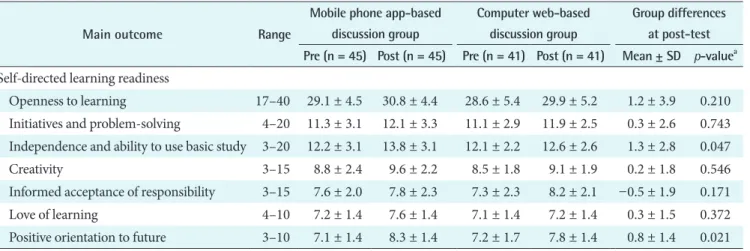
intervention was significantly more positive in the mobile phone app-based discussion group compared to the computer web-based discussion group (p = 0.011) (Table 2). Regarding self-directed learning readiness, the change in independence and ability to use basic study and positive orientation to the future from pre-intervention to post-intervention were significantly more positive in the mobile phone app-based discussion group than the computer web-based discussion group (p = 0.047 and p = 0.021, respectively) (Table 3). In- teraction between learner and interface was significantly
higher in the mobile phone app-based discussion group than it was in the computer web-based discussion group at post- test (p = 0.002) (Table 4). Regarding flow state, knowing exactly what they were going to do (i.e., clear goals) and the recognition of giving and receiving detailed feedback and knowledge that they were performing well (i.e., unambigu- ous feedback) were significantly higher in the mobile phone app-based discussion group than they were in the computer web-based discussion group at post-test (p = 0.012 and p = 0.049, respectively) (Table 5).
Table 2. Group differences in change of academic motivation between the mobile phone app-based and computer web-based discussion group at post-test
Main outcome Range
Mobile phone app-based discussion group
Computer web-based discussion group
Group differences at post-test Pre (n = 45) Post (n = 45) Pre (n = 41) Post (n = 41) Mean ± SD p-valuea Academic motivation
Intrinsic motivation
To know 9–28 18.4 ± 4.4 18.4 ± 4.1 18.0 ± 3.9 18.8 ± 4.1 -0.7 ± 3.6 0.769
To accomplish things 6–28 16.2 ± 4.3 17.3 ± 3.8 15.9 ± 3.4 17.5 ± 3.2 -0.1 ± 3.9 0.690 To experience stimulation 4–27 14.1 ± 4.7 15.0 ± 4.0 15.2 ± 3.8 15.6 ± 3.3 0.7 ± 3.7 0.229 Extrinsic motivation
Identified regulation 10–28 22.6 ± 3.1 23.9 ± 3.2 23.3 ± 4.1 23.3 ± 3.7 1.8 ± 2.8 0.011 Introjected regulation 7–28 15.9 ± 4.9 18.3 ± 4.9 15.9 ± 4.1 17.7 ± 4.6 0.9 ± 4.3 0.211 External regulation 4–28 21.0 ± 4.3 22.6 ± 3.3 20.4 ± 4.6 21.4 ± 3.8 0.6 ± 3.7 0.468
Amotivation 4–26 10.1 ± 5.2 10.8 ± 5.6 10.5 ± 5.4 10.5 ± 5.4 0.9 ± 4.2 0.413
Values are presented as mean ± standard deviation.
aAdjusted for pre-intervention score.
Table 3. Group differences in change of self-directed learning between the mobile phone app-based and computer web-based discussion group at post-test
Main outcome Range
Mobile phone app-based discussion group
Computer web-based discussion group
Group differences at post-test Pre (n = 45) Post (n = 45) Pre (n = 41) Post (n = 41) Mean ± SD p-valuea Self-directed learning readiness
Openness to learning 17–40 29.1 ± 4.5 30.8 ± 4.4 28.6 ± 5.4 29.9 ± 5.2 1.2 ± 3.9 0.210 Initiatives and problem-solving 4–20 11.3 ± 3.1 12.1 ± 3.3 11.1 ± 2.9 11.9 ± 2.5 0.3 ± 2.6 0.743 Independence and ability to use basic study 3–20 12.2 ± 3.1 13.8 ± 3.1 12.1 ± 2.2 12.6 ± 2.6 1.3 ± 2.8 0.047
Creativity 3–15 8.8 ± 2.4 9.6 ± 2.2 8.5 ± 1.8 9.1 ± 1.9 0.2 ± 1.8 0.546
Informed acceptance of responsibility 3–15 7.6 ± 2.0 7.8 ± 2.3 7.3 ± 2.3 8.2 ± 2.1 -0.5 ± 1.9 0.171
Love of learning 4–10 7.2 ± 1.4 7.6 ± 1.4 7.1 ± 1.4 7.2 ± 1.4 0.3 ± 1.5 0.372
Positive orientation to future 3–10 7.1 ± 1.4 8.3 ± 1.4 7.2 ± 1.7 7.8 ± 1.4 0.8 ± 1.4 0.021 Values are presented as mean ± standard deviation.
aAdjusted for pre-intervention score.
IV. Discussion
This study indicated that integrating mobile phones into the discussion teaching and learning method is feasible and agreeable for nursing students. Compared to computer- based discussion, mobile phone-based discussion offers more valuable learning opportunities for self-directed learn- ing readiness, academic motivation, learner–interface inter- action, and flow state of the learning process. Mobile phones are characterized by portability (easy to move), immediacy (easy to search for information on the internet), and interac- tivity (easy to connect users through the Internet) [16]. Mo- bile phone-based app discussions allow nursing students to be more ‘immersed’ and closer to the subject, and to become more involved in their own learning process as compared to computer-based web discussions [16]. Due to these conve- niences, e-learning environments implemented by mobile
phones will be more interactive and responsive than those implemented by computers, thereby leading to more posi- tive learning outcomes. This finding is consistent with prior results from nonmedical education settings, which have reported beneficial effects for mobile-supported e-study modules [17,18]. More generally, it has been suggested that mobile phone apps can be useful and productive tools for e- learning [19].
In this study, mobile phone-based discussion offered a more novel experience for learners, especially in areas, such as independence and basic study abilities, as well as unam- biguous feedback that allow participants to know that they are performing well. It is possible that mobile phone-based learning environments are more flexible than are computer- based discussions. It is easier to create a customized learn- ing environment that facilitates practice through the giving and receiving of detailed feedback in mobile phone-based Table 4. Group differences of time distortion and interaction between the mobile phone app-based and computer web-based discussion
group at post-test
Main outcome Range
Mobile phone app-based discussion group
(post, n = 45)
Computer web-based discussion group
(post, n = 41)
p-valuea
Time distortion 2–14 6.2 ± 2.9 6.5 ± 3.2 0.698
Learner–learner interaction 4–28 10.1 ± 4.6 11.4 ± 4.9 0.236
Learner–interface interaction 7–21 13.2 ± 3.0 10.9 ± 3.3 0.002
Values are presented as mean ± standard deviation.
aAdjusted for pre-intervention score.
Table 5. Group differences of flow state between the mobile phone app-based and computer web-based discussion group at post-test
Main outcome Range
Mobile phone app-based dis- cussion group (post, n = 45)
Computer web-based discussion group
(post, n = 41)
p-valuea
Flow state
Challenge-skill balance 7–20 14.4 ± 2.1 13.8 ± 2.3 0.267
Action-awareness merging 1–5 3.3 ± 0.9 3.4 ± 0.8 0.654
Clear goals 3–10 7.5 ± 1.2 6.7 ± 1.3 0.012
Unambiguous feedback 3–10 7.5 ± 1.4 6.9 ± 1.3 0.049
Concentration on task at hand 4–20 13.9 ± 3.7 13.5 ± 3.2 0.693
Sense of control 3–10 7.8 ± 1.5 7.2 ± 1.5 0.086
Loss of self-consciousness 3–15 9.8 ± 2.5 9.2 ± 2.2 0.243
Transformation of time 1–5 2.8 ± 0.9 3.1 ± 1.1 0.151
Autotelic experience 2–9 6.3 ± 1.4 5.9 ± 1.3 0.230
Values are presented as mean ± standard deviation.
aAdjusted for pre-intervention score.
learning, and it allows participants to recognize that they are performing well. In this study, feedback from peers also ap- pears to have had positive effects on independence and basic study abilities, and feedback from peers might enable stu- dents to participate in online discussion activities more ac- tively [20,21]. Learner–interface interaction was also higher in the mobile phone group than the computer-based group.
Smooth interaction with the learning tool might increase independence in basic study, immersion in study topics, and foster responsibility to solve problems [22].
This study indicated that, among nursing students, the mobile phone-based discussion led to greater awareness of future goals and knowing precise future plans than did computer-based discussion. It also offers improvement in a certain aspect of extrinsic motivation, namely, the recogni- tion that present learning will assist in making better choices regarding career orientation. Generally, nursing students are motivated by goal orientation and want to fulfill self- oriented goals, namely, becoming a future nurse as a result of their education [23]. This ‘clear goal’ outcome is specifi- cally sensitive for nursing students with self-oriented goals.
In addition, being aware of future goals through the learning process is achieved through learners’ cognitive understand- ing processes [24]. Because mobile phone-based learning ac- tivities increase the sense of reality during interaction, they might help to improve the cognitive understanding process than computer-based discussion. For nursing students in particular, the improved cognitive understanding processes may lead to greater adjustment to self-oriented goals. Fur- ther, having self-oriented goals might explain the greater recognition of unambiguous feedback allowing participants to recognize good performance in the mobile phone-based discussion group. Mobile phone-based discussion members are more likely to interpret feedback positively and thus en- gage in more feedback-seeking behaviors to enhance their performance. These individuals interpret feedback from peers as valuable information about how to correct errors and improve future performance on a given task [25]. The increased interaction among learners and improved cogni- tive understanding process might stimulate participants to link the present learning to positive orientations toward fu- ture goals.
This study indicated that integrating mobile phones into discussion offers potential benefits over computer-based dis- cussions in learner–interface interaction. Learner–interface interaction refers to students’ interactions with computer technology, and the desired outcome is that they learn the content and that computer use fosters their willingness to continue with the online course [26]. The major factors
linked to learner–interface interactions included computer experience, students’ perceptions regarding the technology, and access to technology [27]. At baseline, students’ com- puter experience, such as computer skills and proficiency, did not differ between the two groups. Also perceptions of the technology were not measured in this study. However, when used in discussion, students’ easy and frequent access through a mobile phone medium might increase students’
confidence in using a computer [22,28].
Students might also have a more positive perception of their interaction with mobile phones because of their ability to access coursework anytime [28]. A prior study found that students did not like interacting with computer technology for their learning [29]. It has also been reported that students tend to reflect negatively on their learning if they view the technology as time-consuming or contributing to delays in response time [30]. Mobile phones are a similar way of pre- senting content to computers; however, they are more acces- sible. Students belonging to mobile phone-based discussion groups perceived delays more positively because they viewed time delays as time for reflection.
This study has several limitations. The data were derived from volunteer nursing students from one university in South Korea. It is possible, then, that our findings are not generalizable. Future studies in different settings might ad- dress this issue. Although our research design enabled us to examine the potential effects of different types of e-learning on learning outcomes, it is difficult to make firm statements about the most effective roles of the two types of e-learning media in determining discussion outcomes. Statistical sig- nificance was generally weak, and more statistically robust results are required to test the different effects of mobile phone-based and computer-based discussion groups. How- ever, if another randomized controlled trial supports the ef- fectiveness of a mobile phone-based discussion, then confi- dence in the effect of mobile phone-based discussions would increase.
In conclusion, this study suggested that mobile phone- based discussion offers more valuable learning opportunities in aspects of self-directed learning outcome and immersion of the learning process than the computer-based web learn- ing. The benefits of mobile phone-based app learning might be due to users’ positive perceptions as a result of mobile phone characteristics, namely, easy access to technology and telepresence through interactivity and prompt feedback among learners. Together, these findings suggest that effec- tive e-learning tools for discussion teaching and learning methods must consider portability, immediacy, and interac- tivity, as mobile-based learning tools do.
Conflict of Interest
No potential conflict of interest relevant to this article was reported.
Acknowledgments
This research was supported by Basic Science Research Pro- gram through the National Research Foundation of Korea (NRF) funded by the Ministry of Science, ICT & Future Planning (No. 2014R1A1A1006809).
References
1. Prince MJ, Felder RM. Inductive teaching and learning methods: definitions, comparisons, and research bases. J Eng Educ 2006;95(2):123-38.
2. Moule P, Ward R, Lockyer L. Nursing and healthcare students' experiences and use of e-learning in higher education. J Adv Nurs 2010;66(12):2785-95.
3. Du S, Liu Z, Liu S, Yin H, Xu G, Zhang H, et al. Web- based distance learning for nurse education: a system- atic review. Int Nurs Rev 2013;60(2):167-77.
4. Lu DF, Lin ZC, Li YJ. Effects of a Web-based course on nursing skills and knowledge learning. J Nurs Educ 2009;48(2):70-7.
5. Thorne SL, Payne JS. Evolutionary trajectories, Internet- mediated expression, and language education. CALICO J 2005;22(3):371-97.
6. An JY, Hayman LL, Panniers T, Carty B. Theory devel- opment in nursing and healthcare informatics: a model explaining and predicting information and communica- tion technology acceptance by healthcare consumers.
ANS Adv Nurs Sci 2007;30(3):E37-49.
7. Delisle C, Sandin S, Forsum E, Henriksson H, Trolle- Lagerros Y, Larsson C, et al. A web- and mobile phone- based intervention to prevent obesity in 4-year-olds (MINISTOP): a population-based randomized controlled trial. BMC Public Health 2015;15:95.
8. Vallerand RJ, Pelletier LG, Blais MR, Briere NM, Sene- cal C, Vallieres EF. The academic motivation scale: a measure of intrinsic, extrinsic, and amotivation in edu- cation. Educ Psychol Meas 1992;52(4):1003-17.
9. Guglielmino LM. Reliability and validity of the self- directed learning readiness scale and the learning pref- erence assessment. In: HB Long, editor. Expanding hori- zons in self-directed learning. Norman (OK): University of Oklahoma;1997. p. 209-22.
10. Lim SY, Lee WI. Factor analysis & SDLRS assessment in
science and engineering fields’ students: in case of KUT’s students. J Korean Inst Pract Eng Educ 2010;2(1):17-27.
11. Novak TP, Hoffman DL, Yung YF. Measuring the cus- tomer experience in online environments: a structural modeling approach. Mark Sci 2000;19(1):22-42.
12. Nakamura J, Csikszentmihalyi M. The concept of flow.
In: Csikszentmihalyi M, editor. Flow and the founda- tions of positive psychology. Berlin: Springer; 2014. p.
239-63.
13. Sherry AC, Fulford CP, Zhang S. Assessing distance learners' satisfaction with instruction: a quantitative and a qualitative measure. Am J Distance Educ 1998;12(3):4- 28.
14. Novak TP, Hoffman DL, Yung YF. Modeling the struc- ture of the flow experience among web users. In: IN- FORMS Marketing Science and the Internet Mini-Con- ference; 1998 Mar; Boston, MA.
15. Jackson SA, Marsh HW. Development and validation of a scale to measure optimal experience: the Flow State Scale. J Sport Exerc Psychol 1996;18(1):17-35.
16. Dede C. Immersive interfaces for engagement and learning. Science 2009;323(5910):66-9.
17. Parhizkar B, Gebril ZM, Obeidy WK, Ngan MN, Chow- dhury SA, Lashkari AH. Android mobile augmented reality application based on different learning theories for primary school children. In: Proceedings of Inter- national Conference on Multimedia Computing and Systems; 2012 May 10-12; Tangier, Morocco. p. 404-8.
18. Larsen YC, Buchholz H, Brosda C, Bogner FX. Evalu- ation of a portable and interactive augmented reality learning system by teachers and students. In: Augment- ed reality in education: proceedings of the “Science Cen- ter To Go” workshop; 2011 Oct 27-29; Athens, Greece. p.
41-50.
19. Patten B, Sanchez IA, Tangney B. Designing collabora- tive, constructionist and contextual applications for handheld devices. Comput Educ 2006;46(3):294-308.
20. Barak M, Rafaeli S. On-line question-posing and peer- assessment as means for web-based knowledge sharing in learning. Int J Hum Comput Stud 2004;61(1):84-103.
21. Junco R. The relationship between frequency of Face- book use, participation in Facebook activities, and stu- dent engagement. Comput Educ 2012;58(1):162-71.
22. Kenny J. Managing innovation in educational institu- tions. Australas J Educ Technol 2002;18(3):359-76.
23. Nilsson KE, Stomberg MI. Nursing students motiva- tion toward their studies: a survey study. BMC Nurs 2008;7:6.
24. Henri F. Computer conferencing and content analysis.
In: Kaye AR, editor. Collaborative learning through computer conferencing. Berlin: Springer; 1992. p. 117-36.
25. VandeWalle D. A goal orientation model of feed- back-seeking behavior. Hum Resour Manag Rev 2004;13(4):581-604.
26. Hillman DC, Willis DJ, Gunawardena CN. Learner‐
interface interaction in distance education: an extension of contemporary models and strategies for practitioners.
Am J Distance Educ 1994;8(2):30-42.
27. Atack L, Rankin J. A descriptive study of registered nurses' experiences with web‐based learning. J Adv
Nurs 2002;40(4):457-65.
28. Kenny A. Online learning: enhancing nurse education?
J Adv Nurs 2002;38(2):127-35.
29. Faux TL, Black-Hughes C. A comparison of using the Internet versus lectures to teach social work history. Res Soc Work Pract 2000;10(4):454-66.
30. Daley BJ, Watkins K, Williams SW, Courtenay B, Davis M, Dymock D. Exploring learning in a technology-en- hanced environment. Educ Technol Soc 2001;4(3):126- 38.