D I A B E T E S & M E T A B O L I S M J O U R N A L
This is an Open Access article distributed under the terms of the Creative Commons At- tribution Non-Commercial License (http://creativecommons.org/licenses/by-nc/3.0/) which permits unrestricted non-commercial use, distribution, and reproduction in any medium, provided the original work is properly cited.
Economic Impact of Combining Metformin with
Dipeptidyl Peptidase-4 Inhibitors in Diabetic Patients with Renal Impairment in Spanish Patients
Antoni Sicras-Mainar1, Ruth Navarro-Artieda2
1Management Planning, Badalona Serveis Assistencials SA, Barcelona,
2Medical Documentation, Hospital Germans Trias i Pujol, Barcelona, Spain
Background: To evaluate resource use and health costs due to the combination of metformin and dipeptidyl peptidase-4 (DPP- 4) inhibitors in patients with diabetes and renal impairment in routine clinical practice.
Methods: An observational, retrospective study was performed. Patients aged ≥30 years treated with metformin who initiated a second oral antidiabetic treatment in 2009 to 2010 were included. Two groups of patients were analysed: metformin+DPP-4 in- hibitors and other oral antidiabetics. The main measures were: compliance, persistence, metabolic control (glycosylated hemo- globin<7%) and complications (hypoglycemia, cardiovascular events) and total costs. Patients were followed up for 2 years.
Results: We included 395 patients, mean age 70.2 years, 56.5% male: 135 patients received metformin+DPP-4 inhibitors and 260 patients received metformin+other oral antidiabetics. Patients receiving DPP-4 inhibitors showed better compliance (66.0% vs.
60.1%), persistence (57.6% vs. 50.0%), and metabolic control (63.9% vs. 57.3%), respectively, compared with those receiving oth- er oral antidiabetics (P<0.05), and also had a lower rate of hypoglycemia (20.0% vs. 47.7%) and lower total costs (€ 2,486 vs. € 3,002), P=0.001.
Conclusion: Despite the limitations of the study, patients with renal impairment treated with DPP-4 inhibitors had better meta- bolic control, lower rates (association) of hypoglycaemia, and lower health costs for the Spanish national health system.
Keywords: Cardiovascular events; Diabetes; Dipeptidyl-peptidase 4 inhibitors; Health care costs; Metabolic control; Renal im- pairment
Corresponding author: Antoni Sicras-Mainar
Management Planning, Badalona Serveis Assistencials SA, C. Gaietà Soler, 6-8 entlo, 08911 Badalona, Barcelona, Spain
E-mail: [email protected]
INTRODUCTION
Type 2 diabetes mellitus (T2DM) is a highly-prevalent disease that results in high morbidity, resulting in a high consumption of health resources [1]. Diabetic nephropathy is a complica- tion that affects 25% to 40% of T2DM patients during the dis- ease course and is considered as a marker of poor prognosis [2]. The prevalence of microalbuminuria, macroalbuminuria, and reduced glomerular filtration rate (GFR) is 20%, 7%, and 12% [3]. Complications related to renal impairment (RI) be- come more important with decreasing glomerular filtration
[4]. In patients with diabetic nephropathy, these complications require a multifactorial approach ranging from the prevention of complications (metabolic control) to the prevention of neph- rotoxicity [1,3,5].
Metformin is recommended as the first therapeutic choice in these patients, together with dietary and lifestyle measures and when metabolic control is not achieved, the addition of a second drug in combination therapy is recommended [1,2].
The most frequent acute complication of diabetes is hypogly- caemia, especially in patients treated with insulin and/or sul- fonylureas [1,6]. Dipeptidyl peptidase-4 (DPP-4) inhibitors http://dx.doi.org/10.4093/dmj.2015.39.1.74
pISSN 2233-6079 · eISSN 2233-6087
have an advantage over traditional secretagogues in that they significantly reduce hypoglycaemia, since their insulin secre- tion stimulating mechanism is glucose-dependent [7,8].
Some clinical trials have demonstrated the efficacy and safety of DPP-4 inhibitors in patients with renal failure [9,10].
The available evidence in routine clinical practice on the clini- cal and economic effects of therapy in these patients is limited, and therefore this study may be relevant. The aim of the study was to describe the use of resources and health costs resulting from the combination of metformin and DPP-4 inhibitors in patients with T2DM and RI followed up for 2 years. The sec- ondary objectives were to determine adherence, metabolic control, hypoglycaemia, and macrovascular complications.
METHODS
Design and study population
We carried out an observational, longitudinal multicentre ret- rospective study through review of computerized medical re- cords of outpatients and inpatients treated with metformin.
The study population consisted of patients assigned to six pri- mary care centres managed by Badalona Serveis Assistencials SA. Information on health resources used was obtained from two reference hospitals: Hospital Municipal de Badalona and Hospital Germans Trias y Pujol, Badalona. The population as- signed to these centres is mostly urban, with middle-low socio- economic status, and predominantly industrial occupations.
Inclusion and exclusion criteria
We included all patients who started a second antidiabetic treat- ment in 2009 and 2010 and fulfilled the following conditions:
(1) age ≥30 years; (2) diagnosis of T2DM and RI at least 12 months before the study date; (3) patients who regularly fol- lowed (≥1 medical visit/year) the cardiovascular risk protocol/
guidelines of the participating centres; (4) patients currently treated with metformin as the first therapeutic option (mono- therapy); and (5) patients in whom follow-up was guaranteed.
Patients transferring out to other municipalities or regions were excluded. Patients on dialysis or with GFR <30 mL/min were excluded. There were two study groups: (1) patients treated with metformin+DPP-4 inhibitors and (2) patients treated with metformin+other oral antidiabetics. Patients were followed for 24 months, which was considered as a sufficient time to assess the complications and health costs arising from these therapies.
Diagnosis of type 2 diabetes and renal impairment
The diagnosis of T2DM was obtained from the International Clas- sification of Primary Care (ICPC-2, code T90) [11] and the Inter- national Classification of Diseases (ICD-9-CM, code 250). RI (es- timated GFR, Modification of Diet in Renal Disease [MDRD]) was defined as deterioration in renal function (GFR: ≥30 mL/
min/1.73 m2; stage 1 to 3). The last available readings were consid- ered. Baseline data on microvascular complications (diabetic reti- nopathy, diabetic neuropathy) were obtained.
Sociodemographic and comorbidity variables
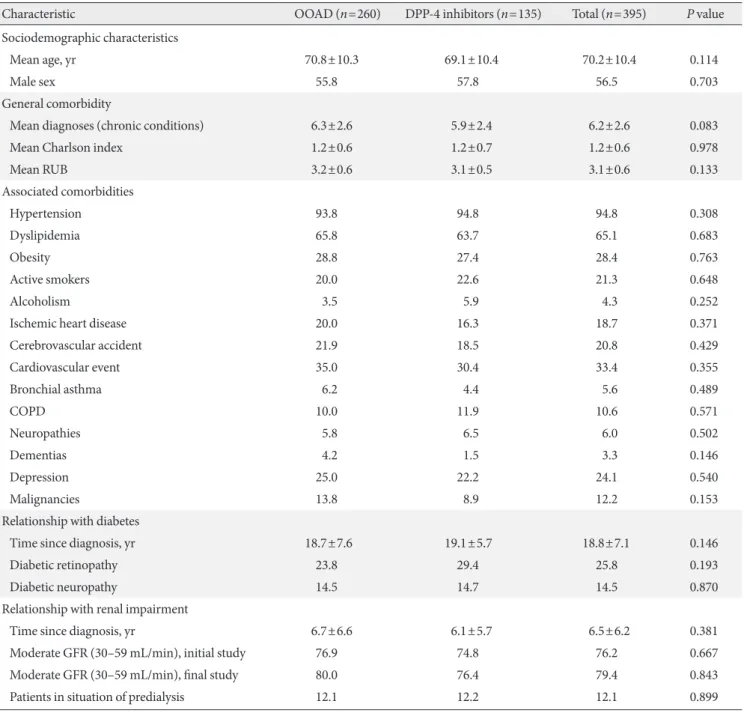
The variables studied were age, sex, length of evolution of T2DM, and RI (from diagnosis), as well as detailed personal history (Ta- ble 1).The general comorbidity summary variables used for each patient treated were: (1) the Charlson comorbidity index [12], which is used as a proxy of the severity of the health status and (2) the individual causality index, obtained from the Adjusted Clinical Groups (ACG), which is a patient classification system based on iso-resource use [13]. The ACG application provides resource utilisation bands (RUBs), with each patient, according to general morbidity, placed in one of five mutually-exclusive categories.
Treatment compliance and persistence and metabolic control
Information was collected on the following oral antidiabetics according to the Anatomical Therapeutic Chemical Classifica- tion System [14]: (1) metformin (A10BA*); (2) insulin release stimulators: sulfonylureas (A10BB*) and glinides (A10BX*);
(3) glitazones (A10BG*); (4) DPP-4 inhibitors (A10BH*) in monotherapy or in combination (A10BD*). We did not include patients receiving α-glucosidase inhibitors due to the insuffi- cient sample size. Compliance during the study period was cal- culated by dividing the total number of tablets dispensed by those recommended or prescribed. Treatment persistence was defined as the time, measured in months, without abandoning the initial treatment or with no change to another medication for at least 30 days after the initial prescription. Metabolic con- trol was defined as levels of glycosylated hemoglobin (HbA1c)
<7% [1].
Macrovascular complications and cardiovascular events Macrovascular complications and cardiovascular events (CVEs) collected included: (1) heart disease, including cardiac ischemia, acute myocardial infarction, and heart failure, as defined by the
diagnostic criteria of the World Health Organization; (2) cere- brovascular disease, including stroke (ischemic or haemorrhagic;
according to the American Heart Association) and transient ischemic attack; and (3) peripheral arterial disease (all types).
The cumulative incidence rate was defined as the proportion of patients who developed the complication (number of new cases
during the study period). All cases of symptomatic hypoglyce- mia were identified during follow-up (according to medical judgment, the record of hypoglycemia was obtained in regular follow-up visits).
Table 1. Baseline characteristics of study participants
Characteristic OOAD (n=260) DPP-4 inhibitors (n=135) Total (n=395) P value
Sociodemographic characteristics
Mean age, yr 70.8±10.3 69.1±10.4 70.2±10.4 0.114
Male sex 55.8 57.8 56.5 0.703
General comorbidity
Mean diagnoses (chronic conditions) 6.3±2.6 5.9±2.4 6.2±2.6 0.083
Mean Charlson index 1.2±0.6 1.2±0.7 1.2±0.6 0.978
Mean RUB 3.2±0.6 3.1±0.5 3.1±0.6 0.133
Associated comorbidities
Hypertension 93.8 94.8 94.8 0.308
Dyslipidemia 65.8 63.7 65.1 0.683
Obesity 28.8 27.4 28.4 0.763
Active smokers 20.0 22.6 21.3 0.648
Alcoholism 3.5 5.9 4.3 0.252
Ischemic heart disease 20.0 16.3 18.7 0.371
Cerebrovascular accident 21.9 18.5 20.8 0.429
Cardiovascular event 35.0 30.4 33.4 0.355
Bronchial asthma 6.2 4.4 5.6 0.489
COPD 10.0 11.9 10.6 0.571
Neuropathies 5.8 6.5 6.0 0.502
Dementias 4.2 1.5 3.3 0.146
Depression 25.0 22.2 24.1 0.540
Malignancies 13.8 8.9 12.2 0.153
Relationship with diabetes
Time since diagnosis, yr 18.7±7.6 19.1±5.7 18.8±7.1 0.146
Diabetic retinopathy 23.8 29.4 25.8 0.193
Diabetic neuropathy 14.5 14.7 14.5 0.870
Relationship with renal impairment
Time since diagnosis, yr 6.7±6.6 6.1±5.7 6.5±6.2 0.381
Moderate GFR (30–59 mL/min), initial study 76.9 74.8 76.2 0.667
Moderate GFR (30–59 mL/min), final study 80.0 76.4 79.4 0.843
Patients in situation of predialysis 12.1 12.2 12.1 0.899
Values are presented as percentage or mean±standard deviation.
OOAD, other oral antidiabetics (including sulfonylureas and glitazones); DPP-4, dipeptidyl peptidase-4; RUB, resource utilisation band;
COPD, chronic obstructive pulmonary disease; GFR, glomerular filtration rate.
Resource use and model of health costs
Direct healthcare costs were defined as costs related to medical care. The unit costs used in the study in 2011 (EUR). The tariffs were obtained from the cost analytical accounting, except for medications whose cost was obtained using the retail price [15].
Description, tariff: medical visits, primary health care €23.19, hospitalization visits €104.41, emergency room €117.53; hospi- talization (1 day) €320.90; laboratory tests €22.30, conventional radiology €18.50, and diagnostic/therapeutic tests €37.12.
Confidentiality of information and statistical analysis The study was classified by the Spanish Agency for Medicines and Health Products (Non-Post Licensing Study) and was subse- quently approved by the Ethics Committee for Clinical Research of the Hospital Universitari Germans Trias i Pujol, Badalona. A descriptive analysis was made, and the 95% confidence intervals (CI) calculated. The normality of the distribution of quantitative variables was verified using the Kolmogorov-Smirnov test. In the bivariate analysis, analysis of variance, the chi-square test, Pear- son linear correlation, and the Mann-Whitney-Wilcoxon non- parametric test were used. A logistic regression analysis was per- formed to determine the variables associated with patients re- ceiving DPP-4 inhibitors using an enter procedure (statistic:
Wald). Costs were compared according to the recommendations of Thompson and Barber [16] using analysis of covariance (AN- COVA), with sex, age, RUB, the Charlson index, and the time of evolution since diagnosis of T2DM and RI as covariates.
RESULTS
The study population consisted of 62,370 patients aged ≥30 years. Of these, 48,295 sought medical attention and 6,620 were diagnosed with T2DM (prevalence, 10.6%; 95% CI, 10.4 to 10.8) (Fig. 1). A total of 395 patients with RI treated with oral antidiabetic agents (combination therapy with metformin) were included. Of which 34.2% (n=135) were receiving DPP-4 inhibitors (vildagliptin, 69.2%) and 65.8% other oral antidia- betics (n=260, 88.8% sulfonylureas and 11.2% glitazones).
The baseline characteristics of the study patients according to treatment received are shown in Table 1. The mean age was 70.2 years (standard deviation 10.4) and 56.5% were male. Patients receiving DPP-4 inhibitors had better compliance (66.0% vs.
60.1%, P<0.05) and treatment persistence (57.6% vs. 50.0%, P<0.05), respectively (Table 2). Overall, the average dose of metformin at baseline was 1,362±363 and 944±238 mgr after the follow-up period. No statistically significant differences
Fig. 1. Flow diagram of study patients. OOAD, other oral antidiabetics (including sulfonylureas and glitazones); DPP-4, dipepti- dyl peptidase-4. aA total of 4,233 patients were excluded from the study: 978 received no drug treatment, 1,127 received other drug therapies (insulin: 663), 241 discontinued treatment, and 1,887 changed therapy during follow-up, bSix hundred fifty-five patients were lost to the study and 326 excluded for other reasons. The percentage distribution of patients who were excluded and lost was similar in the two study groups. Patients with renal impairment were 6.0% of diabetics, 16.5% of those treated and 28.1% of those receiving oral antidiabetic treatment.
62,370 Population aged ≥30 years 48,295 Sought medical care 6,620 Patients with diabetes (10.6%)
4,233 Excludeda 981 Lostb
519 DPP-4 inhibitors Follow-up (2 years)
Years 2009–2010
◀
◀ 886 OOAD
Inclusion criteria ▶
135 DPP-4 inhibitors (26.0%) 1,405 Combination therapy with OOAD
395 Renal impairment (28.1%) 260 OOAD (29.3%)
between the two study groups.
There was an acceptable correlation between the degree of compliance and the time of treatment persistence in months (P<0.001, r=0.449). Metabolic control (HbA1c <7%) of T2DM at the end of follow-up was greater in patients receiving DPP-4 in- hibitors (63.9% vs. 57.3% respectively, P<0.05). In the logistic model, patients treated with DPP-4 inhibitors were associated with better adherence (odds ratio [OR], 1.4; 95% CI, 1.1 to 1.7;
P=0.021), treatment persistence (OR, 1.2; 95% CI, 1.0 to 1.6;
P=0.044), and metabolic control (OR, 1.2; 95% CI, 1.0 to 1.6;
P=0.035).
Patients receiving DPP-4 inhibitors had fewer primary care medical visits (23.1 vs. 34.1, P<0.001) and hospital care visits (2.1 vs. 3.3, P=0.004) than those receiving other oral antidia- betics. The model of gross and adjusted costs (covariates) for the 2-year follow-up according to the study groups is shown in Table 3. The total cost of care for diabetic patients with RI was
€1.1 million. The mean unit cost of patients receiving DPP-4 in-
hibitors was lower than that of those receiving other oral antidia- betics (€2,370 vs. €3,038, P<0.001). In the ANCOVA model ad- justed for covariates, the corresponding sums were €2,486 (95%
CI, 2,251 to 2,721) vs. €3,002 (95% CI, 2,835 to 3,170); P=0.001.
These differences were reflected in all components of the health costs (primary and hospital care). Health costs were moderately correlated with age (r=0.665), general comorbidity (RUB, r=0.548, P<0.001), and the values of RI (MDRD, r=0.787, P<0.001).
During the follow-up, the rate of new CVE was 9.9% (95%
CI, 7.0 to 12.8), and was lower in patients receiving DPP-4 in- hibitors compared with those receiving other oral antidiabet- ics (8.0% vs. 11.5%, P=0.122). Patients receiving DPP-4 inhib- itors had a similar proportion of new cases of ischemic heart disease (2.8% vs. 4.2%, P=0.478) and stroke (5.1% vs. 7.3%, P=0.527) to those receiving other oral antidiabetics. The per- centage of patients with hypoglycemia was 38.2%, and was lower in patients receiving DPP-4 inhibitors (20.0% vs. 47.7%, P<0.001).
DISCUSSION
Our results show that diabetic patients with RI treated with the combination of metformin and DPP-4 inhibitors had better compliance and disease control than those treated with metfor- min and other oral antidiabetics, and that this was associated with lower rates of hypoglycemia and lower health costs in rou- tine medical practice in a population setting. In Spain, there is little evidence of the evaluation of these measures in a single study, thus enhancing the value of our results.
We did not include patients receiving insulin, because they have more advanced T2DM and/or greater genetic susceptibili- ty, making it more difficult to measure adherence to drug treat- ment. The distribution in the two groups (comparability) was similar (around 22%); and therefore, in our opinion, did not af- fect the results. In addition, relatively few diabetic patients pro- gressed to RI (Fig. 1). It is known that the risk of CVE in these patients increases as the rate of reduction in the GFR increases.
Our results are consistent with the literature reviewed [2-4].
At 2-year follow-up, patients receiving DPP-4 inhibitors were more closely associated with better treatment compli- ance/persistence, improved metabolic control, and less hypo- glycaemia. Studies of compliance and persistence with oral agents are scarce and difficult to compare due to the different methods used to measure these factors. These studies show Table 2. Compliance, persistence, and metabolic control ac-
cording to the study groups
Variable OOAD
(n=260) DPP-4 inhibitors
(n=135) Total
(n=395) Duration of treatment
Mean±SD 16.7±7.6 19.1±5.7a 17.5±7.1
Median
(P25–P75) 18.0
(14.0–23.0) 21.0
(17.0–24.0)a 19.0 (14.0–23.0)
Compliance 60.1 66.0a 62.1
≥80%, high 50.1 56.1 52.4
50%–79%,
medium 30.5 29.7 30.1
<50%, low 19.4 14.2 17.4
Treatment
persistence 50.0 57.6a 53.9
Metabolic control of diabetes
Baseline 54.7 55.8 54.8
24-mo
follow-up 57.3 63.9a 59.9
Difference 2.6 8.1a 5.1
Values are presented as percentage.
OOAD, other oral antidiabetics (sulfonylureas and glitazones includ- ed); DPP-4, dipeptidyl peptidase-4.
aStatistically significant results: P<0.05. Adherence: ratio between the number of tablets dispensed between prescribed. Persistence: median time without abandoning the initial treatment or switching to anoth- er medication without at least 30 days after the initial prescription.
Metabolic control: glycosylated hemoglobin <7%.
compliance rates of between 40% and 80% [17,18]. A review of 139 studies by Cramer et al. [19] found that, at 12 months, the rate of persistence with oral antidiabetics was 63% and compliance was 58%: the rates were similar in all therapeutic classes analysed. Jermendy et al. [20] found a persistence rate of 56% at 1 year per year in a series of patients receiving com- bination therapy with metformin and sulfonylureas. Although these results are consistent with ours, there is a slight superior- ity of DPP-4 inhibitors [21]. This may be randomly due to in- dividual variability, but a plausible explanation could be a bet- ter safety and tolerability profile, which would result in lower rates of hypoglycemia, although more studies comparing anti- diabetic drug use in combination therapy are required to en- hance the consistency of these results. Furthermore, the results of some controlled trials suggest a possible cardioprotective effect of DPP-4 inhibitors, with a trend to a reduction in CVE [22,23]. It seems clear that the role of DPP-4 inhibitors in the therapeutic arsenal of T2DM is evolving rapidly, although
long-term data to evaluate their effect on metabolic control are lacking [24,25].
Patients receiving DPP-4 inhibitors also had lower associat- ed health costs and a lesser use of health resources. The few existing studies show that the higher the compliance and met- abolic control in these patients, the lower the risk of hospital- ization. For example, a review by Breitscheidel et al. [26] con- cluded that improving compliance may result in a reduction in total healthcare costs in T2DM: in seven studies, compliance was inversely associated with healthcare costs, especially due to the lower cost resulting from fewer days of hospitalization.
Overall, our findings are consistent with these results.
Our results show lower rates of CVE in patients treated with DPP-4 inhibitors, although the differences were not signifi- cant. Given the close relationship between some microangiop- athies (principally nephropathy) and CVE, it is logical to con- sider that good metabolic control would positively affect this situation, but less intensely than the control of other risk fac- Table 3. Model of gross and adjusted costs according to the study groups (mean unit costs in euros) during the 2-year follow-up
Variable OOAD (n=260) DPP-4 inhibitors (n=135) Total (n=395) P value
Unadjusted cost model
Primary care costs 2,648.4±1,320.3 2,119.7±1,145.8 2,467.7±1,286.7 <0.001
Medical visits 791.5±377.7 535.9±326.5 704.2±380.5 <0.001
Laboratory tests 75.9±45.9 52.2±38.4 67.8±44.9 <0.001
Conventional radiology 22.6±25 19.3±22.6 21.5±24.2 0.199
Others tests 20±30.5 20.9±27.4 20.3±29.4 0.771
Drugs 1,738.4±1,120.6 1,491.3±985.6 1,654±1,081.5 0.031
Hospital care costs 389.5±484.4 249.9±290.5 341.8±432.8 0.002
Days of hospitalization 11.1±124 2.4±27.6 8.1±101.9 0.420
Medical visits 341.3±446.9 219.6±266.1 299.7±398.4 0.004
Emergency department 37.1±64.6 27.9±67.7 33.9±65.7 0.187
Total healthcare costs 3,037.9±1,482.4 2,369.6±1,265.9 2,809.5±1,445.8 <0.001
Adjusted cost modela Difference
Primary care costs 2,622.1 2,216.2 –405.9 0.003
95% CI 2,470.9–2,773.2 2,004.0–2,428.7
Hospital care costs 380.3 269.6 –110.7 0.018
95% CI 327.3–433.2 195.2–343.8
Total healthcare costs 3,002.4 2,485.8 –516.6 0.001
95% CI 2,834.9–3,169.9 2,250.7–2,720.8
Values are presented as mean±standard deviation.
OOAD, other oral antidiabetics (includes sulfonylureas and glitazones); DPP-4, dipeptidyl peptidase-4; CI, confidence interval.
aCovariates: sex, age, co-mobility (Charlson index), and time of evolution since diagnosis of type 2 diabetes mellitus (Bonferroni correction):
analysis of covariance model: the contrasts are based on pair wise comparisons, linearly independent, among the estimated marginal means.
tors such as dyslipidaemia and hypertension [22,23]. DDP-4 inhibitors in patients with RI showed a higher benefice. It is possible for the pharmacological characteristics of the drug;
although the most consistent explanation is to present fewer complications and better metabolic control, circumstances re- lated to a better use of health resources.
The possible limitations of the study include the accurate diagnosis of T2DM, the possible bias in patient classification and the operational measurement of the costs attributable to the information system developed. This type of study design is subject to various types of bias (factors not taken into account such as the socioeconomic, cultural or educational levels, the pharmacological doses administered and the correctness of therapy, among others) which should be minimized. The main limitation of this study is the undoubted selection bias on the part of the attending physician when administering one or an- other drug; and therefore, the results should be interpreted with caution. Another limitation relates to the measurement of hypoglycemia, since only episodes in which the patient re- quired medical care and this was documented were identified, leaving open the possibility of under-diagnosis of cases. Like- wise, although good metabolic control is generally considered to be HbA1c <7%, this remains subject to discussion today, with current recommendations based on individualizing tar- gets. Because of the low number of patients, no subanalysis was performed in the group of other oral antidiabetics (in- cluding sulfonylureas and glitazones), should be considered another limitation of the study.
Our results should be replicated in other health institutions while awaiting the results of current clinical trials on the effi- cacy of DPP-4 inhibitors. Although our study had some limi- tations, diabetic patients with RI treated with DPP-4 inhibitors in combination with metformin had better metabolic control and lower rates of hypoglycaemia overall, resulting in lower health care costs for the Spanish National Health System.
CONFLICTS OF INTEREST
This study was funded by Novartis Pharmaceuticals SA.
REFERENCES
1. Sinclair A, Morley JE, Rodriguez-Manas L, Paolisso G, Bayer T, Zeyfang A, Bourdel-Marchasson I, Vischer U, Woo J, Chapman I, Dunning T, Meneilly G, Rodriguez-Saldana J, Gutierrez Ro-
bledo LM, Cukierman-Yaffe T, Gadsby R, Schernthaner G, Lorig K. Diabetes mellitus in older people: position statement on behalf of the International Association of Gerontology and Geriatrics (IAGG), the European Diabetes Working Party for Older People (EDWPOP), and the International Task Force of Experts in Diabetes. J Am Med Dir Assoc 2012;13:497-502.
2. Van Buren PN, Toto R. Current update in the management of diabetic nephropathy. Curr Diabetes Rev 2013;9:62-77.
3. Arora MK, Singh UK. Molecular mechanisms in the pathogen- esis of diabetic nephropathy: an update. Vascul Pharmacol 2013;
58:259-71.
4. Tramonti G, Kanwar YS. Review and discussion of tubular biomarkers in the diagnosis and management of diabetic ne- phropathy. Endocrine 2013;43:494-503.
5. Fagerudd J, Forsblom C, Pettersson-Fernholm K, Groop PH;
FinnDiane Study Group. Implementation of guidelines for the prevention of diabetic nephropathy. Diabetes Care 2004;27:
803-4.
6. Seaquist ER, Anderson J, Childs B, Cryer P, Dagogo-Jack S, Fish L, Heller SR, Rodriguez H, Rosenzweig J, Vigersky R; American Diabetes Association; Endocrine Society. Hypoglycemia and diabetes: a report of a workgroup of the American Diabetes As- sociation and the Endocrine Society. J Clin Endocrinol Metab 2013;98:1845-59.
7. Stein SA, Lamos EM, Davis SN. A review of the efficacy and safety of oral antidiabetic drugs. Expert Opin Drug Saf 2013;12:153-75.
8. Green JB. The dipeptidyl peptidase-4 inhibitors in type 2 dia- betes mellitus: cardiovascular safety. Postgrad Med 2012;124:
54-61.
9. Kothny W, Shao Q, Groop PH, Lukashevich V. One-year safe- ty, tolerability and efficacy of vildagliptin in patients with type 2 diabetes and moderate or severe renal impairment. Diabetes Obes Metab 2012;14:1032-9.
10. Lukashevich V, Schweizer A, Foley JE, Dickinson S, Groop PH, Kothny W. Efficacy of vildagliptin in combination with insulin in patients with type 2 diabetes and severe renal impairment.
Vasc Health Risk Manag 2013;9:21-8.
11. Lamberts H, Wood M, Hofmans-Okkes I. The International classification of primary care in the European community: with a multi-language layer. Oxford: Oxford University Press; 1993.
12. Charlson ME, Pompei P, Ales KL, MacKenzie CR. A new meth- od of classifying prognostic comorbidity in longitudinal studies:
development and validation. J Chronic Dis 1987;40:373-83.
13. Weiner JP, Starfield BH, Steinwachs DM, Mumford LM. Devel- opment and application of a population-oriented measure of
ambulatory care case-mix. Med Care 1991;29:452-72.
14. The Anatomical Therapeutic Chemical Classification System [Internet]. 1991. Oslo: World Health Organization; 1990 - [cit- ed 2014 Nov 21]. Available from: http://www.who.int/.
15. Sicras Mainar A, Roldan Suarez C, Font Ramos B, Navarro Artie- da R, Ibanez Nolla J. Clinical and economical consequences of the combination of metformin with dipeptidyl peptidase inhibitors in type 2 diabetes patients. Rev Clin Esp 2013;213:377-84.
16. Thompson SG, Barber JA. How should cost data in pragmatic randomised trials be analysed? BMJ 2000;320:1197-200.
17. Asche C, LaFleur J, Conner C. A review of diabetes treatment adherence and the association with clinical and economic out- comes. Clin Ther 2011;33:74-109.
18. Bailey CJ, Kodack M. Patient adherence to medication require- ments for therapy of type 2 diabetes. Int J Clin Pract 2011;65:
314-22.
19. Cramer JA, Benedict A, Muszbek N, Keskinaslan A, Khan ZM.
The significance of compliance and persistence in the treatment of diabetes, hypertension and dyslipidaemia: a review. Int J Clin Pract 2008;62:76-87.
20. Jermendy G, Wittmann I, Nagy L, Kiss Z, Rokszin G, Abonyi-
Toth Z, Katona L, Paragh G, Karadi I, Merkely B. Persistence of initial oral antidiabetic treatment in patients with type 2 dia- betes mellitus. Med Sci Monit 2012;18:CR72-7.
21. Erlich DR, Slawson DC, Shaughnessy A. Diabetes update: new drugs to manage type 2 diabetes. FP Essent 2013;408:20-4.
22. Scheen AJ. Cardiovascular effects of dipeptidyl peptidase-4 in- hibitors: from risk factors to clinical outcomes. Postgrad Med 2013;125:7-20.
23. Baetta R, Corsini A. Pharmacology of dipeptidyl peptidase-4 inhibitors: similarities and differences. Drugs 2011;71:1441-67.
24. Guillausseau PJ. Impact of compliance with oral antihyperglyce- mic agents on health outcomes in type 2 diabetes mellitus: a fo- cus on frequency of administration. Treat Endocrinol 2005;4:
167-75.
25. Scheen AJ. DPP-4 inhibitors in the management of type 2 dia- betes: a critical review of head-to-head trials. Diabetes Metab 2012;38:89-101.
26. Breitscheidel L, Stamenitis S, Dippel FW, Schoffski O. Econom- ic impact of compliance to treatment with antidiabetes medica- tion in type 2 diabetes mellitus: a review paper. J Med Econ 2010;13:8-15.