• 검색 결과가 없습니다.

The Effect of Graston Technique and Chuna manual therapy combined with Korean Medical Treatment for fibromyalgia: A Case Report

N/A
N/A
Protected

Academic year: 2021

Share "The Effect of Graston Technique and Chuna manual therapy combined with Korean Medical Treatment for fibromyalgia: A Case Report"

Copied!
10
0
0

로드 중.... (전체 텍스트 보기)

전체 글

(1)

The Effect of Graston Technique and Chuna manual therapy combined with Korean Medical Treatment for

fibromyalgia: A Case Report

Myung Kwan Kim, Hyun Ji Kim, Hye Su Kim, Jeong Gyo Jeong, Ju Hyun Jeon

*

Dept. of Acupuncture & Moxibustion, College of Korean Medicine, Daejeon University

[Abstract]

Objectives : ThepurposeofthisstudywastoreporttheclinicaleffectsoftheGrastonTechnique andChunamanualtherapy,combinedwithKoreanMedicalTreatmentforfibromyalgia.

Methods : Wetreatedapatientdiagnosedwithfibromyalgia.Weusedacupuncture,theGraston Technique,Chunamanualtherapy,pharmacopuncture,herbalmedicine,moxibustionand physicaltherapy.OutcomeswereevaluatedusingtheAmericanCollegeofRheumatologyPre- liminaryDiagnosticCriteria(ACR),theFibromyalgiaImpactQuestionnaire(FIQ),andtheNu- mericRatingScale(NRS).

Results : Thewidespreadpainindex(WPI)scalescoreoftheACRdecreasedfrom12to9,and thesymptomseverityscale(SS)scoreoftheACRdecreasedfrom8to6.TheFIQscorede- creasedfrom63.69to50.15.OntheNRS,lowerbackpain&lowerlimbpaindecreasedfrom 6to2;neckpainfrom6to3;muscletenderness&morningstiffnessfrom6to4;fatiguefrom 6to3;urticariafrom6to2.

Conclusion : ThiscasestudysuggeststhattheGrastonTechniqueandChunamanualtherapy combinedwithKoreanMedicalTreatmentmaybeeffectivetreatmentsforfibromyalgia.How- ever,furtherstudiesareneeded.

✱ Correspondingauthor:Dept.ofAcupuncture&Moxibustion,CollegeofKoreanMedicine,Dae- jeonUniversity,176-9,Daehung-ro,Jung-gu,Daejeon,RepublicofKorea

Tel:+82-42-229-6816 E-mail:[email protected] Key words :

GrastonTechnique

;

Chunamanualtheraphy;

Fibromyalgia;

AmericanCollegeof RheumatologyPre- liminaryDiagnostic Criteria(ACR);

FibromyalgiaImpact Questionnaire(FIQ);

NumericRatingScale (NRS)

Received : 2017. 05. 24.

Revised : 2017. 07. 19.

Accepted : 2017. 07. 21.

On-line : 2017. 08. 20.

ThisisanOpen-AccessarticledistributedunderthetermsoftheCreativeCommonsAttributionNon-CommercialLicense(http://creativecommons.org/licenses/by- nc/3.0)whichpermitsunrestrictednon-commercialuse,distribution,andreproductioninanymedium,providedtheoriginalworkisproperlycited.

TheAcupuncture istheJournalofKoreanAcupuncture&MoxibustionMedicineSociety.(http://www.TheAcupuncture.org)

Copyright2017KAMMS.KoreanAcupuncture&MoxibustionMedicineSociety.Allrightsreserved.

(2)

Ⅰ. Introduction

Fibromyalgia syndrome (FMS) causes chronic muscle pain and tenderness, however the etiopathophysiology remains unknown. It affects 2-4% of the population and is common in individu- als in their 30-50s. The prevalence of FMS in women is nine times higher than in mens

1)

. It is characterized by widespread pain and is accompa- nied by muscle stiffness, fatigue, insomnia, numb- ness, and edema. Since fibromyalgia may lead to anxiety, depression, headache, or dysmenorrhea, a definitive diagnosis is necessary

2)

.

In Korea, researchers have investigated the effect of Korean medicine on FMS using acupunc- ture or herbal medicine

3)

. A study by Lee et al.

4)

, evaluated Chuna manual therapy, however, studies evaluating spinal manipulative therapy, such as the Graston Technique for relaxing skin or muscle fascia have not been reported.

Chuna manual therapy uses the human hand, body, and instruments, to create stimulation, in- cluding pressure and waves. Chuna manual therapy controls dysfunction of range of movement (ROM), muscles, ligaments, and fascia.

Chuna manual therapy results in muscle relaxation, decreased muscle tenderness, stimula- tion of the circulation of damaged organs, and in- creased tissue synovia

5)

.

The Graston Technique is an Instrument-As- sisted Soft Tissue Mobilization (IASTM) technique that dates from Meridian Scrapping Massage in the year 200 B.C. Graston is now being used for sports injuries, rehabilitation, pain relief, and im- proving range of motion (ROM). The Graston Tech- nique and Chuna manual therapy share similar characteristics

6)

.

We report a case of a patient with FMS treated from January 23, 2017 to February 14, 2017 with the Graston Technique and Chuna therapy, com- bined with Korean medicine.

Ⅱ. Material and Methods

1.Patient

The patient is a Korean male, with a history of FMS presented to the Daejeon University Korean medicine Hospital in January 2017. The original di- agnosis was made in February 2011 at the Yeung- nam University Hospital, Daegu, Korea.

2.Methods

1)Acupuncture Treatment

Acupuncture was done twice daily from January 23 to February 14, 2017 using 0.20 × 30 mm dis- posable sterile acupuncture needles (Dongbang Acupuncture, Inc., Korea). Acupuncture was done to release neck pain, low back pain, bilateral leg pain, and muscle tenderness. .

Acupuncture at acupoints LI11, TE05, LI04, ST36, GB34, LR03, and GB41 was done at 9 AM and GV16, SI09, SI11, SI15, BL52, GB30 and BL56 done at 2 PM. Needles for all acupoints were in- serted to a depth of 0.2 cm, except for SI09 and BL52 (1 cm) and GB30 (4 cm). Needles were retained in place for 15 minutes per session, and electroacupuncture was used as needed for de- creasing pain and stiffness. All interventions were performed by a Korean Medicine doctor with six years of undergraduate education and five years of Korean medicine specialist training courses certi- fied by the Korean Ministry of Health and Welfare.

2)Herbal Medicine

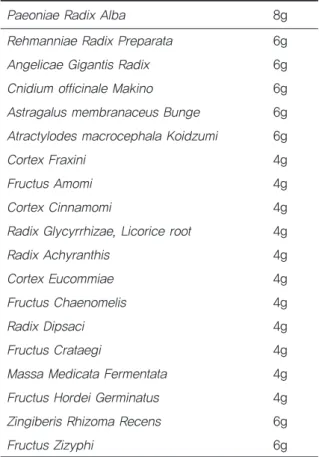
Ssanghwa-tang gamibang (120 cc) was adminis- tered three times daily after meals from January 23 to February 14, 2017 (Table 1).

3)Pharmacopuncture Treatment

Sterilized Soyeon pharmacopuncture from the

Korean Pharmacopuncture Research Institute

was administered at SI09 and BL52 two to three

(3)

times weekly for a total 8 treatments. A 30-gauge needle was used for injection (0.5 to 1 cc) at the acupoints.

4)Manual Therapy

The Graton Technique and cervical Chuna man- ual therapy were done every two to three days for a total of eight treatments

(1) Graston Technique

7)

With the patient in the relaxed prone position, the Graston Technique was used on the trapezius, levator scapulae, latissimus dorsi, and rhomboid muscles. The instrument was held at a 45° angle for 120 to 180 seconds in a direction parallel to the muscle fibers. Brushing, sweeping and scooping techniques were also used, resulting in a total treatment time of approximately 10 minutes.

(2) Chuna Manual Therapy

5)

Chuna manual therapy, a form of Korean spinal

manipulation was done for 10 minutes. With the patient in the supine position, cervical spine exten- sion-mobilization, JSspinedistractionwhichisre- laxing cervical stiffness by distraction in supine position and myofascial release techniques were used. These techniques result in a high-velocity and low-amplitude movement slightly beyond the passive ROM position. Manual force for spinal mo- bilization results in movement of the cervical spinal joints within the passive ROM position. We gavethrusts4-5 timesforeachtechnique. Formy- ofacial release, continuing extension moment ac- cording to the patient’s respiration, we waited until muscles became relaxed enough and repeated the course 2-3 times.

5)Moxibustion

Moxibustion treatment was applied once a day at CV04 and CV06 in hospital.

6)Physical Therapy

Dry cupping and hot packs were applied to the back once a day.

7)Western Medication

Several western medicines had previously been prescribedbyYeungnamUniversity Hospital, which were continued before tapering in our clinic.

3.Outcome measures

1)The American College of Rheuma- tology Preliminary Diagnostic Crite- ria (ACR,2010;Appendix 1)

The ACR was developed by American College of Rheumatology to aid in the clinical diagnosis of FMS. This criteria is simple and practical, does not include a tender point examination, and in- corporates the widespread pain index (WPI) and symptom severity scale (SS)

8)

. We evaluated the ACR before and at the end of the treatment pe- riod.

Table 1. Herbalmedicine

Paeoniae Radix Alba 8g

Rehmanniae Radix Preparata 6g

Angelicae Gigantis Radix 6g

Cnidium officinale Makino 6g

Astragalus membranaceus Bunge 6g Atractylodes macrocephala Koidzumi 6g

Cortex Fraxini 4g

Fructus Amomi 4g

Cortex Cinnamomi 4g

Radix Glycyrrhizae, Licorice root 4g

Radix Achyranthis 4g

Cortex Eucommiae 4g

Fructus Chaenomelis 4g

Radix Dipsaci 4g

Fructus Crataegi 4g

Massa Medicata Fermentata 4g

Fructus Hordei Germinatus 4g

Zingiberis Rhizoma Recens 6g

Fructus Zizyphi 6g

(4)

2)Fibromyalgia Impact Questionnaire (FIQ)(Appendix 2)

The FIQ is a functional and symptom based questionnaire developed in the late 1980s by Oregon Health and Science University to investi- gate the clinical effects of FMS. First published first in 1991, it is widely used, valid, and specific to FMS. It was modified in 1997 and 2002, has been translated in eight languages

9)

. We evaluated the FIQ beforehand at the end of the treatment period.

3)Numeric Rating Scale (NRS)

On the NRS, the patient reports pain from 0 to 10, with higher scores indicating more severe pain

10)

. We assessed neck, low back, and leg pain, and muscle tenderness, morning stiffness, fatigue, and urticarial every morning at 7 AM.

Ⅲ. Case Report

1.Patient

51 years old male with patient with a 6year his- tory of FMS

2.Chief Complaints

1) Neck pain 2) Low back pain 3) Bilateral leg pain 4) Muscle tenderness 5) Morning stiffness 6) Fatigue

7) Urticaria

3.Onset

July 2011

4.Past history

1) Chronic Hepatitis B Virus carrier, diagnosed by Yeungnam University Hospital in 2011 2) Adrenal Hemorrhage, diagnosed by Yeung-

nam University Hospital in 2011

3) Left upper limb fibrous dysplasia, diagnosed by Yeungnam University Hospital in 2014

4.Family History

Nothing specific

5.Present Illness

The patient was diagnosed with FMS on February15, 2012 atYeungnamUniversityHospital.

After hospitalization, the patient had been pre- scribed Amitrptyline hypdrochloride 10mg, Prega- balin 150mg, Cyclobenzaprine Tab., Hydroxyzine HCL 10mg, Bepotastine besilate 10mg, Levoceti- rizine HCL 5mg. Due to severe muscle pain and in- ability to perform activities of daily living, he visited the outpatient clinic in January 2017 and was hospitalized.

6.Results

1)American College of Rheumatology Preliminary Diagnostic Criteria (ACR, 2010)

The WPI decreased from before 12 before treat- ment to 9 at the end of the treatment. The SS de- creased from before 8 before treatment to at the end of the treatment (Table 2).

2)Fibromyalgia Impact Questionnaire (FIQ)

The FIQ was evaluated before (63.69) and at the

end of the treatment (50.15; Table 3).

(5)

3)Numeric Rating Scale (NRS)

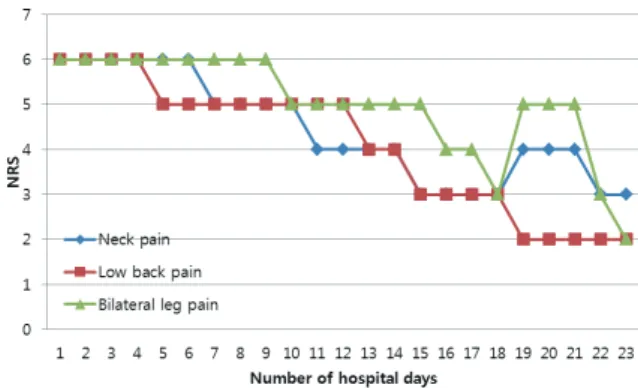
After hospitalization, the patient’s symptoms gradually decreased. Low back pain and bilateral

leg pain decreased from 6 to 2; neck pain from 6 to 3; muscle tenderness and morning stiffness from 6 to 4; fatigue from 5 to 3; and urticaria from 6 to 2 (Fig. 1, 2).

4)Western Medication

After 10 days in the hospital, the patient’s condi- tion improved and morning medications were dis- continued. After 20 days in the hospital, the patient’s condition continued to improve and all western medicines were discontinued (Table 4).

Ⅳ. Discussion

Fibromyalgia is a neurosensitive disorder of un- known etiology. It has been suggested that various neurotransmitters(including, the sero- Table 2. ChangesintheofAmericanCollegeof

RheumatologyPreliminaryDiagnosticCriteriascore

1/23/2017

1. WPI - 12/19: shoulder girdle (L) shoulder girdle (R) hip (L) hip (R) jaw (L) jaw (R) upper back lower back chest neck abdomen upper arm (R) 2. SS - 8/12: fatigue (2), waking

unrefreshed (2), cognitive symptoms (2), somatic symptoms (2)

2/13/2017

1. WPI - 9/19: shoulder girdle (L) shoulder girdle (R) upper arm (R) lower arm (R) hip (R) upper back neck lower leg (L) lower leg (R) 2. SS - 6/12: fatigue (2) waking

unrefreshed (1) cognitive symptoms (1) somatic symptoms (2)

*n/a = patient does not respond or feel difficult to answer.

Table 3. ChangesintheFibromyalgiaImpactQues- tionnairescore

1/23/2017 2/13/2017

1a (shopping) 2 2

1b (laundry) 0 2

1c (prepare meal) 1 1

1d (wash dishes) 1 1

1e (vacuum) 1 3

1f (make bed) 0 0

1g (walk) 1 n/a*

1h (visit friends) 2 n/a*

1i (yard work) 3 n/a*

1j (drive) 2 1

1k (climb stairs) 2 2

2 (feel good) 2 3

3 (work difficulty) 3 2

4 (work) 7 5

5 (pain) 8 5

6 (tired) 8 7

7 (get up) 8 6

8 (stiffness) 8 6

9 (anxious) 7 5

10 (depressed) 6 4

Fig.1.ChangeofNeckpain,Lowbackpain,Bilateral legpain

Fig.2.ChangeofMuscletenderness,Morningstiff-

ness,Fatigue,Urticaria

(6)

tonin transporter gene and catechol-O-methyl- transferase

11)

), infection, or injury may be involved in the pathogenesis of FMS

12)

. Fibromyalgia is characterized by abnormal neural processing re- sulting in widespread pain, muscle stiffness, and fatigue. FMS is generally accompanied with phys- ical and psychological distress, including, insom- nia, edema, numbness, anxiety, depression, or headaches

2)

.

According to the 1990 ACR criteria, a clinical diagnosis of FMS includes chronic widespread pain and tenderness and a tender point count of 11 to 18. This criteria is inadequate to diagnose symptoms other than the manual tender point pain

13)

. In 2010, criteria were modified based on the WPI and SS. The WPI consists of 19 objective pain locations throughout the body (19 possible points), and the SS is a self-report of symptoms including the severity of fatigue, waking unre- freshed, cognitive symptoms, and other somatic symptoms (12 possible points). FMS is diagnosed when the scores of WPI is over than 7 and SS is over than 5 or WPI score is within 3-6 and SS is

over than 9

8)

.

Various pharmacological treatments are recom- mended for FMS. In June 2007, Pregabalin received Food and Drug Administration (Korean FDA) approval for its analgesic properties. In June 2008, Duloxetine, a serotonin and norepinephrine reuptake inhibitor, was determined to have not only antidepressant properties, but also direct ef- fects on pain pathways, decreasing tender points.

In January 2009, Milnacipran received Korean FDA approval

14)

. Pregabalin is known to have ad- verse effects including dizziness, vertigo, nausea, vomiting, hypotension, headache, hallucinations, fatigue, drowsiness, hypersensitivity reaction, and urticaria

15)

. Although these three drugs received FDA approval, they have some side effects which resulted in their rejection by the European regula- tory authorities

16-18)

.

Exercise and mind-body therapy are recom- mended in the treatment of FMS. Exercise provides positive effects on depressed mood, phys- ical function, quality of life, and it is recommended that it be done at low to moderate intensity, 2-3 times per week, for more than four weeks

19)

. Mind- body therapy is a promising intervention in various rheumatoid disease that address psycho- logical and somatic symptoms

20)

. Through medita- tion, deep breathing, and slow, gentle movements, mind-body therapy improves depressed mood and bodily functions. However, these are secondary therapiesthatprimarilyimprovepain, fatigue, and sleep disorder. Therefore it is necessary to provide alternative positive therapies to pharmacotherapy or mind-body therapy

21)

.

Instrument-Assisted Soft Tissue Mobilization originated in the year 200 B.C. The use of IASTM is rapidly growing and involves non-invasive scrap- ping skin therapy

6,22)

. Damaged or adhesive soft tis- sue, including, muscle, muscle fascia, and tendons cause pain and limit ROM. By scrapping with IASTM pressure, microtrauma to damaged tissue and intramuscular fibroblast production is followed by morphologic changes in the rough en- doplasmic reticulum. These results lead to pain re- Table 4. Medicaltreatment

Period Medication Number

of doses

& Time

1/23/2017 - 1/31/2017

Amitrptyline HCl, 10mg hs* 1T Pregabalin, 150mg pc

1-0-1 Cyclobenzaprine HCl, 10mg pc

1-0-1 Hydroxyzine HCl, 10mg pc

1-1-1 Bepotastine besilate, 10mg pc

1-0-1 Levocetirizine, HCl 5mg pc

1-0-1

2/1/2017 - 2/10/2017

Amitrptyline HCl, 10mg hs* 1T Pregabalin, 150mg pc

0-0-1 Cyclobenzaprine HCl, 10mg pc

0-0-1 Hydroxyzine HCl, 10mg pc

0-1-1 Bepotastine besilate, 10mg pc

0-0-1 Levocetirizine HCl, 5mg pc

0-0-1 2/11/2017 -

2/14/2017 None

*hs = at bed time.

†pc = after meals.

(7)

lief and increased ROM. The Iastm, Graston, and Astym techniques are widely used

23)

.

Chuna manual therapy is a Korean spinal ma- nipulation method effective for some types of mus- culoskeletal pain

24)

. It is effective by relaxing tight muscles and adjusting alignment of the spine. It has been used in combination with acupuncture or other integrative methods to the control chronic soft tissue stiffness in patients with FMS

3)

, However, few studies have investigated the effect of the Graston Technique and Chuna manual ther- apy.

In this case, the patient developed neck, low back, and bilateral leg pain, muscle tenderness, morning stiffness, fatigue, and urticaria. The pa- tient visited our clinic with a five-year history of unresolved pain and dysfunction. Neither pharma- cotherapy nor physical therapy resolved the pa- tient’s symptoms. Our results show that the Graston Technique and cervical Chuna manual therapy accompanied with Korean medical treat- ment relieved pain and other physical symptoms.

This case has the limitation of a single case report. Also, as complex Korean medical treatment wasadministered, theindividualeffectsofGraston Technique or Chuna manual therapy cannot be discerned. Despite these limitations, FMS is gener- ally treated with chronic symptomatic treatment using analgesics, antidepressants, or mind-body therapy. This case study suggests the possibility of new treatment methods for FMS using the Graston Technique and Chuna manual therapy with existing Korean medical treatment. Future large- scale studies are necessary. Additionally, further research is needed to investigate additional treat- ments for FMS.

Ⅴ. References

1. Korean Rehabilitaion Medicine. Rehabilitation medicine of Korean Medicine. 4th ed. Seoul:

Koonja Publishing Co. 2015:122-6.

2. Suh CH. Fibromyalgia. Korean J med. 2003;

64(3):330–2.

3. Lee JY, Kim MS, Yum SL, Kyun YD. The Clini- cal Study on a Case of Fibromyalgia Syndrome Patient by Korean Medicine Treatment. JORM.

2016;26(4):127–36.

4. Lee CH, Lee MJ. Two Case Report on the Pa- tient with Fibromyalgia Syndrome(FMS) with Chuna and Acupuncture. The Journal of Korea CHUNA Manual Medicine for Spine & Nerves.

2006;1(1):91–103.

5. Korean society of CHUNA Manual Medicine for Spine & Nerves. Chuna manual medicine. 1st ed. Seoul: Korean society of CHUNA Manual Medicine for Spine & Nerves. 2011:1, 5, 58-9, 171-3, 182-3.

6. Braun M, Schwickert M, Nielsen A et al. Effec- tiveness of Traditional Chinese“Gua Sha” Ther- apy in Patients with Chronic Neck Pain: A Randomized Controlled Trial. Pain Med.

2011;12(3):362–9.

7. Moon JH, Jung JH, Won YS, Cho HY. Immedi- ate effects of Graston Technique on hamstring muscle extensibility and pain intensity in pa- tients with nonspecific low back pain. J Phys Ther Sci. 2017;29(2):224–7.

8. Wolfe F, Clauw DJ, Fitzcharles MA et al. The AmericanCollegeofRheumatologyPreliminary DiagnosticCriteriaforFibromyalgiaandMeas- urement of Symptom Severity. Arthritis Care Res. 2010;62(5):600–10.

9. Bennett R. The Fibromyalgia Impact Question- naire(FIQ): areviewofitsdevelopment, current version, operating characteristics and uses.

Clin Exp Rheumatol. 2005;23(5):154.

10. Lee JY, Park SH, Han SY, Park JY, Lee HJ. A Case-control Study of The Effect of Cotreat- ment with Sinseon Moxibustion on Low Back Pain of HIVD Patients. The Acupunt. 2011;

28(4):77-83.

11. Offenbaecher M, Bondy B, de Jonge S et al.

Possible association of fibromyalgia with a

polymorphism in the serotonin transporter

(8)

gene regulatory region. Arthritis Rheum. 1999;

42(11):2482–8.

12. Clauw DJ, Chrousos GP. Chronic pain and fa- tigue syndromes: overlapping clinical and neu- roendocrine features and potential pathogenic mechanisms. Neuroimmunomodulation. 1997;

4(3):134–53.

13. Wolfe F, Smythe HA, Yunus MB et al. The American College of Rheumatology 1990 Crite- ria for the Classification of Fibromyalgia. Re- port of the Multicenter Criteria Committee.

Arthritis Rheum. 1990;33(2):160–72.

14. Lee SS. Diagnosis and Treatment of Fi- bromyalgia Syndrome. Korean J Med. 2013;

84(5):650–8.

15. Salinsky M, Storzbach D, Munoz S. Cognitive effects of pregabalin in healthy volunteers A double-blind, placebo-controlled trial. Neurol- ogy. 2010;74(9):755–61.

16. Mease PJ, Clauw DJ, Gendreau RM et al. The efficacy and safety of milnacipran for treatment of fibromyalgia. A randomized, dou- ble-blind, placebo-controlled trial. J Rheuma- tol. 2009;36(2):398–409.

17. Arnold LM, Russell IJ, Diri EW et al. A 14- week, randomized, double-blinded, placebo- controlled monotherapy trial of pregabalin in patients with fibromyalgia. J Pain. 2008;9(9):

792–805.

18. Schmidt-Wilcke T, Clauw DJ. Pharmacother- apy in fibromyalgia (FM)—implications for the underlying pathophysiology. Pharmacol Ther.

2010;127(3):283–94.

19. H ä user W, Klose P, Langhorst J et al. Efficacy of different types of aerobic exercise in fi- bromyalgia syndrome: a systematic review and meta-analysis of randomised controlled trials.

Arthritis Res Ther. 2010;12(3):79.

20. Ali A, McCarthy PL. Complementary and inte- grative methods in fibromyalgia. Pediatr Rev.

2014;35(12):510.

21. Bernardy K, F ü ber N, K ö llner V, H ä user W. Ef- ficacy of cognitive-behavioral therapies in fi- bromyalgia syndrome-a systematic review and metaanalysis of randomized controlled trials. J Rheumatol. 2010;37(10):1991-2005.

22. Gehlsen GM, Ganion LR, Helfst R. Fibroblast responses to variation in soft tissue mobiliza- tion pressure. Med Sci Sports Exerc. 1999;31(4):

531–5.

23. Vardiman JP, Siedlik J, Herda T et al. Instru- ment-assisted soft tissue mobilization: effects on the properties of human plantar flexors. Int J Sports Med. 2015;36(3):197–203.

24. Moon TW, Choi TY, Park TY, Lee MS. Chuna

therapy for musculoskeletal pain: A systematic

reviewofrandomizedclinicaltrialsinKoreanlit-

erature. Chin J Integr Med. 2013;19(3):228–32.

(9)

Appendix 1. AmericanCollegeofRheumatologyPreliminaryDiagnosticCriteria(ACR,2010) Criteria

A patient satisfies diagnostic criteria for fibromyalgia if the following three conditions are met :

1. Widespread pain indexes (WPI)≥7and symptom severity (SS) scale score≥5 or a WPI of 3-6 and a SS scale score of ≥9.

2. Symptoms have been present at a similar level for at least three months.

3. The patient does not have a disorder that would otherwise explain the pain.

Ascertainment

1. WPI: note the number areas in which the patient has had pain over the last week. In how many areas as the patient had pain? Score will be between 0 and 19.

Shoulder girdle, left; Hip (buttock, trochanter), left; Jaw, left; Upper back Shoulder girdle, right; Hip (buttock, trochanter), right; Jaw, right; Lower back Upper arm, left; Upper leg, left; Chest; Neck

Upper arm, right; Upper leg, right; Abdomen Lower arm, left; Lower leg, left

Lower arm, right; Lower leg, right 2. SS scale score:

Fatigue

Waking unrefreshed Cognitive symptoms

For the each of the three symptoms listed above, indicate the level of severity over the past week using the following scale:

0=no problem

1=slight or mild problems, generally mild or intermittent

2=moderate, considerable problems, often present and/or at a moderate level 3=severe: pervasive, continuous, life-disturbing problems

Considering somatic symptoms in general, indicate whether the patient has:*

0=no symptoms 1=few symptoms

2=a moderate number of symptoms 3=a great deal of symptoms

The SS scale score is the sum of the severity of the 3 symptoms(fatigue, waking unrefreshed, cognitive symptoms) plus the extent(severity) of somatic symptoms in general. The final score is between 0 and 12.

*Somatic symptoms that may be considered include muscle pain, irritable bowel syndrome, fatigue/tiredness, thinking of memory prob-

lems, muscle weakness, headache, abdominal pain/cramps, numbness/tingling, dizziness, insomnia, depression, constipation, pain in

the upper abdomen, nausea, nervousness, chest pain, blurred vision, fever, diarrhea, dry mouth, itching, wheezing, Raynaud’s phe-

nomenon, hives/welts, ringing in ears, vomiting, heartburn, oral ulcers, loss of/change in taste, seizures, dry eyes, shortness of breath,

loss of appetite, rash, sun sensitivity, hearing difficulties, easy bruising, hair loss, frequent urination, painful urination, and bladder

spasms.

(10)

Appendix 2. TheFibromyalgiaImpactQuestionnaire The FIQ Directions and Questions

Directions: For questions 1 through 3, please circle the number that best describes how you did overall for the past week. If you don't normally do something that is asked, cross the question out.

Question 1.

Were you able to Always Most Occasionally Never

1. Do shopping? 0 1 2 3

2. Do laundry with washer and dryer? 0 1 2 3

3. Prepare meals? 0 1 2 3

4. Wash dishes/cooking utensils by hand? 0 1 2 3

5. Vacuum a rug? 0 1 2 3

6. Make a bed? 0 1 2 3

7. Walk several blocks? 0 1 2 3

8. Visit with friends or relatives? 0 1 2 3

9. Do yard work? 0 1 2 3

10. Drive a car? 0 1 2 3

11. Climb stairs? 0 1 2 3

Question 2. Of the previous 7 days, how many days did you feel good?

0 1 2 3 4 5 6 7

Question 3. How many days last week did you miss work, including housework, because of fibromyalgia?

0 1 2 3 4 5 6 7

Directions: For the remaining items, mark the point on the line that best indicates how you felt overall for the past week.

Question 4. When you worked, how much did pain or other symptoms of your fibromyalgia interfere with your ability to do your work, including housework?

| | | | | | | | | | |

No problem Great difficulty

With work With work

Question 5. How bad has your pain been?

| | | | | | | | | | |

No pain Very severe

pain Question 6. How tired have you been?

| | | | | | | | | | |

No tiredness Very tired

Question 7. How have you felt when you get up in the morning?

| | | | | | | | | | |

woke up well Woke up very

restd tired

Question 8. How bad has your stiffness been?

| | | | | | | | | | |

No stiffness Very stiff

Question 9. How nervous or anxious have you felt?

| | | | | | | | | | |

Not anxious Very anxious

Question 10. How depressed or blue have you felt?

| | | | | | | | | | |

Not depressed Very depressed

수치

Table 1. Herbalmedicine
Table 3. ChangesintheFibromyalgiaImpactQues- ChangesintheFibromyalgiaImpactQues-tionnairescore 1/23/2017 2/13/2017 1a (shopping) 2 2 1b (laundry) 0 2 1c (prepare meal) 1 1 1d (wash dishes) 1 1 1e (vacuum) 1 3 1f (make bed) 0 0 1g (walk) 1 n/a*

참조

관련 문서

Methods : The patient of essential tremor was treated by Myofascial Release Technique(MRT) and Chuna manual therapy with acupuncture, cupping, Transcutaneous

Moon TW, Choi TY, Park TY, Lee MS, Chuna therapy for musculoskeletal pain: a systematic review of randomized clinical trials in Korean literature.. Jeong B, Chung SH, Lee

And the Numerical Rating Scale(NRS) was adopted to measure changes of pain level. Two patients both had Chuna Cranio-Sacral Therapy category Ⅲ disorder with short right leg. We

Retrospective Study on Effect of Chuna Therapy, Also Known as Supine JS Cervical Therapy, Combined with Korean Medicine Treatment on Neck Pain and Headache

Thirty-one studies (91%) showed that Cobb’s angle decreased after Chuna manual therapy, and 4 studies (12%) indicated chiropractic manipulation was as effective as brace

Embedding therapy combined with Korean medical treatment might be effective in reducing pain and improving the life quality of patients with supraspinatus tendon

A Clinical Study on One Case of a Patient with Fibromyalgia by Chuna Therapy and Traditional Korean Medicine Treatment.. The Journal of Korea CHUNA Manual Medicine for Spine &

A Clinical study on One case of a Patient with Fibromyalgia by Chuna Therapy and Traditional Korean Medicine Treatment.. The Journal of Korea CHUNA Manual