• 검색 결과가 없습니다.

An Identification Technique Based on Adaptive Radial Basis Function Network for an Electronic Odor Sensing System

N/A
N/A
Protected

Academic year: 2021

Share "An Identification Technique Based on Adaptive Radial Basis Function Network for an Electronic Odor Sensing System"

Copied!
5
0
0

로드 중.... (전체 텍스트 보기)

전체 글

(1)

DOI:10.5369/JSST. 2011.20.3.151 pISSN 1225-5475/eISSN 2093-7563

An Identification Technique Based on Adaptive Radial Basis Function Network for an Electronic Odor Sensing System

Hyung-Gi Byun

+

Abstract

A variety of pattern recognition algorithms including neural networks may be applicable to the identification of odors. In this paper, an identification technique for an electronic odor sensing system applicable to wound state monitoring is presented. The performance of the radial basis function(RBF) network is highly dependent on the choice of centers and widths in basis function. For the fine tuning of centers and widths, those parameters are initialized by an ill-conditioned genetic fuzzy c-means algorithm, and the distribution of input patterns in the very first stage, the stochastic gradient(SG), is adapted. The adaptive RBF network with singular value decomposition(SVD), which provides additional adaptation capabilities to the RBF network, is used to process data from array-based gas sensors for early detection of wound infection in burn patients. The primary results indicate that infected patients can be distinguished from uninfected patients.

Keywords : Adaptive radial basis function network, Stochastic gradient, Singular value decomposition, Identification, Wound monitoring

1. INTRODUCTION

There is demand for the development of instrumentation that senses humans by a means mimicking the human sense of smell, which is a sophisticated chemosensory system. Electronic odor sensing systems comprise chemical sensors, associated electronics, and signal processing algorithms. Extremely selective information for discrimination between adsorbed chemical species can be obtained by exploiting the cross-sensitivities between sensor elements. The relative responses between sensor elements produce patterns that may be unique

‘fingerprints’ that can be used as odor descriptors. This strategy has been successful for the design of chemical sensors that are capable of detecting some volatile chemicals that are difficult to detect by other methods.

When using an electronic odor sensing system, it is desirable to discriminate between chemicals, and compare one sample with another. The ability to classify pattern characteristics from relatively small pieces of information has led to growing

interest in methods of sensory recognition. Adaptive neural networks are currently an active area of research and are applied to odor identification problems[1, 2].

We have investigated an adaptive radial basis function(RBF) network[3, 4], which had tuned centers and widths using the stochastic gradient(SG), and demonstrated good identification performance for complex and noisy chemical patterns giving relatively ill-conditioned clustering centers and widths. The characteristics of the adaptive RBF Network based on the SG method to adapt for fine tuning of weights between hidden and output layers based on singular value decomposition(SVD) gave additional adaption capabilities to the RBF network.

In this paper, we present an adaptive RBF network using SG and SVD which was able to identify wound infection from burn patient data obtained from a wound monitoring system using an electronic odor sensing system and incorporating an automated solid-phase microextrac- tion(SPME) desorption component to enable the system to be used for clinical validation[5]. The primary results show that infected patients may be discriminated from uninfected patients by using an adaptive RBF network pattern recognition technique with a wound monitoring system for burn patients.

School of Electronics, Information & Communication Engineering, Kangwon National University at Samcheok, Korea

+
Corresponding author: [email protected]

(Received: Jan. 7, 2011, Accepted: Mar. 16, 2011)

(2)

2. METHOD OF APPROACH 2.1 Radial Basis Function (RBF) Network

The RBF network should be designed to provide an artificial neural network with good generalization abilities and rapid training capabilities that are orders of magnitude faster than error back-propagation, while exhibiting none of back-propagation's training pathologies such as paralysis or local minimum problems. The architecture of the RBF network must be simple and consist of input, hidden, and output layers. The basis functions in the hidden layer produce a localized response to the input, and typically use hidden layer neurons with Gaussian response functions[6].

In this case, the activation levels(Oj) of hidden unit j are calculated by

where x is the input vector, cj is the center associated with hidden unit j, and σis the width parameter, which represents a measure of the data spread. The outputs of the hidden unit lie between 0 and 1; the closer the input is to the center of Gaussian, the larger the response of the node.

The activation leve(Oj) of an output unit is determined by

where Wji is the weight from hidden unit i to output unit j.

The performance of the RBF network is highly dependent on the choice of centers and widths in basis function. For a minimum number of nodes, the selected centers should accurately represent the data for acceptable identification. Most of the learning algorithms for the RBF network have been divided into 2 stages of processing.

First, as a clustering method, a fuzzy c-means algorithm[7]

which we found relatively good, is applied to the input patterns to determine the centers for hidden layer nodes.

After the centers are fixed, the widths are determined in a way that reflects the distribution of the centers and input patterns. Once the centers and widths are fixed, the weights between hidden and output layers are determined by a single shot process using SVD[8]. This two-stage method provides some useful solutions for the pattern identification problem. However, since the centers and widths are fixed after they are chosen, and only weights are adapted for learning, this technique often results in unsatisfactory performance when input patterns are not properly

clustered. To avoid these problems, we propose an adaptation method to select optimum centers and widths for the RBF network using the SG algorithm.

2.2 Radial Basis Function(RBF) - Stochastic Gradient (SG) Algorithm

When the adaptive RBF network is operated, the weights between hidden and output layers can be tuned during the adaptation routines for widths and centers. For a given set of input patterns measured by array-based gas sensors, the fuzzy c-means algorithm with random initial conditions is carried out to find locations of clusters' centers, which are then fed into the hidden layer units of the RBF network.

The Euclidean distance between the input patterns and the clusters' center is evaluated, and a Gaussian basis function with initial widths is applied. The weights between hidden and output units are trained by a single shot process using the SVD method. For the tuning of centers and widths, these are initially selected by a fuzzy c-means algorithm, and pattern distributions and weights are also initialized by SVD in the very first learning stage, with the SG method being adapted to finely tune centers and widths as described as follows[9]:

where μ

s

and μ

c

are adaptation coefficients for widths σ

1

and centers с

j

respectively, and they control the speed of adaptation. The weights between the hidden and output layer are also tuned by SVD calculations in the same iteration, together with centers and widths.

3. EXPERIMENTS AND RESULTS 3.1 Electronic odor sensing system for wound monitor

For the measurement of wound state, we used an electronic odor sensing system that has an array of sensors

(1)

(3)

(4)

(2)

(3)

together with an automated SPME sampler developed by Prof. Krishna C. Persaud at the University of Manches- ter(see Fig. 1). The electronic odor sensing system consisted of a combined sensor module, electronic air flow channel, and SPME fiber tray for real time wound stage monitoring. The system exposed the fiber to the heated sensor array, desorbing the volatile compounds off the fiber and directly onto the sensors to acquire data.

The sensors in the system are commercially available metal oxide sensors fabricated by Figaro(TGS 2602, TGS 2610), Japan, and experimental SnO

2

based thin film sensors doped with Au, Cr, or WO developed by INFM- CNR, Italy and the Semiconductor Physics Institute, Lithuania[10, 11].

The instrumentation incorporated an automated SPME sampler, which allowed the SPME fibers to be contained and used for sampling via a plunger and locking system.

The device acts as a mechanism for pre-concentration of the sample, which effectively increases the sensitivity of the measurement.

Samples from patients were collected from the burn unit of the Wythenshawe Hospital in Manchester, UK.

Microbial laboratory analysis was carried out for swab and dressing samples taken from the patients.

The results from analysis can be used to verify the possibility of an odor sensing system for detection of bacteria at early stages of wound infection. The common strains of bacteria present in wounds are Staphylococcus aureus, Streptococcus pyogenes, and Pseudomonas aeruginosa which identify potential volatile bio-markers of infection [12, 13].

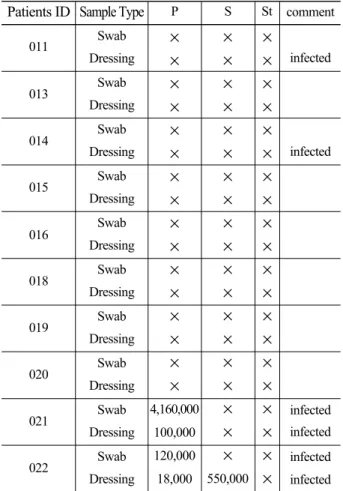
Table 1 shows the results of analyses which can be used to verify the performance of an adaptive RBF network capable of identifying infected patient samples.

The system exposed the fiber to a heated sensor array desorbing the volatile compounds off the fiber and directly onto the sensors. The response of each individual sensor was measured over time after exposure to the volatiles.

Data patterns collected during the measurement process were used as input patterns for the adaptive RBF network identifier.

3.2 Results and discussion

An adaptive RBF network using SG and SVD was applied to identify infected patients among the burn patients whose data were obtained from a wound monitoring system. For the network, 2 centers for each class were chosen from 10 patient samples related to treatments(swab and dressing) by using a fuzzy c-means algorithm. The centers and widths were fine tuned using the SG algorithm to improve identification results.

Fig. 1. Electronic odor sensing system for wound monitoring.

Table 1. Microbial laboratory analysis results from samples.

X: no growth, P: Pseudomonas, S: Staphylococcus, St: Streptococcus

Patients ID Sample Type P S St comment Swab

Dressing infected

infected

infected infected

infected infected Swab

Dressing Swab Dressing

Swab Dressing

Swab Dressing

Swab Dressing

Swab Dressing

Swab Dressing

Swab Dressing

Swab Dressing

×

×

×

×

×

×

×

×

×

×

×

×

×

×

×

× 4,160,000

100,000 120,000 18,000

×

×

×

×

×

×

×

×

×

×

×

×

×

×

×

×

×

×

× 550,000

×

×

×

×

×

×

×

×

×

×

×

×

×

×

×

×

×

×

×

× 011

013

014

015

016

018

019

020

021

022

(4)

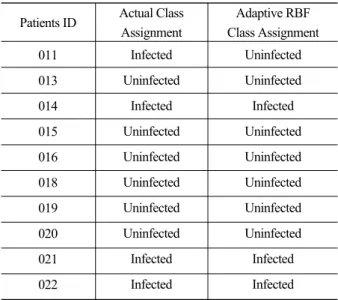
Table 2 shows identification results which were applied with the adaptive RBF network. Data were obtained from the electronic odor sensing system using the SPME headspace technique from swab samples taken from small patients with serious burns. Two infected patients, diagnosed from microbial laboratory analysis shown in Table 1, could be distinguished from others that were uninfected.

Identification of dressing samples taken from patients was also done by the electronic odor sensing system using same technique and display as shown in Table 3.

This identification clearly indicates that three patients were infected. This was not shown in swab samples.

However, one patient was not identify as the infected samples because low microbial counts were found in microbial laboratory analysis. The identification results of data from electronic odor sensing system coupled with an automated SPME samplers give the indication that infected patients can be discriminated from uninfected patients using an adaptive RBF network, and the microbial laboratory analysis for samples taken from patients verifies the performance of adaptive RBF network.

4. CONCLUSION

This paper presents an adaptive RBF network using SG and SVD which is applicable for identifying wound infection by using burn patients’ data obtained from a wound monitoring system using an electronic odor sensing system. The network incorporates an automated solid- phase microextraction(SPME) desorption component to enable the system. Throughout the experimental trails with data from the wound state monitoring system, we confirmed that the adaptive RBF network based on a genetic fuzzy c-means algorithm and SG tuning technique combined with SVD processing showed good discrimina- tion between infected patients and uninfected patients, and has wide applicability for analysis of clinical samples.

Primary results at this stage showed that infected patients can be distinguished from uninfected patients using an adaptive RBF network pattern recognition technique with a wound monitoring system for burn patients. However, more clinical data from hospitals where wound patients are treated are needed for actual validation of an adaptive RBF network for wound classification.

ACKNOWLEDGMENT

This work is supported by the research promotion fund(2011.5~2012.2) from Kangwon National University at Samcheok Campus, Korea.

REFERENCES

[1] H. Byun, J. Lee and J. Kim, “Implementation of a portable electronic nose systems for field screening”, J.

Table 2. Identification data obtained by the electronic odor sensing system of an adaptive RBF network from swab samples taken from patients

Patients ID 011 013 014 015 016 018 019 020 021 022

Uninfected Uninfected Uninfected Uninfected Uninfected Uninfected Uninfected Uninfected Infected Infected

Uninfected Uninfected Uninfected Uninfected Uninfected Uninfected Uninfected Uninfected Infected Infected Actual Class

Assignment

Adaptive RBF Class Assignment

Table 3. Identification results data from electronic odor sensing system from dressing samples taken from patients using an adaptive RBF network

Patients ID 011 013 014 015 016 018 019 020 021 022

Infected Uninfected

Infected Uninfected Uninfected Uninfected Uninfected Uninfected Infected Infected

Uninfected Uninfected Infected Uninfected Uninfected Uninfected Uninfected Uninfected Infected Infected Actual Class

Assignment

Adaptive RBF

Class Assignment

(5)

Kor. Sensors Soc., vol. 13, no. 1, pp. 1-10, 2004.

[2] J. Kim, H. Byun and Y. Ham, “Design of a portable electronic nose system using PDA”, J. Kor. Sensors Soc., vol. 13, no. 6, pp. 454-461, 2004.

[3] N. Kim, H. Byun and K. Kwon, “Learning behaviors of stochastic gradient radial basis function network algorithms for odor sensing systems”, ETRI Journal, vol. 28, no. 1, pp. 59-66, 2006.

[4] N. Kim, H. Byun and K. Persaud, “Normalization approach to the stochastic gradient radial basis function network algorithm for odor sensing systems”, Sensors and Actuators, B 124, pp. 407-412, 2007.

[5] H. Byun, K. Persaud and A-M Pisanelli, “Wound-state monitoring for burns patients using E-Nose/SPME system”, ETRI Journal, vol. 32, no. 3, pp. 440-446, 2010.

[6] M. Vaki-Baghmished and N. Pavesi, “Training RBF networks with selective back-propagation”, Neurocomputing, vol. 62, pp. 39-64, 2004.

[7] M. Karnel and S. Selim, “New algorithms solving the

fuzzy clustering problem”, Pattern Recognition, pp.

421-428, 1994.

[8] D. Broomhead and D. Lowe, “Multivariable functional interpolation and adaptive network”, Complex System, vol. 2, pp. 321-355, 1988.

[9] I. Cha and S. Kassam, “Interface cancellation using radial basis function network”, Signal Processing, vol.

47, pp. 247-268, 1995.

[10] www.figarosensor.com

[11] A. Setkus, Z. Kancleris, A. Olekas, R. Rimdeika, D.

Senuliene and V. Strazdiene, “Qualitative and quantitative characterization of living bacteria by dynamic response parameters of gas sensor array”, Sensors and Actuators, B 130, pp. 351-358, 2008.

[12] G. Revathi, J. Puri, and B. K. Jain, “Bacteriology of burns”, Burns, vol. 24, no. 4, pp. 347-349, 1998.

[13] H.A.L. Mousa, “Aerobic, anaerobic, and fungal burn wound infections”, J. of Hospital Infection, vol. 37, pp. 317-323, 1997.

Hyung-Gi Byun received his M.Sc. in electrical engineering and electronics and PhD. in Instrumentation and Analytical Science from The University of Manchester(formerly UMIST), Manchester, U.K. in 1990 and 1995, respectively. He is currently a professor at School of Electronics, Information &

Communication Engineering, Kangwon

National University at Samcheok,

Korea. His research interests include

signal processing and pattern

recognition applicable to chemical

sensing systems.

수치

Table 1 shows the results of analyses which can be used to  verify  the  performance  of  an  adaptive  RBF  network capable of identifying infected patient samples
Table 2. Identification  data  obtained  by  the  electronic  odor sensing  system  of  an  adaptive  RBF  network  from swab samples taken from patients

참조

관련 문서