<연구논문> http://dx.doi.org/10.5805/SFTI.2013.15.4.642
642
Sensibility Evaluation of Eco-friendly Apparel Products according to Recognition of Eco-friendliness
Young Joo Na
†and Hee Jin Kim
Dept. of Clothing & Textiles, Inha University; Incheon, Korea
Abstract : This study investigates the changes inconsumer sensibility and product preferences according to theireco- friendly productperceptions. Stimulants (released by three companies of sport casual brands)include three shirts made of recycled polyester and three made of organic cotton. A surveymethod was used to respond to the emotion and image while watching the presented pictures of the clothes. The change in the reactions was analyzed before and after the pre- sentation of eco-friendliness information. The questionnaire consists of sensibility adjectives, open-ended questions about the associated image of eco-friendliness, color attractiveness, product favorability, price satisfaction, and reasons for an eco-friendly productpurchase. The survey was conducted on 200adult male and female participants. Two factors (‘eco’ and
‘design’)were identifiedthrough the factor analysis of image adjectives. There was a statistically significant increase in the evaluation of sensibility, color attractiveness, product favorability, and price satisfactiondue to the re-evaluation of the same products after consumers recognized the eco-friendly information of apparel products. When consumers recognize products aseco-friendly, they evaluate the products more positively than before. The result of the analysis of the increases by textile materials shows no significant difference in the sensibility changes depending on the materials. However, with regard to ‘eco’, the increase of sensibility change for organic cotton products was larger than for recycled polyester prod- ucts.
Key words: eco-product satisfaction, recognition, predicted price, sensibility change, sportswear
1. Introduction
Recently, the rapid development of science and technology and industrialization has led to increasing the quality of life and enjoy- ing the rich life of people. At the same time, however, such devel- opment has also brought side effects such as the environmental contamination. As a variety of issues regarding the environmental pollution have come to the fore and the side effects have appeared, people began to be interested in protecting the environment. They have protected the environment from being contaminated and have strived for the restoration of the polluted environment. As part of such vigorous movement, ‘green’ issues have been emerg- ing rapidly.
‘Eco-friendliness’ is an important factor throughout the living areas. In term of company, it has been one of the emerging chal- lenges. Appeared in the early 2000s, ‘Well-being’ fever is not a temporary phenomenon any more, but has been established itself as a lifestyle. It also means to care for the healthy and sustainable soci- ety. LOHAS (Lifestyle of Health and Sustainability), which involves the people who aim at eco-friendly and reasonable con- sumption patterns, has appeared and attracted its attention recently
(Choi, 2010; Na & Lee, 2013). According to the World Research Report conducted in 2007, the survey result on the interest in domestic eco-friendly products shows that 60.6% of the total respondents are a little interested and 13.7% are very interested in green products. This result indicates that the domestic interest in eco-friendly product has been picking up gradually ("Conscious collection launching", 2011; Park, 2012).
Moreover, various research studies have been carried out with regard to eco-friendliness, such as ‘consumer’s attitude on eco- friendly product’, ‘consumer’s purchasing behavior depending on their awareness of eco-friendliness and attitudes’, and ‘emotional preference and reliability of eco-friendly textile and apparel prod- ucts. Therefore, the eco-friendliness is an essential area in apparel industry (Kim, 2009; Na & Kim, 2012).
The technology for developing eco-friendly textile has actively been made. However, the consumer has little understanding of the eco-friendly product. Also, clothing companies tend to give the ste- reotypical images for directing eco-friendly products and to leave much to be desired for the product designs. In other words, although consumer’s awareness of environmental conservation has been increasing and the relevant marketing has also been wide- spread along with the release of a number of eco-friendly products, still too limited and stereotypical design can only be found on the market. This indicates that the emotional development of eco-
†Corresponding author; Young Joo Na Tel. +82-32-860-8136, Fax. +82-32-865-8130 E-mail: [email protected]
friendly textile is tardy, which causes the customers not to be sat- isfied. The research study investigating the factors which influence the consumers’ behavior to purchase eco-friendly clothing reports that the consumer’s awareness of eco-friendly products is relatively high. On the other hand, their awareness of eco-friendly apparel products is still low. In addition, the consumers who lay more stress on the properties of clothing products such as design, quality, price, and brand tend to be less favorable in their purchase attitudes (Cheon, 2004).
Thus, although the research studies investigating the topics regarding the purchase attitude and behavior depending on the awareness of eco-friendly product, no research has focused on the quantitative study on the eco-friendliness sensibility and design for eco-friendly apparel products. Moreover, there has been no research which investigates the changes of emotion and image depending on the awareness of eco-friendliness. Therefore, the pur- pose of this study is to analyze the change of consumers’ sensibility and image depending on their awareness of eco-friendly apparel products. Also, this study aims to understand the sensibility of eco- friendly apparel products. Through this study, the customer’s sat- isfaction with the eco-friendly apparel products is to be measured and the current limitations of eco-friendly apparel product are to be discovered. These findings can help develop the eco-friendly apparel products in the future.
2. Study background
Eco-friendly product means that the relatively good product with regard to recyclability of products, energy efficiency, safety in the process of use and disposal, service life, and environmental impact of packaging and raw materials (Kim, 2009). In addition, it includes the products which are made of environmental products only, recyclable, or the products of which possible factors to cause pollution are removed. However, the products which are made of natural materials only cannot be seen as eco-friendly product any- more because it might require much more resources such as water and land to produce the natural materials than the synthetic ones (Kim et al., 2013). Thus, eco-friendly products can be regarded as the products returning to nature. In other words, the eco-friendly products should minimize the use of resources and the hazards to the environment in all processes from production to disposal including materials, process, use, and disposal of products.
Meanwhile, eco-friendly apparel product is defined as the prod- ucts which can contribute to the conservation of resources and reduce environmental pollution, compared to other products or ser- vices with the same purpose (“Opening of eco-friendly textile era”, 2008). Besides the harmfulness of apparel products and its mate-
rials, environmentally friendly products are defined as the ones which do not harm the safety and health of the workers and con- sumers in the whole process including planning, production, use, and disposal. Furthermore, they can be referred to the clothing products which contribute to environmental protection (Cheon, 2004). With regard to the use of materials, the products are only made of the materials which are produced by environmentally friendly process, by reusing or recycling pieces of cloth or used clothes, or by being made of biodegradable products to minimize the environmental pollution in recycling or disposal of the wastes for reproduction. The products can solve the environmental prob- lems for the entire process including planning, production, distri- bution, and disposal of apparel products (Lee et al., 2007).
Therefore, eco-friendly apparel product can be defined as the prod- ucts which are made of environmentally friendly materials, which recycle the clothes and the wastes that are treated with the eco- friendly process, which do not harm the environment when they are recycled and which are made of biodegradable fibers. Hyosung, which focuses on the expansion of recycled textile business, obtained GRS (Global Recycle Standard) certified by Control Union for its eco-friendly nylon and polyester textile product,
‘Regen’, in the early 2009. Furthermore, Kolon Fashion Material, a representative eco-friendly brand of Kolon Company, released PET recycled thread, ECOFREN, which can reduce CO
2emission upto 84% based on the company’s production process (Kim et al., 2013).
Sensibility is a complex feeling to response intuitively and instantly, such as senses of comfort, luxury, freshness, and dis- comfort. Because the sensibility is complex feeling, it is sometimes difficult to articulate. It is also personal and changes in a diverse way (Kwan et al., 2000). Such sensibility has a significant impact on person’s daily life as a consumer. In the ‘sensibility consump- tion era’, it is time to sell the image of product which can meet the high-level desire of consumption with an emphasis on the sensi- bility of the consumer, as well as on functional aspect (Yim, 2010).
With regard to the consumption of apparel products, in particular, the sensibility factor has a larger impact and the consumers also try to express their own emotions through clothing. Because of this, the common factors discovered from individual’s subjective and various emotion are applied to the development of apparel designs.
Hence, in order to refine and objectify the sensibility of consumers, it should be preceded to collect and select the adjectives which rep- resent the meaning of objects to be evaluated (Lee & Kim, 2002).
3. Research method and procedure
3.1. Research questions
(1) The consumers’ sensibility and images to eco-friendly apparel products are investigated.
(2) The changes of sensibility, color attractiveness, product favorability, and price satisfaction, which depend on whether the eco-friendly apparel product is recognized, are examined.
3.2. Research method
3.2.1. The selection of the stimulants of eco-friendly apparel product and the collection of sensibility adjectives
Among the sports and outdoor brands, three brands presenting eco-friendly products were selected. Two items were selected from K sport brand because ‘TREKKING LINE’ among their four prod- uct lines addresses eco-friendly natural materials. Two items were selected from P outdoor brand because the company aims to develop environmentally friendly materials and design under the philosophy of the conservation of earth environment and nature.
Additionally, two items were selected in ‘A by S.M.’ product lines from A sport brand, which is produced by collaborating with eco- friendly designers. Two apparels from each of three sports/outdoor brands were selected and the total stimulants were 6 top items. As made of eco-friendly materials, they are 3 made of organic cotton and 3 of recycled polyester, which are relatively widely used and have various designs.
Five eco-friendly words among adjectives were selected from a research paper which addresses the word occurrences of eco- friendly words mentioned in the Internet and newspapers (Na &
Kim, 2012; Na, 2011). For the rest of the words, four words were selected from the image scale words which were collected by experts in ‘a study on the image scale through the classification of sensibility in web site’ (Hong et al., 2009). Nine scales in total were created. Other basic questions were added, regarding demographic characteristics and reasons for purchasing or not purchasing eco- friendly apparel products.
3.2.1. Survey and analysis method
The questionnaire including stimuli pictures of Fig. 1, presented six eco-friendly products, first as if they were non-eco products without giving any information about eco-friendly materials. Then, 9 questions regarding sensibility adjectives, color attractiveness, product favorability, and price satisfaction were asked to score by 5-point scale. After that, they were asked to answer the open ques- tions about their images in mind when thinking about ‘eco-friend- liness’. Also, brief descriptions about 6 eco-friendly products and environmentally friendly materials were presented. Then again, they were asked to score the same questions regarding six eco- friendly apparel products, which were presented earlier.
The research subjects were male and female adults in their twen-
ties to fifties in Seoul. 207 subjects in total participated in the sur- vey. The questionnaires were distributed and collected in person or by email by investigator. This survey was conducted from May 10 to May 30, 2012. A total of 207 questionnaires were distributed and 200 questionnaires were used for statistical data after excluding insincere and inaccurate responses. For data analysis, factor anal- ysis with Varimax rotation and Cronbach’s a value, frequency anal- ysis, and t-test were used by using SPSS 18.0 program.
4. Results and Discussion
4.1. Associated image from eco-friendly apparel product In order to investigate the consumer’s perception on eco-friendly apparel product, they were asked to answer the open-ended ques- tions about their images in mind when thinking about ‘eco-friendly clothing’ The questions also allowed multiple responses. As a result, 90.0% of the total participants, 180 out of 200 persons responded to this question (Table 1). A number of images were col- lected and these were classified into six groups in general by inves- tigator with the basis of the results (Na, 2011). 30.6% was a
‘natural’ image group including images such as ‘eco-friendly’,
‘nonpolluting’, and ‘preventing environmental pollution’. Next group was ‘healthy’ image group accounting for 23.1%, including
‘healthy’, ‘harmless to human body’, and ‘well-being’ The rest
groups were ‘emotional (19.9%)’ > material (11.6%)’ > ‘colorful
(9.1%)’ > ‘related to price (5.6%)’ The majority of the collected
images were the typical eco-friendly images related to the envi-
ronment and human health, such as ‘natural’ and ‘healthy’ Other
Fig. 1. Stimulant pictures of eco-friendly apparel tops used in questionnaire.responses were strange and weird. Additionally, they had the images of positive sensibility, such as ‘comfortable and friendly’, and those of negative sensibility, such as ‘old-fashioned and expen- sive’ as well.
4.2. Sensibility changes depending on the recognition of eco-friendly apparel product
4.2.1. Overall changes of sensibility depending on the recogni- tion of eco-friendly apparel product
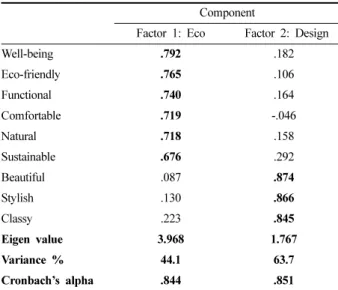
As a result of factor analysis, eco-friendliness sensibility are classified into ‘eco-friendly’ adjectives and ‘designing’ adjectives.
The total variance is 63.7 % (Table 2). Factor 1 is named ‘eco’
grouping adjectives such as ‘well-being’, ‘eco-friendly’, ‘func- tional’, ‘sustainable’, ‘natural’, and ‘comfortable’ The variance is 44.1 %. Factor 2 is named ‘design’ grouping adjectives such as
‘beautiful’, ‘stylish’, and ‘classy’. The variance is 19.6 %. As a result of Cronbach's Alpha of the adjectives, the reliability is over 0.8, which indicates the sufficient reliability (Table 2).
By using the factor scores, it is examined how the perception of apparel products is changed before and after the recognition of eco-
friendliness. It is found that there is statistically significant increase in the sensibility evaluation after the recognition. As the consumer recognize the environmentally friendly information about apparel products, their sensibility evaluation increases. In particular, there is more significant increase in the change of ‘eco’ than that of
‘design’ (Table 3).
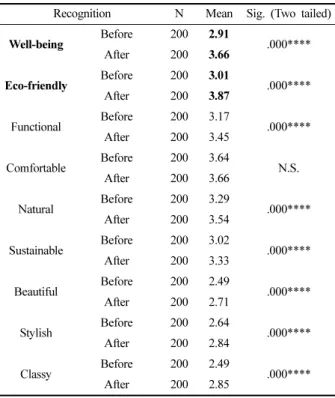
Moreover, as a result of the analysis examining the change of perception of each sensibility adjective (Table 4), there is a dis- tinctive increase of ‘eco-friendly’ and ‘well-being’, compared to other adjectives such as ‘comfortable’, ‘natural’, ‘functional’, and
‘sustainable’ in ‘eco‘. This might result from the findings that the former adjectives are included in two emotions (i.e., ’natural’ and
‘healthy’), which were the majority of ‘Associated images from eco-friendly clothing’ (Table 1). Therefore, the result might be sim- ilar. On the other hand, two emotions such as ‘stylish’ and ‘beau- tiful’ show relatively a little increase. Consumers bring relatively more eco-friendly and well-being images to mind after they rec- ognize the eco-friendly product, whereas the images regarding design, such as stylish or beautiful, do not increase.
Meanwhile, ‘comfortable’ sensibility does not show any changes before and after the recognition. This might result from the fact that the existing comfortable sensibility is already high because sport casual ware is already used as eco-friendly apparel product in the survey.
4.2.2. Sensibility changes by materials, depending on the rec- ognition of eco-friendly apparel product
Table 1. Associated images from eco-friendly clothing
Title/Name Description Frequency(%)
Natural eco-friendly, natural, nonpolluting, preventing environmental pollution, reuse, recycling, saving, sustainable 115(30.7) Healthy stable for atopy, healthy, good for skin, well-being, harmless to human body, sanitary 87(23.3) Emotional comfortable, friendly, favorable, clean, cool, clear, pure, unaffected, simple, country-like, inurbane, rough,
fresh, refreshing, old-fashioned 74(19.8)
Material using natural materials, functional, easily washable, practical, light, easily wrinkled, soft, feeling smooth,
active, sturdy, strong, sweat-absorbing 43(11.5)
Colorful yellow-green, green, blue, ochre, natural colors, faded colors, calming colors, dull 34(9.1)
Related to price expensive 21(5.6)
Total 374(100)
Table 2. Rotated component matrix from factor analysis Component
Factor 1: Eco Factor 2: Design
Well-being .792 .182
Eco-friendly .765 .106
Functional .740 .164
Comfortable .719 -.046
Natural .718 .158
Sustainable .676 .292
Beautiful .087 .874
Stylish .130 .866
Classy .223 .845
Eigen value 3.968 1.767
Variance % 44.1 63.7
Cronbach’s alpha .844 .851
Table 3. t-test results of the sensibility's factor scores before and after the recognition
Sensibility factor Recognition N Mean Sig. (Two tailed)
Eco Before 200 -.264
.000****
After 200 .263
Design Before 200 -.109
.000****
After 200 .109
****p < .0001
t-Test for each material was conducted by using two sensibility fac- tors. The result shows that the two types of ‘eco’ sensibility for organic cotton products, such as ‘eco-friendly’ and ‘well-being’, increase more than for recycled polyester products. This finding indi- cates that consumers seem to feel more eco-friendly image for organic cotton products than for recycled polyester products (Table 5).
For more examination, the change of two factor scores (i.e., ‘eco’
and ‘design’) for three recycled polyester products and three organic cotton products is analyzed. The result shows that the values of
‘After’ increase in general. The values of ‘eco’ group increase sig- nificantly compared to those of ‘design’ group : organic cotton (.641) and recycled polyester (.658) to organic cotton (.413) and recycled polyester (.227). However, there is no significant differ- ence by material when it comes to the overall image scale (Table 6).
4.2.3. The changes of color attractiveness, product favorability, and price satisfaction, depending on the recognition of eco-friendly apparel product
There is a slight increase in both color attractiveness and product favorability after the recognition (Table 7, 8). This result shows that consumers find the colors of apparel more attractive and feel more favorable to the product after they recognize that they are eco- friendly products. However, in light of the fact that the overall mean values stay in the middle score of 3.0, the consumers’ color attractiveness and product favorability of eco-friendly products are
low in general.
There is a slight increase in the price satisfaction. This indicates that the consumers seem to accept the price of eco-friendly apparel products to some degree after they recognize that they are eco-
Table 4. t-test of each sensibility adjectiveRecognition N Mean Sig. (Two tailed)
Well-being Before 200 2.91
.000****
After 200 3.66
Eco-friendly Before 200 3.01
.000****
After 200 3.87
Functional Before 200 3.17
.000****
After 200 3.45
Comfortable Before 200 3.64
After 200 3.66 N.S.
Natural Before 200 3.29
.000****
After 200 3.54
Sustainable Before 200 3.02
.000****
After 200 3.33
Beautiful Before 200 2.49
.000****
After 200 2.71
Stylish Before 200 2.64
.000****
After 200 2.84
Classy Before 200 2.49
.000****
After 200 2.85
****p < .0001
Table 5. t-test by materials with the two sensibility factors Material Product Sensibility
factor Recognition N Mean Sig.
(Two-tailed)
Recycled polyester
A
Eco Before 200 -.384
.000****
After 200 .163
Design Before 200 .382
.006***
After 200 .605
B
Eco Before 200 -.014
.000****
After 200 .322
Design Before 200 -.123 .014**
After 200 .093
C
Eco Before 200 -.066
.001***
After 200 .292
Design Before 200 -.426 .012*
After 200 -.185
Organic cotton
D
Eco Before 200 -.292
.000****
After 200 .307
Design Before 200 -.574 .002**
After 200 -.292
E
Eco Before 200 -.658
.000****
After 200 .023
Design Before 200 .267 After 200 .370 N.S.
F
Eco Before 200 -.166
.000****
After 200 .474
Design Before 200 -.186
.000****
After 200 .067
****p < .0001 N.S. not significant
Table 6. Increase by each material between the two sensibility factors Organic cotton Recycled polyester
N Mean Difference N Mean Difference Eco Before 200 -.372
.641 Before 200 -.398 .658
After 200 .268 After 200 .259
DesignBefore 200 -.164
.413 Before 200 -.056 After 200 .249 After 200 .171 .227
Table 7. t-test of color attractiveness by the recognition of eco-friendly apparel product
Recognition N Mean Sig. (Two-tailed) Color
attractiveness
Before 200 2.97
.031*
After 200 3.05
*p < .05
friendly products (Table 9). However, the scores of price satisfac- tion tend to be low in general, which shows that the consumers have negative perception that eco-friendly apparel product is some- what expensive.
4.3. The satisfaction with eco-friendly apparel products and the reasons for purchasing
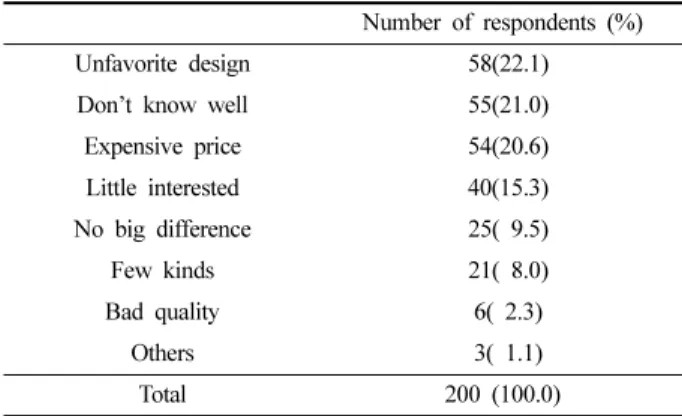
The consumers’ satisfaction with eco-friendly apparel products which are currently on the market is examined. The result shows that 47 participants (23.5%) responding ‘satisfied’ and 153 partic- ipants (76.5%) responding ‘unsatisfied’, which indicates that most participants are not satisfied with eco-friendly apparel products. In addition, for the questions regarding their experiences of purchas- ing eco-friendly apparel products, only 54 participants (27.0%) responding to have purchased before, whereas 146 participants (73.0%) responding not to have purchased before. The main reason for not purchasing the product (Table 10) is because of its ‘unfa- vorite design’ (22.1%), and it is followed by ‘don’t know well’
(21.0%), ‘expensive price’ (20.6%), and ‘little interested’ (15.3%).
As can be seen in Table 11, the reasons for the purchase includ- ing ‘purchasing because of good functional material’ (3.51), ‘pur-
chasing because of harmlessness’ (3.06), and ‘purchasing for contributing to the conservation of environment’ (3.06) are rela- tively high. The means of responses regarding the product design, on the other hand, show relatively low scores, including ‘purchas- ing because of good design’ (2.62) and ‘purchasing because of being more unique and rare than existing clothing products’ (2.29).
This finding can be regarded as the similar result of the comparison of sensibility between 'eco' and 'design'. In other words, consumers do not seem to find the design of eco-friendly product attractive.
6. Conclusion
In order to examine the sensibility reflected on eco-friendly apparel product and the changes of consumers’ sensibility and favorability before and after their recognition of eco-friendly prod- uct, this study surveyed male and female adults in their twenties to fifties in Seoul. The findings are as follows.
1) The consumers’ associated images for eco-friendly apparel product are natural and healthy images such as ‘eco-friendly’,
‘nonpolluting’, ‘well-being’, and ‘healthy’ There are good sensi- bility images such as ‘comfortable’ and ‘friendly’. However, neg- ative images can also be found, including ‘old-fashioned’, ‘simple’, and ‘expensive’.
2) Through the factor analysis of nine sensibility adjectives, two factors including ‘eco’ and ‘design’ are identified, and the total variance is 63.7%. In general, all sensibility increase after the con- sumers recognize eco-friendly products. However, ‘eco’ sensibility increases more highly than ‘design’ sensibility. Moreover, as a result of the sensibility change by each sensibility, two emotions such as ‘eco-friendly’ and ‘well-being’ are distinctively increased, compared to other emotions such as ‘comfortable’, ‘natural’, ‘func- tional’, and ‘sustainable’. On the other hand, two emotions such as
‘stylish’ and ‘beautiful’ are increased slightly, which indicates that the consumers associate ‘eco-friendly’ and ‘well-being’ images more than design images such as ‘stylish’ or ‘beautiful’ after they recognize the products are eco-friendly.
With regard to materials, the increase of each factor (i.e., ‘eco’
Table 8. t-test of product favorability by the recognition of eco-friendly apparel product
Recognition N Mean Sig. (Two-tailed) Product
favorability
Before 200 2.82
.000****
After 200 3.01
****p < 0.0001
Table 9. t-test of price satisfaction by the recognition of eco-friendly apparel product
Recognition N Mean Sig. (Two-tailed) Price
satisfaction
Before 200 1.76
.000****
After 200 2.16
****p < .0001
Table 10. Reasons for not purchasing eco-friendly apparel products (multiple response allowed)
Number of respondents (%)
Unfavorite design 58(22.1)
Don’t know well 55(21.0)
Expensive price 54(20.6)
Little interested 40(15.3)
No big difference 25( 9.5)
Few kinds 21( 8.0)
Bad quality 6( 2.3)
Others 3( 1.1)
Total 200 (100.0)
Table 11. Reasons for the purchase of eco-friendly apparel products
Questions N Mean
Purchasing because of good functional material 200 3.51 Purchasing for contributing to the conservation of
environment 200 3.06
Purchasing because of harmlessness 200 3.06 Purchasing because of good design 200 2.62 Purchasing because of being more unique and rare than
existing clothing products 200 2.29
and ‘design’) for three recycled polyester products and three organic cotton products is analyzed respectively. The result shows that the values of sensibility increase in both materials in general after the recognition. The values of ‘eco’ factor increase signifi- cantly compared to those of ‘design’ factor. There is a little more increase in the organic cotton products. In particular, among the
‘eco’ emotions, two adjectives such as ‘eco-friendly’ and ‘well- being’ are compared each other by material. It shows that the 'eco' sensibility for organic cotton products is significantly increased.
This finding indicates that consumers seem to feel more eco- friendly image for organic cotton products.
There is a slight increase in both color attractiveness and product favorability after the recognition. This result shows that consumers find the colors of apparel more attractive and feel more favorable to the product after they recognize that they are eco-friendly products.
There is also a slight increase in the price satisfaction. This indi- cates that the consumers seem to accept the price of eco-friendly apparel products to some degree after they recognize that they are eco-friendly products. However, the overall scores of product favorability, product attractiveness, and price satisfaction tend to be low in general, which shows that the consumers still have negative perception on eco-friendly apparel product.
Overall, the image of eco-friendliness tends to increase signifi- cantly after the consumers recognize the product is eco-friendly apparel. However, the images regarding design do not increase sig- nificantly. Moreover, the main reason for not purchasing the eco- friendly apparel product is its ‘unfavorite design’ The reasons for the purchase are also more largely related to the conservation of environment and health, rather than the product design. Therefore, it can be found that the consumers are not satisfied with the design of eco-friendly products. In light of these findings, when it comes to the development of eco-friendly apparel product, it is suggested that the product design be improved to meet the consumer’s needs, as well as to highlight the functional aspect of eco-friendly products.
For the future eco-friendly apparel products, it is recommended that both aspects including a variety of stylish designs and functionally outstanding features of eco-friendliness need to be pursued.
Acknowledgement
This work was supported by the National Research Foundation of Korea (2012S1A5A2A01019471).
References
Cheon, Y. J. (2004). Factors affecting on purchasing attitude of eco- apparel products-focusing female customer. Unpublished master's thesis, Seoul National University, Seoul.
Choi, S. H. (2010). Lohas index of consumers and their purchasing behavior of lohas product. Unpublished master's thesis, Konkuk University, Seoul.
'Conscious Collection launching'. (2011, March 22). Fashion journal
& textile life. Retrieved May 22, 2012, from http://okfashion.co.kr/
index.cgi?action=detail&number= 16754&thread=81r15 Hong, S. Y., Lee, H. J., & Jin, K. N. (2009). A study on the image scale
through the classification of emotion in web site. Korean Journal of the Science of Emotion & Sensibility, 12(1), 1-10.
Kim, S. Y. (2009). Analysis of purchase attitude according to the cognition of eco-fashion products. Unpublished master's thesis, Mokpo University, Mokpo.
Kim, E. A., Kim, H. K., Na, Y. J., Shin, Y. S., Oh, K. W., Yim, E. H.,
& Jeon, Y. J. (2013). Fashion Textiles. Seoul: Kyomunsa.
Kwan, O. K., Kim, H. E., & Na, Y. J. (2000). Fashion & Sensibility.
Seoul: Kyomunsa.
Lee, J. S., Yang, L. N., & Choi, N. Y. (2007). An analysis of environmentally conscious consumers' features and their awareness of green fashion products-focusing on female residents of Seoul (comparison between 1999 and 2007). Journal of the Korean Society for Clothing Industry, 9(4), 401-408.
Lee, K. H., & Kim, Y. J. (2002). Process of the scale in fashion sensibility. Korean Journal of the Science of Emotion &
Sensibility, 4(1), 33-42.
Na, Y. J., & Kim, H. W. (2012). Sensibility preference of eco-friendly fabric products and trust reliability. Journal of the Korean Society for Clothing Industry, 14(3), 430-437.
Na, Y. J. (2011). Appearance frequency of eco-friendly emotion and sensibility words and their changes. Korean Journal of the Science of Emotion & Sensibility, 14(2), 207-220.
Na, Y. J., & Lee, H. K. (2013). An exploration according to clothing category for increasing the sustainability of fashion and textiles.
Journal of the Korean Society for Clothing Industry, 15(2), 294- 301.
'Opening of eco- friendly textile era'. (2008, September 29). Apparel news. Retrieved May 29, 2010, from http://www.appnews.co.kr Park, Y. H. (2012). A study on the purchase appraisal standard and post-purchase satisfaction of natural dyeing products. Journal of the Korean Society for Clothing Industry, 14(1), 64-74.
Yim, H. B. (2010). FUN fashion design of sensibility consumers' era.
Unpublished master's thesis, Konkuk University, Seoul.
(Received 9 July 2013; 1st Revised 8 August 2013;
2nd Revised 9 August 2013; Accepted 23 August 2013)
Copyright © The Society of Fashion and Textile Industry. 2013. This is an open access article distributed under the terms and condi- tions of the Creative Commons Attribution Non-Commercial license (http://creativecommons.org/licenses/by-nc/3.0/), which permits unrestricted non-commercial use, distribution, and reproduction in any medium, provided the original work is properly cited.