• 검색 결과가 없습니다.

Enterobacter sakazakii : New emerging pathogen Review on E. sakazakii and development of selective medium

N/A
N/A
Protected

Academic year: 2021

Share "Enterobacter sakazakii : New emerging pathogen Review on E. sakazakii and development of selective medium"

Copied!
17
0
0

로드 중.... (전체 텍스트 보기)

전체 글

(1)

Enterobacter sakazakii : New emerging pathogen

Review on E. sakazakii and development of selective medium

오 세 욱 식품안전성연구본부

The first cases of neonatal meningitis believed to have been caused by Enterobacter sakazakii were reported in 1961. Prompted by several subsequent outbreaks of E. sakazakii infections in neonates and an increasing number of neonates in intensive care units being fed rehydrated powdered infant formula, considered to be a source of the pathogen, public health authorities and researchers are exploring ways to eliminate the bacterium or control its growth in dry infant formula, processing environments and formula preparation areas in hospitals. Reviewed here are advances in taxonomy and classification of E. sakazakii, methods of detecting, isolating and typing the bacterium, antibiotic resistance, clinical etilogy and pathogenicity. Outbreaks of E. sakazakii infections in neonates and adults are summarized. Reports on the presence of E. sakazakii in clinical settings, the environment and foods and food processing facilities are reviewed.

Ⅰ. 서론

1961년 Urmenyi와 Franklin은 1958년 영국 St.

Albans에서 발생하였던 두 가지 종류의 neonatal meningitis에 대하여 보고함으로서 Enterobacter sakazakii에 대한 최초의 보고자가 되었으며 이후 1965년 Joker 등도 Denmark에서 발병된 meningitis 에 대해 보고하였다. 보고된 yellow-pigmented Enterobacter cloacae는 1980년에 이르러서야 DNA relatedness, pigment production, biotyping, antibiotic susceptibility 등의 실험(Farmer et al., 1980; Izard et al., 1983)에 의해 Enterobacteriaceae

의 새로운 species로 분류되었으며 일본인 미생물 학자인 Riichi sakazakii의 이름을 따서 Enterobacter sakazakii로 명명되었다. Farmer 등(1977)과 Brenner 등(1977)이 E. sakazakii라는 이름을 최초로 사용 하였다고 알려져 있다. E. sakazakii로 명명되기 전까지 Urmenyi and Franklin bacillus, yellow coliform, yellow Enterobacter, pigmented cloacae 와 yellow-pigmented E. cloacae의 다섯 가지의 이름으로 명명되었다.

E. sakazakii infection은 주로 생후 3일부터 4년

까지의 신생아와 어린이에게 병을 유발하며 현재

(2)

까지 적어도 76건의 infection과 19건의 사망이 보 고되고 있다(Iversen and Forsythe, 2003). 또한 어른을 대상으로는 아홉 건 이상의 infection이 보 고되고 있다(Dennison and Morris, 2002; Emery and Weymouth, 1997; Hawkins et al. 1991;

Jimenez and Gimenez, 1982; Pribyl et al., 1985;

Lai, 2001). Infection은 세계적으로 8개국에서 보 고되고 있으며 또한 미국 내에서 9개주에서 발생 이 보고되고 있다.

최근의 E. sakazakii infection은 2004년 7월 뉴 질랜드에서 발생하여 미숙아가 사망하였으며, 동년 10월과 12월 사이에 프랑스에서 9명이 infection되 어, 4명이 발병하였으며 그 결과 2명이 사망하였다.

아직까지 E. sakazakii와 관련된 infection의 감 염원 및 경로는 밝혀져 있지 않지만, 역학적 조사 결과에 따르면 rehydrated infant milk formula(a non-sterile product), 분유를 탄 장소의 환경조건, 사용한 기구 등이 가장 유력한 오염경로라고 알려 져 있다(Bar-Oz et al., 2001; Biering et al., 1989;

Clark et al., 1990; Muytjens and Kollee, 1990;

Muytjens et al., 1983; Noriega et al., 1990;

Simmons et al., 1989; Van Acker et al., 1990).

E. sakazakii에 오염되어 있을 것으로 추정되는 조제분유에 대하여 2002년 미국에서 자발적인 recall(Wyeth nutrition)이 진행되었으며 2005년 1월 네덜란드에서도 전 세계를 대상으로 한 recall (Pregestimil)이 진행된 바 있다. 따라서 그 어느 때 보다도 조제분유에 대한 미생물 안전성 및 위 생 관리에 대한 관심이 고조되고 있는 상황이다.

Ⅱ. 본론

1. Taxonomy and biochemical characterization

E. sakazakii는 Enterobacteriaceae family에 속

한다. 특징으로는 Gram-negative rod이며, glucose 를 발효하여 산을 생성하며 동시에 lactose를 분해 하여 산을 생산한다. 또한 hydrogen sulfide gas 및 indole을 생산하지 못하며 motility를 가지고 있 다(Coliform, Enterobacteriaceae spp.).

Enterobacter spp 중에서 D-sorbitol을 carbon source로 이용하지 못하는 것으로 알려져 왔으며 extracellular deoxyribonuclease를 생산한다고 알 려져 있다(Farmer et al., 1980). 그러나 최근 예외 적으로 D-sorbitol을 carbon source로 이용하는 균 주도 보고되고 있다(Heuvelink et al., 2001).

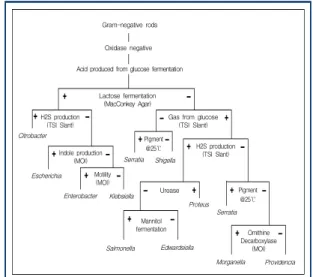
Gram-negative rods Oxidase negative Acid produced from glucose fermentation

Lactose fermentation (MacConkey Agar)

Gas from glucose (TSI Slant) H2S production

(TSI Slant) Citrobacter

Escherichia Enterobacter Indole production

(MOI)

Klebsiella Motility

(MOI)

Pigment

@25℃

Serratia Shigella

H2S production (TSI Slant)

Urease Proteus

Serratia Mannitol

fermentation Salmonella Edwardsiella

Pigment

@25℃

Morganella Providencia Omithine Decarboxylase

(MOI)

Fig. 1. Biochemical differentiation of Entero- bacteriaceae family

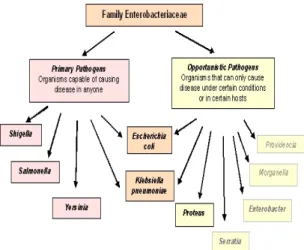
Enterobacteriaceae family는 항상 pathogen으로 활동할 수 있는 Shigella spp. Salmonella spp.

Yersinia spp. 등의 primary pathogen이 있으며

특정 환경조건이나 host에 따라서 pathogenisity를

나타내는 Proteus spp. Serratia spp. Morganella

spp.와 Enterobacter 등의 opportunistic pathogen

으로 구성되어 있으며 이러한 두 가지 성질을 동

시에 가지고 있는 Escherichia coli, Klebsiella

pneumoniae도 있다. 대부분의 Enterobacteriaceae

(3)

균주는 대장에 존재하는 normal microflora로 진 화되어 왔기 때문에 질병을 유발하지 않지만 plasmid, transposons와 phage 등에 의해 genetic information을 흡수하여서 pathogen이 되기도 한 다고 알려져 있다.

Fig. 2. Enterobacter sakazakii as an opportunistic pathogens

1980년대 이전에 yellow-pigmented E. cloacae 로 알려져 왔던 E. sakazakii는 DNA-DNA hybridization 실험 결과 non-pigmented strain과 비교하여 50% 이하의 homology를 나타내었기 때 문에 새로운 species로 분류되었다. 일반적으로 균 주를 분류할 때는 phenotypic characteristics, biochemical traits, serotyping, bacteriophage typing과 antibiotic resistance를 이용하며(Arbeit, 1995; Einstein, 1990, Nazarowec-White and Farber, 1999) 또한 실제적으로 phenotype test에 의하여 Enterobacter species를 분류하기도 하지 만 Enterobacter species 전체 분류에 적용하기 어 려우며 또한 그 결과가 그다지 효과적이지도 못한 것으로 알려져 있다(Gaston, 1988; Grattard et al., 1994; Nazarowec-White and Fraber, 1999;

Poilane et al., 1993). 따라서 대안으로서 유전자를 이용한 분류 방법이 개발되고 있다. Iverson 등 (2004)은 16S ribosomal DNA와 hsp60 sequencing 에 의해 상관관계를 조사한 결과, type strain의 16S rDNA sequence는 Cirobacter roseri와 97.8%

유사한 sequence를 가지고 있었으며 E. cloacae와 97.0% 유사한 것으로 나타났다고 하였으며 또한 최근 연구결과에 의하면 E. sakazakii는 hsp60 sequence에 의해 더욱 더 세분화 될 수 있는 2가 지의 특징적인 group으로 구분될 수 있으며 이러 한 group간의 biochemical profile이 서로 일치 하 지 않았다고 하여 phenotypic typing 보다 객관적 인 분류가 가능하다고 하였다.

따라서, phenotypic characterization 뿐만 아니라 PCR, randomly amplified polymorphic DNA(RAPD) PCR, pulsed-field gel electrophresis(PFGE), chromosomal DNA restriction analysis, ribotyping 과 plasmid typing(Grant and Kroll, 1993; Farber, 1996, Nazarowec-White and Farber, 1999)에 의 한 DNA와 RNA finger printing이 비약적으로 발 전되어 왔다. Nazarowec-White와 Farber(1999)는 EcoRI restriction endonuclease를 이용하여 18종 의 E. sakazakii isolate에 대하여 분석한 결과 10 종의 ribotype으로 분류 할 수 있었다고 하였으며 restriction endonuclease analysis(REA, Clark et al., 1990) 보다 더욱 더 효율적이었다고 하였다.

그러나 아직까지 가장 정확하게 분류에 이용할 수 있는 객관적인 finger printing 방법은 없는 것으 로 생각되며 AP-PCR, ribotyping, PFGE, plasmid typing 결과를 종합하여 molecular typing 하는 것 이 가장 효율적인 방법이라고 생각한다.

2. Isolation, identification and typing

U.S. Food and Drug Adminstration(FDA, 2002)

은 dehydrated powdered infant formula(Table 1)에

(4)

Step Time Temperature

√ Sterilize can lid margins and sample spoons N/A N/A

√ Dilute 100g, 10g, 1g of powdered infant formula with pre-warmed sterile distilled water at 1:10 ratio, mix and incubate

Overnight 36℃

√ Add 10 ml of each suspension to 90 ml of Enterobacteriaceae

enrichment broth and incubate Overnight 36℃

√ Mix suspensions and surface plate 0.1 ml on VRBG agar, streak on VRBG agar with a 10 μl incubating loop onto three quadrants for isolation and incubate

Overnight 36℃

√ Pick five presumptive-positive E. sakazakii colonies from both sets of VRBG plates and subculture by streaking onto TSA and incubate

48-72 h 25℃

√ Select yellow-pigmented colonies only and confirm per manufacture's instructions for the API 20E biochemical confirmation system

N/A N/A

√ Calculate the most probable number(MPN) after determining

the number of positive tubes at each dilution N/A N/A Table 1. Method for analyzing powdered infant formula for presumptive E. sakazakii

서 E. sakazakii를 분리, 계수할 수 있는 방법을 권고하였다. 이 방법은 Muytjens 등(1988)과 Nazarowec-White와 Farber(1997) 방법을 근간으 로 하고 있지만 FDA 방법은 powdered infant formula를 buffered peptone water에 reconstitute 하는 대신에 증류수를 사용하며 enrichment 후에 sample을 tryptic soy agar(TSA), violet red bile glucose(VRBG) agar에 transfer 하는 방법에서 차 이가 있다.

FDA가 권고하고 있는 방법은 크게 2가지의 단 점이 있다. 첫째, selective media로 사용되고 있는 VRBG의 selectivity가 낮아 검출을 목표로 하고 있는 E. sakazakii 이외의 많은 균들이 특징적인 purple colony를 형성하므로 분리를 방해할 수 있

다. 둘째, VRBG에서 E. sakazakii로 추정되는

colony를 선발하여 TSA에서 배양후 yellow

colony를 선발토록 권고하고 있지만, E. hermanii,

E. vulneris, L. acecarboxylata 등 Enterobacteriaceae

중에서 많은 균주가 yellow pigment를 생성하기

때문에 selectivity가 떨어진다고 할 수 있다. 따라

서 E. sakazakii를 selective하게 검출할 수 있는

배지 개발이 대한 연구가 진행되었다. Selective

배지를 개발하기 위해서는 먼저, 대상으로 하는

균주의 특성을 조사해야 한다. 대상균주만이 가지

고 있는 생화학적 특징이 있다면 이를 selection

marker로 이용하는 것이 가장 바람직하다고 할

수 있다. 특징적인 biochemical metabolites의 생산,

특징적인 enzyme의 생산, antibiotics resistance

(5)

등이 selection marker로 보편적으로 이용되고 있다.

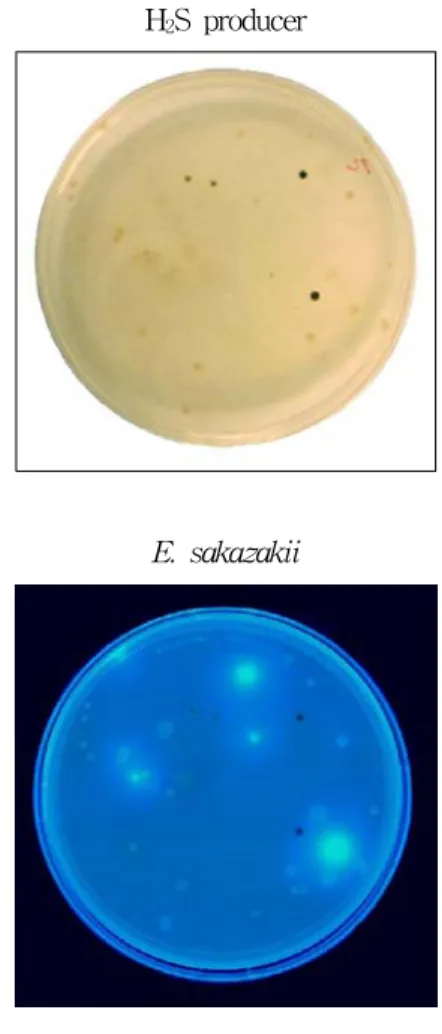
E. sakazakii는 Enterobacter spp. 중에서 유일 하게 α-glucosidase를 생산하기 때문에 이러한 특 징을 selection marker로 이용하여 differentiation media가 개발되었다(Oh and Kang, 2004; Iverson et al., 2004). Oh와 Kang은 E. sakazakii가 α -glucosidase를 생산하는 특징을 selection marker 로, hydrogen sulfide를 생산하지 못한다는 특징을 보조적인 marker로 이용하였다. 즉, Enterobacteria 속 균주의 성장이 가능한 배지조건(bile salt 존재) 에서 α-glucosidase를 생산하지만 hydrogen sulfide 를 생산하지 못하는 균주를 Enterobacter sakazakii 로 선발하도록 설계하였다. Alpha-glucosidase를 detect 하기 위하여 4-methylumbelliferyl-α-D-glucoside (α-MUG)를 기질로 사용하였으며 효소작용에 의하 여 분해, 분리된 4-methylumbelliferyl moiety의 형 광을 자외선(365 nm)을 이용하여 검출하였다. 상 업적으로 판매되고 있는 complex media인 TSA, VRBG agar, Tryptone bile agar중 basal medium 을 선정하였으며 이후 배지성분을 최적화 하여 E.

sakazakii에 의해 생산되는 α-glucosidase를 specific 하게 검출할 수 있도록(background noise 제거) 최적화 하였다. 또한, 보조 marker인 hydrogen sulfide를 생산하는 균주를 분별하기 위하여 sodium thiosulfate와 ferric citrate를 첨가하여 black colony (Salmonella spp. Edwardsiella spp. Proteus spp) 를 제외시켰다. Fig. 3에 나타난 바와 같이 α -glucosidase 활성에 의해 형광을 띠면서 동시에 black colony를 형성하지 않는 균을 E. sakazakii 로 설정하였다. 이후 API 20E identification kit와 oxidase test를 실시하여 confirmation 하였을 때 개발된 선택배지의 selectivity가 우수한 것으로 나 타났다.

H

2

S producer

E. sakazakii

Fig. 3. OK medium developed for E. sakazakii isolation and differentiation. E. sakazakii appeared as blue fluorescent colonies and Hydrogen sulfide producer as black colonies.

Iverson 등(2004)도 α-glucosidase 활성을 검출

하는 동일한 원리를 이용하여 E. sakazakii 선택

배지(Druggan-Forsythe-Iverson agar, DFI)를 개

발하였으며 현재 Oxoid사를 통하여 상업화되어

판매되고 있다. 효소활성을 측정하기 위하여 사

용된 합성 chromogen은 5-bromo-4-chloro-

3-indolyl-α-D-glucopyranoside(XαGlc)으로 고가

이기 때문에 선택배지도 1 파운드(보통 1통)당

(6)

100만원 정도의 고가에 팔리고 있다. 이들은 95종 의 E. sakazakii 균주에 대한 검출실험 결과 FDA 에서 권고하고 있는 방법에 비하여 약 2일 정도의 시간이 단축되었다고 하였으며 또한 17 genera에 속하는 148 strain의 Enterobactriaceae 균주를 대 상으로 실험한 결과 DFI를 이용하였을 경우 19 strain이 false-positive 한 결과를 나타낸 반면 FDA 방법인 VRBG를 이용하는 방법은 31 strain 이 false-positive 하였다고 하여 FDA에서 권고하 고 있는 선택배지 보다 우수하였다고 하였다.

Presumptive-positive한 E. sakazakii의 confirmation 은 주로 API 20E, Enterotube II 등의 biochemical 특성을 판별하는 phenotypic 방법이 널리 사용되 고 있지만(Biering et al., 1989; Cottyn et al., 2001; Gassem, 1999; Kandhai et al., 2004;

Monroe and Tift, 1979; Mosso et al., 1994;

Muytjens et al., 1983; Nazarowec-White and Farber, 1999; No et al., 2002; Seo et al., 2003;

Simmons et al., 1989; Van Os et al., 1996; Willis and Robinson, 1988), 최근 API 20E biochemical test가 false-negative 및 false-positive한 결과를 나타내었다는 보고(Iverson et al., 2004)에 따라 추가적인 실험이 진행되기도 하였다. Seo 등(2003) 은 E. sakazakii를 API ZYM과 Vitek assay에 의 하여 confirmation 하였으며, Cottyn 등(2001)은 fatty acid methylester (FAME) analysis, API 20E kit, Biolog strips을 동시에 사용하여 정확성 을 높였다고 하였다.

Polymerase Chain Reaction(PCR)을 이용한 confirmation으로 Seo 등(2003) 은 real-time PCR assay 기술을 개발하였다. Primer는 partial macromolecular synthesis(MMS) gene을 증폭대상으로 하였으며 E. cloacae와 확실한 구분이 가능하였다고 하였다.

또한 1 ml 당 100 CFU 정도로 존재할 경우 분석 이 가능하다고 하였다. 따라서 보통 오염된 분유

의 경우 1,000g당 4 cell이 존재하는 것으로 가정 하고(Zink, 2003) enrichment broth에 reconstitute 비율을 1:10로 가정한 경우 약 15 generation이 경 과되면 100 CFU가 가능하게 되어 전체적으로 4-5 시간 만에 분석이 가능하다고 하였다.

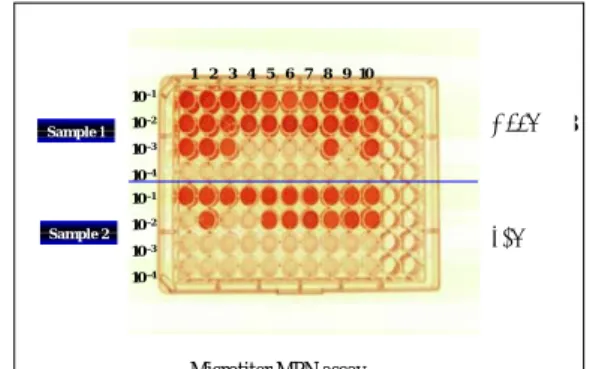
한편, Oh와 Kang 등(2005)은 분유 중에 존재하 는 E. sakazakii를 96 well microtiter plate를 이용 하여 빠르고 간편하게 detection 할 수 있는 miniaturized MPN 방법을 개발하였다. 이 방법은 differential and selective media로 보고된 OK medium(2004)의 특성을 이용한 것으로 α-glucosidase activity에 의한 형광발현을 endpoint determination 으로 활용하였으며 그 결과, 일반 고체배지를 사 용할 때 소요되는 시간(24시간 이상)에 비하여 10 시간 이내의 빠른 분석이 가능하였다고 하였다 (Fig. 4).

1 2 3 4 5 6 7 8 9 10 10 –1

10 –2 10 –3 10 –4 10 –1 10 –2 10 –3 10 –4 Sample 1

Sample 2

Microtiter MPN assay

1,678

408

⇒ 1,678

408

Fig. 4. Microtiter MPN assay. Two samples were enumeratied on 96-well microtiter plate. The number of fluorescent wells was counted under the long wave ultraviolet light(365 nm)

E. sakazakii를 typing하기 위한 방법으로는

PFGE, RFLP, multilocus enzyme electrophoresis

test와 ribotyping이 있으며 이외에도 antibiotic

resistance pattern(antibiogram), toxin assay,

(7)

hemagglutination, serotyping과 phage typing 등이 있다. Nazarowec-White 등(2003)과 Farber(2004)는 효율적인 역학조사 및 전염경로를 파악하기 위하여 실험실에서 분리된 모든 E. sakazakii 균의 molecular typing이 필요하다고 하였다. 한편, biotyping의 한 방법으로서 Williams 등(2004)은 protein biomarker 를 이용한 typing에 대하여 발표하였으며 biomarker 를 sequencing 하여 thermal tolerance를 가지고 있는 균주와의 상관관계를 조사하였다고 하였다.

3. Clinical etiology and pathogeni- city

Enterobacter species는 병원에서 전염될 수 있 는 infection의 절반 정도에 상당할 만큼 사회적으 로 전염성이 높은 미생물이라고 할 수 있다. 따라 서 특히 응급실 등 병원을 자주 왕래하는 사람이 Enterobacter species에 대한 infection 위험이 높 다고 할 수 있다(Al Ansari et al., 1994; Burchard et al., 1986; Flynn et al., 1987).

E. sakazakii infection은 주로 신생아와 영아를 대상으로 하며 sepsis, meningitis와 necrotizing enterocolitis를 유발시킨다(Adamson and Roger, 1981; Arseni et al., 1987; Biering et al., 1989;

Bar-Oz et al., 2001; Borderon et al., 1996;

Burdette and Santos, 2000; Clark et al., 1990;

Willis and Robinson, 1988; Weir, 2002; Van Nierop et al., 1998; Van Acker et al., 2001; Wolf and Young, 1993).

1958년 영국에서 E. sakazakii에 의한 최초의 infection 보고가 있었으며 이후 영아와 신생아를 대상으로 한 infection이 Canada, Belgium(Van Acker et al., 2001), Denmark(Joker et al., 1965), Iceland(Biering et al., 1989), Germany(Ries et al., 1994), Greece(Arseni et al., 1985), Israel(Bar-Oz et al., 2001; Block et al., 2002), Netherlands

(Muytjens et al., 1983), Spain(Reina et al., 1989) 과 USA(Burdette and Santos, 2000; Gallagher and Ball, 1991; Himelright et al., 2002; Kleiman et al., 1981; Lai, 2001; Monroe and Tift, 1979;

Noriega et al., 1990; Simmons et al., 1989; Weir, 2002; Willis and Robinson, 1988)에서 보고되었다.

미국의 경우 적어도 9개 주 이상에서 infection이 보고되고 있다. Iverson 과 Forsythe(2003)은 1958 년부터 2003년 까지 전세계적으로 E. sakazakii infection이 76건 이상 보고되었다고 하였다. 2002 년 International Commission for Microbiological Specifications for foods에서는 E. sakazakii는 영․

유아와 면역력이 저하된 사람에 대하여 치명적이 거나 심각한 장애를 유발할 수 있다고 경고하기도 하였다. Enterobacter specie중 meningitis, cloacae, aerogens, agglomerans, hormechie, gergovial과 sakazakii가 신생아 infection과 관련이 있다고 알 려져 있다(Nazarowec-White and Farber, 1997;

Weir, 2002; Willis and Robinson, 1988). 그렇지만 meningitis와 septicemia 발생 건수의 50-75%가 Streptococcus agalactiae와 E. coli에서 유래하며 (Muytjens et al. 1983), E. sakazakii는 opportunistic pathogen이기 때문에 건강한 신생아 보다는 조산 아, 저체중아, 면역력이 떨어져 있는 신생아를 주 로 infection 시킨다고 하였다(Naqvi et al., 1985;

Willis and Robinson, 1988). 또한 불행하게도, E.

sakazakii에 의해 유발되는 meningitis는 E. cloacae 에 의해 유발되는 것에 비하여 증상이 심하였다고 하였다(Willis and Robinson, 1988). Table 2는 관 련 논문 및 병원 기록을 요약한 내용이다.

신생아를 대상으로 meningitis를 유발하는 E.

sakazakii의 pathogenesis는 아직까지 확실하게 알

려지지는 않았다. 어떤 학자는 pathogenic secretary

factors(elastases, glycopeptides, endotoxins,

collagenase, protease)에 의해 blood-brain barrier

(8)

Table 2. Observations from case reports describing E. sakazakii infections

√ In the University of Massahusetts Medical Center, 3.6% of patients with septicemia (from 1994 to 1996) were positive for Enterobacter species, 0.4% of patients with septicemia were positive for E. sakazakii in 1996, and five cases were diagnosed with nosocomially acquird E. sakazakii infections in 1995-1996.

√ Thirty-one cases of infections in infants and children ranging form 3 days to 4 years linked to E. sakazakii were reported in the literature.

√ 50% of children infected with E. sakazakii was < 1 week old.

√ 73% of children infected with E. sakazakii was < 1 month old.

√ 43% of those cases with meningitis experienced seizures.

√ Case fatality rates of infants with non-meningital E. sakazakii infections were 33%, whereas meningitis patients had a higher fatality rate of 45%.

√ After 1985, patients were treated with the third-generation cephalosporins in addition to combinations of ampicillin, gentamicin and chloramphenicol, which reduced the case fatality rate in meningital E. sakazakii patient from 62% to 14%.

√ There were only four cases of E. sakazakii infections in adults reported in the literature and an additional four reported from the University of Massachusetts Medical Center.

√ All adult E. sakazakii cases were in-patients ≥ 56 year of age, except for one 39-year-old male.

√ Mean and median ages for the adult patients were 68 and 76 years, respectively.

√ Case mortality rate of adult patients was 50%, with the University of Massachusetts Medical Center experiencing a 75% mortality rate

√ Most of the adult cases involved underlying complicating medical factors including 50% with malignancies.

√ Sites of infection for the eight adult cases included bacteremia, osteomyelitis of the foot, pneumonia, and biliary sepsis.

의 permeability가 증가하게 되어 E. sakazakii가 영양성분이 풍부한 cerebral matter로 cellular invasion하게 되는 것으로 보고하기도 하며(Iversen and Forsythe, 2003) 또한 다른 학자는 E. sakazakii 와 C. diversus가 central nervous system에 invasion 및 infection하는 성향이 유사하다고도 하였다

(Willis and Robinson, 1988; Kline, 1988; Burdette and Santos, 2000).

E. cloacae 경우는 exotoxin, aerobactin, hemagluttin

의 pathogenicity와 production에 대해 보고되었지

만(Keller et al., 1998), E. sakazakii는 아직까지

specific virulence factor에 대해서는 잘 알려져 있

(9)

지 않다. Pagetto 등(2003)은 suckling mouse를 동 물 모델로 이용하여 최초로 minimum infectious dose, lethal dose 등을 측정하였다. E. sakazakii는 clinical isolate 9종과 식품에서 분리한 isolate 8종 을 사용하였다. 모든 strain이 경구 투여시 mouse 1 마디당 10

8

CFU 농도가 치사량이었으며, 1종의 clinical isolate와 1종의 food isolate는 정맥 투여 시 10

5

CFU 농도가 치사량인 것으로 나타났다.

저자는 sucking mouse model에서 얻어진 수치를 neonate로 추정변환 시켰을 때 이러한 미생물 농 도는 엄격한 온도 및 시간 관리에 부주의 하면 쉽 게 도달될 수 있다고 하였다. 한편, 최근 연구에 의하면 E. sakazakii가 생산하는 lipopolysaccharide 가 MTT test시 N2a cell에 toxic하다고 하였으며 (Iversen et al., 2004), protease, phosphatase, lipase activity가 host cell 괴사에 영향을 주었다는 보고 도 있다.

4. Food as a sources of E. sakazakii

Muytjens 등(1988)은 35개국에서 수집한 141가 지의 조제분유 중 52.5%에서 Enterobacteriaceae 가 검출되었으며 검출농도는 1 CFU/g 이하였다고 하였다. E. sakazakii는 35개국 시료 중 13개국 시 료에서 검출되었으며, 분유로는 141가지 분유 중 20가지(14.2%) 분유에서 검출되었다고 하였다. 또 한 Leuscher 등(2004)은 58가지 시료 중 8종의 시 료에서 E. sakazakii를 검출하여 검출빈도가 13.8%

에 달하였다고 하였다. Iversen 등(2004)은 82종의 조제분유와 404종의 기타 식품에 대하여 E. sakazakii, Salmonella와 기타 Enterobacteriaceae에 대한 검출 실험 결과, E. sakazakii는 조제분유 82가지 중 2 가지(2.4%) 시료에서 검출되었으며, 기타 식품에 서는 dried infant food은 49 시료 가운데 5개 (10.2%)에서, milk powder는 72시료에서 3개 (4.1%), cheese product와 dry food ingredient에서

는 62 시료 중 2개(3.2%)에서 검출되었으며 herbs 와 spices의 경우 122종 시료 중 40종(37.8%)에서 검출되었다고 하였다.

조제분유가 신생아를 infection 시키는 E. sakazakii 의 source라는 많은 보고가 있다(Biering et al., 1989; Block et al., 2002; Clark et al., 1990;

Himelright et al., 2002; Muytjens et al., 1983, 1988; Noriega et al., 1990; Simmons et al., 1989;

Smeets et al., 1998; Van Acker et al., 2001;

Weir, 2002). 또한, 조제분유 자체에서 뿐 아니라 분유를 물에 탈 때 사용하는 blender에서도 E.

sakazakii가 오염될 수 있다고 하였으며(Noriega et al., 1990), Muytjens 등(1983)은 neonatal meningitis outbreak중 5건이 stirring spoon, blush 등에서 유 래하였다고 하여, 조제분유를 물에 타는 환경조건 도 중요함을 알 수 있다.

E. sakazakii는 조제분유 이외에도 다양한 식품 및 환경조건에서 분리되고 있으며 면역력이 약해 진 어른도 감염 대상이 될 수 있으므로 주의해야 한다. E. sakazakii는 beer mugs(Schindler and Metz, 1990), sour tea(Tamura et al., 1995), cheese, minced beef, sausage, meat, vegetable (Leclercq et al., 2002)에서 분리되었으며 mung bean sprout(Robertson et al., 2002)와 alfalfa sprout(Cruz et al., 2004)에 서도 분리되었으며, rice starch, rice flour, egg에 서도 분리되었다.

5. Hazard analysis and risk management

조제분유는 상업적 살균제품이 아니기 때문에

E. sakazakii가 존재하여 biological hazard로 작용

할 수 있다. 영, 유아식품의 국제적인 code를 변경

하고자 하는 Food Hygiene 분과 Codex Committee

의 요청에 따라 FAO와 WHO는 2004년에 joint

workshop을 개최하였으며 그 결과 FAO, WHO,

(10)

√ In situation where infants are not breast-fed, caregivers, particularly of infants at high risk, should be regularly alerted that powdered infant formula is not a sterile product and can be contaminated with pathogens that can cause serious illness and provided with information that can reduce the risk.

√ In situations where infants are not breast-fed, caregivers of high-risk infants should be encouraged to use, whenever possible and feasible, commercially sterile liquid formula or formula which has undergone an effective point of use decontamination process(e.g., use of boiling water to reconstitute or by heating reconstituted formula).

√ Guideline should be developed for the preparations, use and handling of infant formula to minimized risk.

√ The infant food industry should be encouraged to reduce the concentration of prevalence of E.

sakazakii in both the manufacturing environment and powdered infant formula. To this end, the infant food industry should consider implementing an effective environmental monitoring program and the use of Enterobacteriaceae rather than coliform testing as an indicator of hygienic control in factory production lines.

√ In revising its Code of Practice, Codex should better address the microbiological risks of powdered infants formula and, if deemed necessary, include the establishment of appropriate microbiological specifications for E. sakazakii in powdered infant formula.

√ FAO/WHO should address the particular needs of some developing countries in establishing effective measures to minimize risk in situations where breast-milk substrates may be used in exceptionally difficult circumstance, e.g., feeding infants of HIV-positive mothers or low-birth-weight infants.

√ The use of internationally validated detected and molecular typing methods for E. sakazakii and other relevant microorganism should be promoted.

√ Investigation and reporting of sources and vehicles, including powdered infant milk formulae, of infection by E. sakazakii and other Enterobacteriaceae should be encouraged. This should include the establishment of a laboratory-based network.

√ Research should be promoted to gain a better understanding of the ecology, taxonomy, virulence and other characteristics of E. sakazakii and on ways to reduce its levels in reconstituted powdered infant formula.

Table 3. Joint FAO/WHO recommendations to the powdered infant formula industry and infant caregivers concerning processing, preparing and handling powdered and reconstituted products

Codex, 회원국 및 Non-Governmental Organization 에 대하여 권고안을 제시하였다(Table 3). E.

sakazakii의 위험을 가장 효율적으로 최소화 할 수 있는 실제적인 방법은 온도관리라고 할 수 있 다(Edelson-Mammel and Buchanan, 2004; Jaspar et al., 1990; Kindle et al., 1996; Muytjens and Kollee, 1990; Nazarowec-White et al., 2003).

Simmons 등(1989)은 E. sakazakii의 번식을 억제

하기 위하여 물에 타 논 분유는 냉장온도에서 관

리하라고 권고하였으며 Jaspar 등(1990)은 분유를

물에 타는 과정에 사용되는 스푼, 병, 젖꼭지에 대

한 철저한 소독이 중요하며 또한 끓인 물을 사용

할 것을 권고하였다.

(11)

Ⅲ. 맺는말

최근, 조제분유에 존재할 수 있어 치명적인 뇌 수막염을 유발한다고 알려져 있는 E. sakazakii에 대한 사회적 관심이 높아져 가고 있다. 소비자시 민모임은 국내에서 판매되고 있는 조제분유 제품 이 E. sakazakii로부터 안전한지 점검하기 위하여 2004년 5월과 6월 시중에서 판매되는 국내산 및 수입산 분유제품 11개를 대상으로 샘플테스트를 실시하였으며, 그 결과 모든 제품에서 E. sakazakii 를 검출할 수 없었다고 하였다. 무척이나 다행스 런 결과라고 아니할 수 없다. 그러나 현재, 조제분 유에서 E. sakazakii를 검출할 수 있는 다양한 선 발배지 및 검출방법이 개발되고 있어 검출한계가 향상되고 있다고 할 수 있다. 따라서 향후 국내산 조제분유에서 E. sakazakii가 검출될 가능성도 상 대적으로 높아질 수 있다고 할 수 있다.

잘 알려져 있는 바와 같이 미생물이 성장하기 위해서 중요한 것은 영양분, 성장 온도, 배양시간 이라고 할 수 있다. 조제분유는 E. sakazakii가 성 장하기에 좋은 영양분이 될 수 있기 때문에 성장 온도와 배양시간이 중요한 변수로 작용한다. 따라 서 효율적인 온도 조절 및 방치(배양) 시간 최소 화가 E. sakazakii를 제어할 수 있는 가장 좋은 방법이라고 할 수 있다. 식품의약품안전청에서 발 간된 핸드북인 영․유아식품 선택 가이드에서도 먹다 남은 분유는 버리는 것이 좋다고 권고하고 있는 이유도 바로 이 때문이라고 할 수 있다.

E. sakazakii에 의한 감염을 예방하기 위해서는 소비자와 생산자 모두 노력하여야 한다. 소비자는 깨끗한 용기를 이용하여 필요한 분량의 조제분유 를 제조하여 수유하고 나머지를 바로 버리거나 냉 장고에서 잠시 보관한다면 E. sakazakii 균이 성 장할 시간과 조건이 맞지 않으므로 감염위험이 거 의 없다고 할 수 있다. 생산자인 분유제조 공장에 서는 원재료에 대한 철저한 미생물 모니터링, 제

조 환경관리와 post-contamination이 발생하는 제 품포장 시 위생관리에 철저를 기하여야 한다. 또 한 각 생산단계에서의 주기적인 E. sakazakii 모 니터링, 미생물관리 기준 설정 및 유효성 평가를 통하여 위생관리 시스템을 검증해야 해야 하며 또 한 소비자에 대한 정확한 정보 전달(제품 라벨링, 소비자교육)에 노력해야 할 것이다.

Ⅳ. 참고문헌

1. Adamson, D.H., Roger, J.R., Enterobacter sakazakii meningitis with sepsis. Clin.

Microbial. Newsl. 3: 19-20. 1981

2. Al Ansary, N., McNamar, E.B., Cunney, R.J., Flynn, M.A., Smyth, E.G., Experience with Enterobacter bacteremia in a Dublin teaching hospital. J. Hosp. Infect. 27: 69-72. 1994 3. Arbeit, R.D., Laboratory procedures for the

epidemiologic analysis of microorganisms. In:

Murray, P.R., Baron, E.J., Pfaller, M.A., Tenover, R.C., Yolken, R.D. (Eds.), Manual of Clinical Microbiology, 6th ed. American Society for Microbilogy, Washington, DC, pp.

190-208. 1995

4. Arseni, A., Malamou-Ladas, E., Koutsia, C., Xanthou, M., Trikka, E., Outbreak of colonization of neonates with Enterobacter sakazakii. J. Hosp. Infect. 9: 143-150. 1987 5. Bar-Oz, B., Preminger, A., Peleg, O., Block,

C., Arad, I., Enterobacter sakazakii infection in the newborn. Acta Paediatr. 90: 356-358.

2001

6. Biering, G., Karlsson, S., Clark, N.V.C.,

Jonsdottir, K.E., Ludvigsson, P., Steingrimsson,

O., Thress cases of neonatal meningitis

caused by Enterobacter sakazakii in powdered

(12)

milk. J. Clin, Microbiol. 27: 2054-2056. 1989 7. Block, C., Peleg, O., Minster, N., Bar-Oz, B.,

Simhon, A., Arad, I., Shapiro, M., Cluster of neonatal infections in Jerusalem due to unusual biochemical variant of Enterobacter sakazakii. Eur. J. Clin. Microbiol. Infect. Dis.

21: 613-616. 2002

8. Borderon, J.C., Lionnet, C., Rondeau, C., Suc, A.L., Laugier, J., Gold, F., Current aspects of the fecal flora of the newborn without antibiotherapy during the first 7 days of life:

enterobacteriaceae enterococci, staphylococci. Pathol.

Biol. 44: 416-422. 1996

9. Brenner, D.J., Farmer III, J.J., Hickman, F.W., Asbury, M.A., Steigerwalt, A.G., Taxonomic and Nomenclature changes in Enterobacteriaceae.

Centers for Disease Control and Prevention, Atlanta, GA. 1977

10. Burchard, K.W., Barrall, D.T., Reed, M., Slothman, G.J., Enerobacter bacteremia in surgical patients. Surgery 100: 857-861. 1986 11. Burdette, J.H., Santos, C., Enterobacter

sakazakii brain abscess in the neonate: the importance of neuroradiologic imaging.

Pediatr. Radiol. 30: 33-34. 2000

12. Clark, N.C., Hill, B.C., O'Hara, C.M., Steingrimsson, O., Cooksey, R.C., Epidemiologic typing of Enterobacter sakazakii in two neonatal nosocomial outbreaks. Diagn.

Microbiol. Infect. Dis. 13: 467-472. 1990 13. Cottyn, B., Regalado, E., Lanoot, B., De

Cleene, M., Mew, T.W., Swings, J., Bacterial populations associated with rice and seed in the tropical environment. Phytopathology 91:

282-292. 2001

14. Cruz, A.C., Fernandez, E., Salinas, E., Ramirez, P., Montiel, C., Eslava, C.A., Characterization of Enterobacter sakazakii isolated from different sources. Abstract Q-051, 104th Gen. Mtg., Am., Soc.

Microbiol., 23-27 May, New Orleans, LA, USA. 2004

15. Dennison, S.K., Morris, J., Multiresistant Enterobacter sakazakii wound infection in an adult. Infect. Med. 19: 533-535. 2002

16. Edelson-Mammel, S.G., Buchanan, R.L., Thermal inactivation of Enterobacter sakazakii in rehydrated infant formula. J.

Food Prot. 67: 60-63. 2004

17. Einstein, B.L., New molecular techniques for microbial epidemiology and the diagnosis of infectious diseases. J. Infect. Dis. 161:

595-602. 1990

18. Emery, C.L., Weymouth, L.A., Detection and clinical significance of extended-spectrum beta-lactamases in a tertiary-care medical center. J. Clin. Microbiol. 35: 2061-2067. 1997 19. Farber, J.M., An introduction to the hows an whys of molecular typing. J. Food Prot. 59:

1091-1101. 1996

20. Farber, J.M., Enerobacter sakazakii-new foods from thought? Lancet 363:, 5-6. 2004 21. Farmer III, J.J., Hickman, W., Brenner, D.J.,

Abstr. Annu. Mtg. Am Soc. Microbiol. C 154: 61. 1977

22. Farmer, J.J., Asbury, M.A., Hickman, F.W.,

Brenner, D.J., the Enterobacteriaceae Study

Group, Enterobacteria sakazakii, new species

of Enterobacteriaceae isolated from clinical

specimens. Int. J. Syst. Bacteriol, 30:

(13)

569-584. 1980

23. Flynn, D.M., Weinstein, R.A., Nathan, C., Gaston, M.A., Kabins, S.A., Patients' endogenous flora as the source of "nosocomial"

Enterobacter in cardiac surgery. J. Infect.

Dis. 156: 363-368. 1987

24. Gallagher, P.G., Ball, W.S., Cerebral infarctions due to CNS infection with Enterobacter sakazakii. Pediatr. Radiol. 21:

135-136. 1991

25. Gassem, M.A.A., Study of the micro- organism associated with fermented bread(khamir) produced from sorghum in Gizan region, Saudi Arabia. J. Appl.

Microbiol 86: 221-225. 1999

26. Gaston, M.A., Enterobacter, an emering nosocomial pathogen. J. Hosp. Infect. 11:

197-208. 1988

27. Grant, K.A., Kroll, R.G., Molecular biology techniques for the rapid detection and characterization of foodborne bacteria. Food Sci. Technol. Today 7: 80-88. 1993

28. Grattard, F., Pozzetto, B., Berthelot, P., Rayet, I., Ros, A., Lauras, B., Gaudin, O.G., Arbitrarily primed PCR, ribotyping, and plasmid pattern analysis applied to investigation of a nosocomial outbreak due to Enterobactr cloacae in a neonatal intensive care unit. J. Clin. Microbiol. 32:

596-602. 1994

29. Hawkins, R.E., Lissner, C.R., Sanford, J.P., Enterobacter sakazakii bacteremia in an adult. South. Med. J. 84: 793-795. 1991 30. Heuvelink, A.E., Kodde, F.D., Zwartkruis-Nahuis,

J.T.M., De Boer, E., Enterobacter sakazakii

in melkpoeder. Keuringsdienst van Waren Oost. Project number OT 0110. 2001

31. Himelright, I., Harris, E., Lorch, V., Anderson, M., 2002. Enterobacter sakazakii infections associated with the use of powdered infant formula-Tennessee, 2001. J.

Am. Med. Assoc. 287: 2204-2205

32. Iverson, C., Forsythe, S., Risk profile of Enterobacter sakazakii, an emerging pathogen associated with infant milk formula. Trends Food Sci. Technol. 14: 443-454. 2003

33. Iverson, C., Caubilla-Baron, J., Forsythe, S., Isolation of Enterobacter sakazakii, Enterobacteriaceae, and other microbial contaminants from powdered infant formula milk and related products. Abstract P-004, 104th Gen. Mtg., Am. Soc. Microbiol., 23-27 May, New Orleans, LA. USA. 2004

34. Iverson, C., Dale, H., Druggan, P., Waddington, M., Crawford, J., Forsythe, S.J., The identification of Enterobacter sakazakii using partial 16S sequencing and biochemical techniques. Abstract 037, 104th Gen. Mtg., Am. Soc. Microbiol., 23-27 May, New Orleans, LA. USA. 2004

35. Iverson, C., Druggan, P., Forsythe, S.J., A selective differential medium for Enterobacter sakazakii, a preliminary study. Int. J. Food Microbiol. 96: 133-139. 2004

36. Iverson, C., Lazar Adler, N., Forsythe, S.J., Virulence factors of Enterobacter sakazakii.

Abstract 108, 104th Gen. Mtg., Am. Soc.

Microbiol., 23-27 May, New Orleans, LA.

USA. 2004

37. Izard, D., Richard, C., Leclerc, H., DNA

(14)

retardness between Enterobacter sakazakii and other members of the genus Enterobacter.

Ann. Microbiol., 134: 242-245. 1983

38. Jaspar, A.H.J., Mutyjens, H.L., Kolee, L.A.A., Neonatale meningitis door Enterobacter sakazakii: melkpoeder is niet sterile in bacterien lusten ook melk. (Neonatal meningitis caused by E. sakazakii: Milk powder is not sterile and bacteria like milk too). Tijdschr. Kindergenee Skd. 58: 151-155.

1990

39. Jimenez. E.B., Gimenez, C., Septic shock due to Enterobacter sakazakii. Clin. Microbiol.

Newslett. 4: 30. 1982

40. Joker, R.N., Norholm, T., Siboni, K.E., A case of neonatal meningitis caused by a yellow Enterobacter. Danish Med. Bull. 12:

128-130. 1965

41. Kandhai, M.C., Reji, M.W., Gorris, L.G.M., Guillaume-Gentil, O., van Schothorst, M., Occurance of Enterobacter sakazakii in food production environments and households.

Lancet 363: 39-40. 2004

42. Keller, R., Pedroso, M.A., Ritchman, R., Silva, R.M., Occurance of virulence associated properties in Enterobacter cloacae, Infect.

Immun. 66: 645-649. 1998

43. Kindle, G., Busse, A., Kampa, D., Meyer-Koenig, U., Daschner, F.D., Killing activity of microwaves in milk. J. Hosp.

Infect. 33: 273-278. 1996

44. Kleiman, M.B., Allen, S.D., Neal, P., Reynolds, J., Meningoencephalitis and compartmentalization of the cerebral ventricles caused by Enterobacter sakazakii. J. Clin.

Microbiol. 14: 352-354. 1981

45. Kline, M.W. Pathogenesis of brain abscess caused by Citrobacter divs. or Enterobacter sakazakii. Pediatr. Infect. Dis. J. 7: 891-892.

1988

46. Lai, K.K., Enterobacter sakazakii infections among neonates, infants, children, and adults;

case reports and a review of the literature.

Med. Baltimore 80: 113-122. 2001

47. Leelercq, A., Wanegue, C., Baylac, P., Comparison of fecal coliform agar and violet red bile lactose agar for fecal coliform enumeration in foods. Appl. Environ.

Microbiol. 68: 1631-1638. 2002

48. Leuscher, R.G.K., Baird, F., Donald, D., Cox, L.J., A medium for the presumptive detection of Enterobacter sakazakii infant formula:

interlaboratory study. J. AOAC Int. 87:

604-613. 2004

49. Monroe, P.W., Tift, W.L., Bacteremia associated with Enterobacter sakazakii(yellow, pigmented Enterobacter cloacae). J. Clin.

Microbiol. 10: 850-851. 1979

50. Mosso, M.D.L.A., de la Rosa, M.D.C., Vivar, C., Medina, M.D.R., Heterotrophic bacterial populations in the mineral waters of thermal springs in Spain. J. Appl. Bacteriol. 77:

370-381. 1994

51. Muytjens, H.L., Kollee, L.A.A., Enterobacter sakazakii meningitis in neonates: causative role of formula. Pediatr. Infect. Dis. J. 9:

372-373. 1990

52. Muytjens, H.L., Zanen, H.C., Sonderkamp,

H.J., Kollee, L.A.A., Wachsmuth, I.K.,

Farmer, J.J., Analysis of eight cases of

(15)

neonatal meningitis and sepsis due to Enterobacter sakazakii. J. Clin. Microbiol. 18:

115-120. 1983

53. Muytjens, H.L., ZRoelofs, W.H., Jaspar, G.H.J. Quality of powdered substitutes for breast milk with regard to members of the family Enterobacteriaceae. J. Clin. Microbiol.

26: 743-746. 1988

54. Naqvi, S.H., Maxwell, M.A., Dunkle, L.M., Cefotaxime therapy of neonatal Gram-negative bacillary meningitis. Pediatr. Infect. Dis. 4:

499-502. 1985

55. Nazarowec-White, M., Farber, J.M., Incidence, survival, and growth of Enterobacter sakazakii in infant formula. J. Food Prot. 60: 226-230.

1997

56. Nazarowec-White, M., Farber, J.M., Phenotypic and genotypic typing of food and clinical isolates of Enterobacter sakazakii. J. Med.

Microbiol. 48: 559-567. 1999

57. Nazarowec-White, M., Farber, J.M., Cordier, J.L., van Schothorst, M., Enterobacter sakazakii. In: Miliotis, M.D., Bier, J.W.(Eds.).

International Handbook of Foodborne Pathogens. Marcel Dekker, New York, pp.

408-413. 2003

58. No, H.K., Park, N.Y., Lee, S.H., Hwang, H.J.

Meyers, S.P., Antibacterial activities of chitosans and chitosan oligomers with different molecular weights on spoilage bacteria isolated from tofu. J. Food Sci. 67:

1511-1514. 2002

59. Noriega, F.R., Kotloff, K.L., Martin, M.A., Schwalbe, R.S., Nosocomial bacteremia caused by Enterobacter sakazakii and

Leuconostoc mesentroides resulting from extrinsic contamination of infant formula.

Pediatr. Infect. Dis. 9: 447-449. 1990

60. Oh, S.W., Kang, D.H., Fluorogenic selective and differential medium for isolation of Enterobacter sakazakii. Appl. Environ.

Microbiol. 70: 5692-5694. 2004

61. Oh, S.W., Lee, S.Y., Kang, D.H., Novel selective medium for isolation of Enterobacter sakazakii. Abstract-117. Program and Abstract Books, 91 st Annu. Mtg., Int. Assn.

Food Prot., 8-11 August, Phoenix, AZ, p.

107. 2004

62. Oh, S.W., Kang, D.H., Rapid enumeration of Enterobacter sakazakii in reconstituted milk formula by fluorogenic most-probable- number assay using 96-well microtiter plate.

J. Rapid Method Aut. Microbiol. (in press) 2005

63. Pagotto, F.J., Nazarowec-White, M., Bidawid, S., Farber, J.M., Enterobacter sakazakii:

infectivity and enterotoxin production in vitro and in vivo. J. Food Prot. 66: 370-377. 2003 64. Poilance, I., Cruaud, P., Lachissinne, E.,

Crimont, F., Grimont, P., Collin, M., Gaudelus, J., Torlotin, J.C., Collignon, A., Enterobacter cloacae cross-colonization in neonates demonstrated by ribotyping. Eur. J.

Clin. Microbiol. Infect. Dis. 12: 820-826. 1993 65. Pribyl, C., Salzer, R., Beskin, J., Haddad,

R.J., Pollock, B., Beville, R., Holmes, B., Mogabgab, W.J., Azteonam in the treatment of serious otrhopaedic infections. Am. J.

Med. 78: 51-56. 1985

66. Reina, J., Parras, F., Gil, J., Salva, F.,

(16)

Alomar, P., Human infections caused by Enterobacter sakazakii. Microbiologic considerations.

Enferm. Enecc. Micro. Clin. 7: 147-150. 1989 67. Ries, M., Harms, D., Scharf. J., Multiple

cerebral infarcts with resulting multicystic encephalomalacia in a premature infarct with Enterobacter sakazakii meningitis. Clin.

Padiatr. 206: 184-186. 1994

68. Robertson, L.F., Johannessen, G.S., Gjerde, B.K., Loncarevic, S., Mirobiological analysis of seed sprouts in Norway. Int. J. Food Microbiol. 75: 119-126. 2002

69. Schindler, P.R., Metz, H., Coliform bacteria in rinsed beer mugs-identification with the API 20E system and resistance behavior.

Offentliche Gesundheitswesen 52: 592-700.

1990

70. Seo, K.H., Thammasuvimol, G., Brackett, R.E., Edelson-Mammel, S.G., 2003. CFSAN, FDA, College Park, MD. 2003 FDA Science Forum Poster Abstract: 190 April 24-25.

2003

71. Simmons, B.P., Gelfand, M.S., Haas, M., Metts, L., Ferguson, J., Enterobacter sakazakii infections in neonates associated with intrinsic contamination of a powdered infant formula. Infect. Control Hosp. Epidemiol. 10:

398-401. 1989

72. Smeets, L.C., Voss, A., Muytjens, H.L., Meis, J.F.G.M., Melchers, W.J.G., Genetische karakterisatie van Enterobacter sakazakii- isolaten van Nederlandse patienten met neonatale meningitis. Ned. Tijdschr. Med.

Microbiol. 6: 113-115. 1998

73. Tamura, A., Kato, M., Omori, M., Nanba, A.,

Miyagawa, K., Wang, C.R., Zhou, W.H., Flavor components and microorganisms isolated from Suancha. Nippon Kasei Gakkaishi 46: 759-764. 1995

74. Urmenyi, A.M.C., Frankllin, A.W., Neonatal death from pigmented coliform infection.

Lancet 1, 313-315. 1961

75. U.S. Food and Drug Administration, 2002.

Isolation and enumeration of Enterobacter sakazakii from dehydrated powdered infant formula. Accessed on September 19, 2003 at:

http://www.cfsan.fda.gov/~comm/mmesakaz.ht ml

76. Van Acker, J., De Smet, F., Muyldermans, G., Bougatef, A., Naessens, A., Lauwers, S., Outbreak of neocrotizing enterocolitis associated with Enterobacter sakazakii in powdered milk formula. J. Clin. Microbiol.

39: 293-297. 2001

77. Van Nierop, W.M., Duse, A.G., Stewart, R.G., Bilgeri, Y.R., Koornhof, H.J., Molecular epidemiology of an outbreak of Enterobacter cloacae in the noenatal intensive care unit of a provicial hospital in Gauteng, South Africa.

J. Clin. Microbiol. 39: 3085-3087. 1998 78. Van Os, M., Van Wikeselaar, P.G., Spoelstra,

S.F., Formation of biogenic amines in well fermented grass siliage. J. Agric. Sci.

Cambridge 127: 97-107. 1996

79. Weir, E., Powdered infant formula and fatal infection with Enterobacter sakazakii. Can.

Med. Assoc. J. 166: 1570. 2002

80. Williams, T.L., Edelson-Mammel, S., Buchanan,

R., Musser, S.M., Differentiation of Enterobacter

sakazakii strains using protein expression

(17)

profiles generated by LC/MS. Abstract Q-098, 104th Gen. Mtg., Am. Soc. Microbiol.

23-27 May, New Orleans, LA, USA. 2004 81. Willis, J., Robinson, J.E., Enterobacter

sakazakii meningitis in neonates. Pediatr.

Infect. Dis. J. 7: 196-199. 1988

82. Wolf, M.A., Young, C.L., Antibiotic therapy

for Enterobacter meningitis: a retrospective review of 13 episodes and review of the literature. Clin. Infect. Dis. 16: 772-777. 1993 83. Zink, D., FDA Field Survey of Powdered

Formula Manufacturing U.S. Food and Drug

Adminstration. Food Advisory Committee

Mtg., March 18-19, Washington, DC. 2003

수치

Fig.  1.  Biochemical  differentiation  of  Entero-  bacteriaceae  family
Fig.  2.  Enterobacter  sakazakii  as  an  opportunistic  pathogens
Fig.  3.  OK  medium  developed  for  E.  sakazakii  isolation  and  differentiation.  E
Fig.  4.  Microtiter  MPN  assay.  Two  samples  were  enumeratied  on  96-well  microtiter  plate

참조

관련 문서