J. Korean Soc. of Marime Engineering (JKOSME) ISSN 2234-8352 (Online)
http://dx.doi.org/10.5916/jkosme.2015.39.8.807 Original Paper
This is an Open Access article distributed under the terms of the Creative Commons Attribution Non-Commercial License (http://creativecommons.org/licenses/by-nc/3.0), which permits
†Corresponding Author (ORCID: http://orcid.org/0000-0003-4519-7305): Training ship of Kunsan National University, 588 Daehak-ro, Gunsan, Jeonbuk 573-701, Korea, E-mail: [email protected], Tel: 063-469-1727
Thermal properties of latent heat storage microcapsule-water slurry
Soo-Beom Mun†
(Received October 12, 2015; Revised October 21, 2015;Accepted October 21, 2015)
Abstract: A microcapsule water slurry is a latent heat-storage material having a low melting point. In this study, the thermal properties of a microcapsule water slurry are measured. The physical properties of the test microcapsule water slurry, i.e., ther- mal conductivity, specific heat, latent heat, and density, are measured, and the results are discussed for the temperature region of solid and liquid phases of the dispersion material (paraffin). It is clarified that Eucken’s equation can be applied to the esti- mation of the thermal conductivity of the microcapsule water slurry. Useful correlation equations of the thermal properties of the microcapsule water slurry are proposed in terms of the temperature and concentration ratio of the microcapsule water slurry constituents.
Keywords: Thermophysical property, Cold heat storage, Latent heat, Microcapsule slurry, Paraffin
1. Introduction
Recently, much attention has been paid to the investigation of the usage of slurry-type latent heat-storage (phase-change material) systems [1]. This type of latent heat-storage system can substitute a traditional sensible (water) heat-storage system. The benefit of a low-temperature phase-change materi- al (solid-liquid phase) in water is that it increases the amount of heat transmitted and heat-transfer coefficient by the churn- ing effect [2]. The latent heat-storage material and water can be mixed by dispersion-mixing methods such as micro- encapsulation [3]. As phase-change microcapsules have a com- plex construction, only a few studies on the thermal properties of phase-change microcapsules have been conducted. The pres- ent study considers a microcapsule (paraffin, freezing point
= 278.9K, latent heat = 164 kJ/kg, as the phase-change material) water (continuous phase) slurry as the experimental latent heat-storage material.
The Density, specific heat, latent heat, and thermal con- ductivity of the microcapsule water slurry were measured using a specific-gravity meter, a water calorimeter, a differential scanning calorimeter (DSC), and a transient hot-wire method [4][5], respectively, in the temperature range over the sol- id-liquid phase change. Eucken’s model was applied to estimate the thermal conductivity of the microcapsule water slurry.
2. Feature of Test Microcapsule Water Slurry
Paraffin, which is a cold latent heat-storage material, is an insoluble oil [6]. This type of insoluble oil is dispersed in wa- ter by using capsulation, i.e., microencapsulation is used to ob- tain a homogeneous microcapsule water slurry [8].
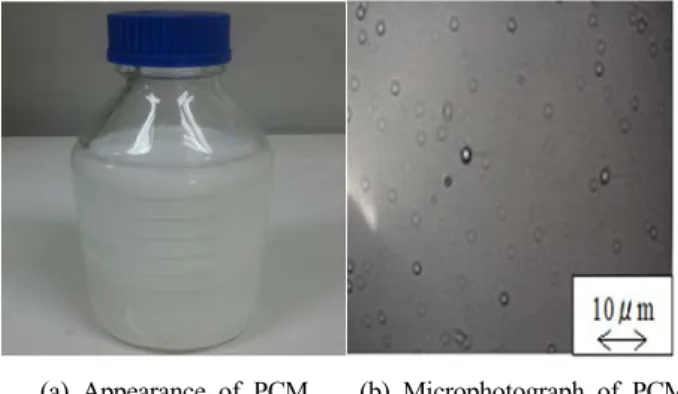
Figure 1 (a) shows the external appearance of the test mi- crocapsule water slurry ( = 40.8wt%). The microcapsule water slurry has a white color and good fluidity. A micro- photograph (2000 magnification of microcapsule water slurry) is shown in Figure 1 (b). Figure 1 (b) illustrates the homoge- neous dispersion of spherical microcapsules in water.
(a) Appearance of PCM (b) Microphotograph of PCM Figure 1: Microcapsule water slurry
3. Estimation of Specific Heat and Latent Heat
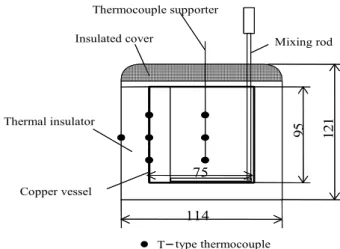
Figure 2 indicates the water calorimeter used for the meas-
urement of specific heat. A water calorimeter was used be- cause paraffin gets supercooled easily. The latent heat of the microcapsule water slurry was measured by a DSC, which can also simultaneously measure the melting point of the micro- capsule water slurry.
114
95 121
75
Mixing rod Thermocouple supporter
Insulated cover
Thermal insulator
Copper vessel
T--type thermocouple Figure 2: Cut view of water calorimeter
3.1 Measuring Device and Procedures for Specific Heat and Latent Heat Measurement
The specific heat of the microcapsule water slurry
was measured using the water calorimeter as mentioned above.
The measuring process was as follows. The temperature of the water ( = 80 g) in the calorimeter (copper vessel = 80.96 g, mixing rod = 12.53 g) was controlled by a tem- perature control bath. Subsequently, the test microcapsule wa- ter slurry, whose temperature is 5.0–6.0K higher than the ini- tial water temperature in the calorimeter, was placed inside the water calorimeter. The specific heat of the microcapsule water slurry was calculated from equation (1), which is derived from the heat capacities of water ( ), copper vessel , and mixing rod , and the heat loss resulting from the temperature difference between the test sample and the envi- ronment temperature.
×
× × (1)
where is the equilibrium temperature of the microcapsule water slurry and the water mixture, is the initial temper- ature of the water in the calorimeter, and is the heat loss from the water calorimeter. The heat loss from the water calo- rimeter was estimated from the temperature variation of the cold water in the water calorimeter [5]. The accuracy of the
mass weight and temperature measurements were within 土 0.1% and ±0.4%, respectively. The ratio of the heat loss to the total heat transfer in the calorimeter was less than 4.0%;
thus, the total accuracy of the water calorimeter is estimated to be within ±5.0%. The specific heat of water measured by the present water calorimeter shows good agreement with the ref- erence value [7] with an accuracy within 土5.0%.
A DSC was used for measuring the latent heat and melting point of paraffin (dispersed phase-change material). The test section of the DSC was mounted into the temperature control bath (capacity 50 × 50 × 50 cm, temperature range = 253–
298 K, temperature control accuracy ±0.1 K). In order to com- pletely freeze the paraffin, the temperature of the test micro- capsule water slurry was decreased to 263 K by the temper- ature control bath. Then, DSC measurements were taken when the microcapsule water slurry temperature reached 274K in or- der to melt the water as a continuous phase.
The latent heat of the microcapsule water slurry was meas- ured under a heating rate of 5.0 K/min, and the mass of the sample was 5.0–6.0 mg. The total accuracy of the measurement was estimated to be within ±2.0% in consid- eration of the heat supply of the electric heater. The temper- ature measurement accuracy was ±0.1% and the measurement accuracy of the mass weight of the sample was ±0.5%. The latent heat of water and indium (purity 99.99%) were meas- ured by the present DSC, and the measured values coincide with the reference values [9] with an accuracy within ±2.0%.
3.2 Measuring Results and Discussion of Specific Heat and Latent Heat
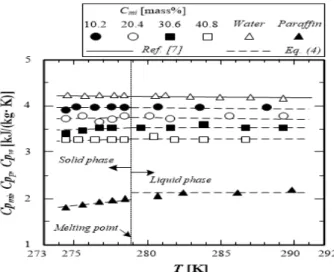
Figure 3 shows the relationship between the specific heat of the microcapsule water slurry , water , and paraffin
, and temperature . The specific heat of paraffin is al- most constant = 1.8 [kJ/(kg·K)] in the temperature region of the solid phase (T < 278.9 K). In contrast, the specific heat of paraffin in the liquid phase (T > 278 K) increases with temperature T, and its value is greater than that in the solid phase (T < 278.9 K). The specific heat of the microcapsule water slurry
shows variation between the solid and liq- uid phases (melting point
= 278.9K). The specific heat of the microcapsule water slurry in the liquid phase is greater than that in the solid phase. The specific heat of the micro- capsule water slurry decreases with an increase in paraf- fin concentration . This tendency of the specific heat of the microcapsule water slurry could be caused by the fact that the specific heat of paraffin has a smaller value than that ofwater . The specific heat of the wall material is constant
=1.67 [kJ/(kg·K)]) in the temperature range of = 273 –293 K[9]. An additional properties equation can be applied to the calculation of the specific heat of the microcapsule water slurry, as shown in equation (4), by using the reference values of the specific heat of water [8], the specific heat of par- affin in the solid phase = 1.8 [kJ/(kg·K)], and the specif- ic heat of paraffin in the liquid phase, which can be calculated from equation (2).
Figure 3: Relationship between specific heat and temperature
× ≺≺ (2)
(3)
The values calculated by equation (3) are shown in Figure 3 as dashed lines. These calculated values agree with the meas- ured values with an accuracy within ±4.0%; thus, the additive property law is applicable to the estimation of the specific heat of the microcapsule water slurry. Figure 4 shows the measured values of the latent heat of the microcapsule water slurry and the calculated values from equation (4), which are expressed by the mass weight ratio of paraffin to the micro- capsule water slurry and the latent heat of paraffin. The meas- ured latent heat of the microcapsule water slurry is consistent with the calculated value from equation (4) with an accu- racy within ±3%. It is clarified that the latent heat of the mi- crocapsule water slurry is proportional to the mass weight ra- tio of paraffin to the microcapsule water slurry. The measured melting point of paraffin, which is the dispersion material, coincides with the proposed value [9] with an accuracy within 土2% considering the standard deviation.
Figure 4: Relationship between latent heat and concentration of paraffin
× (4)
4. Estimation of Density
A specific-gravity meter method was used for measuring the density of the microcapsule water slurry. The specific-gravity meter was mounted in a cylinder, which is filled with the mi- crocapsule water slurry. Supercooling of paraffin, which is the dispersed phase material, is prevented by stirring. The data be- low the freezing point of paraffin were obtained after stirring the microcapsule water slurry in order to prevent the super- cooling of paraffin.
4.1 Measuring Device and Procedures For Density Measurement
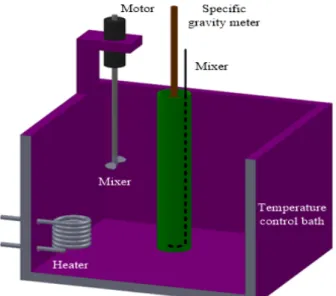
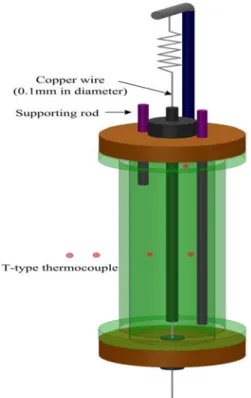
Figure 5 shows the experimental apparatus for the micro- capsule water slurry measurements. The temperature of the mi- crocapsule water slurry was controlled by the temperature con- trol bath (temperature range of = 253–373K, temperature control accuracy ±0.1K). The test microcapsule water slurry (170) was filled into an acrylic cylinder (inner diameter
= 30 mm, height = 300 mm), which was mounted in the temperature control bath. The temperature of the micro- capsule water slurry was measured by T-type thermocouples (0.1 mm in diameter), which were located in the acrylic cylinder. The density of the microcapsule water slurry was measured at a constant temperature. The test microcapsule wa- ter slurry was mixed with the stirrer at a temperature range below the freezing point ( = 278.9K) in order to solidify the dispersed paraffin, which is the phase-change material, without supercooling. The measurement range of the specif-
ic-gravity meter was = 700–1000 [kg/], and the division of its scale was l [kg/m3]. The accuracy of the specific-gravity meter is within ±0.5%.
Figure 5: Schematic diagram for the density measurement by Specific-gravity meter
4.2 Measuring Results and Discussion of Density
The variations of the densities of the microcapsule water slurry , paraffin and water with temperature are shown in Figure 3. The density of paraffin (purity 99.99%) is almost constant (=770kg/m3) in the liquid phase. The den- sity of paraffin in the solid phase is greater (=810kg/m3) than that in the liquid phase.The dashed line shown in Figure 3 indicates the calculated values of the microcapsule water slurry density by the addi- tional properties law, which is defined by the density and con- stituent of the wall material, water, and paraffin as follows:
The water density (from the published water-steam table) [7] and paraffin density (measured in the present study) are used for equation (5). The density of the wall material is con- stant = 1490 kg//m3 from the reference[9]. The calculated values of the microcapsule water slurry density from equation (5) are almost equal to the measured values with an accuracy within ±1.0% (application temperature range is = 273.0–
293.0K). It is understood that the additional properties law equation can be applied to the estimation of the microcapsule water slurry density in both the liquid and solid phases of par- affin as the dispersed phase-change material.
× × ×
(5)
Figure 6: Relationship between density and temperature
5. Estimation of Thermal Conductivity
A transient hot-wire method, using an electrically insulated platinum wire [5][6] was used for measuring the thermal con- ductivity of the microcapsule water slurry. The transient hot-wire method was used because of the following reasons:
(1) the test emulsion is an electrolyte, (2) the transient hot-wire method enables us to measure the thermal con- ductivity of the microcapsule water slurry even if the paraffin changes phase (solid and liquid phase), and (3) the transient method can be used to measure the thermal conductivity in the required temperature range without natural convection induced from the temperature increase of the hot wire.
5.1 Measuring Device and Procedures For Thermal Conductivity Measurements
The device consisted of an acrylic cylinder (inner diameter
= 42 mm, height = 140 mm, 3.5 mm in thickness) and a platinum wire was used as the hot wire (purity 99.99%, wire diameter 76 m, length = 100 mm), which was located in the center of the acrylic resin cylinder. The platinum wire was coated with Teflon (17 m in thickness) in order to eliminate any electric current leakage to the test sample. Both ends of the platinum wire were supported by enameled copper wires (0.1 mm in diameter). The thermal expansion of the platinum wire was absorbed by the tension of the spring, which is mounted on top of the acrylic resin cylinder. The soldered joint between the platinum and copper wires was electrically insulated using acrylic paint. The relationship between the electric resistance of the platinum wire and temperature was calibrated by a standard thermometer and a precision elec- tric-resistance measuring instrument, in the temperature range of = 273–313K. The temperature increase of the hot wire was controlled within ∆ = 1.0K. The temperature difference
between the top and bottom surface of the test sample in the wire direction was measured by the T-type thermocouples, and the temperature difference was controlled within 0.1K. The thermocouples were calibrated by a standard thermometer;
thus, the accuracy of the thermocouples was ±0.05K.
The measurement was initiated by impressing an electric volt- age to the hot wire after the temperature of the test sample layer reached a given temperature, which was controlled by a temperature control bath. The thermal conductivity was calcu- lated from equation (6) [4][5] by using the temperature in- crease ∆ and the elapsed times .
Figure 7: Cut view of measuring device of thermal conductivity
× ∆ ln
(6)
The total accuracy of the device was estimated to be ±2.5%, by considering factors such as the effect of Teflon coating on the temperature rise of the hot wire, the measuring accuracy of the electric voltage, and the measuring accuracy of the wire length. An experimental check of the device’s accuracy was carried out by using pure water. The results coincide with the reference values [8] with an accuracy within ±2.5%.
Eucken’s dispersion model [10] was then applied to estimate the thermal conductivity of the test microcapsule water slurry.
5.2 Measuring Results and Discussion of Thermal Conductivity
The surfactant forms melamine in the water solution, and it makes a wall around the dispersed paraffin in the micro-
capsule water slurry. At the beginning, the thermal con- ductivity of the spherical surfactant construction is complex in the test microcapsule water slurry. The thermal conductivity of the microcapsule water slurry was estimated using the meas- ured results of the two phases (melamine and water). An esti- mation of the thermal conductivity of the microcapsule water slurry is very difficult because the paraffin (phase- change ma- terial) is dispersed in water and coated with the wall material.
In this study, the spherical paraffin dispersed in water was as- sumed for the thermal conductivity model of the microcapsule water slurry, as shown in Figure 8. The thermal conductivity of the assumed microcapsule water slurry model (Eucken’s model) was calculated using the thermal conductivity of water, paraffin, and the microcapsule water slurry as follows:
Figure 8: Eucken’s dispersion model
(7)
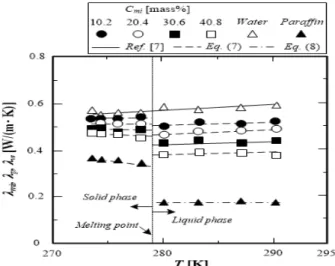
where the thermal conductivity of paraffin is calculated from equation (8). The calculated values in the solid phases are shown in Figure 9 as dashed lines.
× ×
≺≺
(8)
Figure 9 presents the variations of the thermal conductivity of the test microcapsule water slurry , water , and par- affin with temperature . The dashed lines indicate the calculated values from equation (7). The thermal conductivity of paraffin is plotted in Figure 8 as the plus. The thermal con- ductivity of paraffin decreases with an increase in temperature in the solid phase. In contrast, the thermal conductivity of par- affin in the liquid phase is almost constant. The thermal con- ductivity of water is greater than that of paraffin, and it in- creases slightly with temperature.
The thermal conductivity of the microcapsule water slurry
shows a different behavior below and above the freezing point.
The thermal conductivity of the microcapsule water slurry de- creases with increasing paraffin concentration. The thermal conductivity of the microcapsule water slurry for a low paraf- fin concentration is dependent on the thermal conductivity of water. The temperature dependence of the thermal conductivity of the microcapsule water slurry shows a decreasing tendency with an increase in the paraffin concentration. The calculated values from equation (7) are consistent with the measured re- sults with an accuracy within 土0.9%. Therefore, Eucken’s dispersion model can be applied to the estimation of the ther- mal conductivity of the microcapsule water slurry.
Figure 9: Relationship between thermal conductivity and temperature
6. Conclusion
The thermal properties of a microcapsule water slurry were measured, which included the dispersed phase-change (latent heat-storage) material. The following conclusions were obtained.
(1) The density of the microcapsule water slurry was meas- ured using a specific-gravity meter. It was determined that an appropriate property law could be applied to estimate the mi- crocapsule water slurry density with paraffin (dispersed phase), water (continuum phase), and melamine density.
(2) The specific heat of the microcapsule water slurry was measured by a water-calorimeter. The specific heat of the mi- crocapsule water slurry could also be estimated using the property law mentioned above.
(3) A transient hot-wire method was used for the measure- ment of the thermal conductivity of the microcapsule water slurry in the solid and liquid phases of the dispersion material.
It was clarified that a modified Eucken model could be ap- plied to the estimation of the thermal conductivity of the mi- crocapsule water slurry.
Acknowledgement
This microcapsule was provided by KIER (Korea Institute of Energy Research).
References
[1] H. Inaba and S. I. Morita, “Fundamental study of cold heat storage system of O/W-type emulsion having cold latent heat dispersion material (2nd Report, Flow and cold heat-storage characteristics of emulsion in a coiled double-tube heat exchanger),” JSME International Journal Series B: Fluids and Thermal Engineering, vol. 60, no. 572, pp. 1422-1429, 1994.
[2] H. Inaba, “Ice heat-storage system and multiphase flow (Multiphase Flow Lecture Series 9),” Japanese Society for Multiphase Flow,” 97, 1992 (in Japanese).
[3] M. Yoshida, “High-efficiency heat-transport fluid con- taining microencapsulated phase-change material (1) flow characteristics,” Kagakukougaku Symposium Series 23, pp. 32 (in Japanese).
[4] Y. Nagasaka and A. Nagashima. “Precise measurement of the thermal conductivity of liquids: 2nd Report, An absolute meassurement of the thermal conductivity of electrically conducting liquids by the transient hot-wire method,” The Japan Society of Mechanical Engineers, vol. 47, no. 419B, pp. 1323-1331, 1981 (in Japanese).
[5] H. Inaba, H. Otake, S. Nozu, and T. Fukuda, “A study on latent heat storage using a supercooling condition of hydrate: 1st Report, An entimation of properties of hy- drate sodium acetate including a supercooling con- dition,” The Japan Society of Mechanical Engineers, vol. 58, no. 553B, pp. 2848-2856, 1992 (in Japanese).
[6] Chemical Handbook Editorial Department, Chemical Handbook, Ohm, pp. 232, 1987 (in Japanese).
[7] Japan Society of Mechanical Engineers, “JSME Data Book: Heat Transfer 4th Ed.,” Japan Society of Mechanical Engineers, pp. 331, 1986 (in Japanese).
[8] H. Inaba,K. Takeya, and S. Nozu, “Effect of vari- ous parameters on a supercooling phenomenon of still bulk water and water solution,” The Japan Society of Mechanical Engineers, vol 59, no. 560B, pp.
1202-1209, 1993 (in Japanese).
[9] Japan Society of Thermophysical Properties,
“Thermophysical Properties Handbook,” Yokendo, pp.
120, 1990 (in Japanese).
[10] T. Saito and O. Okagaki, “Thermal conduction in wet materials,” The Japan Society of Mechanical Engineers, vol. 62, no. 484, pp. 741-747, 1959 (in Japanese).