국내 임상간호사의 직무배태성 연구에 관한 고찰
강 경 화
1
· 채 영 란2
· 박 수 연3
한림대학교 간호학부 ‧ 간호학연구소 교수1, 강원대학교 간호학과 교수2, 강원대학교 간호학과 대학원생3
Job Embeddedness of Korean Clinical Nurses: A Literature Review
Kang, Kyeonghwa
1· Chae, Young Ran
2· Park, Suyoun
31
Professor, Division of Nursing, Hallym University, Gangwon
2
Professor, College of Nursing, Kangwon National University, Gangwon
3
Graduate Student, Department of Nursing, Graduate School, Kangwon National University, Gangwon, Korea
Purpose: This review aimed to integrate the results of studies related to job embeddedness of clinical nurses and suggest directions for future research. Methods: A search for relevant studies was conducted using six databases according to the predetermined index terms “nurse” and “job embeddedness.” A total of 28 studies that met the inclusion criteria were selected and analyzed. Results: The definition of job embeddedness was consistent in the articles, but the terms, scope, and use of tools to determine job embeddedness were not. In addition, no article suggested a theoretical framework. In all the studies except one, the tool used to measure job embeddedness was one revised from Mitchell et al. (2001). In 15 articles, a negative correlation was found between job turnover and turnover intention. Job embeddedness was also found to be associated with nurses’ work environment, organiza- tional citizenship behavior, and organizational commitment, and it had a positive impact on these variables.
Conclusion: Job embeddedness can be used as a major variable to explain nurses’s turnover intention. Job em- beddedness is multidimensional, and a theoretical framework is needed to explain the job embeddedness of clinical nurses. Tools specific to Korea should be developed to measure the job embeddedness of Korean clinical nurses.
Key Words: Nurse, Job Embeddedness, Review
주요어: 간호사, 직무배태성, 고찰
Corresponding author: Chae, Youngran https://orcid.org/0000-0002-8523-0395
Department of Nursing, College of Nursing, Kangwon National University, 1 Ganwondaehak-gil, Chuncheon 24341, Korea.
Tel: +82-33-250-8886, Fax: +82-33-242-8840, E-mail: [email protected] Received: Apr 5, 2018 | Revised: May 21, 2018 | Accepted: Aug 22, 2018
This is an open access article distributed under the terms of the Creative Commons Attribution Non-Commercial License (http://creativecommons.org/licenses/
by-nc/3.0), which permits unrestricted non-commercial use, distribution, and reproduction in any medium, provided the original work is properly cited.
Vol. 27 No. 3, 139-151, August 2018 https://doi.org/10.5807/kjohn.2018.27.3.139
서 론
1. 연구의 필요성
간호 인력의 안정적 유지관리는 간호서비스의 질을 유지하 는 데에 큰 영향을 미치므로 매우 중요함에도 불구하고 우리나 라 간호사의 이직률은 상당히 높은 편이다 . 2018년 현재 간호 사의 이직률은 12.4%이며, 이중 신규간호사 1년 내 이직률은
경우 33.9%의 높은 이직률로 숙련된 장기근속 인력 부족을 나 타내고 있다 (Korean Hospital Nurses Association, 2018). 간 호사의 이직은 조직적인 면에서는 새로운 인력의 선발과 훈련 에 필요한 비용의 손실을 초래하며 간호사 자신에게도 경력의 단절 또는 업무 환경의 변화 등으로 인한 스트레스를 유발하게 되어 결국 간호의 질을 떨어뜨린다 (Han, Moon, & Yun, 2009).
더불어 구성원의 지속적인 변화로 구성원간의 협동성 , 역할구
분 및 상호 지지적 분위기 등을 저해 받게 되어 간호업무의 연
속성과 전문성에 심각한 문제를 발생시킨다(Kim, 2004).
이러한 이유로 그동안 선행연구에서는 직무만족이나 조직 몰입 등의 직무태도에 초점을 두어 간호사의 이직과 관련된 연 구들이 진행되어 왔다(Lee, Sin, Baeck, & Heo, 2014). 그러나 일부 연구에서는 이러한 직무태도가 구성원의 잔류와 이직에 상대적으로 작은 영향을 미친다는 결과를 보여주고 있어(Grif- feth, Hom, & Gaertner, 2000; Reitz, Anderson, & Hill, 2010), 연구의 방향이 이직이 아닌 어떻게 하면 간호조직에 오래 남아 있는가에 더 관심을 가지게 되었다. 즉 직장을 떠나는 원인에 대한 예측변인이 아닌 이들을 포괄하면서 일련의 사건들과 무 관하게 조직에 잔류하도록 붙잡아주는 차별적 예측변인에 대 한 연구의 필요성이 제시되었다(Mitchell, Holtom, Lee, Sab- lynski, & Erez, 2001; Kim & Ryu, 2016).
직무배태성(job embeddedness)은 바로 그러한 관점에서 대두된 개념이다. 직무배태성이란 직무와 관련하여 조직에 뿌 리를 내리고 있는 정도를 의미하며, Mitchell 등(2001)에 의해 처음 제시하였다. 이는 조직에서 함께 일하는 동료나 집단 또는 그들과의 관계에 대한 애정을 의미하는 직무내적요인과 가족 의 압력이나 지역사회에 대한 몰입 등과 같은 요소들이 구성원 으로 하여금 조직에 잔류하게끔 하는 직무외적요인의 2가지 상위요인으로 구분되며, 각 요인은 개인이 조직과 지역사회 커 뮤니티에 잘 맞는다고 지각하는 정도(적합성, fit)와 개인의 업 무나 상호작용하는 동료 등으로 제시되는 조직 내 네트워크와 지역사회 네트워크(연계, link), 조직이나 지역사회를 떠남으 로써 얻게 되는 손해(희생, scarifice)를 포함하는 총 6개의 범 주로 구분하여 설명하였다(Mitchell et al., 2001).
직무배태성에 대한 국내연구는 2002년 경영학, 심리학 분야 에서 이직의도와 잔류에 대한 연구로 시작되었고(Kim, 2002), Kim (2010)의 논문에서 병원조직구성원의 일부로 간호사를 대상으로 한 연구가 시도되었다. 이후 여러 간호학자들에 의해 연구(Kim, 2017; Kang & Kwon, 2017; Song & Choi, 2017) 되 어 이직의도 또는 재직의도를 설명하는 중요변수로 부각되고 있다. 뿐만 아니라 직무배태성은 조직특성, 간호업무수행 변수 와 이직의도 간의 관계에서 매개변수로 작용하고(Kim & Lee, 2014; Yoo & Kim, 2016), 전문직 자아개념과 조직성과 간의 관 계를 조절하는 개념(Jeon, 2014)이기도 하여 다양한 변수들과 연결된다.
현재까지 직무배태성에 관한 국내 간호학 연구가 40편 이상 보고되고 있음에도 불구하고 국내에서는 ‘직무배태성’ 또는
‘직무착근도’라는 용어로 연구자에 따라 서로 다르게 소개하 고 있으며 두 개의 용어 차이를 명확하게 구분하여 사용하고 있
지 않다. 따라서 개념적 정의와 측정에 한계가 있을 수 있으며 (Lee et al., 2014), 현 시점에서 기존연구에서의 이러한 혼재의 현상을 객관적으로 파악해 보고 향후 합의된 개념과 측정을 위 한 연구 방향성을 제시할 필요가 있다. 또한, 직무배태성 측정 에 있어 다수의 연구에서 연구자의 의도에 따라 Mitchell 등 (2001)의 도구를 일부분만 사용하고 있으며, 좀 더 최근에 개발 된 Reitz (2014) 도구의 사용은 아직 미비한 수준으로 직무배태 성 도구 사용과 관련된 국내 연구의 동향을 심도 있게 분석할 필요가 있다고 판단된다.
이에 본 연구는 국내 간호학 연구에서 직무배태성 개념의 명 료성이 부족하고 사용된 연구도구들이 일관되지 않으며, 관련 변수들이 다양하므로 이를 분석하여 통합하는 과정을 통해, 국 내 임상간호사를 대상으로 한 직무배태성 연구의 방향과 연구 결과에 대해 고찰하고자 한다.
2. 연구목적
본 연구에서는 현재까지 진행된 국내 임상간호사를 대상으 로 한 직무배태성 관련 연구들을 분석함으로써, 주요 결과를 정 리하고 동향을 파악하여 이를 토대로 직무배태성과 관련된 특 성을 알아보고, 도구의 측정과 이에 관련된 주요변수들을 확인 하고자 한다. 구체적 목적은 다음과 같다.
국내 임상간호사의 직무배태성과 관련된 연구의 특성을 고찰한다.
국내 임상간호사의 직무배태성을 측정하기 위해 사용된 도구들을 분석한다.
국내 임상간호사의 직무배태성과 상관성 있는 주요 변수 들을 분류하고 그 변수들 간의 관계를 규명한다.
연 구 방 법
1. 연구설계
본 연구는 임상간호사를 대상으로 한 이직연구에서 직무배 태성 관련 국내 연구논문을 통합적 고찰방법으로 분석한 문헌 고찰 연구이다.
2. 연구진행
본 연구에서 다루는 주제 인 간호사의 직무배태성의 특성을
고려하여 Whittemore와 Knafl (2005)의 통합적 고찰방법에
따라 5단계로 진행하였다. 구체적인 과정은 1단계 문제규명, 2 단계 문헌검색 및 자료수집, 3단계 자료평가, 4단계 자료분석, 5단계 자료제시의 순이었다.
1) 문제규명
문제규명 단계에서는 개인이 조직에 머무르거나 떠나려는 결정을 할 때 영향을 미치는 통합된 변인이라는 Mitchell 등 (2001)의 직무배태성 정의와 국외 직무배태성 연구에 관한 문 헌고찰 결과 직무배태성이 이직의도 또는 재직의도에 큰 영향 을 미침을 근거하여 문제를 단계적으로 규명하였다. 첫째, 국 내연구에서 임상간호사의 직무배태성과 관련된 연구는 무엇 인가? 둘째, 국내연구에서 임상간호사의 직무배태성을 측정하 는 도구는 무엇인가? 셋째, 국내연구에서 임상간호사의 직무 배태성과 관련된 요인은 무엇인가? 등 세 가지 문제를 도출하 였다.
2) 문헌검색 및 자료수집
(1) 문헌검색 방법
문헌검색을 위해 한국학술정보(KISS), 국립중앙도서관(Na- tional Library of Korea), 국회도서관(National Assembly Li- brary), 한국학술연구정보서비스(RISS), 누리미디어(DBpia), 국가과학기술정보센터(NDSL)의 6개 검색엔진을 이용하였다.
검색어는 ‘직무배태성’, ‘직무착근도’, ‘간호사’를 사용했고, 자 료의 수집을 위해 검색기간은 2010년 1월부터 2017년 12월까지 (총 8년)를 검색기간으로 하였다. 추가문헌을 확인하기 위해 주요 검색어를 사용하여 2018년 1월부터 2018년 2월까지(총 2 개월) ‘눈덩이 표집방법(snowball method)’을 사용하였다.
선정기준
① 2017년까지 국내 간호학 및 관련 분야 학술지에 게재된 연구
② 임상간호사를 대상으로 한 연구
③ 양적 연구: 직접 측정된 변수로 직무배태성을 포함한 연구
제외기준
① 임상간호사 외 병원구성원을 포함하여 연구결과에서 분 리하여 제시하지 않은 경우
② 간호사를 대상으로 한 직무배태성 도구의 타당도 검증 연구
(2) 문헌선정
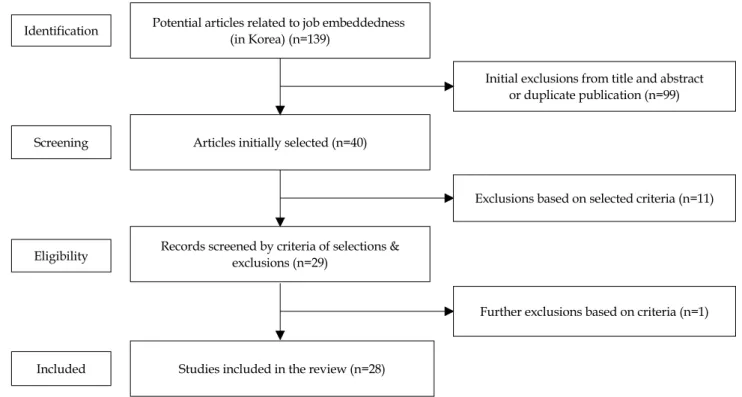
1단계에서 본 연구의 연구자 3인이 문헌을 각각 검색한 결과 총 139개의 문헌이 검색되었다. 연구자 3인이 139개 문헌을 각 각 검토하여 문헌의 제목이 본 연구의 주제와 부합하는지 검토
한 후 논의를 거쳐 부적합하거나 중복 출판된 문헌 99개를 배제 하여 40개의 문헌이 1차적으로 선택되었다.
2단계에서는 40개의 문헌의 초록을 검토한 후 논의를 거쳐 학위논문과 학술지의 제목 및 내용이 동일 한 문헌 7개, 임상간 호사가 대상이 아닌 문헌 2개, 병원조직구성원 전체를 대상으 로 한 문헌 1개, 도구개발 1개 문헌을 배제하였고, 선택된 29개 문헌이 선정기준에 부합하는지 재검토 하였다.
학위논문과 학술지의 제목 및 내용이 동일 한 경우에는 학술 지로 선정하였다.
마지막 3단계에서는 선택된 29개 문헌의 참고문헌을 참조 하여 추가문헌이 있는지 확인하고, 추가문헌이 없음을 확인한 후 29개의 문헌의 전문을 자세히 확인하여 주요어로 포함되어 있으나 직접측정하지 않은 1개의 논문을 배제한 총 28개의 연 구가 선택되었다(Figure 1).
3) 자료평가
자료평가 단계에서는 최종적으로 선택된 28개의 문헌을 Hawker, Payne, Kerr, Hardey와 Powell (2002)이 제시한 문 헌평가지를 사용하여 평가하여 자료분석에 포함시킬 논문을 결정하였다. Hawker 등(2002)의 문헌의 질 평가지는 9개의 항 목으로 구성되어 있으며 Likert 4점 척도로 good=4점, fair=3 점, poor=2점, very poor=1점으로 평가하도록 하고 있다. 총 합산 점수는 최소 9점에서 최대 36점이며, 9개 평가항목은(1) 제목과 초록, (2) 서론 및 연구목적, (3) 연구방법, (4) 연구대상, (5) 자료분석, (6) 윤리적 고려, (7) 연구결과, (8) 전이 및 일반화 의 가능성, (9) 연구의 의의이다. 본 연구의 경우 본 연구의 연구 자 3인이 최종적으로 선택된 28개 논문을 평가한 결과 28개 논 문이 28~35점의 분포를 보이며, 평균 29.0점으로 논문 모두를 자료분석 단계에 포함하는 것으로 하였다.
4) 자료분석
최종적으로 분석에 포함된 자료는 임상간호사를 대상으로
직무배태성을 측정한 연구들 가운데 선정기준에 충족하는 국
내논문 총 28편이었다. 본 연구에서는 분석에 포함된 연구의
특성을 기술하고 각 연구에서 사용한 도구와 연구결과를 분석
하였다. 이를 위해 문제규명단계에서 제시된 내용들이 포함될
수 있도록 자료분석 틀에 들어갈 항목을 연구자 3인이 합의하
여 결정하였다. 자료분석 틀에는 저자, 게재년도, 제목, 용어의
사용, 연구설계, 표본 크기, 병상규모, 측정도구, 직무배태성 변
수형태, 직무배태성과 관련하여 분석된 변수 및 상관관계 결과
등을 별도로 분류하여 테이블로 정리하였다.
Exclusions based on selected criteria (n=11) Potential articles related to job embeddedness
(in Korea) (n=139)
Articles initially selected (n=40)
Records screened by criteria of selections &
exclusions (n=29)
Initial exclusions from title and abstract or duplicate publication (n=99)
Further exclusions based on criteria (n=1)
Studies included in the review (n=28) Identification
Included Eligibility Screening
Figure 1. Flow diagram of study selection.
5) 자료제시
자료제시 단계에서는 문헌고찰의 마지막 과정으로 자료분 석 단계에서 만든 자료분석 틀에 맞게 정리하여 연구결과에 제 시하였다.
연 구 결 과
1. ‘임상간호사의 직무배태성’ 연구의 특성
임상간호사의 직무배태성과 관련된 특성을 분석한 결과, 각 연구들의 설계유형이 모두 서술적 조사연구임을 확인하였다.
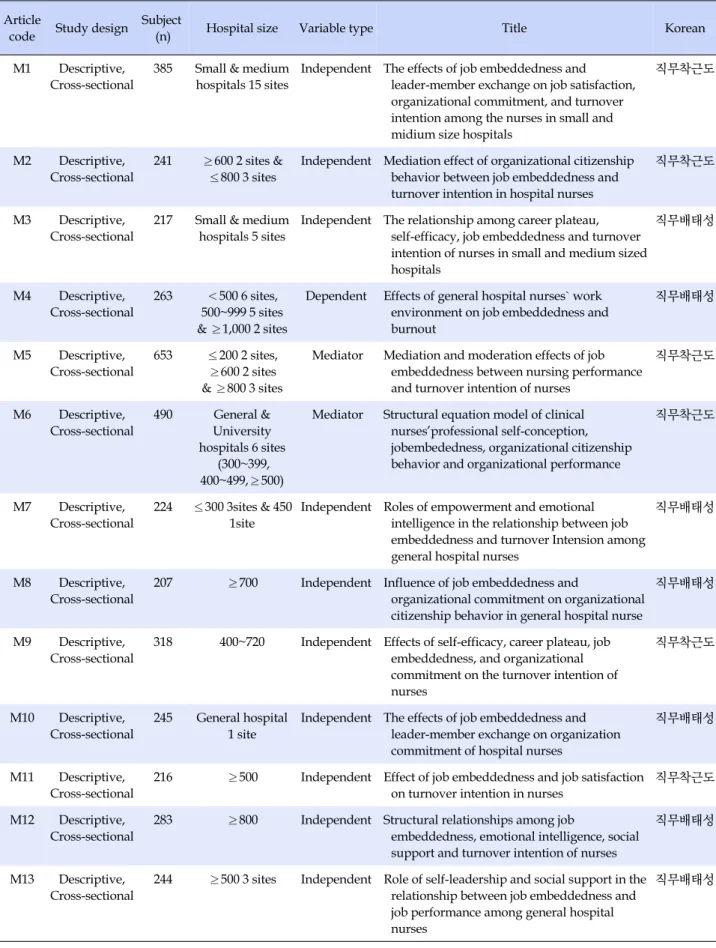
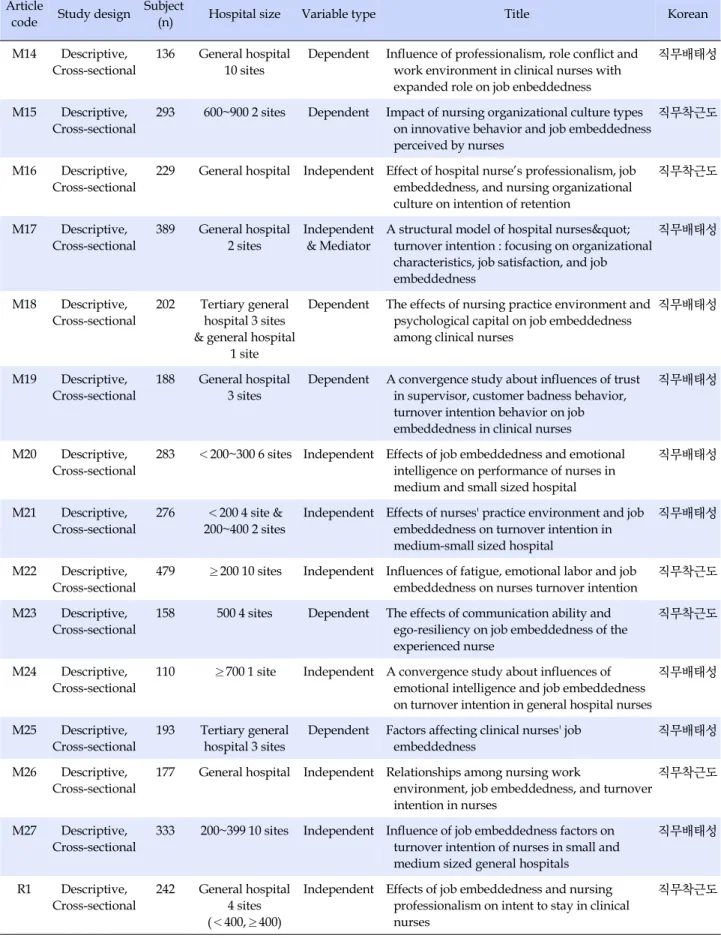
이들의 표본크기는 최소 110명에서 최대 653명이었으며, 병상 규모는 200병상이하에서 1,000병상 이상, 자료수집기관은 중 소병원에서 상급종합병원에 이르기까지 다양하였다. 직무배 태성은 18편의 연구에서 독립변수로, 7편의 연구에서는 종속 변수로, 2편의 연구에서는 매개변수로 작용하였다. 그 외 1편 의 연구에서는 직무배태성을 독립변수이면서 매개변수로써 측정하였다 . 또한, Job embeddedness에 대한 국내에서의 용 어사용은 명확한 구분 없이 단순번안하거나 비유적 표현을 적 용한 것으로서 ‘직무배태성’ 16편, ‘직무착근도’ 12편이었다 (Table 1).
직무배태성에 대한 개념적 정의는 총 28편의 논문 가운데
28편 모두에서 제시하고 있었다. 직무배태성에서 ‘embedded- ness’의 사전적 뜻은(마음속에)‘깊숙이 박다’, ‘파묻다’등을 의 미하는 것으로 어느 한곳에 깊이 파묻히고 박힐 정도로 연관성 이 높음을 표현 한다. 분석된 28편 모두에서 직무배태성은 ‘자 발적 이직을 결정하는데 중요한 요소 중의 하나로서 구성원이 현재 직무와 조직에 계속해서 머무르게 하는 종합적이고 광범 위한 연결망’으로 적합성, 연계, 희생의 세 가지 영역을 포함 개 념으로 정의되었다. 그러나 3편을 제외한 대부분의 연구들은 직무배태성을 직무내적요인인 조직 관련 배태성에 국한되어 정의하였다. 직무내적요인의 조직 관련 직무배태성과 직무외 적요인의 지역사회 관련 직무배태성 모두를 포괄하는 개념으 로 제시한 논문은 3편이었으며, 이 중 1편의 연구에서는 ‘자신 의 직무와 관련하여 개인이 조직에 깊이 뿌리를 내리고 있는 정 도’를 지칭하는 개념으로 조직적합성, 지역사회적합성, 기득 혜택 , 업무팀, 가족 및 친구의 다섯 가지 측면으로 구분되었다.
2. ‘임상간호사의 직무배태성’ 측정을 위해 사용된 도구
직무배태성을 평가하기 위해 기존에 개발된 도구들 가운데
2종의 도구들이 임상간호사의 직무배태성을 측정하는데 사용
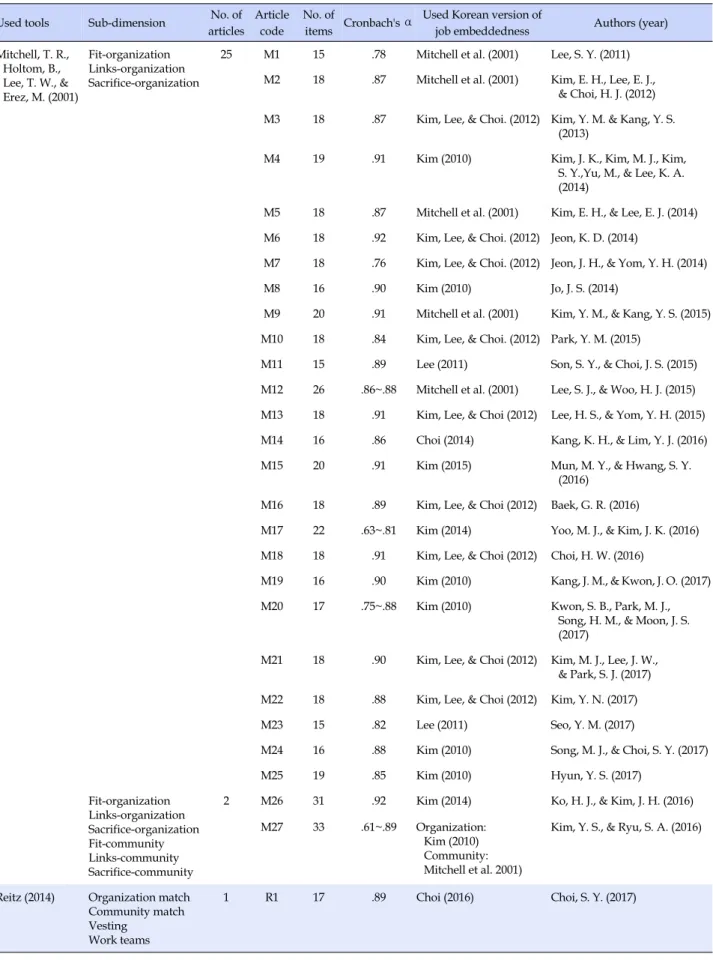
되었다 (Table 2). 가장 많이 사용된 도구는 Mitchell 등(2001)
에 의해 개발된 도구로, 조직적합성, 조직연계, 조직희생, 지역
Table 1. Description of Included Studies
Article
code Study design Subject
(n) Hospital size Variable type Title Korean
M1 Descriptive, Cross-sectional
385 Small & medium hospitals 15 sites
Independent The effects of job embeddedness and leader-member exchange on job satisfaction, organizational commitment, and turnover intention among the nurses in small and midium size hospitals
직무착근도
M2 Descriptive, Cross-sectional
241 ≥600 2 sites &
≤800 3 sites
Independent Mediation effect of organizational citizenship behavior between job embeddedness and turnover intention in hospital nurses
직무착근도
M3 Descriptive, Cross-sectional
217 Small & medium hospitals 5 sites
Independent The relationship among career plateau, self-efficacy, job embeddedness and turnover intention of nurses in small and medium sized hospitals
직무배태성
M4 Descriptive, Cross-sectional
263 <500 6 sites, 500~999 5 sites
& ≥1,000 2 sites
Dependent Effects of general hospital nurses` work environment on job embeddedness and burnout
직무배태성
M5 Descriptive, Cross-sectional
653 ≤200 2 sites,
≥600 2 sites
& ≥800 3 sites
Mediator Mediation and moderation effects of job embeddedness between nursing performance and turnover intention of nurses
직무착근도
M6 Descriptive, Cross-sectional
490 General &
University hospitals 6 sites
(300~399, 400~499,≥500)
Mediator Structural equation model of clinical nurses’professional self-conception, jobembededness, organizational citizenship behavior and organizational performance
직무착근도
M7 Descriptive, Cross-sectional
224 ≤300 3sites & 450 1site
Independent Roles of empowerment and emotional intelligence in the relationship between job embeddedness and turnover Intension among general hospital nurses
직무배태성
M8 Descriptive, Cross-sectional
207 ≥700 Independent Influence of job embeddedness and
organizational commitment on organizational citizenship behavior in general hospital nurse
직무배태성
M9 Descriptive, Cross-sectional
318 400~720 Independent Effects of self-efficacy, career plateau, job embeddedness, and organizational commitment on the turnover intention of nurses
직무착근도
M10 Descriptive, Cross-sectional
245 General hospital 1 site
Independent The effects of job embeddedness and leader-member exchange on organization commitment of hospital nurses
직무배태성
M11 Descriptive, Cross-sectional
216 ≥500 Independent Effect of job embeddedness and job satisfaction on turnover intention in nurses
직무착근도
M12 Descriptive, Cross-sectional
283 ≥800 Independent Structural relationships among job
embeddedness, emotional intelligence, social support and turnover intention of nurses
직무배태성
M13 Descriptive, Cross-sectional
244 ≥500 3 sites Independent Role of self-leadership and social support in the relationship between job embeddedness and job performance among general hospital nurses
직무배태성
Table 1. Description of Included Studies (Continued)
Article
code Study design Subject
(n) Hospital size Variable type Title Korean
M14 Descriptive, Cross-sectional
136 General hospital 10 sites
Dependent Influence of professionalism, role conflict and work environment in clinical nurses with expanded role on job enbeddedness
직무배태성
M15 Descriptive, Cross-sectional
293 600~900 2 sites Dependent Impact of nursing organizational culture types on innovative behavior and job embeddedness perceived by nurses
직무착근도
M16 Descriptive, Cross-sectional
229 General hospital Independent Effect of hospital nurse’s professionalism, job embeddedness, and nursing organizational culture on intention of retention
직무착근도
M17 Descriptive, Cross-sectional
389 General hospital 2 sites
Independent
& Mediator
A structural model of hospital nurses"
turnover intention : focusing on organizational characteristics, job satisfaction, and job embeddedness
직무배태성
M18 Descriptive, Cross-sectional
202 Tertiary general hospital 3 sites
& general hospital 1 site
Dependent The effects of nursing practice environment and psychological capital on job embeddedness among clinical nurses
직무배태성
M19 Descriptive, Cross-sectional
188 General hospital 3 sites
Dependent A convergence study about influences of trust in supervisor, customer badness behavior, turnover intention behavior on job embeddedness in clinical nurses
직무배태성
M20 Descriptive, Cross-sectional
283 <200~300 6 sites Independent Effects of job embeddedness and emotional intelligence on performance of nurses in medium and small sized hospital
직무배태성
M21 Descriptive, Cross-sectional
276 <200 4 site &
200~400 2 sites
Independent Effects of nurses' practice environment and job embeddedness on turnover intention in medium-small sized hospital
직무배태성
M22 Descriptive, Cross-sectional
479 ≥200 10 sites Independent Influences of fatigue, emotional labor and job embeddedness on nurses turnover intention
직무착근도
M23 Descriptive, Cross-sectional
158 500 4 sites Dependent The effects of communication ability and ego-resiliency on job embeddedness of the experienced nurse
직무착근도
M24 Descriptive, Cross-sectional
110 ≥700 1 site Independent A convergence study about influences of emotional intelligence and job embeddedness on turnover intention in general hospital nurses
직무배태성
M25 Descriptive, Cross-sectional
193 Tertiary general hospital 3 sites
Dependent Factors affecting clinical nurses' job embeddedness
직무배태성
M26 Descriptive, Cross-sectional
177 General hospital Independent Relationships among nursing work
environment, job embeddedness, and turnover intention in nurses
직무착근도
M27 Descriptive, Cross-sectional
333 200~399 10 sites Independent Influence of job embeddedness factors on turnover intention of nurses in small and medium sized general hospitals
직무배태성
R1 Descriptive, Cross-sectional
242 General hospital 4 sites (<400,≥400)
Independent Effects of job embeddedness and nursing professionalism on intent to stay in clinical nurses
직무착근도
Table 2. Tools for Measuring Job Embeddedness in Clinical Nurse
Used tools Sub-dimension No. of
articles Article
code
No. of
items Cronbach's ⍺ Used Korean version of
job embeddedness Authors (year) Mitchell, T. R.,
Holtom, B., Lee, T. W., &
Erez, M. (2001)
Fit-organization Links-organization Sacrifice-organization
25 M1 15 .78 Mitchell et al. (2001) Lee, S. Y. (2011)
M2 18 .87 Mitchell et al. (2001) Kim, E. H., Lee, E. J.,
& Choi, H. J. (2012) M3 18 .87 Kim, Lee, & Choi. (2012) Kim, Y. M. & Kang, Y. S.
(2013)
M4 19 .91 Kim (2010) Kim, J. K., Kim, M. J., Kim,
S. Y.,Yu, M., & Lee, K. A.
(2014)
M5 18 .87 Mitchell et al. (2001) Kim, E. H., & Lee, E. J. (2014) M6 18 .92 Kim, Lee, & Choi. (2012) Jeon, K. D. (2014)
M7 18 .76 Kim, Lee, & Choi. (2012) Jeon, J. H., & Yom, Y. H. (2014)
M8 16 .90 Kim (2010) Jo, J. S. (2014)
M9 20 .91 Mitchell et al. (2001) Kim, Y. M., & Kang, Y. S. (2015) M10 18 .84 Kim, Lee, & Choi. (2012) Park, Y. M. (2015)
M11 15 .89 Lee (2011) Son, S. Y., & Choi, J. S. (2015) M12 26 .86~.88 Mitchell et al. (2001) Lee, S. J., & Woo, H. J. (2015) M13 18 .91 Kim, Lee, & Choi (2012) Lee, H. S., & Yom, Y. H. (2015) M14 16 .86 Choi (2014) Kang, K. H., & Lim, Y. J. (2016)
M15 20 .91 Kim (2015) Mun, M. Y., & Hwang, S. Y.
(2016)
M16 18 .89 Kim, Lee, & Choi (2012) Baek, G. R. (2016)
M17 22 .63~.81 Kim (2014) Yoo, M. J., & Kim, J. K. (2016) M18 18 .91 Kim, Lee, & Choi (2012) Choi, H. W. (2016)
M19 16 .90 Kim (2010) Kang, J. M., & Kwon, J. O. (2017)
M20 17 .75~.88 Kim (2010) Kwon, S. B., Park, M. J.,
Song, H. M., & Moon, J. S.
(2017)
M21 18 .90 Kim, Lee, & Choi (2012) Kim, M. J., Lee, J. W.,
& Park, S. J. (2017) M22 18 .88 Kim, Lee, & Choi (2012) Kim, Y. N. (2017)
M23 15 .82 Lee (2011) Seo, Y. M. (2017)
M24 16 .88 Kim (2010) Song, M. J., & Choi, S. Y. (2017)
M25 19 .85 Kim (2010) Hyun, Y. S. (2017)
Fit-organization Links-organization Sacrifice-organization Fit-community Links-community Sacrifice-community
2 M26 31 .92 Kim (2014) Ko, H. J., & Kim, J. H. (2016)
M27 33 .61~.89 Organization:
Kim (2010) Community:
Mitchell et al. 2001)
Kim, Y. S., & Ryu, S. A. (2016)
Reitz (2014) Organization match Community match Vesting
Work teams
1 R1 17 .89 Choi (2016) Choi, S. Y. (2017)
사회적합성, 지역사회연계, 지역사회희생의 6개 영역, 40문항 으로 이루어져있으며 5점 Likert 척도로 측정한다. 28편의 연 구들 가운데, Mitchell 등(2001)의 도구는 국내 연구 27편에서 번안 및 수정하여 사용되었다. 하위영역별 사용에서 25편의 연 구가 직무내적요인에 국한된 조직적합성, 조직연계, 조직희생 의 3개 하위영역만을 사용(Cronbach’s ⍺=.63~.92, 수정된 문 항 수 15~26문항)하여 직무배태성을 측정하였으며 다른 2편 의 연구에서만 6가지 하위영역 모두를 사용(Cronbach’s ⍺=
.61~.92, 수정된 문항 수 31~33문항)하였다. 조직내적요인에 초점을 둔 연구 25편 중 9편에서 Kim, Lee와 Choi (2012)의 도 구를, 6편에서는 Kim (2010)의 도구를 사용하여 직무배태성을 측정하였으나 대부분의 연구에서 수정이나 삭제한 문항이 있 어 연구마다 직무배태성 도구의 측정문항수가 상이하였다.
다음으로 Reitz (2014)에 의해 개발된 도구로, 앞선 Mitchell 등(2001)의 도구를 기반으로 하였다. 원 도구의 지역사회희생 영역을 제외하고 조직적합성, 지역사회적합성, 기득혜택(근무 혜택), 업무 팀, 가족 및 친구의 5가지 하위영역을 측정하며, 23 문항, 5점 Likert 척도로 이루어져 있다. 이 도구를 사용한 1편 의 연구에서는 하위영역 중 ‘가족 및 친구’을 다소 집단주의적 동양사회와 개인주의적 서양사회 간의 문화차이를 고려하여 수정한 한국어판 직무배태성(Choi, S. M., 2016) 도구를 사용 (Cronbach’s ⍺=.89, 17문항)하였다.
28편의 연구 모두에서 매우 그렇지 않다(1점), 그렇지 않다 (2점), 그저 그렇다(3점), 그렇다(4점), 매우 그렇다(5점)의 5점 Likert 척도로 측정하였다.
3. ‘임상간호사의 직무배태성’과 관련 변수와의 관계
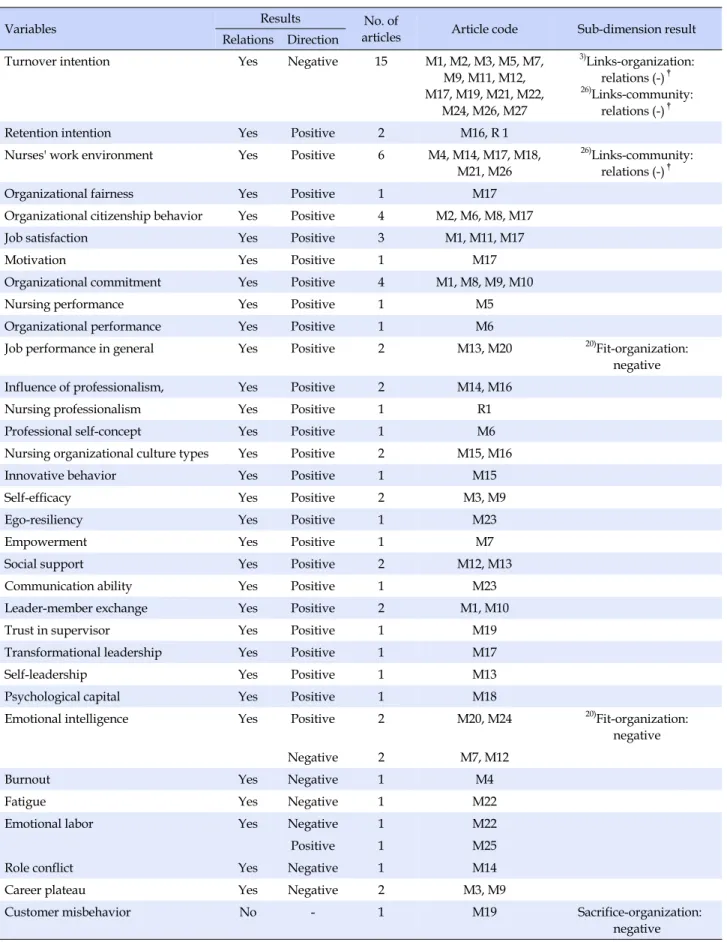
임상간호사의 직무배태성을 설명하기 위해 조사된 변수들 을 분석에서 가장 많이 연구된 변수는 이직의도, 재직의도였 다. 이와 관련된 15편의 연구에서 직무배태성과 이직의도간의 양의 상관관계를 보였으나, Kim과 Kang (2013)의 연구에서는 이직의도가 직무배태성 하위영역인 조직연계와는 뚜렷한 상 관관계가 없음이 확인되었고, Ko와 Kim (2016)의 연구에서는 직무배태성 하위영역인 지역사회연계를 제외한 나머지 영역 에서만 상관관계를 보였다. 또한, 이직의도와 반대되는 개념인 재직의도와의 관계를 확인한 2편의 연구에서도 음의 상관관계 가 확인되어 동일한 결과를 나타냈다(Table 3).
다음으로 많이 확인된 변수는 간호업무환경으로, 6편의 연 구에서 직무배태성과 양의 상관관계를 보고하였으나 Ko와 Kim (2016)의 연구에서는 직무배태성 하위영역인 지역사회
연계와는 뚜렷한 상관관계가 없음이 확인되었다. 조직몰입, 조 직시민행동, 감성지능 변수는 각 4편의 연구에서 양의 상관관 계를 보였으나 감성지능의 경우 2편의 연구에서는 음의 상관 관계가 확인되어 상반된 결과를 나타냈다.
직무만족 변수는 3편의 연구에서 양의 상관관계를 보였으 며, 간호업무성과, 전문직업성, 간호조직문화유형, 자기효능 감, 사회적 지지, 상사-구성원 교환관계의 변수들은 각 2편씩의 연구에서 양의 상관관계 보였다. 경력정체의 변수는 2편의 연 구에서는 음의 상관관계가 확인되었고, 감정노동은 2편에서 연구되었는데 Kim (2017)의 연구에서는 음의 상관관계를 보 였으나 Hyun (2017)의 연구에서 직무배태성과 감정노동의 내 면행위는 양의 상관관계로 나타났다.
그 밖에도 소진, 역할갈등, 피로도의 변수가 각 1편씩의 연구 에서 직무배태성과 음의 상관관계를 보였으며, 임파워먼트, 조 직성과, 셀프 리더쉽, 조직공정성, 변혁적 리더쉽, 혁신행동, 상 사신뢰, 간호업무수행, 심리적 자본, 간호전문직관, 전문직자 아개념, 의사소통능력, 자아탄력성의 변수는 각 1편씩의 연구 에서 직무배태성과 양의 상관관계로 확인되었다.
마지막으로 임상간호사 직무배태성과의 연구결과 중, 고객 불량행동은 직무배태성과 유의하지 않은 상관관계를 보였으 나, 직무배태성 하위요소인 조직희생과는 음의 상관관계가 확 인되었다.
논 의
본 연구에서는 현재까지 진행된 국내 임상간호사의 직무배 태성에 관한 연구를 분석하여 직무배태성의 개념 및 측정도구 의 특성을 분석하고, 직무배태성과 관련된 변수들을 확인하여 직무배태성과의 관계를 규명하고자 하였다.
먼저, 직무배태성의 개념적 정의는 개인을 조직에 머무르게 하는 통합된 영향력(Mitchell & Lee, 2001)으로 분석된 연구들 에서 일관되게 설명하고 있었다. ‘embeddedness’의 용어는 사회적 관계가 경제적 활동에 영향을 미치게 된다는 사회학이 론에서 처음 시작된 개념이며(Uzzi, 1997), 사회학자들이 분석 의 단위나 종속변수로서 배태성의 구성요소를 좀 더 광범위하 게 개인이나 집단, 조직, 다양한 경제활동까지도 포함시켰다.
이러한 맥락에서 Michell 등(2001)이 제시한 직무배태성 도구
에서도 직무내적요인과 직무외적요인으로 구분하였다. 직무
내적요인에는 조직에서의 헌신이나 동료와의 네트워크, 애착
등이 포함되며, 직무외적요인에는 가족이나 지역사회에서의
관계망, 취미 활동, 종교 활동 등을 포함하고 있다.
Table 3. Variables Studied regarding Job Embeddedness in Clinical Nurses
Variables Results No. of
articles Article code Sub-dimension result Relations Direction
Turnover intention Yes Negative 15 M1, M2, M3, M5, M7,
M9, M11, M12, M17, M19, M21, M22,
M24, M26, M27
3)
Links-organization:
relations (-)
†26)
Links-community:
relations (-)
†Retention intention Yes Positive 2 M16, R 1
Nurses' work environment Yes Positive 6 M4, M14, M17, M18,
M21, M26
26)
Links-community:
relations (-)
†Organizational fairness Yes Positive 1 M17
Organizational citizenship behavior Yes Positive 4 M2, M6, M8, M17
Job satisfaction Yes Positive 3 M1, M11, M17
Motivation Yes Positive 1 M17
Organizational commitment Yes Positive 4 M1, M8, M9, M10
Nursing performance Yes Positive 1 M5
Organizational performance Yes Positive 1 M6
Job performance in general Yes Positive 2 M13, M20
20)Fit-organization:
negative
Influence of professionalism, Yes Positive 2 M14, M16
Nursing professionalism Yes Positive 1 R1
Professional self-concept Yes Positive 1 M6
Nursing organizational culture types Yes Positive 2 M15, M16
Innovative behavior Yes Positive 1 M15
Self-efficacy Yes Positive 2 M3, M9
Ego-resiliency Yes Positive 1 M23
Empowerment Yes Positive 1 M7
Social support Yes Positive 2 M12, M13
Communication ability Yes Positive 1 M23
Leader-member exchange Yes Positive 2 M1, M10
Trust in supervisor Yes Positive 1 M19
Transformational leadership Yes Positive 1 M17
Self-leadership Yes Positive 1 M13
Psychological capital Yes Positive 1 M18
Emotional intelligence Yes Positive 2 M20, M24
20)Fit-organization:
negative
Negative 2 M7, M12
Burnout Yes Negative 1 M4
Fatigue Yes Negative 1 M22
Emotional labor Yes Negative 1 M22
Positive 1 M25
Role conflict Yes Negative 1 M14
Career plateau Yes Negative 2 M3, M9
Customer misbehavior No - 1 M19 Sacrifice-organization:
negative
†
(-): 유의하지 않음.
본 연구결과에서는 28편 중 25편의 논문에서 직무내적요인 만을 국한하여 정의하거나 도구로 사용하였다. 직무내적요인 만을 사용한 이유로 도구가 개발된 미국의 지역사회 실정과 다 르게 국내의 경우 지역사회와의 연계가 미미한 점을 감안하거 나(Kim et al., 2012; Kim & Kang, 2013; Jo, 2015), 직무외적요 인의 유의성을 보고한 연구가 매우 부족하고 체계적인 근거를 찾을 수 없기 때문이라고 제시하였다(Kim & Kang, 2015). 그 러나 대부분의 연구에서는 직무외적요인을 배제한 이유가 특 별히 언급되지 않았다. 그럼에도 불구하고 본 연구의 결과에서 다수의 연구가 직무내적요인으로 한정하여 직무배태성을 정 의하고 측정하는 것은 직무배태성의 속성을 고려해 볼 때 단편 적인 설명력을 제공할 것으로 보인다. 현재 국내에서는 일과 삶의 균형과 개인 삶의 질에 대한 관심이 고조되면서 직무외적 요인의 중요성이 부각되고 있다. 그러므로 국내 지역사회 및 문화적 특성을 반영한 직무배태성 도구가 개발 될 필요가 있다.
또한, 선행연구에서 ‘직무착근도’에 비해 ‘직무배태성’을 사 용한 연구가 상대적으로 많아 본 연구에서는 ‘직무배태성’으 로 기술하였다. 그러나 용어의 혼용은 혼란을 야기 시키거나 이 질적인 용어로 해석될 수 있으며, 직무배태성에 대한 이론적 이 해의 부족에 기인하는 요인이 될 수 있으므로 용어사용에 있어 학자 간 일치에 대한 심도 있는 논의가 필요 할 것으로 보인다.
국내 임상간호사들의 직무배태성 측정에 사용된 도구는 크 게 2가지 범주로 구분되었다. 본 연구에서 포함된 논문들은 직 무배태성의 점수를 측정하였으며 점수가 높을수록 직무배태 성이 높음을 설명하였다. 주로 사용된 Mitchell 등(2001)이 개 발한 직무배태성 도구는 식료품점 직원 700명과 간호사 150명 을 포함한 병원직원 500명을 대상으로 연령, 성별, 결혼 여부 등의 개인적 특성과 직무만족, 조직몰입, 직업선택과 이직의도 및 실제적인 이직행위를 직무배태성이라는 새로운 개념과 연 계하여 측정 하였다. 이 도구는 직무배태성의 구성요소로 직무 내적요인(조직)과 직무외적요인(지역사회)으로 나뉘고 적합 성, 연계, 희생이라는 세 가지 영역의 요소들로 총 6가지 하위영 역을 제시하고 있다. 구성은 조직적합성 9문항, 조직연계 7문 항, 조직희생 10문항, 지역사회 적합성 5문항, 지역사회 연계 6 문항, 지역사회 희생 3문항의 총 40문항(Cronbach’s ⍺=
.50~.86, 5점 Likert 척도)으로 되어있다.
Mitchell 등(2001)의 도구로 국내 임상간호사의 직무배태 성을 측정한 연구에서는 Kim과 Ryu (2016), Ko와 Kim (2016) 만이 종합병원 간호사를 대상으로 직무내적인 요인과 직무 외적인 요인 모두를 측정하였고, 다수의 연구에서는 직무내 적요인인 조직에 초점을 둔 원 도구의 일부만을 사용하였다.
Mitchell 등(2001)의 총 40문항 중에 26문항이 직무내적요인 (조직)에 해당됨과는 다르게 15~26문항으로 다양하게 수정 되었으며, 경우에 따라 문항의 일부분을 선택함에 있어 기준 을 명확하게 제시하지 않았다(Choi, S. M., 2016; Lee & Sin, 2017). 더불어 국내에서 주로 사용된 Kim (2010)과 Kim 등 (2012)의 도구에서 명확한 번안과정이 제시되지 않아 도구의 내용타당도가 확보되지 않았으며, 특히 조직연계와 조직희생 영역의 번안이 상이하게 나타났다. 그러므로 체계적인 도구 번 안 및 도구의 평가 검증 과정을 통한 표준화된 도구의 사용이 필요 할 것이다.
국내에서 직무내적요인과 직무외적요인을 모두 측정한 연 구는 2편으로 미미한 실정이다. 일부 연구에서는 일부하위영 역의 내적일치 값(조직연계 .51, 와 지역사회 희생 .57)이 낮게 측정되었고 이는 국외도구가 우리나라 사정을 반영하지 못한 것으로 해석하였다(Ko & Kim, 2016). 국외연구와 비교했을 때도 미국 간호사를 대상으로 한 연구(Mitchell et al., 2001;
Holtom & O'Neill, 2004)나 중국의 일반기업체 대상으로 한 연구(Tang, 2008)의 직무외적요인이 국내연구와 일관되지 않 은 결과들을 보여주고 있으며, 이는 지역사회의 범위나 지역 간 의 이동거리, 특성 및 문화 등의 차이에서 기인된 것으로 해석 되기도 한다(Kim & Ryu, 2016; Ko & Kim, 2016).
Reitz (2014)이 개발한 도구의 경우, 미국 간호사를 대상으 로 직무배태성에 대한 요인 분석을 통하여 Mitchell 등(2001) 의 ‘지역사회 희생’을 제외하고 조직적합성 8문항, 지역사회 적합성 4문항, 기득혜택 4문항, 업무 팀 4문항, 가족 및 친구 3 문항라는 5가지 하위요소 총23문항(Cronbach’s ⍺=.84, 5점 Likert 척도)으로 축소하여 재구성 하였다. 국내연구에서 Choi, S. M. (2016)에 의해 상급종합병원과 종합병원의 간호사 258 명을 대상으로 이 도구의 신뢰도와 타당도를 검증하여 개발되 었으나 이 도구에서도 내용타당도 분석에서 60% 이하로 낮게 측정된 문항인 ‘내가 살고 있는 이곳의 날씨는 나에게 적당 한 가’, ‘나의 가족은 이 지역 출신이다’, ‘병원 내에서 당신이 속한 위원회는 몇 개 인가’를 삭제하였다. 또한 미국과 한국의 문화 적 차이를 고려하여 ‘가족 및 친구’영역을 삭제하고, 기득혜택 영역을 근무혜택으로 재 명명하여 총 4가지 영역(조직적합성, 지역사회 적합성, 근무혜택, 업무 팀)의 총 17문항(Cronbach’s
⍺ =.86, 5점 Likert 척도)으로 재구성되었다. 외국에서 개발된
직무배태성 측정도구에 대해 Yoo와 Kim (2016)연구에서는
설문 문항이 국내 상황에 부합되지 못하는 부분이 있어 정확
한 측정에 어려움이 있음을 제한점으로 제시하였고, Kim 등
(2014)과 Jeon과 Yom (2014) 등은 직무배태성 측정 시 국내 간
호사의 업무환경과 조직문화, 육아 및 출산, 결혼 등과 관련된 문화적 특성과 정서를 고려해야 한다고 하였다.
본 연구에서 직무배태성과 관련된 33개의 변수 중 고객불량 행동(customer badness behavior) 변수를 제외한 32개의 변 수가 직무배태성과 유의한 관련성이 있었다. 이 중 15편의 논 문에서 이직의도와 음의 상관관계를 나타내었다. 반면 재직 의도와는 양의 상관관계를 보여 직무배태성은 이직이나 재직 과 직접적인 관련이 있는 변수임을 제시하였다. Mitchell 등 (2001)은 직무배태성과 이직의도 간에는 높은 음의 상관관계 가 존재하며, 구성원의 직무배태성이 높을수록 이직의도가 낮 아진다고 할 수 있고, 특히 조직 직무배태성과 이직의도 간에 는 높은 음의 상관관계를 나타냈으며, 지역사회 직무배태성의 경우는 이직의도와 유의하기는 하지만 비교적 낮은 상관성을 보이는 연구결과를 제시하여 본 연구에서 제시된 연구결과와 같은 맥락이었다. 직무배태성은 본 연구결과에서 매개변수로 서 조직특성, 간호업무수행, 전문직 자아개념을 조절하는 기능 을 보고하였고, 국외연구(Dawley & Andrews, 2012)에서도 매개효과로서의 기능이 보고되고 있었다.
직무배태성은 임상경력, 근무부서, 기관의 규모 같은 조직 및 개인 특성과도 관련이 있다(Lee & Woo, 2015; Baek, 2016;
Choi, 2016; Mun & Hwang, 2016). 또한 활동범위가 큰 지역 에 거주하는 구성원은 작은 지역보다 일반적으로 지역사회와 연계된 네트워크가 더 크게 영향을 미칠 수 있고, 조직문화의 강도 또는 규모가 크고 작음에 따라 직무배태성에 차이가 있을 수 있으므로 표본의 규모나 거주 지역의 크기 등의 변수들과의 관련이나 개인 및 조직의 특성을 고려한 추가적인 연구가 필요 할 것이다. 이를 바탕으로 임상간호사의 직무배태성을 향상 시 킬 수 있는 조직 또는 개인차원의 중재 프로그램을 개발하여 간 호현장에 적용할 필요가 있을 것으로 생각된다.
결 론 및 제 언
최근 간호학에서의 직무배태성에 관한 관심은 병원조직 내 에서 가장 큰 전문 인력인 간호사들의 생산성과 그에 관한 관리 의 중요성이 병원의 손실비용문제로 까지 확산되는 적극적 경 향을 반영하는 것이라고 할 수 있다. 각 연구들에서 의미 있는 결과들을 통합한 결과, 가장 중요한 요인으로는 대부분의 연구 에서 간호사의 이직이 지적되었으며, 일부 연구들은 직무배태 성과 이직의도의 인과적 관계를 조명하고 그에 대한 잠재적 영 향을 제시하고 있었다. 향후 이러한 축적을 통해 간호환경 및 인적관리에 대한 조직적, 정책적 관심을 이끌어 낼 수 있을 것
으로 기대된다.
본 연구에서는 고찰된 결과를 바탕으로 다음과 같은 제언을 하고자 한다.
첫째, 임상간호사의 직무배태성 연구는 직무내적요인 뿐만 아니라 직무외적요인을 포함하는 다양한 요소들이 확인되어 야 하며, 이를 통해 임상간호사의 직무배태성을 설명하는 이론 적 토대를 마련하여야 한다.
둘째, 국내 병원조직 환경을 고려하여 직무배태성의 속성을 충분히 포함하는 국내 간호사를 대상으로 한 도구가 개발될 필 요가 있다.
셋째, 현재까지 연구된 사실을 바탕으로 임상간호사에 대한 특수화된 직무배태성 중재를 개발하고 직무배태성 증가로 인 한 편익을 입증하는 연구를 시도하여, 간호사에게 보다 우호적 인 조직 환경 변화를 끌어내는 다양한 방안을 모색하는 것이 필 요하다.
REFERENCES