大 韓 不 妊 學 會 誌 : 第 29 卷 第 3 號 2 002 Kor. J. Fertil. Steril., Vol. 29, No. 3, 2002, 9
5,10-Methylenetetrahydrofolate Reductase (MTHFR C677T와 A1298C) 유전자 돌연변이의 반복자연유산 관련성 연구
포천중문 의과대학교 임상의학연구소1, 분당 차병원 산부인과3, 예방의학교실4,
차병원 여성의학연구소2
김남근
1*・남윤성
2・이수만
2・김선희
1・신승주
3・장성운
3김세현
4・차광렬
2・오도연
1Polymorphisms of 5,10-Methylenetetrahydrofolate Reductase (MTHFR C677T and A1298C) Gene in Recurrent Spontaneous Abortion
Nam Keun Kim
1*, Yoon Sung Nam
2, Suman Lee
2, Sun Hee Kim
1, Seung Joo Shin
3, Sung Woon Chang
3, Se Hyun Kim
4, Kwang Yul Cha
2, Doyeun Oh
11
Institute for Clinical Research,
3Department of Obstetrics and Gynecology,
4Department of Preventive Medicine, College of Medicine, Pochon CHA University, Sungnam 463-712, Korea,
2
Infertility Medical Center, CHA General Hospital, Seoul 135-081, Korea
Objective : Previous studies have suggested that hyperhomocysteinemia and methylenetetrahydrofolate reductase (MTHFR C677T) mutations are associated with increased risk of recurrent spontaneous abortion (RSA). Recently, a second site polymorphism in MTHFR, 1298A-->C, which changes a glutamic acid into an alanine residue, was shown to be associated with a decreased enzyme activity. We tested whether the variant alleles of MTHFR C677T and A1298C are risk factor (biomarker) for RSA.
Materials and Methods: We analyzed DNA from a case-control study in the Korean DNA was extracted from blood samples of 118 patients with RSA and 123 healthy fertile patients as the controls.
MTHFR variant alleles were determined by a PCR-restriction fragment length polymorphism assay.
Results: We found no evidence for an association between 677TT genotype and risk of RSA (OR=1.95, 95% CI=0.84~4.50, p=0.12). However, the MTHFR 1298AC (OR=0.36, 95% CI=0.20~
0.63, p=0.0004) and 1298AC+CC (OR=0.35, 95% CI=0.20~0.61, p=0.0002) genotypes were lower among 118 RSA cases compared with 123 controls, conferring a 2.8-fold decrease in risk of RSA, respectively. Moreover, the combined genotypes of MTHFR 677CC/1298AC (OR=0.30, 95% CI=
0.10~0.88, p=0.029) and 677CT/1298AC (OR=0.77, 95% CI=0.60~0.99, p=0.043) also showed significantly lower risk than those with MTHFR 677CC/1298AA type.
Conclusion: MTHFR 1298AC, MTHFR 677CC/1298AC and 677CT/1298AC genotypes may represent genetic markers for the protection of RSA at least in Korean women.
Key Words: MTHFR, Polymorphism, Recurrent spontaneous abortion, Korean, Vascular disease, Thrombotic disease
주관책임자: 김남근, 우) 463-712 경기도 성남시 분당구 야탑동 351, 포천중문 의과대학교 생화학교실 및 임상의학연구소 Tel: (031) 780-5762, Fax: (031) 780-5766, e-mail: [email protected] or [email protected]
반복자연유산 (습관성유산) 환자는 전체 임산부 의 약 1~5%를 차지하며, 그들 중 원인불명인 경우 는 약 40~55%를 차지한다.1~3 고호모시스테인혈증 (hyperhomocysteinemia)은 심근경색, 정맥성 혈전증, 신경판 결손증, 태반조기박리 (placental abruption), 태 반경색 (placental infarction), 전자간증 (preeclampsia) 및 습관성유산의 원인으로 작용하는 것으로 알려져 있다. 5,10-Methylenetetrahydrofolate reductase (MTH- FR)는 5,10-methylenetetrahydrofolate를 5-methyltetra- hydrofolate로 전환시키면서, 이 메틸기가 호모시스 테인에 제공되어 메티오닌을 합성하는 대사과정에 관여한다. 이 유전자의 돌연변이는 아미노산 alanine (A)이 valine (V)으로, glutamate (G)가 alanine (A)으로 각각 변하여, 효소의 활성을 20~30%로까지 떨어뜨 린다.4 그 결과 호모시스테인이 메티오닌으로 전환 되지 못하여 생긴 과량의 호모시스테인이 체내에 축 적된다.5~7 이러한 혈중 호모시스테인 과다증은 여러 가지 혈관성 질환 및 암의 원인으로 작용하는 것으 로 알려져 있다.8,9
Kang 등10이 처음으로 MTHFR 효소가 37℃에서 활성이 저하되며, 46℃에서 내열성이 없어지는 변이 형을 관상동맥질환에서 보고하였으며, 이러한 원인 이 되는 유전자 돌연변이는 Frosst 등11에 의해 MT- HFR C677T mutation이 보고된 이래, 1998년 van der Put 등12에 의해 MTHFR A1298C mutation이 보고되 었다. 이러한 유전자 돌연변이는 집단 내에 10% 이 상 널리 존재하고 있으며, 이는 인종간에 서로 다 른 빈도로 분포하고 있음이 보고된 바 있다.13 특히, MTHFR A1298C 돌연변이형은 C677T 돌연변이형 과 결합하여 효소의 활성을 크게 떨어뜨리며, 혈중 호모시스테인량을 증가시키는 것으로 알려져 있다.6 또한 이 돌연변이형들은 혈전증의 원인으로 알려진 혈액 내 호모시스테인의 증가는 물론이고, 엽산 감 소현상과도 관련이 있는 것으로 알려져 있다.11,14,15 MTHFR C677T의 동형접합성 돌연변이의 경우 엽 산의 요구량이 높으며, 엽산의 인위적 공급에 의해 혈중 호모시스테인의 수치를 낮출 수 있으며, 이 type의 경우 엽산 공급에 의한 호모시스테인 수치의 감소가 더욱 뚜렷하게 나타남을 보고하였다.16~20
특히, MTHFR C677T 돌연변이는 전자간증 (pree- clampsia), 태반조기박리 (placental abruption), 자궁내
성장지연 (intrauterine growth retardation; IUGR), 사산 (stillbirth) 등과의 관련성이 보고되었다.21 그리고, Ne- len 등22,23과 Quere 등24이 반복자연유산과의 관련성 을 보고하였으나, 그 이후 다른 집단에서는 모두 관련이 없음을 보고하고 있어서 한국 집단에서의 연구가 요구되며, 특히, MTHFR A1298C site에서의 연구는 세계적으로 현재까지 보고된 바 없다. 그러 므로 본 연구에서는 MTHFR C677T와 A1298C 돌 연변이형과 더불어 MTHFR C677T/A1298C 조합형 (combined genotype)에서의 반복자연유산 관련성에 대한 연구를 처음으로 시도하였다.
연구 대상 및 방법
1. 연구 대상 및 통계 분석
연구 대상군은 2회 이상 유산 경험이 있는 원인 불명의 반복자연유산 환자 118명과 적어도 1회 이 상 정상분만 경험이 있는 여성 123명을 대조군으로 하여 실시하였다. 이들의 평균 나이는 각각 33.1세 (age range, 23~43)와 31.2세 (age range, 23~43)이었 다. 연구 기간은 2000년 11월 1일부터 2002년 7월 30일까지 포천중문 의과대학교 분당 차병원과 강남 차병원 산부인과에 내원한 환자들을 대상으로 하여 수행하였다.
2. 연구 방법
DNA 분리는 DNA 추출키트 (extraction column, QIAmp blood kit, Qiagen)에 의해 제조자의 프로토콜 에 따라 환자의 혈액에서 추출한 백혈구로부터 분 리하였다. 분리한 DNA 표본은 시발체 세트 (primer set)인 sense primer (5'-TGA AGG AGA AGG TGT CTG CGG GA-3')와 antisense primer (5'-AGG ACG GTG CGG TGA GAG AGT C-3')를 사용하여 Gene- Amp PCR machine (Perkin Elmer 2400)으로 증폭시켰 다. 198 bp 생성물을 증폭시키기 위해 95℃에서 60 초 동안 변성시킨 후 62℃에서 90초 동안 시발체를 아닐링 (annealing)시킨 다음 72℃에서 60초 동안 시 발체 연장 반응을 시행하는 과정을 35 사이클 반복 하였다. 증폭된 단편들에서 MTHFR 677C→T 변이 를 인식할 수 있는 제한효소 Hinf I (10 unit/reaction mixture)으로 37℃에서 3~4시간 동안 분해하였다. A
(Ala) 대립유전자 (allele)에서 얻어진 198 bp 단편은 Hinf I에 분해되지 않은 반면에 V (Val) 대립유전자 에서 얻어진 같은 길이의 단편들은 175 bp와 23 bp 단편으로 분해되었다. 이후 Hinf I으로 처리한 단편 들은 3.0% agarose gel로 전기영동한 후 ethidium bro- mide로 염색하여 변이상태를 관찰하였다. MTHFR 1298A->C 돌연변이에 관한 연구는 primer (5'-CTT TGG GGA GCT GAA CGA CTA CTA C-3' and 5'-CAC TTT GTG ACC ATT CCG GTT TG-3')를 이용하여 163 bp의 fragment를 amplify 하고, 제한효소 MboII를 이용하여 절단한 다음 전기영동 후 돌연변이 여부를 확인하였다. MTHFR 1298AA형은 56, 31, 30, 28, 18
bp의 5개의 단편을, 그리고 MTHFR 1298CC형은 84, 31, 30, 18 bp의 4개의 단편으로 각각 분해되었다.
3. 통계 분석
환자군과 정상대조군을 X2-test로 비교하였고, odds 비 값 (odds ratio; OR)과 95% 신뢰구간 (95% confide- nce interval; CI)을 구하였다. 모든 통계 처리는 SAS release 6.12 for Windows를 이용하였다.
결 과
반복자연유산 환자 118명과 정상대조군 123명을
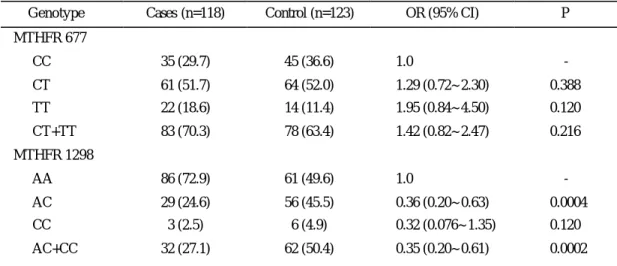
Table 1. Number of recurrent spontaneous abortion (RSA) cases and controls, adjusted ORs and 95% CIs by MTHFR
677, using 677CC as a reference, and MTHFR1298, using 1298AA as a reference
Genotype Cases (n=118) Control (n=123) OR (95% CI) P MTHFR 677
CC 35 (29.7) 45 (36.6) 1.0 -
CT 61 (51.7) 64 (52.0) 1.29 (0.72~2.30) 0.388
TT 22 (18.6) 14 (11.4) 1.95 (0.84~4.50) 0.120
CT+TT 83 (70.3) 78 (63.4) 1.42 (0.82~2.47) 0.216
MTHFR 1298
AA 86 (72.9) 61 (49.6) 1.0 -
AC 29 (24.6) 56 (45.5) 0.36 (0.20~0.63) 0.0004
CC 3 (2.5) 6 (4.9) 0.32 (0.076~1.35) 0.120
AC+CC 32 (27.1) 62 (50.4) 0.35 (0.20~0.61) 0.0002
Table 2. Number of recurrent spontaneous abortion (RSA) cases and controls, adjusted ORs and 95% CIs by MTHFR
677 and MTHFR 1298, using MTHFR 677CC and MTHFR 1298AA as a referenceMTHFR677 MTHFR1298 Case (%) Control (%) OR (95% CI) P
CC AA 19 (16.1) 14 (11.4) 1.0 -
CC AC 13 (11.0) 25 (20.3) 0.30 (0.10~0.88) 0.029
CC CC 3 (2.5) 6 (4.9) 0.49 (0.21~1.16) 0.103
CT AA 45 (38.1) 33 (26.8) 1.01 (0.76~1.33) 0.956
CT AC 16 (13.6) 31 (25.2) 0.77 (0.60~0.99) 0.043
CT CC - - - -
TT AA 22 (18.6) 14 (11.4) 1.03 (0.87~1.20) 0.953
TT AC - - - -
TT CC - - - -
대상으로 MTHFR 유전자 677번 nucleotide가 cyto- sine에서 thymine으로 그리고, 1298번 nucleotide가 adenine에서 cytosine으로의 돌연변이형에 대한 빈도 를 PCR/RFLP 방법으로 조사했다. Table 1에서 보는 것처럼 환자군에서 MTHFR 677CC, CT, TT type의 빈도는 각각 35 (29.7%), 61 (51.7%), 22 (18.6%)로 나 타났으며, 대조군에서는 각각 45 (36.6%), 64 (52.0%), 14 (11.4%)로 나타났다 (Table 1). 통계 분석상 MTH- FR C677T site에서는 환자군과 대조군 사이에서 유 의한 차이를 보이지 않았다. 또한, MTHFR 1298AA, AC, CC type의 빈도를 보면, 환자군에서는 86 (72.9%), 29 (24.6%), 3 (2.5%)로 나타났으며, 대조군에서는 61 (49.6%), 56 (45.5%), 6 (4.9%)로 각각 나타났다 (Table 1). 그런데, MTHFR C677T site에서와는 달리 MTH- FR A1298C site에서는 MTHFR 1298AC type에서 환 자군과 대조군에서 유의한 차이가 관찰되었다 (OR=
0.36, 95% CI=0.20~0.63; p=0.0004). 그런데, 놀랍게도 이 돌연변이 type에서 위험도가 증가하는 것이 아니 라 오히려 2.8배 감소하는 것으로 나타났다. 또한, MTHFR 1298AC와 1298CC type을 합하여 정상형인 1298AA type과 비교하였을 때도 유의한 차이가 관 찰되었다 (OR=0.35, 95% CI=0.20~0.61; p=0.0002).
MTHFR C677T와 A1298C의 조합형 유전자형의 비율을 보면, 677CC/1298AA, 677CC/1298AC, 677CC/
1298CC, 677CT/1298AA, 677CT/1298AC, 677TT/1298 AA형이 환자에서는 19 (16.1%), 13 (11.0%), 3 (2.5%), 45 (38.1%), 16 (13.6%), 22 (18.6%)로 나타났으며, 정 상대조군에서는 14 (11.4%), 25 (20.3%), 6 (4.9%), 33 (26.8%), 31 (25.2%), 14 (11.4%)로 각각 나타났다 (Ta- ble 2). 이들 중 677CC/1298AC (OR=0.23; 95% CI=
0.10~0.88; p=0.029), 677CT/1298AC (OR=0.77; 95%
CI=0.60~0.99; p=0.043) 조합형에서 대조군에 비하여 통계학적으로 유의하게 위험도가 감소하는 결과를 얻었다 (Table 2).
그러나, 돌연변이 대립유전자가 3개 이상으로 구 성된 677CT/1298CC, 677TT/1298AC, 677TT/1298CC 의 3가지 조합형 개체는 발견되지 않아서 착상이나 배 발생 기간 중 사망 (embryonic lethal)한 것으로 추 정된다.25 또한, 환자군과 대조군 모두에서 항상 MT- HFR 677TT 유전자형일 때는 1298AA형을 그리고, 1298CC형이면 677CC형을 갖는다. 이는 이들 대립
유전자들이 tight 하게 linked 되어 haplotype을 형성 하고 있기 때문으로 해석된다.26
고 찰
지금까지 1997년 Nelen 등22에 의해 처음으로 네 델란드 집단에서 MTHFR C677T 유전자 돌연변이 와 반복자연유산과의 관련성을 밝힌 이래, 2000년 에는 네델란드, 이탈리아, 프랑스, 이스라엘, 영국 등 5개 국가들의 data를 종합하여 그 관련성을 보 고한 바 있다.22~24 그러나 한국을 비롯한 일본, 그 리이스, 이탈리아, 아일랜드 집단 등에서는 MTHFR C677T site에서 이러한 유의한 결과가 발견되지 않 았다.2,3,27~32 또한, Kutteh 등33과 Brenner 등34 역시 MTHFR 677T T 동형접합성 돌연변이가 혈중 호모시 스테인량의 증가와는 관련이 있으나, 반복자연유산 과는 관련이 없다는 보고를 한 바 있다. 그러한 결 과들과 본 연구 결과를 종합하여 볼 때 MTHFR C677T 동형접합성 돌연변이에 의한 호모시스테인 량 증가에 대해서는 일치하는 견해를 보이지만, 이 로 인한 정맥 및 동맥성 혈전증에 의한 반복자연유 산 유발기전에 대해서는 아직 논란의 여지가 있다.
11,35
그러나, MTHFR C677T 유전자 돌연변이는 전자 간증 (preeclampsia), 태반조기박리 (placental abrup- tion), 태아의 신경판 결손증 (neural tube defect)과의 관련성이 널리 보고되고 있다.21,36 또한, 태반조기박 리의 경우 호모시스테인, MTHFR 돌연변이, activated Protein C resistance, Protein C 등의 thrombotic risk fac- tor들이 2개 중복될 때는 odd 비 값이 3.40 (95% CI=
1.80~6.42), 3개가 중복될 때는 6.83 (95% CI=1.52~
30.7)로 각각 나타나서 이들 인자가 태아의 출산에 영향을 미치고 있음을 알 수 있다.37
그리고, 최근 들어 보고된 MTHFR A1298C 돌연 변이와 MTHFR C677T/A1298C 돌연변이 조합형에 대한 연구에서 신경판 결손증, 태반 이탈증과의 관 련성이 보고된 바 있다.12,38 그러나, 본 연구에서는 놀랍게도 MTHFR 1298AC 돌연변이형이 반복자연 유산을 현저히 억제하는 것으로 조사되었다 (Table 1; p=0.0004). 또한, MTHFR 1298AC와 1298CC 돌연 변이형 개체를 합하여 정상형인 MTHFR 1298AA와 비교하였을 때도 역시 2.9배 억제하는 결과를 얻었
다 (Table 1; p=0.0002). 이러한 결과는 반복자연유산 환자에서는 최초로 보고되는 것으로 매우 흥미롭다.
이와 유사한 결과는 림프종 (lymphoma), 급성 백혈 병, 대장암 등에서는 이미 보고된 바 있다.9,39 그런 데 이들의 연구 결과 folate 공급이 중요하여서 MT- HFR 돌연변이형이라 할지라도 folate deficiency 인 사 람에서는 암 억제효과가 나타나지 않음을 보고하였 다.40~42
MTHFR 유전자 돌연변이는 이 효소의 활성을 떨 어뜨리며, 이러한 활성감소는 고호모시스테인혈증을 일으킨다. 또한, MTHFR 효소의 활성은 호모시스테 인 대사과정에 관련된 vitamin B12, 엽산 (folic acid) 혹은 메티오닌 등의 아미노산의 인위적인 공급에 의해 MTHFR 유전자 돌연변이에 의한 효소활성의 감소를 극복할 수 있다는 연구 결과들이 발표되고
있다.18,43 이와 같이, 임신 기간 동안 folic acid의 투
여에 의해 쉽게 정상 치를 회복할 수 있는 등 유전 자 이상이 환경 (영양)에 의해 교정될 수 있기 때문 에 그 영향을 밝히기가 쉽지 않다.44
MTHFR 유전자 돌연변이나 엽산 결핍은 methy l THF에 의한 메틸기의 공급부족을 야기하며, 이로 인해 유전자 발현을 조절하는 promoter나 CpG island 부위에 영향을 줄 수 있다. 또는, tumor suppressor gene이나 proto-oncogene에 돌연변이를 유발하여 암 발생의 원인으로 작용할 수 있다. 그러나 이러한 돌연변이형은 dUMP가 dTMP를 형성하는데 필요한 methyl기 (5,10-methylene THF)의 공급은 더욱 원활 하게 되어 "dTMP stress"는 오히려 줄어들게 된다.
더구나, 대장암 (colorectal cancer)과 급성 백혈병 (ac- ute lymphocytic leukemia)의 경우는 C677T 와 A1298C 돌연변이형에서 오히려 발병률이 낮은 것으로 보고 되었다.39,41,45
또한, MTHFR A1298C 돌연변이형과 C677T/A1298C compound heterozygosity 빈도에 대한 연구는 세계적 으로 보고된 적이 거의 없어서 한국인 가임 여성에 서의 연구 결과는 매우 의미있는 것으로 생각된다.
특히, MTHFR C677T와 A1298C 돌연변이는 동일한 유전자 내의 상호작용의 결과로 3개 이상의 돌연변 이 대립유전자들로 이루어진 677CT/1298CC, 677TT/
1298AC, 677TT/1298CC형은 나타나지 않고 있으며, 이러한 결과는 MTHFR의 C677T 과 A1298C 유전자
변이들간에 상호작용이 있음을 추정할 수 있다 (Ta- bles 1 and 2).
결론적으로, 원인불명의 반복자연유산 환자에서 MTHFR 유전자 돌연변이, 혈중 folate량, homocys- teine량 등에 대한 종합적인 조사가 필요하며, 연구 기간 중의 folic acid 복용 여부와 식이 조절에 대한 전반적인 고려가 요구된다. MTHFR은 대표적인 환 경 조절 유전자로 그 나라의 민족적 유전자 구성, 야채섭취 등의 식습관과 관련지어 종합적인 판단이 요구된다. 더구나, MTHFR 유전자 돌연변이의 경우, 질환에 따라 위험인자 혹은 예방인자로 서로 다르 게 작용할 수 있으므로 각 질환의 정확한 발병기전 에 대한 이해가 요구된다. 특히, 지금까지 반복자연 유산 환자에서 주로 MTHFR 677TT 동형접합성 돌 연변이 출현에만 관심을 가져왔으나, A1298C 돌연 변이에 의한 유산의 억제기작에 대한 보다 많은 집 단에서의 연구가 요구된다.
참 고 문 헌
1. Younis JS, Ohel G, Brenner B, Ben-Ami M. Fami- lial thrombophilia--the scientific rationale for throm- bophylaxis in recurrent pregnancy loss? Hum Re- prod 1997; 12(7): 1389-90.
2. Raziel A, Kornberg Y, Friedler S, Schachter M, Sela BA, Ron-El R. Hypercoagulable thrombophilic defects and hyperhomocysteinemia in patients with recurrent pregnancy loss. Am J Reprod Immunol 2001; 45(2): 65-71.
3. Yamada H, Kato EH, Kobashi G, Ebina Y, Shimada S, Sakuragi N, Fujimoto S. Recurrent pregnancy loss:
Etiology of thrombophilia. Semin Thromb Hemost 2001; 27: 121-9.
4. McCully KS. Vascular pathology of homocysteine- mia: implications for the pathogenesis of arterios- clerosis. Am J Pathol 1969; 56: 111-28.
5. Loscalzo J. The oxidant stress of hyperhomocyst (e)inemia. J Clin Invest 1996; 98: 5-7.
6. Chango A, Boisson F, Barbe F, Quilliot D, Droesch S, Pfister M, Fillon-Emery N, Lambert D, Fremont S, Rosenblatt DS, Nicolas JP. The effect of 677
C-->T and 1298A-->C mutations on plasma ho- mocysteine and 5,10-methylenetetrahydrofolate re- ductase activity in healthy subjects. Br J Nutr 2000;
83(6): 593-6.
7. Fodinger M, Wagner OF, Horl WH, Sunder-Plass- mann G. Recent insights into the molecular genetics of the homocysteine metabolism. Kidney Int 59 Supp1 2001; 78: S238-42.
8. Jakubowski H, Zhang L, Bardeguez A, Aviv A.
Homocysteine thiolactone and protein homocyste- inylation in human endothilial cells: implications for atherosclerosis. Circ Res 2000; 87(1): 45-57.
9. M atsuo K, Suzuki R, Hamajima N, Ogura M, Ka- gami Y, Taji H, Kondoh E, Maeda S, Asakura S, Kaba S, Nakamura S, Seto M, Morishima Y, Tajima K. Association between polymorphisms of folate- and methionine- metabolizing enzymes and suscep- tibility to malignant ly mphoma. Blood 2001; 97(10):
3205-9.
10. Kang SS, Wong PW, Susmano A, Sora J, Norusis M, Ruggie N. Thermolabile methylenetetrahydro- folate reductase: an inherited risk factor for coro- nary artery disease. Am J Hum Genet 1991; 48(3):
536-45.
11. Frosst P, Ma HJ, Milos R, Goytte P, Sheppard CA, Matthew Boers GJH, den Heijer M, Kluijtmans AJ, van der Heuvel LP, Rozen R. A candidate genetic risk factor for vascular disease: a common mutation in methylenetetrahydrofolate reductase. Nat Genet 1995; 10: 111-3.
12. van der Put NMJ, Gabreels F, Stevens EM, Smei- tink JA, Trijbels FJ, Eskes TK, van der Heuvel LP, Blom HJ. A second common mutation in the me- thylenetetrahydrofolate reductase gene: an additi- onal risk factor for neural tube defects? Am J Hum Genet 1998; 62: 1044-51.
13. Kim NK, Kang GD, Kim HJ, Kim SH, Nam YS, Lee S, Chung HM, Kang SH, Ahn JY, Choi BO, Hwang SG, Oh D. Genetic polymorphisms of 5, 10-methylenetetrahydrofolate reductase (MTHFR C677T and A1298C) in healthy Korean. Korean J
Genetics 2002; 24(2): 227-34.
14. de Franchis R, Mancini FP, D'Angelo A, Sebastio G, Fermo I, de Stefano V, Margaglione M, Mazzola G, di Minno G, Andria G. Elevated total plasma homocysteine and 677C-->T mutation of the 5,10- methylenetetrahydrofolate reductase gene in throm- botic vascular disease. Am J Hum Genet 1996; 59 (1): 262-4.
15. Jacques PF, Rosenberg IH, Rogers G, Selhub J, Bowman BA, Gunter EW, Wright JD, Johnson CL.
Serum total homocysteine concentrations in ado- lescent and adult Americans: results from the third National Health and Nutrition Examination Survey.
Am J Clin Nutr 1999a; 69(3): 482-9.
16. Lentz SR, Sobey CG, Piegors DJ, Bhopatkar MY, Faraci FM, Malinow MR, Heistad DD. Vascular dysfunction in monkeys with diet-induced hyper- homocyst(e)inemia. J Clin Invest 1996; 98(1): 24-9.
17. Malinow MR, Duell PB, Hess DL, Anderson PH, Kruger WD, Phillipson BE, Gluckman RA, Block PC, Upson BM. Reduction of plasma homocyst (e)ine levels by breakfast cereal fortified with folic acid in patients with coronary heart disease. N Engl J Med 1998; 338(15): 1009-15.
18. Nelen WLDM, Blom HJ, Thomas CMG, Steegers EAP, Boers GHJ, Eskes TKAB. Methylenetetrahyd- rofolate reductase polymorphism affects the change in homocysteine and folate concentrations resulting from low dose folic acid supplementation in women with unexplained recurrent miscarriages. J Nutr 1998; 128: 1336-41.
19. Jacques PF, Selhub J, Bostom AG, Wilson PW, Rosenberg IH. The effect of folic acid fortification on plasma folate and total homocysteine concen- trations. N Engl J Med 1999b; 340(19): 1449-54.
20. Murua AL, Quintana I, Janson J, Batista M, Camera MI, Kordich LC. Plasmatic homocysteine response to vitamin supplementation in elderly people. Th- romb Res 2000; 100(6): 495-500.
21. Kupferminc MJ, Eldor A, Steinman N, Many A, Bar-Am A, Jaffa A, Fait G, Lessing JB. Increased
frequency of genetic thrombophilia in women with complications of pregnancy. Lancet 1999; 340(1):
9-13.
22. Nelen WL, Steegers EA, Eskes TK, Blom HJ. Ge- netic risk factor for unexplained recurrent early pre- gnancy loss. Lancet 1997; 350(9081): 861.
23. Nelen WLDM, Blom HJ, Steegers EAP, den Heijer M, Eskes TKAB. Hyperhomocysteinemia and recu- rrent early pregnancy loss. Fertil Steril 2000; 74(6):
1196-9.
24. Quere I, Bellet H, Hoffet M, Janbon C, Mares P, Gris JC. A women with five consecutive fetal dea- ths: case report and retrospective analysis of hyper- homocysteinemia prevalence in 100 consecutive wo- men with recurrent miscarriages. Fertil Steril 1998;
69(1): 152-4.
25. Isotalo PA, Wells GA, Donnelly JG. Neonatal and fetal methylenetetrahydrofolate reductase genetic po- lymorphisms: an examination of C677T and A1298C mutation. Am J Hum Genet 2000; 67(4): 986-90.
26. Rosenberg N, Murata M, Ikeda Y, Opare-Sem O, Zivelin A, Geffen E, Seligsohn U. The frequent 5, 10-methylenetetrahydrofolate reductase C677T po- lymorphism is associated with a common hyplotype in whites, Japanese, and Africans. Am J Hum Genet 2002; 70: 758-62.
27. Holmes ZR, Regan L, Chilcott I, Cohen H. The C677T MTHFR gene mutation is not predictive of risk for recurrent fetal loss. British J Haematol 1999;
105: 98-101.
28. Lissak A, Sharon A, Fruchter O, Kassel A, San- derovitz J, Abramovici H. Polymorphism for muta- tion of cytosine to thymine at location 677 in the methylenetetrahydrofolate reductase gene is asso- ciated with recurrent early fetal loss. Am J Obstet Gynecol 1999; 181(1): 126-30.
29. Grandone E. Methylenetetrahydrofolate reductase (MTHFR) 677T->C mutation and unexplained early pregnancy loss. Thromb Haemost 1998; 79: 1056-7.
30. Murphy RP, Donoghue C, Nallen RJ, D'Mello M, Regan C, Whitehead AS, Fitzgerald DJ. Prospective
evaluation of the risk conferred by factor V Leiden and thermolabile methylenetetrahydrofolate reductase polymorphism in pregnancy. Artherios- cler Thromb Vasc Biol 1999; 20: 266-70.
31. Foka ZJ, Lambropoulos AF, Saravelos H, Karas GB, Karavida A, Agorastos T, Zournatzi V, Makris PE, Bontis J, Kotsis A. Factor V leiden and prothrombin G20210A mutations, but not methylenetetra- hydrofolate reductase C677T, are associated with recurrent miscarriages. Hum Reprod 2000; 15(2):
458-62.
32. Nam YS, Cha KY, Kim NK, Kim SH, Lim JW, Kang GD, Kang MS, Kim SH, Oh D. The analysis of methylenetetrahydrofolate reductase mutation in recurrent spontaneous abortion. Kor J Fertil Steril 2001; 28(3): 247-53.
33. Kutteh WH, Park VM, Deither SR. Hypercoagu- lable state mutation analysis in white patients with early first-trimester recurrent pregnancy loss. Fertil Steril 1999; 71(6): 1048-53.
34. Brenner B, Sarig G, Weiner Z, Younis J, Blumenfeld Z, Lanir N. Thrombophilic polymorphisms are com- mon in women with fetal loss without apparent cause.
Thromb Haemost 1999; 82(1): 6-9.
35. Kluijtmans LA, Boers GH, Verbruggen B, Trijbels FJ, Novakova IR, Blom HJ. Homozygous cystath- ionine beta-synthase deficiency, combined with fac- tor V Leiden or thermolabile methylenetetrahydro- folate reductase in the risk of venous thrombosis.
Blood 1998; 91(6): 2015-8.
36. Eskes TK. Homocysteine and human reproduction.
Clin Exp Obstet Gynecol 2000; 27(3-4): 157-67.
37. van der Molen EF, Arends GE, Nelen EL, van der Put NJ, Heil SG, Eskes TK, Blom HJ. A common mutation in the 5,10-methylenetetrahydrofolate re- ductase gene as a new risk factor for placental va- sculopathy. Am J Obstet Gynecol 2000; 182(5):
1258-63.
38. Gebhardt GS, Scholtz CL, Hillermann R, Odendaal HJ. Combined heterozygosity for methylenetetra- hydrofolate reductase (MTHFR) mutations C677T
and A1298C is associated with abruptio placenta but not with intrauterine growth restriction. Eur J Obstet Gynecol Reprod Biol 2001; 97: 174-7.
39. Skibola CF, Smith MT, Kane E, Roman E, Rol- linson S, Cartwright RA, Morgan G. Polymorphism in the methylenetetrahydrofolate reductase gene are associated with susceptibility to acute leukemia in adults. Proc Natl Acad Sci USA 1999; 96: 12810-5.
40. Ma J, Stampfer MJ, Giovannucci E, Artigas C, Hunter DJ, Fuchs C, Willett WC, Selhub J, Hen- nekens CH, Rozen R. Methylenetetrahydrofolate reductase polymorphism, dietary interactions, and risk of colorectal cancer. Cancer Res 1997; 57(6):
1098-102.
41. Chen J, Giovannucci E, Kelsey K, Rimm EB, Stampfer MJ, Colditz GA, Spiegelman D, Willett WC, Hunter DJ. A methylenetetrahydrofolate re- ductase polymorphism and the risk of colorectal cancer. Cancer Res 1996; 56: 4862-4.
42. Chen J, Giovannucci EL, Hunter DJ. MTHFR po-
lymorphism, methyl-replete diets and the risk of colorectal carcinoma and adenoma among U.S. men and women: an example of gene-environment inter- actions in colorectal tumorigenesis. J Nutr 1999;
129 (2S Suppl): S560-4.
43. Nappo F, De Rosa N, Marfella R, De Lucia D, Ingrosso D, Perna AF, Farzati B, Giugliano D.
Impairment of endothelial functions by acute hyper- homocysteinemia and reversal by antioxidant vita- mins. JAMA 1999; 281(22): 2113-8.
44. Wouters MGAJ, Thomas CMG, Boers GHJ, Borm GF, Blom HJ, Steegers-Theunissen RPM, Trijbels FJM, Eskes TKAB. Hyperhomocysteinemia: a risk factor in women with unexplained recurrent early pregnancy loss. Fertil Steril 1993; 60(5): 820-5.
45. Wiemels JL, Smith RN, Taylor GM, Eden OB, Alexander FE, Greaves MF. Methylenetetrahydro- folate reductase (MTHFR) polymorphisms and risk of molecularly defined subtypes of childhood acute leukemia. Proc Natl Acad Sci 2001; 98(7): 4004-9.