Journal of Internet Computing and Services(JICS) 2015. Aug.: 16(4): 71-81 71
A Content Analysis for Website Usefulness Evaluation:
Utilizing Text Mining Technique
☆Do Young Kwon11) Seung Ryul Jeong1*
ABSTRACT
With the increasing influence of online media, company websites have become important communication channels between companies and customers. Companies use their websites as a marketing tool for a variety of purposes, including enhancing their image and selling products or services. Many researchers have examined the criteria, methods, and tools for website evaluation, but most have focused on usability. Prior content analyses have focused not on text content but on website components, an approach likely to produce subjective evaluations. This study attempts to objectively evaluate company websites by utilizing text mining. We analyze the usefulness of company websites by presenting visualized outputs from a business perspective, allowing practitioners to easily understand the results of the website evaluation and use them in decision making. To demonstrate our method empirically, we selected a company with a number of affiliates in Korea and analyzed the text content of their websites to assess their usefulness using natural language processing and graphics packages in R. Practitioners can easily employ our objective evaluation method, and researchers can use it to gain a new perspective on website evaluation.
☞ keyword : text mining, website evaluation, content analysis, Usefulness, Usability
1. Introduction
As information technology develops and as the World Wide Web expands, the influence of online media increases, and the business environment changes. Company websites have become important communication channels between companies and customers [1, 2, 3]. Company websites are intended to not only sell products and services but also improve the firm’s image by promoting it and its brands [4, 5]. Buyers want the websites to give them information about products and services [6]. For example, people wishing to purchase a book seek information about it and decide to purchase it by connecting to an e-bookstore such as amazon.com. People seeking to invest will find information about the financial strength and core businesses of companies and decide whether to invest by visiting their
1 Graduate School of Business IT, Kookmin University, Seoul, 136-702, Korea
* Corresponding author ([email protected])
[Received 30 April 2015, Reviewed 4 May 2015, Accepted 27 July 2015]
☆ A preliminary version of this paper was presented at ICONI 2014 and was selected as an outstanding paper.
websites. Thus, companies should meet the needs of their website visitors and convert them into customers by making them want to revisit [5, 7, 8, 9]. Thus, it is possible to obtain a competitive advantage through a company website [10, 11].
What is a good website, and how do companies take advantage of a website to gain competitive advantage? The answers depend on the company’s capability to manage its website. Companies provide information about their businesses, products, and services and sell them through their website. Visitors purchase products and services or decide to invest based on the information on the website. If the content of website is useful, it is considered a good website. Therefore, we propose a new approach that can be used to evaluate the usefulness of website, focusing on the extent to which company’s websites deliver what they are supposed to do.
Many researchers have attempted to evaluate websites and proposed a variety of criteria, methods, and techniques [5, 12]. Most studies, however, have proposed specific evaluation criteria for various properties of website and have used methods such as inspection, testing, and inquiry to identify the problems that occur while performing a specific ISSN 2287-1136 (Online)
http://www.jksii.or.kr
set of tasks. However, these evaluation results cannot be considered objective, as the assessment criteria and evaluation itself were judged subjectively by researchers or evaluators. In addition, there is little research on actual website content. Companies want to know whether their messages are being well-delivered to visitors through their website from business point of view. Thus, our primary goal of this study is to fill the research gaps by objectively evaluating usefulness of website by analyzing their contents.
We would also like to present how to use visualized deliverables, including graphs and word clouds, to help website owners understand the evaluation results.
2. LITERATURE REVIEW
These days, evaluating how much websites meet the needs of users or visitors is one of important issues.
Accordingly, this has been studied extensively in the fields of systems development, e-business, and information resource management.
One of distinct research groups studying website evaluation is based on notions of “user experiences” (UX) and “human–computer interaction” (HCI). ISO 9241-210 defines UX as a “person’s perceptions and responses that result from the use and/or anticipated use of a product, system or service” [13]. UX is the main objective of HCI [14]. Traditional HCI focuses on the principles and methods that may be useful for developing computer systems; it involves human, computer, and interaction (interface) elements. However, Web 2.0 has guided to the new HCI 2.0 era that encompasses HCI for all interactions between systems and humans, not just system interfaces. The principles of HCI (i.e., usefulness, usability, affect) must be satisfied to ensure the best user experience. From the UX point of view, companies have to meet the needs of website visitors for their satisfaction in all three principles.
A number of researchers have conducted studies on user experience and satisfaction [1, 4, 6, 7, 15, 16, 17]. In particular, Chen and Macredie [1] argue that the website meeting users’ needs derives their enjoyment and increases value of purchase. Zhang and Von Dran [7] also assert the importance of user satisfaction and propose a two-factor
model for website design and evaluation by applying the motivator hygiene theory. They argue that well organized information of website can facilitate navigation and report unique results of their factor. Most criteria can be classified into motivator and hygiene factor groups. But, the factors related information have characteristics both motivator and hygiene. Petre et al. [15] develop an empirically grounded evaluation tool and integrate the perspectives and strategies of customer relationship management and HCI to demonstrate its assessment of the customer experience.
However, they only focus on usability of interfaces and this does not seem to be sufficient to overall customer experience. So, they attempt to understand consumers’ needs and perceptions concerning service quality on shopping and travel websites. Wang and Zhou [6] apply opinion mining techniques to analyze the review data. They claim that their proposed evaluation approach, which is designed to understand customers’ reactions, is more effective than traditional website evaluation methods.
There are also many studies related to specific users [18, 19, 20]. With the increasing needs in HCI for disabled users, One HCI study proposes a new evaluation method based on the website evaluation processes of disabled users to overcome the limitations of previous techniques [18]. A similar study formed two assessment groups comprising six disabled and six non-disabled people and analyzed the correlations between the accessibility and usability of a website in terms of the interaction between it and the users [19]. Both studies report that there are significantly differences between blind and sighted people. The specific problems happened to only blind users and some of the problems only encountered by sighted users because of visual effects in website.
The studies on UX can be divided into three categories with its principles: usefulness, usability, and affect.
However, the majority of researchers conduct a study on usability with content or usefulness in their assessment criteria.
ISO 9241-11 defines “usability” as the “extent to which a product can be used by specified users to achieve specified goals with effectiveness (Task completion by users), efficiency (Task in time) and satisfaction (responded by user in term of experience) in a specified context of use (users,
tasks, equipment and environments)” [21]. Dumas et al. [22]
claim that “usability means that the people who use the product can do so quickly and easily to accomplish their own tasks”. Furthermore, Shneiderman [23] introduces a concept of “universal usability” as the state of “having more than 90% of all households as successful users of information and communications services at least once a week”. This notion of “universal usability” broadens the definition of “usability.”
A number of new methodologies, tools, and techniques are proposed to assess the usability of website and improve them [9, 11, 24, 25, 26, 27, 28, 29, 30]. The majority of them contains the criterion on navigation [11, 24, 25, 27, 28, 29]. Cebi [25] proposes a new quality evaluation model and claims that the technical adequacy is the most important characteristic. It is a superordinate concept to include navigation, accessibility, speed, and system availability.
Elling et al. [27] propose a new methodology for evaluating the websites. The website evaluation questionnaire that they propose has seven multi-dimensional structure (i. e., ease of use, hyperlinks, structure, relevance, comprehension, completeness, and layout). They argue that three dimensions (ease of use, hyperlink, and structure) are sub categories of navigation and these dimensions are associated with accessibility.
On the other hand, Petre et al. [15] insist that, regardless of usability of website, customers can not be satisfied with website. In addition, Chi [26] suggests a predictive visualization model called “Information Scent” in order to improve web usability by uncovering patterns and defects in information accessibility. He argues that it would be helpful to understand the complex relationships between information producers and consumers by analyzing web content changes, connection structures, and site usage and visualizing the results. Dreze and Zufryden [31] develop a methodology for evaluating the design and effectiveness of promotional content based on six categories. The objective of their study is to evaluate website content, but they also investigate how to deliver the content to visitors. Empirically analyzing the websites of three Greek mobile phone service providers through the analytic hierarchy process, Moustakis et al. [28]
propose a hierarchical framework for the assessment of websites quality with five categories such as content,
navigation, design and structure, appearance and multimedia, and uniqueness. They demonstrate the relevance and usefulness are very important factor for website evaluation.
Although many researchers have studied on usability, there are relatively a few research on usefulness of website especially dealing with content of it. In addition, most of these studies do not analyze actual content of website but assess it with dichotomous criterion [2, 7, 11, 32]. Robbins and Stylianou [2] investigate the content and design of global corporate websites. They define evaluation criteria based on content and design. But they recognize the content as a component. Baloglu and Pekcan [11] evaluate hotel websites in Turkey with marketing perspective. They utilize content analysis but analyze only whether or not the specific content exists. These dichotomy website evaluations, however, are not able to assess whether their message is well-delivered.
Govers and Go [33] analyze content of website with pictures and text. They use frequency of content on images and words. This method also does not inform us whether derived keywords are well-delivered to the visitors or whether the content of website is appropriate or not.
There are studies focusing on the ‘affect’, where researchers investigate the influence of website design on the user’s affect. Some researchers have analyzed how user perceptions of and satisfaction with websites differ depending on the users’ culture and gender and their response to website design elements such as color, shapes, and images [34, 35]. These researchers demonstrate that users prefer different colors depending on their culture or gender and that their perceptions and satisfaction also differ.
These studies emphasize the importance of emotional factors such as user enjoyment and loyalty. Thielsch and Hirschfeld [36] studies aesthetic website evaluation and argue that user evaluation varies depending on the visual information provided. Ivory and Hearst [37] create a measurement tool called “quality checker,” which operates like the spell-checker of a word processor, and demonstrate an automated approach to improving website design that quantitatively measures the navigation graphics in website information.
3. RESEARCH FRAMEWORK
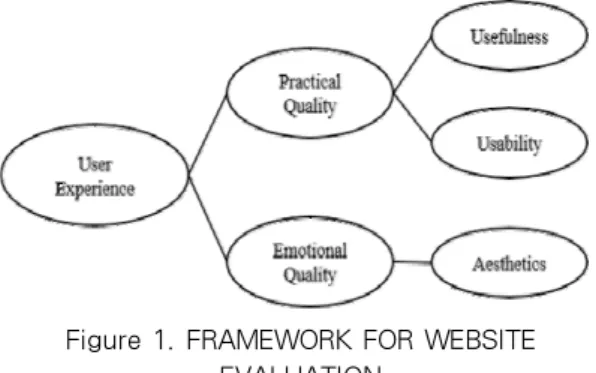
3.1 INTEGRATED USER EXPERIENCE The main objective of HCI is UX. The conditions for optimal UX are usefulness, usability, and affect [14]. User satisfaction is one of a website designer’s goals [7]. We considered usefulness and usability as practical qualities and aesthetics as an emotional quality.
We evaluated usefulness through content analysis.
Because the quality of content is a significant factor in evaluating website usability [9], UX is an important part of determining website quality [16]. Many researchers who have performed website evaluation have used numerical or categorical variables as objects of evaluation. However, we evaluated website usefulness through content.
Figure 1. FRAMEWORK FOR WEBSITE EVALUATION
3.2 PHASES OF ASSESSING USEFULNESS
Figure 2. WEBSITE USEFULNESS EVALUATION STAGES
Our proposed approach to assessing the usefulness of companies’ websites consists of four steps shown in Figure 2. For our data collection and analysis, we applied the methodology of Kim and Jeong [38], which offers a new method of social media analysis through opinion mining.
In the first phase, evaluators collect text content to assess the usefulness of the website. These raw data include HTML tags, special characters, and stop words. The second stage of our approach is pre-processing these data to analyze website content using natural language processing (NLP). After the purifying process, the website content is analyzed for usefulness. The third phase consists of two parts: analyzing the degree of the matching between keywords and website content and assessing the relevance of the keywords for website administrators and/or content developers. Most companies try to publicize certain content in order to convey a message. The last phase of website usefulness evaluation is reporting and visualizing the analysis results using visible deliverables. Practitioners can easily report and visualize the results using an R package.
3.3 CONTENT ANALYSIS
Most studies on content analysis have used dichotomies to assess website content [2, 7, 11, 32], applying the subjective judgments of researchers or evaluators [4, 24, 27, 28, 29, 39, 40, 41]. Many researchers have evaluated websites according to whether specific content is or is not there or whether it is accurate or not. The results of such evaluations reflect subjective assessments because the researchers selected evaluation factors they believed important based on previous studies’ experiments or surveys.
Researchers have performed content analysis by measuring the frequency of certain images or text on a tourism website [33]. Other researchers have conducted web content analysis using a new mechanism evolved from previous studies [42]. They argued that insights into the characteristics of internal ranking mechanisms can be obtained through their method. To overcome the abovementioned limitations in earlier evaluation methods, we propose an objective evaluation method that analyzes text content and empirically determines whether the website is providing content to users effectively.
4. CASE STUDY
4.1 CASE COMPANIES
We selected a company with a number of affiliates in Korea for our website content analysis. The case companies were chosen from among four affiliates with websites.
A is the website of a holding company that wants to enhance the company’s image by providing information such as its corporate philosophy, financial information, and social contributions. B is the website of a recruitment firm that uses the website to deliver information such as human resource systems and job opportunities to visitors considering joining the company; the website is also used to manage the overall recruitment process. C is the website of a firm that manufactures and sells both health and conventional foods. The website promotes their research development and quality control efforts and provides information about the health-oriented products they manufacture. Finally, D is the website of a firm that provides exercise program solutions. Their services are offered by professionals with expertise and qualifications. D offers a range of information on exercising and programs.
Each company’s website has a different purpose (i.e., enhancing their image, promoting their products, providing information, or selling their services).
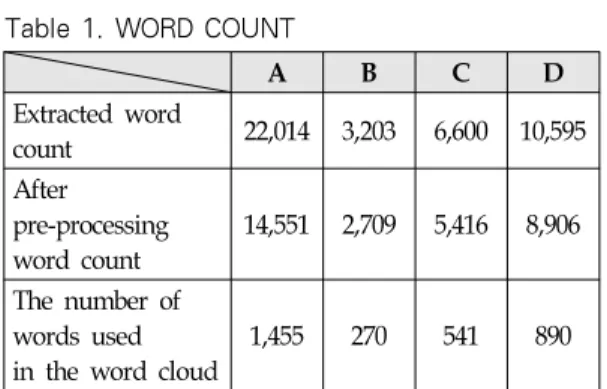
4.2 DATA COLLECTION AND ANALYSIS The first stage of our analysis was collecting text content from the websites using a scraping software tool. We searched the entire body of the text, except for the top and left side of the menu bar, the address, and the information at the bottom. In the second stage, we purified the text content data collected from the websites. The data were refined using natural language processing (NLP) to remove HTML codes and special characters. For pre-processing, we used the R package and Excel. The numbers of words used in the analysis are presented in Table 1 below.
Table 1. WORD COUNT
A B C D
Extracted word
count 22,014 3,203 6,600 10,595
After pre-processing word count
14,551 2,709 5,416 8,906
The number of words used in the word cloud
1,455 270 541 890
We conducted the content analysis after modifying the dictionary to include specific words derived from the websites in the third stage. In the final stage, the content analysis results were presented in visualized outputs using the R package, which practitioners can easily understand and use in their decision making according to whether the message they want to deliver to website visitors is being effectively conveyed. The visualized outputs of content analysis are more easily understood than statistically rendered results.
4.3 RESULTS
Table 2 shows the matches for the keywords the website owners wish to deliver based on the website content. We calculated the matching degree of the keywords by determining whether each was included in the top 10%
exposure frequency of each website. The matching degree of B was the highest and that of A was the lowest. A top 10%
frequency is deemed good; we used the results to form the word clouds presented below.
Table 2. MATCHING DEGREE OF KEYWORDS
A B C D
No. of keywords
of the owner 12 6 12 16
No. of Matching
keyword 7 6 11 12
Matching degree 58.3% 100% 91.6% 75.0%
We evaluated the four websites based on the relevance of the keywords and their matching degree as follows. The website evaluation consists of two steps. The object of the first assessment is the matching degree of the keywords. The
underlying rationale for this is that visitors should be receptive to the content of the website. A website must use certain words repeatedly because it is necessary to impact the user through them. When visitors skim through a website, the content does not remain in their memory, no matter how well-made the website is. The second object is the relevance of the keywords. If the keywords the website owners want to deliver to visitors are not important but merely menu names or other marginal items, it is clear that they did not care about the website content. Therefore, we evaluated whether they cared about matches between the keywords and their company’s website content. Website owners can determine whether content developers have performed their work properly by evaluating the adequacy of these keywords.
Table 3. WEBSITE EVALUATION RESULTS Matching degree
of keywords
Relevance of
keywords Website
High Appropriateness C
High Inappropriateness B
Low Appropriateness D
Low Inappropriateness A
4.4 VISUALIZED OUTPUT
The word cloud is a visualized deliverable showing the results of the text content analysis. The size and color of the words reflect the volume of the content; this allows business users to easily and intuitively understand the evaluation results [38, 43]. Figures 3, 4, 5, and 6 visualize the words extracted at high frequencies from each website.
Figure 3. WORD CLOUD OF A
The most significant word relates to the subsidiaries and the parent company, because the companies’ histories, news, and social contribution activities are all related. As the website A was created not just for the subsidiary but for the image enhancement of the entire group. So, the content of A must provide visitors with information such as the management philosophy and social contribution activities by using many keywords such as “health,” “growth,” “society,” and “volunteer.”
Figure 4. WORD CLOUD OF B
B is the website of a recruitment firm. So, their website largely features keywords consistent with its function, such as
“recruitment,” “schedules,” “growth,” “interview,” and
“confirmation.” However, some content did not appear clearly, such as information on the firm’s human resources, core values, and job-related information prospective employees would want to know. Thus, the content was not properly delivered.
Figure 5. WORD CLOUD OF C
Figure 5 indicates that the main keywords for the health and conventional food company included “product,”
“intake,” and “food.” This is understandable given the purpose of website C. This word cloud was derived because most of the content was product-related information. Website C delivered its content to visitors effectively since the word cloud was consistent with the information the website owners want to convey.
Figure 6. WORD CLOUD OF D
In Figure 6, the most significant keyword is “exercise.”
As the firm that maintains website D provides exercise programs, much of the content on this website is related to exercise, but there is too much of it: the frequency of
“exercise” is 2,803, almost 4.5 times that of “muscles” (its frequency is 628 and is colored yellow-green).
5. CONCLUSIONS
We selected four websites of a company with multiple subsidiaries in Korea and conducted a content analysis to assess their usefulness using text mining. We found that the company C designed its website properly to convert visitors into customers by providing necessary product information.
Website B, for recruitment, is relatively effective. The content on D was also relatively useful. The content of A, however, did not effectively convey the information the website owner wanted to deliver or that visitors would want.
Representing the results of the content assessment as word clouds allows the website owners to intuitively understand
the evaluation results on the usefulness of their websites and use them in decision making.
A number of researchers have proposed evaluation criteria, methods, and techniques for website assessment, but few studies have been conducted on usefulness assessments for websites, and the evaluation results are difficult to understand. Our approach enables a visual understanding of usefulness evaluation results. This study has several implications.
First, current study was performed objectively to assess website content. Although previous studies established evaluation criteria, they were subjective because the researchers had selected those evaluation criteria that they deemed important. Also they evaluated the criteria using their own judgment. By contrast, our evaluation method takes a more objective perspective. We only analyzed the text content of websites as it is.
Second, this study conducted content analysis. The focus of our assessment is the visible content that visitors can cognitively process through the website. We applied text mining for website content evaluation using unstructured text content data. Most studies on content analysis have employed dichotomies to assess website content, such as the presence or absence of certain items. And it is difficult to evaluate all of the content on a website. Also, these analyses often fail to analyze unstructured data to discover business insights. However, we empirically evaluated usefulness of content by analyzing them in response to the owner’s purpose to deliver message to website visitors. Thus, practitioners who take advantage of the evaluation method proposed in this study will be able to complete their content analysis by using our approach as a supplement to other website evaluation methods.
Third, the visualized results demonstrated in this study can help business users understand their websites evaluation results. These outputs will be particularly valuable to the business practitioners who want to evaluate their website.
Also, using the results of this study and performing the appropriate user test will allow them to evaluate their websites more effectively and practically.
Our study also has limitations. It does not measure the reactions of website visitors because we analyze only the content of the websites. We tried to analyze the keywords
that matched the characteristics of the websites and determine whether the keywords were what the owners wanted to deliver to visitors. However, doing so did not assess how the users (visitors) accepted the information the owners wished to deliver. This gap could be addressed through a heuristic or user testing with the evaluation method in future research.
References
[1] S. Y. Chen, and R. D. Macredie, “The assessment of usability of electronic shopping: A heuristic evaluation,”
International Journal of Information Management, Vol.
25, No. 6, pp. 516–532, 2005.
http://dx.doi.org/10.1016/j.ijinfomgt.2005.08.008 [2] S. S. Robbins, and A. C. Stylianou, “Global corporate
web sites: an empirical investigation of content and design”, Information & Management, Vol. 40, No.3, pp.
205–212, 2003.
http://dx.doi.org/10.1016/s0378-7206(02)00002-2 [3] T. W. Gu, S. J. Hong, and K. M. Lee, "Design and
Implementation of Personal Preference Module on Web Service." Journal of Internet Computing and Services (JICS) Vol. 10, No. 4, pp. 161-176. 2009.
http://www.dbpia.co.kr/Article/1070615
[4] A. M. Aladwani, and P. C. Palvia, “Developing and validating an instrument for measuring user-perceived web quality”, Information & Management, Vol. 39, No.
6, pp. 467–476, 2002.
http://dx.doi.org/10.1016/s0378-7206(01)00113-6 [5] W. C. Chiou, C. C. Lin, and C. Perng, “A strategic
framework for website evaluation based on a review of the literature from 1995–2006”, Information &
Management, Vol. 47, No.5-6, pp. 282–290, 2010.
http://dx.doi.org/10.1016/j.im.2010.06.002
[6] W. Wang, and Y. Zhou, “E-business Websites Evaluation Based on Opinion Mining”, In Proc. of International Conference on Electronic Commerce and Business Intelligence, pp. 87–90, 2009.
http://dx.doi.org/10.1109/ecbi.2009.93
[7] P. Zhang, and G. M. Von Dran, “Satisfiers and Dissatisfiers : A Two-Factor Model for website design and evaluation”, Journal of the American Society for
Information Science, Vol. 51, No. 14, pp. 1253–1268, 2000.
http://dx.doi.org/10.1002/1097-4571(2000)9999:9999<::a id-asi1039>3.0.co;2-o
[8] A. Fernandez, E. Insfran, and S. Abrahão, “Usability evaluation methods for the web: A systematic mapping study”, Information and Software Technology, Vol. 53, No. 8, pp. 789–817, 2011.
http://dx.doi.org/10.1016/j.infsof.2011.02.007
[9] L. Huang, and M. Li, “Research on C2C E-Commerce Website Usability Evaluation System”, In Proc. of IEEE 11th International Conference, Computer-Aided Industrial Design & Conceptual Design (CAIDCD), pp. 1371-1374, 2010.
http://dx.doi.org/10.1109/caidcd.2010.5681954
[10] H. Lee, Y. Chae, and B. H. Hong, “Comparative Analysis of Web-based Service Quality of Leading Companies in Korea, U.S., Japan and China”, Journal of Internet Computing and Services (JICS), Vol. 6, No. 127-139, http://www.dbpia.co.kr/Article/6674032005.
[11] S. Baloglu, and Y. A. Pekcan, “The website design and Internet site marketing practices of upscale and luxury hotels in Turkey”, Tourism Management, Vol. 27, No.
1, pp. 171–176, 2006.
http://dx.doi.org/10.1016/j.tourman.2004.07.003 [12] W. Tan, D. Liu, and R. Bishu, “Web evaluation: Heuristic
evaluation vs. user testing”, International Journal of Industrial Ergonomics, Vol. 39, No. 4, pp. 621–627, 2009.
http://dx.doi.org/10.1016/j.ergon.2008.02.012
[13] ISO FDIS 9241-210, Ergonomics of human system interaction - Part 210: Human-centered design for interactive systems (formerly known as 13407).
International Organization for Standardization (ISO), 2008.
[14] J. Kim, "Introduction to HCI", 2012 http://agbook.co.kr/book/1311/
[15] M. Petre, S. Minocha, and D. Roberts, “Usability beyond the website: An empirically-grounded e-commerce evaluation instrument for the total customer experience”, Behaviour & Information Technology, Vol. 25, No. 2, pp.189–203, 2006.
http://dx.doi.org/10.1080/01449290500331198
[16] A. Sivaji, and S. S. Tzuaan, “Website user experience (UX) testing tool development using Open Source Software (OSS)”, In Proc. of Southeast Asian Network of Ergonomics Societies Conference (SEANES), pp. 1–
6, 2012. http://dx.doi.org/10.1109/seanes.2012.6299576 [17] A.P.O.S. Vermeeren, E. L. Law, and V. Roto, M. Obrist,
J. Hoonhout, K. Väänänen-Vainio-Mattila, “User Experience Evaluation Methods : Current State and Development Needs”, In Proc. of the 6th Nordic Conference on Human-Computer Interaction: Extending Boundaries, pp. 521–530, 2010.
http://dx.doi.org/10.1145/1868914.1868973
[18] F. Stefano, S. Borsci, and G. Stamerra, “Web usability evaluation with screen reader users: implementation of the partial concurrent thinking aloud technique”, Cognitive Processing, Vol. 11, No. 3, pp. 263–72, 2010.
http://dx.doi.org/10.1007/s10339-009-0347-y
[19] H. Petrie, and O. Kheir, “The relationship between accessibility and usability of websites”, In Proc. of the SIGCHI conference on Human factors in computing systems, pp. 397-406, 2007.
http://dx.doi.org/10.1145/1240624.1240688
[20] Y. Kim and S. R. Jeong, “A Web Accessability Compliance Framework for Website Development: A Case of W Bank Internet Banking Project.” Journal of Internet Computing and Services (JICS), Vol. 14, No. 5, pp. 87-99, 2013.
http://dx.doi.org/10.7472/jksii.2013.14.5.87
[21] ISO/IEC 9241-11: Ergonomic Requirements for Office work with Visual Display Terminals (VDTs) – Part 11:
Guidance on Usability, International Organization for Standardization (ISO), 1998.
[22] J. S. Dumas, and J. Redish, “A practical guide to usability testing”, 1999.
http://www.jedbrubaker.com/wp-content/uploads/2013/03 /Dumas-99.pdf
[23] B. Shneiderman, “Universal usability”, Communications of the ACM, Vol. 43, No. 5, pp. 84-91, 2000.
http://dx.doi.org/10.1145/332833.332843
[24] T. K. Chiew, and S. S. Salim, “Webuse: website usability evaluation tool”, Malaysian Journal of Computer Science, Vol. 16, No. 1, pp. 47–57, 2003.
http://majlis.fsktm.um.edu.my/document.aspx?FileName=
199.pdf&origin=publicationDetail
[25] S. Cebi, “A quality evaluation model for the design quality of online shopping websites”, Electronic Commerce Research and Applications, Vol. 12, No. 2, pp. 124–135, 2003.
http://dx.doi.org/10.1016/j.elerap.2012.12.001
[26] E. H. Chi, “Improving Web Usability Through Visualization”, Internet Computing, IEEE, Vol. 6, No. 2, pp. 64–71, 2002.
http://dx.doi.org/10.1109/4236.991445
[27] S. Elling, L. Lentz, M. de Jong, and H. van den Bergh,
“Measuring the quality of governmental websites in a controlled versus an online setting with the ‘Website Evaluation Questionnaire’”, Government Information Quarterly, Vol. 29, No. 3, pp. 383-393, 2012.
http://dx.doi.org/10.1016/j.giq.2011.11.004
[28] V. Moustakis, C. Litos, A. Dalivigas, and L. Tsironis,
“WEBSITE QUALITY ASSESSMENT CRITERIA”, In Proc. of the Ninth International Conference on Information Quality, pp. 59–73, 2004.
https://www.researchgate.net/profile/Vassilis_Moustakis/
publication/220918684_Website_Quality_Assessment_Cr iteria/links/0c96051af8db13013c000000.pdf
[29] Perdue, R. R, “Internet Site Evaluations : The Influence of Behavioral Experience, Existing Images, and Selected Website Characteristics”, Journal of Travel & Tourism, Vol. 11 No. 2-3, pp. 21–38, 2002.
http://dx.doi.org/10.1300/j073v11n02_02
[30] L. Manzari, and J. Trinidad-Christensen, “User-Centered Design of a Web Site for Library and Information Science Students: Heuristic Evaluation and Usability Testing”, Information Technology and Libraries, Vol. 25, No. 3, pp.163–169, 2013.
http://dx.doi.org/10.6017/ital.v25i3.3348
[31] X. Dreze, and F. Zufryden, “Testing Web Site Design and Promotional Content”, Journal of Advertising Research, Vol. 37, No. 2, pp. 77–91, 1998.
http://www.xdreze.org/Publications/jar7.pdf
[32] N. Avouris, N. Tselios, C. Fidas, and E. Papachristos,
“Website Evaluation : A Usability-Based Perspective”, Advances in Informatics, pp. 217–231, 2003.
http://dx.doi.org/10.1007/3-540-38076-0_15
[33] R. Govers, and F. M. Go, “PROJECTED DESTINATION IMAGE ONLINE : WEBSITE CONTENT ANALYSIS OF PICTURES AND TEXT”, Information Technology and Tourism, Vol. 7, No.2, pp. 73–89, 2004.
http://dx.doi.org/10.3727/1098305054517327
[34] S. J. Simon, “The impact of culture and gender on web sites: an empirical study”, ACM SIGMIS Database, Vol.
32, No. 1, pp. 18-37, 2000.
http://dx.doi.org/10.1145/506740.506744
[35] D. Cyr, M. Head, and H. Larios, “Colour appeal in website design within and across cultures: A multi-method evaluation”, International Journal of Human-Computer Studies, Vol. 68, No. 1-2, pp. 1–21, 2010.
http://dx.doi.org/10.1016/j.ijhcs.2009.08.005
[36] M. T. Thielsch, and G. Hirschfeld, “Spatial frequencies in aesthetic website evaluations--explaining how ultra-rapid evaluations are formed”, Ergonomics, Vol. 55, No. 7, pp. 731–42, 2012.
http://dx.doi.org/10.1080/00140139.2012.665496 [37] M. Y. Ivory, and M. A. Hearst, “Improving Web Site
Design”, Internet Computing, IEEE, Vol. 6, No. 2, pp.
56–63, 2002.
http://dx.doi.org/10.1109/4236.991444
[38] Y. Kim, and S. R. Jeong, "Opinion Mining Methodology for Social Media Analytics," KSII Transactions on Internet and Information Systems (SCIE), (9:1) pp.
391-406.
http://dx.doi.org/10.3837/tiis.2015.01.024
[39] A. Sutcliffe, “Assessing the Reliability of Heuristic Evaluation for Website Attractiveness and Usability”, In Proc. of the 35th Hawaii International Conference on System Sciences, pp. 1–10, 2002.
http://dx.doi.org/10.1109/hicss.2002.994098
[40] R. Agarwal, and V. Venkatesh, “Assessing a Firm’s Web Presence : A Heuristic Evaluation Procedure for the Measurement of Usability” Information Systems Research, Vol. 13, No. 2, pp. 168–186, 2002.
http://dx.doi.org/10.1287/isre.13.2.168.84
[41] S. Hong, and J. Kim, “Architectural criteria for website evaluation – conceptual framework and empirical validation”, Behaviour & Information Technology, Vol.
23, No. 5, pp. 337–357, 2004.
http://dx.doi.org/10.1080/01449290410001712753 [42] T. Mavridis, and A. L. Symeonidis, “Semantic analysis
of web documents for the generation of optimal content”, Engineering Applications of Artificial Intelligence, Vol .35, pp. 114–130, 2014.
http://dx.doi.org/10.1016/j.engappai.2014.06.008 [43] Y. Kim, D. Y. Kwon, and S. R. Jeong, “Visualizing the
Results of Opinion Mining from Social Media Contents:
Case Study of a Noodle Company”, Journal of Intelligence and Information Systems, Vol 20, No.4, pp.89-105, 2014.
http://dx.doi.org/10.13088/jiis.2014.20.4.89
◐ Authors ◑
Do Young Kwon
2014 B.A. in MIS, Kookmin Univ, Seoul, Korea
2014.03~ Present: Graduate School of Business IT, Kookmin Univ., Korea Research Interests: Text Mining, Visualization, Big Data
E-mail: [email protected]
Seung Ryul Jeong
11985 B.A. in Economics, Sogang Univ, Seoul, Korea 1989 M.S. in MIS, Univ. of Wisconsin, WI, U.S.A.
1995 Ph.D. in MIS, Univ. of South Carolina, SC, U.S.A.
1997~Present: Professor, Graduate School of Business IT, Kookmin Univ., Korea
Research Interests: System Implementation, Process Innovation, Project Management, Information Resource Management etc.
E-mail: [email protected]