Effects of Gender and Interpersonal Factors on Early Adolescents’ Trajectories of Mobile Phone Use With Reference to its Purposes
Faculty of Human Ecology & Welfare, Jeju National University, Jeju, Korea
Mijung Seo
©The Korean Association of Child Studies
This is an Open Access article distributed under the terms of the Creative Commons Attribution Non-Commercial License (http://
creativecommons.org/licenses/by-nc/4.0) which permits unrestricted non- commercial use, distribution, and reproduction in any medium, provided the original work is properly cited.
Corresponding Author: Mijung Seo, Faculty of Human Ecology & Welfare, Jeju National University, 102, Jejudaehak-ro, Jeju, Korea
E-mail: [email protected]
초기 청소년의 성별 및 대인관계 요인이 휴대전화 용도별 이용빈도의 변화에 미치는 영향
Objective: This study aimed to investigate the trajectories of mobile phone use with reference to its purposes, and to examine the effects of gender and interpersonal factors on the same in early adolescents.
Methods: Latent growth modeling was used with a sample of 2,378 early adolescents from Grade 4 to 8. Data from the Korean Children and Youth Panel Survey conducted by the National Youth Policy Institute were used.
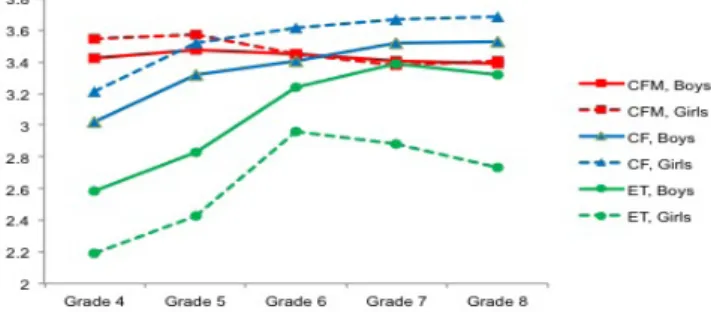
Results: In boys and girls, overtime, the level of mobile phone use for communicating with family decreased, while that for communicating with friends increased. Level of mobile phone use for entertainment increased across time in boys; however, in girls, it increased from Grade 4 to 6 and decreased thereafter, until Grade 8. Gender was associated with the changes of mobile phone use according to the purpose of the same. Positive parenting, negative parenting, relationships with peers, and relationships with teachers predicted changes in mobile phone use for communicating with friends.
Conclusion: These findings suggest that the processes involved in the trajectories of mobile phone use in early adolescence operate differently based on the purposes of the same. Additionally, the present results show that interpersonal factors are highly associated with mobile phone use for communicating with friends.
Keywords: mobile phone use, interpersonal factors, latent growth model 서미정
제주대학교 생활환경복지학부