서 론
남조류 군집은 수환경에 질소와 인의 인위적인 유입
증가의 영향으로 지난
20
여 년 동안 전세계적으로 집약 적 증가를 보였다(Paerl et al., 2001; Khan and Ansari, 2005).
남조류bloom
은 심미적 또는 생태적 문제와 더불 어,
수처리 공정에서 여과지 폐쇄,
남조류 독소와 맛∙냄http://dx.doi.org/10.11614/KSL.2013.46.1.135
ISSN: 2288-1115 (Print), 2288-1123 (Online)
─
─ 135 ─ ─
북한강 수계에서 이취미를 유발하는 남조류 (Anabaena spiroides) 의 증식 특성
유경아∙변명섭1∙윤석제1∙황순진2∙류덕희*
(국립환경과학원 물환경연구부, 1국립환경과학원 한강물환경연구소,
2건국대학교 환경과학과)
Growth Characteristics of Blue-green Algae (Anabaena spiroides) Causing Tastes and Odors in the North-Han River, Korea. You, Kyung-A, Myeong-Seop Byeon
1, Seok-Jea Youn
1, Soon- Jin Hwang
2and Doug-Hee Rhew* (Water Environment Research Department, National Institute of Environmental Research, Environmental Research Complex, Kyungseo-dong, Seo-gu, Incheon, Korea;
1Han River Environment Research Center, National Institute of Envi- ronmental Research;
2Department of Environmental Science, Konkuk University, Korea)
Blue-green algae blooms occurred during early winter in the North-Han River, Korea.
Among blue-green algae, Anabaena spiroides were observed for approximately 33 consecutive days, between 28 November and 30 December, 2011. A. spiroides emerged from Lake Uiam to Lake Paldang, depending on the flow of the river has spread downstream. Changes of physical water environment like rising water temperature and increasing hydraulic retention time influenced the A. spiroides bloom. The A.
spiroides bloom showed a very rapid increase in cell density, and a slow decrease:
the cell density increased to a maximum of 11,325 cells mL
-1in Lake Paldang (st. 5), and was completely disappeared after the water temperature dropped below 4� � C. A decrease in water temperature was the most influential factor among all environmen- tal parameters, for the reduction of A. spiroides cell density. The A. spiroides bloom was accompanied with the occurrence of very high concentrations of the odor meta- bolite geosmin. Geosmin reached the peak value of 1,640 ng L
-1in Lake Paldang (st.
4). The geosmin concentration was very strongly correlated with cell numbers of A.
spiroides.
Key words : Anabaena spiroides, geosmin, water temperature, North-Han River, Lake
* Corresponding author: Tel: +82-32-560-7350, Fax: +82-32-568-2044, E-mail: [email protected]
ⓒ The Korean Society of Limnology. All rights reserved.
This is an open-access article distributed under the terms of the Creative Commons Attribution Non-Commercial License (http://creativecommons.org/licenses/by-nc/3.0/), which permits unrestricted non-commercial use, distribution, and reproduction in any medium, provide the original work is properly cited.
새 물질과 같은 대사물질 생성으로 먹는물 공급에 심각 한 악영향을 가져올 수 있다
(Watson, 2004; van Apel- doorn et al., 2007; Watson et al., 2007).
남조류 중에서bloom
을 유발하는 중요한 속인Anabaena sp.
는 흙∙곰 팡이 냄새와 같은 이취미 물질인 지오스민(geosmin)
을 생성하는 것으로 잘 알려져 있으며(Izaguirre et al., 1982;
Hayes and Burch, 1989; Saadoun et al., 2001; Tsujimura and Okubo, 2003; Wang et al., 2005),
출현종과 환경조건 에 따라anatoxin
등의 독소를 생성하기도 한다(Iza- guirre et al., 1982; McGuire et al., 1984; Mahmood et al., 1988).
선행연구 결과에 따르면
,
수온,
광도,
영양염 농도를 포 함하는 물리∙화학적 인자들과 남조류 종들 간의 부력 기작의 차이는 수체 내에서 남조류 종 조성과 생물량 발 달에 영향을 미치는 주요한 요인들로 제기되어 왔다(Thomas and Walsby, 1986; Carpenter and Kitchell, 1993; Konopka et al., 1993; Fujimto and Sudo, 1997).
대 부분의 남조류는 성장에 높은 수온(¤20� C)
을 선호하나(Van der Westhuizen and Eloff, 1985; Watanabae and Oishi, 1985; Fujimoto and Sudo, 1997),
일부 사상성 남 조류는 색소 조절을 통해 낮은 광도 조건에서도 탁월한 적응 능력을 가지는 것으로 알려져 있으며(Tang et al., 1997), Anabaena spiroides
의 경우에는8� C
이하의 낮은 수온에서도 증식이 관찰된 바 있다(Vincent and Dryden,
1989).
소규모의 저수지에서는 겨울철 결빙 동안에Microcystis spp.
에서 낮은 수온에 내성이 강한 것으로 알려진Oscillatoria sp.
와Aphanizomenon sp.
같은 사상 성 남조류로 천이되었는데,
수온,
광도 및 영양염을 조절 하는 경우2~4
℃의 수온과 낮은 광도 조건에서도 인이 충분한 경우에는 남조류가 성장하는 것으로 조사되었다(Kim et al., 2005a, 2007).
비교적 청정지역으로 알려진 북한강 수계는 소양호
,
춘 천호에서부터 팔당호까지 전체적으로 영양염류의 농도 및 식물플랑크톤 발생량이 모두 중,
빈영양 수준으로 양 호한 수질을 유지하고 있다(Park et al., 2004).
그러나 춘 천시를 통과하는 공지천의 영향으로 의암호의 일부 수역 에서 국지적으로 매우 수질이 악화되고 식물플랑크톤 발 생량이 높으며,
상류인 소양호에서도 조류발생량 특히,
남조류 발생량이 증가하고 있다(Park et al., 2005).
의암 호 내 공지천 유입부에서는 늦가을에 일시적으로 남조류 인Anabaena spp., Microcystis spp.
가 출현하기 때문에 이는 하류의 북한강 수계 식물플랑크톤 군집 변화에 영 향을 미칠 수 있으며,
상류 댐에서의 유입,
방류량에 따른팔당호의 체류시간 변화는 식물플랑크톤 증식에 직접적 으로 영향을 미치는 것으로 알려져 있다
(Park and Jheong, 2003).
본 연구는 북한강 수계에서 저수온기에 우점한 남조류
Anabaena spiroides
현존량과 이취미 물질인 지오스민(geosmin)
에 대해 조사하고 환경인자와의 통계적 분석을 통하여A. spiroides
의 증식 특성을 알아보고자 하였다.
재료 및 방법
1.
조사수계 및 조사지점본 연구는 저수온기에 남조류
Anabaena spiroides
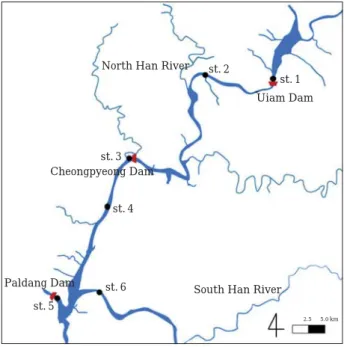
의 과다증식이 발생한 북한강 수계를 대상으로 하였다(Fig.
Fig. 1. Map showing sampling sites in the North-Han River.
North Han River st. 2
st. 3
st. 4
st. 6 st. 5
2.5 5.0 km
st. 1
Cheongpyeong Dam
Paldang Dam
South Han River Uiam Dam
Table 1. Coordinates of sampling sites in the North-Han River.
Site Coordinates
St. 1 37�50′11′′N 127�40′32′′E
St. 2 37�50 ′45′′N 127�33 ′09′′E
St. 3 37�43′30′′N 127�25′19′′E
St. 4 37�35 ′31′′N 127�20 ′29′′E
St. 5 37�31′31′′N 127�16′52′′E
St. 6 37�31 ′46′′N 127�21 ′52′′E
1).
조사구간은A. spiroides
가 출현한 상류 의암호부터 하류 팔당호까지로 조사지점은 유하방향에 따라 의암댐 앞(st. 1),
춘성대교(st. 2),
청평댐 직하류(st. 3),
삼봉리(st.
4),
팔당댐 앞(st. 5)
의5
지점을 선정하였고,
남한강 수계 에 신원리(st. 6)
지점을 대조지점으로 하였다(Table 1).
조사는
2011
년11
월28
일부터12
월30
까지 일일 간격으 로 오전 중에 실시하였다.
2.
수환경 요인 및 식물플랑크톤 분석조사지점별 표층수를 대상으로 현장수질측정기
(YSI- 6600D)
를 이용하여 수온,
용존산소(DO), pH,
전기전도도(Electrical Conductivity),
탁도(Turbidity)
를 측정하였다.
채수한 시료는 실험실에서 수질오염공정시험방법(MOE, 2007)
및Standard methods (APHA, 2005)
에 준하여BOD, COD, SS, TN, DTN, TP, DTP, PO
4-P, Chl. a
를 분 석하였고,
먹는물 수질감시항목 운영지침(MOE, 2011)
에 따라GC/MS (Varian, US/CP3800)
를 이용하여HS- SPME
법으로 지오스민(geosmin), 2-MIB (2-methyliso- borneol)
를 분석하였다.
식물플랑크톤 조사는 표층수를 고정(Lugol’s solution)
하여Sedgwick-Rafter counting chamber
를 이용,
위상차현미경(Nikon, Japan)
으로200~400
배에서 계수한 후 단위체적당 세포수로 환산하였다
.
종의 동정은 한국동식물도감(Chung, 1968),
한국담 수조류도감(Chung, 1993)
및Komárek (1991)
를 참조하 였다.
기온과 강수량은 기상청(www.kma.go.kr)
자료를 참고하였으며,
댐별 강우량,
유입량,
방류량 자료는 국가 수자원관리종합정보시스템(www.wamis.go.kr)
에 게재된 댐 운영정보를 이용하였다.
환경인자와 식물플랑크톤과 의 상관분석은 통계프로그램SPSS 12.0
을 사용하였다.
결과 및 고찰
1.
저수온기 남조류 증식 원인북한강 수계에서
A. spiroides
가 출현한 지역은 의암호 내의 공지천 유입부부터 하류의 팔당호까지 그 범위가 넓고 크게 확산되는 특성을 보였다. A. spiroides
발생의 근원지인 의암호는 춘천시를 통과하여 수질이 매우 오염 된 공지천이 유입되기 때문에 국지적으로 수질이 악화되 고 식물플랑크톤 발생량도 높다(Park et al., 2004).
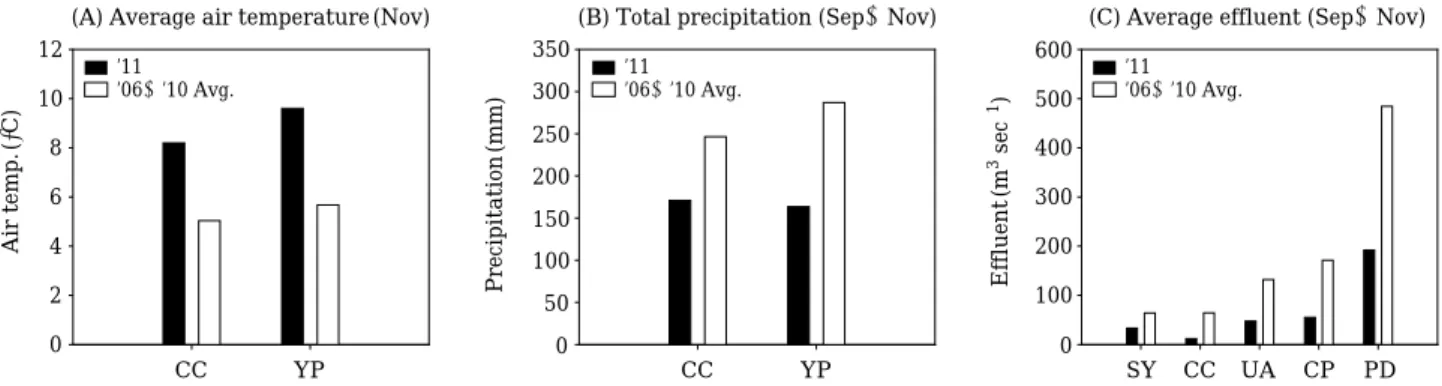
의암댐이 위치한 춘천 지역의
11
월 평균 기온은8.2� C
로 지난5
년(’06~’10
년)
평균 기온보다3.2� C
높았으며,
팔당댐이 위치한 양평 지역 역시11
월 평균 기온이9.6� C
로 지난5
년보다3.9� C
높았다. 9~11
월 동안의 강수량은 춘천 지역246 mm,
양평 지역163 mm
로 예년의2/3
수 준이었다.
동일 시기에 북한강 수계 댐별 방류량은 소양 강댐64 m
3sec
-1,
춘천댐65 m
3sec
-1,
의암댐48 m
3sec
-1,
청평댐55 m
3sec
-1,
팔당댐192 m
3sec
-1로 예년의36%
수준이었다
(Fig. 2).
또한
,
북한에서 금강산발전소 운영을 위하여 북한강 수 계 최상류 지역에 임남댐을 건설하여2003
년 말에 완공 되었는데 이로 인한 북한강 수계 유하량 감소는 연간17
억m
3로 한강 연간유입량의9%
를 차지한다(www.
kwater.co.kr).
갈수현상과 하천유량 감소는 북한강 수계 하류에 위치한 각 댐호의 유입∙방류량 감소 및 체류시 간 증가를 야기하였는데, 11
월에 각 댐호별 수리학적 체 류시간은 의암호23
일,
청평호46
일,
팔당호19
일이었으 며 예년 대비2
배 증가한 것으로 조사되었다.
이와 같이 저수온기에 수온 상승과 체류시간 증가 등
(A) Average air temperature (Nov)
CC YP
Air temp. (° C)
0 2 4 6 8 10 12
’11’06~’10 Avg.
(B) Total precipitation (Sep~Nov)
CC YP
Precipitation (mm)
0 50 100 150 200 250 300 350
(C) Average effluent (Sep~Nov)
SY CC UA CP PD
Effluent (m
3sec
-1) 0 100 200 300 400 500
’11
600
’06~’10 Avg.
’11
’06~’10 Avg.
Fig. 2. Comparison of Meteorologic and hydrologic factors in the North-Han River ((A), (B) CC; Chuncheon region, YP;
Yangpyeong region, (C) SY; Soyang Dam, CC; Chuncheon Dam, UA; Uiam Dam, CP; Cheongpyeong Dam, PD;
Paldang Dam).
의 물리학적 수환경 변화는 남조류
A. spiroides
의 과다 증식에 영향을 미친 것으로 판단할 수 있다.
뉴질랜드Okaro
호에서는 연중 최저 수온인8� C
로 내려간 늦겨울 에Anabaena spiroides
가 증식하였다는 연구결과가 보고 되었으며(Vincent and Dryden, 1989),
팔당호에서Ana- baena spp.
는 수온이 약13� C
이하의 조건에서도 체류시 간이 최소 약11
일 이상이면 출현하는 것으로 조사된 바 있다(NIER, 2008).
2.
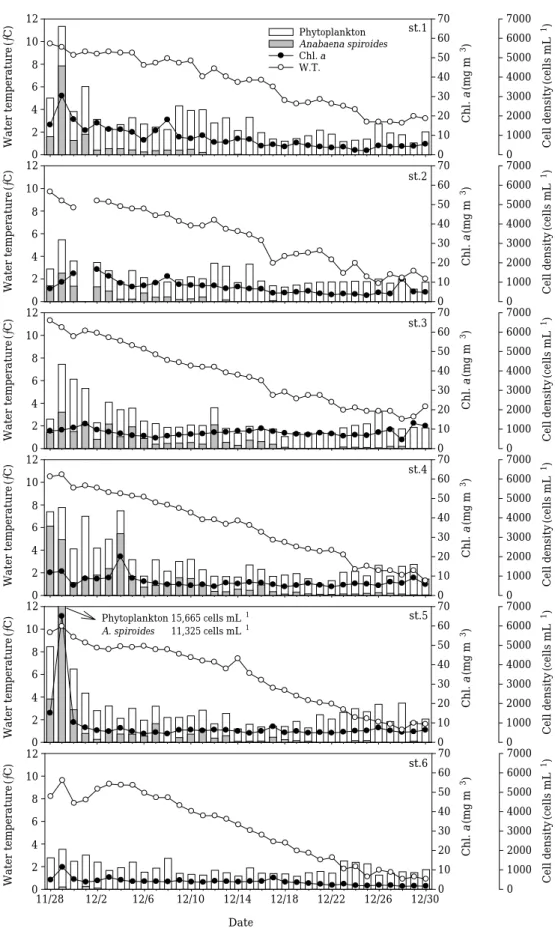
남조류 현존량 변화모든 조사지점에서 수온은
11
월 말에10.0� C
내외였으 며 이후 지속적으로 감소하여12
월 중순 이후에는5.0� C
이하로 내려갔다.
조사기간 동안 북한강 수계 지점별 평 균Chl. a
농도는st. 1
에서8.7 mg m
-3, st. 2
에서7.4 mg m
-3, st. 3
에서8.3 mg m
-3, st. 4
에서7.0 mg m
-3, st. 5
에서8.0 mg m
-3로A. spiroides
출현 지점 간 농도 차이는 적 었으며,
남조류가 출현하지 않았던 남한강 수계st. 6
에서 는3.8 mg m
-3로 북한강 수계보다 낮은 농도였다(Fig. 3).
식물플랑크톤 평균 현존량은
st. 1
에서1,655 cells mL
-1, st. 2
에서1,286 cells mL
-1, st. 3
에서1,460 cells mL
-1, st.
4
에서1,729 cells mL
-1, st. 5
에서1,973 cells mL
-1로 북 한강 수계 조사지점 중 팔당호 내에 위치한st. 4
와st. 5
에서 많은 현존량을 보였으며,
남한강 수계st. 6
은1,074 cells mL
-1로 가장 적었다.
모든 지점에서11
월29
일에 식물플랑크톤 현존량이 가장 많았으며 최하류인 팔당댐 앞(st. 5)
에서15,665 cells mL
-1로 최대 증식하였다(Fig.
3).
북한강 수계 조사지점에서 식물플랑크톤 군집 중
A.
spiroides
의 점유율은 평균25%
였으며, st. 4
와st. 5
에서A. spiroides
가 최대 증식하였을 때에는 각각83%, 72%
의 점유율을 보였다
.
북한강 수계에서 우점종은A. spi- roides
였으며 아우점종은 은편모조류인Rhodomonas sp.
였다
. A. spiroides
발생 지점인 의암호부터 청평호 구간 의 지점(st. 1, st. 2, st. 3)
에서는 수온이4� C
이하로 내려 감에 따라A. spiroides
는 더 이상 출현하지 않았고 우점 종은Stephanodiscus hantzschii
로 천이되었으며, A. spi- roides
가 크게 확산된 팔당호(st. 4, st. 5)
에서는A. spi-
roides
현존량이 급격한 감소추세를 보였다.
남한강 수계에서는 편서풍
(
偏西風)
에 의해 북한강 물이 남한강 수계st. 6
에 영향을 미쳐11
월 말에 일시적으로A. spiroides
가 나타났을 뿐,
규조류Cyclotella atomus
와 은편모조류 인Rhodomonas sp.
가 지속적으로 우점하였다.
팔당호에서 식물플랑크톤 현존량은 봄에 대발생을 보
이고 가을과 겨울에도
5,000 cells mL
-1가까운 높은 발생 량을 보이는데,
이 시기에는 일반적으로 규조류가 우점하 는 양상을 보인다(Kim et al., 2005b; Park et al., 2005;
Youn et al., 2010).
반면에 본 조사 기간에는 예년의 팔당 호 식물플랑크톤 분포와 다르게 식물플랑크톤 현존량이 낮았는데,
이는 부상성을 갖고 있어 다른 조류보다 광을 흡수하는 데 유리한 남조류가 우점하여 다른 종이 성장할 수 없었기 때문이었으며 남조류 중 출현종은A. spiroi- des
단일종이었다.
지점별A. spiroides
현존량 분포는st.
1
에서는11
월29
일에4,576 cells mL
-1로 최대 증식 후 점차 감소하여12
월14
일 이후에는 출현하지 않았다. st.
2
에서는11
월29
일에1,466 cells mL
-1로 최대였고12
월17
일 이후에는 출현하지 않았으며, st. 3
역시11
월29
일1,874 cells mL
-1로 최대를 보인 후12
월28
일 이후에는 출현하지 않았다.
팔당호 내에 위치한st. 4
와st. 5
에서는11
월28
일과29
일에 각각3,574 cells mL
-1, 11,325 cells mL
-1로 최대였으며, 12
월30
일까지 한달 이상A. spiroi- des
가 출현하였다. 12
월30
일 이후에는 북한강 수계 모 든 지점에서A. spiroides
가 출현하지 않았다(Fig. 3).
3.
이취미 물질 농도 변화이취미의 원인물질인 지오스민
(geosmin)
과2-MIB (2- methylisoborneol)
는 방선균이나 남조류의 대사물질에서 기인하는 것으로 알려져 있는데,
남조류 중에서Anaba- ena spp.
는 전세계적으로Geosmin
을 생성하는 가장 대 표적인 종이다(Wu et al., 1991; Bowmer et al., 1992;
Rosen et al., 1992; Aoyama et al., 1995; Blevins et al., 1995; Jones and Korth, 1995). Geosmin
과2-MIB
는 최 저 감지농도가6~10 ng L
-1내외로 알려져 있으며 일본 의 경우 각각에 대해 먹는물 수질기준을10 ng L
-1이하 로 설정하고 있다(Whelton and Dietrich, 2004).
국내의 경우,
먹는물 수질기준에는 없으나 권고기준으로20 ng L
-1설정되어 있다(ME, 2011).
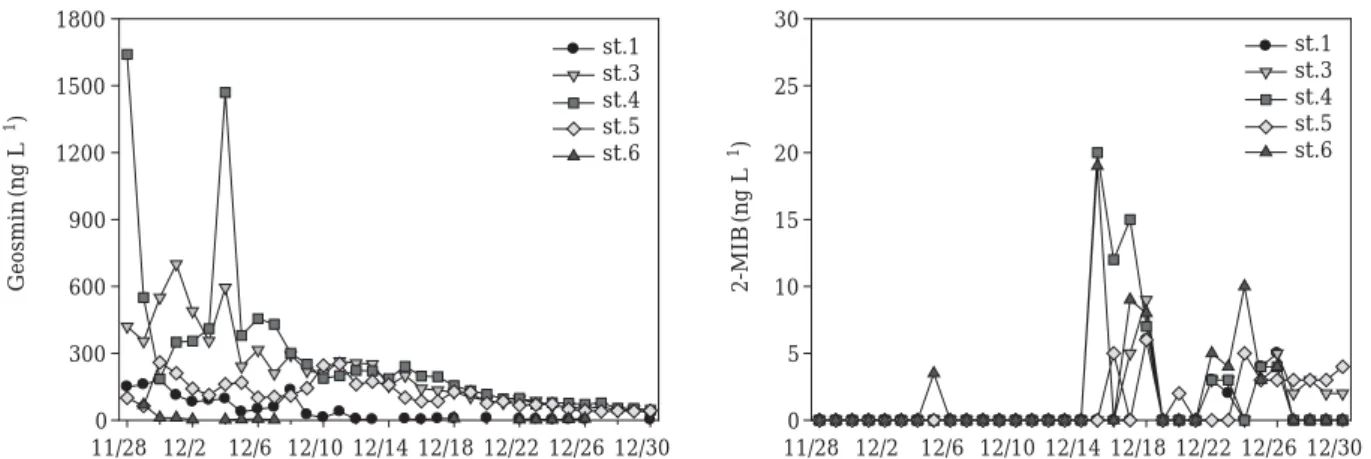
본 연구에서 남조류
A. spiroides
증식에 따른 이취미 물질 농도 변화는2-MIB
의 경우 모든 조사지점에서 최 대20 ng L
-1를 넘지 않았고,
검출되지 않은 일수가 더 많 았다.
반면, Geosmin
은A. spiroides
현존량 변화에 따라 조사지점별로 차이를 보였는데 각 지점별Geosmin
평균 농도는st. 1
에서39 ng L
-1, st. 3
에서221 ng L
-1, st. 4
에 서289 ng L
-1, st. 5
에서116 ng L
-1였으며st. 2
에서는 측 정하지 않았고,
남한강 수계st. 6
의 경우A. spiroides
가 출현하지 않아 불검출 일수가 더 많았다. Geosmin
농도 가 가장 높았던st. 4
에서11
월28
일과12
월4
일에 각각st.1
0 1000 2000 3000 4000 5000 6000 7000
0 10 20 30 40 50 60 70
Water temperature (° C) Chl. a (mg m
-3) Cell density (cells mL
-1) Cell density (cells mL
-1) Cell density (cells mL
-1) Cell density (cells mL
-1) Cell density (cells mL
-1) Cell density (cells mL
-1)
Chl. a (mg m
-3) Chl. a (mg m
-3) Chl. a (mg m
-3) Chl. a (mg m
-3) Chl. a (mg m
-3)
Water temperature (° C) Water temperature (° C) Water temperature (° C) Water temperature (° C) Water temperature (° C)
0 2 4 6 8 10 12
Phytoplankton Anabaena spiroides Chl. a
W.T.
st.2
0 1000 2000 3000 4000 5000 6000 7000
0 10 20 30 40 50 60 70
0 2 4 6 8 10 12
st.3
0 1000 2000 3000 4000 5000 6000 7000
0 10 20 30 40 50 60 70
0 2 4 6 8 10 12
st.4
0 1000 2000 3000 4000 5000 6000 7000
0 10 20 30 40 50 60 70
0 2 4 6 8 10 12
st.5
0 1000 2000 3000 4000 5000 6000 7000
0 10 20 30 40 50 60 70
0 2 4 6 8 10 12
Phytoplankton 15,665 cells mL-1 A. spiroides 11,325 cells mL-1
st.6
Date
11/28 12/2 12/6 12/10 12/14 12/18 12/22 12/26 12/30 0 1000 2000 3000 4000 5000 6000 7000
0 10 20 30 40 50 60 70
0 2 4 6 8 10 12
Fig. 3. Daily variation of phytoplankton, Anabaena spiroides, Chl. a and water temperature in the North-Han River.
1,640 ng L
-1, 1,470 ng L
-1로2
번의peak
를 보였는데,
동 일 시기에A. spiroides
현존량은 각각3,574 cells mL
-1, 3,185 cells mL
-1였다. st. 5
에서는11
월29
일에A. spiroi- des
현존량이11,325 cells mL
-1로 최대였음에도 불구하 고Geosmin
농도는64 ng L
-1였으며 다음날에Geosmin
농도가259 ng L
-1로 증가하였으나st. 4
의1/5
정도에 불 과하였는데,
팔당댐 앞의 경우 북한강과 남한강 그리고 경안천이 합쳐지기 때문에 희석되었을 가능성이 있다(Fig. 4).
Geosmin
의 변화는A. spiroides
현존량과 밀접한 관련 이 있는데, A. spiroides
현존량이 증가한1~2
일 후에Geosmin
농도가 급격히 증가하고A. spiroides
현존량이 감소하면 동일하게 감소한다고 하였다(Li et al., 2010).
현재까지 원수에서 기록된
Geosmin
최대 농도는 중국에 서7,100 ng L
-1(Li et al., 2010)
였으며,
호주에서4,000 ng L
-1(Jones and Korth, 1995),
남아프리카에서3,170 ng L
-1(Wnorowski and Scott, 1992)
로 조사된 바 있다.
팔당호의 경우 댐 앞에서Anabaena spp.
가 식물플랑크 톤 군집의49%
를 우점하여2,352 cells mL
-1였을 때Geosmin
농도는189 ng L
-1였으며, Anabaena spp.
가 전 체 현존량의14%
인252 cells mL
-1였을 때Geosmin
농 도는179 ng L
-1였다(Kim et al., 2009).
4.
남조류,
이취미 물질,
환경인자와의 관계A. spiroides
증식에 영향을 미치는 환경인자를 파악하고
A. spiroides
와Geosmin
농도와의 관계를 규명하기 위하여 통계학적 상관관계를 분석하였다.
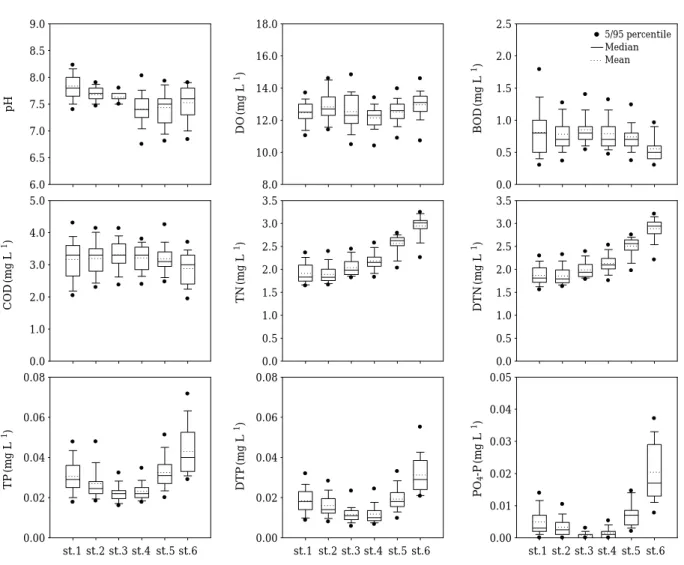
조사지점별 이 화학적 수질의 농도 범위는Fig. 5
와 같다.
이화학적 수질 인자 중에서 유의한 상관관계를 보인 항목은 지점에 따라 차이는 있으나 수온
, Chl. a, BOD, COD
등으로 나타 났다(Table 2).
북한강 수계 조사지점에서A. spiroides
는 수온과 양의 상관관계를 나타냈는데st. 3 (r = =0.743, p⁄
0.01)
과st. 4 (r= =0.709, p⁄0.01)
에서 매우 유의한 상관관 계를 보였다. Chl. a, BOD, COD
는A. spiroides
와 양의 상관관계를 보였으나 이는A. spiroides
증식에 의해Chl.
a
농도 및 수중 유기물 농도가 증가한 결과로,
식물플랑 크톤 증식에 영향을 주는 영양염류와는 큰 상관관계를 나타내지 않았다.
팔당호에서 식물플랑크톤 현존량에 상당한 영향을 미 치는 것으로 알려진 체류시간
(Park et al., 2005)
은 상류 에 위치한 댐들의 수문조작에 직접적인 영향을 받는다. 11
월 중순까지30 m
3sec
-1를 방류했던 소양강댐에서29
일에50 m
3sec
-1로 방류량을 늘렸고 하류의 의암댐,
청평 댐도 방류량을 증가하는 등 북한강 수계 댐들의 수문조 작에 의해A. spiroides
는 유량과 함께 하류로 내려갔다.
그러나 팔당댐 방류량은250 m
3sec
-1내외로 팔당호 물 이 교체될 수준의 양이 아니었기 때문에 오히려 상류에 서 내려온A. spiroides
가 팔당호에서 집적 및 확산되는 경향을 보였다.
팔당호 방류량 증가에 의해12
월 초 팔당 호의 수리학적 체류시간은11
일로 예년보다2
일 단축되 었으나 이미 과다증식한A. spiroides
의 현존량 감소에는 별다른 영향을 미치지 못하였다(r= =0.380, p= =0.06).
남조류의 우점기간은 영양상태와 수온에 의존하여 결 정될 수 있으며
,
동절기의 낮은 수온은 남조류 소멸의 중 요한 원인으로 지적되고 있기 때문에(Reynolds, 1984;
Sommer et al., 1986; Romo and Miracle, 1994),
본 연구 에서는 수온 하강이A. spiroides
현존량 감소에 가장 큰 영향을 준 인자로 파악되었다(Table 2, Fig. 6).
A. spiroides
와Geosmin
농도와의 관계는 북한강 수계11/28 12/2 12/6 12/10 12/14 12/18 12/22 12/26 12/30 Geosmin (ng L
-1)
0 300 600 900 1200 1500 1800
st.1 st.3 st.4 st.5 st.6
11/28 12/2 12/6 12/10 12/14 12/18 12/22 12/26 12/30 2-MIB (ng L
-1)
0 5 10 15 20 25 30
st.1 st.3 st.4 st.5 st.6
Fig. 4. Daily variation of geosmin and 2-MIB in the North-Han River.
조사지점에서 양의 상관관계를 보였으며
,
특히st. 3 (r= = 0.636, p⁄0.01)
과st. 4 (r= =0.909, p⁄0.01)
에서는 매우 유 의한 양의 상관관계를 나타냈다(Table 2). A. spiroides
와Geosmin
농도와의 회귀분석 결과, A. spiroides
가 증가함 에 따라Geosmin
농도가 증가하였으며 청평호(st. 3)
와팔당호
(st. 4)
에서 경향성이 뚜렷하였다(Fig. 7).
중국의Yanghe
호에서Geosmin
농도는Anabaena sp.
현존량(r
2= = 0.912)
과 상관관계가 매우 컸으며Geosmin
은A. spiroi- des
에 의해 주로 생성됨이 증명되었다(Li et al., 2010).
또한
, A. spiroides
세포당 평균Geosmin
생성 농도가0.1
pH
6.0 6.5 7.0 7.5 8.0 8.5 9.0
8.0 10.0 12.0 14.0 16.0 18.0
0.0 0.5 1.0 1.5 2.0 2.5
COD (mg L
-1) BOD (mg L
-1) DTN (mg L
-1) PO
4-P (mg L
-1)
TN (mg L
-1)D O (mg L
-1) DTP (mg L
-1)
TP (mg L
-1) 0.0 1.0 2.0 3.0 4.0 5.0
0.0 0.5 1.0 1.5 2.0 2.5 3.0 3.5
0.0 0.5 1.0 1.5 2.0 2.5 3.0 3.5
st.1 st.2 st.3 st.4 st.5 st.6 st.1 st.2 st.3 st.4 st.5 st.6 st.1 st.2 st.3 st.4 st.5 st.6 0.00
0.02 0.04 0.06 0.08
0.00 0.02 0.04 0.06 0.08
0.00 0.01 0.02 0.03 0.04 0.05
5/95 percentile Median Mean
Fig. 5. Concentration range of water quality parameters in the North-Han River.
Table 2. Correlation coefficient between Anabaena spiroides abundance and water quality parameters in the North-Han River.
Site Water
Chl. a Geosmin 2-MIB pH EC DO BOD COD SS TN TP DTN DTP PO
4-P
temp.
St. 1 0.461 0.846** 0.531 - 0.317 0.267 -0.112 0.770** 0.569* 0.356 0.053 0.361 0.017 0.160 0.184 St. 2 0.614* 0.415 - - -0.196 0.377 -0.390 0.406 0.679** 0.028 0.231 0.300 0.244 0.331 0.183 St. 3 0.743** 0.432* 0.636** -0.116 0.206 0.196 -0.349 0.441* 0.149 -0.137 -0.254 0.237 -0.274 0.427* -0.016 St. 4 0.709** 0.830** 0.909** 0.581 0.179 0.536** -0.310 0.749** 0.470** -0.068 -0.419* 0.308 -0.462** 0.357* -0.146 St. 5 0.428* 0.992** -0.156 0.713 0.314 -0.262 0.242 0.846** 0.772** 0.532** -0.666** 0.415* -0.649** 0.068 -0.157 St. 6 -0.386 0.112 0.302 - -0.753 -0.086 0.112 0.375 -0.946 -1.000** -0.938 -0.950 -0.950 -0.959 0.073
**: p ⁄ 0.01, *: p ⁄ 0.05
pg cell
-1로 호주에서Anabaena sp.
대발생 시 조사된0.01 pg cell
-1보다10
배 이상이었다(Jones and Korth, 1995).
그러나 팔당호 댐앞(st. 5)
에서는A. spiroides
현존 량이 높았음에도 불구하고Geosmin
농도와의 상관관계 가 명확하지 않아(Table 2, Fig. 7)
남한강 유입유량에 의 한 희석효과,
이취미 발현 환경조건,
조류 외 이취미 유발 원인 등 다양한 요인에 대한 분석이 필요할 것으로 사료 된다.
적 요
본 연구는 청정수역으로 알려져 있던 북한강 수계에서 저수온기에 우점한 남조류
Anabaena spiroides
현존량과 이취미 물질인 지오스민(geosmin)
에 대해 조사하고 환 경인자와의 통계적 분석을 통하여A. spiroides
의 증식 특성을 알아보고자 하였다. 2011
년11
월 말에A. spi-
roides
가 과다증식하였는데 출현지역은 의암호 내의 공지천 유입부 부터 하류의 팔당호까지 그 범위가 넓고 하 류로 확산되는 특성을 보였다
.
저수온기에 수온 상승과 체류시간 증가 등의 물리학적 수환경 변화가 남조류A.
spiroides
의 과다증식에 영향을 미쳤다. A. spiroides
현존 량은 팔당호에서11,325 cells mL
-1로 최대증식을 보였으 며,
수온이4� C
이하로 내려가면서A. spiroides
현존량이 급격히 감소하였다.
수환경 요인 중에서 수온 하강이A.
spiroides
현존량 감소에 가장 큰 영향을 준 인자였다.
남 조류의 대사물질로 이취미의 원인물질인Geosmin
은 팔 당호에서 최대1,640 ng L
-1농도를 나타냈다.
북한강 수 계에서Geosmin
농도는A. spiroides
와 매우 유의한 상 관관계를 보여A. spiroides
에 의해 이취미가 유발되었음 을 시사하였다.
인 용 문 헌
Aoyama, K., N. Kawamura, M. Saitoh, Y. Magara and Y.
Ishibashi. 1995. Interactions between bacteria-free Ana- baena macrospora clone and bacteria isolated from unial- gal culture. Water Science and Technology 31: 121-126.
0 1000 2000 3000 4000 5000
G e osm in (ng L
-1) G e osm in (ng L
-1)
0 50 100 150 200 250
0 500 1000 1500 2000 0
200 400 600 800
Anabaena spiroides (cells mL
-1)
0 1000 2000 3000 4000 50000 500 1000 1500 2000
0 5000 10000 15000
0 50 100 150 200 250 300
st. 1
r2=0.399 p⁄0.0001
r2=0.827
p⁄0.0001 r2=0.001
p=0.8371 r2=0.484 p⁄0.0001
st. 3
st. 4 st. 5
Fig. 7. Relationship between Anabaena spiroides abun- dance and geosmin concentration in the North-Han River.
Date
11/1 11/8 11/15 11/22 11/29 12/6 12/13 12/20 12/27
Hydraulic retention time (day)
5 10 15 20 25
’06~’10 Avg.
’11 PD
Date
11/1 11/8 11/15 11/22 11/29 12/6 12/13 12/20 12/27 Effluent (m
3sec
-1)
0 50 100 150 200 250 300 350
SY UA CP PD