접수일자 : 2014. 08. 21 심사완료일자 : 2014. 10. 06 게재확정일자 : 2014. 10. 20
* Corresponding Author Woochun Jun(E-mail:[email protected], Tel:+82-2-3475-2504)
Department of Elementary Computer Education, Seoul National University of Education, Seoul, 137-742, Korea
Open Access
http://dx.doi.org/10.6109/jkiice.2014.18.12.3013
print ISSN: 2234-4772 online ISSN: 2288-4165 한국정보통신학회논문지(J. Korea Inst. Inf. Commun. Eng.) Vol. 18, No. 12 : 3013~3019 Dec. 2014정보영재아동의 성별차이분석 연구
전우천1* · 홍석기2
A Study on Gender Difference Analysis for Gifted Children in IT
Woochun Jun
1*· Suk-Ki Hong
21*
Department of Computer Education, Seoul National University of Education, Seoul, 137-742, Korea
2
Department of Business Administration, Dankook University, Yongin, Gyeonggi-do, 448-701, Korea
ABSTRACT
In the knowledge-based society, a nation’s national power depends on IT industry. Also, literacy and application of IT technology can make a person live in comfortable circumstances. Currently, a few outstanding people lead entire IT industry and academy. In this sense, it is necessary to identify and nurture the gifted children in IT as early as we can.
The purpose of this paper is to investigate gender difference of the gifted students in IT. Especially we are interested in their grade difference so that we select programming ability and logical thinking ability as academic performance evaluation. For this purpose, the gifted children in gifted science education center attached to a university at Seoul Metropolitan Area are selected. Their grades for 8 years were collected and analyzed. The analysis results show that there is no significant difference between male students and female students for programming ability and logical thinking ability. This also means that there is no academic difference between male and female students for the gifted children in IT.
요 약
현대 지식정보사회에서 있어서 , 한 나라의 국력은 IT 산업에 달려있다. 또한, 개인차원에 있어서도 IT 기술의 소양
과 활용은 한 개인의 삶을 윤택하게 해준다. 현재 뛰어난 인재 몇 사람이 전체 IT 산업과 학계를 주도하고 있다. 따라
서 정보영재 아동을 조기에 발굴하고 양육하는 것은 매우 중요하다 . 본 논문의 목적은 정보영재아동의 성별 차이를
분석하고 조사하는 것이다 . 특히 본 논문에서는 성별에 따른 성적차이에 관심을 두고, 프로그래밍 능력과 논리적 사
고력을 중심으로 비교하였다 . 성별차이분석을 위해서 서울지역의 대학부설 영재원의 정보영재아를 대상으로 하였
으며, 8년 동안의 성적을 조사 및 분석하였다. 분석결과는 남녀 정보영재학생들 간에 있어서 프로그래밍 능력과 논 리적 사고력에 유의미한 차이가 없음을 보여주었다. 이는 남녀 학생들 간의 성적차이가 없음을 의미한다.
Key word :
Gifted Children in IT, Gender Difference, Programming Ability, Logical Thinking Ability키워드 :
정보영재, 성별차이, 프로그래밍 능력, 논리적 사고력Ⅰ. Introduction
In the current know-based society, IT-related industry has importance in a nation’s national power. In other words, development of IT industry and academy has a strong influence on a nation’s competitiveness.
For improvement of competitiveness of a person, literacy and application of IT technology become a measure of value. In this sense, nurturing IT human resources is one of the big educational objectives of a nation.
In the literature, in IT industry, a few outstanding persons, like Bill Gates and Steve Jobs, have a big influence on a nation’s economy. In this sense, identifying and fostering gifted children in IT is more important than identifying and nurturing gifted children in other areas for strengthening national power.
Currently, though gifted education in IT is still immature comparing with other subjects, it takes center stage in gifted education.
The purpose of this paper is to investigate gender difference between male and female gifted children in IT. In the literature, there have been some works on gender difference in gifted children for other subjects such as science and mathematics. However, to our best knowledge, there is no such work in gifted education in IT so far. Our purpose to identify gender difference in gifted education in IT is to develop differentiated teaching-learning models and selection examinations for male and female students. For the comparison, the gifted children in gifted science education center attached to a university at Seoul Metropolitan Area are selected.
Their academic grades for 8 years were collected and analyzed. In addition to our preliminary research results [1], we augment statistical analysis.
The rest of paper is organized as follows. In Chapter 2, related works are introduced. In Chapter 3, gender differences between male and female students are analyzed. Finally, in Chapter 4, conclusions and further works are discussed.
Ⅱ. Related Works
2.1. Definition and Characteristics of Gifted Children in IT
There is no academic agreement on the definition of gifted children in IT. There are some definitions in the literature.
In [2], the definition is as follows: A child who understands and analyzes a given problem, and collects, refines, recreates new information based on ICT application ability.
In [3], the definition is as follows: A child who has above average or higher ability in general intelligence, curiosity for computers, high creativity, math-linguistic ability, task commitment for problem-solving, a child who has high potential in computer-related works.
In the meanwhile, in [4], gifted child in IT is defined as follows: First, a child who has above average or higher ability in general intelligence, curiosity for computers, high creativity, math-linguistic ability, task commitment for problem-solving. Second, a child who is interested in applying programming, application software to his/her daily life. Third, a child who has a high potential in adaptability, creativity, and imagination in computer-related works.
Also, Characteristics of gifted students in IT are presented in [2]. In [3], conditions of the gifted children in IT are introduced. In [3], the conditions are divided into three domains, cognitive domain, affective domain, and creative domain, respectively.
2.2. Literature Review
Literature reviews for gender difference analysis of gifted children are as follows.
In [5], a gifted education center for middle students is selected for survey work. Middle schol seniors and high school freshmen (105 male students and 47 female students) at Seoul Metropolitan Area are selected and surveyed. Those students are selected as gifted students in either mathematics or science.
For analysis of gender difference, various test items
such as study strategy, self-success feeling, belief for intellectual ability, belief for study ability, problem- solving preference, leadership, personal relationship, psychological environment in home, personal character, frequency in study activitiy, and social talent are selected. After statistical analysis, some test items such as study ability, problem-solving preference, and self- success feeling show significant gender differences.
In [6], gender difference for mathematics is analyzed.
The gender difference for mathematics is caught up in controversy in the last decades. That is, some researchers said that a man is superior to a woman in mathematics, however, the others said that there is no gender difference in mathematics. The purpose of the study is to find gender difference for mathematical study style and behavioral characteristic recognition. For this purpose, gifted student in middle schools and ordinary students are selected and surveyed.
The research results are as follows. First, for mathematical study style, there is some gender difference for cognizing mathematical information.
However, there is no difference for preferring style.
Also, there is no difference in gender difference for processing information. Second, the results show that there is a big gender difference for behavioral characteristic recognition. Especially, for mathematical behavioral characteristic and creative behavioral characteristic, male students think that they are superior to female students. Third, comparing with ordinary female students, female gifted students tend to think that, for behavioral characteristic, a female student is superior to a male student. Fourth, female students tend to think that, for mathematical study characteristic, male students are superior to female students, as they are getting older.
In [7], the purpose of the study is to find out the differences between the gifted and ordinary students in their achievement goal orientations. The study also investigated the differences in the achievement goal profiles based on so called the ‘2×2 goal orientations model’ between gifted students and ordinary students.
In the study, the interaction effects of giftedness and gender on the achievement goal orientations are also investigated.
The test sample group includes 208 gifted (110 male students and 98 female students) and 208 ordinary students (138 male students and 70 female students).
All of them are applied to the 2×2 factor goal orientation scale. The statistical survey results are analyzed by the cluster analysis to find the predominant goal orientation profiles. The results show that there are significant differences in the achievement goal orientations and goal profiles between the gifted and ordinary students, and also between the male and female students.
In [8], 1,993 gifted students (male students 65.2%
and female students 34.8%) in elementary schools and middle schools attending over 16 gifted education centers and institutes are selected and surveyed for gender difference analysis. The following research results are obtained. First, mathematical self-concept of female gifted students is lower than that of male students. Also, scientific self-concept and immanent study motive of female students are lower than those of male students. However, there is no statistical significance. Second, as far gender stereotype that science and mathematics are male areas, female students have higher ratio over male students. Finally, for study style, female students prefer reflective style and male students prefer active style. As both of male and female students are promoted in grade, they prefer deductive study style. Especially female students prefer sensuous study style, however, male students prefer intuitive study style.
In the literature, research works show gender
differences in terms of study style, psychological
attitudes for gifted child. Also, some research work
shows gender difference for mathematics and science
subject. However, there is no research work on gender
difference for the gifted children in IT.
Ⅲ. Gender Difference Analysis of Gifted Children in IT
3.1. Analysis Samples
The analysis is done for gifted students in IT in a gifted science education center at Seoul Metropolitan Area. Table 1 shows a summary of the gifted students in IT.
표 1. 분석을 위한 표본정보요약
Table. 1 A summary of samples for analysis
Item Information
Institute
A gifted science education center attached in a university at Seoul Metropolitan Area
Grade 4th, 5th and 6th grade in elementary school
Number of students Total 157 (male students: 124, female students: 33)
Attending year of
students 2003~2010
In the gifted science education center, 20 students are selected each year based on their paper works, written test scores, and interview, and some other achievements.
The applicants are eligible for 4
th, 5
th, and 6
thgrade students of elementary schools. Those students are supposed to study the basic courses and get a certificate after successful completion of one-year program. 4
thand 5
thgrade students can be promoted to the advanced program depending on their scores during their study.
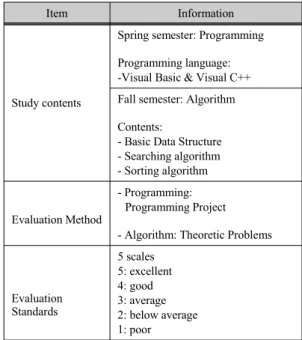
Those students can take two-semester courses. For each semester, students are requited to take 8 weekend classes, an outdoor camp (during summer or winter break), cyber classes, etc. For gifted students in IT, 8 weekend classes consist of 4 informatics classes and 4 common subjects (mathematics and science). The detail information is shown at table 2. For gifted children in IT, as informatics classes, two major subjects, programming and algorithm, are selected and taught.
The reason is that two subjects are used in most gifted institutions in IT as study contents and widely used
performance evaluation standards[4]. Programming and algorithm belong 5 major education components in ICT literacy education [9]. It means that programming and education are essential for IT education for general citizen as well as the gifted children in IT.
표 2. 정보영재 교육과정
Table. 2 Study process of gifted children in IT
Item Information
Study contents
Spring semester: Programming Programming language:
-Visual Basic & Visual C++
Fall semester: Algorithm Contents:
- Basic Data Structure - Searching algorithm - Sorting algorithm
Evaluation Method
- Programming:
Programming Project - Algorithm: Theoretic Problems
Evaluation Standards
5 scales 5: excellent 4: good 3: average 2: below average 1: poor
3.2. Analysis Results
In order to analyze the gender difference between male students and female students in terms of programming ability and logical thinking ability, the following statistical methods are used.
The following table 3 shows gender difference of gifted children in IT for programming ability.
표 3. 프로그래밍 능력의 성별 차이
Table. 3 Gender difference for programming ability
Gender N Average SD t p-value
(both sides)
Male 429 3.33 1.561
-.058 .954
Female 112 3.33 1.554
In table 3, N represents the number of overall tests.
SD represents standard deviation. In this statistical analysis t-test is used. The t-test is used to identify difference in two groups, and to verify difference in average values for dependent variables using t value. In hypothesis testing, the significance level is the criterion used for rejecting the null hypothesis. The significance level is used in hypothesis testing as follows: First, the difference between the results of the experiment and the null hypothesis is determined. Then, assuming the null hypothesis is true, the probability of a difference that large or larger is computed. Finally, this probability is compared to the significance level. If the probability is less than or equal to the significance level, then the null hypothesis is rejected and the outcome is said to be statistically significant [10]. Also, the p-value is the probability of obtaining a test statistic result at least as extreme or as close to the one that was actually observed, assuming that the null hypothesis is true [11].
For significance level analysis, p=.05, p=.01, and p=.001 are usually used.
In order to check gender difference for programming ability, independent t-test is performed. After statistical analysis, male students have average value of 3.33, and female students have average value of 3.33. Also, there is no significant difference in the level of p<.05.
The following table 4 shows gender difference for logical thinking ability of gifted children in IT.
표 4. 논리적 사고력의 성별 차이
Table. 4 Gender difference for logical thinking ability
Gender N Average SD t p-value
(both sides)
male 468 3.34 1.515
-1.783 .075
Female 131 3.60 1.397
where N represents the number of overall tests
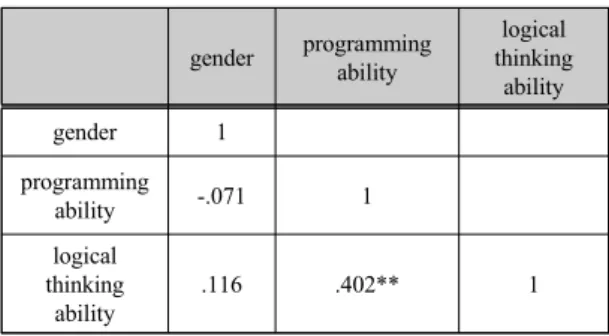
On the other hand, table 5 shows the overall corelation among gender, programming ability, and logical thinking ability.
표 5. 상관관계 분석
Table. 5 Correlation analysis
gender programming ability
logical thinking
ability
gender 1
programming
ability -.071 1
logical thinking
ability
.116 .402** 1
where the symbol '**' represents that the value is statistically significant with p<.01.
As we can see from table 5, there is no relationship among gender, programming ability, and logical thinking ability. However, there is some correlation between programming ability and logical thinking ability. It means that, the higher programming ability, the higher logical thinking ability.
Based on the above statistical analysis for gender difference of programming ability and logical thinking ability, we can conclude that there is no significant difference between male students and female students.
Ⅳ. Conclusions and Further Works
Comparing with other gifted education subjects like science and mathematics, gifted education in IT is relatively new subject. However, interests in gifted education in IT are increasing gradually as interests are arising with government support. In Korea, IT industry contributes to GDP every year gradually. According to [12], IT industry takes 8.6%(2005), 9.5%(2007), 10.3%(2009), and 11.8%(2011) in GDP. In this sense, it is our responsibility to support the gifted education in IT.
For gifted education for science and mathematics as
well as the general gifted education, there have been
some research works for gender difference. However, to
our best knowledge, there is no research work for
gender difference in gifted education in IT. Therefore, in this paper, we investigate and analyze gender difference in gifted education in IT in terms of programming ability and logical thinking ability.
For this purpose, we analyze the test scores of 157 gifted students in IT for 8 years (2003 ~ 2010). Those gifted children have attended a gifted science education center attached to a university at Seoul Metropolitan Area. For objective analysis, we collected and analyzed only objective test results. 5 Likert scales have been adopted for the objective tests. Other subjective test results are not included for unbiased analysis. After thorough statistical analysis, we conclude that there is no significant gender difference between male students and female students for programming ability and logical thinking ability.
Our future research works are as follows.
First, we will include various evaluation standards other than programming ability and logical thinking ability, and analyze the gender difference. We will include some psychological standards such as creativity, task commitment, and study attitudes, etc.
Second, regardless of gender, various teaching- learning models for enhancing programming ability and logical thinking ability must be developed and their effectiveness must be checked. So far there are only a few works for teaching-learning models for development of programming ability and logical thinking ability. For different cognitive levels of the gifted children, various teaching-learning models must be developed.
REFERENCES
[ 1 ] W. C. Jun and S. K. Hong, "A Study on Gender Difference of the Gifted Children in IT - Focused on Programming Ability and Logical Thinking Ability", Proceedings of the 8th International Conference on Information Science and Technology, Jeju, Korea, August 2013.
[ 2 ] S. K. Oh, "The Definition and Judgment System of a Computer-gifted Student", Master Thesis, Sungkyunkwan University, Seoul, Korea, 2002.
[ 3 ] K. M. Yu, "A Study on the Outlook of Computer Teachers on Gifted Education in Information Science", Master Thesis, Hanyang University, Seoul, Korea, 2003.
[ 4 ] W. C. Jun, "A Study on the Current Status and Improvement Plans of Gifted Elementary Information Science Education Curriculum", Gifted Education Research, Vol. 20, No. 1, pp.
347-368, April 2010.
[ 5 ] H. C. Shin, "Research on Factors that have influence on Characteristics of Gifted Students", Ph.D. Dissertation, Kangwon National University, Chunchon, Kangwondo, Korea, 2007.
[ 6 ] H. A. Jeon, "A Study on Gender Difference between Mathematically Gifted Students and Ordinary Students:
Focused on Mathematics Study Style and Behavioral Characteristic Recognition", Master Thesis, Korea University, Seoul, Korea, 2011.
[ 7 ] D. J. Na, "A Comparison of the Gifted and ordinary students in their achievement goal orientations", Korean Educational Research, Vol. 48, No. 3, pp. 25-44, September 2010.
[ 8 ] K. A. Jung, Y. J. Choi, C. H. Yoon, and M. S. Lee, "Gender Status of Gifted Education and Education Plan of Gifted Female Students", 2006 Research Report 10, Korean Women’s Development Institute, Hanhakmunwha Press, Seoul, Korea, 2006.
[ 9 ] W. Jun, "Identification and Education of the Gifted Children in IT", Sungyun Press, Seoul, Korea, 2013.
[10] Davidmlane.com, http://davidmlane.com/hyperstat/A72117.
html. September 21, 2014.
[11] Wikipedia, http://en.wikipedia.org/wiki/P-value, September 21, 2014.
[12] Digital Times, http://www.dt.co.kr/contents.html?article_
no=2012101102011060600001, October 10, 2012.
전우천(Woo-Chun Jun)
1985년 서강대학교 전산학과 졸업(학사) 1987년 서강대학교 대학원 전산학과 졸업(석사)
1997년 School of Computer Science, University of Oklahoma 졸업(박사) 1998 ~ 현재 서울교육대학교 컴퓨터교육과 교수
※관심분야 : 장애인정보화교육, 정보영재, 정보통신윤리, etc.
E-mail : [email protected]
홍석기(Suk-Ki Hong)
1986년 서강대학교 경제학과 졸업(학사)
1996년 University of Nebraska-Lincoln, Management 졸업(박사) 2003~현재 단국대학교 경영학과 교수
※관심분야 : e-Business, e-Service, SCM, etc.
E-mail : [email protected]