• 검색 결과가 없습니다.

Multiscale-Architectured Functional Membranes Based on Inverse-Opal Structures

N/A
N/A
Protected

Academic year: 2021

Share "Multiscale-Architectured Functional Membranes Based on Inverse-Opal Structures"

Copied!
11
0
0

로드 중.... (전체 텍스트 보기)

전체 글

(1)

1. Introduction 1)

Recently, due to the increasing concerns related to the preservation of water resources and the growing demand for strict water quality control, tremendous at- tention has been paid to clean environmental tech-

nologies, which typically utilize membrane materials.

Membrane technology can be generally categorized ac- cording to the size of the species that is targeted for separation, ranging from microfiltration for larger par- ticles to ultrafiltration, nanofiltration, and reverse os- mosis for smaller species. When developing membrane

Corresponding author(e-mail: [email protected], http://orcid.org/0000-0002-5499-6566)

멀티스케일 아키텍쳐링 기반 역오팔상 구조체 기능성 멤브레인 기술

유 필 진

성균관대학교 화학공학과

(2016년 12월 20일 접수, 2016년 12월 23일 수정, 2016년 12월 23일 채택)

Multiscale-Architectured Functional Membranes Based on Inverse-Opal Structures

Pil J. Yoo

School of Chemical Engineering and SKKU Advanced Institute of Nanotechnology (SAINT), Sungkyunkwan University (SKKU), Suwon 16419, Republic of Korea

(Received December 20, 2016, Revised December 23, 2016, Accepted December 23, 2016)

요 약: 최근 들어 정렬구조의 나노구조체를 이용한 분리막 응용기술이 큰 관심을 받고 있다. 나노구조체 분리막은 낮은 흐름저항을 통해 높은 투습성을 유지하면서도 매우 균일한 기공크기 특성으로 인해 높은 분리선택비를 가질 수 있다는 장점 을 지닌다. 특히 콜로이드 입자의 자기조립체인 오팔상 및 그 역구조인 역오팔상 구조체를 이용한 분리막 기술이 각광을 받 고 있는데, 기공크기를 자유롭게 제어하면서도 내부에 다양한 기능기의 도입이 가능하여 크기선별 분리 뿐 아니라 반응성 분 리막의 응용에까지 폭넓게 적용이 가능하다. 더불어 다양한 멀티스케일 구조화 기술을 이용하여 기존의 분리막 소재에서는 다룰 수 없었던 다양한 형태의 기공 및 채널구조를 도입할 수 있어, 차세대 고부가가치 분리막 소재기술에 있어 큰 활용이 기대된다. 본 기고에서는 다양한 소재를 활용한 역오팔상 구조체 분리막 기술과 더불어 계층구조화를 통한 기능성 분리막의 개발에 대해 총괄적으로 살펴보고 논의하고자 한다.

Abstract: Novel membrane technologies that harness ordered nanostructures have recently received much attention be- cause they allow for high permeability due to their reduced flow resistance while also maintaining high selectivity due to their isoporous characteristics. In particular, the opaline structure (made from the self-assembly of colloidal particles) and its inverted form (inverse-opal) have shown strong potential for membrane applications on account of several advantages in processing and the resulting membrane properties. These include controllability over the pore size and surface functional moieties, which enable a wide range of applications ranging from size-exclusive separation to catalytically-reactive membranes. Furthermore, when combined with multiscale architecturing strategies, inverse-opal-structured membranes can be designed to have specific pores or channel structures. These materials are anticipated to be utilized for next-generation, high-performance, and high-value-added functional membranes. In this review article, various types of inverse-opal-structured membranes are reviewed and their functionalization through hierarchical structuring will be comprehensively investigated and discussed.

Keywords: Inverse-Opal, Colloids, Self-Assembly, Multiscale Architecturing, Isoporous Membranes

(2)

materials, the regions of microfiltration and reverse os- mosis, which are the two extremes of membrane tech- nology, have been particularly successful in terms of commercialization[1-3]. However, the development of mid-range-covering membranes, such as ultrafiltration for removing colloids and viruses and nanofiltration for separating organics and multivalent ions, has been rela- tively hampered; this is the case because these applica- tions require precise control over the pore size to en- able size-exclusive separation properties, which is diffi- cult to achieve in an economically viable way.

Meanwhile, in order to develop high-performance membranes, it is necessary to simultaneously attain high permeability and high selectivity. However, as presented in the Hagen-Poiseuille equation, which is commonly used to explain membrane permeability, there is a clear contradictory relationship between per- meability and selectivity; a thicker membrane is re- quired for high selectivity, whereas a thinner mem- brane is desirable for high permeability to reduce the flowing resistance. This dilemma in membrane design is often encountered in dense filtration systems[4].

However, when a nanoporous surface membrane is em- ployed, uniform pores in the membrane surface can provide ideal performance while providing both high

permeability and selectivity. However, nanoporous sur- face membranes with thinner dimensions are generally prone to surface deformation and collapse, leading to failure upon utilization.

For ultrafiltration purposes, asymmetric membranes (where a thin mesoporous active layer is placed on a microporous support) are widely used for water treat- ment; polymeric membranes using the phase-inversion method have been mainly developed for this pur- pose[5-6]. However, non-uniformity in the pore size in- trinsically limits the performance in terms of the selectivity. To overcome this issue, it has been re- ported that block copolymers can be exploited to create an isoporous surface layer using a non-solvent-induced phase separation (NIPS) method[7-8]. The self-assem- bly process of the microphase separation of block co- polymers enables the formation of a thin membrane layer comprised of cylindrical mesopores; this layer has high uniformity in its pore size and periodicity, leading to the formation of a high-performance ultra- filtration (UF) membrane with high permeability (due to the thin membrane film) and outstanding selectivity (due to the isoporous properties). However, the high-cost synthesis of the block copolymer for this membrane layer limits its use for scalable applications.

Also, the mechanical and chemical stability of block copolymer membranes must be improved so that they are comparable to those of conventional UF membranes.

In this review article, we suggest a multiscale struc- turing strategy as a novel approach to realize an ideal membrane with high permeability and selective separation properties while also satisfying the requirements of eco- nomic viability, productivity, and durability. Multiscale structuring utilizes the combinative integration of different length scales into a well-designed and complexly-struc- tured single architecture. In terms of the membranes, multiscale structuring can be implemented via the prepa- ration of the primary microporous structure followed by the incorporation of secondary mesopores using nanoscale interfacial engineering. As a result, the good mechanical stability offered by the primary structure enables the Fig. 1. Chemical separation with dense and porous

membranes. The Robeson plot shows that the performance

of conventional dense membranes is limited by an “upper

bound.” Reproduced from[4].

(3)

fabrication of a thinner membrane film, which results in highly-enhanced permeability. At the same time, the isoporous characteristics provided by the secondary meso- pores impart high selectivity in the separation. Therefore, the utilization of a multiscale architecturing strategy is expected to overcome the known dilemmas encountered when designing high-performance membranes.

To implement multiscale-structured porous mem- branes, it is imperative to select a relevant primary template that is comprised of macropores. Also, obtain- ing uniformity in the pore size in the primary template is important for assuring the structural integrity and mechanical stability of the final structure. As a means to accomplish these requirements, one can utilize the self-assembled structure of colloidal particles to gen- erate an ordered porous template. In general, mono- disperse colloidal particles, with sizes ranging from several hundred nanometers to several micrometers, are known to form a stacked crystal structure with a face-centered cubic (FCC) geometry when they are concentrated and self-assembled; this is called an

“opaline” structure[9-10]. The opal phase structure it- self can be utilized for membrane applications since its interconnected structure forms highly-porous networks;

opaline-structured membranes will be introduced in a later section in greater detail. According to the packing rules of FCC crystalline structures, the opal phase ex- hibits a packing efficiency of 74% with a void space of 26%; this is considered to be a relatively low-poros- ity structure. Therefore, if the opaline structure is re- versed to its inverse form, the resulting structure is ex- pected to show a highly-porous structure with a greatly enhanced void volume (at least 74%). This inverse-opal

structure can be fabricated by filling the void space of the opaline structure with an inorganic or organic pre- cursor followed by a solidification or crosslinking re- action to form the interconnected skeletal frame.

Finally, the solidified (or crosslinked) inverse-opal structure is exposed after dissolving the internally-con- fined colloidal particles using a solvent treatment.

Also, since the number of the nearest-neighbor par- ticles of an FCC structure is 12, the individual hollow chamber of the inverse-opal structure includes 12 inter- connecting pores inside, which is highly desirable for reducing the tortuosity of the internally-porous structures. In this article, we will introduce and review recent technologies and examples of membrane materi- als that harness inverse-opal structures and multiscale architecturing approaches.

2. Opaline-Structured Membranes

As a means to obtain membranes with isoporous characteristics, a number of studies have been reported using the self-assembled structure of surface-function- Fig. 2. Schematic illustration showing the generation of the inverse-opal structure from the opaline phase. Adapted from[11].

(a)

(b)
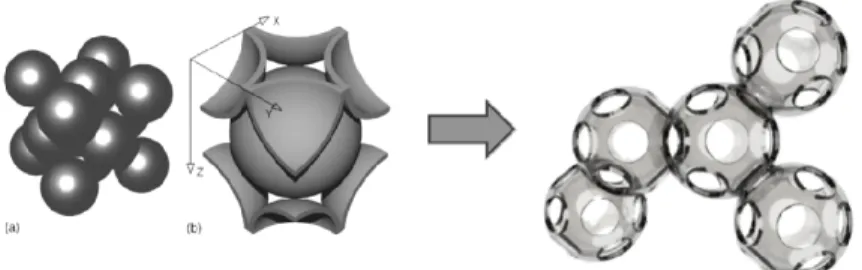
Fig. 3. A gold nanoparticle monolayer freely suspended

over a hole with a 250 nm radius in a silicon nitride

substrate. Reproduced from[12].

(4)

alized nanoparticles. Since the interspacing between nanoparticles can be altered by varying the type and chain length of functional groups, the resulting mem- brane properties can be tuned accordingly. In partic- ular, monodisperse Au nanoparticles functionalized with thiol-moieties can be assembled into close-packed two-dimensional structures or semi-three-dimensional structures (a few-layer stacked) to form nano- and mesopores between nanoparticles; these structures can be utilized for ultrafiltration applications to remove small organic molecules[13]. Although high perme- ability can be obtained by using very thin membranes, these encounter intrinsic limitations related to the diffi- culties in forming large-scale self-assembled structures and are vulnerable to the penetration of impurity par- ticles or deformation by external mechanical impacts;

these factors limit the practical applications of these membranes. To overcome this lack of mechanical sta- bility, instead of using organic moiety-functionalized Au nanoparticles, silica nanoparticles decorated with longer polymeric chains have been adopted to form self-assembled, structured membranes with an opaline phase[13]. As a result, stably-bound and three-dimen- sionally-interconnected nanoparticles can provide much stronger mechanical properties; thus, structured mem- branes can be fabricated in the form of free-standing

films. However, the highly-constrained processing con- ditions for the self-assembly of nanoparticles limit the maximum size of membrane films to below several mm

2

.

3. Inorganic-Based Inverse-Opal (IO)- Structured Membranes

The main reason behind the limited scalability of

opaline-structured membranes can be attributed to the

weakly bound interactions between nanoparticles,

which are mostly supported by organic functional

groups. In order to overcome this drawback and obtain

mechanical stability, inverse-opal (IO)-structured mem-

branes are exploited. Here, the void fraction of the

opal phase is filled with a frame species that is me-

chanically intact. In 2004, the Caruso group reported

that the interparticle voids of the opal phase, consisting

of 1-2 mm-sized silica microparticles, could be filled

with silica zeolite nanoparticles and then subjected to a

hydrothermal process to reinforce the bonding between

nanoparticles[14]. After removing the silica micro-

particles, an IO-structured zeolite membrane with 100-

140 nm-sized interconnecting pores was formed. These

enzyme-functionalized zeolite membranes were also

Fig. 4. Schematic illustration of the fabrication of a three-dimensional microporous zeolitic membrane bioreactor (left) and ac-

companying SEM images (right). Adapted from[14].

(5)

tested as bioreactors. As a result, it was reported that the loading amount and activity of enzymes were pro- portional to the membrane thickness, by which the structural uniformity of the IO structures could be confirmed. However, due to the brittleness of in- organic-based IO structures, it is difficult to shape these membranes or use them to produce larger films.

It has also been reported that hierarchically-struc- tured IO membranes can be fabricated via the consec- utive use of multiple inorganic precursors. In 2011, the Bein group synthesized the primary IO-structured frame using poly(methyl methacrylate) (PMMA) colloidal par- ticles and the inorganic precursor of tetraethyl orthoti- tanate[15]. Then, the internal void of the TiO

2

-made IO frame is again filled with a mixed precursor sol- ution of Pluronic P123 and tetraethyl orthotitanate and treated with a hydrothermal process. Finally, the con- structed hierarchically-porous structures made of TiO

2

exhibit double-scale internal pores; it has macropores on the order of 200 nm and mesopores on the order of 4-6 nm. The increased surface area brought about by these hierarchically-developed pores, which is greater by a factor of two compared to planar mesoporous films, can substantially enhance the surface activity and photoconversion efficiency when they were used as electrodes for solar cells.

4. Organic-Based Inverse-Opal-Structured Membranes

Organic-based IO-structured membranes, which typi- cally utilize polymeric materials, have been proposed to address the problem of mechanical brittleness that is observed in inorganic IO structures. These organic-

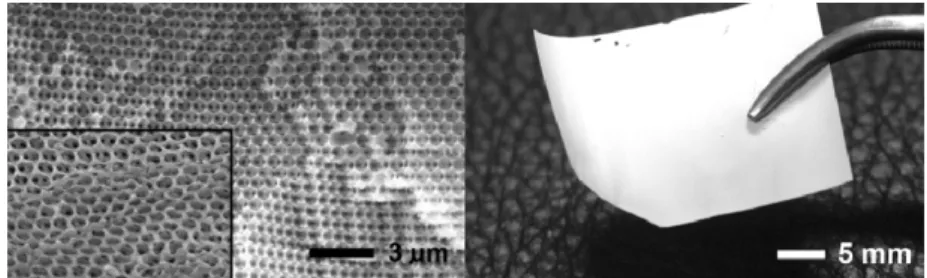
based membrane films also have the added advantage being flexible and stretchable, which allow for large-scale implementation and roll-to-roll processing of membrane films. To generate the polymeric IO struc- tures, a monomeric or oligomeric liquid precursor is infiltrated through the void space of the colloidal opa- line structure. The liquid is then polymerized or cross- linked to form solidified polymeric networks. In 1998, the Xia group first reported the feasibility of polymeric IO-structured membranes[16-18]. One-micrometer-sized polystyrene (PS) colloidal particles are first self-as- sembled into the opal phase inside the gap between glass slides placed in parallel and separated by a spacer. Then, UV-curable poly(urethane acrylate) (PUA) (NOA-73; a product of Norland Optical Adhesive) is injected and UV-cured to form the IO-structured membrane with internal interconnecting pores that are 300 nm in diameter. Additionally, in- stead of PUA, the copolymer of poly(acrylate-meth- acrylate) can be used to fill the opaline structure (using 480-nm-sized PS colloids) to generate IO struc- tures with smaller dimensions, where the interconnect- ing pores are shrunk to 100 nm. Moreover, IO-struc- tured membranes can be prepared in the form of free standing films with a size of ~1 cm

2

; these are flexible and physically manageable. However, there still exists a limitation for large-scale processing because gap-fill- Fig. 5. A strategy for the preparation of hierarchical titania

frameworks. Reproduced from[15].

Fig. 6. Schematic procedure for the assembly of spherical

particles into crystalline arrays. The aqueous dispersion of

monodispersed particles was injected into the cell (via the

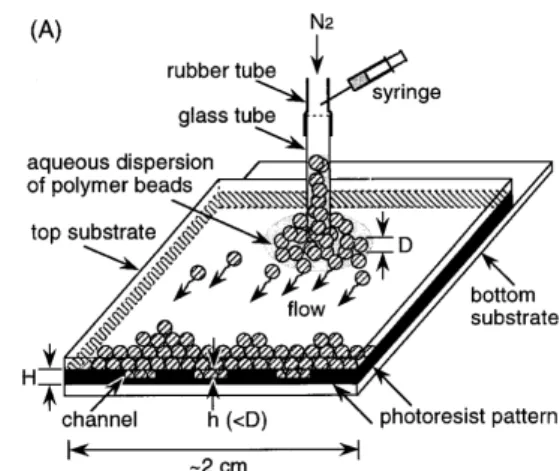
gap-filling method). Reproduced from[17].

(6)

ing with a viscous prepolymer (between the planar slabs) via capillary action requires a long time.

Likewise, the slow and non-uniform removal rate of solvent through the small gap between slabs strongly restricts the ability to obtain structural uniformity in the resultant membrane films.

In 2011, the Yoo group presented a means to imple- ment large-scale PUA-based IO-structured mem- branes[19]. Instead of inducing the self-assembly of colloidal particles within a confined geometry, they formed self-assembled opaline structures on a flat sub- strate over a large area and then used bar-coating to apply the PUA prepolymer atop the colloid-assembled surface. It should be noted that excess PUA on the surface must be removed, otherwise only a single side of the IO structure will have open pores on the surface after the UV crosslinking of PUA; this would form a structure that is not applicable as a membrane. To re- move this excess PUA, they spin-coated alcohol (which is a non-solvent of the PUA prepolymer) on the surface after bar-coating PUA, which swept the ex- cess PUA away via centrifugal forces. As a result, free-standing films of IO-structured membranes were

prepared over a large scale (greater than 2 in × 2 in).

Organic-based IO-structured membranes can also be fabricated via crosslinking reactions. The Matyjaszewski group reported that an opaline structure made of PMMA colloidal particles (size ~400 nm) can be filled with various types of chloride-functionalized precursors mixed with a dicationic crosslinker, resulting in a crosslinking reaction, to form IO-structured mem- branes[20]. Finally, these constructed membranes were subjected to a humidity swing process to observe the adsorption-desorption characteristics of CO

2

molecules, from which their feasibility as a membrane for the se- lective separation of CO

2

gas was confirmed.

5. Pore-Size-Controllable Inverse-Opal Structured Membranes

The aforementioned IO membranes involve a poly- merization/crosslinking reaction to solidify the pre- cursor molecules; this reaction is accompanied by volu- metric shrinkage, which reduces the free volume be- tween organic molecules to some extent. Therefore, as an example, using colloidal particles that are 400-500 Fig. 7. Preparation of 3DOM polymeric materials by PMMA colloidal crystals templating with crosslinking monomers.

Reproduced from[19].

Fig. 8. Preparation of the 3DOM polymeric materials by PMMA colloidal crystals templating with crosslinking monomers.

Reproduced from[20].

(7)

nm in size usually generates relatively large inter- connected pores of 100-150 nm. On one hand, this ef- fect of volumetric shrinkage is desirable since it helps maximize the volumetric porosity of IO structures.

Alternatively, in terms of practical applications as a membrane (typically for nanofiltration and/or ultra- filtration purposes), the size of the internal pores is too large to impart size-exclusive separation for smaller tar- geted species. To address this issue, an additional proc- ess for decreasing the pore size of the IO-structured membranes is required. In 2012, the Wickramasinghe group employed a secondary polymerization reaction over the surface of the primary IO structures[21]. First, they prepared the opaline structure by using silica par- ticles (440 nm in size) and generated the IO structures by using the monomer of poly(ethylene glycol) (PEG) derivatives. Afterward, using an atom transfer radical polymerization (ATRP) technique, PEG-methacrylate chains were polymerized and grown from the skeletal frame of the IO structure. This approach allows the ef- fective pore size of the IO structures to be reduced to 70 nm, such that the molecular weight cut-off (MWCO) value for dextran molecules of the IO-struc- tured membranes was measured to be 300 kDa, there- by allowing separation in the UF regime.

The layer-by-layer (LbL) coating method provides another means to control the internal pore size of IO structures (Yoo group)[19]. PUA-based IO structures

are prepared using 600-nm-sized PS colloidal particles,

leading to the formation of internal interconnected

pores that are 150-200 nm in size. The IO-structured

membranes subsequently undergo LbL self-assembly by

applying alternate coatings of positively-charged and

negatively-charged polyelectrolyte chains via electro-

static attractive interactions. However, the waterborne

nature of the LbL deposition process leads to the in-

trinsically hydrophobic properties of the UV-cured

PUA surface. Therefore, LbL coatings produced with

polyelectrolyte chains are not uniform or localized at

the surface region because the strong hydrophobicity of

the PUA IO structures suppresses the penetration of

the polyelectrolyte solution and the adsorption of poly-

meric chains on the surface. This problem can be read-

ily resolved by adding alcohol (isopropanol, 30 vol%)

to the polyelectrolyte solutions, which reduces the sur-

face energy of the solution and greatly improves the hy-

drophilic wettability. Meanwhile, polyelectrolyte chains

themselves are sensitively conformed in their chain

configuration according to the pH value of the sol-

ution; this is the case because the charge density along

the polyelectrolyte chains varies according to the pH

due to protonation/deprotonation processes. Utilizing

this property, the assembly density of LbL-deposited

films can be dramatically varied from sparsely-coated

to densely-packed conditions. Finally, LbL-modified

and pore size-controlled IO membranes have been used

Fig. 9. Schematic procedure for the fabrication of Ag nanoparticle-incorporated free-standing membranes using a template of

PDA-coated IO membranes (left) and the membrane performances (right). Reproduced from[22].

(8)

for nanofiltration to remove multivalent ions according to the Donnan-exclusion principle. For example, when removing Cu

2+

ions, the structured and LbL-modified membranes can exhibit a considerably high perme- ability value of 300 liter⋅m

-2

h

-1

(LMH) under 1 bar-pressurized conditions, without sacrificing the sepa- ration efficiency (greater than 95%).

The Yoo group also reported an example of a pore-regulated IO-structured membrane for catalytic re- actions[22]. Due to the isoporous characteristics and highly-interconnected geometry of IO structures, the feed solution can penetrate through IO membranes with reduced resistance while maximizing the contact area with the internal surface. To obtain these properties, the size of the interconnected pores needs to be re- duced appropriately, and the internal surface is deco- rated with Ag nanoparticles, which bear catalytic activity. Therefore, a bifunctional mediator, which was chosen as polydopamine (PDA), should be introduced over the IO surface to simultaneously reduce the pore size and provide in-situ synthesis of Ag nanoparticles.

However, as discussed previously, the intrinsic surface of the PUA-based IO structure is quite hydrophobic, which suppresses the permeation and coating of aque- ous dopamine precursors. To overcome this limitation, a mixed solvent with methanol (30 vol%) was in- troduced, resulting in greatly improved wetting charac- teristics and uniform coating of PDA within the inner surface of the PUA-IO structure. As a result, the initial interconnected pores (180 nm in size) were reduced to 60 nm and Ag nanoparticles were incorporated into the PDA-coated layer with a high density. As a representa- tive catalytic reaction, the organic reduction reaction was introduced to convert 4-nitrophenol to 4-amino- phenol using NaBH

4

as a reducing agent. The con- version performance was measured to be greater than 99% while maintaining a high permeability of 700 LMH at 1 bar, which is outstanding compared to con- ventional catalytic membranes. This demonstration con- firms the possibility of using IO-structured catalytic membranes in high-performance membrane systems.

6. Multiscale-Architectured Inverse-Opal- Structured Membranes

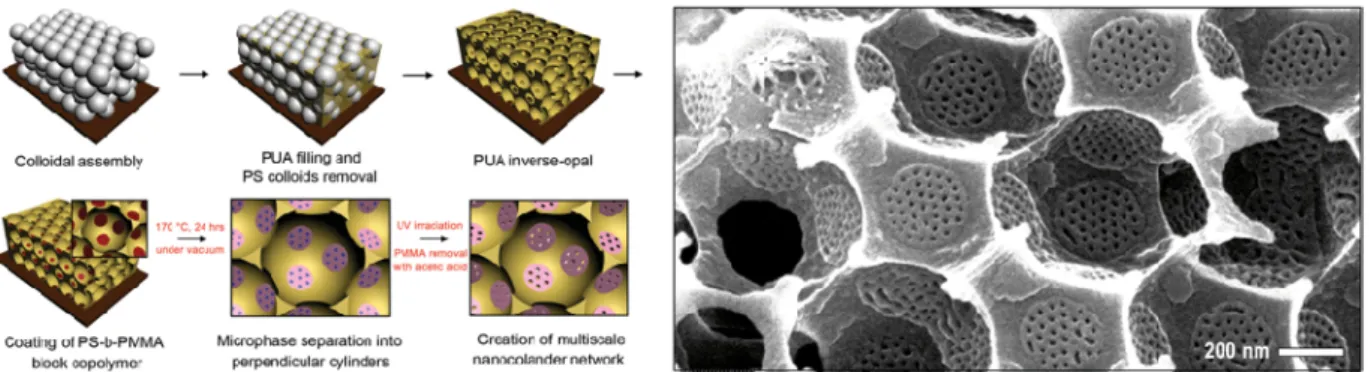
Finally, we will review structured IO membranes that have been aided by multiscale architecturing approaches. In 2014, the Yoo group reported IO-struc- tured membranes that included hierarchically-structured nanocolander networks[23]. As previously mentioned, the primary template of IO structures includes rela- tively large internal pores (generally > ~100 nm) that are not applicable to UF or NF membranes. Therefore, an additional structuring technique is required to create internal mesopores for effective separation in the re- gimes of NF and UF. In their work, they induced mi- crophase separation of diblock copolymers inside of PUA-based IO structures. This was followed by the se- lective removal of a minor component of the block co- polymer to create secondary mesopores. In their ex- periments, a solution of the PS-b-PMMA diblock co- polymer was dip-coated inside a PUA-based IO tem- plate, creating a thin coating of the block copolymer inside the IO structure. The processing temperature was then raised above the glass transition temperature of the block copolymer to impart mobility in the poly- mer films. At the same time, competitive dewetting in- teractions of the block copolymer films on the PUA surface occurred, which induced localized segregation of block copolymer films at the interconnecting pores due to the minimization of the total free energy of the system. Then, microphase separation within the block copolymer films induced the formation of perpendicu- larly-aligned cylinders of the PMMA phase within the PS matrix. The minor phase of PMMA, which occu- pies the core part of cylindrical pores, was removed by washing with acetone. This completed the formation of the multiscale architecture with nanosieves embedded in the frame of the IO structure. This is reminiscent of a nanoscale-miniaturized colander; thus, it is referred to as a nanocolander network.

One interesting feature of this structure is that un-

covered macropores remain, even after the in-

(9)

corporation of the block copolymer nanosieves. This is presumably due to the evaporation of residual solvent from the block copolymer, which migrates through the internal space within the IO membranes. The presence of macropores would be undesirable for the separation performance of surface membranes (two-dimensional membranes) since the majority of the feed solution would be concentrated on those macropores. However, the residual macropores inside the nanocolander net- works serve to enhance the permeability of the mem- branes without sacrificing the separation efficiency.

This is due to the three-dimensionality of the nanoco- lander networks, wherein the feed solution can be maximally distributed throughout the internal surface of IO-structured membranes by utilizing the residual mac- ropores as bypasses. This process effectively increases the active area for separation, not only on the surface region, but also in the internal regions of the nanoco- lander networks. While conventional block copolymer membranes exhibit a permeability of ~200 LMH at 1 bar with a membrane thickness of 300 nm, this study

reported a dramatic increase in the permeability (700 LMH at 1 bar) with outstanding separation selectivity despite its increased thickness (~20 mm). This work clearly proves the feasibility of the proposed multiscale architecturing strategy to obtain membranes that pos- sess both high selectivity and high permeability.

As a final example of multiscale-architectured IO membranes, one can employ complexly designed col- loidal particles as a starting material for the self-as- sembled opaline phase. The Yoo group also reported that monodisperse core-shell colloidal particles, in which the core is PS and the shell is silica, can be self-assembled into opaline structures[24]. After form- ing the IO frame with a UV-curable PUA material, on- ly the silica shell regions of the internally-confined colloidal particles were removed by an acid treatment with hydrofluoric acid. The resulting structure is in- triguing because each hollow chamber inside the IO-structured frame contains a single colloidal particle of PS; this is referred to as a particle-nested IO (PN-IO) structure. Due to the size of the internally- nested colloidal particles, which are much larger than the interconnected pores, concerns related to particle leaching and contamination are addressed. At the same time, it is expected to form very fine nanochannels be- tween the nested particles and the outer chamber of in- dividual IO units. The size of nanochannels can be readily controlled by varying the ratio between the core and the shell of the colloidal particles, leading to various nanochannel widths in the range of 5-50 nm Fig. 10. Schematic of the generation of the nanocolander network using the sequential combination of macroporous IO tem- plates and mesoporous BCP nanosieves (left) and an SEM image (right). Reproduced from[23].

Fig. 11. Simplified unit geometry of the PN-IO structure

and SEM observation of the PN-IO structure. Adapted

from Adapted from[24].

(10)

(i.e., the mesoporous regime). In order to prove their applicability as high-performance ultrafiltration mem- branes, the structural properties of PN-IO structures were mathematically interpreted; these results have been compared with observed experimental results.

7. Conclusion and Summary

In general, polymeric membrane technologies have been considered to be relatively stagnant in terms of materials innovation since they reached the status of commercialized production several decades ago.

However, recent developments in nano-structuring and large-scale processing technologies have motivated the creation of novel membrane materials with elaborate but controllable structures and functional pores[25]. In this review article, among a number of candidate struc- tures, we focused on inverse-opal-structured membranes because these can offer the advantages of high volu- metric porosity and pore-size controllability. Inverse- opal-structured membranes have been fabricated by in- troducing various inorganic and organic precursors, but their utilization has been highly restricted due to their inability to be used on a large scale. However, recent studies have enabled the creation of free-standing films of inverse-opal-structured membranes over a large area, while obviating the need for the conventional gap-fill- ing method, successfully leading to nano- and ultra- filtration applications for water treatment. Moreover, by using the strategy of multiscale architecturing for in- verse-opal structured membranes, it is possible to ob- tain more elaborate controllability over the pore size and functionality in order to achieve more effective separation. Overall, inverse-opal-structured membranes impart the notable advantages of highly-enhanced per- meability by virtue of a large volumetric porosity and greatly reduced flow resistance. They also possess per- fect size-exclusive separation properties, which benefit from the isoporous structural characteristics. These re- markable performances, which overcome the traditional limitations of membrane design, may lead to a versa-

tile platform for devising the next generation of high-performance membranes. With further develop- ments in processing, such as coating over hollow fibers or roll-to-roll production, it is anticipated that these materials will be commercialized for practical mem- brane applications in the near future.

Acknowledgement

This work was supported by research grants of the NRF (2014M3A7B4052200) funded by the National Research Foundation under the Ministry of Science, ICT & Future, Korea.

Reference

1. B. Jung and N. Kim, “Preparation and character- ization of microfiltration membranes for water treatment”, Membr. J., 24, 50 (2014).

2. C.-H. Yun, J.-H. Kim, K. W. Lee, and S. H. Park,

“Water treatment application of a large pore mi- cro-filtration membrane and its problems”, Membr.

J., 24, 194 (2014).

3. T. H. Lee, H. D. Lee, and H. B. Park, “Current research trends in polyamide based nanocomposite membranes for desalination”, Membr. J., 26, 351 (2016).

4. D. L. Gin and R. D. Noble, “Designing the next generation of chemical separation membranes”, Science, 332, 674 (2011).

5. D. Wang, K. Li, and W. Teo, “Preparation and characterization of polyvinylidene fluoride (PVDF) hollow fiber membranes”, J. Membr. Sci., 163, 211 (1999).

6. N. A. Hashim, F. Liu, M. M. Abed, and K. Li,

“Chemistry in spinning solutions: Surface mod- ification of PVDF membranes during phase in- version”, J. Membr. Sci., 415, 399 (2012).

7. G. R. Guillen, Y. Pan, M. Li, and E. M. Hoek,

“Preparation and characterization of membranes

formed by nonsolvent induced phase separation: a

(11)

pore sizes”, J. Membr. Sci., 451, 266 (2014).

9. S.-H. Kim, S. Y. Lee, S.-M. Yang, and G.-R. Yi,

“Self-assembled colloidal structures for photonics”, NPG Asia Mater., 3, 25 (2011).

10. J. Zhang, Z. Sun, and B. Yang, “Self-assembly of photonic crystals from polymer colloids”, Curr.

Opin. Colloid Interface Sci., 14, 103 (2009).

11. S. Gasser, F. Paun, A. Cayzeele, and Y. Bréchet,

“Uniaxial tensile elastic properties of a regular stacking of brazed hollow spheres”, Scr. Mater.,

48, 1617 (2003).

12. K. E. Mueggenburg, X.-M. Lin, R. H. Goldsmith, and H. M. Jaeger, “Elastic membranes of close-packed nanoparticle arrays”, Nat. Mater., 6, 656 (2007).

13. E. Green, E. Fullwood, J. Selden, and I. Zharov,

“Functional membranes via nanoparticle self-as- sembly”, Chem. Commun., 51, 7770 (2015).

14. Y. Wang and F. Caruso, “Macroporous zeolitic membrane bioreactors”, Adv. Funct. Mater., 14, 1012 (2004).

15. B. Mandlmeier, J. M. Szeifert, D. Fattakhova- Rohlfing, H. Amenitsch, and T. Bein, “Formation of interpenetrating hierarchical titania structures by confined synthesis in inverse opal”, J. Am. Chem.

Soc., 133, 17274 (2011).

16. S. H. Park and Y. Xia, “Fabrication of three-di- mensional macroporous membranes with assem- blies of microspheres as templates”, Chem. Mat.,

10, 1745 (1998).

17. S. H. Park and Y. Xia, “Macroporous membranes with highly ordered and three-dimensionally inter- connected spherical pores”, Adv. Mater., 10, 1045 (1998).

18. B. Gates, Y. Yin, and Y. Xia, “Fabrication and

Yoo, “Layer-by-layer assembly of polyelectrolyte multilayers in three-dimensional inverse opal struc- tured templates”, ACS Appl. Mater. Interfaces, 4, 2107 (2012).

20. H. He, M. Zhong, D. Konkolewicz, K. Yacatto, T.

Rappold, G. Sugar, N. E. David, J. Gelb, N.

Kotwal, A. Merkle, and K. Matyjaszewski, “Three- dimensionally ordered macroporous polymeric ma- terials by colloidal crystal templating for reversible CO

2

capture”, Adv. Funct. Mater., 23, 4720 (2013).

21. X. Wang, S. M. Husson, X. Qian, and S. R.

Wickramasinghe, “Inverse colloidal crystal ultra- filtration membranes”, Sep. Purif. Technol., 93, 33 (2012).

22. G. H. Choi, D. K. Rhee, A. R. Park, M. J. Oh, S.

Hong, J. J. Richardson, J. Guo, F. Caruso, and P.

J. Yoo, “Ag nanoparticle/polydopamine-coated in- verse opals as highly efficient catalytic mem- branes”, ACS Appl. Mater. Interfaces, 8, 3250 (2016).

23. Y. H. Kim, H. Kang, S. Park, A. R. Park, Y. M.

Lee, D. K. Rhee, S. Han, H. Chang, D. Y. Ryu, and P. J. Yoo, “Multiscale porous interconnected Nanocolander network with tunable transport prop- erties”, Adv. Mater., 26, 7998 (2014).

24. D. K. Rhee, B. Jung, Y. H. Kim, S. J. Yeo, S.-J.

Choi, A. Rauf, S. Han, G.-R. Yi, D. Lee, and P. J.

Yoo, “Particle-nested inverse opal structures as hi- erarchically structured large-scale membranes with tunable separation properties”, ACS Appl. Mater.

Interfaces, 6, 9950 (2014).

25. B. Hatton, L. Mishchenko, S. Davis, K. H.

Sandhage, and J. Aizenberg, “Assembly of large-

area, highly ordered, crack-free inverse opal films”,

Proc. Natl. Acad. Sci. U.S.A., 107, 10354 (2010).

수치

Fig. 3. A gold nanoparticle monolayer freely suspended  over a hole with a 250 nm radius in a silicon nitride  substrate
Fig. 6. Schematic procedure for the assembly of spherical  particles into crystalline arrays
Fig. 8. Preparation of the 3DOM polymeric materials by PMMA colloidal crystals templating with crosslinking monomers
Fig. 11. Simplified unit geometry of the PN-IO structure  and SEM observation of the PN-IO structure

참조

관련 문서