†
: This research was supported by the 2015 scientific promotion program funded by Jeju National University.
Corresponding author: Hoon Kang, Research Institute for Subtropical Agriculture and Animal Biotechnology, Jeju National University, Jeju 63243, Korea, Tel.: +82-64-754-3327, E-mail: [email protected]
여름철 해변지역의 인간 열환경지수 및 열쾌적성 †
- 제주특별자치도 제주시 구좌읍 월정리 해변 -
박수국*․신지환**․조상만**․현철지**․강훈*
*
제주대학교 생명자원과학대학 생물산업학부 원예환경전공․아열대농업생명과학연구소․친환경농업연구소
**
제주대학교 생명자원과학대학 생물산업학부 원예환경전공
Human Thermal Sensation and Comfort of Beach Areas in Summer
- Woljeong-ri Beach, Gujwa-eup, Jeju-si, Jeju Special Self-Governing Province -
Park, Sookuk*․Sin, Jihwan**․Jo, Sangman**․Hyun, Cheolji**․Kang, Hoon*
*
Research Institute for Subtropical Agriculture and Animal Biotechnology, SARI, Horticultural Science, College of Applied Life Science, Jeju National University
**
Horticultural Science, College of Applied Life Science, Jeju National University
ABSTRACT
The climatic index for tourism(CIT) has recently been advanced, which includes complete human energy balance models such as physiological equivalent temperature(PET) and universal thermal climate index(UTCI). This study investigated human thermal sensation and comfort at Woljung-ri Beach, Jeju, Republic of Korea, in spring and summer 2015 for landscape planning and design in beach areas. Microclimatic data measurements and human thermal sensation/comfort surveys from ISO 10551 were conducted together. There were 869 adults that participated. As a result, perceptual and thermal preference that consider only physiological aspects had high coefficients of determination( r
2) with PET in linear regression analyses:
92.8% and 87.6%, respectively. However, affective evaluation, personal acceptability and personal tolerance, which consider both physiological and psychological aspects, had low r
2s: 60.0%, 21.1% and 46.4%, respectively. However, the correlations between them and PET were all significant at the 0.01 level. The neutral PET range in perceptual for human thermal sensation was 25~27℃, but a PET range less or equal to 20% dissatisfaction, which was recommended by ASHRAE Standard 55, could not be achieved in perceptual. Only PET ranges in affective evaluation and personal tolerance affected by both aspects were qualified for the recommendation as 21~32℃ and 17~37℃, respectively. Therefore, the PET range of 21~32℃
is recommended to be used for the human thermal comfort zone of beach areas in landscape planning and design as well as tourism and recreational planning. PET heat stress level ranges on the beach were 2~5℃ higher than those in inland urban areas of the Republic of Korea. Also, they were similar to high results of tropical areas such as Taiwan and Nigeria, and higher than those of western and middle Europe and Tel Aviv, Israel.
Key Words: Human Thermal Comfort, Human Biometeorology, CIT, Beach, PET
국문초록
최근에 관광기후지수가 생리등가온도(PET)와 범용열기후지수(UTCI)와 같은 완전한 인간 에너지 균형 모델들을 포함 함으로써 발전되어 오고 있다. 이 연구는 해변에서의 조경계획 및 설계를 위해, 2015년 봄과 여름에 대한민국 제주특별자치 도 월정리해변에서 인간 열환경지수 및 열쾌적성을 조사하였다. 미기후 측정과 국제표준화기구 10551을 바탕으로 만들어 진 설문조사를 동시에 실시하였으며, 성인 869명이 참가하였다. 그 결과, 생리적인 요소만 고려된 ‘열환경 지각’과 ‘열환경 선호도’가 선형 회귀 분석에서 생리등가온도와 92.8과 87.6%의 높은 결정계수를 나타내었다. 그러나, 생리적 요소와 심리적 요소 둘 다 고려된 ‘열환경 평가’, ‘열환경 수용도’와 ‘열환경 부담도’에서는 60.0, 21.1, 46.4%로 낮은 결정계수를 보였다. 그렇지만, 생리등가온도와의 상관성 분석에서는 모두 0.01 레벨에서 유의성이 있는 것으로 나타났다. 인간 열환경 지수를 나타내는 ‘열환경 지각’에서 덥지도 춥지도 않는 ‘중간’의 생리등가온도의 범위는 25~27℃로 나타났으나, 미국의 냉온난방협회 표준 55에서 추천한 20% 이하의 불만족성 범위는 없었다. 다만, ‘열환경 평가’와 ‘열환경 부담도’에서 21~32℃와 17~37℃의 생리등가온도 범위들이 그 추천범위에 속하는 것으로 나타났다. 그러므로, 21~32℃의 생리등가온도 를 해변지역의 조경계획 및 디자인뿐만 아니라 관광 및 레크리에이션 계획을 위한 인간 열쾌적성 범위로 적용될 수 있을 것이다. 해변에서의 열 스트레스 레벨들은 한국의 내륙들보다 2~5℃ 높게 나타났으며, 대만과 나이지리아와 같은 열대지역과 유사한 높은 결과들을 보였고, 서․중유럽과 이스라엘의 텔아비브보다 높은 것으로 나타났다.
주제어: 인간 열쾌적성, 인간 생명기상, 관광기후지수, 해변, 생리등가온도
Ⅰ. 서론
기후가 인간의 열환경에 미치는 영향을 정량적으로 예측할 수 있다면, 보다 쾌적한 생활환경을 만들 수 있을 것이다. 그 영향을 기후적인 관점에서 판단할 수 있도록 개발된 척도가 인 간 열환경지수(human thermal sensation) 또는 인간 열쾌적성 (human thermal comfort)이다. 현재 전세계적으로 다양한 지 수와 모델들이 이용되고 있으며(Park, 2012), 도시계획과 조경 분야에서는 physiological equivalent temperature(PET; Höppe, 1999; Matzarakis et al ., 1999)와 universal thermal climate index (UTCI; Bröde et al ., 2012a; Bröde et al ., 2012b; http://
www.utci.org)가 가장 많이 이용되고 있다.
국내에서 이루어진 인간 열환경지수 및 열쾌적성 관련 연구 로 초기에는 operative temperature(OT)과 new effective tem- perature(ET*)를 이용해 도시옥외공간의 열환경을 분석한 연 구(Jeong and Yoon, 1998), 여름철 해풍이 도시공간 열환경에 미치는 영향을 분석한 연구(Jeong et al ., 1999), 도시가로의 열 환경을 분석한 연구(Jeong and Yoon, 2001)가 있었다. 또한, 복사에너지를 제외한 기온, 습도, 풍속자료만으로 열쾌적성을 나타낸 ‘생체기후도 챠트(Bioclimatic chart)’를 이용해 도시공 간 구성요소와 열쾌적성과의 관련성을 분석한 연구(Lee, 2006) 와 ET*에서 유래된 standard effective temperature(SET*)을 이용해 공동주택 단지 내 열환경을 분석한 연구(Lim et al ., 2008) 도 있었다.
그 다음으로 이용된 지수는 평균복사온도(mean radiant tem-
perature, T
mrt)를 정확성은 떨어지지만, 간단히(Nikolopoulou et al ., 1999) 측정할 수 있는 구 형태의 globe 온도계(thermo- meter)를 이용하는 wet bulb globe temperature(WBGT)로서, 도시 녹음수의 그늘이 WBGT에 미치는 효과에 대한 연구(Ju et al ., 2004)와 조경포장면의 종류에 따른 하절기 열환경을 분 석한 연구(Lee and Ryu, 2010)가 있었다. WBGT를 이용하지 는 않았으나, globe 온도계를 이용해 대학 캠퍼스의 토지피복 종류에 따른 열쾌적성 분석을 설문조사 방식으로 진행한 연구 (Joo et al ., 2008)도 있었다.
마지막으로, 인간 열환경에 영향을 끼치는 주요 기후요소들 (기온, 습도, 풍속, 태양 및 지구 복사에너지)을 모두 포함하여 분석하는 인간 에너지 균형 모델(human energy balance model) 에 기초하여 개발된 모델들인 predicted mean vote(PMV; Fanger, 1972), PET, comfort formula(COMFA; Brown and Gillespie, 1986; Brown and Gillespie, 1995; Vanos et al ., 2012), OUT_
SET*(Pickup and de Dear, 2000), UTCI를 이용한 연구들이
있었다. 도시 미기후 모델링 프로그램인 ENVI-met을 이용해
도시 옥외공간의 PMV를 분석한 연구(Moon et al ., 2010; Park,
2012), 대학 캠퍼스의 공간구조에 따른 PMV와 PET를 분석한
연구(Lee et al ., 2009), COMFA 모델을 이용해 도시옥외공간
(하드스케이프 공간, 잔디공간, 수목차양공간)의 열환경을 분
석한 연구(Jo and Ahn, 2010), 도시근린공원을 포함한 중심상
업지역에서 PMV와 UTCI를 이용해 열환경을 분석하고, 인간
생명기후지도(Human bioclimatic map)를 작성한 후, 조경계획
및 디자인에 미기후적인 접근방법의 필요성에 대해 강조한 연
구(Park, 2013), 여름철 공원 수림지와 잔디밭의 열환경 개선 효과를 PET, UTCI, OUT_SET*을 이용하여 분석한 연구 (Ryu and Lee, 2014)와 수림지 가장자리로부터의 거리별 열저 감효과를 UTCI를 이용해 분석한 연구(Ryu and Lee, 2015)가 있었다.
위의 지수들과 모델들은 모두 서유럽과 미국에 거주하는 서 양인을 기준으로 개발되어, 한국형 모델 개발이 필요한 상황이 다. 한국형 모델 개발을 위한 기존의 연구들은 체감온도지수 개발에 대한 연구(Park et al ., 2008)와 남부지방인 창원과 대 구에서 미기후자료 측정과 설문조사를 통해 얻어진 인간 열환 경지수 및 열쾌적성 모델 개발에 대한 연구(Park, 2014)뿐이다.
특히, 전 세계적으로 레크리에이션 유형에 따라 개발되고 있는 관광기후지수(Climatic Index for Tourism, CIT)를 고려해 보 았을 때, 국내에서도 등산, 골프, 축구, 수영, 요트 타기 등 다양 한 형태에 맞는 한국형 모델 개발이 필요할 것이다.
본 연구는 여름철 관광 및 레크리에이션이 집중되는 장소인 해변지역의 조경계획 및 설계를 위한 기초 자료 조사로서 제주 특별자치도 구좌읍 월정리 해변을 방문한 내국인 관광객 및 제 주도민을 대상으로 설문조사와 미기후 측정을 실시하여, 인간 열환경지수 및 열쾌적성 모델 기준을 마련해 보고자 하였다.
이 연구의 결과는 월정리 해변에서 얻어진 기준으로, 향후 국 내의 여러 해변지역에서의 추가 연구가 행해져야 할 것이다.
Ⅱ. 연구방법
인간 열환경지수를 연구하기 위해 봄․여름철 데이터를 수 집하였다. 봄철에는 2015년 5월 1일과 5일, 여름철에는 동년 8 월 1일과 2일에 10:00~17:00 동안 제주특별자치도 구좌읍 월 정리 해변(Figure 1 참조)에서 미기후 자료(기온, 상대습도, 풍 속, 태양 및 지구 복사에너지)를 측정하였다(Table 1 참조). 옥 외공간에서 열환경지수에 가장 큰 영향을 미치는 태양 및 지구
a: Study site: Woljeong-ri beach b: Fisheye lens photograph
(SVF=0.995) c: Woljeong-ri beach
Figure 1. Study site: Woljeong-ri beach
Source: a from http://www.google.co.kr/maps. Sky view factor (SVF) was calculated with BMSky-view (Gálet al., 2007)
Season
Spring Summer
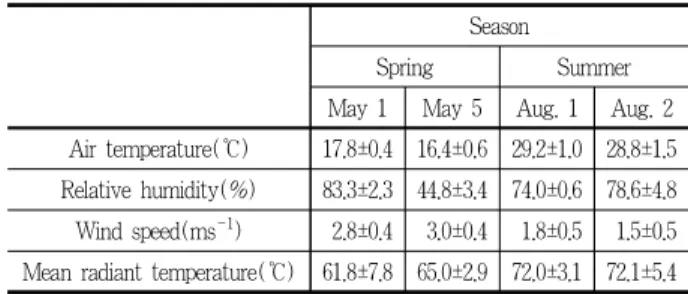
May 1 May 5 Aug. 1 Aug. 2 Air temperature(℃) 17.8±0.4 16.4±0.6 29.2±1.0 28.8±1.5 Relative humidity(%) 83.3±2.3 44.8±3.4 74.0±0.6 78.6±4.8 Wind speed(ms-1) 2.8±0.4 3.0±0.4 1.8±0.5 1.5±0.5 Mean radiant temperature(℃) 61.8±7.8 65.0±2.9 72.0±3.1 72.1±5.4 Table 1. Seasonal microclimatic factors
복사에너지양이 높고, 평균복사온도 계산에 용이한 맑은 날을 기준으로 측정하였다. 기온은 봄철 자료는 제주, 서울과 부산의 30년(1981~2010년) 평균기온값과 비슷하였으나, 여름철자료는 최고기온값과 유사하게 높았다(http://www.kma.go.kr/weather/
climate/average_30years.jsp; Table 2 참조). 평균습도는 봄철 에는 30년 평균습도값들에 비해 변화폭이 컸으나, 여름철에는 유사한 값을 나타내었다. 풍속은 반대로 봄철에는 30년 평균풍 속값들과 비슷하였으나, 여름철에는 평균값들에 비해 낮은 값 들을 보였다. 평균복사온도(mean radiant temperature; T
mrt) 는 기온이 유사했던(30.8±0.6℃) 내륙지역인 경상남도 함양군 상림공원의 액상우레탄포장으로 된 운동광장의 여름철 낮시간 대(10:00~16:00) T
mrt가 61.1±1.8℃(최대값 65.9℃)인 것에 비 해(Ryu and Lee, 2014), 월정리 해변이 11℃ 정도 높게 나타났 다(Table 1 참조). 미기후 자료 측정은 사람 가슴높이인 1.2m 에서 1분 단위로 이루어졌으며, 사용된 장비는 Table 3과 같다.
설문조사는 국제 표준화 기구의 열환경지수 평가 설문지(ISO
10551)를 바탕으로 만든 한국형 인간 열환경지수 평가 설문지
(Figure 2 참조)를 이용하여 해변에서 산책하는[서 있거나(생
리적 에너지, 93Wm
-2) 천천히 걷는(속도 2km/hr일 때 110
Wm
-2) 동작] 성인(18~70세) 내국인 관광객 및 제주도민들을
대상으로 총 870명(봄철, 658명; 여름철, 212명)의 자료를 모았
다(Figure 3 참조). 설문지는 5가지 주요 질문들로 구성되어,
Factors March April May June July August
Jeju
Mean air temperature(℃) 9.4 13.8 17.8 21.5 25.8 26.8
The highest air temperature(℃) 12.8 17.5 21.6 24.8 29.0 29.8
The lowest air temperature(℃) 6.1 10.2 14.4 18.7 23.3 24.3
Mean wind speed(ms-1) 3.9 3.4 3.0 3.0 3.0 3.0
Mean relative humidity(%) 64.9 66.5 70.4 76.8 78.3 76.5
Seoul
Mean air temperature(℃) 5.7 12.5 17.8 22.2 24.9 25.7
The highest air temperature(℃) 10.4 17.8 23.0 27.1 28.6 29.6
The lowest air temperature(℃) 1.6 7.8 13.2 18.2 21.9 22.4
Mean wind speed(ms-1) 2.8 2.8 2.5 2.2 2.3 2.1
Mean relative humidity(%) 57.8 56.2 62.7 68.1 78.3 75.6
Busan
Mean air temperature(℃) 8.6 13.6 17.5 20.7 24.1 25.9
The highest air temperature(℃) 13.4 18.2 21.7 24.4 27.3 29.4
The lowest air temperature(℃) 4.9 9.9 14.1 17.9 21.8 23.4
Mean wind speed(ms-1) 4.0 4.0 3.6 3.3 3.8 3.7
Mean relative humidity(%) 57.7 62.7 69.8 77.4 84.3 79.9
Source: Korea Meteorological Administration, 2011
Table 2. Mean monthly climatic factors of Jeju, Seoul and Busan between 1981 and 2010
Figure 2. Survey form
Instruments
Radiation CNR4 Net Radiometer Kipp &
Zonen Inc.
Air temp. and relative humidity HMP155A
Campbell Scientific Inc.
Wind speed and direction Met One 034B-L Windset
Datalogger CR1000
Table 3. Instruments for microclimatic data
a: Sex b: Age
Figure 3. Frequencies of participants' sexes and ages
열환경 지각(perceptual), 열환경 평가(affective evaluation), 열 환경 선호도(thermal preference), 열환경 수용도(personal accep- tability), 열환경 부담도(personal tolerance)를 분석해 보고자 하였다. 남녀의 비율이 각각 35.7%와 64.3%로 여자들의 참여자 가 많았고, 연령별로도 20대가 59.3%를 차지하여 젊은 여자층 이 선호하는 관광지임을 알 수 있었다. 연구 대상지에서 측정 한 미기후 자료 중 태양 및 지구 복사에너지를 이용하여 T
mrt를 계산(Park, 2011)하였으며, 기온, 상대습도, 풍속, T
mrt를RayMan Pro. Ver. 2.2(Matzarakis et al ., 2010; http://www. urbanclimate.
net/rayman; Figure 4 참조)에 입력하여 PET 값들을 산출하 였다. PET 값을 이용하여 5가지 주요 결과들과의 상관성 및 회귀 분석과 80% 이상의 열쾌적성 분포가 나타나는 PET 값
Figure 4. RayMan Pro. Ver. 2.2
Source: http://www.urbanclimate.net/rayman
의 범위를 SPSS Ver. 20(IBM SPSS Co., 2012; http://www.
spss.co.kr)을 이용하여 분석하였다.
Ⅲ. 연구결과 및 고찰
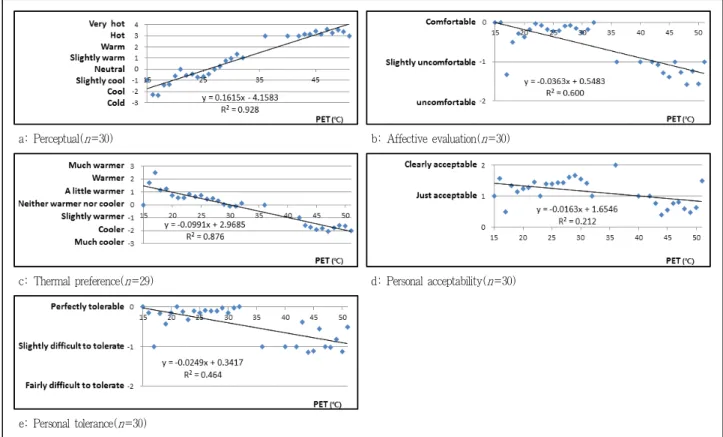
월정리 해변에서 내국인들을 대상으로 조사한 설문조사 결 과와 PET와의 선형 회귀 분석 결과, 생리적인 요소만을 고려 한 열환경 지각(perceptual)과 결정계수(coefficients of deter- mination, r
2)가 92.8%, 열환경 선호도(thermal preference)가 r
2=87.6%로 높게 나타났으나, 심리적인 요소까지 고려한 열환 경 평가(affective evaluation), 열환경 수용도(personal acceptability) 와 열환경 부담도(personal tolerance)와는 각각 r
2=60.0, 21.1, 46.4%로 낮게 나타났다(Figure 5 참조).
PET와 설문조사 결과와의 상관성(correlation, r ) 분석 결과, 5가지 질문에 대해 99% 수준에서 모두 유의성이 있는 것으로 나타났으며, 생리적 요소만을 고려한 변수인 열환경 지각과 열 환경 선호도와는 r =80.6%와 75.2%로 높게 나왔으며, 이 둘의 상관성도 77.7%로 높게 나왔다. 심리적인 요소까지 포함한 나 머지 3가지 결과들의 PET와의 상관성은 다소 낮은 31.6~56.4%
로 나타났으나, 이들 상호간의 상관성은 53.7~64.3%로 다소 높 게 나왔다(Table 4 참조). 성별(sex)과 나이(age)는 PET뿐만 아니라, 5가지 결과와도 최대 r =13.5%로 유의성이 약하거나 없는 것으로 나타나, 해변에서의 인간 열환경 분석 연구에서는 영향을 끼치지 않는 것으로 생각된다.
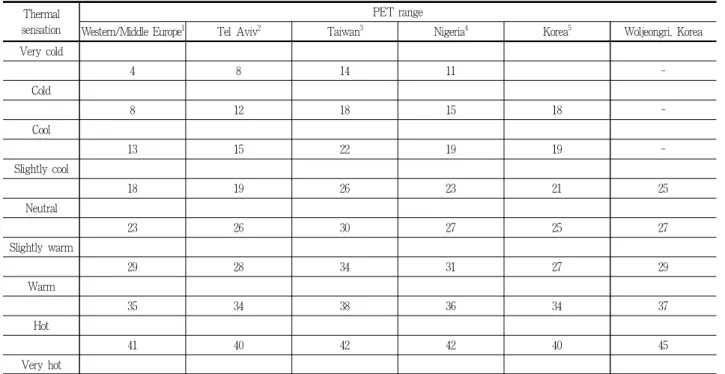
열환경 지각에서 가장 이상적인 범위(neutral)는 slightly cool (평균 24.31℃ PET)과 neutral(26.25℃)의 정수 중간값(25℃) 과, neutral과 slightly warm(27.53℃)의 정수 중간값(27℃)인 25~27℃ PET로 나타났으나(Table 5 참조), ASHRAE Standard 55에서 권장하는 20% 이하의 불만족 범위(80% 이상이 만족하 는 범위)를 갖는 열환경을 조성하기 위한 PET 값의 범위는 열 환경지수를 나타내는 열환경 지각에서는 없는 것으로 나타났다.
그래서, 문화, 역사, 사회 등의 심리적인 요소들(Nikolopoulou and Steemers, 2003)이 반영된 열환경 평가와 열환경 부담도를 통하여 80% 이상의 설문대상자들이 쾌적하거나 견딜만하다고 대답한 PET 값의 범위를 구해 본 결과, 21~32℃와 17~37℃
로 열환경 지각의 neutral PET 값의 범위보다 훨씬 넓은 범위 의 결과를 보였다(Figure 6 참조). 특히, 열환경 평가는 기존의 연구에서 많이 언급된 열쾌적성을 뜻하는 것으로, 해변지역을 포함한 관광 및 레크리에이션 계획/디자인에서는 인간 열환경 지수인 열환경 지각의 neutral PET 범위보다는 심리적인 요소 들이 반영된 인간 열쾌적성 PET 범위인 21~32℃를 기준으로 하여, 계획 및 디자인 가이드라인을 잡으면 될 것으로 판단된다.
본 연구는 2012~13년도 창원시와 대구광역시(Park, 2014)
에서 분석된 결과보다 2~5℃ 높은 PET 기준들을 보여, 연구
a: Perceptual(n=30) b: Affective evaluation(n=30)
c: Thermal preference(n=29) d: Personal acceptability(n=30)
e: Personal tolerance(n=30)
Figure 5. Linear regression analyses between PET values and results of the five questions
Sex Age PET(℃) Perceptual Affective
evaluation Thermal
preference Personal
acceptability Personal tolerance
Sex 1 -.138** -.111** -.135** .083* .111** .038 .040
Age 1 .011 .004 .128** .003 .005 .116**
PET(℃) 1 .806** -.564** -.752** -.316** -.416**
Perceptual 1 -.467** -.777** -.263** -.343**
Affective evaluation 1 .479** .537** .643**
Thermal preference 1 .269** .336**
Personal acceptability 1 .632**
Personal tolerance 1
*Correlation is significant at the 0.05 level (2-tailed),**Correlation is significant at the 0.01 level (2-tailed) Table 4. Correlations between variables
대상지가 해변지역이라는 장소 특성과 관광지라는 심리적인 요인들이 생리적인 결과에도 반영된 것으로 보여진다(Table 5 참조). 이 기준들은 열대성 기후인 타이완(Lin and Matzarakis, 2008)이나 나이지리아(Omonijo and Matzarakis, 2011)와 비슷 한 결과를 보였으며, 서․중유럽(Matzarakis and Mayer, 1996) 과 지중해 기후에 속하는 이스라엘 텔아비브(Cohen et al ., 2013) 보다 높은 결과를 보였다.
Ⅳ. 결론
본 연구는 여름철 해변지역의 관광 및 레크리에이션 계획/
디자인을 위한 한국형 열환경 기준을 마련하기 위해, 제주특별
자치도 구좌읍 월정리 해변에서 관광객과 제주도민 성인을 대
상으로 미기후 자료 측정과 설문조사를 동시에 실시하였다. 그
결과, 내륙보다는 2~5℃ PET 높은 열환경 기준을 갖는 것으
로 나타났으며, 해변지역이라는 특성상 열대성 기후인 타이완
이나 나이지리아와 비슷한 결과를 보였다. 여름철 해변지역 계획
및 디자인을 위해서는 인간 열쾌적성을 고려한 21~32℃ PET를
기준으로 인간 열환경을 조성하면 될 것으로 나타났다. 이 기
Thermal sensation
PET range
Western/Middle Europe1 Tel Aviv2 Taiwan3 Nigeria4 Korea5 Woljeongri. Korea
Very cold
4 8 14 11 -
Cold
8 12 18 15 18 -
Cool
13 15 22 19 19 -
Slightly cool
18 19 26 23 21 25
Neutral
23 26 30 27 25 27
Slightly warm
29 28 34 31 27 29
Warm
35 34 38 36 34 37
Hot
41 40 42 42 40 45
Very hot
1Matzarakis and Mayer(1996),2Cohenet al.(2013),3Lin and Matzarakis(2008),4Omonijo and Matzarakis(2011),5Park(2014) Table 5. Comparison of thermal sensation PET ranges between previous studies and Koreans
a: Perceptual(n=19) b: Affective evaluation(n=24)
c: Thermal preference(n=23) d: Personal acceptability(n=26)
e: Personal tolerance(n=25)
Figure 6. Dissatisfaction under microclimate variables
준은 slightly cool에서 slightly warm까지의 범위를 나타내고 있다(Figure 5의 a 참조). 이 연구는 시간적 범위로 봄철과 여 름철로 한정되어 수행되어, 향후 가을철과 겨울철 자료를 측정 하여 월정리 해변에서의 사계절 인간 열환경지수 및 열쾌적성 모델을 완성해 보고자 하며, 국내의 여러 해변지역에서의 추가 연구를 통해 한국형 기준을 만들어 보고자 한다. 또한, 기상청 자료를 이용한 PET, UTCI 등 인간 열환경지수를 계산할 수 있는 시스템을 만들어야 할 것이며, 미기후요소들이 지수 및 열쾌적성에 미치는 영향을 파악한다면, 조경계획 및 디자인에 적용할 수 있는 방안을 구축해 나갈 수 있을 것이다. 이 결과는 여름철 해변지역의 관광 및 레크리에이션 계획 및 디자인을 위 해 필요한 많은 설계고려요소 중 열환경에 대한 기준만을 제시 한 것으로, 장소의 여건과 환경에 따라 다른 요소들과 원활하 게 작용하도록 고려하여야 할 것이다.
References
1. Bröde, P., D. Fiala, K. Blażejczyk, I. Holmér, G. Jendritzky, B. Kampmann, B. Tinz and G. Havenith(2012a) Deriving the operational procedure for the universal thermal climate index(UTCI). International Journal of Biometeorology 56: 481-494.
2. Bröde, P., E. L. Krüger, F. A. Rossi and D. Fiala(2012b) Predicting urban outdoor thermal comfort by the universal thermal climate index UTCI-a case study in southern Brazil. International Journal of Biometeo- rology 56: 471-480.
3. Brown, R. D. and T. J. Gillespie(1986) Estimating outdoor thermal comfort using a cylindrical radiation thermometer and an energy budget model. International Journal of Biometeorology 30: 43-52.
4. Brown, R. D. and T. J. Gillespie(1995) Microclimatic Landscape Design:
Creating Thermal Comfortand Energy Efficiency. New York: Wiley.
5. Cohen, P., O. Potchter and A. Matzarakis(2013) Human thermal perception of coastal mediterranean outdoor urban environments. Applied Geography 37: 1-10.
6. Fanger, P. O.(1972) Thermal Comfort: Analysis and Applications in Environmental Engineering. New York: McGraw-Hioo.
7. Gál, T., M. Rzepa, B. Gromek and J. Unger(2007) Comparison between sky view factor values computed by two different methods in an urban environment, ACTA Climatologica et Chrologica, Universitatis Szegediensis, Tomus 40-41: 17-26.
8. Höppe, P.(1999) The physiological equivalent temperature-a universal index for the biometeorological assessment of the thermal environment.
International Journal of Biometeorology 43: 71-75.
9. Jeong, C. and I. Yoon(1998) Human solar heat load and thermal com- fort in an outdoor environment. Journal of Korean Society of Industrial Application 1(2): 65-74.
10. Jeong, C. and I. Yoon(2001) The effect of the thermal radiation inter- change of the long-wave and the solar radiation on human thermal comfort in the urban canyon. Architectural Institute of Korea 17(9):
219-226.
11. Jeong, C., I. Yoon and Y. Choi(1999) Estimating the cooling effect of see breeze along canals and outdoor thermal comfort on urban heat load in summer. Journal of Korea Society of Industrial Application 2(1): 19-25.
12. Jo, H. and T. Ahn(2010) A study on greenspace planning strategies for
thermal comfort and energy savings. Journal of the Korean Institute of Landscape Architecture 38(3): 23-32.
13. Joo, C., Y. Yoon, B. Park and W. Kim(2008) The influence of land cover types on thermal comfort in urban openspace. Journal of Korean Society for People, Plants and Environment 11(3): 59-65.
14. Ju, M., C. Lee and N. Ryu(2004) The effect of urban shade trees on the WBGT(Wet Bulb Globe Thermometer Index). Journal of the Korean Institute of Landscape Architecture 32(3): 51-59.
15. Korea Meteorological Administration(2011) Climatological Normals of Korea. Korean Meteorological Administration, Seoul, Republic of Korea.
16. Lee, C. and N. Ryu(2010) The influence of landscape pavements on the WBGT of outdoor spaces without ventilation or shade at summer midday. Journal of the Korean Institute of Landscape Architecture 38(2):
1-8.
17. Lee, E.(2006) The Relationship between Urban Spatial Elements and the Thermal Comfort-The Case Study of Seoul. Master Thesis, Hanyang University, Seoul.
18. Lee, J., D. Jung, J. Chon and Y. Song(2009) An evaluation of human thermal comfort and improvement of thermal environment by spatial structure. Proceedings of the Korean Institute of Landscape Architecture, 18-21.
19. Lim, J., H. Hwang, D. Song and T. Kim(2008) Assessment on thermal environment and human thermal comfort in residential building block through field measurement. The Korean Solar Energy Society Autumn Annual Conference, 311-317.
20. Lin, T. P. and A. Matzarakis(2008) Tourism climate and thermal comfort in Sun Moon Lake, Taiwan. Int J Biometeorol 52: 281-290.
21. Matzarakis, A. and H. Mayer(1996) Another kind of environmental stress: thermal stress. WHO News 18: 7-10.
22. Matzarakis, A., F. Rutz and H. Mayer(2010) Modelling radiation fluxes in simple and complex environments: Basics of the RayMan Model.
International Journal of Biometeorology 54(2): 131-139.
23. Matzarakis, A., H. Mayer and M. G. Iziomon(1999) Application of a universal thermal index: physiological equivalent temperature. International Journal of Biometeorology 43: 76-84.
24. Moon, S., H. Kim and K. Lee(2010) A study on the urban climate mitigation effects with ecological landscape planning with reference to Namyang-Ju Walsanli Master-plan. Journal of the KIEAE 10(6): 11-19.
25. Nikolopoulou, M. and K. Steemers(2003) Thermal comfort and psy- chological adaptation as a guide for designing urban spaces. Energy and Buildings 35: 95-101.
26. Nikolopoulou, N., N. Baker and K. Steemers(1999) Improvements to the globe thermometer for outdoor use. Architectural Science Review 42: 27-34.
27. Omonijo, A. G. and A. Matzarakis(2011) Climate and bioclimate analysis of Ondo State, Nigeria. Meteorologische Zeitschrift 20(5): 531-539.
28. Park, J., W. Jung, B. Kim, S. Yoon, J. Lee, E. Kim, G. Park, S. Kim and K. Jeong(2008) A study of the development of a Korea wind chill temperature index (Ⅲ)–Principal experiment for development of the Korea wind chill temperature index. Journal of the Environmental Sciences 17(10): 1093-1109.
29. Park, S.(2011) Human-Urban Radiation Exchange Simulation Model.
Ph.D. Dissertation, University of Victoria, Victoria, B.C., Canada.
30. Park, S.(2012) Landscape planning and design methods with human thermal sensation. Journal of the Korean Institute of Landscape Archi- tecture 40(1): 1-11.
31. Park, S.(2013) A way for creating human bioclimatic maps using human thermal sensation(comfort) and applying the maps to urban and landscape planning and design. Journal of the Korean Institute of Landscape Architecture 41(1): 21-33.
32. Park, S.(2014) Korean human thermal sensation and comfort model.
The 20th International Congress of Biometeorology, Sept. 18-Oct. 2, 2014, Cleveland, USA.
33. Pickup J, de Dear R(2000) An outdoor thermal comfort index (OUTSET*) part Ι—the model and its assumptions. In: de Dear R, Kalma J, Oke T, Auliciems A (ed) Biometeorology and Urban Climatology at the Turn of the Millennium-selected Papers from the Conference ICB- ICUC’ 99 (Sydney, 8–12 November 1999), WCASP-50, WMO/TD-No.
1026. World Meteorological Organization, Geneva, pp 279-283.
34. Ryu, N. and C. Lee(2014) Effects for the thermal comfort index
improvement of park woodlands and lawns in summer. Journal of the Korean Institute of Landscape Architecture 42(6): 21-30.
35. Ryu, N. and C. Lee(2015) The gradient variation of thermal environments on the park woodland edge in summer-A study of Hadongsongrim and Hamyangsangrim. Journal of the Korean Institute of Landscape Archi- tecture 43(6): 73-85.
36. Vanos, J. K., J. S. Warland, T. J. Gillespie and N. A. Kenny(2012) Improved predictive ability of climate-human-behaviour interactions with modifications to the COMFA outdoor energy budget model. International Journal of Biometeorology 56(6): 1065-1074.
Received Revised
Accepted 4인익명 심사필 : :
:
14 March, 2016 17 June, 2016 1 August, 2016 21 August, 2016 29 August, 2016 29 August, 2016
(1st) (2nd) (3rd) (4th)