JDCS Vol. 19, No. 3, pp. 569-577, Mar. 2018
대중 교통을 위한 NFC 결제 시스템 사용의도에 영향을 미치는 요인에 관한 연구 -베트남 호치민 시민을 중심으로
리수안황
1
· 한 경 석2*
1
숭실대학교 경영대학 경영학과
2
숭실대학교 경영대학 경영학과, 교수
A Study on Factors Influencing the Intention to Use NFC Payment System for Public Transport - Focused on Ho Chi Minh Citizens in Vietnam
Xuan-Hoang Ly
1
· Kyeong-Seok Han2*
1
Department of Business Administration, Soongsil University, Seoul, Korea
2
*Professor of MIS, School of Business Administration, Soongsil University, Seoul, Korea
[요 약]
근거리 무선통신 (NFC)은 전 세계적으로 주목 받고 있는 유용한 기술이다. NFC 모바일 결제는 많은 금융 기관을 포함한 기술 회사에서 개발되었고 특히 대중교통에 많이 적용되고 있다. 본 연구에서 우리는 NFC 결제 시스템을 채택하려는 의도에 영향을 미 치는 NFC 시스템에 관련된 주요 요인들을 확인하였다. 이러한 연구 가설을 검증하기 위하여 최근 한국에서 Post China로 많은 관 심을 받고 있는 베트남의 경제 중심지인 호치민시에 거주하는 355 명의 응답자를 대상으로 설문을 통하여 자료를 수집하고 Amos 를 활용하여 통계적 분석을 실시하였다. 이론적으로는 기술 수용 모델 (TAM)을 사용하였다. 사회적 영향력, 신뢰, 보안, 사용자의 편의성 모두가 매개변수(인지된 유용성 및 사용용이성)를 통하여 NFC결제 방법 사용의도 및 실제 사용에 영향을 미치는 중요한 역할을 하는 것으로 나타났다.
[Abstract]
Near-Field Communication(NFC) is a useful technology that is receiving worldwide attention. NFC mobile payment systems are being developed by many technology companies including financial institutions especially for the public transportation. In this research we find several factors for the intention to adopt NFC payment system. We surveyed 355 respondents who live in Ho Chi Minh city, Vietnam which became more interested by Korean as a post China country to test our research hypothesis. Using Technology Acceptance Model(TAM) we find that the factors of Social influence, Trust, Security, and Users’ Convenience play the significant role to the factor of Intention to Use of NFC payment system.
색인어 : Ho Chi Minh City,
근거리 무선 통신(NFC), 사용자 동의, TAM.
Key word : Ho Chi Minh City, Near Field Communication(NFC), User Acceptance, TAM .
http://dx.doi.org/10.9728/dcs.2018.19.3.569
This is an Open Access article distributed under the terms of the Creative Commons Attribution Non-CommercialLicense(http://creativecommons .org/licenses/by-nc/3.0/) which permits unrestricted non-commercial use, distribution, and reproduction in any medium, provided the original work is properly cited.
Received 22 March 2018; Revised 29 March 2018 Accepted 29 March 2018
*Corresponding Author; Kyeong-Seok Han Tel: +82-10-8954-7137
E-mail: [email protected]
Ⅰ. Introduction
In Ho Chi Minh City, it is impossible to applied NFC payment systems since the growing number of vehicles and the old traffic system. To solve this problem, a rapid rail system is scheduled to operate in early 2018 with NFC as a main payment system. NFC is well-known because it’s convenient and secure for users.
Therefore, Ho Chi Minh citizens who are dissatisfied with the old services, they will be attracted by NFC that have higher ease of use and usefulness value [1]. In addition, the security of the transaction is one of the most important factors because the users tend to avoid risking their information by using the service [2].
Ⅱ. Theoretical background
2-1 Definition of Near Field Communication(NFC) NFC is a relatively new short-range wireless connectivity technology that has developed from a combination of existing interconnection technologies and contactless identification interconnection technologies [3]. The earliest patent related to Radio Frequency Identification (RFID) was granted to Charles Walton in 1983. [3] conducted a research study to investigate the adoption of NFC by users. An NFC chip in a smartphone can be used to communicate with another NFC-ready device. The technology operates in a two-way fashion, so that information can be passed in both directions. That means manager can electronically authorize payment to the station via an NFC-ready smartphone or smartphone, and the station's NFC payment terminal can then send the phone a receipt as well as a coupon or other promotion for a future purchase.
About Vietnam Electronic Payment Forum(VEPF) in 24 November 2016, Vice Minister of Transportation Department Nguyen Hong Truong stated that they have a plan to provide a standard of electronic payment that could apply for all of types of public transport in near future.
2-2 Technology Acceptance Model (TAM)
Ajzen and Fishbein extended Theory of Reasoned Action in the literature (TRA), TRA and TAM, that have strong behavioral components, assume that an individual set up an intention to act; there is unlimited freedom to implement the action. TAM proposes that the perceived usefulness and ease of use by an individual are the factors that determine the attitude towards the adoption of a specific technology, and impact on his final intention to adopt the technology [1]. The case of intention of use new payment systems [4] approach to Adoption of NFC Payment System by the User [5].
Ⅲ. Research design
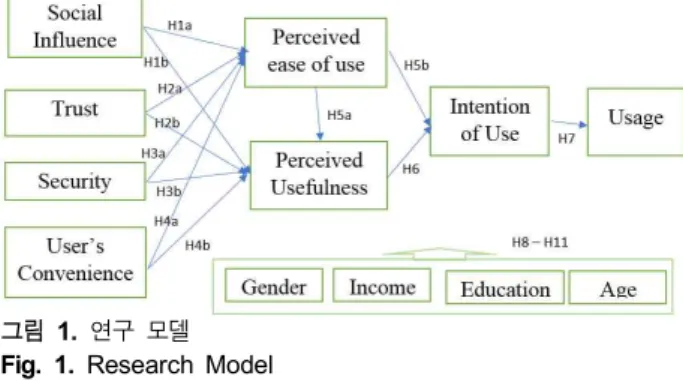
Social Influence, Trust, User’s Convenience, Security are set as sub-variables of external factor. Perceived ease of use and perceived of usefulness are set of parameters, Usage is the dependent variable. Then the relationship between those variables is analyzed by using TAM model which is considered the most robust method to identify key factors affecting the intention of using NFC payment.
In the Fig. 1, 11 hypotheses was implied in the research model.
그림 1. 연구 모델 Fig. 1. Research Model
3-1 Hypothesis about Social Influence
[6] stated trust in the transaction and network is a factors impact on user by enhancing intention to use. In additional, trust contributed significant to consumer’s behavioral intentions and actual behavior [7]. [8] believed Perceived Usefulness and Perceived Ease of Use related positively with trust and perceived usefulness.
In view of these findings, we hypothesize the following:
H1a: The social influence has a positive impact on the perceived ease of use of intention to use NFC payment.
H1b: The social influence has positive impact on the perceived usefulness of intention to NFC payment.
3-2 Hypothesis about Trust
[9] found social influence have the relationship with people’s opinion, superior influence and peer influence. Besides that, social influence affected the acceptance and usage of new IT [10].
Both [11] and [12] mentioned the intention in adopting NFC system of France have a positive connection with social influence.
Thus we could proposed the hypothesis as following.
In view of these findings, we hypothesize the following:
H2a: Trust has a positive impact on the perceived
ease of use of intention to use NFC payment.
H2b: Trust has positive impact on the perceived usefulness of intention to NFC payment.
3-3 Hypothesis about Security
[13] suggested that the security need to be concerned in order to persuading the customers. A lot of researches mentioned about the adoption of technology could be influenced negatively because of the insecure services [14]. Thus, it could be explained the positive connection of perceived security and attitude of using NFC payment system in the study of [15]. However, Perceived ease of use and perceived usefulness doesn’t have significant relationship to insecurity of the system based on opinion of [16].
In view of these findings, we hypothesize the following:
H3a: Security has a positive impact on the perceived ease of use of intention to use NFC payment.
H3b: Security has positive impact on the perceived usefulness of intention to NFC payment.
3-4 Hypothesis about User's Convenience
Technology is accepted when it make people lives easier.
Hence, the most significant factor of system is User Convenience which is combination of saving time and reducing travelling distance for users. Obviously, a system will attract more users if it is more convenient compare to other systems. Then we could have hypothesizes as follow.
In view of these findings, we hypothesize the following:
H4a: User’s Convenience has a positive impact on the perceived ease of use of intention to use NFC payment.
H4b: User’s Convenience has positive impact on the perceived usefulness of intention to NFC payment.
3-5 Hypothesis about Perceived Ease of Use
The ease of use is a human perception that includes three main components such as effortless, simply and easy to handle [1]. It is one of the most important aspects related to the user’s decision of adopting new technology. Regarding to [1], ease of use has double impacts on the attitude and utility. Moreover, ease of use has relationships with attitude and intention to use that proved by [17].
In view of these findings, we hypothesize the following:
H5a: Perceived Ease of Use has a positive impact on the perceived usefulness of intention to NFC payment.
H5b: Perceived Ease of Use has positive impact on the intention to NFC payment.
3-6 Hypothesis about Perceived Usefulness.
[18] stated TAM is a modified version from TRA. TAM distinguishes the intention to use to relate to two variables which are perceived ease of use and perceived usefulness. Recently, [19]
mentioned that TAM is popular used, while perceived ease of use and perceived usefulness rank as top five constructs in IS research.
H6: Perceived Usefulness has a positive impact on the perceived usefulness of intention to NFC payment.
3-7 Hypothesis about Intention to Use
[1] suggested that actual system usage related to how often people use the system and the volume of system usage. Therefore, a person who has enough intention will tend to actual use of the system.
H7: Intention to Use has a positive impact on the Usage to NFC payment.
3-8 Hypothesis about the Moderating
Gender, Income, Education level and Age can effect to the Intention to Use NFC payment system in Public transport in Ho Chi Minh city, Vietnam. So we suggested the following hypotheses:
H8 ~ H11: Intention to Use NFC payment will be moderated by Gender, Income, Education level and Age.
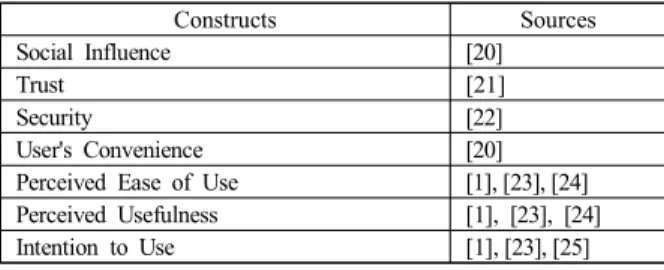
The data in our research was collected via the personal questionnaire that were redrawn based on original items in Table 1.
표 1. 모델의 측정 항목
Table. 1. Measurement Items in the Model
Ⅳ. Empirical Analysis
4-1 Data collection and population statistics
The data was collected through online survey randomly Vietnamese who live in Ho Chi Minh city, Vietnam by Google Docs tool (Table 2). A final analysis was conducted using 355 responses out of a total of 386 responses, excluding 31 negative responses.
Constructs Sources
Social Influence [20]
Trust [21]
Security [22]
User's Convenience [20]
Perceived Ease of Use [1], [23], [24]
Perceived Usefulness [1], [23], [24]
Intention to Use [1], [23], [25]
표 2. 인구통계 특성
Table. 2. Demographic data
4-2 Exploratory factor analysis and reliability analysis
To check the validation of the research model, a feasible and reliable analysis was conducted.
표 3. 신뢰성 분석 및 탐색적 요인분석
Table. 3. The result of Validity, Reliability test of EFA
As the result in the Table 3, the value of Cronbach's Alpha is above 0.7 in all cases (0.816 - 0.86). It can explain that the measure is reliable.
Moreover, the Exploratory Factor Analysis (EFA) was conducted which provided that eight components were extracted.
4-3 Measurement Model Assessment
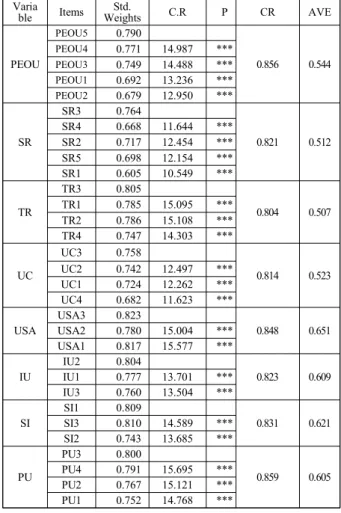
The Confirmatory Factor Analysis (CFA) is a statistical technique that can yield precise results about reliability, validity, and single dimension. In addition, CFA could be used to test the validity of scale and the exploratory factor analysis model.
As shown in Table 4, the result of Confirmatory Factor Analysis(CFA) determined that the fitting of measurement model is good because all standardization factors are higher than 0.7.
표 4. 확인적 요인분석 결과
Table. 4. Confirmatory Factor Analysis
The absolute and relative indexes were used to assess the model fit, which yielded the following values: Confirmation Fit Index(CFI) = 0.962, Tucker-Lews Index(TLI) = 0.958, Root
Category Freq %
Gender Male 152 42.8%
Female 203 57.2%
Monthly Income
(USD/
Month)
Under 250 53 14.9%
250-500 142 40%
500-1.000 112 31.5%
Over 1.000 48 13.5%
High School diploma 83 23.4%
Education Bachelor's Degree 161 45.4%
Master's Degree 79 22.3%
Doctorate's Degree 32 9%
Age
Under 25 70 19.7%
25-35 126 35.5%
36-45 96 27.0%
Over 45 63 17.7%
Construct name Variable
Number of items for
analysis
Construct Validity
Cronb ach’s Alpha
Social Influence SI 3
0.785 0.83 0.766 0.732
Trust TR 4
0.841 0.86 0.763 0.763 0.750
Security SR 5
0.765 0.819 0.755 0.701 0.659 0.543
User’s Convenience UC 4
0.780 0.816 0.744 0.713 0.672
Perceived Ease of Use PEOU 5
0.811 0.854 0.799 0.771 0.667 0.576
Perceived Usefulness PU 4
0.875 0.859 0.746 0.611 0.551
Intention of Use IU 3
0.788 0.823 0.769 0.752
Usage USA 3
0.902 0.848 0.747 0.752
Varia
ble Items Std.
Weights C.R P CR AVE
PEOU
PEOU5 0.790
0.856 0.544
PEOU4 0.771 14.987 ***
PEOU3 0.749 14.488 ***
PEOU1 0.692 13.236 ***
PEOU2 0.679 12.950 ***
SR
SR3 0.764
0.821 0.512
SR4 0.668 11.644 ***
SR2 0.717 12.454 ***
SR5 0.698 12.154 ***
SR1 0.605 10.549 ***
TR
TR3 0.805
0.804 0.507
TR1 0.785 15.095 ***
TR2 0.786 15.108 ***
TR4 0.747 14.303 ***
UC
UC3 0.758
0.814 0.523
UC2 0.742 12.497 ***
UC1 0.724 12.262 ***
UC4 0.682 11.623 ***
USA
USA3 0.823
0.848 0.651
USA2 0.780 15.004 ***
USA1 0.817 15.577 ***
IU
IU2 0.804
0.823 0.609
IU1 0.777 13.701 ***
IU3 0.760 13.504 ***
SI
SI1 0.809
0.831 0.621
SI3 0.810 14.589 ***
SI2 0.743 13.685 ***
PU
PU3 0.800
0.859 0.605
PU4 0.791 15.695 ***
PU2 0.767 15.121 ***
PU1 0.752 14.768 ***
Mean Square Error of Approximation(RMSEA) = 0.035, X
2= 600.987, X
2/ df =1.445, Incremental Fit Indices(IFI) = 0.963, The Adjusted Goodness of Fit Index(AGFI) = 0.083 . The values of the fit indexes exceeded those recommended by the literature, thus indicating good model fit.
As shown in Table 4, the value of Construct Reliability(CR) are also 0.7 or higher (0.804 ~ 0.859). Therefore, the internal consistency of the indicator is guaranteed. Moreover, the convergent validity to be secured because the Average Variance Extracted(AVE) are higher than 0.5 (0.507 ~ 0.651) (Table 4).
표 5. 판별타당성 분석
Table. 5. Discriminant Validity
According to the analysis results, the square of highest correlation 0.056 (0.237^2) less than the smallest average variance extracted 0.507 , therefore, the discriminant validity is confirmed. (Table 5).
4-4 Structural Model Analysis
표 6. 연구모델 적합도 검정
Table. 6. Results of Measurement Model
The Structural Equation Modeling (SEM) analysis of the structural model yielded the result the following fit indexes: X
2= 600.987 (df = 416, p=0.000), X
2/df = 1.445, RMSEA=0.035, GFI
= 0.902, AGFI = 0.883, IFI = 0.963, TLI = 0.958, CFI = 0.962.
It means a good fit between the data and structural (Table 6).
표 7. 경로분석 결과
Table. 7. Path Analysis Results
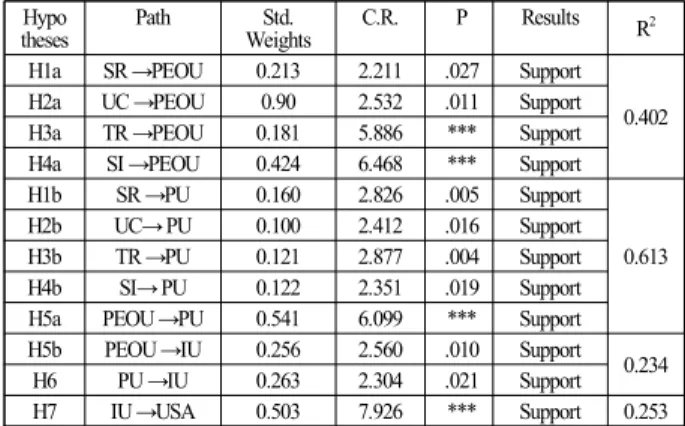
The result of the hypothesis tested show that all 12 hypothesis were accepted (Table 7). We find that Users' Convenience the greatest impact on Perceived Ease of Use (β=0.9, p<0.05), flowing by Social Influence (β=0.424, p<0.001), Security (β
=0.213, p<0.05) and Trust (β=0.181, p<0.001).
The analysis shows a significant finding with regard to Perceived Usefulness is the most influenced by Perceived Ease of Use (β=0.541, p<0.001). In addition, Security has significant effect on Perceived Ease of Use (β=0.16, p<0.01), whereas, Social Influence (β=0.122, p<0.05), Trust (β=0.121, p<0.01), Users' Convenience (β=0.1, p<0.05) insignificantly influence on Perceived Ease of Use. In addition, the study find Perceived Usefulness and Perceived Ease of Use explain 40.2% and 61.3%
of the variance in the model respectively.
We find that Perceived Usefulness (β=0.256, p<0.01) and Perceived Ease of Use (β=0.263, p<0.05) directly affect on Intention to use. The Intention to use NFC payment for public transport in Ho Chi Minh city, Vietnam explains 23.4% of the varian in the model.
Finally, Usage is impacted by Intention to use (β=0.503, p<0.001) and the model explains 25.3% of the variation in the Usage.
4-5 Moderating Effects Analysis
To evaluate the influence of Gender, Income, Education, and Age as a moderator on the research model, the moderating effect analysis was conducted. The pairwise parameter comparison confirms individually the difference between the groups. If there was different between the groups, the Critical Ratios for Differences between Parameters (Z-Statistics) was used to estimate the distinction between them.
PEOU SR UC TR PU USA SI IU
PEOU .544
SR .159 .605
UC .14 .088 .609
TR .177 .105 .067 .621 PU .34 .202 .17 .192 .651 USA .189 .107 .071 .061 .206 .512
SI .233 .114 .105 .08 .237 .50 .523 IU .167 .052 .014 .041 .034 .199 .08 .507
Hypo theses
Path Std.
Weights
C.R. P Results R
2H1a SR →PEOU 0.213 2.211 .027 Support
0.402 H2a UC →PEOU 0.90 2.532 .011 Support H3a TR →PEOU 0.181 5.886 *** Support H4a SI →PEOU 0.424 6.468 *** Support
H1b SR →PU 0.160 2.826 .005 Support
0.613
H2b UC→ PU 0.100 2.412 .016 Support
H3b TR →PU 0.121 2.877 .004 Support
H4b SI→ PU 0.122 2.351 .019 Support
H5a PEOU →PU 0.541 6.099 *** Support H5b PEOU →IU 0.256 2.560 .010 Support
0.234
H6 PU →IU 0.263 2.304 .021 Support
H7 IU →USA 0.503 7.926 *** Support 0.253
Fit indices Indicator Desirable
Absolute fit index
x²(CMIN)p 4390.367
(p=0.000)
p≦0.05~
0.10
x²(CMIN)/df 1.445 1.0≦CMIN/df
≦2.0~3.0
RMSEA 0.035 ≦0.05~0.08
RMR 0.045 ≦0.08
GFI 0.902 ≧0.8~0.9
AGFI 0.883 ≧0.8~0.9
PGFI 0.703 ≧0.5~0.6
Incremental Fit index
NFI 0.815 ≧0.8~0.9
NNFI(TLI) 0.941 ≧0.8~0.9
CFI 0.962 ≧0.8~0.9
Parsimony Fit index
PNFI 0.729 ≧0.6
PCFI 0.847 ≧0.5~0.6
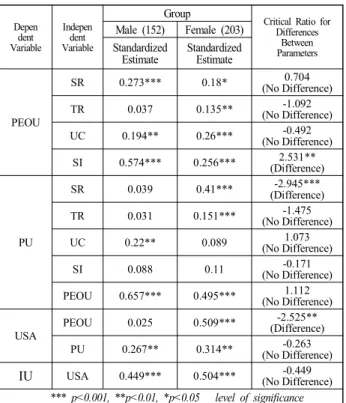
표 8. 성별에 따른조절효과 분석
Table. 8. Gender Hypotheses Comparison
표 9. 수입에 따른 조절효과 분석
Table. 9. Income Hypotheses Comparison
The Intention so use NFC payment system for Public transport in Ho Chi Minh city, Vietnam can be different according to the
Gender. As shown in Table 8, the effect of Social Influence on Perceived Usefulness is more significant in Female than Male, the difference test statistics is 2.531**. In addition, we find that the Male is more sensitive to the different test statistic -2.945*** in the effect of the Perceived Ease of Use on Security. Finally, the result shows that Perceived Usefulness of the Gender effect the Usage, and the difference test statistic is -2.525**.
In order to confirm the possibility of group differences according to the Income, we reorganized and compared under 500 USD/ month (Low Income) and upper 500 USD/ month (High Income). The results indicate that Perceived Usefulness has effect on Usage is more important in High Income than Low Income, the difference test statistic is -3.141*** (Table 9).
The result was shown in Fig. 2
그림 2. 가설검증 결과
Fig. 2. The Result of Hypothesis test
Ⅴ. Discussion
We find that Users Convenience has the greatest impact on Perceived Usefulness. This can be explained by the fact that Vietnamese users avoid to waste their time and money to try the public services and only accept the new technology when it improve their standard of living, which is found in previous studies[26], [27]. Therefore, when the technology could save their time by reducing the traveling distance, it obviously influence to their perceived usefulness[28], [29].
Moreover, it also documents that Social Influence has significant effect on the Perceived Usefulness, which can probably be best explained by the spread of Social Network Service (SNS) changed the way of an individual access to the information. Through the volume of image, comments and posts could change the perceived usefulness about NFC[28],[29], [30].
As a result, the higher perceived usefulness lead to higher intention to use of the users.
It provides evidence that Trust has significantly effect on both Perceived Usefulness and Perceived Ease of Use. It can probably be best explained by in the high technology field, the positive
Depen dent Variable
Indepen dent Variable
Group
Critical Ratio for Differences
Between Parameters Male (152) Female (203)
Standardized Estimate
Standardized Estimate
PEOU
SR 0.273*** 0.18* 0.704
(No Difference)
TR 0.037 0.135** -1.092
(No Difference)
UC 0.194** 0.26*** -0.492
(No Difference)
SI 0.574*** 0.256*** 2.531**
(Difference)
PU
SR 0.039 0.41*** -2.945***
(Difference)
TR 0.031 0.151*** -1.475
(No Difference)
UC 0.22** 0.089 1.073
(No Difference)
SI 0.088 0.11 -0.171
(No Difference)
PEOU 0.657*** 0.495*** 1.112
(No Difference)
USA
PEOU 0.025 0.509*** -2.525**
(Difference)
PU 0.267** 0.314** -0.263
(No Difference)
IU USA 0.449*** 0.504*** -0.449
(No Difference)
*** p<0.001, **p<0.01, *p<0.05 level of significance
Depen dent Variable
Indepen dent Variable
Group
Critical Ratio for Differences
Between Parameters Low Income
(195)
High Income (160) Standardized
Estimate
Standardized Estimate
PEOU
SR 0.237** 0.225 0.086
(No Difference)
TR 0.166** 0.003* 1.705
(No Difference)
UC 0.198* 0.199 -0.006
(No Difference)
SI 0.425*** 0.469 -0.336
(No Difference)
PU
SR 0.098 0.314 -1.684*
(No Difference)
TR 0.037 0.138 -1.214
(No Difference)
UC 0.213** 0.136 0.621
(No Difference)
SI 0.156** 0.016 1.026
(No Difference)
PEOU 0.62*** 0.499 0.779
(No Difference)
USA
PEOU -0.055 0.576 -3.141***
(Difference)
PU 0.448*** 0.111 1.743
(No Difference)
IU USA 0.529*** 0.431 0.795
(No Difference)
*** p<0.001, **p<0.01, *p<0.05 level of significance
feedback of the users is the key role to create trust for other people. In fact, people do not notice about secure and only adopt the system when they have trust. This is the reason why trust is a factor that contribute significant to perceived usefulness and perceived ease of use [12].
The results suggest that security is one the factor related to perceived ease of use and perceived usefulness. The users require a protection of their information and third-party could not collect their information as in the study of [31].
The study found that Intention to Use have similar effect to perceived ease of use and perceived usefulness. This mean if the users aware the perceived ease of use and perceived usefulness, it will enhance intention of use immediately.
When Users’ convenience, trust, security, social influence influences to intention to use of a user, then it is higher chance that they will become an actual users, especially in a developing countries such as Vietnam [1].
VI. Conclusions
NFC payment has become a global system and this research provide the evidence about adopting NFC through analyzing factors related to intention of use, especially in public transport.
The results illustrate that User’s Convenience and Social Influence affect the most to perceived usefulness because of trust and security. Moreover, perceived usefulness and perceived ease of use influence significant to intention to use and then contribute to the decision to use NFC. Although, there are limitation about sample and context, the research identified the overview of factors affecting intention of use NFC payment system for public transport.
References