http://dx.doi.org/10.11620/IJOB.2018.43.2.069 pISSN 1226-7155, eISSN 2287-6618
Oral squamous cell carcinoma (OSCC) is the most common type of oral malignancy. Numerous therapies have been proposed for its cure. Research is continually being conducted to develop new forms of treatment as current therapies are associated with numerous side-effects. Luteolin, a common dietary flavonoid, has been demonstrated to possess strong anti-cancer activity against various human cancer cell lines.
Nevertheless, research into luteolin-based anticancer activity against oral cancer remains scarce. Thus, the objective of this study was to assess the effect of luteolin as an anti-cancer agent.
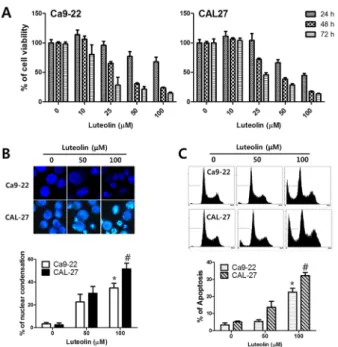
After treatment with luteolin, Ca9-22 and CAL-27 oral cancer cells showed condensed nuclei and enhanced apoptotic rate with evidence of mitochondria-mediated apoptosis. Epithelial- mesenchymal transition (EMT) is closely related to tumor migration and invasion. Luteolin suppressed cancer cell invasion and migration in the current study. Elevated
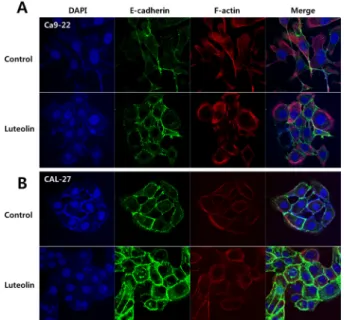
expression of E-cadherin, an adherens junction protein, was evident in both cell lines after luteolin treatment. Luteolin also significantly inhibited transcription factors (i.e., N-cadherin, Slug, Snail, Twist, and ZEB-1) that regulated expression of tumor suppressors such as E-cadherin based on Western blot analysis and quantitative PCR. Thus, luteolin could induce mitochondrial apoptosis and inhibit cancer cell invasion and migration by suppressing EMT-induced transcription factors.
Key words: OSCC, luteolin, apoptosis, EMT, E-cadherin
Introduction
Oral squamous cell carcinoma (OSCC) is the most common type of malignant tumor in the oral cavity [1]. It is caused by exposure to various types of carcinogen (i.e., chemical, physical, or microbial) and results in DNA mutation [2]. A combination of surgery, radiation therapy, and chemotherapy is commonly proposed as treatment for OSCC [3]. Research is continually being conducted into new forms of treatment as the current therapies are associated with low survival rates and adverse effects [4, 5].
Flavonoids are polyphenolic compounds that are found in various fruits, vegetables, and medicinal plants [6, 7]. Luteolin (3’,4’,5,7-tetrahydroxy flavone) is a common dietary flavonoid
Luteolin Induces Apoptosis via Mitochondrial Pathway and Inhibits Invasion and Migration of Oral Squamous Cell Carcinoma by Suppressing
Epithelial-Mesenchymal Transition Induced Transcription Factors
Bong-Soo Park
1,2, Jong-Jin Kil
1, Hae-Mi Kang
1,2, Su-Bin Yu
1,2, Dan-Bi Park
1,2, Jin-A Park
1,2and In-Ryoung Kim
1*1
Department of Oral Anatomy, School of Dentistry, Pusan National University, Busandaehak-ro, 49, Mulguem-eup, Yangsan-si, Gyeongsangnam-do, 50612, South Korea
2