
초청총설논문
1. Introduction
1)
Natural organic matter (NOM) originates from the contact of water with dead and living organic matter in the hydrologic cycle, and is a fundamental component of aquatic ecosystems. NOM has important roles in water treatment processes since it produces harmful by- products with oxidants, increases chemical cost and deteriorates product water quality during distribution. Therefore, it is important to characterize NOM from many water supply systems in detail.
NOM present in natural water is constituted of over 1000 organic compounds. Faced with this complexity, traditional analytical and assessment methods use bulk parameters, such as oxidant demand tests or even simpler surrogates like true colour. Indeed, simple methods are affordable and satisfactory in many applications. However, it is increasingly important to better understand the origins, detailed characteristics, and aquatic behaviours of individual NOM constituents to address water quality management and treatment needs more
주 저자
† (e-mail: [email protected])
Figure 1. Typical constituents in surface water and their size range[1,2].
effectively.
NOM in natural water can be classified into two main groups by size: i) particulate organic carbon (POC) above 0.45 µm and ii) dissolved organic carbon (DOC) below that limit. Both groups include a wide variety of constituents (Figure 1).
POC includes zooplankton, algae, bacteria, and debris organic matter
물 속의 자연 유기물 성분이 환경에 미치는 영향
손호경․Laszlo Erdei․김종호*
,†
시드니공과대학교 환경공학부, *전남대학교 응용화학공학부
년 월 일 접수
(2006 3 22 )
-
Constituent of Natural Organic Matter (NOM) and its Effect in Water
Hokyong Shon, Laszlo Erdei, and Jong-Ho Kim*
,†
Faculty of Engineering, University of Technology, Sydney, P.O. Box 123, Broadway, NSW 2007, Australia
*Faculty of Applied Chemical Engineering & The Institute for Catalysis Research, Chonnam National University, Gwangju 500-757, Korea
(Received March 22, 2006)
물 속에 존재하는 자연 유기물의 성분은 계절과 장소에 따라 다양하게 변하므로 이들 성분에 대한 고찰과 이들
이 환경에 미치는 영향을 고찰할 필요가 있다 본 총설에서는 물 속에 존재하는 휴믹 물질 탄수화물 단백질 아. , , (
미노산), hexosamine, 유지 오일 그리스 및 미량 유기물질 내분비교란화학물질과 의약품 등의 자연 유기물의 특, , ( )
성을 정리하였다.
Natural organic matter (NOM) should be carefully considered in terms of its constituent and effect because NOM is complex substances that occur in spatially and seasonally varying concentrations in natural water. This review presents characteristics of natural organic matter present in water. These compounds mainly include humic substances, carbohydrates, proteins (amino acids), hexosamines, fats, oils, greases, and trace organic compounds (endocrine disrupting chemicals and pharmaceuticals and personal care products).
Keywords: natural organic matter, humic substance, trace organic matter, disinfection by product, biomass growth
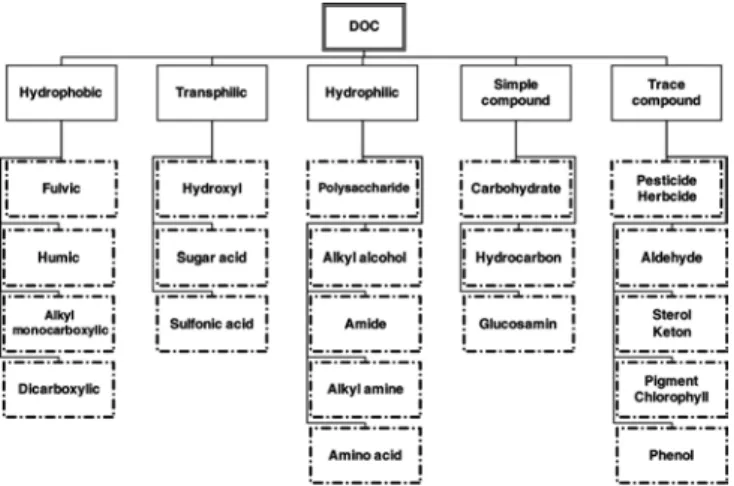
Figure 2. Main DOC constituents.
from soil and plants. Usually it represents less than 10% of total NOM, and can be removed easily by solid-liquid separation processes.
DOC imparts many adverse effects on water quality so it remains in the focus of research. Figure 2 shows the most significant DOC components in surface water. The hydrophobic and hydrophilic fractions together often make up the bulk (up to 80%) of DOC. DOC affects essentially all chemical and biological processes in aquatic environments because it controls the surface properties and colloidal stability of particles. It has a stabilising effect, opposite to that of metal ions. The adverse effects of DOC in drinking water supply are pre- cursor for disinfection-by-products (DBPs) formation, exert coagulant and oxidant demands, foul adsorbent and membranes, cause aesthetic and corrosion problems, and provid substrate for biomass growth in water distribution networks.
In some case the presence of DOC in water can also be beneficial.
For example, DOC substances can react with metals and many compounds to reduce availability and toxicity, or some treatment processes implicitly benefit from the physico-chemical effects of DOC on colloids. Further, humic acids can be used as direct means to extract pollutants[3].
2. Characteristics of NOM Components
The predominant fraction of NOM is comprised of complex humic substances because of the relative abundance of plant materials in the
Figure 3. Generic structure of HS[7].
environment[4]. However, many natural biopolymers (polysaccharides, proteins, hexosamines), or various oils, fats, and other components also significantly contribute to aquatic NOM compositions. The nature of the source materials strongly influences the chemical characteristics of the resulting NOM pool. DOC derived from higher plants is rich in aromatic molecules, while microbial sources impart relatively high level of nitrogen. Geochemical interactions between NOM and porous soil cause selective sorption thus chemical fractionation of organic matter[5].
2.1. Humic Substances (HS)
There are two major pathways by which humic substances can be formed in nature[6]. Macromolecules, chief plant biopolymers, such as lignin or cellulose partially decompose to HS, while the metabolic pathway involves condensation polymerisation reactions[7]. HS repre- sent a broad class of naturally occurring biogenic, heterogenous or- ganic materials. Being polydispersed polyelectrolytes[8] HS possess a high degree of molecular irregularity and heterogeneity; hence their chemical definition is impossible[9]. HS consist of multifunctional aromatic components, linked chemically and physically by a variety of aliphatic constituents, and functional groups to form self-similar fractal molecular structures as shown in Figure 3. The acidic nature (typically 8 to 12 meq/g) of HS is attributable to -COOH- and phenolic OH- groups which are unbalanced by the basic functional groups such as NH and NH
2
. HS show molecular binding tendency towards silica minerals and iron hydroxides. The anionic macromolecular confor- mations of HS are analogous to those of flexible polyelectrolytes, adjusting to changing pH and ionic strength.For operational definitions on the basis of solubility, the term HS represents three subclasses: 1) humins, 2) humic acids (HA), and 3) fulvic acids (FA). Humins are chiefly allochtonous in origin and washed into aquatic systems by runoff or percolating water as fine insoluble particles. HA are intermediates between humins and fulvic acids, soluble above pH 2. Their molecular weight (MW) ranges from 100 to about 100000 daltons. They contain less aromatic rings and more carboxylic groups than humins. The dominant FA class has a lower MW range (600 to 1000 daltons), has much less aromatic rings but more carboxylic groups, and soluble under all pH conditions. In non-coloured freshwater and humic-rich water FA and HA comprise about 40 to 55% and 60 to 80% of DOC, respectively.
Table 1. Concentration of Total Dissolved Carbohydrates in Various Natural Waters[11]
Natural water Concentration (µg/L) % DOC
Ground water 100 1 ~ 4
Sea water 250 5 ~ 10
River water 500 5 ~ 10
Lake
Eutrophic Mesotrophic Oligotrophic
900 680 250
10 ~ 15 8 ~ 12 5 ~ 10
HS are natural to the food chain with very low toxicity [10] thus do not pose any health concern. Moreover, HS reduce the chemical stress of aquatic systems indirectly by changing bioconcentrations and reducing metal toxicities[7]. HS are directly involved in particle formation, complexation and binding, metabolic interaction, and hormone-like action. Chlorine reacts with NOM substances like HS to produce trihalometanes (THM), haloacetic acids (HAA), and a host of other halogenated DBPs, some of which are toxic or carcinogenic. HS also react with ozone to produce carbonyl compounds (aldehydes, carboxylic acids) that contribute to biodegradable organic carbon con- tent, thus promoting biofilm formation and microbial regrowth in water distribution systems[4].
2.2. Carbohydrates
The majority of the carbohydrates present in fresh water originates from terrestrial systems[2]. Plants may release 30% of their organic matter into water as simple carbohydrates or organic acids rich in carbohydrate. Water leachate of vegetable matter is an important source of arabinose, xylose, and glucose in water. Moreover, the majority of aquatic microorganisms and algae also produce carbo- hydrates, mainly rhamnose, fructose, mannose, and galactose. The carbohydrate content and composition of water vary with source, biological availability, and degree of biodegradation. Polysaccharides are the largest fraction of carbohydrate, followed by sugars bound to HS. Monosaccharides represent about 25%, and the rest is amino sugars, sugar alcohols, sugar acids, and methylated sugars. Table 1 shows typical dissolved concentations in water sources.
Bound carbohydrates predominantly occur in higher molecular mass fractions (above10 kDa) of isolated HS and there are fewer car- bohydrates in FA than in HA fractions[12]. In treated drinking water carbohydrates represent 5 to 25% of organic substances. Although some polysaccharides such as lignin are difficult to degrade, in general carbohydrates provide a carbon source to micro and macroorganisms and have an important role in biological treatment processes. Carbohy- drates do not interfere significantly with traditional treatment technologies but are recognised as major foulants in membrane separation processes[13-15].
2.3. Amino Acids and Proteins
Proteins are complex high molecular weight organic compounds that consist of amino acids (AA) joined by peptide bonds. Protein is essential to the structure and function of all living cells and viruses.
Table 2. Characteristic of Essential Amino Acids
Name Nature IEP Name Nature IEP
Alanine Cysteine Aspartic acid Glutamic acid Phenylalanine Asparagine Glutamine Serine Tryptophan Tyrosine
HP HL Acidic Acidic HP HL HL HL HP HL
6.11 5.05 2.85 3.15 5.49 5.41 5.65 5.68 5.89 5.64
Glycine Histidine Isoleucine
Lysine Leucine Methionine
Proline Arginine Threonine
Valine
HL Basic
HP Basic
HP HP HP Basic
HL HP
6.06 7.60 6.05 9.60 6.01 5.74 6.30 10.76 5.60 6.00 IEP = isoelectric point, HP = hydrophobic, HL= hydrophilic
Thus, in natural water the majority of AA and proteins come from living cells (extracelluar enzyme), dead cells (debris), whether from animals or plants. Metabolism and catabolism of microorganisms in natural water produce these materials and HS also consist of about 5~ 10% protein[16]. The most definitive list on the origin of proteins and AA related to soluble microbial products is provided by Kuo[17].
While over 500 AA have been found in nature, research has been directed towards the 20 essential amino acids with available detailed measuring techniques (Table 2).
Sea and ground water has the smallest concentrations of AA (around 50 µg/L), followed by oligotrophic lakes and rivers (100 to 300 µg/L), and eutrophic lakes and marshes (600 µg/L). These figures correspond to 2% to 3% of DOC in common drinking water supply sources.
Generally, 0.5% is present as dissolved AA, 1% is bound to HS and the rest is bound to other substances[2]. In humic substances HA and FA contain relatively higher amounts of basic and acid AA, respectively.
AA and proteins are potential carbon and nitrogen sources for heterotrophs and have received considerable attention because of their importance to protein synthesis, bacterial metabolism, and algal/bacte- rial interactions. Organic nitrogen can result in the formation of nitrogenous DBPs, which are of health and regulatory concern, and is known to impact membrane processes by fouling, and chlorination by chloramine formation. Nonetheless, organic nitrogen removal across treatment processes is still largely unknown due to the lack of sensitive analytical methods.
2.4. Hexosamines
Hexosamines are derived from terrestial cutin material (waxy substances covering leaves), in water from zooplankton and occur only scarcely in phytoplankton[18,19]. Figure 4 shows the chemical structure of glucosamines. Glucosamine (C
6
H14
NO5
) and galactosamine (C6
H13
NO5
) are the intermediate between AA and carbohydrates[12].Up to 8% of HS nitrogen exists as hexosamines. There are HS building blocks that possess a constant ratio of glucosamine to AA, as is known for bacterial cell walls. In surface water the dominant hexosamine is glucosamine-NH
2
, accounting for 53~87% of the total.Glucosamine-NH
2
content decreases with depth in surface water, while galactosamine-NH2
shows the opposite characteristics. Owing to their general incorporation into structural biopolymer matrices, such asFigure 4. Structure of glucosamines.
bacterial cell walls and chitinous material (the main ingredient of the shell of insects and crustaceans), hexosamines are relatively resistant to decomposition, whereas AA is labile compared with bulk organic matter[20]. The ratio of amino acids to hexosamines is a good indicator of the degree of organic matter degradation.
Hexosamines are components of chitin and microbial cell wall[21]
and thus inherently have low toxicity. N-acetylaminosugars represent a significant percentage of aquatic NOM. Other bacterial polymers, such as polyhydroxybutyrates are almost systematically observed in natural water; however their relative contribution to aquatic NOM is unknown.
Hexosamines are relatively easily removed by clarification treatment and thought to play a little role in the DBP formation. However, their retainment by ultrafiltration indicates strong membrane fouling properties.
2.5. Fats, Oils, and Greases
Fats, oils, and greases (FOG) can be classified into three main classes by origin: 1) vegetable FOG, 2) animal FOG, and 3) mineral oils and derivatives from crude petroleum. Natural FOG consist of a wide variety of organic compounds such as fatty acids, n-alkyl hydrocarbons, n-alkyl acohols, sterols, terpenes, polycyclic hydro- carbons, chlorophyll, fats, waxes, and resins[7]. Among these com- pounds, differentiation is possible in terms of structure as i) hydro- carbons (aliphatic and aromatic compounds, as detailed by Saliot [22]) or ii) triglycerides (fatty acid and glycerol). The majority of FOG in natural water exists as fatty acids and glycerines, allowing further classification of FOG in terms of carboxylic acids.
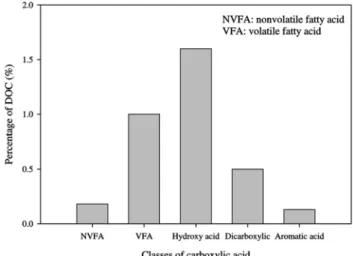
Non-volatile fatty acids (such as steric and palmitic acids) are the degradation products of fats and triglycerides, and are also important constituents of plants. Volatile fatty acids like acetic or valeric acid are short-chain molecules and result from anaerobic metabolism. Hydroxy acids are common intermediates in biochemical pathways, and excreted by algae during photorespiration. Dicarboxylic acids are common degradation products within soils and include oxalic acid and succinic acid. Lignin degradation products are aromatic acids, and occur in water extracts of leaf or conifer needle litter[23]. Their contribution to DOC is presented in Figure 5.
The common man-made hydrocarbons entering natural water include chlorinated aliphatic and aromatic hydrocarbon (common solvent),
Figure 5. Monomeric carboxylic in surface water[23].
polynuclear aromatic hydrocarbons (from combustion sources), satu- rated and unsaturated alkanes (from waste oil), and water.
FOG removal pathways using microorganisms have been investi- gated concerning natural water[24,25], though a much larger body of knowledge exists for specific components, especially in relation to tertiary biological wastewater treatment processes[26-30].
2.6. Trace Organic Compounds
In natural water, there are many different organic compounds that are usually present in very low or trace concentrations. Due to their large numbers, here only some important groups as examples will be mentioned, noting that details are available from Thurman[2] and other works.
Organic sulphur compounds mostly result from decaying algae and can impart taste and odour to water. The concentration of volatile sulphur compounds in raw water ranges from 1 to 350 µg/L and the dominant compound (up to 75%) is dimethylsulfide. Sterols present in cell membrane, have one hydroxyl functional group, thus are only slightly soluble in water. Characteristic levels are from 0.1 to 6.0 µg/L in natural water. Aldehydes are of biogenic origin resulting from photochemical oxidation, and present in the ng/L to µg/L concentration range. Aliphatic compounds have volatile characteristics hence lower concentrations (10 to 50 ng/L). Aromatic aldehydes originate from lignin and other plant products, are nonvolatile and water soluble. The most common compounds of organic bases are in mononucleotides and nucleic acids. These are fundamental compounds of plant and animal cells, and contribute to DOC concentrations from ng/L to µg/L levels.
Alcohols, ketons, and ethers contribute a few g/L portion to DOC in natural water. Alcohols and ketones can react with chlorine to form harmful compounds. In lake water usually octanol and butanol are present, while in river water methanol and hexanol are typical. The majority of pigments originates from plants (chlorophyll, xanthophylls, and cartenoids). These compounds degrade relatively fast, hence they usually represent less than 1% of DOC in natural water.
Recently, endocrine disrupting chemicals (EDCs) and pharmaceutical and personal chemical products (PPCPs) have been regarded as
Table 3. Classes of Emerging Compounds[47]
Compound class Examples
Pharmaceuticals Veterinary and human antibiotics Trimethoprim, erythromycin
Analgesics and anti-inflammatory drugs Codein, ibuprofen, acetaminophen, acetylsalicylic acid, diclofenac, fenoprofen
Psychiatric drug Diazepam
Lipid regulators Bezafibrate, clofibric acid, fenofibric acid -blockers
Β Metoprolol, propranolol, timolol
X-ray contrast media Lopromide, iopamidol, diatrizoate Steroids and hormones (contraceptives) Estradiol, estrone, estriol, diethylstilbestrol
Personal care products
Fragrances Nitro-, polycyclic-, and macrocyclic-musks
Sun-screen agents Benzophenone, methylbenzylidene camphor
Insect repellents N,N-dimethyltoluamide (DEET)
Antiseptics Triclosan, chlorophene
Surfactants and surfactant metabolites Alkylphenol ethoxylates, alkylphenols (nonylphenol and octylphenol), alkylphenol carboxylates Flame retardants Polybrominated diphenyl ethers (PBDEs), Tetrabromo bisphenol A, Tris(2-chloroethyl)phosphate (TCEP) Industrial additives and agents Chelating agents (EDTA), aromatic sulfonates
Gasoline additives Dialkyl ethers, methyl-4-butyl ether (MTBE)
Disinfection by-products Iodo-THMs, bromoacids, bromoacetonitriles, bromoaldehydes, cyanoformaldehyde, bromate, NDMA
important emering chemicals. EDCs refer to a class of toxicity in which an endogenous or exogenous chemical has the ability to mimic or block the natural action of endocrine system in animals[31,32]. The ability of certain chemicals to mimic estrogen has been known for decades[33-36]. However, the discovery that human hormones and a synthetic hormone used as a pharmaceutical for birth control may have been primarily responsible for reproductive impacts in fish below wastewater outfalls stimulated a plethora of new research on EDCs [37-40]. In response to amendments to the US Safe Drinking Water Act and Food Quality Protection Act mandating comprehensive screening of commercial chemicals for endocrine activity, the US EPA set forth to develop a screening program to evaluate approximately 87000 chemicals in commerce for which minimal, if any, data are available regarding endocrine-related toxicity. The endocrine system of animals is vast and affects nearly all aspects of metabolism, growth, development, and reproduction. However, the primary classes of EDCs are compounds which mimic or block the natural action of estrogen, androgen, and/or thyroid. PPCPs represent another group of emerging contaminants that can also be detected at ng/L concentrations in water.
Collectively, PPCPs are known as PPCPs. Most of the EDCs and PPCPs are more polar than traditional contaminants and the majority has acidic or basic functional groups. These properties, coupled with occurrence at trace levels (i.e. < 1 µg/L), create unique challenges for both analytical detection and removal processes[41]. Molecular structures of several EDC and PPCP compounds can be found in Vanderford et al.[42]. Details of removal of EDC and PPCP compounds in water can be found elsewhere[43-46]. Table 3 presents general classes of emerging contaminants. The majority of these contaminants is not currently regulated; however, they may be can-
didates for future regulation once environmental and human health relevance has been established. An interesting characteristic of these contaminants is that they need not persist in the environment to cause negative effects, since their high transformation/removal rates can be compensated for by their continuous introduction into environment [47]. For most of these emerging contaminants, occurrence, risk assessment, and ecotoxicological data are not yet available and it is therefore difficult to predict their actual risk.
Some compounds are known to cause serious problems even when present in very low concentrations in water sources. For instance, some algal products are known toxins, while others, such as geosmin.
Pesticides are typically synthetic products thus cannot be properly classified as NOM. However it has been observed that NOM can associate with pesticides and many other organic compounds to form complex and toxic substances[48]. Pesticide concentrations vary according to regions, countries and locations, but may be present in the order of µg/L in many water.
Acknowledgements
The first author sincerely appreciates the support of Chancellor’s postdoctoral research fellowship grant of University of Technology, Sydney. This work was supported by Regional Research Center for Photonic Materials and Devices at Chonnam National University under grant R12-2002-054.
References
1. A. I. Schafer, Natural Organics Removal Using Membranes:
Principles, Performance, and Cost. Technomic Publishing Com- pany, Inc., Pennsylvania (2001).
2. E. M. Thurman, Organic Geochemistry of Natural Waters, Martinus Nijhoff/Dr. W. Junk Publishers, Dordrecht (1985).
3. L. M. Yates III, R.Von Wandruszka, Environ. Sci. Technol., 33, 2076 (1999).
4. P. C. Singer, Formation and Control of Disinfection By-products in Drinking Water. American Water Works Association, Denver (1999).
5. G. Aiken, Utilization of NOM characteristics to improve process selection and performance. In CRCWQT, AwwaRF, Vivendi Water workshop: Relating NOM Characteristics to Improvements in Water Treatment Process Selection and Performance, Castle Blossin, Germany (2001).
6. P. G. Hatcher and E. C. Spiker, Selective Degradation of Plant Biomolecules. eds. F. H. Frimmel and R. F. Christman, Wiley, Chichester, 59 (1988).
7. C. E. W. Steinberg, Ecology of Humic Substances in Freshwaters.
Springer (2003).
8. D. S. Orlov, I. A. Amosova, and G. I. Glebova, Geoderma, 13, 211 (1972).
9. D. Kleinhempel, Albrecht-Thaer-Arch, 14, 3 (1970).
10. K. D. Thiel, B. Heibig, R. Kloching, P. Vutzier, M. Sprossig, and H. Schweizer, Pharmazie, 36, 50 (1981).
11. E. Tanoue, Proteins in the Sea-synthesis. eds. H. Handa, E.
Tanoue, and T. Hama, Terra Sci. Pub., Tokyo/Kluwer Acad. Publ., Cordrecht, 383 (2000).
12. J. B. Jahnel and F. H. Frimmel, Acta Hydrochim Hydrobiol., 23, 31. (1995).
13. Cho, J. Ph. D Dissertation, University of Colorado, USA (1998).
14. Jarusutthirak, C. Ph. D Dissertation, University of Colorado, USA (2002).
15. H. K. Shon, S. Vigneswaran, R. Ben Aim, H. H. Ngo, In S. Kim, and J. Cho, Environ. Sci. Technol., 39, 3864 (2005).
16. P. J. Muller, E. Suess, and C. A. Ungerer, Deep-Sea Res., 33, 819 (1986).
17. W. C. Kuo, Ph. D Dissertation, University of Iowa, Iowa City, USA (1993).
18. E. T. Degens and K. Mopper, Factors Controlling the Distribution and Early Diagenesis of Oganic Material in Marine Sediments.
eds. J. P. Riley and R. Chester, 6, Academic Press, London, 59 (1976).
19. V. Ittekkot, E. T. Degens, and S. Honjo, Deep Sea Res., 31, 1017 (1984).
20. B. Dauwe and J. J. Middelburg, Limnol. and Oceano., 43, 782 (1998).
21. L. P. Gupta and H. Kawahata, Quaternary Res., 60, 394 (2003).
22. A. Saliot, Natural Hydrocarbons in Sea Water, eds. E. K. Duursma and R. Dawson, Elsevier, Amsterdam, 327 (1981).
23. L. A. Kaplan and J. D. Newbold, The Role of Monomers in Stream Ecosystem Metabolism. Academic Press, California, USA (2003).
24. W. D. Nunn, Microbiol., 50, 179 (1986).
25. C. H. Park, Y. K. Kim, H. J. Yu, and P. S. O, Kor. J. Appl.
Microbiol. Biotechnol., 19, 88 (1991).
26. K. H. Tan and C. O. Gill, Appl. Microb. Biotechnol., 21, 292 (1985).
27. D. S. Han, D. Y. Kwon, and J. S. Rhee, Kor. J. Appl. Microbiol.
Bioeng., 16, 250 (1988).
28. J. S. Koh, Y. H. Ko, and G. S. Kim, Kor. J. Appl. Microbiol.
Biotechnol., 20, 477 (1992).
29. B. K. Hur, D. J. Woo, and C. B. Kim, J. Microbiol. Biotechnol., 9, 624 (1999).
30. Y. Shimada, A. Sugihara, T. Nagao, and Y. Tominaga, J. Ferment.
Bioeng., 74, 77 (1992).
31. G. Ankley and E. Mihaich, Environ. Toxicol. Chem., 17, 68 (1998).
32. B. E. Gillesby and T. R. Zacharewski, Environ. Toxicol. Chem., 17, 3 (1998).
33. J. W. Cook and E. C. Dodds, Proceedings of the Royal Society of London B114, 272 (1934).
34. S. W. Stroud, J. Endocrinol., 2, 55 (1940).
35. A. L. Fisher and H. H. Keasling, Proc. Soc. Exptl. Biol. Med., 81, 439 (1952).
36. R. M. Welch and W. Levin, Toxicol. Applied Pharmacol., 14, 358 (1969).
37. J. E. Harries and D. A.Sheahan, Environ. Toxicol. Chem., 16, 534 (1997).
38. C. Desbrow and E. J. Routledge, Environ. Sci. Technol., 32, 1549 (1998).
39. S. A. Snyder and T. L. Keith, Environ. Sci. Technol., 33, 2814 (1999).
40. S. Jobling and S. Coey, Biol. Reprod., 67, 515 (2002).
41. S. A. Snyder, B. Vanderford, R. Pearson, and Y. Yoon, Pract.
Period. Hazar., Toxic, Radio. Waste Manage., 7, 224 (2003).
42. B. J. Vanderford, R. A. Pearson, D. J. Rexing, and S. A. Snyder, Analy. Chem., 75, 6265 (2003).
43. R. E. Alcock and A. Sweetman, Chemosphere 38, 2247 (1999).
44. J. E. Drewes and T. Heberer, Water Sci. Technol., 46, 73 (2002).
45. N. Lindqvist and T. Tuhkanen, Water Res., 39, 2219 (2005).
46. H. K. Shon, S. Vigneswaran, and S. A. Snyder. Critical Rev. in Environ. Sci. Technol., In press. (2006).
47. D. Barceló, TrAC Trends in Analytical Chemistry., 22, xiv (2003).
48. M. Schnitzer, Humic Substances: Chemistry and Reactions. eds.
M. Schnitzer and S. U. Khan, Marcel Dekker, New York, 1 (1972).
![Figure 1. Typical constituents in surface water and their size range[1,2].](https://thumb-ap.123doks.com/thumbv2/123dokinfo/5047998.312223/1.892.467.827.715.897/figure-typical-constituents-surface-water-size-range.webp)
![Table 1. Concentration of Total Dissolved Carbohydrates in Various Natural Waters[11]](https://thumb-ap.123doks.com/thumbv2/123dokinfo/5047998.312223/3.892.464.829.127.302/table-concentration-total-dissolved-carbohydrates-various-natural-waters.webp)
![Table 3. Classes of Emerging Compounds[47]](https://thumb-ap.123doks.com/thumbv2/123dokinfo/5047998.312223/5.892.65.847.119.522/table-classes-of-emerging-compounds.webp)