Parameterization for Longwave Scattering Properties of Ice Clouds with Various Habits and Size Distribution for Use in Atmospheric Models
Joon-Bum Jee
1),* and Kyu-Tae Lee
2)1)
Weather Information Service Engine, Seoul 121-835, Korea
2)
Department of Atmospheric and Environmental Sciences, Gangneung-Wonju National University, Gangneung 210-702, Korea (Received: 4 November 2012, Revised: 8 January 2013, Accepted: 25 February 2013)
Abstract A parameterization for the scattering of longwave radiation by ice clouds has been developed based on spectral scattering property calculations with shapes and sizes of ice crystals. For this parameterization, the size distribution data by Fu (1996) and by Michell and Arnott (1994) are used. The shapes of ice crystal considered in this study are plate, solid column, hollow column, bullet-rosette, droxtal, aggregate, and spheroid. The properties of longwave scattering by ice crystals are presented as a function of the extinction coefficient, single-scattering albedo, and asymmetry factor. The heating rate and flux by the radiative parameterization model are calculated for wide range of ice crystal sizes, shapes, and optical thickness. The results are compared with the calculated results using a six-stream discrete ordinate scattering algorithm and Chou’s method. The new method (with various habits and size distributions) provides a good simulation of the scattering properties and cooling rate in optically thin clouds (optical thickness < 5). Depending on the inclusion of scattering by ice clouds, the errors in the calculation of the cooling rates are significantly different.
Key words: Longwave radiation, ice cloud, single scattering property, parameterization and cooling rate
1. Introduction
About 16% or more of the whole earth is covered with thin clouds (Patterson, 2001), which include a great amount of ice crystals. The radiative effects of cirrus clouds should be treated carefully, since the flux density change in the atmosphere and at the surface according to the sizes and shapes of these clouds. On average, cirrus clouds have a net warming effect on the atmosphere, in part because they tend to absorb and trap outgoing longwave radiation (NASA facts, 1999). More specifically, the radiative scattering by cirrus clouds has a strong influence on climate change, the greenhouse effect, etc.
because radiation is scattered according to the shapes and sizes of ice crystals.
Most of the uncertainty surrounding climate prediction using general circulation models (GCMs) arises from interactions and feedback between dynamic, microphysical, and radiative processes affecting cirrus clouds (Zhang et al., 2005). Model climates are sensitive to even small changes in cirrus coverage (Lohmann and Kärcher, 2002) or ice microphysics (Lynch et al., 2002).
The radiation parameterization process is essential in modeling of climate and the atmospheric general circulation.
However, precise estimation of the radiative effects by cirrus is difficult since various sizes and habits have not been taken into account in most of the processes of radiation parameterizations included in the existing general circulation models. The effects of clouds on climate changes in the earth’s atmosphere include a great uncertainty regarding the physical process as well as the radiation component.
This study investigates the parameterization of longwave scattering, using a (New method) that is similar to that of
*Corresponding Author: Joon-Bum Jee, Weather Information Service Engine, 12Fl. SAIT Tower, Sangamdong 1950, Mapo-gu, Seoul 121-835, Republic of Korea.
Phone : +82-70-4617-3764, Fax: +82-2-6922-2930 E-mail : [email protected]
연 구 논 문
Chou et al. (1999), whose target was restricted to only plate in ice crystal shape. However, the present study also considered data regarding the various shapes and sizes of ice crystals, and these data were derived from cloud observations and theoretical calculation of the radiative properties of ice crystals. In this study, the flux and cooling rate were calculated with the newly parameterized model according to the shapes and sizes of ice crystals, and these results were compared with those obtained with a six-stream discrete ordinate algorithm (Stamnes et al., 1988) and Chou’s parameterization (Chou et al., 1999).
2. Data and methods
Let us consider the plane parallel atmosphere, the upward and downward flux (Chou et al., 2002b) at level p can be computed from following Eqs. (1) and (2).
F
↑( p) = (1)
F
↓(p) = (2)
where, B
sis the planck function at the surface, B( p') is planck function at level p' and the transmittance between
p and p' is . If the optical
thickness of the ice cloud is τ, the transmittance between p and p'
(3) In the atmosphere, optical thickness is calculated with the dτ
aby absorption and the (1 − f )dτ
aby scattering.
Therefore, , the optical thickness of ice clouds is approximately
(4) Where single scattering albedo of ice crystal clouds between level p and p' is ω, the fraction of radiation scattered downward (upward) for radiation incident from above (below) is f, the transmittance between p and p' is
(5) When the scattering is neglected, f = 1, and the optical thickness is
(6) The scattering of ice crystals is characterized by the extinction coefficient ( β
ν), single scattering albedo ( ω
ν) and asymmetrical factor (g
ν). According to wavelength and ice crystal habit, ice crystals show different scattering properties as follows.
(7) (8) (9) where, σ
λ(r)is an extinction section (extinction efficiency) whose size is r, n(r) is number of ice crystals, C is cloud water mass concentration, superscript s is scattering, and P
λ(µ) is scattering phase function and µ is light angle.
The ice crystal scattering database in the longwave wavelength area calculated by Yang et al. (2000; 2001) is based on the equation of Maxwell according to the habit and spectral wavelength of each ice crystal. It uses the approximate theories such as FDTD (Finite-Difference Time Domain), FEM (Finite-Element Method), T-Matrix, DDA (Discrete Dipole Approximation), Geometric- Optics, Anomalous Diffraction method, etc. The 7 habits of ice crystals are assumed to be as in Fig. 1. The extinction coefficient, the single scattering albedo and the asymmetrical factor are calculated for the shape of each supposed ice crystal, the ice crystal size (2-9500 µm), and wave number (100-3250 cm
−1). The following Fig. 2 characterizes the scattering properties according to the shapes and wave number when the ice crystal size is 50 µm.
The size distribution data of ice crystals were used by Fu (1996) and Michell and Arnott (1994). The data on πB S T p p ( , S ) πB p' ( ) ∂
∂p' ---T p p' ( , )
p
S∫ p
+ dp'
πB p' ( ) ∂ ∂p' ---T p p' ( , )
p
S∫ p dp'
T p p ( , S ) 2 T µ ( p p' , )µ µ d
0
∫ 1
=
T µ ( p p' , ) 1
µ --- τ ∂τ p p'' ( , ) --- p'' ∂p'' d
p
∫ p'
– exp
=
d τ˜
d τ˜ = [ d τ a + ( 1 f – )dτ s ] = ( 1 – ωf )dτ
T µ ( p p' , ) 1
µ --- ∫ p p' [ 1 – ω p'' ( )f p'' ( ) ]
– ∂τ p p'' ( , )
--- p'' ∂p'' d exp
=
dτ˜ = ( 1 – ω )dτ
β ν = ∫ σ ν ( )n r r ( ) r d C ⁄ ω ν = β ν s ⁄ β ν
g ν 1
2 --- P ν ( )µ µ µ d
1 1
∫ –
=
Fig. 1. Idealized shapes of the ice crystal habits. From left to right: plate, solid-column, hollow-column, bullet-rosette, spheroid, aggregate, and droxtal.
the size distribution of ice crystals have been observed using airplanes. Thirty were used: 28 by Fu and 2 by Michell and Arnott. Twenty-one samples have been observed in the middle latitude, and nine samples in the tropical area. They show the amount of ice crystals observed according to size. The size distribution of ice crystals has been observed at intervals of 38 of 2-3500 µm and follows gamma distribution. These clouds were also used by Key et al. (2002) and Chou et al. (2002a) to parameterize shortwave optical properties of ice clouds.
In the longwave spectral region, the single scattering
properties calculation by Yang et al. (2000) is as follows:
(10)
(11)
(12)
where C
extand C
scatare the extinction cross section (efficiency) and the scattering cross section (efficiency), respectively; n is number density of ice crystals; L
minand L
maxare maximum and minimum sizes of ice crystals; k
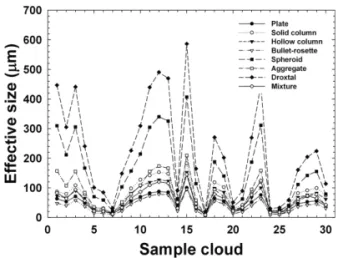
iis a ice crystal number distribution-density function (Yang et al., 2000, 2001); and subscript i is size distribution data of ice crystals. Figure 3 shows the effective sizes, calculated according to each size distribution and ice crystal shape. In the case of a mixture of ice crystals, Eqs.
(10)-(12) give a minimum effective size of 8.52 µm and maximum size is of 145.08 µm.
The scattering properties with the size distribution data were parameterized as a function of the following effective ice crystal sizes.
(13)
(14) β C ext i , ( )k L i ( )n L L ( )
∑ i d L
L
minL
max∫
=
ω
C scat i , ( )k L i ( )n L L ( )
∑ i d L
L
minL
max∫
C ext i , ( )k L i ( )n L L ( )
∑ i d L
L
minL
max∫
---
=
g
C scat i , ( )g L i ( )k L i ( )n L L ( )
∑ i d L
L
minL
max∫
C scat i , ( )k L i ( )n L L ( )
∑ i d L
L
minL
max∫
---
=
β r ( ) c e β 1 , c β 2 , D e ( ) c
β 3,--- +
=
ω r ( ) c e ω 1 , c ω 2 , D e ( ) c
ω 3,--- +
=
Fig. 2. Extinction efficiency, single-scattering albedo, andasymmetry factor for ice crystal habits with a maximum dimension of 50 µm.
Fig. 3. Effective size of sample clouds with ice crystal habits.
(15)
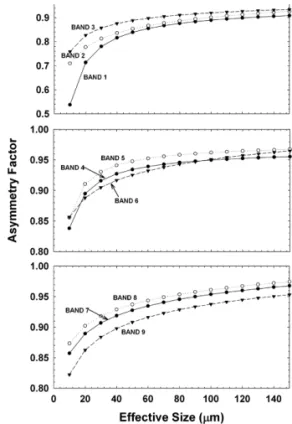
Figures 4-6 show regression curves of scattering properties according to the effective sizes and the nine spectral bands (Table 1) for the mixture of ice crystals (Chou et al., 2002b) with Eqs. (13)-(15). Scattering properties of the ice cloud are calculated with regression curve spectral bands in the longwave radiation model.
The extinction coefficients exponentially decrease with effective sizes in all spectral bands. The single scattering
g r ( ) c e g 1 , c g 2 , D e ( ) c
g 3,--- +
=
Fig. 4. Extinction coefficient with effective sizes for ninespectral bands (Chou et al., 2002b).
Fig. 5. Same as Fig.4 except for the Single Scattering Albedo.
Table 1. Spectral bands and absorbers in the parameterized longwave model (Chou et al., 2002b).
Band Spectral range (cm−1)
1 0-340
2 340-540
3 540-800
4 800-980
5 980-1100
6 1100-1215
7 1215-1380
8 1380-1900
9 1900-3000
Fig. 6. Same as Fig. 4, except for the Asymmetry Factor.
albedo decreases with effective sizes except for bands 1, 3 and 4. The asymmetry factors logarithmically increase with effective sizes, having value less than 1.
3. Results
The flux and cooling rates were calculated with the optical thickness and the effective size of ice crystals, applying the six-stream discrete ordinate algorithm to estimate the effects of ice crystals on the longwave spectral region. In this calculation, the ice cloud was assumed to consist of three layers of 200-260 hPa with visible optical thickness 0.79-25, which are mixed according to the k
irates of Yang et al. (2000) in Eqs.
(10)-(12). The profiles of temperature, humidity, and ozone typical of a middle latitude summer are used. In the following Figures, the results from the method developed in this study (hereafter the New method) and from the method of Chou et al. (1999) (hereafter the Old method) are calculated by longwave scattering for ice crystal habit, assuming only plate and mixed cloud using Chou et al. (2002b).
Figure 7 shows that downward surface flux increases with increasing the cloud optical thickness, but TOA flux decreases with increasing the cloud optical thickness.
When the cloud optical thickness reaches 5 or larger, the variations of downward surface flux and TOA flux become very small. Upward and downward fluxes for very small and large effective sizes are larger than those for the other effective sizes. The flux differences between
New and Old methods are similar in the upper panel, but the differences are more variable with smaller and larger effective sizes when the optical thickness is 2. Ice crystal habits contributed to these differences.
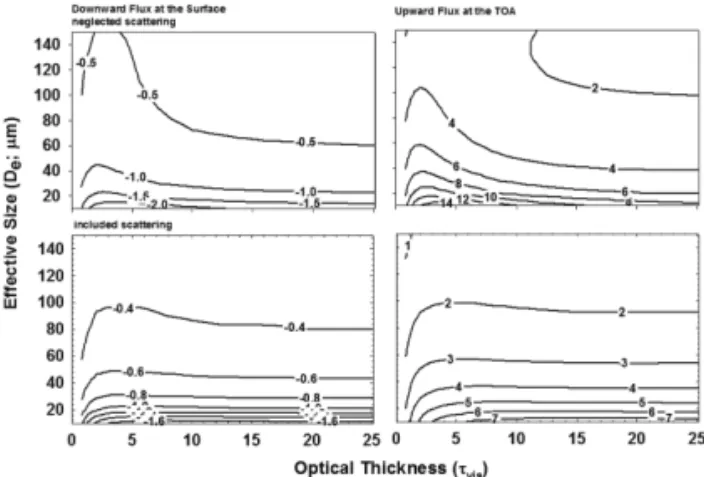
Figure 8 shows the flux differences between the six- stream discrete ordinate algorithm and the parameterization method. When scattering is neglected, this gives rise to an underestimation of the surface flux and overestimation of TOA flux. However, when the effect of scattering is included by scaling the optical thickness using Eq. (4), the TOA flux is smaller and the downward surface flux is larger than in the former case. Therefore, including the scattering effect reduces the flux errors by the parameteri- zation method at the surface and TOA. The differences between the New and Old methods are very small, but these values are not negligible, especially when the small effective size and included scattering difference is smaller than the neglected scattering case.
The calculation of cooling rate differences in the model, which includes the cooling rate at the time of optical thickness of 1, 5 and 25, and the six-stream scattering algorithm at the time when scattering is included, is shown in Fig. 9. When the optical thickness is thick, cooling and heating are made directly over the cloud layer and within clouds, respectively. As the optical thickness increases, the cooling rate greatly increases. The extent of change in the cooling rate is great when the optical thickness is small, compared to when it is large. This shows that if a
Fig. 7. Upward flux at the TOA and downward flux at thesurface are calculated by a six-stream discrete ordinate scattering algorithm. Lower 2 panels show the difference between the New and Old methods for scattering parameterization of ice clouds.
Fig. 8. Flux errors at the surface and TOA for ice clouds.
Left panels indicate downward flux at the surface and right panels indicate upward flux at the TOA. Upper panels indicate the case where scattering is neglected, and lower panels indicate the case where absorption and scattering are included.
certain size is exceeded, the cloud layer is not scattered, but follows absorption. The cooling rate differences between the New and Old clouds in the model cloud are greater than with thicker visible optical thickness; these values are 0.52, 1.73, and 0.09 when visible optical thickness are 1, 5, and 25, respectively. These values are only cooling rate differences, but relative cooling rate differences are 16.1, 6.6, and 1.8% when visible optical thickness are 1, 5 and 25, respectively. Therefore, when the cooling rate is calculated in atmospheric models with the New and Old method, the Old method relatively over-estimates longwave scattering in thinner optical thickness. The cooling rate over and within clouds is also about 2 K Day
−1as an error for the neglected scattering and included scattering of ice clouds. The relative errors are 9.1% and 3.0% when optical thicknesses are thin
( τ
vis= 1) and thick ( τ
vis= 25), respectively. This difference shows that as the optical thickness increases parameteri- zation decreases regardless of exclusion or inclusion of scattering. Calculations are made of the cooling rate within clouds according to the cloud optical thickness and the downward flux at the surface according to the ice cloud amount by applying this result to the parameteriza- tion model (Chou et al., 1999) used as the actual atmospheric model.
4. Conclusion
In the existing GCM or numerical model, the calculation of longwave flux considers only the absorption of ice clouds by a simple experience formula, leaving the scattering properties of clouds out of consideration when the optical thickness is small. This study takes the scattering effect of clouds into account, this study develops the longwave radiation parameterization model which can calculate the scattering effect of ice clouds capable of being used in GCM or numerical models.
The scattering properties according to size are para- meterized and applied to the longwave radiation model (Chou et al., 2002b). This is done using the single scattering property data according to the habits and wavelengths of ice crystals calculated by the size distribution data of ice crystals, and using the composition according to habits and sizes of ice crystals by airplane observation.
In the model to which the six-stream discrete ordinate algorithm of radiation is attributed, great error appears in small optical thickness and great effect size, when the scattering effect is neglected, but a somewhat small error appears when the scattering effect of clouds is included.
Applying the properties of ice crystals, calculations are made of the flux and cooling rate according to the sizes of ice crystals and the optical thickness.
As a result, when the optical thickness is small, scattering effects are very important and the upward and downward radiations show drastic changes with optical thickness. Cooling rate also shows great changes with small optical thickness. The relative cooling rate differences between the New and Old method (Chou et al., 1999) are 16.1, 6.6, and 1.8% when visible optical thicknesses 1, 5, and 25, respectively. The relative errors in cooling rate are 9.1% and 3.0% when scattering is included or neglected. This shows that the scattering effect decreases with the increase in optical thickness. The absorption of longwave radiation dominates over scattering when the
Fig. 9. Cooling rate and cooling rate error in the modelcloud layers. Left panels are cooling rates calculated by the New and Old methods with different optical thicknesses (1, 5 and 25 µm). Right panels are cooling rate errors calculated by neglecting and including scattering, using the New method.
optical thickness is large; this may increase the uncertainty in calculating the flux in consideration of only absorption, since scattering dominates over absorption when the optical thickness is small. Calculations are also made according to habits and sizes, including the scattering of clouds in the longwave model capable of being used as the actual atmospheric model. Therefore, the smaller the size of ice crystals is, the more carefully the observation data of ice crystals should be treated or application to the numerical model. Since, differences in the cloud generation occur according to latitude zone and the absorptive gas within atmosphere, it is necessary to make a comparative analysis with the newly parameterized cloud scattering effects through the ice cloud size distribution data on various regions and clouds.
Acknowledgements
This research is supported by “Weather Monitoring and Implementation of Integrated Weather Information Service for Urban and Rural Areas” of WISE(Weather Information Service Engine).
REFERENCES
Chou, M. D., K. T. Lee, and P. Yang, 2002a : Parameterization of shortwave cloud optical properties for a mixture of ice particle habits for use in atmospheric models.
J. Geophys. Res., 107(D21), 4600, doi:2002JD002061.
______, M. J. Suarez, X. Z. Liang, and M. M.-H Yan, 2002b: A Thermal Infrared Radiation Parameterization f o r A t m o s p h e r i c St u d i es . N A S A Te c h n i c al Memorandum, 19(104606), 55 pp.
__ _ _ __ , K . T. L ee, S . C. Ts a y, an d Q . F u , 1 99 9 : Parameterization for Cloud Longwave Scattering for Use in Atmospheric Models. J. Climate, 12, 159-169.
Fu, Q., 1996: An accurate parameterization of the solar radiative properties of cirrus clouds for climate models.
J. Climate, 9, 2058-2082.
Key, J. R., P. Yang, B. A. Baum, and S. L. Nasari, 2002:
Parameterization of shortwave ice clouds in terms of the ambient temperature and ice water content. J.
Geophys. Res., 107(D13), 4181, doi:2001JD000742.
Liou, K. N., 1986: Influence of cirrus clouds on weather and climate process. Mon. Wea. Rev., 114, 1167-1199.
Lohmann, U. and B. Kärcher, 2002. First interactive simulations of cirrus clouds formed by homogeneous freezing in the ECHAM GCM. J. Geophys. Res., 107:4105.
Lynch, D. K., K. Sassen, D. O’C. Starr, and G. Stephens, ed., 2002: Cirrus. New York: Oxford Univ. Press.
Mitchell, D. L. and W. P. Arnott, 1994: A model predicting the evolution of ice particle size spectra and radiative properties of cirrus clouds. Part II: Dependence of absorption and extinction on ice crystal morphology. J.
Atmos. Sciences, 26, 138-147.
National Aeronautics and Space Administration facts, 1999:
Clouds and the energy cycle. Goddard Space Flight Center.
Paterson, C. A., 2001: The role of cloud type and cover in global warming. http://jrscience.wcp.muohio.edu/
climatechange01/FinalArticles/TheRoleofCloud TypeandCove.html
Stamnes, K., S. C. Tsay, W. Wiscombe, and K. Jayaweera, 1988: Numerically stable algorithm for discrete- ordinate-method radiative transfer in multiple scattering and emitting layered media. J. Appl. Optics, 27, 2502-2509.
Yang, P., M. G. Mlynczak, H. L. Wei, D. P. Kratz, B. A.
Baum , Y. X. Hu, W. J. Wiscombe, A. Heidinger, and M. I. Mishchenko, 2003: Spectral signature of cirrus Clouds in the far-infrared region: single-scattering calculation and radiative sensitivity study. J. Geophys.
Res., 108(D18), 4569, doi:10.1029/2002JD003291.
______, B. C. Gao, B. A. Baum, W. Wiscombe, Y. X. Hu, S.
L. Nasiri, P. F. Soulen, J. Heymsfield, G.M. McFarquhar, and L.M. Miloshevich, 2001: Sensitivity of cirrus bidirectional reflectance to vertical homogeneity of ice crystal habits and size distribution for two MODIS bands. J. Geophys. Res., 106, 17267-17291.
______, K. N. Liou, K. Wyser, and D. Mitchell, 2000:
Parameterization of the scattering and absorption properties of individual ice crystals. J. Geophys. Res., 105, 4699-4718.
Zhang, M. H. and Coauthors, 2005: Comparing clouds and their seasonal variations in 10 atmospheric general circulation models with satellite measurements. J.
Geophys. Res., 110:D15S02.