키워드 네트워크 분석을 활용한 생태자산 연구 경향 분석
김벼리·이재혁·권혁수 국립생태원 생태연구본부융합연구실
Recent Ecological Asset Research Trends using Keyword Network Analysis
Kim, Byeori·Lee, Jae-Hyuck·Kwon, Hyuksoo Bureau of Ecological Research, National Institute of Ecology
요 약 : 이 연구의 목적은 국내·외 생태자산 관련 연구 경향을 파악하는 것이다. 생태자산과 의미가 유사 한 12개 키워드와 연관 있는 분야 및 영역들을 확인하면서 연구흐름을 이해하고자 하였다. 우리는 키워드 네트워크 분석을 이용하여 방대하게 이루어지고 있는 국내외 연구들을 분석하였다. 키워드 네트워크 분석 은 정보의 구조적 흐름을 이해하고 방향성을 파악하는데 유용하다. 국외 연구들은 지속가능성을 중심으로 보전, 경제적 평가, 관리, 정책 분야로 연결되는 것을 보았다. 국내연구 분석은 문헌자료가 적어 다양한 흐름들을 확인하기 어려웠으나 지역의 활성화를 위해 경제적인 가치를 확인하고자 하는 연구들이 있었다.
이 연구는 향후 국내 생태자산 관련 연구 방향들에 설정하는데 활용할 수 있다.
주요어 : 생태자산, 리뷰, Net-miner, 중심성
Abstract : The purpose of this study was to determine domestic and foreign ecological asset research trends. We aimed to understand ecological assets research directions and trends by comprehensively analyzing 12 keywords, including those similar to keywords for comparable assets, to identify related fields and regions. Extensive analysis of domestic and foreign studies was conducted through keyword network analysis of textural information. This approach is helpful for understanding the flow of information and identifying research directions. Foreign studies based on sustainability were connected with ‘Economic assessment’, ‘Management’ and ‘Policy’ areas. It was difficult to determine domestic research trends because there are fewer domestic studies than foreign. There were studies that sought to identify economic value of developing regions. This research can be used to guide the research direction for future ecosystem asset analysis in Korea.
Keywords : Ecosystem Assets, Review, Net-miner, Centrality Research Paper
First Author: Byeori Kim, Division of Ecosystem Services & Research Planning, Bureau of Ecological Research, National Institute of Ecology, Seocheon 33657, Korea, Tel: +82-41-950-5965, E-mail: [email protected]
Corresponding Author: Hyuksoo Kwon, Division Division of Ecosystem Services & Research Planning, Bureau of Ecological Research, National Institute of Ecology, Seocheon 33657, Korea, Tel: +82-41-950-5962, E-mail: [email protected]
Co-Authors: Jae-Hyuck Lee, Division of Ecosystem Services & Research Planning, Bureau of Ecological Research, National Institute of Ecology, Seocheon 33657, Korea, Tel: +82-41-950-5807, E-mail: [email protected]
Received: 24 April, 2017. Revised: 7 September, 2017. Accepted: 22 September, 2017.
https://doi.org/10.14249/eia.2017.26.5.303
I. 연구 배경 및 목적
생태계서비스(Ecosystem services)에 대한 연구가 활발해지면서 이를 지탱하는 생태자산(Ecosystem Assets)에 대한 연구도 주요하게 다루어지고 있다 (Dicie 2014). 생태계서비스 평가는 의사결정자들에 게 개발과 보전의 우선순위를 판단하는데 과학적이 고 객관적인 근거를 제시하는 도구로 활용되고 있다 (Costanza 2014). 이와 같이 생태계서비스의 중요성 이 부각되면서 생태자산 관리에 대한 관심도 높아지 고 있다. 영국은 국가단위로 생태계서비스를 평가하 면서 자연자본(Natural Capital)의 개념 안에 생태 자산을 포함하였다(UK NEA 2011).
생태계서비스 평가는 생태계 내에서 생태자산의 축적량과 시간단위에 따라 제공될 수 있는 개별 서비 스 개념을 분명하게 제시하여야 한다(Hein et al.
2016). 또한 생태자산에 대한 지속가능한 관리를 위 해서는 생태자원의 목록구축이 필요하다(Ahn 2014).
국내에서는 생태자산이라는 용어를 언급하지는 않 았으나 환경자산, 자연자산, 자연자원 등과 같이 자 연환경의 요소들을 의미하는 개념 및 용어들을 사용 하였다(Lee 2008; Park 2014; Ahn 2014). 용어를 혼용하거나 같은 개념을 다르게 사용할 수 있어 관련 연구를 진행하는데 제한을 줄 수 있다. 이를 위해 국 내·외 관련 연구 흐름을 파악할 필요가 있다.
본 연구는 키워드 네트워크 분석을 통해 생태자산 과 관련한 국내외 연구를 분석하였다. 해당분야 국내 외 연구의 구조적 흐름을 이해하고 연구의 중심과 방 향성을 파악하여 향후 국내 연구의 방향을 설정하는 데 기여하고자 한다.
II. 연구방법
국·내외 연구들의 동향을 파악하고자 키워드 네트 워크 분석을 이용하였다. 이 방법은 다양한 연구 분 야에서 경향과 핵심 키워드를 파악하기 위해 활용하 고 있다. 키워드 네트워크 분석은 저자들의 영향력, 연계정도, 지식구조, 연구동향 등을 연결구조, 중심 구조, 응집구조로 도출하여 정량적이고 구조적으로 파악하는데 가능하도록 도와준다. 이를 활용한 연구 로 기술경영(Kho 2013), 지리공간정보(Kim 2015), 생태관광(Lee 2016)에 대한 연구 동향 등이 있다. 키 워드 네트워크 분석은 연구와 전체적인 구조를 보여 주기 때문에 과거부터 진행된 연구를 파악하고 앞으 로의 연구 설정을 하기에 유용한 방법이라고 볼 수 있다. 특히 생태자산의 경우 다양한 키워드가 많고 전체적인 흐름파악이 어렵기 때문에 연계되는 연구 들을 분석하는 키워드 네트워크 분석이 적합하다.
다양한 개념을 포괄하기 위해 ‘생태’와 유사개념인
‘환경, 자연’의 접두어와 ‘자산’과 유사한 ‘자본, 가치, 자원’의 접미어로 12개의 키워드를 추출하여 분석하 였다. 분석자료 수집을 위해 국내·외 대표적인 학술 DB인 RISS(www.riss.kr)와 SCOPUS(www.scopus.
com)를 활용하였다. 앞서 제시한 키워드를 중심으로 검색하여 국내는 1998년부터 2016년까지의 학술지 를 수집하였고 국외는 1966년부터 2015년까지의 자 료를 수집하였다. 그 결과 국내 학술지는 44건, 해외 는 10,675건이 검색되었다. 키워드를 Excel을 통해 정리한 후, Netminer4를 실행하였다. 특히 해외 논 문의 경우 건수가 많은 만큼 빈도수 또한 높아 전체 를 보면 구조적으로 해석하기에 어려움이 있어서 적 합한 조건을 찾아 실행해야 한다. 국외의 경우 연결 빈도가 50번 이상의 키워드를 선정하여 분석하였다.
국내외 연구 데이터 전처리와 분석조건을 적용하여
Figure 1. Analysis procedure
단어 빈도수를 확인하고 키워드 네트워크 분포지도 를 확인하였다. 마지막으로 최종적으로 연결망 지수 를 확인하고 국내외 연구를 비교분석을 하였다.
III. 분석 결과
1. 해외 생태자산 연구에 대한 키워드 네트워크 분석 1) 키워드 빈도분석
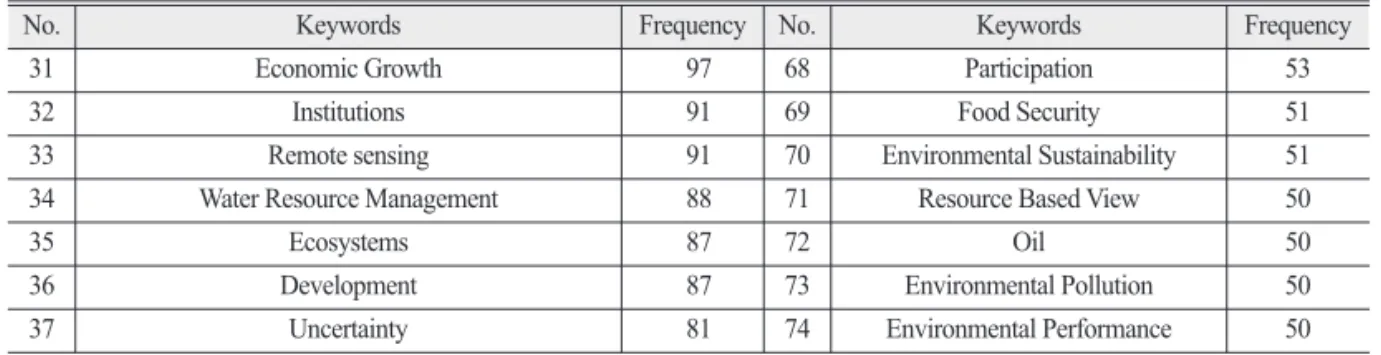
키 워 드 의 빈 도 수 를 보 면 자 연 자 원 (Natural Resource)이 1,661회로 가장 많이 도출되었고, 자연
자원관리(Natural Resource Management; 748회), 생태계서비스(Ecosystem Services; 447회), 지속 가능성(Sustainability; 390회), 지속가능한 개발 (Sustainable Development; 376회 ), 자 연 자 본 (Natural Capital; 318회) 순으로 나타났다(Table 1).
2) 네트워크 분석
구조적인 연결성을 보기 위해 빈도수 50번 이상의 키워드 중 주요네트워크 연결망 47개로 분포지도를 그렸다. 여기서 관심 단어 12개의 합성어 중 ‘자연자원 (Natural Resource)’, ‘자연자본(Natural Capital)’이 Table 1. Keywords of Associated Ecological Asset in Foreign Studies
No. Keywords Frequency No. Keywords Frequency
1 Natural Resource 1,661 38 GIS 81
2 Natural Resource management 912 39 Policy 73
3 Ecosystem Services 447 40 Environmental Education 70
4 Sustainability 390 41 Human Capital 70
5 Sustainable Development 376 42 Environmental Ethics 69
6 Natural Capital 318 43 Land Use Change 69
7 Water Resource 264 44 Renewable resources 69
8 Environment 256 45 Australia 68
9 Ecosystem Services Valuation 231 46 Ecology 68
10 Value 227 47 Resilience 66
11 Environmental management 218 48 Collaboration 63
12 Climate change 217 49 Africa 62
13 Social Capital 205 50 Water 62
14 Environmental Values 204 51 Adaptive Management 61
15 Biodiversity 197 52 Economics 61
16 Conservation 179 53 Economic Value 61
17 Resource management 174 54 Management 60
18 Natural gas 148 55 Decision Making 58
19 China 132 56 Poverty 57
20 Environmental Policy 129 57 Economic Development 57
21 Environmental Impact 185 58 Pollution 57
22 Governance 119 59 Conflict 56
23 Resources 118 60 Environmental Change 56
24 Ecosystem 111 61 Environmental Impact Assessment 55
25 Community-based Natural Resource Management 110 62 Water Quality 55
26 Ecosystem Management 110 63 Environmental Resources 55
27 Land Use 103 64 Natural Language Processing 54
28 Energy 100 65 Property Rights 54
29 Agriculture 98 66 Natural Selection 53
30 Environmental protection 98 67 Resource Curse 53
연결망 내 중심에 위치하였다. Figure 2와 같이 연결 망을 보면 ‘자연자원’과 가장 직접적인 연결성을 가진 키워드는 ‘지속가능성(Sustainability)’, ‘지속가능한 개 발(Sustainable Development)’, ‘보전(Conservation)’,
‘환경(Environmnet)’이다. 그리고 ‘자연자본’의 경우
‘지속가능성(Sustainability)’, ‘지속가능한 개발 (Sustainable Development)’, ‘인적자본(Human
Capital)’, ‘사회자본(Social Capital)’, ‘생태계서비스 (Ecosystem Services)’와 연결되어 있는 것을 확인 하였다. ‘자연자원’, ‘자연자본’에 공통으로 연결되어 있는 키워드로 ‘지속가능성’, ‘지속가능한 개발’이 있 었다.
구체적인 연구방향성을 파악하기 위해 2차적으로
‘자연자원’과 연결성이 있는 단어를 확인하였다. ‘자연 Table 1. Continued
No. Keywords Frequency No. Keywords Frequency
31 Economic Growth 97 68 Participation 53
32 Institutions 91 69 Food Security 51
33 Remote sensing 91 70 Environmental Sustainability 51
34 Water Resource Management 88 71 Resource Based View 50
35 Ecosystems 87 72 Oil 50
36 Development 87 73 Environmental Pollution 50
37 Uncertainty 81 74 Environmental Performance 50
Figure 2. Ecological Asset network in Foreign Studies
자본(Natural Capital)’, ‘생물다양성(Biodiversity)’,
‘에너지(Energy)’, ‘오염(Pollution)’, ‘사회자본(Social Capital)’이 연결되어 있었다. ‘자연자본’의 경우 ‘자연 자원(Natural Resource)’, ‘생물다양성(Biodiversity)’,
‘환경(Environment)’, ‘회복탄력성(Resilience)’, ‘경 제적 가치(Economic value)’가 연결되어 있었다. 2차 적으로 연결되어 있는 키워드를 보면 ‘자연자원’과
‘자연자본’은 공통적으로 ‘생물다양성’이 연결되었다.
서로 연구 키워드가 동일해지고 유사한 경향으로 연 구 흐름이 가고 있었다. 빈도수와 연결망 지도와 연 결지어 보면 ‘자연자원’과 ‘자원자본’을 중점적으로 연 구들이 진행되는 것을 확인하였다.
3) 중심성 지수
앞서 연결망을 통해 연관된 키워드를 확인 할 수 있지만 수치적으로 전체적인 흐름과 연관되는 연구 의 위계를 보기 위해 중심성 비율을 확인하였다. 특
히 다른 연구와의 연결성들을 확인하는 매개중심성 (Betweenness Centrality)과 최신연구동향의 흐름 을 보여주는 연결중심성(Degree Centrality)을 보았 다(Table 2).
매개중심성을 통해 키워드 간에 연관되어 있는 다른 주제들의 키워드를 보았다. 그 결과 ‘환경 (Environment)’, ‘에너지(Energy)’, ‘천연가스(Natural gas)’, ‘사회자본(Social capital)’, ‘중국(China)’, ‘아프리 카(Africa)’, ‘빈곤(Poverty)’, ‘회복탄력성(Resilience)’,
‘적응 관리(Adaptive Management)’, ‘생물다양성 (Biodiversity)’ 등 순으로 도출이 되었다. 이를 통해 환경이나 천연가스 같은 에너지 부분, 관심 국가들, 자연 또는 생태 기능 등 다양한 분야와 주제로 나누어 연구가 진행되고 있다. 더 나아가 연구의 흐름을 파악 할 수 있는 연결중심성을 보면 ‘환경(Environment)’,
‘자연자본(Nautral Capital)’, ‘적응 관리(Adaptive Management)’, ‘생태계서비스(Ecosystem Services)’, Table 2. Ecotourism Keywords in Foreign Studies by Centrality
Rank Betweenness Centrality Degree Centrality
Keyword Rate Keyword Rate
1 Environment 0.20 Environment 0.08
2 Energy 0.14 Natural Capital 0.07
3 Natural Gas 0.14 Adaptive Management 0.07
4 Social Capital 0.13 Ecosystem Services 0.05
5 China 0.12 Natural Resource 0.05
6 Africa 0.11 Energy 0.05
7 Poverty 0.10 Natural gas 0.05
8 Resilience 0.10 Social Capital 0.05
9 Adaptive Management 0.09 Institutions 0.04
10 Biodiversity 0.09 Biodiversity 0.04
11 Natural Capital 0.08 Uncertainty 0.04
12 Ecosystem Services 0.08 Sustainability 0.04
13 Agriculture 0.07 Poverty 0.04
14 Climate Change 0.07 Ecosystem services valuation 0.04
15 Natural Resource 0.07 Oil 0.04
16 Water Resources 0.06 Resource corse 0.04
17 Land use 0.06 Governance 0.04
18 Conservation 0.06 Resources 0.04
19 – – Water Resources 0.04
20 – – Sustainable Development 0.04
21 – – Remote sensing 0.04
‘자연자원(Natural Resource)’, ‘에너지(Energy)’,
‘천연가스(Natural gas)’, ‘사회자본(Social Capital)’,
‘기관(Institutions)’, ‘생물다양성(Biodiversity)’ 등 순으로 도출되었다. 관심키워드들이 다루는 영역이 광범위하기 때문에 연구의 방향들이 다양한 것을 확 인 할 수 있었다.
4) 주요 키워드 관련 연구
자연자원 분야는 보전을 위한 자료 수집, 비정부 기관 활동, 교육활동 등에 대한 연구들이 많이 나타 났다. 고유종을 자연자원으로 간주한 생물권 보전 연 구(Camargo-Ricalde & Dhillion 2004), 해양 자연 자원 보전을 목표로 지속가능한 개발(Seker et al.
2004), 자연자원 보전을 위한 비정부 기관 활동 (Hosseini 2003), 해양 관광을 위한 자연자원 보전 과 환경교육 연구(Hayes 2015), 자연자원을 문화적 가치로 제시한 연구(Thondhlana & Shackleton 2015)등이 있었다.
자연자원과 자연자본 키워드의 1차 공통 연결키워 드인 지속가능성 관련한 연구를 확인하였다. 도시 개 발(Tang & Shi 2015), 보전(Roy 1998), 중국의 탄소 및 자원 활용(Chen & Chen 2010; Zhou et al.
2010) 등의 연구가 있었다.
생물다양성 관련 연구로는 생물다양성 보전을 위 한 기구 설립(Agudo & Rodriguez 1993), 자연자원 보전 위한 화폐가치평가(Hampicke 1999), 지속가능 한 발전을 위한 경제적 지원(Vuta et al. 2015), 경제 성장과 환경의 상호 보완된 파급 효과(Smulders et al. 2014), 사회적 지속가능성과 생태적·경제적 분야 조화(Langeweg 1998; Barbier 2011), 지속가능한 자연자원 관리를 위한 기구와 정책 역할(Veeman &
Politylo 2003)등의 연구가 있었다.
자연자본 관련 연구로는 생태계접근법을 통한 자연 자본의 효과적인 환경 관리(Holt & Hattam 2009), 연안지역의 생태계서비스 관리를 위한 정책적 전략을 제시(Elliff & Kikuchi 2015) 등이 있었다.
자연자원을 에너지 차원의 접근 연구는 에너지 고 갈에 따른 새로운 시스템 설계(Sakai 2015), 지열을 이용한 재생가능한 에너지(Putra & Lelawati 2014)
등에 대한 연구가 있었다.
지속가능성 개념을 바탕으로 자연자원은 보전을 위한 자료 수집, 교육활동, 기구들의 설립 필요성을 다루는 연구들로 확대되고, 자연자본은 환경정책과 적합한 관리들을 위해 생태계서비스 연구로 확장되 고 있었다.
2.국내 생태자산 연구에 대한 키워드 네트워크 분석 1) 키워드 빈도 분석
본 절에서는 국외분석과 마찬가지로 접두어 ‘환경’,
‘자연’, ‘생태’ 3개의 단어와 접미어 ‘자산’, ‘자원’, ‘자본’,
‘가치’ 4개의 단어를 결합하여 12개의 합성어를 검색 하였다. 국외의 문헌수와는 많은 차이가 있었다. 국 내 연구논문 44개를 모은 후, 키워드의 빈도수가 5회 이상인 것을 대상으로 Excel를 통해 정리하였다. 그 리고 수집한 키워드들은 Net-miner4.0로 분석하여 연결망을 가진 모든 관계를 분석하였다.
먼저 빈도수 결과를 보면 ‘자연자원’이 17회로 가장 많이 도출 되었고, 그 다음으로 ‘환경가치’, ‘생태자 원’, ‘조건부가치측정법’ 등 순이었다(Table 3). 관심 단어 12개의 합성어 중 ‘환경가치’, ‘자연자원’, ‘환경 가치’, ‘생태가치’ 총 4개가 연결망 안에 속해 있음을 Table 3. Keywords of Associated Ecological Asset in
Domestic Studies
No. Keywords Frequency
1 Natural Resource 17
2 Environmental Value 12
3 Ecological Resource 5
4 Contingent Valuation Method 4
5 Environmental Conflict 3
6 Ecological Value 3
7 Ecotourism 3
8 Natural Capital 3
9 Gotjawal 2
10 Cultural Resources 2
11 Willingness to pay 2
12 Multiple Attribute Utility 2
13 Ecosystem Services 2
14 Economic Value 2
15 Environmental Assets 2
확인하였다.
2) 네트워크 분석
Figure 3과 같이 관심키워드를 중심으로 연결망을 살펴보면 ‘자연자본’은 ‘생태계서비스’와 ‘생태관광’과 의 연결성을 보여주고 ‘생태관광’은 ‘자연자원’과 연 결되었다. ‘곶자왈’, ‘인문자원’은 ‘자연자원’에만 연결 성을 보였고 ‘조건부가치측정법’은 ‘환경가치’와 연결 성을 보였다. ‘환경가치’는 하나의 그룹으로 ‘조건부 가치측정법’과 같이 ‘지불의사액’, ‘다속성효용이론’과 연결성을 보여주었고 또 다른 그룹으로 ‘경제가치’,
‘환경갈등’과 연결성을 보여주었다. 마지막으로 ‘경제 가치’와 ‘환경갈등’이 ‘생태가치’와 연관성을 보이고 있다.
3) 중심성 지수
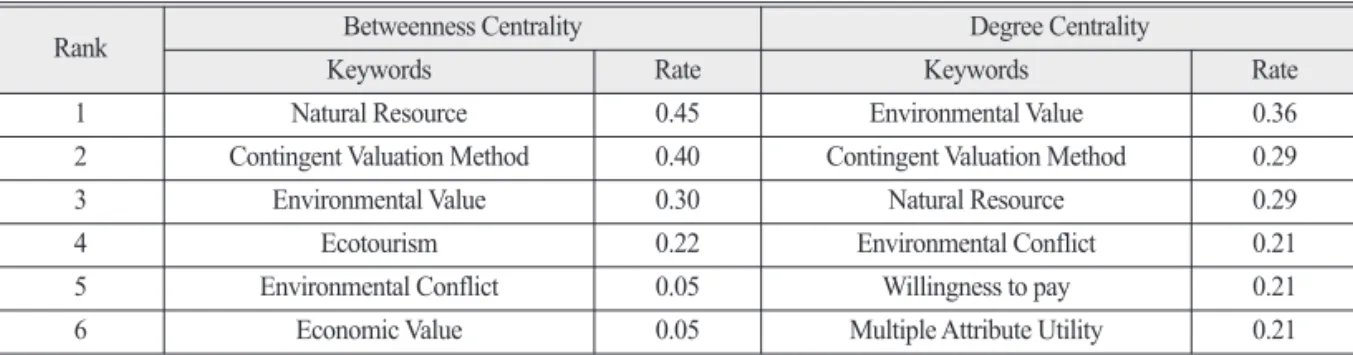
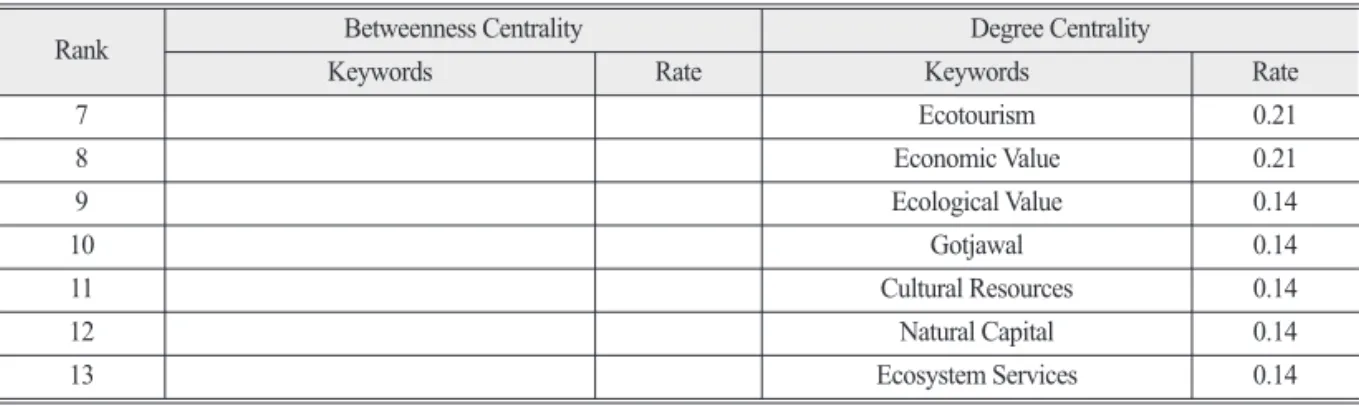
다음으로 매개중심성과 연결중심성을 보았다(Table 4). 매개중심성을 통해 국내의 연구 연결성을 보면
‘환경가치’에 대한 측정을 위한 노력을 ‘조건부가치측 정법’을 통해 ‘환경갈등’을 해소하고자 하는 부분과
‘생태관광’의 발전을 위한 ‘경제가치’, ‘생태가치’, 여 러 자원들을 보는 부분으로 연구들로 연결되었다. 그
Figure 2. Ecological Asset network in Foreign Studies
Table 4. Ecotourism Keywords in Domestic Studies by Centrality
Rank Betweenness Centrality Degree Centrality
Keywords Rate Keywords Rate
1 Natural Resource 0.45 Environmental Value 0.36
2 Contingent Valuation Method 0.40 Contingent Valuation Method 0.29
3 Environmental Value 0.30 Natural Resource 0.29
4 Ecotourism 0.22 Environmental Conflict 0.21
5 Environmental Conflict 0.05 Willingness to pay 0.21
6 Economic Value 0.05 Multiple Attribute Utility 0.21
리고 연결중심성을 통해 ‘환경가치’, ‘조건부가치측정 법’, ‘자연자원’, ‘환경갈등’, ‘지불의사액’, ‘다속성효 용이론’, ‘생태관광’, ‘경제가치’, ‘생태가치’, ‘곶자왈’,
‘인문사회’, ‘자연자본’, ‘생태계서비스’ 순으로 국내의 연구 흐름을 확인할 수 있었다.
4) 주요 키워드 관련 연구
이에 해당하는 연구키워드 중 자연자본에 대한 연 구는 해양생태계의 생태계서비스(Nam 2016), 생태 관광(Lee 2015)이 있었다.
다음으로 자연자원에 대한 연구는 생태관광, 인문 자원, 가치측정법 총 세 가지로 나눠서 볼 수 있다.
먼저 생태관광지역에 대한 자연자원 관리모델(Park 2014), 제주도 자연자원을 대상으로 생태관광 활성화 (Choi 2003) 등이 있었다. 인문자원적 접근으로 제 주도의 마을 활성화(Jeong 2012)와 제주도의 곶자왈 시계열 연구(Jeong 2015)가 있었다. 마지막으로 조 건부가치측정법에 대한 자연자원의 경제모형 검증
(Ahn 2015), 금강하구의 보전과 개발 간의 효과적인 관리(Kwon 2013), 섬진강 하구(Yoo 2007), 경제적 가치와 환경가치를 결합한 접근법으로 인간중심적 자연관과 생태중심적 자연관(생태가치)을 비교하는 연구(Joh 2008)가 있었다.
국내 연구는 자연자원을 활용해 지역의 활성화를 위해 연구가 진행되어 최종적으로 경제적인 가치를 평가하고자 하는 연구가 주된 흐름이라고 볼 수 있다.
IV. 고 찰
생태자산 키워드 분석을 통해 볼 때, 국외연구들은 자연자원의 지속가능한 관리에 관심이 많다면 국내 연구들은 경제적 가치평가에 초점이 맞추어져있다.
먼저 국내·외 키워드 빈도수를 보면 국내·외 모두 ‘자 연자원’와 ‘생태계서비스’가 많이 도출되었지만 국외 는 ‘자연자원 관리’가 국내는 ‘환경가치’가 많이 도출 되었다. 다음으로 네트워크 연결망 지도에서 합성어 Table 4. Continued
Rank Betweenness Centrality Degree Centrality
Keywords Rate Keywords Rate
7 Ecotourism 0.21
8 Economic Value 0.21
9 Ecological Value 0.14
10 Gotjawal 0.14
11 Cultural Resources 0.14
12 Natural Capital 0.14
13 Ecosystem Services 0.14
Table 5. Summary of Analysis results
Analysis Foreign Studies Domestic Studies
Keywords Frequency
Natural Resource(1,661 times), Natural Resource management(748times),
Ecosystem Services(447 times),
Natural Resource(17 times), Environmental Value(12 times),
Ecosystem Resource(5 times), Network Sustainability, Social Capital, Conservation Ecotourism, Contingent Valuation Method,
Economic Value
Centrality
Betweenness
Centrality Environment, Energy, Natural Gas Betweenness Centrality
Natural Resource, Contingent Valuation Method,
Environmental Value Degree
Centrality Environment, Natural Capital,
Adaptive management Degree Centrality
Environmental Value, Contingent Valuation Method,
Natural Resource
들과 가깝게 연결된 단어를 보면 국외는 ‘지속가능 성’, ‘사회자본’, ‘보전’과 같이 다양한 분야로 넓혀갈 수 있는 단어들로 연결고리가 이어지고 국내는 ‘생태 관광’, ‘조건부가치평가’, ‘경제가치’와 같이 관광 및 경제쪽에 대한 단어를 중심으로 연결되었다. 수치적 으로 중심성을 보면 국외의 매개중심성은 ‘환경’, ‘에 너지’, ‘천연가스’, 연결중심성은 ‘환경’, ‘자연자본’,
‘적응관리’ 다양한 영역의 단어들이 높은 값으로 나 왔다. 국내의 매개중심성은 ‘자연자원’, ‘조건부가치 평가’, ‘환경가치’, 연결중심성은 ‘환경가치’, ‘조건부 가치평가’, ‘자연자원’과 같이 가치평가에 대한 단어 들이 높은 값으로 나왔다. 연구 중심성을 통해 국외 는 분석한 연구의 수도 많지만 실제로 가치, 관리, 지 속성 등 다양한 영역의 연구들이 이루어지고, 국내 연구들은 자연자산의 경제적 가치평가 및 분석 방법 쪽에 집중된 것을 확인할 수 있다. 주요 키워드와 관 련된 논문들을 보면 국외의 경우 자료수집, 교육 및 기구의 활동, 환경정책 및 관리를 위한 연구로 이어 지고, 국내의 경우 생태관광, 가치평가, 평가법으로 연구가 주를 이룬다. 국내연구는 국외에 비해 양이 많지 않지만 12개의 합성어 중 6개의 합성어로 다양 하게 용어를 쓰지만 연구의 폭은 넓지 않았다. 연구 가 다양하고 많이 이루어진 국외의 연구흐름을 참고 하여 연구성격에 맞는 용어를 쓰면서 국내 또한 연구 의 가지를 넓혀가야 한다.
V. 결 론
본 연구는 키워드 네트워크 분석을 통해 국내외 생 태자산의 연구동향을 분석해보았다. 국내·외 연결망 에 있는 모든 연구들을 세밀하게 분석하기에는 한계 가 있다. 하지만 흐름과 방향성을 파악하는데 충분한 결과를 도출하였다. 국내·외 연구들이 모두 생태자원 의 지속가능성 측면에 관심을 두었지만, 국외연구는 관리에 대한 기반을 정책적, 사회적 동의로 수립하고 자 하는 접근방법에 대한 연구가 있고 국내연구는 지 역의 경제 활성을 위한 가치평가 부분에 주안점을 두 었다는 차이점을 확인할 수 있었다. 전반적으로 연구 가 많이 이루어진 국외연구 흐름을 참고하여 앞으로
국내연구의 방향이 경제적 가치 외에 지속가능성, 관리, 활용 등으로 넓혀갈 수 있을 것이다.
References
Agudo M., Rodriguez, D. 1993. A proposal for the establishment of the National Center for Phytogenetic Resource Conservation in the Venezuelan Republic. Science of the total environment. 139: 193-196.
Ahn DS, Lee SY, Jeong NR. 2014. Planning on the Baekdudaegan Eco and Cultural Park.
Journal of Recreation and Landscape. 8(3):
79-86. [Korean Literature]
Ahn SE, Kim JA, Jeon DJ, Kwon YH, Noh BH.
2014. Development and Application of Integrated Measurement system to Assess Freshwater Ecosystem Services in Korea(1). Korea Environment Institute.
p.105-237. [Korean Literature]
Ahn HK, Kim YW. 2015. A Validity Test in the CVM Measurement of Economic value of Natural Resources-Focusing on the Case of Munjangdae Hot Spring Developmnent- . Korean Association for policy Sciences.
19(1): 35-57. [Korean Literature]
Barbier EB. 2011. Transaction costs and the transition to environmentally sustainable development. Environmental Innovation and Societal Transitions. 1(1): 58-69.
Camargo-Ricalde SL, Dhillion SS. 2004. Use and management of Mimosa species in the Tehuacan-Cuicatlan Valley, a tropical semi- arid region in Mexico (Fabaceae- Mimosoideae). Revista de biologia tropical.
52(4): 845-851.
Chen GQ, Chen ZM. 2010. Carbon emissions and resources use by Chinese economy 2007: a 135-sector inventory and input-
output embodiment. Communications in Nonlinear Science and Numerical Simulation. 15(11): 3647-3732.
Choi YB. 2003. A Study on Alternatives for Tourism Vitalizations with a Consideration of Ecological Chracteristics in Jeju International Free City. 36: 97-110.
[Korean Literature]
Costanza R, De Groot R, Sutton P, van der Ploeg S, Anderson SJ, Kubiszewski I, Turner RK. 2014. Changes in the Global value of ecosystem services. Global Environmnetal Change. 26:152-158.
Elliff CI, Kikuchi RK. 2015. The ecosystem service approach and its application as a tool for integrated coastal management.
Natureza & Conservacao. 13(2): 105-111.
[Korean Literature]
Hampicke U. 1999. The limits to economic valuation of biodiversity. International journal of social economics. 26(1/2/3):
158-173.
Hayes MC, Peterson MN, Heinen-Kay JL, Langerhans RB. 2015. Tourism-related drivers of support for protection of fisheries resources on Andros Island, The Bahamas. Ocean & Coastal Management.
106: 118-123.
Hein L, Bagstad K, Edens B, Obst C, de Jong R, Lesschen JP. 2016. Defining ecosystem assets for natural capital accounting. PLoS One. 11(11): e0164460.
Holt AR, Hattam C. 2009. Capitalizing on nature:
how to implement an ecosystem approach.
Biology letters. 5: 580-582.
Hosseini SM. 2003. The study on establishment possibility of non governmental organizations for conservation of environment and natural resources. Journal
of Environmental Studies. 29(31): 105-114.
Jeong KJ. 2012. A Study on Perception and us of Gotjawal in Jeju Island. The Association of Korean Photo-Geographers. 22(2): 11- 28. [Korean Literature]
Jeong KJ. 2015. The Past, present and future of Gotjawal-Questions and proposals about the existence of Gotjawal. The Association of Korean Photo-Geographers. 25(3): 15- 32. [Korean Literature]
Joh SH. 2008. Happiness Economics Approach to Anthropocentric-Nature Perspective and Ecocentric Nature Perspective. Journal of Environmental policy. 7(2): 49-66. [Korean Literature]
Kho JH, Cho KT, Cho YH. 2013. A Study on Recent Research Trend in Management of technology using keywords network analysis. Korea Intelligent information system society. 19(2): 101-123. [Korean Literature]
Kim BS, Jeong MW, Jeon SE, Shin DB. 2015.
Global Research Trends on Geospatial Information by Keyword Network Analysis. Journal of Korea spatial information society. 23(1): 69-77. [Korean Literature]
Kwon YJ, Yoo SH Park SH. 2013. Assessment of the Environmental Value of the Geum- river Estuary. Journal of the Korean Society of marine environment&safety.
19(5): 417-429. [Korean Literature]
Langeweg F. 1998. The implementation of Agenda 21our common failure’?. Science of the total environment. 218(2): 227-238.
Lee HW, Kim CG, Hong HJ, Noh YH, Kang SI, Kim JH, Sin SC, Lee SJ, Kang JY. 2015.
Development of Decision Supporting Framework to Enhance Natural Capital
Sustainability: Focusing on Ecosystem Service Analysis. 3479-3651. [Korean Literature]
Lee JH, Son YH. 2016. The recent research wave in ecotourism research using keyword network analysis. Journal of Korean Society of Rural Planning. 22(2): 45-55.
[Korean Literature]
Lee WB, Min MS. 2008. Sustainable Planning for Enhancing the Local Competitiveness: A Case Study of Namhae Couny, Gyeongnam, Journal of Local Government Studies. 12(3): 289-302. [Korean Literature]
Nam, JH, Kang, DS. 2016. Natural capital and ecosystem service of marine ecosystems : concepts and valuation methods. The Korean Society for Marine Environment and Energy. 5: 111. [Korean Literature]
Park HC, Oh CH. 2014. Direction for imporving management model based on carrying capacity for managing natural resources in ecotourism area: Focused on Getz, LAC, VIM, and VERP. Journal of Environmental policy. 13(4): 107-133.
[Korean Literature]
Putra DD, Lelawati I. 2014. Finding Geothermal Energy based on Radioisotopes Technology. Energy Procedia. 47: 71-75.
Roy KC. 1998. Issues in resource conservation and sustainable development: Indian situation. International Journal of Social Economics. 25(1): pp.16-24.
Sakai K. 2015. From The “Old” To A “New”
Construction Industry-Sustainability Design Of Structures. Special Publication. 305:
40.1-40.8.
Seker DZ, Tanik A, Gurel M, Ekdal A, Erturk A, Kabdasli S, Aydingakko A. 2004. An overview of integrated and interdisciplinary
studies on conservation of a coastal lagoon system in Turkey. Management of Environmental Quality: An International Journal. 15(4): 364-379
Smulders S, Toman M, Withagen C. 2014.
Growth theory and ‘green growth’. Oxford Review of Economic Policy. 30(3): 423- 446.
Tang L, Gao L, Shi L. 2015. Sustainable management and protection of ecosystems in Shangri-La County, Yunnan Provinc, China: Introduction. International Journal of Sustainable Development & World Ecology. 22(2): 99-102.
Thondhlana G, Shackleton S. 2015. Cultural values of natural resources among the San people neighbouring Kgalagadi Transfrontier Park, South Africa. Local Environment. 20(1): 18-33.
Dicie I, Cryle P, Maskell L. 2014. UK Nation Ecosystem Assessment Follow-on. Work Package Report 1: Developing the evidence base for a Natural Capital Asset Check: What characteristics should we understand in order to improve environmental appraisal and natural income account? UNEP-WCMC. LWEC.
UK
Veeman TS, Politylo J. 2003. The role of institutions and policy in enhancing sustainable development and conserving natural capital. Environment. Development and Sustainability. 5(3): 317-332.
Vuta M, Andreica A, Calin AM. 2015. Rephrasing the challenges for sustainable development.
Calitatea. 16(S1): 556.
Yoo SH. 2007. Measurement of the Environmental Value of the Seomjing- River Estuary. Journal of Environmental
policy. 6(2): 1-25. [Korean Literature]
Zhou SY, Chen H, Li SC. 2010. Resources use and greenhouse gas emissions in urban economy: ecological input-output modeling
for Beijing 2002. Communications in Nonlinear Science and Numerical Simulation.
15(10): 3201-3231.