자연지역을 연결하기 위해 생태네트워크에 대한 개념이 등장하였다
(Turner et al. 2001).
생태네트워크는 핵심지역,
완충지역,
연결통로,
징검다리(Stepping stone)
로 구분되며(Turner et al. 2001),
아파트 정원,
옥상녹화,
비오톱 등 소규 모 조경공간은 생태네트워크 측면에서 도시 내에 징검다 리(Stepping Stone)
역할을 하기 때문에 중요성이 강조되고https://doi.org/10.11626/KJEB.2020.38.4.658
서 론
식물군락은 이웃하는 식물군락과 공유를 통하여 연속적 인 상호관계를 유지하며 생물서식처 등 다양한 기능을 제 공하고 있다
(Thompson et al. 2012).
식물군락의 상호관계 는 생물다양성에도 영향을 미치며,
도시화에 따라 단절된Note
인공지반에서 식재지반의 구성이 장미와 수국의 생장에 미치는 영향
유수진, 한승원*, 김광진, 정나라, 윤지혜
농촌진흥청 국립원예특작과학원 도시농업과Effect of substrate composition on the growth of roses and hydrangeas in artificial ground
Soojin You, Seung Won Han*, Kwang Jin Kim, Na Ra Jeong and Ji Hye Yun
Urban Agricultural Research Division, National Institute of Horticultural and Herbal Science, Rural Development Administration, Wanju 55365, Republic of Korea
Korean J. Environ. Biol.
38(4) : 658-666 (2020) ISSN 1226-9999 (print) ISSN 2287-7851 (online)
* Corresponding author Seung Won Han Tel. 063-238-6911
E-mail. [email protected]
Received: 8 November 2020 First Revised: 19 November 2020 Second Revised: 11 December 2020 Revision accepted: 11 December 2020
Abstract: The purpose of this study was to select a suitable planting substrate for multi-
layered plantings in an apartment landscape space. The experiment was conducted between May to October 2019, at the National Institute of Horticultural and Herbal Science. Planting substrate was prepared in six repetitions of eight treatment zones using mulching material, horticultural soil, bottom ash, and subgrade soil. Rosa hybrid
‘Barkarole’ and Hydrangea macrophylla ‘Nikko Blue’ were selected as the experimental plants. We investigated the monthly variation and effect of the substrate type on the growth (plant height, number of branches, leaf length, leaf width, and plant area of the substrates) of the plants. In R. hybrid ‘Barkarole’ grown in 20 cm of horticultural soil and 10 cm of bottom ash, the plants were taller (102.2±5.8 cm), had more branches (5.5±0.6 each), longer leaves (10.9±1.0 cm), and greater leaf width (6.2±0.5 cm) and plant area (4077.1±416.6 cm
2) (p
<0.05). H. macrophylla ‘Nikko Blue’ showed the best growth from 3 cm of mulching, 20 cm of horticultural topsoil, and 10 cm of bottom ash, which resulted in taller plants (43.6±2.1 cm), more branches (4.9±0.8 each), longer leaves (7.2±0.5 cm), and greater leaf width (4.3±0.3 cm) and plant area (344.5±43.2 cm
2). Through this study, it was possible to propose an optimal planting substrate for shrubs for multi-layered landscaping.
Keywords: shrub, landscape architect, substrate, growth form, planting design
있다
(Choi et al. 2004; Sung et al. 2014).
아파트 단지의 조경은 이용자들에게 다양한 문화공간 을 제공해 줄 뿐만 아니라 생태네트워크를 향상시켜 줄 수 있는 것으로 공간의 가치와 인식이 확장되고 있기 때문에
(Han et al. 2017; Kang and Cho 2018)
식재기법도 함께 변화 하고 있는 추세이다. 1970
년대부터1990
년대까지 아파트 단지 내 조경수목 식재기법을 조사한 연구에 의하면1990
년대까지 메타세콰이어,
은행나무 등의 대교목을 일렬로 열식하는 등 단조로운 형태인 것으로 나타났다(Sim and Lee 2001; Lee et al. 2004).
또한Kim (2011), Ghazal (2019), Han and Jang (2020)
등의 연구자들도 아파트 조경식재가 교목에 비해 관목과 초본 종의 수가 적은 것을 지적하면 서 실제 생태계의 층위구조를 재현한 다층식재 도입을 제 안하였다.
특히2010
년 이후 조경용 목본류와 초본류의 특 성을 분석한 연구들이 증가하였다(Ju et al. 2010; Cho et al.
2010).
구체적인 수종으로는 아파트 주민들을 대상으로 선호하는 관목을 조사하였을 때에 장미와 수국과 같은 화목 류에 대한 선호도가 높게 나타났다
(Han 2018).
장미는 월 동이 가능한 품종과 흑반병 등의 병에 대한 저항성이 높 은 품종들이 개발되면서 활용이 높아지고 있다(Lee et al.
2012).
수국은 목질계 다년생 식물로,
아파트 조경에 활용되어 오고 있다
(Dole and Wilkins 2004; Lee et al. 2011).
한편 아파트 단지 지하주차장 면적이 증가함에 따라 지 반구조가 인공지반의 형태로 변화하고 있어
,
이를 고려한 다층식재가 진행되어야 한다(Han et al. 2017).
인공지반 식 재는 자연지반보다 식물 생육에 영향을 끼치며(You et al.
2019),
식생이 건강하게 생장하지 못할 경우 다층식재를도입하더라도 생물 서식처 기능을 발휘하지 못할 우려가 있다
.
따라서 인공지반 상태의 아파트 단지에서 식물 생육 이 건강하게 유지될 수 있는 방법이 필요하다.
인공지반에 다층식재를 하기 위해서는 식재지반의 구 조를 알아야 한다
.
관목의 인공지반 권장 식재지반의 토 심은30 cm
이하이며,
배수토양층,
육성토양층,
식재층으 로 구분된다(Hwang and Lee 1997; Seoul 2011).
배수토양층(Drainage layer)
은 공극이 크고 하중이 가벼운 난석,
맥반 석,
바텀애시 등을 활용하고 있으며,
육성토양층(Growing
medium layer)
은 식물 생육을 위해 유기물이 풍부한 상토및 인공토양을 활용하고 있다
.
식재층(Plant layer)
은 식물 잡초 방제 및 토양유실 방지를 위한 멀칭재료를 사용하게 된다(Kwon et al. 2013).
식재지반을 개량하는 것은 토양 내 공극을 늘려줌으로
써 기존에 식재된 교목 뿌리의 호흡과 발달을 도와주기 때 문에 조경하자는 저감시키고 식물 생장률은 향상시킬 수 있다
(Kwon et al. 2013; Kim 2014; You et al. 2019; Han et al.
2020).
그러나 아파트 조경공간에서 토양재료의 비율과 같이 식재지반의 토양층을 구체적으로 제시한 연구는 부족 하였다
.
이에 따라 본 연구의 목적은 아파트 조경공간 다층 식재기법 중,
관목 식재에 적합한 식재지반 선발을 위하여 토양재료 조합이 관목의 생육에 미치는 영향을 분석하였 다.
본 연구를 통하여 아파트 조경에 다층식재를 지속가능 하게 유지관리 할 수 있는 식재지반을 제안하는 데 기초자 료로 활용 가능 할 것이다.
또한 생태네트워크 측면에서 공 간의 기능성을 강화시킬 것으로 기대된다.
재료 및 방법
1. 실험식물
본 실험에서 사용한 식물 재료는 장미
(Rosa hybrid ‘Bar
ka role’)
와 수국(Hydrangea macrophylla ‘Nikko Blue’)
이며2019
년4
월16
일 충청북도 옥천군에 위치한 농장에서 구 매하였다.
시험구는 식재지반 조합에 따른 식물의 생육특 성을 분석하기 위하여 전라북도 완주군에 위치한 농촌진 흥청 국립원예특작과학원 시험포장 내에 조성되었다.
규격490
×330
×370 mm (
내경×높이×아래지름)
의 플라스틱 화분을200 mm
간격으로 지중식재하였다.
식물은 화분에1
개체씩6
반복으로 식재하였으며,
주3
회 스파이크 핀을 이 용해1
시간씩 관수하였다.
2. 식재지반 특성
실험에 사용된 토양은 배수토양층
(Low level)
에Kim et al. (2013)
과MOLIT (2020)
에서 제시한 바텀애시(Bottom Ash),
육성토양층(Middle level)
에NIHHS (2017)
에서 제시 한 원예용상토Sunshine Mix4 (Sun Gro Horiculture, Belle
vue, WA)
이다.
식재층(Top level)
은 멀칭재료로NIHHS (2017)
에서 제시한 바크(KumjungwonBark, Korea)
를 사용 하였다.
실험의 공간적 범위는 지하주차장이 있는 아파트 단지 조경공간으로 한정지었다
.
배수토양층과 육성토양층,
식 재층의 깊이 구성은 식물 생육에 영향을 주게 된다(Lee
and Moon 2000).
따라서 처리구는200
~330 mm
범위에서 토양재료의 깊이를 다르게 한 조합(Soil 1
~7)
과 대조구(Soil 8)
를6
반복으로 조성하였다(Table 1).
건설공사표준시 방서(KCS 34 30 10:2019)
의 식재기반 조성에 따르면 아파 트 조경에 활용되는 토양은 현장발생토 또는 반입토양을 활용하게 되어 있다.
현장발생토를 활용할 경우는 배수토 양층과 육성토양층을 구분하지 않는 경향이 있기 때문에(Han et al. 2020)
대조구는 전주지역 아파트 현장발생토(Subgrade Soil)
를 활용하였으며,
배수토양층과 육성토양층 을 구분하지 않았다.
배수토양층과 육성토양층에 활용된 토양재료의 아파트 현장 적용가능성을 확인하기 위해 토양산도
(pH),
전기전도도
(EC; Electrical Conductivity),
유기물함량(OM; Orga
nic Matter),
유효인산(Av. P
2O
5; Available P
2O
5),
치환성양이 온(K, Ca, Mg, Na)
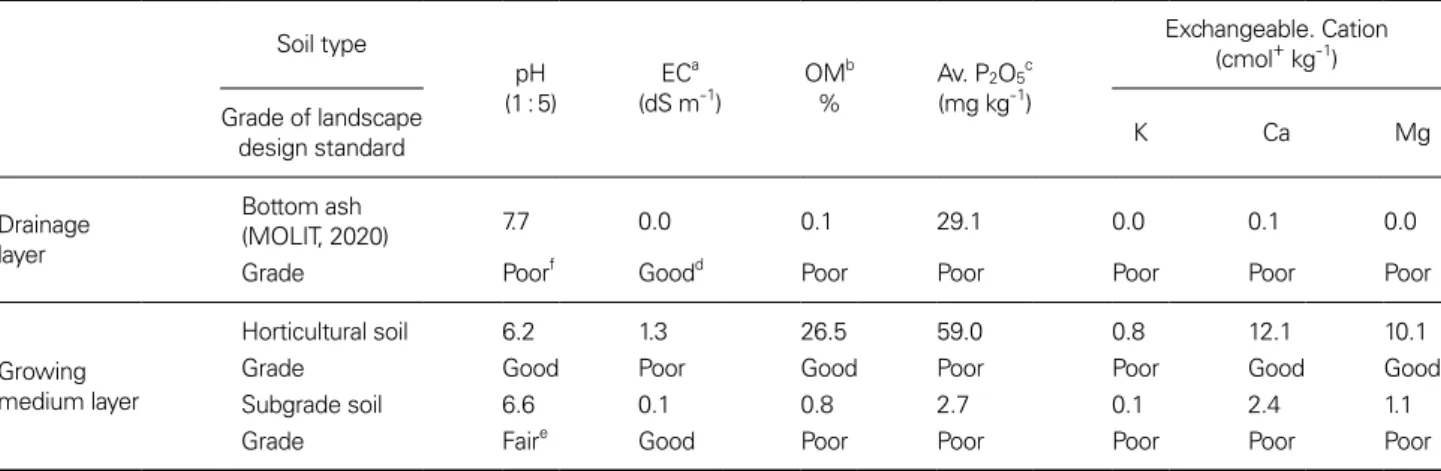
에 대한 물리적 특성을 조사하였다(Table 2).
분석기준은 농촌진흥청 토양화학분석법 기준을 적용하 였다(NIAST 2000).
바텀애시는MOLIT (2020)
에서 조사 한 값을 적용하였으며,
원예용상토는 시험구 조성 전에 채 취하였다.
대조구 토양 시료는 토심20 cm
오거(Auger)
를 활용해 약1.0 kg
을 채취하였다.
원예용상토와 대조구 토양 시료는 상온에서 건조시킨 다음2 mm
체로 쳐 항목별로 측 정하였다. pH
는 초자전극법(Origon 520 pH meter; Orion
Table 1. Composition of the eight tested substrate types. Soil 1-Soil 7 differed in the depth of the mulching layer, the growing medium
layer, and the drainage layer. Soil 8 was a control
Substrate type Mulching layer (depth) Growing medium layer (depth) Drainage layer (depth)
Soil 1 Bark (3 cm) Horticultural soil (20 cm) -
Soil 2 - Horticultural soil (20 cm) -
Soil 3 Bark (3 cm) Horticultural soil (10 cm) Bottom ash (10 cm)
Soil 4 - Horticultural soil (10 cm) Bottom ash (10 cm)
Soil 5 Bark (3 cm) Horticultural soil (20 cm) Bottom ash (10 cm)
Soil 6 - Horticultural soil (20 cm) Bottom ash (10 cm)
Soil 7 Bark (3 cm) Subgrade soil (30 cm) -
Soil 8
a- Subgrade soil (30 cm) -
aControl: Insite soil used in the landscaping of apartments in Jeonju in the condition that the drainage layer and the mulching layer are not separated.
Table 2. Soil chemical properties of the soil materials by soil layer. According to the landscape design standard grade, the pH and OM of
horticultural soil were “good” grades. In the subgrade soil and bottom ash, EC was a “good” grade
Soil type
pH
(1 : 5) EC
a(dS m
−1) OM
b% Av. P
2O
5c(mg kg
−1)
Exchangeable. Cation (cmol
+kg
−1) Grade of landscape
design standard K Ca Mg
Drainage layer
Bottom ash
(MOLIT, 2020) 7.7 0.0 0.1 29.1 0.0 0.1 0.0
Grade Poor
fGood
dPoor Poor Poor Poor Poor
Growing medium layer
Horticultural soil 6.2 1.3 26.5 59.0 0.8 12.1 10.1
Grade Good Poor Good Poor Poor Good Good
Subgrade soil 6.6 0.1 0.8 2.7 0.1 2.4 1.1
Grade Fair
eGood Poor Poor Poor Poor Poor
aElectrical conductivity
bOrganic matter
cAvailable P2O5
dGood grade criteria for evaluation of soil chemical properties in “Landscape Design Standard(The Korean Institute of Landscape Architect 2016)”: pH 6.0-6.5;
EC <0.2; OM 5.0≤; Av. P2O5 200≤; K 3.0≤; Ca 5.0≤; Mg 3.0≤
eFair grade criteria for evaluation of soil chemical properties in “Landscape Design Standard(The Korean Institute of Landscape Architect 2016)”: pH 5.5-6.0 or 6.5-7.0; EC 0.2-1.0; OM 3.0-5.0; Av. P2O5 100-200; K 0.6-3.0; Ca 2.5-5.0; Mg 0.6-3.0
fPoor grade criteria for evaluation of soil chemical properties in “Landscape Design Standard(The Korean Institute of Landscape Architect 2016)”: pH 4.5-5.5 or 7.0-8.0; EC 1.0-1.5; OM <3.0; Av. P2O5 <100; K <0.6; Ca <2.5; Mg <0.6
Research Inc., USA)
으로 측정하였으며,
전기전도도는 전 극법으로 측정하였다.
유기물함량은Tyurin
법,
유효인산은Lancaster
법으로 비색계(UV1650PC; Shimadzu Co., Japan)
를 사용하였다.
치환성양이온은1 M NH
4OAc
로 추출하여 원자흡광분광광도계(AAnalyst 300; PerkinElmer, USA)
로 분석하였다.
조경설계기준
(The Korean Institute of Landscape Architect
2016)
에서 제시한 토양의 화학적 특성 평가항목과 비교하면
,
배수토양층에서 활용되는 바텀애시는EC
를 제외하고 모두 하급의 상태였다.
육성토양층에 활용된 원예용상토는pH 6.2
로 조경설계기준에서 정하는 상급(pH 6.0
~6.5)
에 해당하였으며,
유기물26.5%,
칼슘12.1 cmol
+kg
-1,
마그네 슘10.1 cmol
+kg
-1에서도 상급의 범위에 해당하여 식재지 반 개량에 적합한 것으로 나타났다.
현장토(Subgrade Soil)
는pH 6.6
으로 중급(pH 6.5
~7.0)
에 해당하고, EC
는 상급(EC 0.2 dS m
-1미만)
이었으나 나머지 유기물,
유효인산,
치 환성이온K, Ca, Mg
는 하급의 범위에 해당하였다. Han et al.
(2020)
은 아파트 조경 조성기간을5
년 이하, 5
년~10
년, 10
년 이상으로 분류하여 화학적 특성을 분석하였는데,
본 연 구에서 사용된 현장토는5
~10
년이 경과한 아파트의 토양 특성과 같은 범위에 포함되었다.
3. 분석방법
식재식물의 생장특성 조사는
2019
년5
월부터10
월까지 월1
회 초장,
분지수,
엽장,
엽폭,
피복면적을 측정하였다.
초 장,
분지수,
엽장,
엽폭은RDA (2012)
의 농업과학기술 연구 조사분석기준을 바탕으로 측정하였다.
식물별 피복면적은 오후2
시~5
시 사이에1 m
높이에서 식물을 수직 촬영한 뒤, Image J 1.8.0 (Wayne Rasband, National Institutes of Health, Bethesda, MD)
프로그램을 이용하였다.
데이터는 평균
(means)
±표준오차(SE)
로 표기하였으며,
통계분석은SAS 7.1 (SAS Institute Inc., Cary, NC, USA)
을 이용하였다.
식재지반 조건과 생육기간에 따른 초장,
분지 수,
엽장,
엽폭,
피복면적의 차이는Twoway ANOVA
를 이 용하여 분석하였다.
분석값이 유의할 경우Duncan
검정법 을 이용하여 유의수준5%
에서 분석하였다.
결과 및 고찰
1. 식재지반별 장미의 생육특성
식재지반 조건과 생육기간에 따른 장미의 생육특성 변 화를 살펴보았다
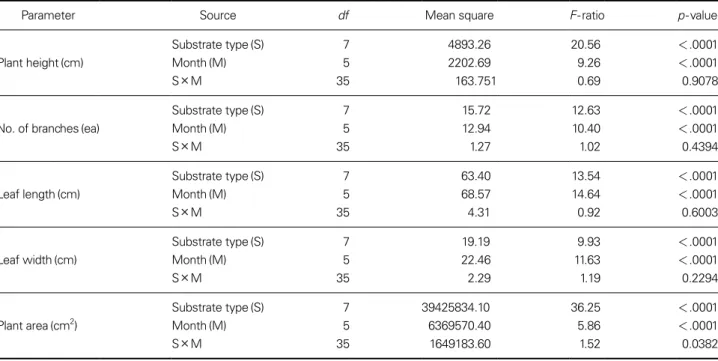
(Table 3, Fig. 1).
월별 식재지반에서 초 장평균은 통계적으로 유의한 차이를 나타냈다(Table 3,
Table 3. Summary of ANOVA results for the growth
(plant height, number of branches, leaf length, leaf width, and plant area) of Rosa hybrid ‘Barkarole‘
Parameter Source df Mean square F-ratio p-value
Plant height (cm)
Substrate type (S) 7 4893.26 20.56
<.0001
Month (M) 5 2202.69 9.26
<.0001
S×M 35 163.751 0.69 0.9078
No. of branches (ea)
Substrate type (S) 7 15.72 12.63
<.0001
Month (M) 5 12.94 10.40
<.0001
S×M 35 1.27 1.02 0.4394
Leaf length (cm)
Substrate type (S) 7 63.40 13.54
<.0001
Month (M) 5 68.57 14.64
<.0001
S×M 35 4.31 0.92 0.6003
Leaf width (cm)
Substrate type (S) 7 19.19 9.93
<.0001
Month (M) 5 22.46 11.63
<.0001
S×M 35 2.29 1.19 0.2294
Plant area (cm
2)
Substrate type (S) 7 39425834.10 36.25
<.0001
Month (M) 5 6369570.40 5.86
<.0001
S×M 35 1649183.60 1.52 0.0382
Fig. 1A). 5
월부터10
월까지 초장은 지속적으로 성장하였 다. Soil 2
는102.2
±5.8 cm
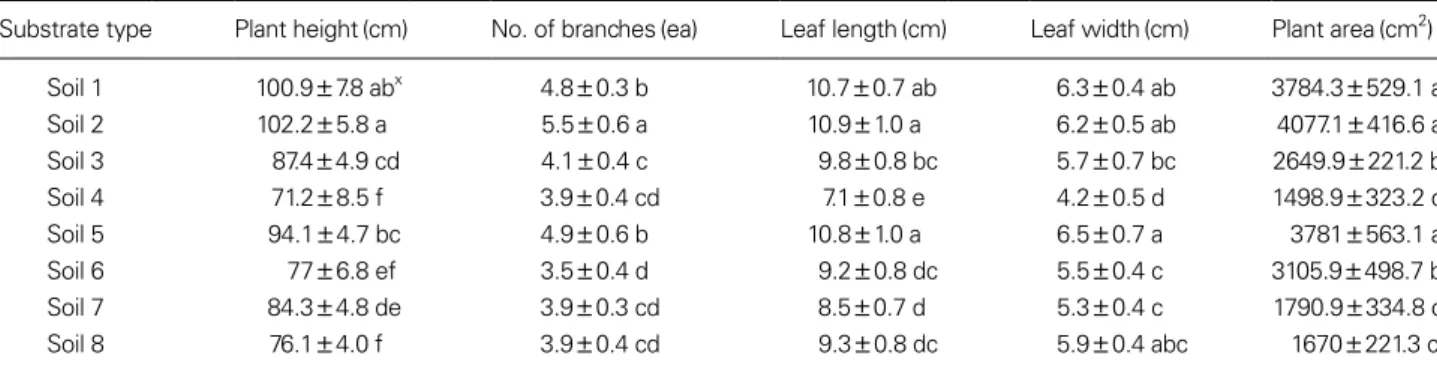
로 생육이 가장 우수하였으며(p
<0.05) (Table 4),
대조구인Soil 8
은76.1
±4.0 cm
로,
가장낮은 값이 관찰되었다
.
장미의 월별 분지수 차이는 유의한 것으로 나타났다(Table 3, Fig. 1B). Soil 2
의 분지수는5.5
±0.6
개로 가장 많았다(p
<0.05) (Table 4).
대조구인Soil 8
은3.9
±0.4
개였으며, Soil 6
은3.5
±0.4
개로 가장 낮았다.
엽 장은6
월까지 성장하다가9
월 이후로 감소하는 것으로 나타났다
(Fig. 1C).
식재지반에 따른 엽장 차이는 통계적으로 유의한 것으로 나타났다
(p
<0.05) (Table 3).
엽장이 가 장 긴 처리구인Soil 2
에서10.9
±1.0 cm
와Soil 5 10.8
±1.0 cm
는 차이가 없었으며,
그 밖의 처리구에서는 유의한 차이 가 있었다(p
<0.05) (Table 4).
또한 엽장의 길이가 가장 짧 은 처리구는Soil 4 7.1
±0.8 cm
로 나타났다.
엽폭은 식재지 반 처리구와 생육시기에 따라 유의한 차이가 있는 것으로 나타났다(Table 3).
엽폭은6
월까지 성장하다가9
월 이후로 감소하는 것으로 나타났다(Fig. 1D).
엽폭은Soil 5 6.5
±0.7 cm
에서 가장 길게 나타났으며,
나머지 처리구들과 유의한 차이를 나타냈다(p
<0.05) (Table 4). “
원예용 상토10 cm,
바텀애시10 cm”
로 구성된Soil 4
는4.2
±0.5 cm
로 가장 낮 은 값을 나타냈다.
피복면적은 처리구와 생육기간에 따라 유의한 차이가 있는 것으로 나타났다(p
<0.05) (Table 3).
피복면적은
7
월까지 확장하다가9
월부터10
월까지 감소하 였다(Fig. 1E).
식재지반 처리구별 면적은Soil 2
가4077.1
±416.6 cm
2로 가장 넓었으며, Soil 4
에서 피복면적이 가장 낮 았다.
2. 식재지반별 수국의 생육특성
식재지반 조건과 생육기간에 따른 수국의 생육특성 변 화를 살펴보았다
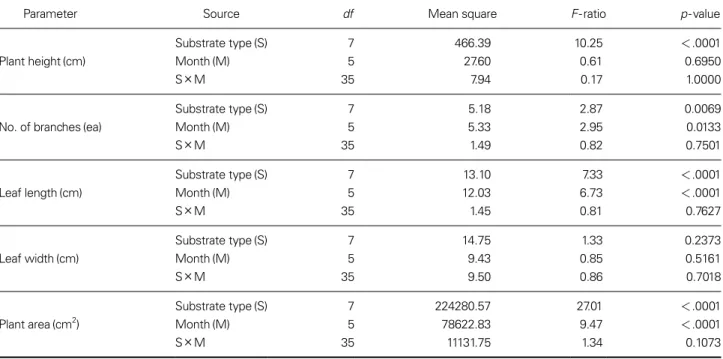
(Table 5, Fig. 2).
초장은 식재지반별로 통 계적으로 유의한 차이를 나타냈다(p
<0.05) (Table 5, Fig.
2A). Soil 5
조건에서48.9
±1.5 cm
로 초장이 가장 우수하였Table 4. Effect of substrate type on the growth
(plant height, number of branches, leaf length, leaf width, and plant area) of Rosa hybrid
‘Barkarole’ six months after treatment
Substrate type Plant height (cm) No. of branches (ea) Leaf length (cm) Leaf width (cm) Plant area (cm
2)
Soil 1 100.9±7.8 ab
x4.8±0.3 b 10.7±0.7 ab 6.3±0.4 ab 3784.3±529.1 a
Soil 2 102.2±5.8 a 5.5±0.6 a 10.9±1.0 a 6.2±0.5 ab 4077.1±416.6 a
Soil 3 87.4±4.9 cd 4.1±0.4 c 9.8±0.8 bc 5.7±0.7 bc 2649.9±221.2 b
Soil 4 71.2±8.5 f 3.9±0.4 cd 7.1±0.8 e 4.2±0.5 d 1498.9±323.2 c
Soil 5 94.1±4.7 bc 4.9±0.6 b 10.8±1.0 a 6.5±0.7 a 3781±563.1 a
Soil 6 77±6.8 ef 3.5±0.4 d 9.2±0.8 dc 5.5±0.4 c 3105.9±498.7 b
Soil 7 84.3±4.8 de 3.9±0.3 cd 8.5±0.7 d 5.3±0.4 c 1790.9±334.8 c
Soil 8 76.1±4.0 f 3.9±0.4 cd 9.3±0.8 dc 5.9±0.4 abc 1670±221.3 c
x Mean separation within columns by Duncan’s multiple range test, p<0.05. Different letters within a column indicate significant differences(p<0.05).
Fig. 1. Changes in the morphological characteristics
(plant height, number of branches, leaf length, leaf width, and plant area) of Rosa hybrid ‘Barkarole’ in the different planting substrates. Soil 1 [
●], Soil 2 [
○], Soil 3 [
▼], Soil 4 [
△], Soil 5 [
■], Soil 6 [
□], Soil 7 [
◆], and Soil 8 [
◇].
A D
B
C
E
으며
, Soil 1
은38.7
±2.3 cm
로 초장이 가장 낮았다(Table 6).
수국의 분지수 차이는 월별 식재지반에 따라 유의한 것으 로 나타났다
(p
<0.05) (Table 5, Fig. 2B).
수국의 분지수는8
월에 가장 우수하였다(Fig. 2B).
처리구별로는Soil 2
의 분지 수가4.9
±0.8
개로 가장 많았으며, Soil 7
에서3.7
±0.5
개로 분지수가 가장 낮았다(Table 6).
월별 식재지반의 엽장 차 이는 통계적으로 유의한 것으로 나타났다(p
<0.05) (Table 5, Fig. 2C).
엽장이 가장 긴 처리구는Soil 1
에서7.7
±0.4 cm
였으며,
대조구는6.0
±0.4 cm
로 가장 짧게 나타났다(Table 6).
엽폭은 식재지반 처리구와 생육시기에 따라 유의한 차 이가 없는 것으로 나타났다(Table 5, Fig. 2D).
피복면적은 처리구와 생육기간에 따라 유의한 차이가 있는 것으로 나 타났다(p
<0.05) (Table 5).
피복면적은8
월까지 확장하다 가9
월부터10
월까지 감소하였다(Fig. 2E).
처리구별 면적은
Soil 6
이438.6
±40.4 cm
2로 가장 넓었으며Soil 7 198.7
±28.3 cm
2과 대조구인Soil 8 187.2
±19.1 cm
2에서 피복면적 이 가장 낮았다.
종합하면 수국의 생육시기별 차이분석 결과
8
월까지 영 양생장을 한 뒤, 9
월부터는 생장을 멈추는 것을 확인할 수 있었다. Nam et al. (2017)
에 따르면 수국은 자연상태에서6
월부터8
월까지 영양생장을 한 뒤 화아분화를 한다고 보고 하였으며,
본 연구에서도 선행연구와 일치하는 경향을 나 타냈다.
식재지반은Soil 1, Soil 2, Soil 5
가 가장 우수한 것으 로 나타났다.
3. 고찰
본 연구는 생태네트워크 측면에서 아파트 조경에 다층 식재 적용을 위한 관목의 최적 식재지반을 선정하는 것을 목적으로 하였다
.
다층식재기법은 자연생태계의 모습을 모 방한 식재기법으로,
생물 서식처를 제공해 줄 뿐만 아니라 이용자들에게 생태계서비스를 제공할 수 있다.
다층식재기 법에 대한 연구 및 필요성에 대한 연구는2000
년대 초반부 터 진행되어 왔지만(Sim and Lee 2001; Lee et al. 2004),
식 재된 관목류가 생육불량으로 하자가 발생하는 부분에 대 한 고려는 부족하였다.
아파트 주민 선호도가 높고,
정원용 관목으로 활용되는 장미와 수국을 대상으로 식재지반에 따른 생육차이를 분석하였다.
장미의 초장
,
분지수,
엽장,
엽폭,
피복면적은 식재지반 별 로 유의한 차이를 나타냈다(p
<0.05) (Table 3).
특히“
원 예용 상토20 cm”
로 구성된Soil 2
처리구와“
멀칭3 cm,
원 예용 상토20 cm,
바텀애쉬10 cm”
로 구성된Soil 5
의 토양 조합이 우수한 것으로 나타났다.
이러한 결과는 선행연구(Oberndorfer et al. 2007; Jim and Tsang 2011; El Bachawati et al. 2016; Cascone, 2019)
에서 제시한 인공지반 관목류의 식재 기준 중 육성토양층을20 cm
로 보고한 것과 동일한 값을 나타냈다.
수국은 초장,
분지수,
엽장,
엽폭,
피복면적 은 식재지반별로 유의한 차이를 나타냈다(p
<0.05) (Table 5).
생육이 우수했던Soil 2
처리구는“
원예용 상토20 cm”
로
, Soil 6
은“
원예용 상토20 cm,
바텀애시10 cm”
로 구성되 어 있었다.
한편 대조구와“
원예용 상토10 cm,
바텀애시10 cm”
로 구성된Soil 4
에서 생육이 낮게 나타났다.
이러한 결 과는Cascone (2019)
의 연구에서 제시한10 cm
미만의 육 성토양층에는 새덤 및 초화류가 적합하다고 보고한 결과 와 일치하며,
다층식재를 위한 식재지반 구성에는 부적합 Fig. 2. Changes in the morphological characteristics(plant height,
number of branches, leaf length, leaf width, and plant area) of Hydrangea macrophylla ‘Nikko Blue’ in the different planting sub- strates. Soil 1 [
●], Soil 2 [○], Soil 3 [
▼], Soil 4 [△], Soil 5 [
■], Soil 6 [
□], Soil 7 [
◆], and Soil 8 [
◇].
A D
B E
C
한 것으로 해석하였다
.
한편“
원예용 상토20 cm,
바텀애시10 cm”
로 구성된Soil 6
의 식재지반 조합도 우수하였다.
배 수토양층에 활용된 바텀애시는 조경분야에서 인공지반 토 양으로 활용 가능성에 대한 연구가 활발이 진행되고 있으 며(Kim et al. 2013; Hong et al. 2015; Kim et al. 2018; MOLIT
2020),
본 연구에서도 바텀애시의 활용 가능성을 검증할수 있었다
.
연구의 결과는 생태적 측면과 사회적 측면에서 의미를 해석할 수 있다
.
생태적 측면으로는 수직적 층위를 다양하 게 조성하는 기법은 조류 및 소형포유류의 서식처를 제공할 수 있다
(Han et al. 2017).
또한 관목과 초본의 층위로 구 성된 다층식재기법은 곤충 서식지 조성에도 기여할 수 있 다. Lee et al. (2019)
에 따르면 식물의 생장은 곤충 개체군 에 긍정적인 영향을 주는 것으로 나타났다.
도시에서 발견 되는 나비는 장미과,
콩과,
산형과,
국화과 등이 흡밀식물 과 기주식물로서 효과적인 것으로 알려져 있다(Son et al.
2015).
나비류는 특히 우리나라 전역에서 관찰되어 농업생태계 기후변화 지표종으로도 활용되고 있기 때문에 중 요성을 갖는다
(Choi 2019).
이처럼 본 연구에서 제안한 식 재지반은 관목류의 생육불량을 완화시키고,
안정적인 생Table 5. Summary of ANOVA results for the growth
(plant height, number of branches, leaf length, leaf width, and plant area) of Hydrangea macrophylla ‘Nikko Blue’
Parameter Source df Mean square F-ratio p-value
Plant height (cm)
Substrate type (S) 7 466.39 10.25
<.0001
Month (M) 5 27.60 0.61 0.6950
S×M 35 7.94 0.17 1.0000
No. of branches (ea)
Substrate type (S) 7 5.18 2.87 0.0069
Month (M) 5 5.33 2.95 0.0133
S×M 35 1.49 0.82 0.7501
Leaf length (cm)
Substrate type (S) 7 13.10 7.33
<.0001
Month (M) 5 12.03 6.73
<.0001
S×M 35 1.45 0.81 0.7627
Leaf width (cm)
Substrate type (S) 7 14.75 1.33 0.2373
Month (M) 5 9.43 0.85 0.5161
S×M 35 9.50 0.86 0.7018
Plant area (cm
2)
Substrate type (S) 7 224280.57 27.01
<.0001
Month (M) 5 78622.83 9.47
<.0001
S×M 35 11131.75 1.34 0.1073
Table 6. Effect of substrate type on the growth
(plant height, number of branches, leaf length, leaf width, and plant area) of Hydrangea macro- phylla ‘Nikko Blue’ six months after treatment
Substrate type Plant height (cm) No. of branches (ea) Leaf length (cm) Leaf width (cm) Plant area (cm
2)
Soil 1 38.7±2.3 e
x4.7±0.3 a 7.7±0.4 a 4.5±0.3 a 336.3±28.7 bc
Soil 2 43.6±2.1 bc 4.9±0.8 a 7.2±0.5 a 4.3±0.3 a 344.5±43.2 b
Soil 3 42.3±3.8 cd 4.3±0.4 ab 7.2±0.4 a 4.5±0.3 a 254.7±28.9 d
Soil 4 40.2±2.7 de 4.5±0.4 a 6.5±0.7 b 3.6±0.5 a 284.9±42.0 d
Soil 5 48.9±1.5 a 4.8±0.6 a 7.3±0.6 a 4.7±0.6 a 293.6±61.5 cd
Soil 6 47.3±2.2 a 4.2±0.8 ab 7.7±0.7 a 4.5±0.6 a 438.6±40.4 a
Soil 7 46±4.0 ab 3.7±0.5 b 6.4±0.6 b 4.0±0.4 a 198.7±28.3 e
Soil 8 39.8±2.6 de 4.3±0.5 ab 6.0±0.4 b 5.8±2.3 a 187.2±19.1 e
x Mean separation within columns by Duncan`s multiple range test, p<0.05. Different letters within a column indicate significant differences (p<0.05).
물 서식처를 제공하는 데 기여할 것으로 기대된다
.
사회적 측면에서Han et al. (2020)
에서 제안한 바와 같이 주민참 여 프로그램을 통한 아파트 화단 가꾸기 및 아파트 조경 관 리 가이드라인 등에 관목의 하자저감을 위해 식재지반 기 준으로 활용될 것으로 기대된다.
주민참여 프로그램은 교 목보다 관목 및 초본이 적합하며(You et al. 2019),
주민들이 공동체적 인간관계와 이웃관계를 형성함으로써 생태계의 문화서비스도 제공할 수 있을 것이다.
본 연구는 식재지반 조합별 식물 생육 차이에 초점을 두 었으며
,
경제성 평가 및 토양개량 이후의 토양수분과 토양 경도 등 토양의 물리적 성질에 대한 효과를 검증하지 못한 한계가 있다.
향후 토양의 경제성 및 토양의 물리적 성질 및 환경개선 기능도 함께 검증될 수 있도록 후속 연구가 진 행되어야 할 것이다.
적 요
본 연구는 아파트 조경공간에 다층식재기법을 적용하기 위한 기초단계 연구로서
,
교목중심의 단층구조 식재지역 에 관목이 건강하게 생육할 수 있는 최적의 식재지반을 선 정하는 것을 목적으로 하였다. 2019
년5
월부터10
월까지 농촌진흥청 국립원예특작과학원 시험포장에서 실험을 실 시하였다.
식재지반은 멀칭재,
원예용 상토,
바텀애시,
현장 토를 활용해8
가지 처리구6
반복 조성하였다.
실험식물은 아파트 조경용 관목으로 선호도가 높은 장미(Rosa hybrid
‘Barkarole’)
와 수국(Hydrangea macrophylla ‘Nikko Blue’)
으로 선정하였다.
토양재료의 화학성은 농촌진흥청 토양 화학분석 기준에 따라 분석하였으며,
처리구 간 유의성은SAS7.1
을 활용해Twoway ANOVA
분석을 실시하였다.
식재지반별 장미와 수국의 초장
,
분지수,
엽장,
엽폭,
피복 면적의 변화를 분석하였다.
분석결과 장미는“
원예용 상토20 cm”
조합과“
멀칭3 cm,
원예용 상토20 cm,
바텀애쉬10 cm”
의 조합에서 생장이 우수한 것으로 나타났다(p
<0.05).
그중
“
원예용 상토20 cm”
에서는 초장102.2
±5.8 cm,
분지 수5.5
±0.6
개,
엽장10.9
±1.0 cm,
엽폭6.2
±0.5 cm,
피복면 적4077.1
±416.6 cm
2로 우수한 것으로 나타났다(p
<0.05).
수국은
“
멀칭3 cm,
원예용 상토20 cm”, “
원예용 상토20 cm”
조합과“
원예용 상토20 cm,
바텀애쉬10 cm”
의 조합에 서 생장이 우수한 것으로 나타났다.
초장43.6
±2.1 cm,
분 지수4.9
±0.8
개,
엽장7.2
±0.5 cm,
엽폭4.3
±0.3 cm,
피복면적
344.5
±43.2 cm
2인“
원예용 상토20 cm”
의 조합에서 생 장이 우수하였다.
본 연구는 통해 아파트 다층식재를 위해 서는 최소20 cm
이상 경운한 뒤에 육성토양층에 원예용상 토를 충전하여 식재할 것은 제안하였다.
이러한 기준은 향 후 아파트 화단 리모델링 사업에 활용될 것으로 기대된다.
사 사
본 연구는 농촌진흥청 연구개발사업