Print ISSN: 2288-4637 / Online ISSN 2288-4645 doi:10.13106/jafeb.2020.vol7.no12.577
The Effect of Training, Information Technology,
Intellectual and Emotional Intelligence on Teacher’s Performance
Kusni INGSIH
1, Agus PRAYITNO
2, Dwi Eko WALUYO
3, Suhana SUHANA
4, Shujahat ALI
5Received: September 01, 2020 Revised: October 26, 2020 Accepted: November 05, 2020
Abstract
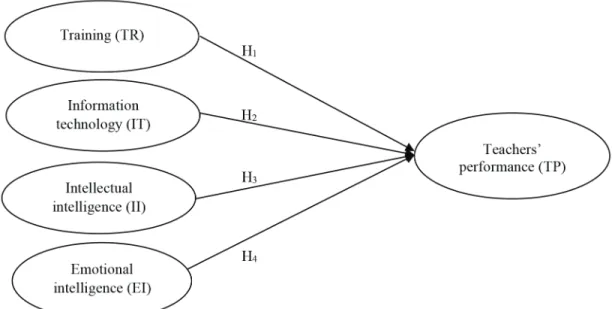
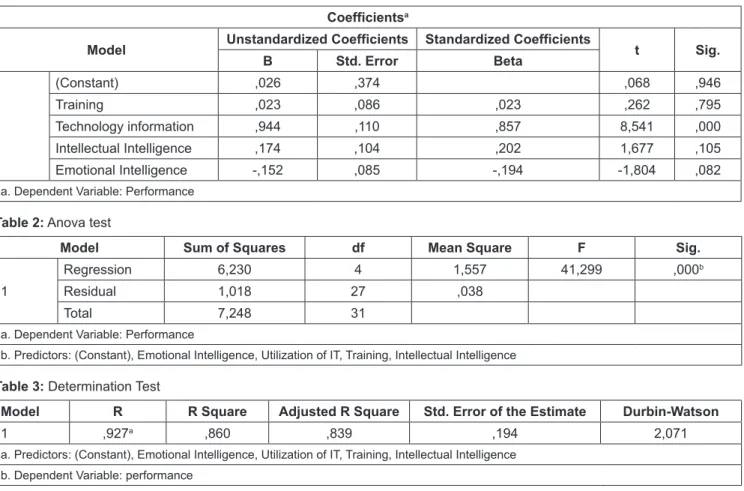
The performance of a teacher has an important role in the success of education in general. This study aims to determine the factors that affect the decline in teacher performance in one of the junior secondary schools in Indonesia. Based on the literature review, four exogenous variables were identified, namely, training, utilization of information technology, intellectual intelligence, and emotional intelligence. This study uses primary data, collected from a questionnaire distributed to respondents. The questionnaire items are measured using a Likert scale. The sample in this study were all teachers at MTS Darul Falah Sirahan, totaling 32 people. The analysis technique used in testing the hypothesis of this study is multiple regression analysis. Statistical product and service solutions are used as analysis tools. The results of this study indicate that only the variable ‘utilization of information technology’ has a positive and significant effect. However, the variables
‘training,’ ‘intellectual intelligence,’ and ‘emotional intelligence’ did not have a significant effect. This finding contradicts the literature in general. Therefore, this study recommends improving training methods, both those carried out internally by schools and by related agencies, and schools still need to optimize guidance and potential for teacher’s intelligence in improving performance.
Keywords: Teacher Performance, Training, Information Technology JEL Classification Code: J00, J24, M53
to various studies, is that teachers in Indonesia seem unable to show adequate performance (Muhammad, 2015; Tanang
& Abu, 2014). Teacher’s performance in learning includes understanding the nature and characteristics of students and their development, understanding the concept of learning, mastering several appropriate learning methods, and proper evaluation methodologies (Elliott, 2015; Pope, 2019;
Taylor & Tyler, 2012). Several studies show that to improve performance, one method that can be used is to optimize training (Nielsen, 2010; Vesely, et al., 2014). Training refers to a series of activities that provide opportunities to acquire and improve work-related skills. Several studies conducted in Indonesia also show that training has a positive correlation with performance (Constantine et al., 2009; Tanang & Abu, 2014). This is in line with the research findings of Wolor et al. (2020) that show that e-training has a positive effect on employee’s performance.
In the modern era, a factor that is no less important is information technology. Several studies have argued that technology has a positive influence on improving the general performance, including teacher’s performance (Tran et al., 2020; Ambarwati et al., 2020; Palao et al., 2015; Forehand, 2012; Means, 2010). For example, Betrancourt (2012)
1
First Author and Corresponding Author. Lecturer, Management Department, Faculty of Economic and Business, University of Dian Nuswantoro, Indonesia [Postal Address: Jl. Nakula I No. 5-11, Semarang, Central Java, 50131, Indonesia]
Email: [email protected] ; [email protected]
2
Lecturer, Management Department, Faculty of Economic and Business, University of Dian Nuswantoro, Indonesia.
Email: [email protected].
3
Lecturer, Management Department, Faculty of Economic and Business, University of Dian Nuswantoro, Indonesia.
Email: [email protected].
4
Lecturer, Management Department, Faculty of Economic and Business, University of Unisbank, Indonesia.
Email: [email protected].
5