• 검색 결과가 없습니다.

The Influence of Digital Literacy and Demographic Characteristics on Online Shopping Intention: An Empirical Study in Palestine

N/A
N/A
Protected

Academic year: 2021

Share "The Influence of Digital Literacy and Demographic Characteristics on Online Shopping Intention: An Empirical Study in Palestine"

Copied!
11
0
0

로드 중.... (전체 텍스트 보기)

전체 글

(1)

Print ISSN: 2288-4637 / Online ISSN 2288-4645 doi:10.13106/jafeb.2021.vol8.no8.0205

The Influence of Digital Literacy and Demographic Characteristics on Online Shopping Intention: An Empirical Study in Palestine

Ayman NAZZAL

1

,

Armanu THOYIB

2

, Djumilah ZAIN

3

, Ananda Sabil HUSSEIN

4

Received: April 10, 2021 Revised: June 26, 2021 Accepted: July 04, 2021

Abstract

The purpose of the study is to investigate the effect of digital literacy, perceived usefulness, and perceived ease of use on Internet users’

online purchase intention in Palestine, as well to examine the moderating effect of Internet users’ socioeconomic characteristics – age and gender on the relationships between digital literacy and online purchase intention. An extended technology acceptance model (TAM) by including digital literacy was applied in this research. The study applied a quantitative method, where 400 respondents participated in a questionnaire. The collected data was tested against the research framework using the partial least squares (SEM-PLS) method. The findings indicate that digital literacy has a significant effect on perceived usefulness, perceived ease of use, and online purchase intention; there is a significant effect of perceived usefulness on online purchase intention, but not perceived ease of use. On the other hand, socioeconomic variables demonstrate that neither age nor gender moderates the relationship between digital literacy and online purchase intention; in short, age and gender do not condition the intention of the Internet user.

Keywords: Digital Literacy, Perceived Usefulness, Perceived Ease of Use, Online Purchase Intention, Palestine JEL Classification Code: E21, M21, N95

e-commerce and creates opportunities for businesses to remain competitive by providing individuals with a more convenient, faster, and less expensive way to make purchases.

This is because it creates or provides new opportunities for companies and customers to share information or services among themselves and produce sophisticated new forms of business methods. Scholars recognized an increasing number of Internet-enabled devices that help individuals search for information through the Internet or even purchase products and services online (Grewal et al., 2017) Consequently, with the development of the Internet and technology, our daily life has changed dramatically, with various benefits for the e-retailer, individuals, and even business development as a whole. As a result, Internet has emerged as a critical driver of economic growth and improving the business method such as transforming from traditional to online shopping.

Because of the low transaction costs, e-commerce has become the primary key to facilitating electronic transactions by relying on information and communications technology (ICT) in e-commerce transactions, making it more accessible, convenient, and time-saving. As one of the most significant advantages provided by the advancement of ICT, online shopping is a form of e-commerce that allows consumers to directly buy goods or services from a seller

1

First Author and Corresponding Author. Doctoral Student, Department of Management, Faculty of Economics and Business, University of Brawijaya, Malang, Indonesia [Postal Address: Jl.

Veteran, Ketawanggede, Kec. Lowokwaru, Kota Malang, Jawa Timur 65145, Indonesia] Email: [email protected]

2

Lecturer, Department of Management, Faculty of Economics and Business, University of Brawijaya, Malang, Indonesia.

Email: [email protected]

3

Lecturer, Department of Management, Faculty of Economics and Business, University of Brawijaya, Malang, Indonesia.

Email: [email protected]

4

Lecturer, Department of Management, Faculty of Economics &

Business, University of Brawijaya, Malang, Indonesia.

Email: [email protected]

© Copyright: The Author(s)

This is an Open Access article distributed under the terms of the Creative Commons Attribution Non-Commercial License (https://creativecommons.org/licenses/by-nc/4.0/) which permits unrestricted non-commercial use, distribution, and reproduction in any medium, provided the original work is properly cited.
1. Introduction

There is no doubt that the Internet has grown rapidly in

recent years and has become an effective and profitable tool

for communication, electronic businesses, and sustainable

business development (Law et al., 2016). Increased Internet

penetration has accelerated the global adoption of B2C

(2)

over the Internet using a web browser or a mobile app.

Several prior studies demonstrated that online shopping is an effective shopping method because it saves individuals time, is more practical, more convenient than conventional shopping, and provides a new shopping experience (Ganesh et al., 2010). Online shopping has been around for nearly two decades in developed countries; however, it is still in its early stages in developing countries (Alyoubi, 2015).

Purchase intention toward online shopping is one of the most leading research fields in B2C e-commerce over the last decade. The intentions of the consumer are an indicator of the extent to which people are willing to carry out a specific behavior (Ajzen, 1991). To capture what is in the individuals’ minds, measuring their intentions is more effective than measuring their actual behaviors due to constraints during the actual purchase process (Day, 1976).

As a result, individuals` purchase intentions toward online shopping will demonstrate the power of the individuals’

attitude toward their willingness to online shopping. The buying behavior of online customers is related to how customers decide what product or services to purchase online, which is defined by a cognitive state known as purchase intention. According to the prior review of the literature, the majority of scholars have defined online purchase intention with nearly the same meaning. For example, according to the definition of online purchase intention by Pavlou (2003), it is the desire and intent to purchase services or products over the Internet.

As a developing country, Palestine is an example that has a low percentage of adopting online shopping by their populations. Even though Palestine has adequate infrastructure in terms of Internet, software, and hardware, which are the main requirements for online shopping, only 79.6% of households have Internet, 86.2% have smartphones.

However, according to the Palestinian Statistics Centre, only 8.1% did online shopping in 2019. Thus, this can be viewed as an empirical gap and motivation for this study to fill this gap by investigating the factors that influence Palestinians not to shop online. Many previous studies were conducted in developed countries to investigate individuals’ intention to shop online. However, there are still limited studies in developing countries, particularly in Palestine. Furthermore, up to our knowledge, there are no such studies conducted to investigate the influence of digital literacy on online purchase intention; thus, the study will fulfill this knowledge gap in the body of the literature.

Many substantial previous studies have investigated the influence of various factors on individuals’ online purchase intentions. For example, perceived ease of use (Nasution et al., 2019), perceived usefulness (Jin, 2016; Nasution et al., 2019; Ha et al., 2021), computer self-efficacy (Ranganathan & Jha, 2009), perceived risk (Tham et al., 2019), perceived risk (Tham et al., 2019;

Ha et al., 2021), and self-efficacy (Phong et al., 2018).

Based on these previous studies, it appears that there is a lack of clarity and consistency in terms of the factors that influence purchase intention in e-commerce.

The significant problem that e-retailers meet is attracting individuals’ purchase intentions to shop online, particularly Internet users. To fulfill the empirical and knowledge gaps, this study adopts a different model as part of the solution that includes four variables to investigate the factors that deter Palestinian Internet users from shopping online.

Furthermore, the study uses socioeconomic characteristics of Internet users - such as age and gender, to investigate their moderating effect on the relationship between digital literacy and online purchase intention.

The objective of this study is to find out whether digital literacy, perceived usefulness, and perceived ease of use influence Internet users’ intention to shop online;

as well as to test the moderating effect of socioeconomic characteristics of Internet users - such as age and gender - on the relationship between digital literacy and online purchase intention. Furthermore, to test whether perceived usefulness and perceived ease of use mediate the relationship between digital literacy and online purchase intention. Moreover, limited studies are being conducted on individuals’ purchase intention toward online shopping, especially in the Palestine context. As the online shopping concept is still in its early stages of development in Palestine, it is necessary to investigate the factors influencing individuals’ purchase intentions in this area.

This study developed an extended technology acceptance model (TAM) by including the digital literacy construct to achieve the objectives mentioned above. The SEM- PLS method (i.e., causal model) will be applied to test the model, mediating effect, and moderating effect. The causal model will be tested using the structural equation modeling (SEM) technique, followed by testing the moderating effect of socioeconomic variables on digital literacy and online purchase intention. Furthermore, the study will estimate the mediating effect of perceived usefulness and perceived ease of use on the relationship between digital literacy and online purchase intention. Thus, in short, the study tries to answer the following research questions:

•    Does digital literacy have a significant effect on individuals’ online purchase intention?

•    Does perceived usefulness have a significant effect on individuals’ online purchase intention?

•    Does perceived ease of use have a significant effect on individuals’ online purchase intention?

•    Does perceived usefulness mediate the relationship between digital literacy and online purchase intention?

•    Does perceived ease of use mediate the relationship

between digital literacy and online purchase intention?

(3)

•    Does gender moderate the relationship between digital literacy and online purchase intention?

•    Does age moderate the relationship between digital literacy and online purchase intention?

2. Literature Review and Hypotheses 2.1. Digital Literacy

Access to technology does not guarantee that individuals will achieve the expected socioeconomic goals because specific fundamental skills and understanding are required for IT systems (i.e., E-commerce) to be adopted effectively and critically. Digital literacy refers to an individual’s ability to find, evaluate, and clearly communicate information through typing and other media on various digital platforms.

Digital literacy is the awareness, attitude, and ability of individuals to appropriately use digital tools and facilities to identify, access, manage, integrate, evaluate, analyze and synthesize digital resources, construct new knowledge, create media expressions, and communicate with others, in the context of specific life situations, to enable constructive social action and reflect upon this process. In that essence, a person with digital literacy skills requires his/her ability to correctly understand and interpret information through the use of ICT in a way that facilitates their own goals.

Meyers et al. (2013) also stated that an individual who lacks digital literacy is less likely to become a competent student, a motivated employee, or an engaged individual in various technological contexts such as e-learning, e-commerce, e-government, and e-health. In general digital literacy plays a critical contribution in developing business and marketing networks.

The digital literacy framework is a general framework for measuring an individual’s digital literacy that takes three concepts into account: cognitive, technical, and socio- emotional, all of which interact and interfere with one another. Based on these concepts, an individual with digital literacy skills should have operational and technical skills, think critically and evaluate digital content, and use the Web safely for work, learning, and other day-to-day activities.

Callum and Jeffrey (2014) demonstrated the importance of digital literacy in accepting mobile learning technology.

Nawafleh (2018) showed that digital literacy has a positive and significant influence on increasing individuals` intention to use e-government services.

H1: Digital literacy has a positive effect on online purchase intention.

H2: Digital literacy has a positive effect on perceived usefulness.

H3: Digital literacy has a positive effect on perceived ease of use.

2.2. Technology Acceptance Model (TAM)

The Technology Acceptance Model (TAM) was formed by Davis et al. (1989). TAM is the most widely applied model by scholars to investigate the factors influencing an individual’s attitude, intention, and readiness to adopt a new technology or system, particularly in the information system context. Based on TAM theory, the individuals’

attitudes, intentions, and behaviors toward accepting a particular new technology or system are influenced by two main determinants: perceived usefulness (PU) and perceived ease of use (PEOU). Furthermore, the TAM model was empirically validated to predict individuals`

behavior in the e-commerce context (Pavlou, 2003).

As a result, this study proposes that TAM can predict and explain the adoption of online shopping. Furthermore, according to Tahar et al. (2020), together, perceived ease of use and perceived usefulness determine attitudes toward the use of technology, which can influence the behavioral intention to use, leading to the actual use of the system.

2.2.1. Perceived Usefulness (PU)

The perceived usefulness of an information system is a major predictor of individuals’ initial intentions to adopt it (Davis et al., 1989). Perceived usefulness is the degree to which a person believes that using a particular system would enhance his/her job performance (Davis et al., 1989; Zhu et al., 2009). Information technology in developing countries is still in its early stages when compared to the developed countries. As a result, this study used perceived usefulness as a proposed factor that could influence an individual’s purchase intention to shop online in Palestine, a developing country, and e-commerce still in its early stages.

The majority of previous research on perceived use- fulness was conducted in developing countries (Zhao & Cao, 2012; Nguyen & Barrett, 2006). The study conducted by Rehman (2019) and Ha et al. (2021) revealed that perceived usefulness positively and significantly influences consumer purchase intention.

H4: Perceived usefulness has a positive effect on online purchase intention.

2.2.2. Perceived Ease of Use (PEOU)

Davis et al. (1989) defined perceived ease of use as the

degree to which a person believes that using a particular

system would be free of effort. In other words, perceived ease

of use is an individual’s belief a technology or an information

system is easy to understand. In other words, perceived ease

(4)

of use is a subjective perception by individuals concerning the degree of effort required to adopt a new information system. Several previous studies were conducted to assess the causal relationship between perceived ease of use and an individual’s online purchase intention, which demonstrated that perceived ease of use has a positive influence on online purchase intention, such as (Jin, 2016; Nasution et al., 2019;

Pavlou, 2003).

H5: Perceived ease of use has a positive effect on online purchase intention.

2.3. The Moderating Effect 2.3.1. Age

Age is an essential socioeconomic characteristic that directly and as a moderator affects an individual’s behavioral intention, adoption, and acceptance of technology (Wang & Chen 2009; Chung, 2010). The literature review emphasized the significance of individuals’ age in predicting their behaviors. Younger individuals typically have more experience with the Internet, and aspects such as usefulness and attitude become more critical (Morris

& Venkatesh, 2000; Trocchia & Janda, 2000). In contrast, older individuals perceive greater risks, have more difficulty creating syntactically complex commands, and emphasize the perception of self-efficacy (Morris & Venkatesh, 2000;

Trocchia & Janda, 2000). As a result, some studies have assessed age as a relevant variable in explaining individuals`

shopping behavior online.

Some scholars demonstrated that age does not significantly affect IT use, stating that the assumption young individuals were already familiar with the Internet and that older individuals were resistant was incorrect

(Roussos, 2007). Furthermore, Chung (2010) hypothesized that age as a moderator would increase the explanatory power of a TAM. Based on the above findings, it is clear that there is still inconsistency in the results concerning the moderating role of age. Thus, the study predicted that the moderating effect of age on the relationship between digital literacy and online purchase intention would be stronger for younger Internet users.

H6: The effect of digital literacy upon online purchase intention is moderated by age of the internet users.

2.3.2. Gender

Several studies related to the acceptance of new IT systems have been conducted to investigate the influence of gender on decision-making and shopping behavior, which concluded that IT features and use are assessed differently depending on the gender of the individual (Morris

&Venkatesh, 2000).

Male and female individuals have different charac- teristics, which affect their diverse consumption choices.

Gender plays an essential role in making purchase decisions. An increasing number of women are using the Internet, decreasing the gender gap in using this medium.

Furthermore, Shin (2009) suggested no statistically significant differences in Internet use between men and women.

H7: The effect of digital literacy upon online purchase intention is moderated by the gender of the internet users.

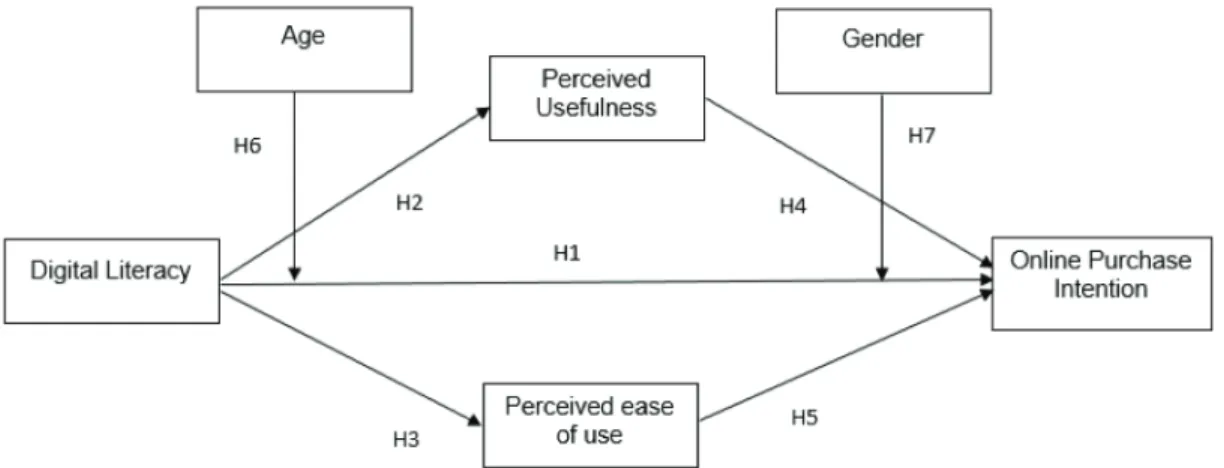
The proposed research framework has six constructs and seven hypotheses derived from the relationships between these six constructs (Figure 1).

Figure 1: Research Framework and Hypotheses

(5)

3. Methodology

The research method of study consists of two major aspects of procedures: data collection and data analysis. The research design is critical to every study, including a plan for collecting, measuring, and analyzing data to answer the research study questions. The study aims to examine the impact of digital literacy, perceived usefulness, and perceived ease of use on online purchasing intention. The research model was assessed using a sample of Internet users in Palestine.

The current study used a quantitative approach because it was based on grounded theory and previous research.

The population of this study is Palestinian Internet users. The data was derived from 400 questionnaires, answered by Palestinians of different backgrounds, ages, incomes, genders, and the number of hours per day spent on the Internet. As a result, the research sample will be drawn from university academics, students, adminis- trative staff, and employees from various ministries and households.

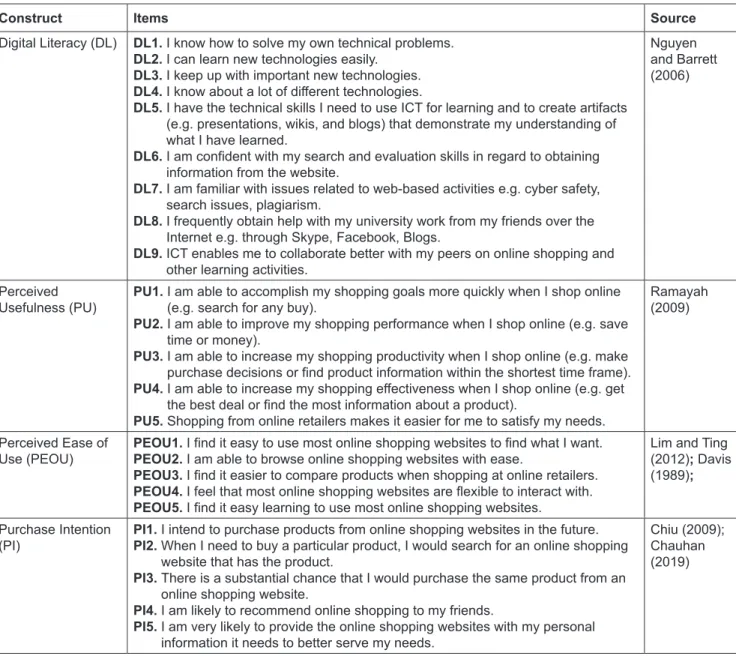
A set of measurement indicators was applied to the context of this research based on the hypothesized research framework developed through a detailed reviewing of prior literature on the proposed constructs (Figure 1

Table 1: Constructs, Items, and Source

Construct Items Source

Digital Literacy (DL) DL1. I know how to solve my own technical problems.

DL2. I can learn new technologies easily.

DL3. I keep up with important new technologies.

DL4. I know about a lot of different technologies.

DL5. I have the technical skills I need to use ICT for learning and to create artifacts (e.g. presentations, wikis, and blogs) that demonstrate my understanding of what I have learned.

DL6. I am confident with my search and evaluation skills in regard to obtaining information from the website.

DL7. I am familiar with issues related to web-based activities e.g. cyber safety, search issues, plagiarism.

DL8. I frequently obtain help with my university work from my friends over the Internet e.g. through Skype, Facebook, Blogs.

DL9. ICT enables me to collaborate better with my peers on online shopping and other learning activities.

Nguyen and Barrett (2006)

Perceived

Usefulness (PU) PU1. I am able to accomplish my shopping goals more quickly when I shop online (e.g. search for any buy).

PU2. I am able to improve my shopping performance when I shop online (e.g. save time or money).

PU3. I am able to increase my shopping productivity when I shop online (e.g. make purchase decisions or find product information within the shortest time frame).

PU4. I am able to increase my shopping effectiveness when I shop online (e.g. get the best deal or find the most information about a product).

PU5. Shopping from online retailers makes it easier for me to satisfy my needs.

Ramayah (2009)

Perceived Ease of

Use (PEOU) PEOU1. I find it easy to use most online shopping websites to find what I want.

PEOU2. I am able to browse online shopping websites with ease.

PEOU3. I find it easier to compare products when shopping at online retailers.

PEOU4. I feel that most online shopping websites are flexible to interact with.

PEOU5. I find it easy learning to use most online shopping websites.

Lim and Ting (2012); Davis (1989);

Purchase Intention

(PI) PI1. I intend to purchase products from online shopping websites in the future.

PI2. When I need to buy a particular product, I would search for an online shopping website that has the product.

PI3. There is a substantial chance that I would purchase the same product from an online shopping website.

PI4. I am likely to recommend online shopping to my friends.

PI5. I am very likely to provide the online shopping websites with my personal information it needs to better serve my needs.

Chiu (2009);

Chauhan

(2019)

(6)

and Table 1), and a 24-indicator survey questionnaire was used to collect data for this study. Table 1 shows the complete list of indicators measured using multi- scales for the constructs examined in this study. The respondents’ responses to each of the items of the survey were measured using a 7-point Likert scale ranging from (1 = “strongly disagree” to 7 = “strongly agree”).

This study implements a pre-test to validate the questionnaire items based on the opinions of an e-commerce focus group of academics and professionals who were asked if the questionnaire items were appropriate for evaluating online purchase intention. Based on their experience and feedback, some modifications were made to improve the items’ meaning accuracy. Furthermore, the study adopted a pilot test to reduce ambiguity in the items by ensuring that the questionnaire is properly worded, to find out if there are any difficulties in understanding the questionnaire, highlight the biased and confusing questions, and to ensure that questionnaire items have an acceptable level of validity and reliability. A group of thirty respondents with Internet experience participated in the pilot test in Palestine.

According to Hulland (1999), the threshold value for the item factor loading should be more than 0.5; consequently, all 24 items are declared valid.

4. Results and Discussions

Structural Equation Modeling (SEM) is considered one of the best ways to test multi-variable models. The researcher can test the relationships between those variables simultaneously, as well as whether or not the proposed model fits the collected data through several conformity indicators (Hair et al., 2016). Consequently, the Structural Equation Model (SEM) was used in this research using the Smart-PLS method to perform the statistical analysis. According to Hair et al. (2016), following the PLS method, the data analysis is performed by two primary assessments of the model:

measurement assessment (external model) and structural assessment (internal model).

4.1. Measurement Assessment (External Model) It deals with the research variables with its indicators to determine the constructs’ convergent and discriminate

validity and the individual reliability for each item. The measurement model includes the assessment of convergent validity and discriminate validity. Convergent validity refers to how closely the new scale is related to other variables and other measures of the same construct. Not only should the construct correlate with related variables but it should not correlate with dissimilar, unrelated ones. Discriminant validity is demonstrated by evidence that measures of constructs that theoretically should not be highly related to each other are, in fact, not found to be highly correlated to each other.

Convergent validity in this study was assessed using the three basics criterion: Indicator Reliability (Factor Loading), Internal Consistency Reliability (Composite Reliability &

Cronbach’s Alpha, and Average Variance Extracted (AVE).

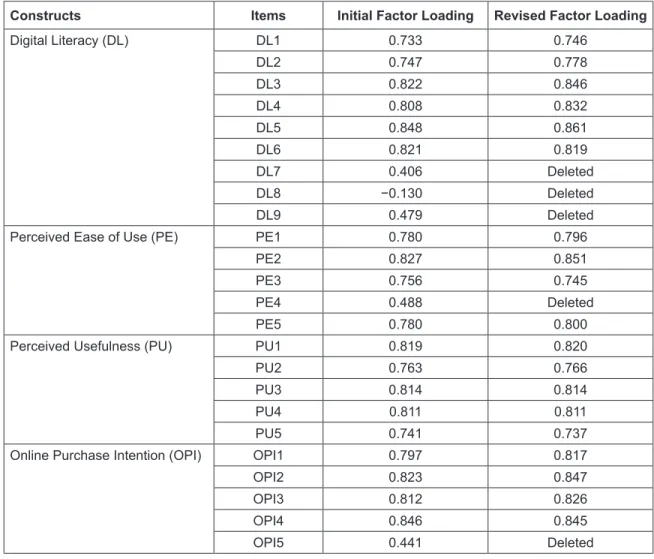
Table 2 shows the acceptable threshold values for assessing convergent validity indexes applied in this study. Based on the results, Table 3 presents the items factor loading. DL7, DL8, DL9, PEOU4, and OPI5 were removed because their factor loading was <0.5. The value of factor loading for all other items used in this study was more than the required threshold (i.e., >0.5), and thus, the items used for measuring each variable are valid. Besides that, average variance extracted (AVE) is another criterion used to measure convergent validity. As shown in Table 4, the AVE value for all constructs ranged from 0.624 to 0.695, greater than the threshold value (i.e., >0.5), implying that convergent validity for all latent variables is sufficient.

The internal consistency reliability is defined as the degree to which all items can measure the same phenomenon.

It is measured by two main criteria: Cronbach’s alpha, whose value ranges from 0 to 1, and composite reliability.

Table 4 shows the values of composite reliability (CR) and Cronbach’s alpha for each construct. CR values range from 0.875 to 0.922, while Cronbach’s alpha values range from 0.810 to 0.898. Based on the threshold values considered in this study, as shown in Table 2, it is clear that the values for the two criteria have reached the recommended threshold value. Thus internal consistency reliability for the constructs is established.

Following the PLS-SEM method, there are two appro- aches to test the discriminant validity of the measurement model, cross-loading to measure the discriminant validity at the items level and the Fornell-Larcker criterion to test

Table 2: Threshold Values for Convergent Validity

Indicator Accepted Values References

Indicator Reliability (Factor loading) Higher than 0.5 Hulland (1999)

Composite Reliability (CR) Higher than 0.7 Fornell and Larcker (1981)

Average Variance Extracted (AVE) Higher than 0.5 Hair et al. (2016)

(7)

Table 3: Items Factor Loadings

Constructs Items Initial Factor Loading Revised Factor Loading

Digital Literacy (DL) DL1 0.733 0.746

DL2 0.747 0.778

DL3 0.822 0.846

DL4 0.808 0.832

DL5 0.848 0.861

DL6 0.821 0.819

DL7 0.406 Deleted

DL8 −0.130 Deleted

DL9 0.479 Deleted

Perceived Ease of Use (PE) PE1 0.780 0.796

PE2 0.827 0.851

PE3 0.756 0.745

PE4 0.488 Deleted

PE5 0.780 0.800

Perceived Usefulness (PU) PU1 0.819 0.820

PU2 0.763 0.766

PU3 0.814 0.814

PU4 0.811 0.811

PU5 0.741 0.737

Online Purchase Intention (OPI) OPI1 0.797 0.817

OPI2 0.823 0.847

OPI3 0.812 0.826

OPI4 0.846 0.845

OPI5 0.441 Deleted

Table 4: Values for CR, Cronbach’s Alphs, and AVE

Constructs Composite Reliability

(CR) Cronbach’s

Alpha AVE

Digital Literacy (DL) 0.922 0.898 0.664

Perceived Ease of Use (PEOU) 0.875 0.810 0.638

Perceived Usefulness (PU) 0.892 0.849 0.624

Online Purchase Intention (OPI) 0.901 0.854 0.695

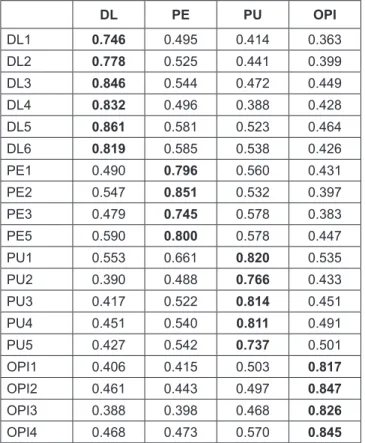
the discriminant validity at the constructs level. Table 5 below shows the cross-loading between all items and their constructs.

As shown in Table 5, the outer loadings for all items on their related constructs were more than their outer loadings

on other constructs. Consequently, the measurement

model’s discriminant validity was established. The

conclusion derived from the analysis of the measurement

model is that all variables used in the study are reliable

and valid.

(8)

4.2. Structural Model (Internal Model)

It is the model that explains the causal relationships between the research variables, as it clarifies the nature of the relationship between independent and dependent factors and shows the ratio of impact and interpretation factor to each of the independent factors in the dependent factor. Through the structural model results, it is possible to clarify the results of the research hypotheses and the value of relationships, and their indication (positive or negative).

Following the PLS-SEM method, the essential criteria for testing the structural model to ensure its robustness and accuracy are as follows: Coefficient of determination (R

2

Value) and Hypothesis testing (i.e., path coefficient) (Hair, 2010). Figure 1 depicts the results of the hypothesized structural model test.

R

2

value measures the amount of variance in the endogenous construct that can be explained by all the exogenous constructs correlated to it (Hair, 2010). The value of R

2

in the dependent variable (i.e., level of accuracy) is above 0.67, between 0.33 to 0.67, between 0.19 to 0.33, and below 0.19, each of which represents a high, moderate, weak, and not acceptable, respectively. Table 6 shows the value of R

2

for all dependent constructs in this study.

For example, as shown in Table 6, the R

2

value for online

purchase intention (OPI) is 0.427, which can be defined as moderate. Furthermore, 0.427 means that 42.7% of online purchase intention is explained by perceived usefulness and perceived ease of use. Consequently, 100–42.7 (i.e., 57.3%) are explained by other latent constructs outside of the research. The same explanation applies to the rest of the dependent variables in this study.

The value of path coefficient (β-value) is evaluated to measure the significance of the influence among variables and test hypotheses (Hair, 2010). This study used a PLS algorithm test to assess the sign and magnitude of the path coefficient and the significance level of the path coefficient among dependent and independent variables, using operating bootstrapping (Hair et al., 2013). In addition, according to Hair et al. (2013), the significant t-statistical values are 1.65, 1.96, and 2.59 at a p-value of 10%, 5%, and 1% respectively.

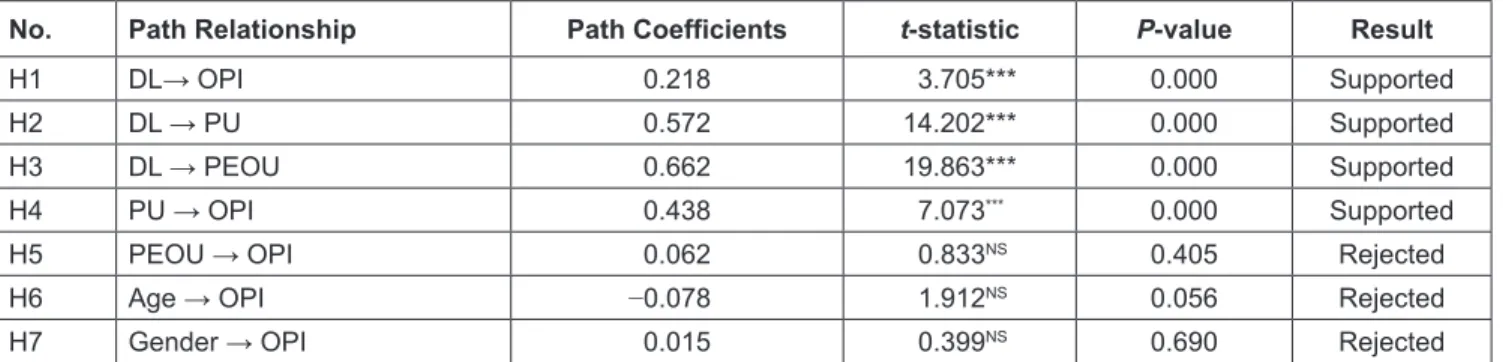
Table 7 shows evaluations of path coefficient value, t-value, and hypotheses significance.

Table 7 shows that digital literacy significantly influences online purchase intention (R

2

= 0.218; p = 0.01), indicating that H1 is supported. So digital literacy was recognized as playing a critical and significant role in estimating users’ intention to shop via the Internet. This finding is consistent with the results of previous studies.

For example, Callum and Jeffrey (2014) demonstrated that digital literacy influences the lecturers’ behavioral intention to use mobile learning.

Regarding the relationship between digital literacy and perceived usefulness, it displays a standard coefficient β = 0.572, t-value = 14.202 at p-value > 0.01, and thus, hypothesis H2 is supported with a high level of significance.

This finding is consistent with Feriady (2020), who revealed that digital literacy significantly impacts perceived usefulness. Furthermore, Elhajjar and Ouaida (2019) demonstrated that digital literacy positively influences perceived usefulness towards the intention to adopt online mobile banking.

Concerning the relationship between digital literacy and perceived ease of use, the finding shows that digital literacy positively influences perceived ease of use with a high level of significance (β = 0.662; p < 0.01), and thus, H3 is supported. This finding is consistent with several previous studies that have demonstrated that digital literacy has a significant influence on perceived ease of use towards Table 5: Cross Loading of Reflective Items

DL PE PU OPI

DL1 0.746 0.495 0.414 0.363

DL2 0.778 0.525 0.441 0.399

DL3 0.846 0.544 0.472 0.449

DL4 0.832 0.496 0.388 0.428

DL5 0.861 0.581 0.523 0.464

DL6 0.819 0.585 0.538 0.426

PE1 0.490 0.796 0.560 0.431

PE2 0.547 0.851 0.532 0.397

PE3 0.479 0.745 0.578 0.383

PE5 0.590 0.800 0.578 0.447

PU1 0.553 0.661 0.820 0.535

PU2 0.390 0.488 0.766 0.433

PU3 0.417 0.522 0.814 0.451

PU4 0.451 0.540 0.811 0.491

PU5 0.427 0.542 0.737 0.501

OPI1 0.406 0.415 0.503 0.817

OPI2 0.461 0.443 0.497 0.847

OPI3 0.388 0.398 0.468 0.826

OPI4 0.468 0.473 0.570 0.845

Table 6: R

2

Value of Dependent Constructs

Constructs R

2

Adj R

2

Result

Online Purchase Intention

(OPI) 0.427 0.416 Moderate

Perceived Ease of Use

(PEOU) 0.439 0.437 Moderate

Perceived Usefulness (PU) 0.328 0.326 Weak

(9)

Table 7: Path Coefficient Value, t-value, and Significance of Hypotheses

No. Path Relationship Path Coefficients t-statistic P-value Result

H1 DL→ OPI 0.218 3.705*** 0.000 Supported

H2 DL → PU 0.572 14.202*** 0.000 Supported

H3 DL → PEOU 0.662 19.863*** 0.000 Supported

H4 PU → OPI 0.438 7.073

***

0.000 Supported

H5 PEOU → OPI 0.062 0.833

NS

0.405 Rejected

H6 Age → OPI −0.078 1.912

NS

0.056 Rejected

H7 Gender → OPI 0.015 0.399

NS

0.690 Rejected

**Significance at t-value ≥ 1.96 with p ≤ 0.05, ***Significance at t-value ≥ 2.58 with p ≤ 0.01, NS: Not Significant, Dl: Digital Literacy, PU: Perceived Usefulness, PEOU: Perceived Ease of Use, OPI: Online Purchase Intention.

the intention to use an electronic business such as using mobile banking (Elhajjar & Ouaida, 2019) and electronic- learning system (Feriady, 2020).

The perceived usefulness has a positive effect with a high significance level (β = 0.438; p < 0.01) on the online purchase intention so that H4 is supported. This finding is consistent with previous studies (Jin, 2016; Nasution et al., 2019).

Meanwhile, the perceived ease of use does not affect online purchase intention (β = 0.062; p = 0.405 > 0.10), so H5 is rejected. It can be concluded that the perceived ease of use variable does not play a critical factor in influencing the intention of Palestinians to shop through the Internet.

This finding is consistent with Callum and Jeffrey (2014) who demonstrated that perceived ease of use does not influence lecturers’ behavioral intention to adopt mobile learning. Nevertheless, this finding contradicts several findings of previous studies conducted by (Jackson &

Farzaneh 2012; Thomas et al. 2019; Nasution et al., 2019),

which demonstrated that perceived ease of use has a positive influence on individuals’ purchase intention.

Regarding the moderating effect, age (β = −0.078;

p = 0.056 > 0.05) and gender (β = 0.015; p = 0.690 > 0.05), the findings show that they do not have a moderating effect on the relationship between digital literacy and online purchase intention so that H6 and H7 are rejected. Based on the analysis results, the model estimation results on the Palestinian Internet users ‘intention to shop online using SmartPLS can be seen in Figure 2.

5. Managerial Implication

The main contribution of this study is the development of a framework for assessing the influence of digital literacy on online purchase intention, either directly or indirectly.

This research provides information to online retailers

about the factors that influence Internet users’ intention

to shop online in Palestine. Based on this information,

Figure 2: The Final Estimated Results of the Research Model

(10)

retailers will be able to understand which aspects of their marketing strategies and actions they should highlight to encourage non-purchasing Internet users to participate in online shopping. Based on the study’s findings, the digital literacy variable has a significant effect and the most decisive factor in online purchase intention. Consequently, the crucial managerial implication from this study is the need to increase the digital literacy skills of Palestinians.

6. Conclusion

The online purchase intention of Palestinian’ internet users is influenced by both digital literacy and perceived usefulness. Digital literacy and perceived usefulness have a highly significant influence on Palestinians intention to shop online. Digital literacy has a significant impact on both perceived usefulness and perceived ease of use.

In addition, the results demonstrated that perceived usefulness has a positive and significant effect on online purchase intention. On the other hand, perceived ease of use does not directly affect Palestinian intentions to shop through the Internet. Finally, both age and gender were found to have no moderate effect between digital literacy and online purchase intention.

References

Ajzen, I. (1991). The theory of planned behavior. Organizational Behavior and Human Decision Processes, 211(2), 179–211.

https://doi.org/10.1016/0749-5978(91)90020-T

Alyoubi, A. A. (2015). E-commerce in developing countries and how to develop them during the introduction of modern systems. Procedia Computer Science, 65(1), 479–483. https://

doi.org/10.1016/j.procs.2015.09.127

Callum, K. M., & Jeffrey, L. (2014). Factors impacting teachers.

Adoption of Mobile Learning, 13(1), 141–162. http://

www.jite.org/documents/Vol13/JITEv13ResearchP141- 162MacCallum0455.pdf

Chauhan, S. (2019). The impact of website quality and reputation on purchasing intention towards online shopping. Journal of Content, Community & Communication, 10(1), 1–8. https://doi.

org/ 10.31620/JCCC.12.19/15

Chiu, C. M. (2009). Determinants of customer repurchase intention in online shopping. Online Information Review, 33(4), 761–784. https://doi.org/10.1108/14684520910985710 Chung, J. E. (2010). Age differences in perceptions of online

community participation among non-users: An extension of the technology acceptance model. Computers in Human Behavior, 26(6), 1674–1684. https://doi.org/10.1016/j.chb.2010.06.016 Davis, F. D., Bagozzi, R. P., & Warshaw, P. R. (1989). User

acceptance of computer technology: A comparison of two theoretical models. Management Sciences, 35(8), 982–1003.

https://www.researchgate.net/publication/227446117

Day, G. S. (1976). Mathematical models in marketing. Heidelberg, Berlin: Springer-Verlag.

Elhajjar, S., & Ouaida, F. (2019). An analysis of factors affecting mobile banking adoption. International Journal of Bank Marketing, 38(2), 352–367. https://doi.org/10.1108/IJBM-02- 2019-0055

Feriady, M. (2020). Influence of organizational support and digital literacy on lecturer acceptance of e-learning in Indonesia:

A modification of technology acceptance model. International Journal of Scientific & Technology Research, 9(01), 1–5.

Fornell, C., & Larcker, D. F. (1981). Evaluating structural equation models with unobservable variables and measurement. Journal of Marketing Research, 38(2), 39–50. https://www.jstor.org/

stable/3151312

Ganesh, J. (2010). Online shopper motivations and e-store attri- bute: An examination of online patronage behavior and shopper typologies. Journal of Retailing, 86(1), 106–115.

https://doi.org/10.1016/j.jretai.2010.01.003

Grewal, D., Roggeveen, A. L., & Nordfält, J. (2017). The future of retailing. Journal of Retailing, 93(1), 1–6. https://doi.

org/10.1016/j.jretai.2016.12.008

Hair, J. F. (2010). Multivariate data analysis. New York: Pearson Education.

Hair, J. F., Ringle, C. M., & Sarstedt, M. (2013). Partial least squares structural equation modeling: Rigorous applications, better results, and higher acceptance. Long Range Planning, 46(1–2), 1–12. https://doi.org/10.1016/j.lrp.2013.01.001 Hair, J. F., Ringle, C. M., & Sarstedt, M. (2016). A primer on

partial least squares structural equation modeling (PLS-SEM).

Thousand Oaks, CA: Sage Publications.

Hulland, J. (1999). A new antihypertensive drug ameliorates insulin resistance. Acta Pharmacologica Sinica, 33(4), 429–430.

https://doi.org/10.1038/aps.2012.31

Jackson, T. W., & Farzaneh, P. (2012). Theory-based model of factors affecting information overload. International Journal of Information Management, 32(1), 523–532. https://doi.

org/10.1016/j.ijinfomgt.2012.04.006

Jin, Y. (2016). Factors influencing online shopping behavior: The mediating role of purchase intention. Procedia Economics and Finance, 12(1), 401–410. https://doi/org/10.1016/S2212- 5671(16)00050-2

Law, M., Kwok, R. C., & Ng, M. (2016). Electronic commerce research and applications: An extended online purchase intention model for middle-aged online users. Electronic Commerce Research and Applications. Elsevier, 20(1), 132–146. https://doi.org/10.1016/j.elerap.2016.10.005

Lim, W. M., & Ting, D. H. (2012). E-shopping: An analysis of the technology acceptance model. Modern Applied Science, 6(4), 49–62. https://doi.org/10.5539/mas.v6n4p49

Meyers, E. M., Erickson, I., & Small, R. V. (2013). Digital literacy

and informal learning environments: An introduction. Learning,

Media and Technology, 38(4), 355–367. https://doi.org/10.108

0/17439884.2013.783597

(11)

Morris, M. G., & Venkatesh, V. (2000). Age differences in technology adoption decisions: Implications for a changing workforce. Personnel Psychology, 53(2), 375–403. https://doi.

org/10.1111/j.1744-6570.2000.tb00206.x

Nasution, M. D. T. P. (2019). An empirical examination of the factors influencing consumer’s purchase intention toward online shopping. Journal of Business & Retail Management Research, 13(04), 14–30. https://doi.org/10.24052/jbrmr/

v13is04/art-02

Nawafleh, S. (2018). Factors affecting the continued use of e-government websites by citizens: An exploratory study in the Jordanian. Transforming Government People Process and Policy, 12(3/4), 244–264. https://doi.org/10.1108/TG-02-2018- 0015

Nguyen, T. D., & Barrett, N. J. (2006). The adoption of the internet by export firms in transitional markets. Asia Pacific Journal of Marketing and Logistics, 18(1), 29–42. https://doi.

org/10.1108/13555850610641073

Pavlou, P. A. (2003). Integrating trust and risk with the technology acceptance model. International Journal of Electronic Commerce, 7(1), 101–134. https://doi.org/10.1080/10864415.

2003.11044275

Phong, N. D., Khoi, N. H., & Nhat-Hanh Le, A. (2018). Factors affecting mobile shopping: A Vietnamese perspective. Journal of Asian Business and Economic Studies, 25(2), 186–205.

https://doi.org/10.1108/jabes-05-2018-0012

Ramayah, T. (2009). A decomposed theory of reasoned action to explain intention to use Internet stock trading among Malaysian investors. Computers in Human Behavior, 25(6), 1222–1230.

https://doi.org/10.1016/j.chb.2009.06.007

Ranganathan, C., & Jha, S. (2009). Examining online purchase intentions in B2C e-commerce: Testing an integrated model.

Comparison-Shopping Services and Agent Designs, 20(4), 217–234. https://doi.org/10.4018/978-1-59904-978-6.ch014

Rehman, S. U. (2019). The moderating role of trust and commitment between consumer purchase intention and online shopping behavior in the context of Pakistan. Journal of Global Entrepreneurship Research, 9(1), 25–32. https://doi.

org/10.1186/s40497-019-0166-2

Roussos, P. (2007). The Greek computer attitudes scale:

Construction and assessment of psychometric properties.

Computers in Human Behavior, 23(1), 578–590. https://doi.

org/10.1016/j.chb.2004.10.027

Shin, D. H. (2009). Towards an understanding of the consumer acceptance of mobile wallets. Computers in Human Behavior, 25(6), 1343–1354. https://doi.org/10.1016/j.chb.

2009.06.001.

Tham, K. W., Dastane, O., Johari, Z., & Ismail, N. B. (2019).

Perceived risk factors affecting consumers’ online shopping behavior. Journal of Asian Finance, Economics, and Busi- ness, 6(4), 246–260. https://doi.org/10.13106/jafeb.2019.vol6.

no4.246

Trocchia, P. J., & Janda, S. (2000). A phenomenological investigation of Internet usage among older individuals.

Journal of Consumer Marketing, 17(7), 605–614. https://doi.

org/10.1108/07363760010357804

Wang, C., & Chen, C. (2009). The impact of knowledge and trust on e-consumers’ online shopping activities: An empirical study.

Journals of Computer, 4(1) 11–18. http://www.jcomputers.us/

vol4/jcp0401-02.pdf

Zhao, Z., & Cao, Q. (2012). An empirical study on continual usage intention of microblogging: The case of Sina. Nankai Business Review International, 3(4), 413–429. https://doi.

org/10.1108/20408741211283755

Zhu, Y., Basil, D. Z., & Hunter, M. G. (2009). The extended website stage model: A study of Canadian winery websites. Canadian Journal of Administrative Sciences, 26(4), 286–300. https://doi.

org/10.1002/CJAS.118

수치

Figure 1: Research Framework and Hypotheses
Table 1: Constructs, Items, and Source
Table 2 shows the acceptable threshold values for assessing  convergent validity indexes applied in this study
Table 4: Values for CR, Cronbach’s Alphs, and AVE
+3

참조

관련 문서