* First Author : [email protected], 051-720-2234 Corresponding Author : [email protected], 051-720-2233
년 한국 수산자원보호해역에서 식물플랑크톤 군집의 2016
계절 및 해역별 분포
유만호 박경우 오현주 구준호 권정노 윤석현
국립수산과학원 기후변화연구과 국립수산과학원 어장환경과
*, ** , ***
The Seasonal and Regional Distribution of Phytoplankton Communities in the Fisheries Resources Protection Area of Korea in 2016
Man Ho Yoo Kyung Woo Park Hyun Ju Oh Jun Ho Koo Jung No Kwon Seok Hyun Youn
*, ** Oceanic Climate and Ecology Research Division, National Institute of Fisheries Science, Busan 46083, Korea
*** Marine Environment Research Division, National Institute of Fisheries Science, Busan 46083, Korea
요 약 : 수산자원보호해역의 계절 및 해역별 식물플랑크톤 군집특성을 파악하기 위해, 2016년 천수만 통영, (I, II), 한산만 진동만에, 서 식물플랑크톤 군집조성 현존량 및 우점종을 조사하였다 조사결과 대부분의 환경요인 수온 염분 영양염류 은 계절적인 변화가 뚜, . , ( , , ) 렷한 반면 부유물질은 해역별 차이를 보였다 식물플랑크톤 현존량은 평균 . 13 ~ 4,062 cells·ml-1의 범위로 조사시기 및 해역에 따라 큰 변동범위를 보였다 특히 천수만은 월과 . 4 10월에 식물플랑크톤 대량증식(>103cells·ml-1)이 발생하였고 우점종인 , Skeletonema spp.(4 )월 와 Chaetoceros socialis(10 )월 가 시기적인 차이를 보였다 조사해역의 식물플랑크톤 우점종은 . Pseudo-nitzschia spp., Skeletonema spp., Chaetoceros pseudocriniuts 등의 돌말류와 와편모류인 Scrippsiella trochoidea, Tripos furca 등이 출현하였다 계절적으로는 돌말류가 동 추계에 우점하는 . ·
반면 와편모류가 춘 하계에 우점하는 일반적인 연안특성을 보였다 단 지역적으로는 고탁도 해역인 서해에 위치한 천수만이 남해 해역· . ,
보다 돌말류가 차지하는 비율이 9 ~ 27 가 높았다% .
핵심용어 : 식물플랑크톤 수산자원보호해역 우점종 분포 연안, , , ,
Abstract : This study was conducted to understand the characteristics of the seasonal and regional distribution of phytoplankton communities in the Fisheries Resources Protection Area of Korea (FRPA). We investigated the phytoplankton composition, abundance and dominant species collected from five different regions (Cheonsu, Tongyeong-I, Tongyeong-II, Hansan, and Jindong) in 2016. According to the results, most environmental parameters, such as temperature, salinity and nutrients, showed statistically significant seasonal differences. Suspended particulate material (SPM) only showed a statistically significant regional difference. The mean abundance of phytoplankton ranged from 13 to 4,062 cells·ml-1, with large spatio-temporal fluctuations. In particular, the bloom of phytoplankton (>103 cells·ml-1) in Cheonsu Bay occurred in April and October with Skeletonema spp. and Chaetoceros socialis being the dominant species during these two seasons, respectively. The dominant species in the FRPA were diatoms (Pseudo-nitzschia spp., Skeletonema spp., and Chaetoceros pseudocriniuts) and dinoflagellates (Scrippsiella trochoidea and Tripos furca). The seasonal distribution of phytoplankton communities showed typical characteristics of coastal waters, i.e., that diatoms usually dominated in winter and autumn, while dinoflagellates tended to dominate in spring and summer. Meanwhile, the dominance rate of diatoms in the phytoplankton community in Cheonsu Bay, which is located in a high-turbidity region, was 9~27 % greater than that of diatoms in the phytoplankton community found in the south coastal waters, which is a low turbidity region.
Key Words : Phytoplankton, Fisheries Resources Protection Area (FRPA), Dominant species, Distribution, Coast
2016
서 론 1.
연안해역은 육상과 해양이 맞닿는 완충수역으로 관광자,
원 및 패류 어류 등 각종 양식 활동뿐만 아니라 수산생물의 , 서식 산란 회유지 등의 다양한 인문 경제 생태학적으로 중, , · · 요한 기능을 담당한다(NFRDI, 2008). 또한 전 세계적으로 연 안역은 식물플랑크톤 생산력과 다양성이 높은 대표적인 해 역이기도 하다(Underwood and Kromkamp, 1999; Brito et al.,
이로 인해 세계공원총회 는 연안해역의 생
2013). (WPC, 2014)
물 다양성 및 생산성을 회복하기 위해 해양보호구역을 30 %
까지 확대하는 것을 목표로 설정하였고 최근 해양보호구역,
의 확대로 인해 안정적인 식량 확보 일자리 창출 해안 마, , 을 보호 등 막대한 경제적 혜택이 발생한다고 보고하였다
우리나라에서는 년에 해양보호구역
(Brander et al., 2015). 1975
중 수산자원의 보호 육성을 위한 용도로 수산자원보호구역·
을 최초로 지정하였고 이후 , 1982년까지 국토의 계획 및 이용에 관한 법률 을 근거로 10개 지구까지 확대하였다
년말 기준 수산자원보호구 (MIFAFF, 2008; NFRDI, 2008). 2015
역의 면적은 총 3,161 km2로 이중 해역이 79 를 차지하였고% , 대부분 남해의 전남과 경남해역에 집중되어 분포하였다 (MOF, 2016a).
우리나라는 최근까지 산업화 도시화에 따른 각종 연안개,
발사업의 증가와 밀식양식 등으로 인해 어장환경의 오염심 화 어업권 면적 및 생산력변화 등 수산자원보호구역에서 , 다양한 생태 환경변화가 발생하고 있다· (Lee et al., 2009). 이 로 인해 주요 일차생산자인 식물플랑크톤 분포특성을 이해 하는 것은 수산자원보호구역의 생태시스템을 이해하는데 매우 중요하나 국내에서는 일부 해역 및 시기에 제한된 연, 구만이 이루어졌을 뿐이다(Shim and Yeo, 1988; Shin et al., 1990; Choi et al., 1997; Ko, 1999; Kang et al., 2003; Lee et al., 2005; Jung et al., 2008; Lim et al., 2010; Joo et al., 2011; Lee et 특히 우리나라 수산자원보호구역 al., 2012; Lee et al., 2014).
을 대상으로 한 식물플랑크톤의 광역조사는 극히 드물다 (MOF, 2016b).
따라서 본 연구는 2016년 수산자원보호구역 중 곳을 선5 정하여 계절 및 해역별 식물플랑크톤 군집 현존량 우점종 ( , 등 의 분포특성을 파악하고자 하였다) .
재료 및 방법 2.
년은 수산자원보호구역 중 천수만 통영 통영
2016 (3), -I(3),
한산만 진동만 의 총 개 정점에서 월 월 월
-II(8), (9), (8) 31 2 , 4 , 8 과 월에 총 회 조사를 수행하였다10 4 (Fig. 1).
환경요인 중 수온과 염분은 YSI-6600을 이용하여 측정하
였고 부유물질, (SPM)과 영양염류(DIN, DIP, DSi)는 해양환경공 정시험기준을 따라 조사 분석하였다· (MOF, 2013). 환경요인 및 식물플랑크톤은 각 해역의 조사정점을 평균하여 해역의 대표 자료로 이용하였다 식물플랑크톤의 현존량은 표층에서 . 1 L 해수를 채수한 후 루골용액으로 고정하였고, 3-4일간 정치시 켜 최종농도 20ml로 농축하였다 농축시료는 . Sedwick-Rafter
를 이용하여 광학현미경 하에서
Chamber (Nikon eclipse Ni-U) Rines and Hargraves(1988), Round et al.(1990), Shim(1994),
등을 참조하여 동정 및 계수하였다 계수된 자
Tomas(1997) .
료는 cells·ml-1로 환산하였고 총 현존량의 , 10% 이상을 차지
하는 종을 우점종으로 구분하였다 출현종에 근거한 각 정.
점과 시기에 따른 유사도를 알아보기 위하여 Bray-Curtis 집괴분석을 실시하였다 이때 사용된 자료는 총 현
similarity .
존량의 0.5% 이상 총 현존량의 ( 91.8%)을 차지하는 종을 이용 하였고 극 우점종으로 인한 자료의 편중을 피하기 위해 로그 , 변환하였다 이화학적 환경요인 및 식물플랑크톤의 단변량 . 변수는 대부분 정규성(Kolmogorov-Smirnov’s test)과 등분산성 (Leven’s test)을 만족하지 않아 비모수 검정인 Kruskal-Wallis
를 이용하여 계절 및 해역별 차이를 검정하였다 또한
H-test .
환경요인과 식물플랑크톤의 생태학적 관계를 파악하기 위해 상관관계(Spearman rank correlation)을 수행하였다(SPSS statistics ver.21).
Fig. 1. Location of sampling stations in the FRPA (Cheonsu, Tongyeong-I, II, Hansan and Jindong) of Korea.
결과 및 고찰 3.
환경요인 3.1
조사기간 동안 환경요인은 부유물질(SPM)이 통계적으로
유의한 해역간 차이를 보인 반면 수온 염분 및 영양염류, , 는 계절적으로 뚜렷한 차이가 있었다
(DIN, DIP, DSi) (p<0.05;
로 가장 높았다 염분은 강수량이 증가하는 월과 월에 상. 8 10 대적으로 낮았다 특히 이 시기의 영양염류는 최대농도를 . , 보이며 다른 시기와 유의한 차이를 보였다(p<0.05). 부유물질 은 대조차(>4m) 환경으로 조석에 의한 수직적 혼합이 활발 히 발생하는 천수만에서 최대 59.2 mg·L-1로 높았다(Park et al., 2013).
Parameters Cs Ty-I Ty-II Hs Jd
Temperature ( )℃
4.0~29.9 (16.1±10.1)
5.1~28.6 (16.9±8.5)
5.5~29.1 (17.3±7.9)
4.1~30.0 (17.1±7.7)
5.5~29.0 (17.2±8.5) Salinity 30.8~32.3
(31.7±0.6)
24.2~33.4 (31.0±3.0)
26.0~33.6 (31.9±1.7)
28.0~34.1 (32.4±1.5)
26.3~33.0 (31.0±1.9) SPM
(mg·L-1)
14.0~59.2 (35.9±13.0)
1.8~13.0 (5.3±2.8)
0.4~12.0 (5.1±2.1)
1.0~8.8 (4.6±1.9)
2.2~14.5 (5.9±3.2) DIN
(µM)
0.8~11.6 (5.8±4.0)
1.6~27.0 (7.0±8.0)
1.5~20.9 (5.0±4.0)
1.4~23.6 (5.0±4.2)
0.6~22.6 (5.9±7.0) DIP
(µM)
0.1~1.5 (0.6±0.5)
0.1~1.4 (0.4±0.3)
0.1~1.1 (0.5±0.3)
0.1~1.4 (0.5±0.3)
<0.1~0.7 (0.3±0.2) DSi
(µM)
0.3~34.2 (13.4±12.0)
3.3~28.1 (13.9±7.6)
1.8~49.6 (18.0±11.2)
3.3~35.9 (16.9±8.1)
0.4~28.9 (8.7±9.0) Table 1. Distribution of environmental parameters in the FRPA of
Korea in 2016. data: min.~max. (average±sd)
식물플랑크톤군집의 시 공간 분포
3.2 ·
조사해역에서 출현한 식물플랑크톤 현존량은 13 ~ 2,279 cells·ml-1의 범위로 시기 및 해역에 따라 큰 변동범위를 보였 다(Fig. 2). 2월은
Skeletonema spp.(340 cells·ml
-1)와Chaetoceros
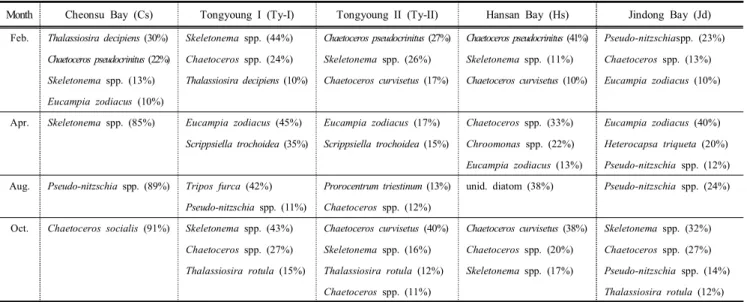
spp.(184 cells·ml-1)가 높게 출현한 통영-I(Ty-I)에서 780 cells·ml-1 로 가장 높았다(Table 2). 다음으로 통영-II(Ty-II), 천수만(Cs), 한산만(Hs), 진동만(Jd) 순으로 높았다 이 시기 식물플랑크톤 . 군집조성은 돌말류가 진동만을 제외하고 85% 이상을 차지31 로 높게 출현하였다% (Fig. 2). 진동만은 수직혼합이 강하 게 발생하는 동계시기임에도 불구하고 탁도 평균 , ( 2.4 mg·L-1) 와 영양염류가 낮아 상대적으로 안정적인 수괴가 형성됨을 파악하였다 이로 인해 대부분 해역에서는 .
Skeletonema spp., Chaetoceros pseudocrinitus 등 주로 돌말류가 우점종으로 출현한
반면 진동만은 안정된 수괴와 빈영양해역을 선호하는 와편,
모류가 증가한 것으로 판단된다(Smayda, 1970; Margalef, 1978).
월은 천수만 에서
4 (Cs)
Skeletonema
spp.가 1,940 cells·ml-1로 대 량발생하여 2,000 cells·ml-1 이상으로 조사기간 중 현존량이 가장 높았다 동일시기 천수만의 영양염류. (DIN, DIP, DSi)는월보다 크게 감소하였고 특히 가 평균
2 , DSi 0.6µM로 10.1배
감소하여 돌말류인 Skeletonema spp.의 대량발생에 의한 영양 염류 소비가 두드러지게 나타났다. Skeletonema spp.는 일반적 으로 우리나라 연안해역에서 연중 우점하는 대표적인 종이 며 특히 춘 하계에 극우점하여 본 연구결과와 유사한 특성을 , · 보였다(Shim and Yeo, 1988; Yoon et al., 2007). 나머지 해역에서 는 150 cells·ml-1 이하로 비교적 유사한 분포를 보였다 이 . 시기 의 천수만을 제외한 남해 해역은 와편모류인
Scrippsiella trocoidea, Hetercapsa triqueta와 은편모류인 Chroomonas
spp.가월보다 급격히 증가하였다 월의 천수만은 식물플랑크톤 현
2 . 8
존량이 500 cells·ml-1로 가장 높았으나, Skeletonema spp.의 대량 증식에 기인한 월과 달리 4
Pseudo-nitzschia spp.(89
%)가 극우점 하며 뚜렷한 종천이가 발생하였다 깃돌말류인 .Pseudo-nitzschia
는 일반적인 저서성미세조류 로 활발한
spp. (microphytobenthos) ,
수직혼합이 발생한 천수만에서 저층 퇴적물의 영향을 받은
것으로 판단된다 나머지 해역에서는 와편모류가 전체 현존.
량에서 차지하는 비중이 월보다 4 1.6 ~3.2배 증가하였고 특히 , 통영 에서 -I
Tripos furca가 70 cells·ml
-1로 최대치를 기록하였다.식물플랑크톤 군집조성은 천수만에서 돌말류가 97% 이
상 차지하였고, Tripos furca가 최대치를 나타낸 통영 에서 -I
Fig. 2. Seasonal and regional distributions of phytoplankton abundance (upper) and composition (lower) in the FRPA of Korea in 2016.
2016
와편모류가 58.7 를 차지하였다 춘 하계 남해의 와편모류% . · 의 증가는 다수 보고된 바 있다(Lee and Youn, 2000; Park et
천수만은 월에도
al., 2009). 10 103cells·ml-1이상의 식물플랑크 톤 대량증식이 발생하였다 특히 각 대량증식시기마다 종특. , 이성이 나타났다. 4월에는
Skeletonema
spp., 10월은Chaetoceros socialis가 1,424 cells·ml
-1로 전체 현존량의 90% 이상 극우점 하였다. Chaetoceros socialis는 온대부터 극지까지 분포하는 광역종으로 우리나라에서는 진해만 남해연안 등 다양한 해, , 역에서 출현하며 각기 다른 특성을 보인다(Jung et al., 2008).이와 함께 돌말류는 와편모류보다 상대적으로 영양염류의
흡수가 빠르고 수직혼합이 활발한 해역에서 성장이 우세하,
기 때문에 천수만에서 돌말류의 극우점 현상이 발생한 것으 로 판단된다(Sullivan and Swift, 2003; Carter et al., 2005). 동일 시기 다른 해역에서는 주로 Chaetoceros속과 Skeletonema spp.
가 출현하여 해역간 식물플랑크톤 군집조성이 비교적 유사 하였다.
우리나라 연안해역에서 수산자원보호해역이 가지는 생태 적 가치를 살펴보기 위해 해양생태계 기본조사, (2006 ~ 2013 년 와 본 조사결과를 비교하였다) (MOF, 2016b). 수산자원보호 해역의 식물플랑크톤은 돌말류와 와편모류 중심의 일반적
인 연안성 군집특성을 보이고 일부시기 및 해역에서 따라 ,
다소 차이가 있었다 지역적으로 서해의 천수만은 현존량이 . , 평균 1,168 cells·ml-1로 서해 평균 ( 596 cells·ml-1) 평균 현존량보 다 약 배 높았고 계절적으로 춘 추계에 높았다 천수만이 2 , · . 위치한 서해 중부해역은 지역적 특성 반폐쇄성 서산방조제( , , 하천 등 으로 인해 상대적으로 현존량이 높고 주요 우점종) , 인 Skeletonema spp.(4 ) 월 등의 시기적인 차이에 의해 계절적
인 분포변화가 결정되는 것으로 나타났다 또한 남해 수산.
자원보호해역 통영( -I,II, 한산만, 진동만 에서도 돌말류인 )
Skeletonema spp., Chaetoceros속, Eucampia zodiacus중심으로 와
, 편모류와 은편모류가 일부시기에 크게 증가하는 해양생태 계 기본조사와 유사한 결과가 나타났다 따라서. , 2016년 수 산자원보호해역의 식물플랑크톤은 일반적인 서해 중부와남해연안과 비교적 유사한 군집특성을 보였다.
Fig. 3. Dendrogram showing the degree of similarity among the seasons and regions by the cluster analysis with percent similarity in the FRPA of Korea in 2016.
집괴분석 3.3
년 수산자원보호해역에 출현한 식물플랑크톤 현존량 2016
을 기반으로 한 식물플랑크톤 유사도 분석결과 주로 계절,
에 따라 크게 개의 그룹으로 구분되는 특성을 보였다 첫4 . 째 와편모류가 상대적으로 높은 진동만을 제외한 돌말류 , , 중심의 식물플랑크톤 군집구조가 나타난 평균 10 이하의 Month Cheonsu Bay (Cs) Tongyoung I (Ty-I) Tongyoung II (Ty-II) Hansan Bay (Hs) Jindong Bay (Jd)
Feb. Thalassiosira decipiens (30%) Skeletonema spp. (44%) Chaetoceros pseudocrinitus (27%) Chaetoceros pseudocrinitus (41%) Pseudo-nitzschiaspp. (23%) Chaetoceros pseudocrinitus (22%) Chaetoceros spp. (24%) Skeletonema spp. (26%) Skeletonema spp. (11%) Chaetoceros spp. (13%) Skeletonema spp. (13%) Thalassiosira decipiens (10%) Chaetoceros curvisetus (17%) Chaetoceros curvisetus (10%) Eucampia zodiacus (10%)
Eucampia zodiacus (10%)
Apr. Skeletonema spp. (85%) Eucampia zodiacus (45%) Eucampia zodiacus (17%) Chaetoceros spp. (33%) Eucampia zodiacus (40%) Scrippsiella trochoidea (35%) Scrippsiella trochoidea (15%) Chroomonas spp. (22%) Heterocapsa triqueta (20%)
Eucampia zodiacus (13%) Pseudo-nitzschia spp. (12%)
Aug. Pseudo-nitzschia spp. (89%) Tripos furca (42%) Prorocentrum triestinum (13%) unid. diatom (38%) Pseudo-nitzschia spp. (24%)
Pseudo-nitzschia spp. (11%) Chaetoceros spp. (12%)
Oct. Chaetoceros socialis (91%) Skeletonema spp. (43%) Chaetoceros curvisetus (40%) Chaetoceros curvisetus (38%) Skeletonema spp. (32%)
Chaetoceros spp. (27%) Skeletonema spp. (16%) Chaetoceros spp. (20%) Chaetoceros spp. (27%)
Thalassiosira rotula (15%) Thalassiosira rotula (12%) Skeletonema spp. (17%) Pseudo-nitzschia spp. (14%)
Chaetoceros spp. (11%) Thalassiosira rotula (12%)
Table 2. Seasonal and regional distribution of dominant phytoplankton species in the FRPA of Korea in 2016
의 천수만을 제외한 추계(10 ) 월 남해해역으로 강우에 따른 , 염분(<30 psu)과 고농도의 영양염(DIN: 평균 1.5 ~ 3.9µM) 유 입이 영향을 미친 시기이다 셋째. , Prorocentrum triestinum와
Pseudo-nitzschia
spp.가 우점하고 비교적 단순한 군집구조를 , 보인 하계 월 시기이다 이로 인해 다른 조사시기와 달리 (8 ) .조사해역간 유사한 식물플랑크톤 군집이 나타났다 마지막.
으로 와편모류인 ,
Scrippsiella trochoidea, Heterocapsa triqueta와
돌말류인Eucampia zodiacus 등이 우점한 춘계 월 시기이다
(4 ) . 다만 천수만 월 과 진동만 월, (4 ) (2 , 4 )월 이 일부시기에 다른 해역과 식물플랑크톤 군집특성이 차이를 보였다.
결 론 4.
년 수산자원보호해역은 지역적인 영향보다 주로 계 2016
절변동에 따라 식물플랑크톤의 군집특성이 변화됨을 확인 할 수 있었다 시기적으로 대부분 동계와 추계에 높은 현존.
량을 보이나 춘계에 천수만은 단일 종의 대량증식으로 지,
역적인 차이가 발생하였다 또한 남해 동부에 위치한 진동.
만은 폐쇄적인 지역특성으로 인해 다양한 와편모류가 식물
플랑크톤 군집특성에 영향을 미치고 있음을 알 수 있었다.
향후 해양보호구역의 효율적 관리 및 이용을 위해 전 해역 의 생태특성을 파악할 수 있는 광역조사가 필요할 것으로 판단된다.
사 사
본 연구는 국립수산과학원 과제인 한국근해 해양변동 모
‘
니터링 및 생태계 특성 연구(R2018047)’의 지원에 의해 수행 되었습니다.
References
[1] Brander, K. M., C. Baulcomb, J. A. C. van der Lelij, F.
Eppink, A. McVittier, L. Nijsten and P. van Beukering(2015), The benefits to people of expanding Marine Protected Area.
VU university, Amsterdam, The Netherlands, p. 190.
[2] Brito, A. C., I. Benyoucef, B. Jesus, V. Brotas, P. Gernez, C.R. Mendes, P. Launeau, M.P. Dias and L. Barillé(2013), Seasonality of microphytobenthos revealed by remote-sensing in a South European estuary, Cont. Shelf Res., Vol. 66, pp.
83-91.
[3] Carter, C. M., A. H. Ross, D. R. Schiel, C. Howard-Williams and B. Hayden(2005), In situ microcosm experiments on the
composition, J. Exp. Mar. Biol. Ecol., Vol. 326, pp. 1-13.
[4] Choi, W. J., Y. Y. Chun, J. H. Park and Y. C. Park(1997), The influence of environmental characteristics on the fatness of Pacific Oyster, Crassostre gigas, in Hansan-Koje Bay, J.
Korean Fish. Soc., Vol. 30, No. 5, pp. 794-803.
[5] Joo, H. M., J. H. Lee and S. W. Jung(2011), Correlations between cell abundance, bio-volume and chlorophyll a concentration of phytoplankton communities in Coastal Waters of Incheon, Tongyeong and Ulsan of Korea, Korean J.
Environ, Biol., Vol. 29, No. 4, pp. 312-320.
[6] Jung, S. W., O. Y. Kwon and J. H. Lee(2008), Variation and relationship between standing crops and biomass of phytoplankton dominant species in the marine ranching ground of Tongyeong Coastal Waters from 2000 to 2007, Algae, Vol. 23, No. 1, pp. 53-61.
[7] Kang, Y. S., J. N. Kwon, J. K. Shon, S. J. Hong and J. Y.
Kong(2003), Interrelation between water quality and community structure of phytoplankton around the season of red tide outbreak off the coast of Tongyeong Area, 2002, J.
Kor. Fish. Soc., Vol. 36, No. 5, pp. 515-521.
[8] Ko, T. H.(1999), Dynamic of phytoplankton communities in Tongyoung Bay during the summer seoson, 1998, Master’s Thesis, Busan Univ, p. 68.
[9] Lee, D. I., D. S. Park, K. A. Jeon, K. H. Eom, J. S. Park and G. Y. Kim(2009), Preliminary diagnosis of fishing ground environment for establishing the management system in Fisheries Resources Protection Area, Korean Soc. Mar.
Environ. Saf., Vol. 15, No. 2, pp. 79-89.
[10] Lee, J. H., S. W. Jung and J. M. Kim(2005), Effects of environmental factors on phytoplankton communities in the marine ranching ground of Tongyeong Coastal Waters, Korea, Ocean and Polar Res., Vol. 27, No. 1, pp. 15-24.
[11] Lee, J. H. and S. M. Youn(2000), Water quality and phytoplankton communities in Yeoja Bay of Korea, Korean Algae, Vol. 15, No. 2, pp. 89-98.
[12] Lee, J. K., C. Park, D. B. Lee and S. W. Lee(2012), Variations in plankton assemblage in a semi-closed Chunsu Bay, Korea, The Sea J. Korean Soc. Oceanogra., Vol. 17, No. 2, pp. 95-111.
[13] Lee, S. W., C. Park, D. B. Lee and J. G. Lee(2014), Effects of freshwater discharge on plankton in Cheonsu Bay, Korea during the rainy season, The Sea J. Korean Soc.
Oceanogra., Vol. 19, No. 1, pp. 41-52.
2016
[14] Lim, W. A., Y. S. Lee, Y. S. Kang, S. S. Kim, S. H. Kim, H. S. Choi, H. Y. Baek, T. S. Lee and J. Y. Lee(2010), Inter-annual variation of phytoplankton community structure in aquacultural areas of Tongyeong, SE Coastal Waters of Korea, The Sea J. Korean Soc. Oceanogra., Vol. 15, No.
4, pp. 158-165.
[15] Margalef, R.(1978), Life-forms of phytoplantkon as survival alternatives in an unstable environment, Oceanol. Acta, Vol.
1, pp. 493-509.
[16] MIFAFF(2008), Ministry for Food, Agriculture, Forestry &
Fisheries, The Geographical map of fishery resources protected zone (Sea area and adjacent land), The notification of the Ministry for Food, Agriculture, Forestry & Fisheries, Article, p. 146.
[17] MOF(2013), Ministry of Oceans and Fisheries, Guideline to standard methods for the marine environment, Ministry of Government Legislation, p. 516.
[18] MOF(2016a), Ministry of Oceans and Fisheries, http://www.
mof.go.kr/article/view.do?articleKey=11791&boardKey=2&sear chEtc5=code061&menuKey=341¤tPageNo=1.
[19] MOF(2016b), Korean marine ecosystems through basic survey of marine ecosystems, 11-119200-000523-01, pp. 86-103.
[20] NFRDI(2008), National Fisheries Research & Development Institute, Annual monitoring report of Korean marine environment 2007, NFRDI report, Vol. 12, pp. 1-408.
[21] Park, J. S., Y. H. Yoon and S. J. Oh(2009), Variational characteristics of phytoplankton community in the mouth parts of Gamak Bay, Southern Korea, Korean J. Environ. Biol., Vol. 27, No. 2, pp. 205-215.
[22] Park, S. Y., S. Heo, J. Yu, U. K. Hwang, J. S. Park, S. M.
Lee and C. M. Kim(2013), Temporal and spatial variations of water quality in the Cheonsu Bay of Yellow Sea, Korea, Korean Soc. Mar. Environ. Saf., Vol. 19, No. 5, pp. 439-458.
[23] Rines, J. E. B. and P. E. Hargraves(1988), The Chaetoceros Ehrenberg (Bacillariophyceae) Flora of Narragansett Bay, Rhode Island, p. 196.
[24] Round, F. E., R. M. Crawfor and D. G. Mann(1990), The diatoms, Cambridge university press, p. 746.
[25] Shim, J. H and H. G. Yeo(1988), Spatial and temporal variations of phytoplankton in Chǒnsu Bay, J. Oceanol. Soc.
Korea, Vol. 23, No. 3, pp. 130-145.
[26] Shim, J. H.(1994), Flora and fauna of Korea: vol. 34 marine phytoplankton, Ministry of Education, p. 487.
[27] Shin, Y. K., J. H. Shim, J. S. Jo and Y. C. Park(1990),
Relative significance of nanoplankton in Chonsu Bay: species composition, abundance, chlorophyll and primary productivity, J. Oceanol. Soc. Korea, Vol. 25, No. 4, pp. 217-228.
[28] Smayda, T.J.(1970), The suspension and sinking of phytoplankton in the sea, Mar. Biol. Ann. Rev., Vol. 8, pp.
353-414.
[29] Sullivan, J. M., and E. Swift(2003), Effects of small-scale turbulence on net growth rate and size of ten species of marine dinoflagellates, J. Phycol., Vol. 39, pp. 83-94.
[30] Tomas, C. R.(1997), Identifying marine diatoms and dinoflagellates, Academic Press, Inc., p. 858.
[31] Underwood, G. J. C and J. Kromkamp(1999), Primary production by phytoplankton and microphytobenthos in estuaries, Ecol. Res., Vol. 29, pp. 93-153.
[32] WPC(2014), World Parks Congress, The promise of Sydney, IUCN World Parks Congress, Sydney, Australia, http://world parkscongress.org/downloads/approaches/ThemeM.pdf.
[33] Yoon, S. K., S. Y. Park, H. C. Kim and P. J. Kim(2007), The characteristics of spatial and temporal distribution on phytoplankton communities in the Coastal Waters of Cheonsu Bay, Yellow Sea, Proceedings of Korean Environ. Sci. Soc.
Conf., Vol. 16, No. 1, pp. 307-307.
Received : 2018. 01. 25.
Revised : 2018. 04. 05. (1st) : 2018. 04. 16. (2nd) Accepted : 2018. 04. 27.