Introduction
The destination where patients receive postsurgical rehabilita
tive care after discharge, following total knee arthroplasty (TKA), has important clinical implications. After TKA, patients are discharged to either of the two discharge destinations, home or
extended care facility (ECF), with the latter including inpatient rehabilitation facility (IRF) and skilled nursing facility (SNF)1). However, in South Korea, the clinical pathway for discharge to a SNF is inadequately developed. The implementation of the bun
dled payment system has brought newer developments in patient care and the clinical pathways after TKA1,2). Its introduction has resulted in an increased need for efficient delivery of postopera
tive care and subsequently has led to an increasing interest in the selection of discharge disposition after TKA. Although this sys
tem has not yet found its place in the Korean healthcare system, it is expected to be introduced soon in the South Korean medical system.
In the West, multiple studies have investigated the effect of discharge destination on postoperative functional outcomes and complications after TKA1,3,4). However, a paucity of available data exists on this subject in Asian countries, and no such data are available in South Korea. Moreover, we could not find any study evaluating and comparing functional outcomes at 2 years
Does Discharge Destination Matter after Total Knee Arthroplasty? A SingleInstitution Korean Experience
Vivek Tiwari, MS (Ortho), DNB (Ortho)
1,*, Chang Kyu Park, MD
2,*, Seon Woo Lee, MD
2, Moon Ju Kim, MS
2, Jeong Seong Seong, MS
2, and Tae Kyun Kim, MD
2,31Department of Orthopaedics, All India Institute of Medical Sciences, Bhopal, MP, India; 2Department of Orthopaedic Surgery, Joint Reconstruction Center, Seoul National University Bundang Hospital, Seongnam; 3Department of Orthopaedic Surgery, Seoul National University College of Medicine, Seoul, Korea
Purpose: To compare extended care facility (ECF) and home as discharge destination after total knee arthroplasty (TKA) at a single highvolume tertiary center in South Korea.
Materials and Methods: We retrospectively analyzed 1,120 primary TKAs (614 patients) performed between January 2012 and December 2013. A telephonic survey was conducted to determine discharge destination. The data reviewed included demographic and surgical data, functional outcome at 2 years and complications within 3 months.
Results: ECF and home received 316 patients (51%) and 298 patients (49%), respectively. The ECF group had more bilateral TKA patients than the home group (272 vs. 234; p=0.014) and more patients with additional hospital stay (44 vs. 22; p=0.009). A higher tendency of complications was seen at home (n=8, 2.7%) than the ECF (n=2, 0.6%) (p=0.057). No significant differences were found in any functional outcome measure. Home patients had better patient satisfaction than ECF patients (81.9% vs. 54.3%; p<0.001).
Conclusions: Patients who returned home after discharge had similar functional outcome at 2 years after surgery and higher patient satisfaction than those in the ECF in spite of the higher tendency of complications. Patients need adequate counseling and education regarding advantages and limitations of the two discharge destinations.
Keywords: Knee, Arthroplasty, Discharge, Home, Extended care facility pISSN 2234-0726 · eISSN 2234-2451
Knee Surgery & Related Research
Received August 2, 2017; Revised (1st) August 27, 2017;
(2nd) September 7, 2017; Accepted September 7, 2017 Correspondence to: Tae Kyun Kim, MD
Department of Orthopaedic Surgery, Joint Reconstruction Center, Seoul National University Bundang Hospital, 82 Gumiro 173beongil, Bundanggu, Seongnam 13620, Korea
Tel: +82317877196, Fax: +82317874056 Email: [email protected]
*The first two authors contributed equally to this study.
215
This is an Open Access article distributed under the terms of the Creative Commons Attribution NonCommercial License (http://creativecommons.org/licenses/bync/4.0/) which permits unrestricted noncommercial use, distribution, and reproduction in any medium, provided the original work is properly cited.
Copyright © 2018 KOREAN KNEE SOCIETY www.jksrr.org
after TKA. Furthermore, the influence of bilateral surgery on the choice of a discharge destination has not been investigated.
Therefore, we aimed 1) to identify the status of discharge destina
tion after TKA at this single highvolume tertiary center in South Korea; 2) to determine whether demographic and surgical fac
tors, including bilateral TKAs, differ between patients discharged to an ECF and those discharged to home; and 3) to assess whether patients managed at ECFs had less complications, better functional outcome at 2 years, and better patient satisfaction than those cared at home.
Materials and Methods
1. Study Design and Setting
We retrospectively reviewed all primary TKA procedures per
formed at a single highvolume tertiary care institution in South Korea between January 2012 and December 2013. During the abovementioned period, 1,371 primary TKAs were performed in 764 patients. The patients were treated with either unilateral or bilateral TKA, performed either in a staged or simultaneous manner based on the age and comorbidity profiles of the patients.
The second procedure in staged bilateral TKA was performed 1 week after the index surgery.
2. Surgical Procedure and Rehabilitation
All the surgeries were performed by a single surgeon (TKK) using the medial parapatellar approach. All the TKA procedures were performed using either a fixed bearing system (Genesis II Total Knee System; Smith & Nephew, Memphis, TN, USA) or a mobile bearing system (e.motion Total Knee System; B. Braun
Aesculap, Tuttlingen, Germany). A posteriorstabilized design was used in all knees. The selection of the implant was made at the surgeon’s discretion, without any preset selection criteria. The patella was routinely resurfaced, and all the implants were fixed with cement. Postoperative care was delivered according to a standardized clinical pathway.
3. Description of Discharge and Follow-up Routine
All the patients were discharged as per our standardized in
stitutional protocol. The unilateral, simultaneous bilateral, and staged bilateral cases were discharged on the 7th, 10th, and 14th postoperative day, respectively. Those with wound problems, medical problems, inadequate pain control, or severe patient anxiety were allowed additional hospital stay. As part of the dis
charge planning, the patients were provided with information describing the postoperative care, including complications and
rehabilitation. The decision for the discharge destination was made at the patient’s discretion without any specific intervention.
The patients were regularly followed up based on the standard
ized care pathway, at 2 weeks, 6 weeks, 3 months, 6 months, 1 year, and annually thereafter. At each followup visit, data includ
ing complications and postoperative function were prospectively collected. Postoperative function was assessed based on motion arc, American Knee Society (AKS) score5), Western Ontario and McMaster Universities Arthritis index (WOMAC) score6), and 36item ShortForm Health Survey (SF36) score7).
4. Telephone Survey
We conducted a telephone survey on all the patients to collect data regarding their discharge destination. As no previous study had been conducted with a similar purpose, we invented the survey questionnaire form after several research consensus meet
ings (Appendix 1). An independent investigator (JSS) called each patient twice a week for 2 consecutive weeks until the patient could be contacted to reduce missing responses. In the survey, we enquired about the type of discharge destination (ECF or home).
In the ECF group, we asked about the admission route for ECF, reasons for selection, location of the facility, length of stay at the ECF, rehabilitation modality provided, and satisfaction with the discharge destination. In the home group, we asked who provid
ed the postoperative care and about satisfaction with the home
based care. We also asked about the reasons for dissatisfaction of the unsatisfied patients in both groups.
5. Medical Record Review
We reviewed the prospectively collected clinical data from the medical records of all the patients. The data included demo
graphic characteristics such as age, sex, weight, height, and body mass index (BMI) and surgical factors such as the number of bilateral TKA patients and those who required additional hos
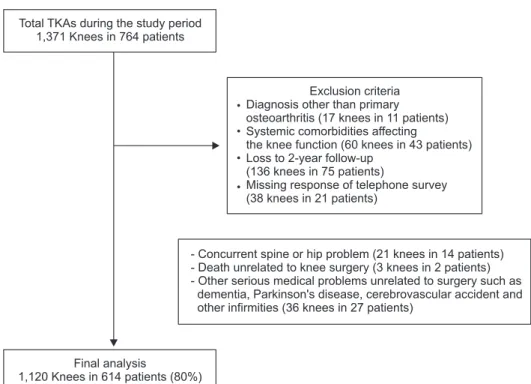
pital stay. We excluded patients who had diagnoses other than primary osteoarthritis, had systemic comorbidities affecting knee function, were lost to 2year followup, and had missing respons
es to a telephone survey. As a result, 1,120 TKAs in 614 patients (80% of the initial sample) were analyzed (Fig. 1). The primary outcome variables were WOMAC scores for pain, stiffness, and function at 2 years. The secondary outcome variables were mo
tion arc, AKS score, and SF36 score at 2 years; complications within 3 months after surgery, including wound complication, deep infection, deep vein thrombosis, and urinary tract infection;
and patient satisfaction.
6. Statistical Analysis
All statistical analyses were performed using SPSS ver. 18.0 (SPSS Inc., Chicago, IL, USA), and pvalues of <0.05 were consid
ered significant. Quantitative variables were expressed as mean and standard deviation. Continuous and categorical variables were compared using the Student t and chisquare tests, respec
tively. To determine whether our sample size was adequate, we performed a priori power analysis using the twosided hypothesis test at an alpha level of 0.05 and a statistical power of 80% to de
tect a minimal clinically important difference in WOMAC scores at 2 years after TKA. Sixtyfour knees were required for each group to detect a 5° difference in motion arc and 6% difference in functional scores, which we considered as the minimal clinically important difference (motion arc was measured to the nearest 5°, and a 6% difference in maximum score has been suggested as the minimal clinically important difference for WOMAC and SF36 scores8)). Thus, the sample size used in this study was regarded as adequate.
Results
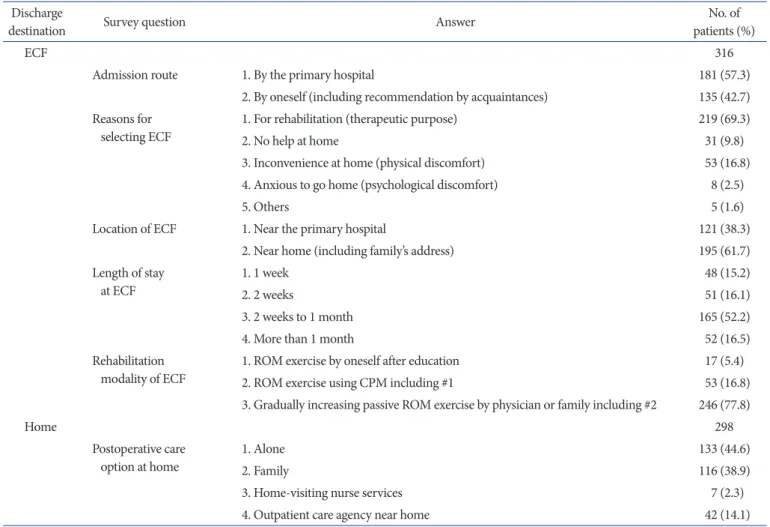
More than half of the patients were discharged to ECFs after undergoing TKA. During the study period, 316 patients (51%) were discharged to ECFs, while 298 patients (49%) were dis
charged to home. The most common reason for selecting an ECF rather than home care was to aid in postoperative rehabilitation (69%). More than half (52%) of the patients stayed from 2 weeks
to 1 month duration in the facility. Most (78%) of them received gradually increasing passive range of motion (ROM) exercises by physicians or family members, performed ROM exercises themselves, and used continuous passive motion. Among the patients discharged to home, 45% had to take care of themselves as opposed to receiving care from family members (39%), home visiting nurse service (2%), or any nearby outpatient care agency (14%) (Table 1).
A greater proportion of the patients who underwent bilateral TKAs and those who had prolonged stay in the primary care institution went to an ECF rather than home (Table 2). Eighty
six percent of the patients in the ECF group (n=272) underwent bilateral TKA as compared with 79% in the home group (n=234) (p=0.014). Among the patients who required extended hospital stay, 67% (n=44) went to an ECF and only 33% selected home as their discharge destination (n=22) (p=0.009). The patients in the ECF group tended to have higher BMIs than those in the home group (p=0.051), although the mean height and weight of the two groups were similar. No significant difference in mean age (ECF vs. home; 73.1 years vs. 73.2 years) or sex distribution (ECF vs. home; 95% females [n=301] vs. 93% females [n=276]) were found between the two discharge groups.
The ECF group tended to have lower complication rates, had similar functional outcome at 2 years, and had a less proportion of satisfied patients than the home group. Eight patients expe
rienced a complication within 3 months after TKA in the home group as compared with only two patients in the ECF group
Total TKAs during the study period 1,371 Knees in 764 patients
Final analysis
1,120 Knees in 614 patients (80%)
Exclusion criteria Diagnosis other than primary osteoarthritis (17 knees in 11 patients) Systemic comorbidities affecting
the knee function (60 knees in 43 patients) Loss to 2-year follow-up
(136 knees in 75 patients)
Missing response of telephon survey (38 knees in 21 )
e patients
- Concurrent spine or hip problem (21 knees in 14 patients) - Death unrelated to knee surgery (3 knees in 2 patients) - Other serious medical problems unrelated to surgery such as
dementia, Parkinson's disease, cerebrovascular accident and other infirmities (36 knees in 27 patients)
Fig. 1. Flowchart showing patient enrol
ment and exclusion criteria.
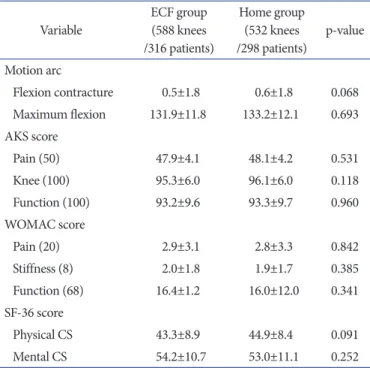
(p=0.057) (Table 3). Wound complication was the main problem in both groups. The mean AKS scores for pain, knee, and func
tion; WOMAC scores for pain, stiffness, and function; SF36
scores for physical and mental component summary scales; and motion arc were found to be similar in the two groups at 2 years’
followup (Table 4). A significantly greater proportion (81.9%) of patients (p<0.001) in the home group than that in the ECF group (54.3%) was satisfied with their discharge destination (Table 5).
Of the 50 patients who were unsatisfied with ECF, 30 (60%) com
plained of unavailability of sufficient postoperative care except rehabilitation (Table 6). Among the unsatisfied patients in the Table 2. Comparison of Demographic and Surgical Factors
Variable ECF group
(n=316) Home group
(n=298) pvalue Demographic
Age (yr) 73.1±6.1 73.2±6.1 0.804
Gender (female) 301 (95.3) 276 (92.6) 0.170
Height (cm) 154.8±7.2 153.2±6.6 0.164
Weight (kg) 62.4±9.2 62.9±9.5 0.338
BMI (kg/m2) 27.3±3.6 26.7±3.1 0.051
Surgical factor
Bilateral surgery 272 (86.1) 234 (78.5) 0.014 Additional hospital stay 44 (13.9) 22 (7.4) 0.009 Values are presented as mean±standard deviation or number (%).
ECF: extended care facility, BMI: body mass index.
Table 3. Comparison of Complications
Variable ECF group
(n=316) Home group
(n=298) pvalue
Wound complication 2 4
Deep infection 0 1
Deep vein thrombosis 0 1
Urinary tract infection 0 2
Total (%) 2 (0.6) 8 (2.7) 0.057
ECF: extended care facility.
Table 1. Results of the Telephone Survey Regarding Discharge Destination Discharge
destination Survey question Answer No. of
patients (%)
ECF 316
Admission route 1. By the primary hospital 181 (57.3)
2. By oneself (including recommendation by acquaintances) 135 (42.7) Reasons for
selecting ECF 1. For rehabilitation (therapeutic purpose) 219 (69.3)
2. No help at home 31 (9.8)
3. Inconvenience at home (physical discomfort) 53 (16.8)
4. Anxious to go home (psychological discomfort) 8 (2.5)
5. Others 5 (1.6)
Location of ECF 1. Near the primary hospital 121 (38.3)
2. Near home (including family’s address) 195 (61.7)
Length of stay
at ECF 1. 1 week 48 (15.2)
2. 2 weeks 51 (16.1)
3. 2 weeks to 1 month 165 (52.2)
4. More than 1 month 52 (16.5)
Rehabilitation
modality of ECF 1. ROM exercise by oneself after education 17 (5.4)
2. ROM exercise using CPM including #1 53 (16.8)
3. Gradually increasing passive ROM exercise by physician or family including #2 246 (77.8)
Home 298
Postoperative care
option at home 1. Alone 133 (44.6)
2. Family 116 (38.9)
3. Homevisiting nurse services 7 (2.3)
4. Outpatient care agency near home 42 (14.1)
ECF: extended care facility, ROM: range of motion, CPM: continuous passive motion.
home group (n=23), the most common cause was psychological anxiety (48%).
Discussion
The choice of discharge destination following TKA and its eco
nomic, clinical, and social implications are controversial. Many studies on this aspect, mostly from the West, have been conduct
ed over the last decade2,925). However, in an extensive literature search, we could not find any previous study about the status of discharge destination and its effect on functional outcome and patient satisfaction after TKA in an Asian country. To the best of our knowledge, this is the first study to address such issues in an Asian population.
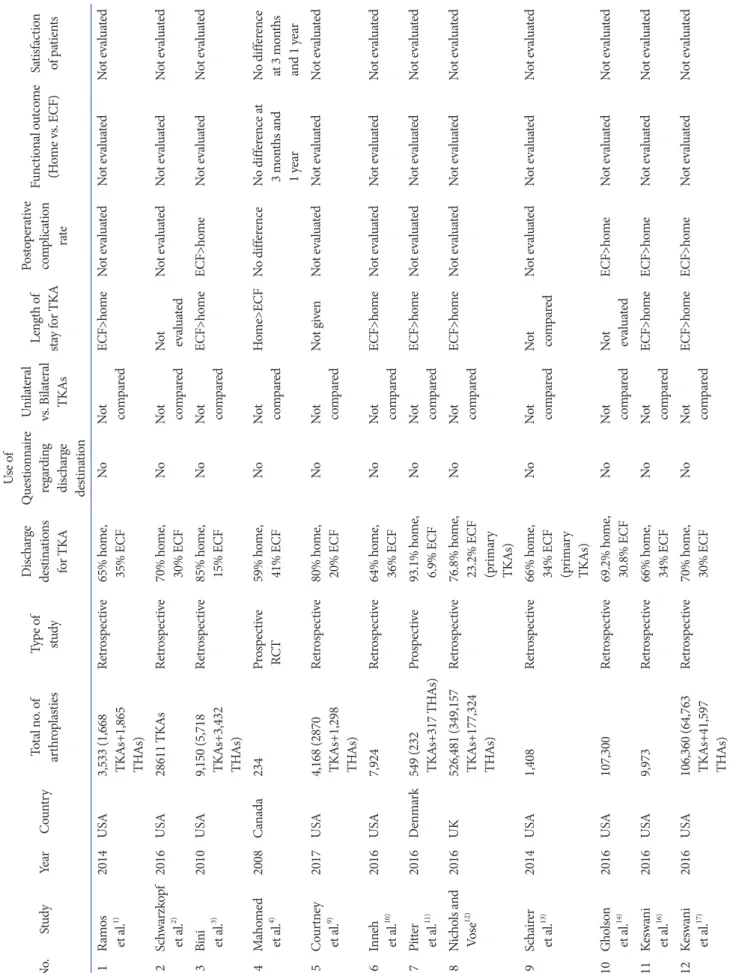
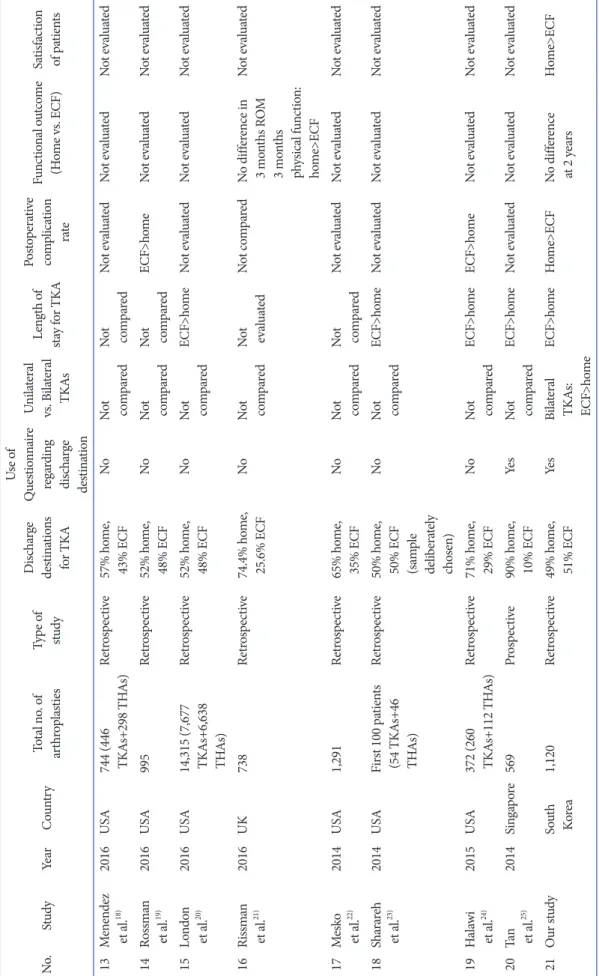
We found that more than half of the patients were discharged to an ECF after TKA. This finding contradicts those of other published studies, mostly from the West, that reported that homebased care was more popular than an inpatient set
ting14,914,1622,24,25) (Table 7). Such results demonstrate the current pattern of discharge disposition in South Korea, which does not seem to follow the Western pattern, probably as the bundled payment system has not been introduced yet in the country. As about 55% of the cost incurred in TKA is for postacute care and
discharge to a nonhome destination was reported to consume 36% of the total cost of care20), measures must be taken to reduce the number of inpatient facility discharges to mitigate the total cost of patient care after TKA.
Some of the various demographic and perioperative variables reported from the West to favor an inpatient facility as discharge destination after TKA include older age2,3,10,14,16,17, 20,21,24), female sex2,3,10,14,16,17,21), higher comorbidity index1,2,14,16,17,19,21), low socio
economic status9,10), nonwhite race2,10), higher BMI16,17,21), longer operation time16,17), and longer length of stay in the acutecare hospital1,1012,16,17,20,24). In our study, we did not find any difference in age and sex distribution between the two groups. Similar to our findings, two retrospective studies on total knee and hip ar
throplasties also did not find any differences in age and sex distri
butions among the discharge destination groups15,23). Like most of the previous studies, our study revealed that among the patients with extended hospital stay, more were discharged to an ECF than to home. As in other studies, in our study, the patients in the ECF group tended to have higher BMIs than those in the home group, although the result was only close to reaching statistical significance (p=0.051). Besides the abovementioned factors, we for the first time studied the difference in the number of bilateral TKAs between the home and ECF groups. More patients who Table 4. Comparison of Functional Outcome
Variable ECF group
(588 knees /316 patients)
Home group (532 knees
/298 patients) pvalue Motion arc
Flexion contracture 0.5±1.8 0.6±1.8 0.068 Maximum flexion 131.9±11.8 133.2±12.1 0.693 AKS score
Pain (50) 47.9±4.1 48.1±4.2 0.531
Knee (100) 95.3±6.0 96.1±6.0 0.118
Function (100) 93.2±9.6 93.3±9.7 0.960
WOMAC score
Pain (20) 2.9±3.1 2.8±3.3 0.842
Stiffness (8) 2.0±1.8 1.9±1.7 0.385
Function (68) 16.4±1.2 16.0±12.0 0.341
SF36 score
Physical CS 43.3±8.9 44.9±8.4 0.091
Mental CS 54.2±10.7 53.0±11.1 0.252
Values are presented as mean±standard deviation.
ECF: extended care facility, AKS: American Knee Society, WOMAC:
Western Ontario and McMaster Universities Arthritis index, SF36: 36
Item Short Form Health Survey, CS: component summary.
Table 5. Comparison of Satisfaction Level
Variable ECF group (n=316) Home group (n=298) pvalue
Unsatisfied 50 (16.0) 23 (7.7)
Neutral 93 (29.7) 31 (10.4) <0.001
Satisfied 173 (54.3) 244 (81.9)
Values are presented as number (%).
ECF: extended care facility.
Table 6. Reasons for Dissatisfaction in the Two Groups
Answer No. of
patients (%)
Extended care facility group 50
Worse than expected rehabilitation (expertise, number
of rehabilitation sessions, etc.) 11 (22.0) Uncomfortable facilities (diet, bedding, etc.) 9 (18.0) Insufficient postoperative care except rehabilitation 30 (60.0)
Home group 23
Unavailability of family 5 (21.7)
Psychological anxiety (complication, rehabilitation,
accident such as falling, etc.) 11 (47.8)
Lack of rehabilitation instruments 7 (30.4)
Table 7. Comparison of Our Study with Previous Studies on Discharge Destination after Total Knee Arthroplasty (TKA) No.StudyYearCountryTotal no. of arthroplastiesType of study
Discharge destinations for TKA
Use of Questionnaire regarding discharge destination
Unilateral vs. Bilateral TKAs
Length of stay for TKA
Postoperative complication rate
Functional outcome (Home vs. ECF)Satisfaction of patients 1Ramos et al.1) 2014USA
3,533 (1,668 TK
As+1,865 THAs)
Retrospective65% home, 35% ECFNoNot comparedECF>homeNot evaluatedNot evaluatedNot evaluated 2Schwarzkopf et al.2) 2016USA28611 TKAsRetrospective70% home, 30% ECFNoNot comparedNot evaluatedNot evaluatedNot evaluatedNot evaluated 3Bini et al.3) 2010USA
9,150 (5,718 TK
As+3,432 THAs)
Retrospective85% home, 15% ECFNoNot comparedECF>homeECF>homeNot evaluatedNot evaluated 4Mahomed et al.4) 2008Canada234Prospective RCT59% home, 41% ECFNoNot comparedHome>ECFNo differenceNo difference at 3 months and 1 year
No difference at 3 months and 1 year 5Courtney et al.9) 2017USA
4,168 (2870 TK
As+1,298 THAs)
Retrospective80% home, 20% ECFNoNot comparedNot givenNot evaluatedNot evaluatedNot evaluated 6Inneh et al.10) 2016USA7,924Retrospective64% home, 36% ECFNoNot comparedECF>homeNot evaluatedNot evaluatedNot evaluated 7Pitter et al.11) 2016Denmark549 (232 TK
As+317 THAs)Prospective93.1% home, 6.9% ECFNoNot comparedECF>homeNot evaluatedNot evaluatedNot evaluated 8Nichols and Vose12)2016UK
526,481 (349,157 TK
As+177,324 THAs)
Retrospective76.8% home,
23.2% ECF (primary TKAs)
NoNot comparedECF>homeNot evaluatedNot evaluatedNot evaluated 9Schairer et al.13) 2014USA1,408Retrospective66% home,
34% ECF (primary TKAs)
NoNot comparedNot comparedNot evaluatedNot evaluatedNot evaluated 10Gholson et al.14) 2016USA107,300Retrospective69.2% home, 30.8% ECFNoNot comparedNot evaluatedECF>homeNot evaluatedNot evaluated 11Keswani et al.16) 2016USA9,973Retrospective66% home, 34% ECFNoNot comparedECF>homeECF>homeNot evaluatedNot evaluated 12Keswani et al.17) 2016USA
106,360 (64,763 TK
As+41,597 THAs)
Retrospective70% home, 30% ECFNoNot comparedECF>homeECF>homeNot evaluatedNot evaluated
Table 7. Continued No.StudyYearCountryTotal no. of arthroplastiesType of study
Discharge destinations for TKA
Use of Questionnaire regarding discharge destination
Unilateral vs. Bilateral TKAs
Length of stay for TKA
Postoperative complication rate
Functional outcome (Home vs. ECF)Satisfaction of patients 13Menendez et al.18) 2016USA
744 (446 TK
As+298 THAs)Retrospective57% home, 43% ECFNoNot comparedNot comparedNot evaluatedNot evaluatedNot evaluated 14Rossman et al.19) 2016USA995Retrospective52% home, 48% ECFNoNot comparedNot comparedECF>homeNot evaluatedNot evaluated 15London et al.20) 2016USA
14,315 (7,677 TK
As+6,638 THAs)
Retrospective52% home, 48% ECFNoNot comparedECF>homeNot evaluatedNot evaluatedNot evaluated 16Rissman et al.21) 2016UK738Retrospective74.4% home, 25.6% ECFNoNot comparedNot evaluatedNot comparedNo difference in 3 months ROM 3 months physical function: home>ECF
Not evaluated 17Mesko et al.22) 2014USA1,291Retrospective65% home, 35% ECFNoNot comparedNot comparedNot evaluatedNot evaluatedNot evaluated 18Sharareh et al.23) 2014USAFirst 100 patients (54 TKAs+46 THAs)
Retrospective50% home,
50% ECF (sample deliberately chosen)
NoNot comparedECF>homeNot evaluatedNot evaluatedNot evaluated 19Halawi et al.24) 2015USA
372 (260 TK
As+112 THAs)Retrospective71% home, 29% ECFNoNot comparedECF>homeECF>homeNot evaluatedNot evaluated 20Tan et al.25) 2014Singapore569Prospective90% home, 10% ECFYesNot comparedECF>homeNot evaluatedNot evaluatedNot evaluated 21Our studySouth Korea1,120Retrospective49% home, 51% ECFYesBilateral TKAs: ECF>homeECF>homeHome>ECFNo difference at 2 yearsHome>ECF ECF: extended care facility, THA: total hip arthroplasty, RCT: randomized controlled trial, ROM: range of motion.
underwent bilateral TKA were discharged to an ECF than home.
These results further signify the importance of patients’ anticipa
tions and apprehensions regarding their postoperative rehabilita
tive care in deciding their discharge location after TKA.
Home patients were found to have more complications within the first 3 months after TKA than ECF patients. Although the difference was remarkable, it did not reach statistical significance (p=0.057), probably because the complications were fewer over
all and the sample size was too small to decipher any difference.
Although a prospective randomized study found no difference in the postoperative complication rate in the two discharge destina
tions4), most of the other studies from the Western world report
ed increased rates of early complications in patients discharged to an ECF as compared with those discharged to home3,14,16,17,19,24). The difference between our results and those of other studies could be because of the lower comorbidity profile of the patients discharged to ECFs in South Korea than that in Western coun
tries. This hypothesis needs to be confirmed through future studies that evaluate the comorbidity index in the two discharge groups. Moreover, lack of a caregiver at home as admitted by a large number (45%) of the patients discharged to home could also be a contributing factor.
Only a couple of studies have compared functional outcome be
tween home and nonhome discharge destinations4,21). However, none of these studies evaluated the outcome at 2 years’ follow
up. We found no significant difference in functional outcome at 2 years between the two groups. In a retrospective study of 738 TKAs, the authors found that homebased rehabilitation was as
sociated with greater 3month postoperative patientreported physical function improvement than nonhome group, although no significant difference in ROM at 3 months was found21). A prospective randomized study found no significant difference in functional outcome evaluated using WOMAC and SF36 scores at 3month and 1year postoperative periods between the two groups4). As functional outcome measures were reported to im
prove up to 2 years of followup after TKA26,27), a difference in outcome at 2 years more comprehensively indicates the role of discharge destination. These results need to be communicated with patients, preoperatively, so that they can make informed de
cisions about their discharge destination.
Homebased rehabilitation was found to provide better patient satisfaction than ECF in our study. In the only other published study that compared patient satisfaction assessed using the Hip and Knee Satisfaction Scale between the home and nonhome groups, the authors did not find any difference4). We believe that by asking the patients directly through our telephone survey, we
were in a better position to elucidate satisfaction levels with the discharge destination. The patients in the ECF group reported that insufficient postoperative care besides rehabilitation was the chief reason for their dissatisfaction. This signifies the importance of improving the inpatient rehabilitation facilities in South Korea, which are not so well equipped with modern rehabilitation in
struments. When the ECF options after TKA are compared, IRF is reported to have shorter length of stay than SNF with superior functional outcomes, although at an increased cost28,29). On the other hand, SNF patients are reported to be more independent in selfcare after discharge following lowerextremity joint replace
ments30). Since SNF facilities after TKA are not adequately de
veloped in South Korea, attention needs to be given on improve
ment of the nursing facilities. Moreover, as psychological anxiety was the main cause of dissatisfaction in the home patients (48%), adequate psychological counseling needs to be provided before discharging patients to home.
Our study had a number of strengths, including use of a stan
dardized clinical pathway, use of validated outcome measures, and the 2 years of followup. A further strength was the relatively large proportion (80%) of the original sample included in the analysis. Moreover, a post hoc power analysis confirmed the adequacy of the sample size. However, this study had some limi
tations that should be considered while interpreting the results.
First, it was a singleinstitutionbased study. Thus, whether the results are applicable to the TKA population of the country at large needs consideration. However, being a largevolume ter
tiary care referral institution, with patients coming from all parts of the country, we boast of a sufficiently heterogeneous patient population, similar to the national population. Second, as it was a retrospective study, selection bias cannot be ruled out. As we selected the consecutive patients from the two groups, an attempt was made to mitigate the bias. The other limitations included re
call bias in the telephone survey and variable bias inherent in ret
rospective studies. We did not study the effect of race, insurance, socioeconomic status, comorbidity index, blood transfusions, and unplanned readmissions in our study. Additional comprehensive studies in the future are required to evaluate the influence of the abovementioned variables on the discharge destination follow
ing TKA in South Korea.
Conclusions
ECF was slightly more popular than home as discharge desti
nation after TKA, more so in bilateral cases and after prolonged hospital stay. However, homebased care had similar functional
outcome at 2 years and higher patient satisfaction albeit with a higher tendency of complications. These results provide an in
sight into the status of discharge destinations after TKA in South Korea. Patients need to be adequately counseled and educated about the advantages and limitations of the two equally effica
cious discharge destination options.
Conflict of Interest
No potential conflict of interest relevant to this article was re
ported.
References
1. Ramos NL, Karia RJ, Hutzler LH, Brandt AM, Slover JD, Bosco JA. The effect of discharge disposition on 30day re
admission rates after total joint arthroplasty. J Arthroplasty.
2014;29:6747.
2. Schwarzkopf R, Ho J, Quinn JR, Snir N, Mukamel D. Factors influencing discharge destination after total knee arthroplas
ty: a database analysis. Geriatr Orthop Surg Rehabil. 2016;7:
959.
3. Bini SA, Fithian DC, Paxton LW, Khatod MX, Inacio MC, Namba RS. Does discharge disposition after primary total joint arthroplasty affect readmission rates? J Arthroplasty.
2010;25:1147.
4. Mahomed NN, Davis AM, Hawker G, Badley E, Davey JR, Syed KA, Coyte PC, Gandhi R, Wright JG. Inpatient com
pared with homebased rehabilitation following primary unilateral total hip or knee replacement: a randomized con
trolled trial. J Bone Joint Surg Am. 2008;90:167380.
5. Insall JN, Dorr LD, Scott RD, Scott WN. Rationale of the Knee Society clinical rating system. Clin Orthop Relat Res.
1989;(248):134.
6. Bellamy N, Buchanan WW, Goldsmith CH, Campbell J, Stitt LW. Validation study of WOMAC: a health status instrument for measuring clinically important patient relevant outcomes to antirheumatic drug therapy in patients with osteoarthritis of the hip or knee. J Rheumatol. 1988;15:183340.
7. Ware JE Jr, Sherbourne CD. The MOS 36item shortform health survey (SF36): I. Conceptual framework and item selection. Med Care. 1992;30:47383.
8. Angst F, Aeschlimann A, Stucki G. Smallest detectable and minimal clinically important differences of rehabilitation intervention with their implications for required sample sizes using WOMAC and SF36 quality of life measurement
instruments in patients with osteoarthritis of the lower ex
tremities. Arthritis Rheum. 2001;45:38491.
9. Courtney PM, Huddleston JI, Iorio R, Markel DC. Socioeco
nomic risk adjustment models for reimbursement are neces
sary in primary total joint arthroplasty. J Arthroplasty. 2017;
32:15.
10. Inneh IA, Clair AJ, Slover JD, Iorio R. Disparities in dis
charge destination after lower extremity joint arthroplasty:
analysis of 7924 patients in an urban setting. J Arthroplasty.
2016;31:27004.
11. Pitter FT, Jørgensen CC, LindbergLarsen M, Kehlet H;
Lundbeck Foundation Center for Fasttrack Hip and Knee Replacement Collaborative Group. Postoperative morbid
ity and discharge destinations after fasttrack hip and knee arthroplasty in patients older than 85 years. Anesth Analg.
2016;122:180715.
12. Nichols CI, Vose JG. Clinical outcomes and costs within 90 days of primary or revision total joint arthroplasty. J Arthro
plasty. 2016;31:14006.
13. Schairer WW, Vail TP, Bozic KJ. What are the rates and causes of hospital readmission after total knee arthroplasty?
Clin Orthop Relat Res. 2014;472:1817.
14. Gholson JJ, Pugely AJ, Bedard NA, Duchman KR, Anthony CA, Callaghan JJ. Can we predict discharge status after total joint arthroplasty? A calculator to predict home discharge. J Arthroplasty. 2016;31:27059.
15. Phan DL, Ahn K, Rinehart JB, Calderon MD, Wu WD, Schwarzkopf R. Joint arthroplasty perioperative surgical home: impact of patient characteristics on postoperative outcomes. World J Orthop. 2016;7:37682.
16. Keswani A, Weiser MC, Shin J, Lovy AJ, Moucha CS. Dis
charge destination after revision total joint arthroplasty: an analysis of postdischarge outcomes and placement risk fac
tors. J Arthroplasty. 2016;31:186672.
17. Keswani A, Tasi MC, Fields A, Lovy AJ, Moucha CS, Bozic KJ. Discharge destination after total joint arthroplasty: an analysis of postdischarge outcomes, placement risk factors, and recent trends. J Arthroplasty. 2016;31:115562.
18. Menendez ME, Schumacher CS, Ring D, Freiberg AA, Rubash HE, Kwon YM. Does “6clicks” day 1 postoperative mobility score predict discharge disposition after total hip and knee arthroplasties? J Arthroplasty. 2016;31:191620.
19. Rossman SR, Reb CW, Danowski RM, Maltenfort MG, Mariani JK, Lonner JH. Selective early hospital discharge does not increase readmission but unnecessary return to the emergency department is excessive across groups after pri
mary total knee arthroplasty. J Arthroplasty. 2016;31:11758.
20. London DA, Vilensky S, O’Rourke C, Schill M, Woicehovich L, Froimson MI. Discharge disposition after joint replace
ment and the potential for cost savings: effect of hospital policies and surgeons. J Arthroplasty. 2016;31:7438.
21. Rissman CM, Keeney BJ, Ercolano EM, Koenig KM. Pre
dictors of facility discharge, range of motion, and patient
reported physical function improvement after primary total knee arthroplasty: a prospective cohort analysis. J Arthro
plasty. 2016;31:3641.
22. Mesko NW, Bachmann KR, Kovacevic D, LoGrasso ME, O’Rourke C, Froimson MI. Thirtyday readmission follow
ing total hip and knee arthroplasty: a preliminary single institution predictive model. J Arthroplasty. 2014;29:15328.
23. Sharareh B, Le NB, Hoang MT, Schwarzkopf R. Factors determining discharge destination for patients undergoing total joint arthroplasty. J Arthroplasty. 2014;29:13558.
24. Halawi MJ, Vovos TJ, Green CL, Wellman SS, Attarian DE, Bolognesi MP. Patient expectation is the most important predictor of discharge destination after primary total joint arthroplasty. J Arthroplasty. 2015;30:53942.
25. Tan C, Loo G, Pua YH, Chong HC, Yeo W, Ong PH, Lo NN, Allison G. Predicting discharge outcomes after total knee
replacement using the risk assessment and predictor tool.
Physiotherapy. 2014;100:17681.
26. Nerhus TK, Heir S, Thornes E, Madsen JE, Ekeland A.
Timedependent improvement in functional outcome fol
lowing LCS rotating platform knee replacement. Acta Or
thop. 2010;81:72732.
27. Nilsdotter AK, ToksvigLarsen S, Roos EM. A 5 year pro
spective study of patientrelevant outcomes after total knee replacement. Osteoarthritis Cartilage. 2009;17:6016.
28. Herbold JA, Bonistall K, Walsh MB. Rehabilitation follow
ing total knee replacement, total hip replacement, and hip fracture: a casecontrolled comparison. J Geriatr Phys Ther.
2011;34:15560.
29. Walsh MB, Herbold J. Outcome after rehabilitation for total joint replacement at IRF and SNF: a casecontrolled com
parison. Am J Phys Med Rehabil. 2006;85:15.
30. Mallinson TR, Bateman J, Tseng HY, Manheim L, Almagor O, Deutsch A, Heinemann AW. A comparison of discharge functional status after rehabilitation in skilled nursing, home health, and medical rehabilitation settings for patients after lowerextremity joint replacement surgery. Arch Phys Med Rehabil. 2011;92:71220.