http://dx.doi.org/10.4491/KSEE.2014.36.6.434 ISSN 1225-5025
서울시내 건축물 석면해체․제거 사업장 및 주변에서의 공기 중 석면농도 특성에 관한 연구
A Study on Characteristics of Airborne Asbestos Concentrations at Demolition Sites and Surrounding Areas of Asbestos Containing Buildings in Seoul
이진효*,**․이수현*․김정연*․김지희*․정숙녀*․김진아*
김익수*․어수미*․정권*․이진숙***․구자용**,†
Jinhyo Lee*,**․Suhyun Lee*․Jeongyeun Kim*․Jihui Kim*․Sooknye Chung*․Jina Kim*
Iksoo Kim*․Soomi Eo*․Kweon Jung*․Jinsook Lee***․Jayong Koo**,†
*서울특별시 보건환경연구원․**서울시립대학교 환경공학과․***인천광역시 보건환경연구원
*Seoul Metropolitan Government Research Institute of Public Health and Environment
**Department of Environmental Engineering, University of Seoul
***Incheon Institute of Public Health and Environmental Research (2014년 3월 19일 접수, 2014년 6월 23일 수정, 2014년 6월 27일 채택)
Abstract : This study is purposed to measure airborne asbestos concentrations at demolition sites and surrounding areas of asbestos
containing buildings in Seoul and examine whether the measurement results correspond with allowable exhaust standard for asbestos of the Asbestos Safety Control Act. The airborne asbestos concentrations for 37 sites were below the detection limit (7 fiber/mm2) in 101 (35%) out of 288 samples. The whole average airborne asbestos concentration in 37 sites was 0.003±0.002 f/cc (max 0.0013 f/cc) and almost the whole airborne asbestos concentrations were satisfied with allowable exhaust standard for asbestos, 0.01 f/cc, of the Asbestos Safety Control Act. So possibility of asbestos exposure is not yet a major concern at current levels for sites demolished of asbestos containing buildings in Seoul. Looking at each sampling point, the average airborne asbestos concentrations in boundary line of site, entrance of sanitation, around the workplace (in), around the workplace (out), negative pressure units, storage area for waste, outlet for waste and residential area of residents were respectively 0.002±0.002 f/cc, 0.004±0.002 f/cc, 0.004±0.002 f/cc, 0.004±0.002 f/cc, 0.004±0.002 f/cc, 0.005±0.004 f/cc, 0.005±0.003 f/cc and 0.003±0.002 f/cc. As a result, all sampling points of study were satisfied with allowable exhaust standard for asbestos, 0.01 f/cc, of the Asbestos Safety Control Act.Key Words : Asbestos, Demolition Sites of Asbestos Containing Buildings, PCM, TEM
요약 : 본 연구에서는 석면해체․제거작업에 따른 작업자 및 주변 환경에 미치는 영향 등을 파악하기 위해 서울시내 건축물
석면해체․제거 사업장을 대상으로 공기 중 석면농도를 조사하고, 측정결과가 「석면안전관리법」에서 명시된 사업장 주변의 석면배출허용기준에 적합한지를 살펴보았다. 서울시내 총 37개소 석면해체․제거 사업장에서 총 288개의 공기 중 시료를 분 석하였으며, 전체 288개 시료 중 101개 시료에서(35%) 검출한계(7 fiber/mm2) 이하로 나타났다. 이 때 전체 공기 중 석면농도 평균값은 0.003±0.002 f/cc로(최대 0.013 f/cc) 대부분의 공기 중 석면농도는 「석면안전관리법」에서 명시된 사업장 주변의 석 면배출허용기준 0.01 f/cc 이하로 나타나 서울시내 건축물 석면해체․제거 사업장에서의 석면 노출가능성은 우려할 수준이 아닌 것으로 판단된다. 채취지점별로 살펴보면, 부지경계선(148개), 위생설비입구(25개), 작업장주변(실내)(7개), 작업장주변 (실외)(11개)에 대한 공기 중 석면농도 결과, 각각 53개(36%), 5개(20%), 1개(14%), 4개(36%) 시료에서 검출한계 이하로 나타 났으며 평균농도는 각각 0.002±0.002 f/cc(최대 0.008 f/cc), 0.004±0.002 f/cc(최대 0.009 f/cc), 0.004±0.002 f/cc(최대 0.007 f/cc), 0.004±0.002 f/cc로(최대 0.008 f/cc) 나타났다. 또한 음압기(13개), 폐기물보관지점(27개), 폐기물반출구(9개), 거주자주거지역 (48개)에 대한 공기 중 석면농도 결과, 각각 3개(23%), 8개(30%), 2개(22%), 25개(52%) 시료에서 검출한계 이하로 나타났으며 평균농도는 각각 0.004±0.002 f/cc(최대 0.009 f/cc), 0.005±0.004 f/cc(최대 0.013 f/cc), 0.005±0.003 f/cc(최대 0.009 f/cc), 0.003±0.002 f/cc로(최대 0.009 f/cc) 나타났다.
주제어 : 석면, 석면해체․제거 사업장, 위상차현미경, 투과전자현미경
1. 서 론
석면은 불에 잘 타지 않고 부식과 마찰에 강하며, 방음․
단열 효과가 뛰어난 물성을 가지고 있어서 전기 절연재, 방 직재, 건축자재 등 다양한 제품으로 전 세계에서 광범위하게 사용되어 왔다.1) 국내에서도 석면은 1960년대 경제개발과
함께 산업사회에서 광범위하고 대량으로 사용되기 시작하였 으며,2) 건설관련 사업이 활발하게 이루어졌던 70년대부터는 학교, 공공건물, 다중이용시설 등의 건축물에도 석면이 널리 사용되었다.3) 특히 1976년부터 1995년까지의 석면수입량이 연간 평균 6만 4천톤에 이르는 등 석면사용량은 산업발달과 함께 꾸준히 증가하였으며, 수입된 석면의 약 82% 이상은
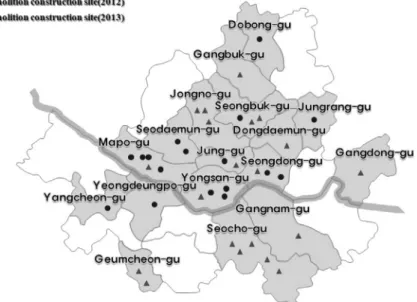
Fig. 1. Each demolition construction site in the study.
건축자재로 사용되었다.4,5) 하지만 국제암연구소( International Agency for Research on Cancer, IARC)에서 1급 발암물질로 (Group 1) 규정하고 있는 석면이 공기 중으로 방출되었을 경 우, 석면입자는 호흡기를 통해 체내로 들어와 오랜 잠복기 를 거쳐 폐암(Lung Cancer), 석면폐증(Asbestosis) 및 중피종 (Mesothelioma) 등의 악성질병을 발생시키는 것으로 보고 되고 있다.6,7) 이러한 이유 때문에 국내에서도 2006년에 석 면을 취급금지물질로 지정하였으며, 2009년부터는 모든 석 면 및 석면함유제품의 사용을 금지하였다. 그러나 아직까 지 그 이전에 지어진 학교, 공공건물, 다중이용시설 등 석 면함유자재를 사용한 건축물이 상당수 남아있어 향후 건축 물의 수명 도래와 함께 해체․제거작업이 점차 증가할 것 으로 예상되며 동시에 해체․제거되는 과정에서 공기 중의 비산문제가 발생할 수 있을 것으로 판단된다.8) 따라서 석 면함유 건축물 철거 시, 석면은 작업자뿐만 아니라 작업현 장 주변에도 비산되는 등 2차적인 피해를 발생시킬 수 있 기 때문에 신속하고 정확한 공기 중 석면농도 측정이 무엇 보다 중요하다. 또한 석면의 긴 잠복기를 고려할 때, 직업 성, 환경성 노출에 의한 건강문제는 지속적으로 증가할 것 으로 예상되며, 이러한 상황에서 석면에 관한 연구는 계속 적으로 이루어져야 할 부분이다.9) 이와 관련 국내에서도 석면함유 건축물 철거 시, 작업자와 사업장 인근 주민들의 건강을 보호하기 위한 「석면안전관리법」10)제도를 2012년에 도입하였다.
「석면안전관리법」은 석면을 안전하게 관리함으로써 석면 으로 인한 국민의 건강 피해를 예방하고 국민이 건강하고 쾌적한 환경에서 생활할 수 있도록 하는 것을 목적으로 한 다. 특히 「석면안전관리법」에서는 건축물 석면해체․제거작 업의 안전성을 향상시키기 위해 석면해체․제거 사업장의 주변 환경 등을 관리하도록 따로 명시되어 있기 때문에 이 를 통해 궁극적으로 석면으로 인한 국민건강 피해예방 및
불안감을 해소시킬 수 있을 것이다.
본 연구에서는 「석면안전관리법」에 따라 서울시내 건축물 석면해체․제거 사업장에서의 공기 중 석면농도를 조사하 고, 측정결과가 법적 기준치에 상응하는지를 살펴보는 등 석면해체․제거작업에 따른 작업자 및 주변 환경에 미치는 영향과 지속적인 석면모니터링 자료를 확보함으로써 향후 서울시 석면관리를 위한 기초자료를 제공하고자 하였다.
2. 연구방법
2.1. 조사기간 및 대상
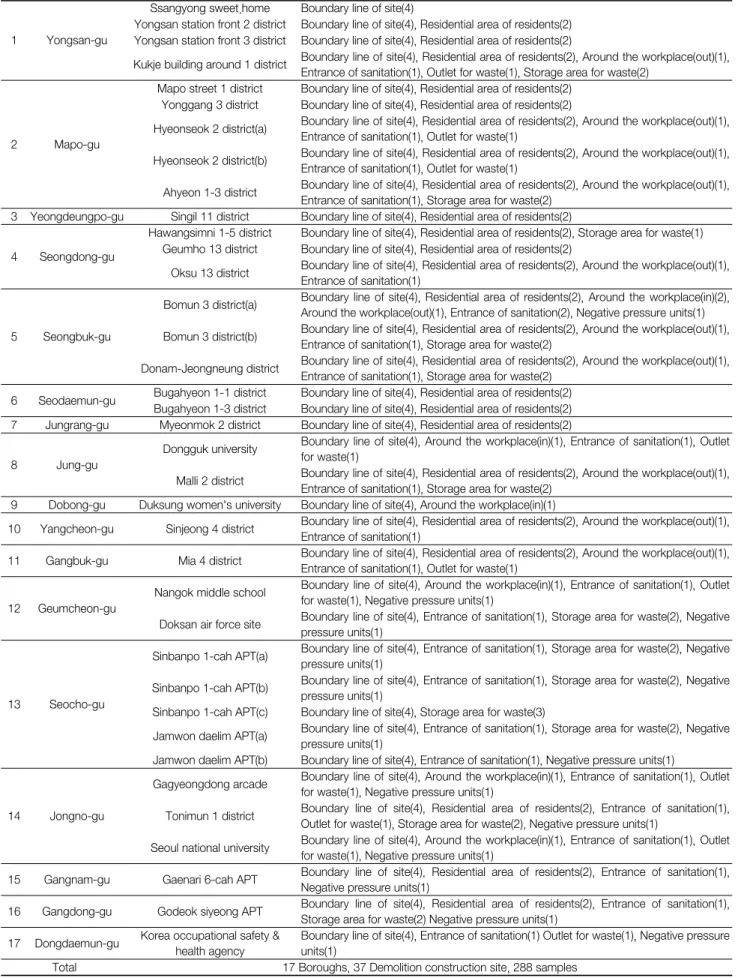
본 연구는 2012년 5월~2013년 12월까지 「석면안전관리 법 제 28조 제4항」에 따라 영 제40조에 따른 사업장을 대상 으로(① 석면건축자재가 사용된 면적의 합이 5천제곱미터 이상인 건축물 또는 설비를 해체․제거하는 사업, ② 주택 재개발사업 및 주택재건축사업, ③ 재정비촉진사업) 17개 자치구, 37개 사업장에서 총 288개의 공기 중 시료를 채취 하여 서울시내 건축물 석면해체․제거 사업장에서의 공기 중 석면농도 실태를 조사하였다. 이와 관련 측정지점 및 세 부내역은 Fig. 1, Table 1과 같다.
2.2. 시료채취 및 분석방법
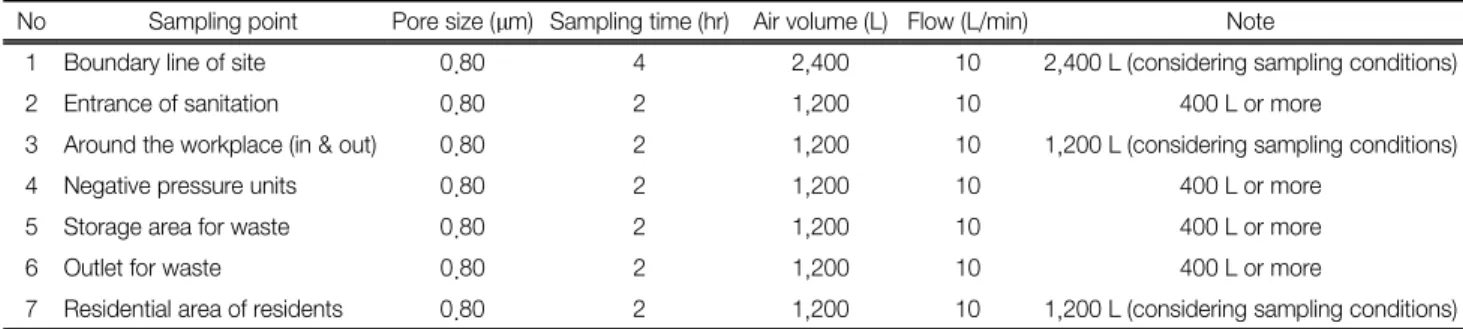
본 연구에서 시료채취는 환경부고시 제2012-79호 「석면해 체․제거 작업 사업장 주변 석면 비산관리를 위한 조사방 법」11)에 따라 이루어졌으며(Table 2, 3), PCM 분석용 시료는 직경 25 mm, pore size 0.80 µm의 MCE (Mixed cellulose ester) 필터(Filter)가 장착되어 있는 cassette (Z008BA, Zefon, USA)와 공기 중 시료채취 펌프(SARA-4000S, KEMIK)를 이용하여 포집하였다. 분석방법은 실내공기질 공정시험기준 (Indoor air quality management guideline)의 「실내공기 중
Table 1. The details of each sampling points in the study
No Borough Demolition construction site Sampling point(number of point)
1 Yongsan-gu
Ssangyong sweet.home Boundary line of site(4)
Yongsan station front 2 district Boundary line of site(4), Residential area of residents(2) Yongsan station front 3 district Boundary line of site(4), Residential area of residents(2)
Kukje building around 1 district Boundary line of site(4), Residential area of residents(2), Around the workplace(out)(1), Entrance of sanitation(1), Outlet for waste(1), Storage area for waste(2)
2 Mapo-gu
Mapo street 1 district Boundary line of site(4), Residential area of residents(2) Yonggang 3 district Boundary line of site(4), Residential area of residents(2)
Hyeonseok 2 district(a) Boundary line of site(4), Residential area of residents(2), Around the workplace(out)(1), Entrance of sanitation(1), Outlet for waste(1)
Hyeonseok 2 district(b) Boundary line of site(4), Residential area of residents(2), Around the workplace(out)(1), Entrance of sanitation(1), Outlet for waste(1)
Ahyeon 1-3 district Boundary line of site(4), Residential area of residents(2), Around the workplace(out)(1), Entrance of sanitation(1), Storage area for waste(2)
3 Yeongdeungpo-gu Singil 11 district Boundary line of site(4), Residential area of residents(2)
4 Seongdong-gu
Hawangsimni 1-5 district Boundary line of site(4), Residential area of residents(2), Storage area for waste(1) Geumho 13 district Boundary line of site(4), Residential area of residents(2)
Oksu 13 district Boundary line of site(4), Residential area of residents(2), Around the workplace(out)(1), Entrance of sanitation(1)
5 Seongbuk-gu
Bomun 3 district(a) Boundary line of site(4), Residential area of residents(2), Around the workplace(in)(2), Around the workplace(out)(1), Entrance of sanitation(2), Negative pressure units(1) Bomun 3 district(b) Boundary line of site(4), Residential area of residents(2), Around the workplace(out)(1),
Entrance of sanitation(1), Storage area for waste(2)
Donam-Jeongneung district Boundary line of site(4), Residential area of residents(2), Around the workplace(out)(1), Entrance of sanitation(1), Storage area for waste(2)
6 Seodaemun-gu Bugahyeon 1-1 district Boundary line of site(4), Residential area of residents(2) Bugahyeon 1-3 district Boundary line of site(4), Residential area of residents(2) 7 Jungrang-gu Myeonmok 2 district Boundary line of site(4), Residential area of residents(2)
8 Jung-gu
Dongguk university Boundary line of site(4), Around the workplace(in)(1), Entrance of sanitation(1), Outlet for waste(1)
Malli 2 district Boundary line of site(4), Residential area of residents(2), Around the workplace(out)(1), Entrance of sanitation(1), Storage area for waste(2)
9 Dobong-gu Duksung women's university Boundary line of site(4), Around the workplace(in)(1)
10 Yangcheon-gu Sinjeong 4 district Boundary line of site(4), Residential area of residents(2), Around the workplace(out)(1), Entrance of sanitation(1)
11 Gangbuk-gu Mia 4 district Boundary line of site(4), Residential area of residents(2), Around the workplace(out)(1), Entrance of sanitation(1), Outlet for waste(1)
12 Geumcheon-gu
Nangok middle school Boundary line of site(4), Around the workplace(in)(1), Entrance of sanitation(1), Outlet for waste(1), Negative pressure units(1)
Doksan air force site Boundary line of site(4), Entrance of sanitation(1), Storage area for waste(2), Negative pressure units(1)
13 Seocho-gu
Sinbanpo 1-cah APT(a) Boundary line of site(4), Entrance of sanitation(1), Storage area for waste(2), Negative pressure units(1)
Sinbanpo 1-cah APT(b) Boundary line of site(4), Entrance of sanitation(1), Storage area for waste(2), Negative pressure units(1)
Sinbanpo 1-cah APT(c) Boundary line of site(4), Storage area for waste(3)
Jamwon daelim APT(a) Boundary line of site(4), Entrance of sanitation(1), Storage area for waste(2), Negative pressure units(1)
Jamwon daelim APT(b) Boundary line of site(4), Entrance of sanitation(1), Negative pressure units(1)
14 Jongno-gu
Gagyeongdong arcade Boundary line of site(4), Around the workplace(in)(1), Entrance of sanitation(1), Outlet for waste(1), Negative pressure units(1)
Tonimun 1 district Boundary line of site(4), Residential area of residents(2), Entrance of sanitation(1), Outlet for waste(1), Storage area for waste(2), Negative pressure units(1)
Seoul national university Boundary line of site(4), Around the workplace(in)(1), Entrance of sanitation(1), Outlet for waste(1), Negative pressure units(1)
15 Gangnam-gu Gaenari 6-cah APT Boundary line of site(4), Residential area of residents(2), Entrance of sanitation(1), Negative pressure units(1)
16 Gangdong-gu Godeok siyeong APT Boundary line of site(4), Residential area of residents(2), Entrance of sanitation(1), Storage area for waste(2) Negative pressure units(1)
17 Dongdaemun-gu Korea occupational safety &
health agency
Boundary line of site(4), Entrance of sanitation(1) Outlet for waste(1), Negative pressure units(1)
Total 17 Boroughs, 37 Demolition construction site, 288 samples
Table 2. Sampling conditions for the demolition construction sites
Classification Sampling point Number of point Sampling location Note
While at work
Boundary line of site 4 or more Boundary line of site : height 1.2~1.5 m Entrance of sanitation All
(more than one)
Entrance of sanitation : height 1.2~1.5 m, distance up to 1 m
Around the workplace
Interior more than one Around the workplace : height 1.2~1.5 m ・Exception when there is no user
Outdoor more than one Outdoor of relevant building : height 1.2~1.5 m
・Distance up to 5m from relevant building
・Exception when negative pressure units is installed
Negative pressure units All (more than one)
Outlet of negative pressure units : distance up to 0.3~1 m
Storage area for waste All (2 or more)
Around the storage area for waste : height 1.2~1.5 m, distance up to 1 m
・Considering direction of wind
・Exception for individual demolition con- struction site
Outlet for waste All (more than one)
Outlet for waste : height 1.2~1.5 m, distance ut to 1 m Residential area of
residents 2 or more
Nearest residential from demolition construction site : height 1.2~1.5 m, distance of 2~3 m
・Considering direction of wind
・Exception for individual demolition cons- truction site
Fig. 2. Sampling location in the demolition construction sites.
Table 3. Sampling conditions for analysis of the airborne asbestos concentrations
No Sampling point Pore size (µm) Sampling time (hr) Air volume (L) Flow (L/min) Note
1 Boundary line of site 0.80 4 2,400 10 2,400 L (considering sampling conditions)
2 Entrance of sanitation 0.80 2 1,200 10 400 L or more
3 Around the workplace (in & out) 0.80 2 1,200 10 1,200 L (considering sampling conditions)
4 Negative pressure units 0.80 2 1,200 10 400 L or more
5 Storage area for waste 0.80 2 1,200 10 400 L or more
6 Outlet for waste 0.80 2 1,200 10 400 L or more
7 Residential area of residents 0.80 2 1,200 10 1,200 L (considering sampling conditions)
석면 및 섬유상 먼지 농도 측정방법(ES 02303.1)」12)에 따 라 위상차현미경법(Phase Contrast Microscopy, PCM)과 투 과전자현미경법(Transmission Electron Microscopy, TEM)으 로 공기 중 석면농도를 측정하였으며, 이때 건축물 석면해 체․제거 사업장에서의 석면배출허용기준은 「석면안전관리 법」에 따라 0.01 f/cc 이하이다. 여기서 TEM은 입자의 형태, 원소조성, 결정구조를 확인하여 모든 섬유상 입자를 구분
할 수 있는 가장 정확한 방법으로, PCM으로 관찰할 수 없는 지름 0.25 µm 이하의 가는 석면섬유도 관찰할 수 있기 때 문에 일반대기 중 석면농도에 대한 정확한 실태조사를 위해 서 특히 비석면섬유상 물질이 많이 함유된 공공건축물, 학교, 작업장 등의 공기 중 석면농도를 파악하기 위해서는 TEM 을 이용한 분석이 필요하다.13)
따라서 본 연구에서는 PCM 분석결과가 석면배출허용기준
Fig. 3. Field sampling view for analysis of the airborne asbestos concentrations.
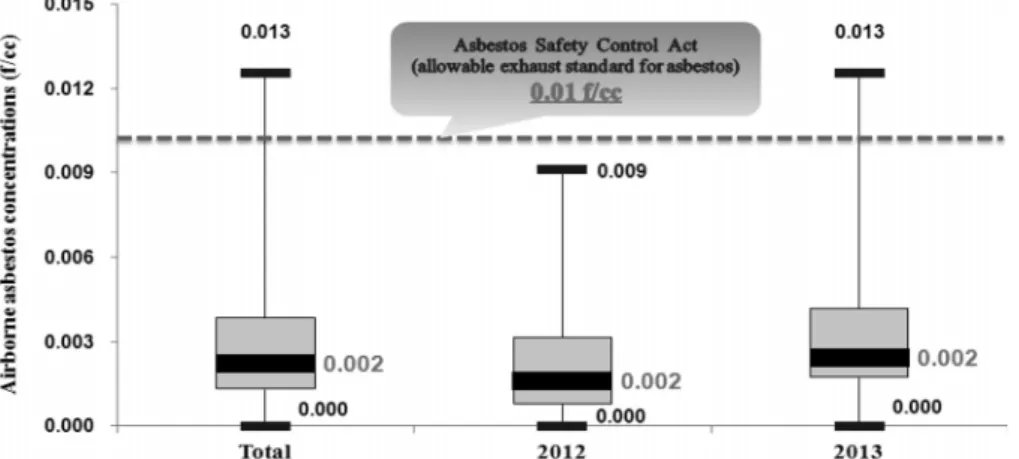
Fig. 4. Annual airborne asbestos concentrations for the demolition construction sites.
을 초과하는 경우, 별도의 시료채취 없이 이미 분석된 MCE 필터에 남아 있는 시료를 대상으로 TEM 분석을 추가로 실 시하였으며, 이를 통해 PCM 분석결과에서 나온 공기 중 섬유상 물질이 실제 석면입자인지를 파악함으로써 석면해 체․제거 작업 사업장에서의 공기 중 석면농도에 대한 정 확한 실태조사를 수행하였다.
또한 석면 노출에 대한 최악의 경우를 대비하기 위해 PCM 분석결과(검출한계 7 fiber/mm2)인 공기 중 섬유상 물질의 농도를 공기 중 석면농도로 간주하였다.
3. 결과 및 고찰
3.1. 사업장에서의 공기 중 석면농도 특성
서울시내 건축물 석면해체․제거 사업장 총 37개소에서의 공기 중 석면농도를 조사한 결과는 Fig. 4, Table 4와 같다.
PCM 분석결과, 석면해체․제거 작업과정에서 미세먼지, 석면분진 등 다종의 입자상 물질이 부유하기 때문에 석면농 도가 높을 것으로 예상했지만 이와 달리 Table 4에서와 같이,
Table 4. Summary of the airborne asbestos concentrations with PCM* analysis
Year No.
sample Max (f/cc)
Min (f/cc)
Mean±SD
(f/cc) Note
2012 115 0.009 ND 0.002±0.002 Asbestos safety control Act 0.01 f/cc 2013 173 0.013 ND 0.003±0.002
Total 288 0.013 ND 0.003±0.002
* The concentration (f/cc) is determined by counting only fibers with length>5 µm and length : width≥3 : 1
전체 평균농도는 0.003±0.002 f/cc로(최대 0.013 f/cc) 대부분 의 공기 중 석면농도는 「석면안전관리법」에서 명시된 사업 장 주변의 석면배출허용기준 0.01 f/cc 이하로 나타났다. 이 중 폐기물보관지점에서 채취된 4개의 시료에서는 작업특성 등의 영향으로 각각 0.012 f/cc, 0.011 f/cc, 0.013 f/cc, 0.012 f/cc로 나타나 석면배출허용기준을 초과하였다. 하지만 TEM 을 이용한 추가분석 결과, 실제 석면은 모두 불검출로 나타 나 서울시내 건축물 석면해체․제거 사업장에서의 석면 노 출가능성은 우려할 수준이 아닌 것으로 판단된다.
3.2. 채취지점별 공기 중 석면농도 특성
서울시내 총 37개소 석면해체․제거 사업장에서 부지경계 선 148개, 위생설비입구 25개, 작업장주변(실내) 7개, 작업 장주변(실외) 11개, 음압기 13개, 폐기물보관지점 27개, 폐 기물반출구 9개, 거주자주거지역 48개 등 총 288개의 공기
Fig. 5. Composition of samples in the demolition construction sites.
No Sampling point Max (f/cc)
Min (f/cc)
Mean±
SD (f/cc) Note
1 Boundary line of site 0.008 ND 0.002±
0.002
Asbestos safety control act 0.01
f/cc 2 Entrance of sanitation 0.009 0.001 0.004±
0.002 3 Around the workplace (in) 0.007 0.002 0.004±
0.002
4 Around the workplace (out) 0.008 ND 0.004±
0.002 5 Negative pressure units 0.009 0.002 0.004±
0.002 6 Storage area for waste 0.013 ND 0.005±
0.004
7 Outlet for waste 0.009 0.001 0.005±
0.003 8 Residential area of residents 0.009 ND 0.003±
0.002
Total 0.013 ND 0.003±
0.002
Fig. 6. Ratios of below the detection limit of samples in the demolition construction sites.
Fig. 7. Airborne asbestos concentrations for boundary line of site, entrance of sanitation and around the workplace (in & out).
Table 5. Airborne asbestos concentrations by sampling points 중 시료를 분석하였으며, 분석결과는 Table 5와 같다. 또한 전체 288개 분석시료 중 101개 시료에서(35%) 위상차현미 경 방법의 검출한계(7 fiber/mm2) 이하로 나타났다(Fig. 6).
Table 5에서 보듯이, PCM 분석결과에서 폐기물보관지점 일부 시료를 제외하고는 서울시내 건축물 석면해체․제거 사업장 모든 지점에서 석면배출허용기준을 만족시키는 것으 로 나타났다. 전반적으로 부지경계선, 거주자주거지역의 경 우, 다른 채취지점보다 석면해체․제거 사업장으로부터 거리 가 멀기 때문에 공기 중 석면농도결과가 상대적으로 낮게 나 타났으며, 반면에 석면해체․제거 사업장으로부터 거리가 가 깝고, 석면을 취급하고 보관하는 폐기물반출구, 폐기물보관지 점에서는 상대적으로 공기 중 석면농도결과가 높게 나타났다.
3.2.1. 부지경계선, 위생설비입구, 작업장주변 실내 및 실외 부지경계선 148개 시료에 대한 공기 중 석면농도 결과, 53 개 시료에서(36%) 검출한계 이하로 나타났으며, 평균농도 는 0.002±0.002 f/cc로(최대 0.008 f/cc) 모든 시료에서 석면 배출허용기준 0.01 f/cc 이하로 나타났다. 또한 위생설비입 구 25개 시료에 대한 공기 중 석면농도 결과, 5개 시료에서
Fig. 8. Airborne asbestos concentrations for negative pressure units, storage area waste, outlet for waste and residential area of residents.
(20%) 검출한계 이하로 나타났으며, 평균농도는 0.004±0.002 f/cc로(최대 0.009 f/cc) 위생설비입구 시료 모두 석면배출 허용기준 이하로 나타났다. 마찬가지로 작업장주변(실내) 7 개, 작업장주변(실외) 11개 시료에 대한 공기 중 석면농도 결과, 각각 1개(14%), 4개(36%) 시료에서 검출한계 이하로 나타났으며, 평균농도는 각각 0.004±0.002 f/cc(최대 0.007 f/cc), 0.004±0.002 f/cc로(최대 0.008 f/cc) 위생설비입구에 서의 공기 중 석면농도 결과와 유사하게 나타나는 등 모든 채취지점에서 석면배출허용기준을 만족시키는 것으로 조사 되었다.
Fig. 7을 살펴보면, 위생설비입구, 작업장주변에서의 공기 중 석면농도 결과가 부지경계선보다 상대적으로 높게 나타났 는데, 이는 위생설비입구, 작업장주변과 같은 측정지점은 석 면해체․제거가 이루어지고 있는 작업현장과 거리가 상대적 으로 짧아 석면해체․제거 작업과정에서 석면입자가 상대적 으로 많이 비산되었기 때문에 나타난 결과로 생각된다.
3.2.2. 음압기, 폐기물보관지점, 폐기물반출구 및 거주자 주거지역
음압기 13개 시료에 대한 공기 중 석면농도 결과, 3개 시 료에서(23%) 검출한계 이하로 나타났으며, 평균농도는 0.004±
0.002 f/cc로(최대 0.009 f/cc) 모든 시료에서 석면배출허용기 준 0.01 f/cc 이하로 나타났다. 또한 폐기물반출구 9개 시료에 대한 공기 중 석면농도 결과, 2개 시료에서(22%) 검출한계 이 하로 나타났으며, 평균농도는 0.005±0.003 f/cc로(최대 0.009 f/cc) 폐기물반출구 시료 모두 석면배출허용기준 이하로 나 타났다. 마찬가지로 거주자주거지역 48개 시료에 대한 공기 중 석면농도 결과, 25개 시료에서(52%) 검출한계 이하로 나 타났으며, 평균농도는 0.003±0.002 f/cc로(최대 0.009 f/cc) 나 타나는 등 음압기, 폐기물반출구, 거주자주거지역 모든 채취 지점에서 석면배출허용기준을 만족시키는 것으로 나타났다.
폐기물보관지점의 경우, 27개 시료에 대한 공기 중 석면농 도 결과, 8개 시료에서(30%) 검출한계 이하로 나타났으며, 평
균농도는 0.005±0.004 f/cc로(최대 0.013 f/cc) 나타났다. 하 지만 폐기물보관지점에서 채취된 4개의 시료에서 0.011~
0.013 f/cc로 나타나는 등 석면배출허용기준을 초과한 경우 도 발생하였기 때문에 초과한 시료들에 대해서는 TEM을 이용한 추가분석을 실시하였으며 그 결과, 실제 석면은 모 두 불검출로 나타났다. 따라서 본 연구에서 조사된 모든 모 니터링 대상 석면해체․제거 사업장은 환경부 「석면안전관 리법」에서 명시된 석면배출허용기준을 만족시키는 것으로 나타나 앞서 언급했듯이, 서울시내 건축물 석면해체․제거 사업장에서의 석면 노출가능성은 우려할 수준이 아닌 것으 로 판단된다.
하지만 TEM을 이용한 추가분석 결과에서 실제 석면입자 는 아니었더라도, 일부 폐기물보관지점에서의 PCM 분석결 과, 석면배출허용기준을 초과한 경우도 발생하였듯이, 폐기 물보관지점, 폐기물반출구와 같은 지점에서는 작업특성상 작 업자가 직접 석면함유자재, 석면폐기물을 운반하고 적재하는 등의 석면작업이 활발히 이루어지고 그러한 과정에서 석면 이 비산될 수 있기 때문에 다른 지점보다 작업자가 석면에 노출될 위험이 높을 것으로 판단된다. 따라서 석면을 직접 취급하는 작업자의 경우, 호흡용 보호구, 장갑, 신발 등 개 인 보호구 착용 및 관리도 소홀히 해서는 안될 것이다. 동 시에 채취지점 주변에도 공기 중으로 석면이 노출될 가능 성이 높을 것으로 예상되기 때문에, 이러한 지점들에 대해 서는 보다 철저한 석면모니터링 및 비산방지조치가 필요할 것으로 생각된다.
4. 결 론
본 연구에서는 서울시내 건축물 석면해체․제거 사업장 을 대상으로 공기 중 석면농도를 조사하고, 석면해체․제거 작업에 따른 작업자 및 주변 환경에 미치는 영향 등을 파 악하기 위해 측정결과가 「석면안전관리법」에서 명시된 사
업장 주변의 석면배출허용기준에 적합한지를 살펴보았으며 다음과 같은 결론을 도출하였다.
1) 서울시내 37개소 석면해체․제거 사업장에서 총 288 개의 공기 중 시료를 분석하였으며, 전체 288개 시료 중 101 개 시료에서(35%) 검출한계(7 fiber/mm2) 이하로 나타났다.
PCM 분석결과, 전체 공기 중 석면농도 평균값은 0.003±0.002 f/cc로(최대 0.013 f/cc) 대부분의 공기 중 석면농도는 「석 면안전관리법」에서 명시된 사업장 주변의 석면배출허용기준 0.01 f/cc 이하로 나타나 서울시내 건축물 석면해체․제거 사업장에서의 석면 노출가능성은 우려할 수준이 아닌 것으 로 판단된다.
2) 부지경계선(148개), 위생설비입구(25개), 작업장주변(실 내)(7개), 작업장주변(실외)(11개)에서의 공기 중 석면농도 결과, 각각 53개(36%), 5개(20%), 1개(14%), 4개(36%) 시료 에서 검출한계 이하로 나타났으며 평균농도는 각각 0.002±
0.002 f/cc(최대 0.008 f/cc), 0.004±0.002 f/cc(최대 0.009 f/cc), 0.004±0.002 f/cc(최대 0.007 f/cc), 0.004±0.002 f/cc로 (최대 0.008 f/cc) 모든 채취지점에서 석면배출허용기준 0.01 f/cc을 만족시키는 것으로 조사되었다.
3) 음압기(13개), 폐기물보관지점(27개), 폐기물반출구(9개), 거주자주거지역(48개)에 대한 공기 중 석면농도 결과, 각각 3개(23%), 8개(30%), 2개(22%), 25개(52%) 시료에서 검출 한계 이하로 나타났으며 평균농도는 각각 0.004±0.002 f/cc (최대 0.009 f/cc), 0.005±0.004 f/cc(최대 0.013 f/cc), 0.005±
0.003 f/cc(최대 0.009 f/cc), 0.003±0.002 f/cc로(최대 0.009 f/cc) 나타났다.
4) PCM 분석결과, 폐기물보관지점에서 채취된 4개의 시 료에서 석면배출허용기준을 초과하였지만 TEM을 이용한 추가분석 실시결과, 모두 불검출로 나타나 본 연구에서 조 사된 모든 모니터링 대상 석면해체․제거 사업장 모두 석 면배출허용기준을 만족시키는 것으로 조사되었다.
최근 학교운동장, 학원건물, 공원이나 하천의 조경석 등 석면과 관련된 사건들이 언론매체를 통해 보도되면서 일상 생활 중 석면노출로 인한 건강피해에 대한 우려가 높아지고 있다. 이는 1급 발암물질인 석면이 소량이라 할지라도 우리 인체에 노출이 되면 오랜 잠복기를 거쳐 석면질환을 유발시 키며, 더욱이 아직까지 석면질환에 대한 뚜렷한 치료법이 없 기 때문에 석면의 노출을 금지해야 한다. 따라서 아직까지 석면함유자재를 사용한 건축물이 상당수 남아있고, 향후 건 축물의 수명 도래와 함께 석면함유 건축물 철거, 재개발․
재건축 공사 등과 같이 건축물 석면해체․제거 사업장이 증 가할 것으로 예상되기 때문에 「석면안전관리법」에 따라 공 기 중으로 비산되는 석면농도를 신속하고 정확하게 평가하고, 건축물 석면해체․제거작업의 안전성을 향상시켜 석면의 노 출을 금지해야 할 것이다. 이를 통해 궁극적으로 석면으로 인 한 국민건강 피해예방 및 불안감을 해소시킬 수 있을 것이다.
Reference
1. Kim, H. W., “Asbestos Content in Friable Sprayed-on Sur- face Material and Airborne Fiber Concentrations in Com- mercial Buildings,” Korean Ind. Hyg. Assoc. J., 5(2), 137~
146(1995).
2. Oh, S. M., Shin, Y. C., Park, D. Y., Park, D. U. and Chung, K. C., “A Study on Worker Exposure Level and Variation to Asbestos in Some Asbestos Industries,” Korean Ind. Hyg.
Assoc. J., 3(1), 100~109(1993).
3. Kim, G. Y., Kim, S. Y., Hwang, J. H. and Lee, E. Y., “Air- borne Fiber Concentrations in Asbestos Removal Work by Building Materials Types,” In Proceeding of the 46th Meeting of KOSAE, KOSAE, Seoul, p. 542(2008).
4. Choi, J. K., Pack, D. M. and Paik, N. W., “The production, the use, the number of workers and exposure level of asbestos in korea,” Korean Ind. Hyg. Assoc. J., 8(2), 242~253(1998).
5. Kim, Y. C., Hong, W. H. and Son, B. H., “Analysis of ge- neration pattern and generation amount of asbestos containing material, when demolition of buildings in the housing redev- elopment district,” ACI. J., 29(7), 317~324(2013).
6. Artvinii, M. and Bais, Y. I., “Malignant mesotheliomas in a small village in the Anatolian region of Turkey,” An Epide- miol. Study JNCI, 63, 17~22(1979).
7. Christopher, B. M., Val, V. and Brooke, T. M., “Diseases caused by asbestos: mechanisms of injury and disease dev- elopment,” Int. Immunopharmacol., 2, 191~200(2002).
8. Jeon, R. E., Yu, Y. S., Jung, I. S. and Lee, C. S., “Analysis of Importance on the Inspection Task in Asbestos Disman- tlement & Removal Work,” Arch. Inst. Kor. J., 32(2), 629~
630(2012).
9. Kang, D. M., “Health Effects of Environmental Asbestos Ex- posure,” J. Environ. Health. Sci., 35(2), 71~77(2009).
10. Ministry of Environment, “Asbestos Safety Control Act,”
(2012).
11. Ministry of Environment, “Notification No. 2012-79 of the Ministry of Environment,”(2012).
12. Ministry of Environment, “Indoor Air Quality Management Guideline,”(2010).
13. Lee, J. H., Lee, S. H., Kim, J. H., Oh, S. R., Shin, J. H., Eom, S. W., Chae, Y. Z., Lee, J. S. and Koo, J. Y., “A Study on Characteristics of Airborne Asbestos Concentrations Using PCM and TEM in Life Environment Surroundings of Seoul,” J. Kor. Soc. Environ. Eng., 35(9), 613~623(2013).