Moisture Content Change of Korean Red Pine Logs During Air Drying: II. Prediction of Moisture Content
Change of Korean Red Pine Logs under Different Air Drying Conditions 1 KOR APP
Yeonjung HAN 2,† ⋅Yoon-Seong CHANG 2 ⋅Chang-Deuk EOM 2 ⋅Sang-Min LEE 2
ABSTRACT
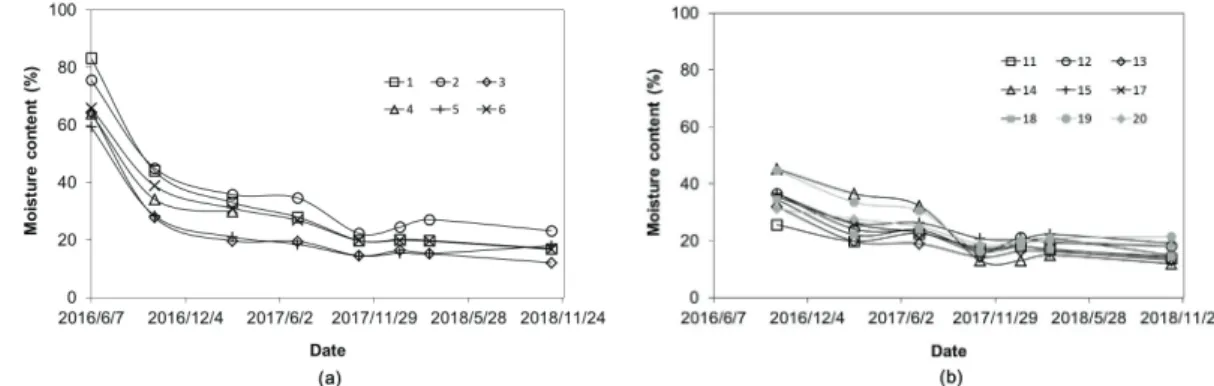
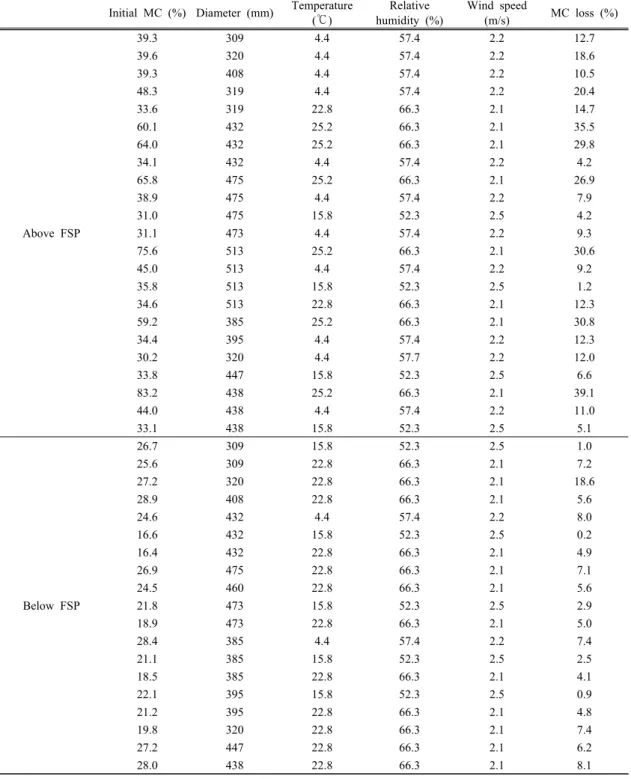
1)Air drying was carried out on 15 Korean red pine logs to provide a prediction model of the moisture content (MC) change in the wood during drying. The final MC was 17.4% after 880 days since the beginning of air drying in the summer for 6 Korean red pine logs with 68.7% initial MC. The final MC was 16.0% after 760 days since the beginning of air drying in the winter for 9 Korean red pine logs with 35.8% initial MC. A regression model with R-squared of 0.925 was obtained as a result of multiple regression analyses with initial MC, top diameter, temperature, relative humidity, and wind speed as independent variable and and MC change during air drying as dependent variable. The initial MC and top diameter, which is the characteristic of Korean red pine, have greater effect on the MC decrease during air drying compared to meteorological factors such as the temperature, relative humidity, and wind speed.
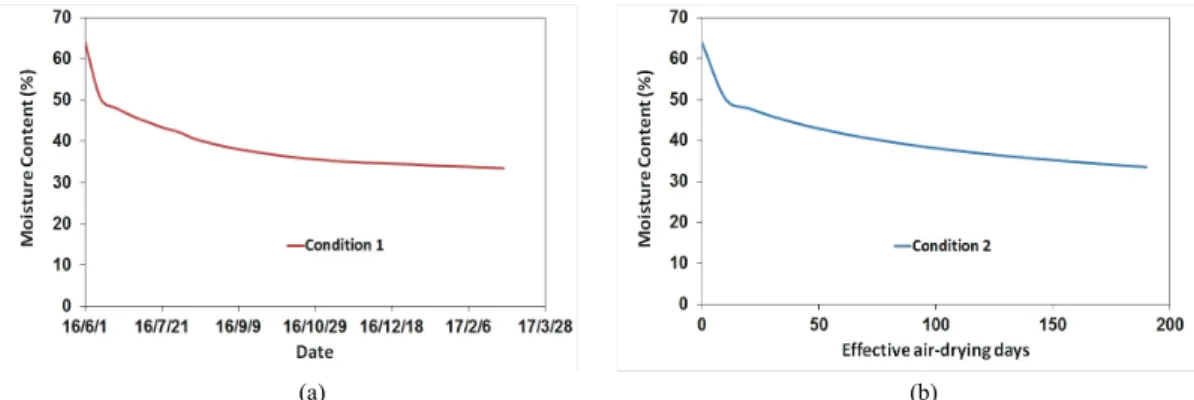
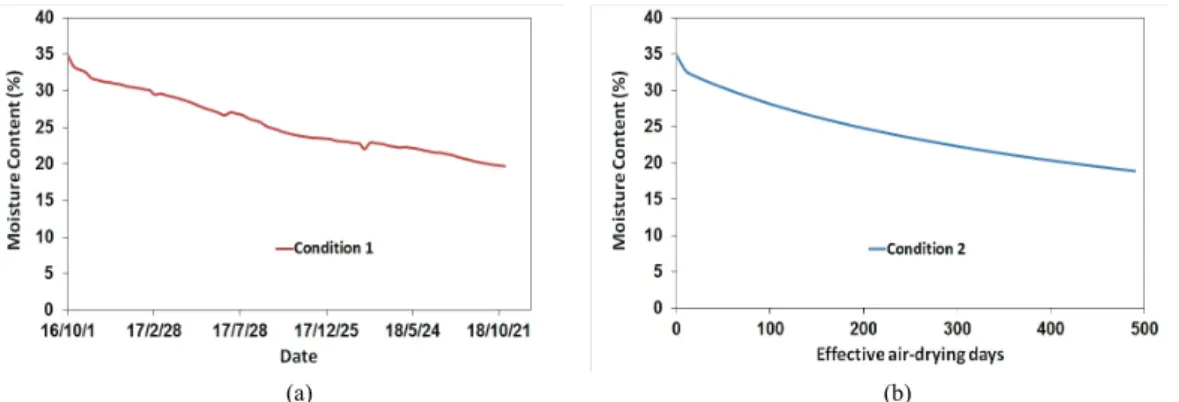
Two-dimensional mass transfer analysis was performed to predict the MC distribution of Korean red pine logs during air drying. Two prediction models with different air drying days and different meteorological factors for the determination of the diffusion coefficient and surface emission coefficient were presented. The error between the different two methods ranged from 0.1 to 0.8% and the difference from the measured value ranged from 2.2 to 3.6%. By measuring the internal MC during air drying of Korean pine logs with various initial MC and diameter, and calculating the moisture transfer coefficient in wood for each meteorological condition, the error of the prediction model can be reduced.
Keywords: air drying, moisture content distribution, mass transfer, finite difference method, Korean red pine
1. INTRODUCTION
It is not an easy task to estimate the time for air drying of wood. It is affected by the geopolitical location of the drying facilities, and species and thickness of the wood. In general, small-density species could have
a faster drying rate than greater-density species, but changing weather conditions make the results more complicated. The variables involving weather con- ditions, such as temperature and relative humidity that affect the drying rate, change from year to year. One of the best ways to decide on the weather conditions
1
Date Received October 11, 2019, Date Accepted October 28, 2019
2
Department of Forest Products, National Institute of Forest Science, 57 Heogi-ro, Dondaemun-gu, Seoul, 02455, Republic of Korea
†
Corresponding author: Yeonjung HAN (e-mail: [email protected], ORCID: 0000-0002-0962-5918)
Original Article
Korean Red Pine Logs under Different Air Drying Conditions
in a particular area is to use the averages of weather factors across several years (Simpson and Hart, 2000).
Wood stacked in spring takes relatively shorter to dry because the drying period is longer, i.e. in spring and summer, whereas wood stacked in late summer or early autumn takes relatively longer to dry because of the longer period of cold days in winter.
Among the studies on air drying, those related to the change of moisture content (MC) and drying time of wood have generally used lumber with a thickness of 50 mm or less. Studies have been conducted in the United States to show the time required for air drying of softwood and hardwood lumbers 25 mm and 50 mm thick up to a target MC of 20% (Rietz and Page, 1971; McMillen and Wengert, 1978). However, the list of time periods for air drying suggested in those studies is limited to the wood stacked in a specific area and at a specific time due to lack of data for calculating the time periods. And the results for species such as hardwoods are not exact (Simpson and Hart, 2000).
In these studies, variables such as initial MC, temperature, and relative humidity were put into a regression equation to apply the results obtained in a specific area across the country (Denig and Wengert, 1982). In addition, these studies have developed a numerical analysis model using moisture diffusion coefficients obtained through experiments and suggested a method of changing each coefficient by using weather data from different regions (Hart, 1982).
While these studies have presented finite difference methods to analyze heat and mass transfer in arbitrary materials (Holman, 1989), the method was used to conduct one-dimensional analysis (Sutherland et al., 1992) and two-dimensional analysis (Ranta-Maunus, 1994; Perré et al., 1993). There were studies in Korea to predict the MC change during the high temperature drying of Korean red pine timber (Kim et al., 2017) and to predict the temperature distribution during heat treatment of black pine wood (Han et al., 2016). In
both of these studies, the finite difference method was used. In those studies, when comparing the predicted and measured values of the MC distribution during wood drying, appropriate choice of diffusion coefficients and surface emission coefficients turned out to be very important (Kamke and Vaneck, 1994). A study on air drying in Korea reported that it took 38 and 84 days for a 25mm thick and 50 mm taun lumber to reach 20% MC, respectively (Jung, 1985) and other studies have analyzed seasonal changes in the rate of air drying of softwood and hardwood lumbers (Lee and Jung, 1989;
Jung et al., 1997). One study involving the air drying of timbers and logs measured the time it took for MC to reach 18% for air drying of Korean red pine and Japanese larch (Jung et al., 2003). Another study was carried out to analyze the effect of air drying as a preliminary drying for high temperature and low humidity drying of Korean red pine wood’s large cross section (Lee et al., 2014).
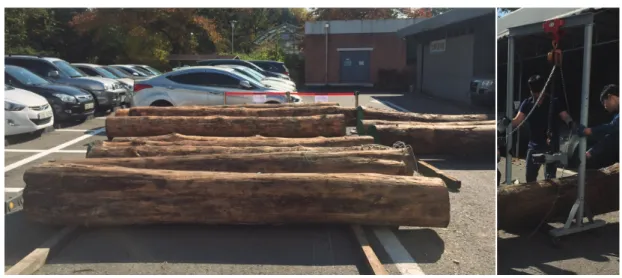
The purpose of this study is to analyze the change of MC during air drying of Korean red pine logs and to suggest air drying time to reach the target. A air drying facility was set up in Seoul, and the weight of logs was measured to evaluate the changes in MC.
Then, wood-related data such as initial MC, top diameter, and dry weight of Korean red pine logs and weather data such as temperature, relative humidity, and wind speed were used to conduct two-dimensional moisture transfer analysis, which led to the prediction of MC distribution of wood.
2. MATERIALS and METHODS 2.1. Test materials and air drying of
Korean red pine logs
Test species are Korean red pine trees (Pinus
densiflora) collected from Uljin-gun, Gyeongsangbuk-
do and 15 logs with IV-XI age class were cut to
Species Age class
Average top-diameter (mm)
Total number
Initial moisture content (%)
Average oven-dry specific gravity
Average ring width (mm)
Korean red pine
III‒IV 339 (46.3 SD
1) 5 41.7 (4.4 SD) 0.47 (0.03 SD) 4.6 (0.8 SD) VI‒VII 455 (21.2 SD) 5 49.7 (18.8 SD) 0.50 (0.01 SD) 3.5 (0.5 SD) IIX‒IX 412 (72.3 SD) 5 46.7 (19.9 SD) 0.51 (0.04 SD) 2.6 (0.4 SD)
XI 438 1 83.2 0.52 2.1
Table 1. Physical properties of Korean red pine for air drying
1