Tyrosinase Activity and Melanogenic Effects of Rhododendron schlippenbachii Extract In vivo and In vitro 1
Si Young HA
2⋅ Ji Young JUNG
2⋅ Hee Young KANG
3⋅ Tae-Heung KIM
4⋅Jae-Kyung YANG
2,†ABSTRACT
1)Rhododendron schlippenbachii have been used as a medicine because of their various biological activities. In this study, R. schlippenbachii ethanol extract was evaluated for the treatment of vitiligo. The R. schlippenbachii ethanol extract did not show any cell cytotoxicity. The effect on mushroom tyrosinase and cellular tyrosinase activities were further assessed. In addition, the determination of melanin content in melanocytes was measured using both the B16 melanoma cells and C57BL/6J Ler-vit/vit mice. Finally, the existence of quercetin in R. schlippenbachii was confirmed by qualitative analysis using HPLC. The results clearly demonstrated the R. schlippenbachii extract enhanced melanogenesis and also increased tyrosinase activity in cultured melanoma cells and C57BL/6J Ler-vit/vit mice. In addition, treatment with R.
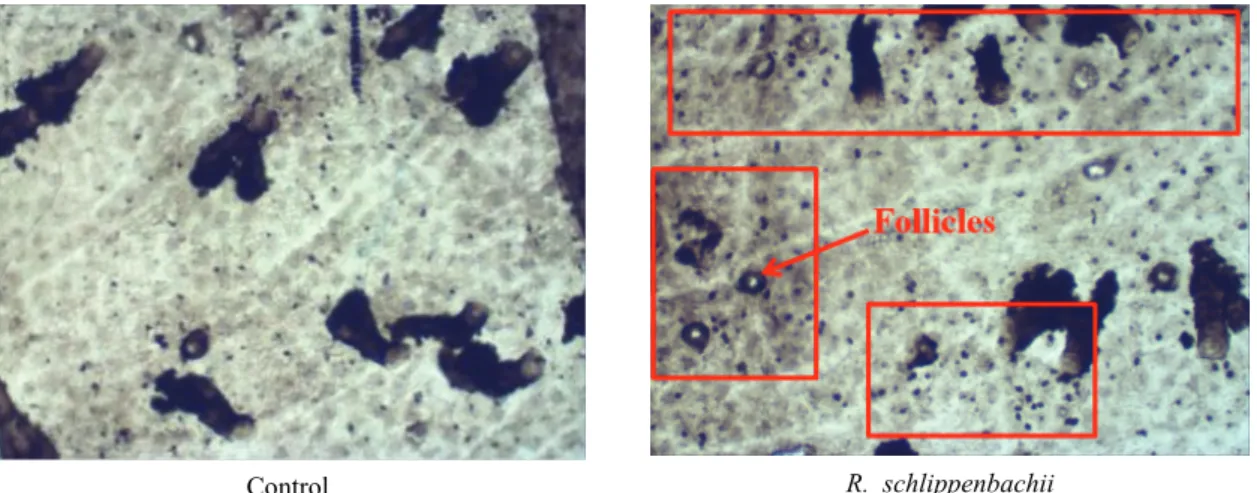
schlippenbachii extract led to a higher content of melanin and eumelanin in C57BL/6J Ler-vit/vit mice hair than in control (untreated) mice, which demonstrated the therapeutic effect of hair-graying associated with vitiligo. Finally, we confirmed a notable increase in melanocytes in the skin of C57BL/6J Ler-vit/vit mice treated with R. schlippenbachii extract compared with the control. Extracts of R. schlippenbachii was shown to be potent tyrosinase and melanin synthesis activator in B16 melanoma cells. The R. schlippenbachii extract have significantly higher melanin content than the untreated control in C57BL/6J Ler-vit/vit mice hair. The results suggest that R. schlippenbachii extract might be considered as an alternative treatment for improvement of vitiligo.
Keywords: Rhododendron schlippenbachii, tyrosinase activity, melanogenesis, vitiligo
1. INTRODUCTION
Vitiligo is a common depigmenting skin disease, associated with certain autoimmune endocrinopathies, and autoantibodies to several antigens can be found in melanoma cells. Vitiligo is an acquired condition without other apparent presymptoms in the skin (Spritz, 2010). It was suggested that there were melanocytes but their melanin producing activity was inhibited.
When melanocyte activity is affected, melanin is not synthesized in the melanosomes of melanocytes. In addition, the development of vitiligo is related to the rates of synthesis and decay of tyrosinase. As present, many studies have investigated the importance of tyrosinase in the regulation of racial pigmentation. Song et al. (1994) showed that tyrosinase was an enzyme important in melanin formation. The current treatment options for vitiligo include medication, surgery, and
1Date Received November 5, 2019, Date Accepted February 10, 2020
2Division of Environmental Forest Science/Institute of Agriculture and Life Science, Gyeongsang National University, Jinju 52828, Republic of Korea
3Department of Dermatology, Ajou University School of Medicine, Suwon 16499, Republic of Korea
4White-Line Skin Clinic, Changwon 51496, Republic of Korea
†Corresponding author: Jae-Kyung YANG (e-mail: [email protected], ORCID: 0000-0003-0423-6398) Original Article