30: 577 ∼ 581, 2015 September eISSN: 2287-6936
⃝2015. The Korean Astronomical Society. All rights reserved. c http://dx.doi.org/10.5303/PKAS.2015.30.2.577
THE PARKES PULSAR TIMING ARRAY PROJECT George Hobbs
CSIRO Astronomy and Space Science, PO Box 76, Epping, NSW, 1710, Australia E-mail: [email protected]
(Received November 30, 2014; Reviced May 31, 2015; Aaccepted June 30, 2015)
ABSTRACT
The main goals of the Parkes Pulsar Timing Array (PPTA) project are to 1) detect ultra-low-frequency gravitational waves, 2) improve the solar system planetary ephemeris and 3) provide a long-term, stable time standard. In this paper, we highlight the main results from the project so far and discuss our expectations for the future.
Key words: pulsars: general
1. INTRODUCTION
Very precise determinations of pulse times-of-arrival (ToAs) from millisecond pulsars can be obtained with the Parkes radio telescope. The pulsar timing method (see e.g., Edwards et al., 2006) provides the means by which those ToAs can be modelled using a relatively simple parameterisation of the pulsar and the interstel- lar medium. Physical effects that are not in the param- eterisation, but cause variations in the pulse ToAs, will lead to structure in the “timing residuals” (the difference between the observed and predicted ToAs). Phenom- ena that are local to the pulsar (e.g., magnetospheric variations) will induce timing residuals that are not cor- related between different pulsars. Errors in the clock used for measuring the ToAs will lead to identical resid- uals for all pulsars analysed with that particular clock.
The effect of errors in the solar system ephemeris or the passage of gravitational waves (GWs) past the Earth will lead to timing residuals that can be distinguished by studying how the timing residuals are correlated on different angular scales.
The Parkes Pulsar Timing Array (PPTA) was started in 2004 (see Manchester et al. 2013a for details and Hobbs 2012 for a historical review) and has the three main goals of 1) detecting GWs, 2) improving the solar system ephemerides and 3) developing a pulsar-based timescale. In this paper we describe our research related to these main project goals, but note that the data sets have also been used for numerous other projects such as studying the interstellar medium (You et al., 2007;
Keith et al., 2013), the solar wind (You et al., 2012) and the pulsars themselves (Os lowski et al., 2011; Shannon et al., 2014; Verbiest et al., 2009).
http://pkas.kas.org
2. THE PPTA DATA SETS
The PPTA project has been described in detail by Manchester et al. (2013a). In brief, all observations are obtained with the 64-m diameter Parkes radio tele- scope. We now observe 24 millisecond pulsars (some pul- sars have been recently added, other pulsars have been removed from the sample) with a typical observing ca- dence of about three weeks. During each observing ses- sion we attempt to observe each pulsar at least once with a 20 cm receiver that provides a bandwidth of 256 MHz and once with a dual-frequency receiver that simultane- ously enables observations in the 10 and 50 cm bands. In the 10 cm band, 1 GHz of bandwidth is available and the 50 cm band provides a bandwidth of 64 MHz. We cur- rently use two digital filterbank systems (PDFB3 and PDFB4) to record the data along with two coherent dedispersion instruments (CASPSR and APSR). Typ- ical observation times are 1 hour and each observation is preceded by a short calibration observation of a pulsed noise signal.
We process the observations using the PSRCHIVE software package (Hotan, van Straten & Manchester, 2004) to obtain pulse ToAs. Those ToAs are subse- quently processed using the tempo2 software package (Hobbs et al., 2006).
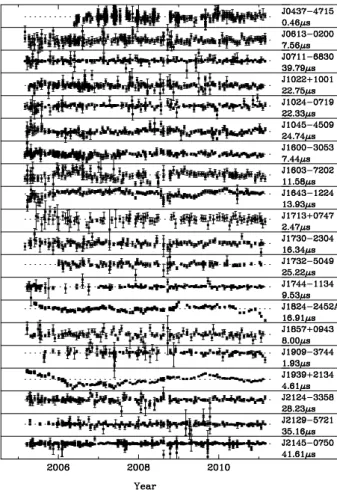
High-quality PPTA observations started in the year 2005. Data from 2005 to 2011 have been published as the first data release (known as the “dr1” data set; see Section 7 and the timing residuals in Figure 2). Combin- ing these data with earlier observations from the Parkes telescope (Verbiest et al. 2009) led to the extended data release 1 (known as “dr1e”). For some pulsars this pro- vides a data span extending back to the year 1996.
3. NEW TECHNIQUES
In order to achieve the timing precision necessary to
search for GWs, we have had to make numerous im-
577
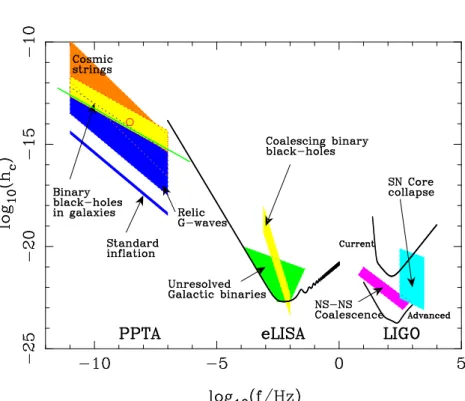
Figure 1. The sensitivity of the PPTA (red circle), space-based detectors, such as eLISA, and ground-based detectors, such as LIGO, to gravitational waves. Pulsar timing arrays are sensitive to GWs with frequencies between ∼ 10
−9to 10
−7Hz.
provements to our software and algorithms. van Straten (2013) describes calibration methods that are required to determine ToAs at this level of precision. Previ- ous timing software packages did not provide the nec- essary level of precision and so the tempo2 software package (Hobbs et al., 2006) was developed with the aim of including all phenomena that affect pulse ToAs at the >1 ns level. Timing residuals for pulsars that have been monitored over many years are affected by low-frequency noise processes. Coles et al. (2011) de- scribed how to generalise the least-squares-fitting rou- tines within tempo2 to account for such noise. Deng et al. (2012) discussed how pulsar timing data sets could be interpolated and extrapolated.
The main project goal requires us to search for GWs, errors in time standards and errors in the solar system ephemeris. To do this we have introduced into tempo2 the ability to fit for functions of arbitrary shapes that have a monopolar, dipolar or a quadrupolar spatial signature. These can be fitted globally to the entire data set simultaneously with a fit for the specific tim- ing model parameters for each individual pulsar. This has required the development of a global (introduced in Champion et al., 2010) and constrained (Keith et al., 2013) least-squares fitting procedure.
The dominant signal seen in the timing residuals for most pulsars is caused by dispersion measure variations.
A procedure to remove those variations without remov- ing any underlying GW signal was described by Keith
et al. (2013).
Os lowski et al. (2011, 2013) and Shannon et al.
(2014) showed that the timing residuals for some of the PPTA pulsars are affected by jitter noise. This jitter noise was thought to be a fundamental noise floor in pulsar timing. However, Os lowski et al. (2011) demon- strated a method that led to an improvement in the rms timing residuals for PSR J0437 −4715 of ∼20 per- cent. An improved version of this method doubled this improvement to ∼40 per cent.
4. GRAVITATIONAL WAVES
Detweiler (1979) showed that GWs with frequencies be- tween 10
−9–10
−7Hz induce timing residuals that could be detectable with a sufficiently sensitive PTA. As shown in Figure 1 these GW frequencies are comple- mentary to those probed by other GW detectors such as LIGO/Virgo (ground-based) and eLISA (space-based).
The astrophysical predictions shown on this figure were obtained at the start of the PPTA project. More recent research has been published by Sesana et al (2008; 2009) and Ravi et al. (2014b). They show that the most likely source of detectable GWs will arise from a large number of coalescing supermassive binary black hole systems at the centres of merging galaxies
1. Ravi et al. (2014b)
1
Sanidas et al. (2012) have also described implications of recent
GW limits for models of cosmic strings. Some such models
produce a GW background that has a higher amplitude to the
predicted backgrounds from black hole coalescence.
predicts a “most likely” signal, which is indicated by the solid green line in Figure 1. The red circle indi- cates our most recent bound on the amplitude of the GW background (Shannon et al. 2013) showing that we have already ruled out many of the early predictions.
The design of the PPTA experiment (number of pul- sars, observing cadence etc.) was based on Jenet et al.
(2005) who showed that it is necessary to observe around 20 pulsars, with weekly observing cadence over a dura- tion of ∼5 yr to make a detection of the GW background.
Even though we have searched for such a background (e.g., Yardley et al., 2011), no detection has yet been made. Instead we have continued to place ever more stringent constraints on the amplitude of any possible background (Jenet et al., 2006; Shannon et al., 2013).
The most recent limits (Shannon et al., 2013) rule out some models for black-hole formation and evolution in galaxies.
We have also searched for individual supermassive bi- nary black hole systems (Yardley et al., 2010 and Zhu et al., 2014). Our most recent work shows that, in some sky directions, we are sensitive to GWs from circular supermassive binary black holes with masses of 10
9M
⊙out to a luminosity distance of about 100 Mpc. We have also searched for the burst event predicted from the fi- nal merger of an individual black hole binary system.
Wang et al. (submitted to MNRAS) places bounds on the size of any such events and shows that the expected event rate for detectable bursts is so low that our non- detection is not surprising.
Our algorithms have been based on frequentist statis- tics. In the future we will continue to develop our al- gorithms and apply them to increasingly sensitive data sets. We will also be applying the Bayesian methods developed elsewhere (e.g., van Haasteren et al., 2011;
Demorest et al., 2013; Lentati et al., 2014) to our data sets. Finally, the detection of a GW signal will be of enormous scientific interest. We are currently carrying out research to ensure that our algorithms will not give a false positive detection.
5. THE SOLAR SYSTEM EPHEMERIS
The pulsar timing method relies on knowledge of the observatory position with respect to the solar system barycentre. In Champion et al. (2010) we used ob- servations from the PPTA combined with observations from the Arecibo and Effelsberg telescopes in order to search for errors in the assumed solar system barycen- tric position caused by inaccurate planetary mass esti- mates. This technique allowed us to provide very precise estimates of the planetary masses. These masses were shown to be consistent with independent space-craft de- terminations.
The Champion et al. (2010) method can find mass er- rors in known planetary objects, but cannot be applied to search for unknown objects in the solar system. We have updated the tempo2 software package to fit for errors in the Earth–solar system barycentric vector as a function of time. That method is currently being ap- plied to the PPTA data in order to search for unknown
Figure 2. The timing residuals from the first PPTA data re-
lease. The value gives the range of the residuals for a given
pulsar in microseconds. Figure from Wang et al. (submitted
to MNRAS).
objects. The results of this processing will be published elsewhere.
Deng et al. (2013) assumed that the position of the solar system barycentre was known and developed a pro- cedure to use observations of millisecond pulsars to de- termine the position of the telescope. Of course, the telescope need not be on Earth and we demonstrated that with an X-ray telescope on board a spacecraft on a trajectory between Earth and Mars it is possible to determine its position with a precision and accuracy of
∼10 km .
6. A PULSAR-BASED TIME STANDARD
Hobbs et al. (2012) and references therein demonstrated how errors in a terrestrial time standard could be iden- tified by searching for the common signal in the pulsar timing residuals. Any such errors could then be “cor- rected” using the pulsar data enabling a long-term, sta- ble time scale using both atomic clocks and pulsar ob- servations. We demonstrated that known changes to In- ternational Atomic Time (TAI) could be identified using the PPTA data set and there was evidence for possible discrepancies with the world’s best time standard, ter- restrial time as realised by the BIPM.
7. DATA ACCESS
The raw observations and corresponding calibration data obtained for the project are available from the CSIRO data archive (data.csiro.au; Hobbs et al., 2011). All data are publically available for download after an embargo period of 18 months. Making use of these data requires knowledge of the processing software (such as PSRCHIVE) to calibrate and visualise the data.
We have also made pulse ToAs, timing parameters and red-noise models available. Our first data release of processed data is also available from the data archive
2. We are currently working towards a second data release, which we expect will include all observations until mid- 2014 and should be published by the end of this year.
8. THE INTERNATIONAL PULSAR TIMING ARRAY AND FUTURE TELESCOPES
Over the next few years it is expected that the Parkes telescope will be upgraded. We are hoping that a new ultra-wide band receiver (covering from around 700 MHz to 3 GHz) will be commissioned along with a new coherent-dedispersion backend system to process and record the data.
The PPTA data set is already being combined with data from the European (Kramer & Champion, 2013) and North American (McLaughlin 2013) timing arrays to form the International Pulsar Timing Array (IPTA) data set (Manchester et al., 2013b). The IPTA data set will be more sensitive to GWs, ephemeris errors and clock errors than the individual PTA data sets and it is likely that, in the relatively near future, an IPTA data set will lead the first detection of GWs.
2