Ⅰ. Introduction
X-rays were first discovered by Roentgen in 1895 and made it possible to visualize and diagnose information
through film. In modern medicine, radiation is used for medical diagnosis, treatment and research of humans which has played an important role in protecting and advancing medicine[1-3].
<원저>
The Knowledge, Attentions and Behaviors of Radiation Safety Managment by Dental Health care Workers
Lee Sun-Mi
1)・Kim Min-Ji
2)1)
Department of Dental Hygiene, Kyungnam College of Information & Technology
2)
Department of Dental Hygiene, Dongseo University
치과종사자들의 방사선 안전관리에 대한 지식 및 행태
이선미
1)・김민지
2)1)경남정보대학교 치위생과・2)동서대학교 치위생학과
Abstract
The purpose of this study examines the education, knowledge and behavior of radiation safety management among dental workers and compares the education, knowledge and behavior between dental hygienist group and other occupational groups. This study was conducted from November 2nd to November14th, 2019. The survey was conducted on dental workers(dental hygienists, nursing, assistants, coordinators, etc.) who worked in dental hospitals and clinics in Busan area. The tool of this study was modified and adapted to the clinical setting based on the questionnaire. Radiation safety education has 39 dental hygienists who had more education than non-dental hygienists (p=0.286). The most com- mon types of radiation safety education were self-education which usually performed by dentistry, followed by con- servative education and others. The average of radiation attitudes, knowledge and behaviors was higher in the dental hy- gienist group then in the non-dental hygienist group. On the item-specific behavior among employees, the question of
‘the radiation should be shielded according to the menstrual cycle or pregnancy of the woman of childbearing’ was sig- nificant (p<0.05). On the item-specific knowledge between occupations, the question of ‘the intensity of X-rays decreases over distance’ and ‘the individual exposure can be measured by TLD badge or film badge’ was significant (p<0.05).
Taken together, these results indicate that the dental hygienist group is more concerned about radiation safety and that the dental hygienist group is receiving more radiation safety management training. However, if there is a low level of
‘has experienced’ in the presence or absence of safety management education, it is difficult to train radiation safety man- agement in dentistry. Therefore, it is considered that dentists should be trained in radiation safety management periodi- cally to pay attention to radiation safety accidents.
Key Words :
Radiation, Radiation safety management, Knowledge, Behaviors, Attention
중심 단어 :방사선, 방사선 안전관리, 지식, 행동, 태도
This work was supported by Dongseo University, "Dongseo Cluster Project" Research Fund of 2019 (DSU-20190002).
Corresponding author: Min-Ji Kim, Department of Dental Hygiene, Dongseo University, 47 Jurye-ro, Sasang-gu, Busan, 47011, Republic of Korea / Tel: +82-51-320-2873 / E-mail: [email protected]
Received 9 December 2019; Revised 18 December 2019; Accepted 22 December 2019
In addition, oral care institutions are using radiation to diagnose oral disease and establish treatment plans using radiation. In recent years, the share of the radiation in the oral cavity as well as off-campus radiography, panorama shooting, and digital radiography is increasing rapidly. However, in the medical field, radiation has significant benefits for diagnosis and treatment, while also being a barrier to radiation exposure[4]. Even a small amount of medical radiation can be affected by long-term radiation. Therefore, dental workers working with radiation should know the basic knowledge, behavior and attitudes of radiation in order to protect themselves and their patients, and should be inclined not to exceed the maximum allowable dose of radiation exposure[5].
Regarding the safety management of radiation, radiation workers have received safety training and attention. However, the treatment of radiation in the clinic neglects the safety management of the radiation because the busy work neglects the attention and the continuous maintenance training is not provided.
Therefore, in the clinic, regular training on the safety management of radiation should be carried out[6].
Therefore, this study examines the education, knowledge and behavior of radiation safety management among dental workers and compares the education, knowledge and behavior between dental hygienist group and other occupational groups and can supplement it by radiation safety management which wanted to prepare the basic materials for preparing the education system.
Ⅱ. Subjects and Method
1. Subjects and data collection
This study was conducted from November 2
ndto November 14
th, 2019. The survey was conducted on dental workers(dental hygienists, nursing, assistants, coordinators, etc.) who worked in dental hospitals and clinics in Busan area.
The data collection of this study was surveyed through a questionnaire. 150 copies of the questionnaire was distributed and the recovery rate was 78% which was
118 copies of it.
2. Method and contents
The tool of this study is the questionnaire, which was modified and adapted to the clinical setting based on the questionnaire used in the study of Kim[1]. The content of the questionnaire includes 11 questions of the general characteristics of the dental workers (gender, occupation, age, marital status, workplace, years of service, equipment status, radiation defense facilities, training status, number of safety trainings), 12 questions about the knowledge of radiation, 11 questions of the attitude and behavior of radiation defense equipment management, radiation exposure, operators and guardians, and 11 questions of the radiation safety management on the patient’s side respectively.
3. Statistical analysis
Radiation safety management behaviors, attitudes, and knowledge were measured on a five-point scale, and the higher the score, the higher the behavior, attitude and knowledge. The collected data were analyzed using SPSS 24.0 statistical program. The main analysis techniques are as follows.
1) The general characteristics of the subjects and the status of dental equipment were analyzed by frequency analysis.
2) Average comparison of attitude behavior knowledge between dental hygienists and another group of dental hygienists was used as the student t-test.
3) Items related to radiation safety management education were analyzed by cross analysis.
Ⅲ. Results
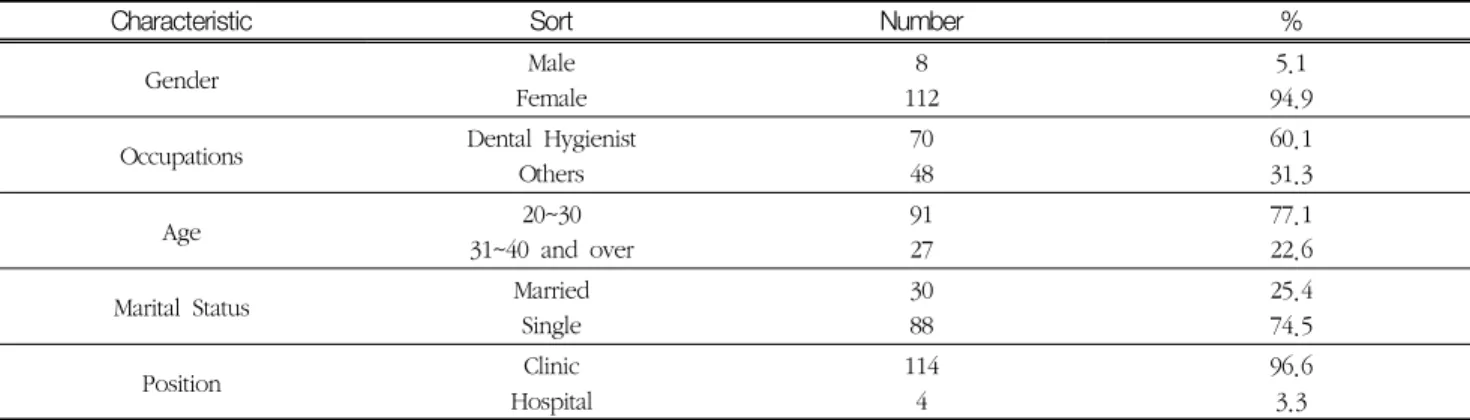
1. General characteristics of the subject
There were 118 dental workers consisting of 112
females(94.9%) 6 males(5.1%) which shows females
were far more prevalent in terms of occupational
characteristics. There were 70 dental hygienists (60.1%) and 48 non-dental hygienists(31.3%). 91(77.1%) were the most in their 20s and 30s, and 88(74.5%) were unmarried, 114(96.6%) were working at clinics whereas 4(3.3%) were working at hospitals due to the nature of dental work, the number of clinics was far superior
<Table 1>.
2. Equipment Status of Dentistry
The number of intraoral/ Extraoral cameras was the highest with 84 units(71.1%) and the digital radiographs were 102 with 86.4%. The largest number of digital
radiation protection equipment is 64(54.2%) of lead suits, followed by TLD badge>shooting with smaller exposure>thyroid guard>other respectively. The most frequently used were lead armor>TLD badge>thyroid protector>other respectively<Table 2>.
3. Radiation Safety Management Training
31(44.3%) dental hygienist group had ‘safe education’
which was higher than non-dental hygiene groups
<Table 3>.
4. Carrying out training according to the type Table 1. General Characteristics
Characteristic Sort Number %
Gender Male
Female 8
112 5.1
94.9
Occupations Dental Hygienist
Others 70
48 60.1
31.3
Age 20~30
31~40 and over 91
27 77.1
22.6
Marital Status Married
Single 30
88 25.4
74.5
Position Clinic
Hospital 114
4 96.6
3.3
Table 2. Equipment Status of Dentistry
Characteristics Sort Number %
Radiation Unit
<Intraoral camera>
1 unit 2 units 3 units and more
84 276
71.1 22.95.1
<Extraoral camera>
1unit 2 units 3 units and more
94 145
79.6 11.94.23
<Digital radiography>
Yes
No 102
16 86.4
13.6
Digital radiation protection equipment
Lead armor Thyroid Guard
TLD badge Small exposure
Others
64 499 30 6
54.2 41.57.6 25.4 5.1
Radiation protection equipment
Lead wall(Shielding plate) TLD badge Lead armor Thyroid Guard
Others
8955 84 124
75.447.6 71.1 10.13.4
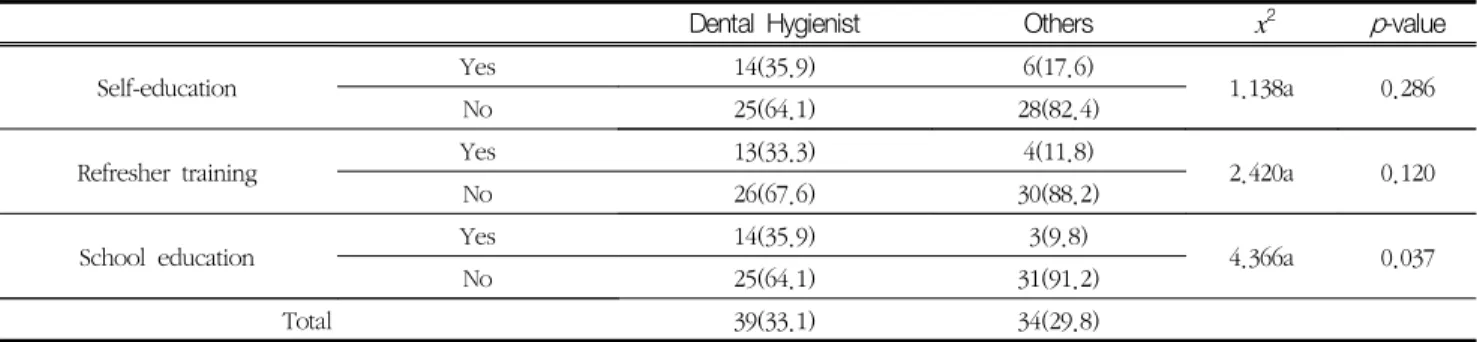
of radiation safety management training In the type of radiation safety management education, self-education was the highest among the dental hygienists’ group: 14(35.9%) in the dental hygienist group and 6(17.6%) in the non-dental hygienist group.
With the refresher training, there were 13 with dental hygienist groups(33.3%) and 4 with non-dental hygienist groups(11.8%). 14 dental hygienists(35.9%) were trained at a school whereas 3 non-dental hygienists (9.8%)
<Table 4>.
If they were listed in order, the group of dental
hygienists was in order of self-education ≧ school education > refresher training, and the groups other than dental hygienists were self-education > refresher training > school education.
5. Item-specific knowledge between occupations The average of knowledge among occupations was higher in the dental hygienist group than in the non-dental hygienist group, and in questions no. 2, the non-dental hygienist group was higher than the dental hygienist group. The highest average in the
Table 3. Radiation Safety Management Training (N (%))
Dental Hygienist Others 匪2 p-value
Safety Training Yes 31(44.3) 14(29.2)
1.138a 0.286
No 39(55.7) 34(70.8)
Total 70(59.3) 48(40.7)
Table 4. Carrying out training according to the type of radiation safety management training (N (%))
Dental Hygienist Others 匪2 p-value
Self-education Yes 14(35.9) 6(17.6)
1.138a 0.286
No 25(64.1) 28(82.4)
Refresher training Yes 13(33.3) 4(11.8)
2.420a 0.120
No 26(67.6) 30(88.2)
School education Yes 14(35.9) 3(9.8)
4.366a 0.037
No 25(64.1) 31(91.2)
Total 39(33.1) 34(29.8)
Table 5. Item-specific knowledge between occupations
Question Dental Hygienist Others p-value
1. The intensity of the X-rays decreases over distance. 4.11±0.956 3.50±1.272 0.003* 2. Occupational doses should not exceed 20 mSv per year on average over the five
years prescribed. 3.24±1.377 3.35±1.345 0.663
3. There are two types of radiation disorders: chronic and acute. 3.89±1.057 3.54±1.237 0.108 4. The gonads in the human body are very sensitive to radiation. 4.14±1.026 3.81±1.197 0.111 5. X-ray shielding is possible with materials made of lead or concrete. 4.06±1.075 3.50±1.399 0.016
6. Radiation exposure can have a genetic effect. 4.29±0.705 4.04±0.849 0.092
7. An X-ray irradiation switch is installed outside the shooting room. 4.37±0.920 4.31±0.854 0.722 8. According to the safety management rules, the head of the medical institution or
the person in charge of safety management should ensure that the worker undergoes
regular medical examination at least once a year. 4.36±0.660 4.27±0.664 0.481
9. Extraoral radiography has a higher radiation dose than intraoral radiography. 3.79±1.226 3.29±1.383 0.044* 10. The operator or patient should not hold the x-ray crown by hand while the x-ray
is exposed. 4.13±1.020 3.06±1.390 <0.001*
11. Longer focal-film distances reduce skin exposure. 3.37±1.253 2.96±1.398 0.096
12. Individual exposure can be measured on TLD badges or film media. 4.01±0.955 3.29±1.398 0.001*
dental hygienist group was 7 questions and the lowest average was question no. 2<Table 5>.
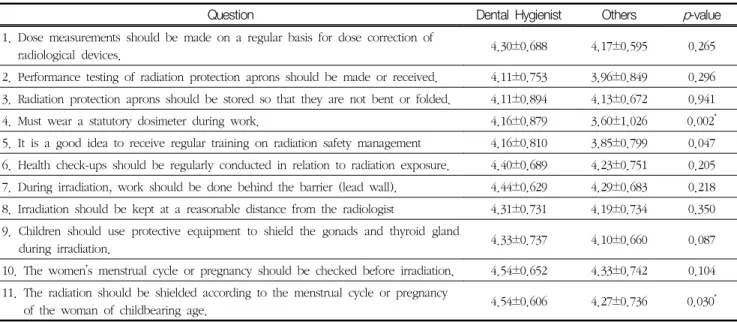
6. Item attitudes between occupations
The average of attitudes among occupations was higher in the dental hygienist group than in the non-dental hygienist group, and in question no.3, the non-dental hygienist group was higher than the dental hygienist group. The highest average in the dental hygienist group was 10 questions, and the lowest average was questions no. 2 and 3. The highest
average of the non-dental hygienists’ group was question no. 10 and the lowest average was question no. 4<Table 6>.
7. Item-specific behavior among employees The average of the behaviors among occupations was higher in the dental hygienist group than in the non-dental hygienist groups and questions no. 2, 3, and 10 were higher in the non-dental hygienist group than in the dental hygienist group. The highest average in the dental hygienist group was questions
Table 6. Item attitudes between occupations
Question Dental Hygienist Others p-value
1. Dose measurements should be made on a regular basis for dose correction of
radiological devices. 4.30±0.688 4.17±0.595 0.265
2. Performance testing of radiation protection aprons should be made or received. 4.11±0.753 3.96±0.849 0.296 3. Radiation protection aprons should be stored so that they are not bent or folded. 4.11±0.894 4.13±0.672 0.941
4. Must wear a statutory dosimeter during work. 4.16±0.879 3.60±1.026 0.002*
5. It is a good idea to receive regular training on radiation safety management 4.16±0.810 3.85±0.799 0.047 6. Health check-ups should be regularly conducted in relation to radiation exposure. 4.40±0.689 4.23±0.751 0.205 7. During irradiation, work should be done behind the barrier (lead wall). 4.44±0.629 4.29±0.683 0.218 8. Irradiation should be kept at a reasonable distance from the radiologist 4.31±0.731 4.19±0.734 0.350 9. Children should use protective equipment to shield the gonads and thyroid gland
during irradiation. 4.33±0.737 4.10±0.660 0.087
10. The women’s menstrual cycle or pregnancy should be checked before irradiation. 4.54±0.652 4.33±0.742 0.104 11. The radiation should be shielded according to the menstrual cycle or pregnancy
of the woman of childbearing age. 4.54±0.606 4.27±0.736 0.030*
Table 7. Item-specific behavior among employees
Question Dental Hygienist Others p-value
1. Check the radiation-related equipment at work is in good working condition before use. 4.10±0.854 4.02±0.758 0.598 2. After using the radiation protection apron, straighten out and store it. 3.71±1.229 3.75±0.978 0.861 3. Perform or test performance of radiation protection aprons. 3.13±1.329 3.23±1.153 0.663 4. During radiation work, a regular statutory dosimeter is worn. 3.47±1.271 3.44±1.165 0.881 5. I check the doses of radiation that have been measured on a monthly or quarterly basis. 3.33±1.370 3.00±1.255 0.181 6. Receive regular training on radiation safety management. 3.07±1.386 3.07±1.386
2.77±1.259 0.224
7. Work behind a barrier during irradiation. 4.07±1.026 3.85±0.850 0.213
8. Irradiation should be kept at an appropriate distance from the source and the patient. 4.04±0.970 3.88±0.890 0.334 9. Protective equipment should be used to shield the gonads and thyroid gland during
irradiation. 3.66±1.214 3.42±1.145 0.277
10. Check the menstrual cycle or pregnancy of the woman of childbearing age before
irradiation. 4.16±1.058 4.17±0.808 0.956
11. When irradiating pregnant women, use protective equipment in addition to the
imaging area. 4.23±1.132 3.90±1.115 0.117