Article Info
Received June 29, 2020 Revised July 16, 2020 Accepted July 29, 2020 Corresponding Author Bong-sam Choi E-mail: [email protected]
https://orcid.org/0000-0002-0165-4941
Key Words Cancer survivors
Health related quality of life Palliative medicine Psychometrics
Background: Although the original version of the health-related quality of life (HRQOL) questionnaires are found to be acceptable, the cross-culturally adapted versions may not be comparable to their original version.
Objects: To examine dimensionality and construct validity of two Korean versions of the brief version of the World Health Organization Quality of Life (WHOQOL-BREF) and EuroQOL-5 dimension (EQ-5D) questionnaires.
Methods: A total of 77 cancer survivors undergoing palliative rehabilitation programs from two rehabilitation institutes was recruited from April 16, 2018 to June 26, 2019. The WHO- QOL-BREF and the EQ-5D were filled out by the various cancer survivors following a particular session of rehabilitation programs. The scores were analyzed with Winsteps Rasch analysis computer program using the rating scale model. Rasch fit statistics were used to determine the dimensionality and the item difficulty calibrations of WHOQOL-BREF and EQ-5D.
Results: All items except two, negative feeling, need treatment function and pain prevent activity (mean square [MnSq] = 2.42, 1.82 and 2.51, respectively), were found to be accept- able, while two items of the EQ-5D, anxiety/depression and self-care, were misfit (infit MnSq = 1.65 and 0.38, respectively). Item difficulty calibrations of WHOQOL-BREF match person ability measures (i.e., HRQOL) fairly well. However, the person ability distribution showed obvious ceiling effects for EQ-5D. All items of EQ-5D were appeared to be less challenged in compari- son with those of WHOQOL-BREF.
Conclusion: Item-level analysis using the Rasch model supports the quality of culturally adapted items used to measure the HRQOL one exception; that is, whether or not to include misfit items as part of the HRQOL measurements. Additionally, cancer survivors undergoing palliative rehabilitation programs appear to have more of a tendency to view the EQ-5D items as being more challenging than the WHOQOL-BREF.
Copyright ⓒ Korean Research Society of Physical Therapy
This is an Open Access article distributed under the terms of the Creative Commons Attribution Non-Commercial License (http://creativecommons.org/licenses/by-nc/4.0) which permits unrestricted non-commercial use, distribution, and reproduction in any medium, provided the original work is properly cited.
INTRODUCTION
The latest worldwide cancer statistics estimated 9.6 mil
lion deaths in 2018 and reported an increasing burden of care resulting from various cancers. It is one of the most costly conditions of global population with the economic impact exceeding 1.16 trillion dollars in 2010 in the United States [1].
According to the national cancer control institute in Korea, the average 5year survival rate of individuals with various cancer conditions increased about 69.4% in 2017 [2]. Despite potential improvements in the survivorship, these cancer survivors are
generally susceptible to have some limitations in their health
related quality of life (HRQOL). Yet they are three times more likely to report their limitations during the course of survivor
ship [3].
In general, palliative rehabilitation program (PRP) control
ling negative symptoms includes approaches primarily in
tended to enhance the HRQOL of the cancer survivors. This has been well evidenced in many peerreviewed journals [3
7]. The primary goals of PRP are now acknowledged to include concept of the HRQOL addressing the palliative care of cancer survivors [8,9]. The HRQOL questionnaires often include global
Physical Therapy Korea
PTK https://doi.org/10.12674/ptk.2020.27.3.212 pISSN: 1225-8962 eISSN: 2287-982X Phys Ther Korea. 2020;27(3):212-219
Original Article
Construct Validity of a Korean Version of the WHOQOL-BREF and EQ-5D Questionnaire Applied on Various Cancer Survivors Undergoing Palliative Rehabilitation Programs
Bong-sam Choi, PT, MPH, PhD
Department of Physical Therapy, College of Health and Welfare, Woosong University, Daejeon, Korea
ratings of health status and multidimensional status of HRQOL.
These measures often deal with a broad spectrum of health concepts and are intended to provide scores that are sensitive to all ranges of the concept being measured. By contrast, some measures are designed to assess the aspects of health status re
sulting from a particular pathology and to view the attribution of functional limitations to the specific condition [4,5].
Most commonly used HRQOL questionnaires, if not all, have often been noted for being psychometrically narrow, whereas the HRQOL is a multidimensional healthoriented concept encompassing aspects of health or health care, such as func
tioning and symptoms [8]. Therefore, the outcome measures require underlying constructs reflecting particular goals of the types of rehabilitation programs, such as improving the HRQOL before death, controlling symptoms and supporting other factors [10]. During the course of cancer survivorship, it is imperative to monitor how the programs impact the HRQOL and how optimally assess any variation of the HRQOL over time in suitable manner.
Of the most widely accepted HRQOL questionnaires, the brief version of the World Health Organization Quality of Life (WHOQOLBREF) and EuroQOL5 dimension descriptive sys
tem (EQ5D) are considered to be optimal for cancer survivors in many peer reviewed journals in regards to construct validity and psychometric adequacy [7,1113]. Crossculturally adapt
ed versions of them were validated in many peerreviewed journals and proved to be reliable, also responsive [12,14,15].
Since these two questionnaires were simultaneously developed in many countries, such approaches offered intriguing a possi
bilities warranting the crosscultural adaptation related validity of the measure. However, as demand for the measure grew in countries where no language version of the measure existed, it naturally developed many translated versions. Accordingly, in such cases, the most appropriate version has been used as a starting point for the adaptation and updated by many au
thors.
Numerous classical test theory (CTT)based HRQOL mea
sures for cancer survivors have been developed and cross
culturally adapted into other languages. With almost endless array of translated HRQOL measures attempted to maintain psychometrical properties after crosscultural adaptation pro
cedure, often there is little distinction between the versions of the measures [1316]. While designed to assess ongoing dif
ficulties on the dimension of HRQOL, crossculturally adapted
versions of the measures often fail to maintain the dimensions referred to in the original version [6]. An evidence was ob
tained for a multidimensional perspective of the HRQOL in re
gards to construct validity. That is, the measurement structure accounts for construct validity in item responses either due to factors underlying the data or mistakenly treated latent traits they are intended to measure [6].
In addition, despite the myriad existing HRQOL measures, most investigators are often faced with a prevailing challenge of selecting an optimal measure. Although most CTTbased questionnaires have adequate psychometric properties, they may be insensitive either to a broad range of HRQOL level or to the actual variations that result from particular cancer ex
periences. One of the reasons is that these questionnaires are commonly developed to target the average person, hence the questionnaires are more likely to be sensitive at center than at both extremes in the ability range [17]. Consequently, these measures often demonstrate ceiling effects when these mea
sures are administered to persons with low ability score and floor effects when administered to persons with high ability score [1820].
The purpose of this study was to compare dimensionality and construct validity of two Korean version of WHOQOL
BREF and EQ5D questionnaires.
MATERIALS AND METHODS
1. Subjects
A total of 77 cancer survivors undergoing palliative rehabili
tation programs from an oriental medicine hospital in Busan and a rehabilitation hospital in Daejeon, Republic of Korea were recruited from April 16, 2018 to June 26, 2019. Potential subjects consisted of all appropriate clients undergoing the palliative rehabilitation program at the participating sites dur
ing the period. All participants received detailed information on the present study including informed consent and potential conflict of interests of which nonparticipation in the study may not influence whether the palliative rehabilitation pro
grams terminated. Subjects were asked to sign an informed consent and the Korean version of the WHOQOLBREF and the EQ5D approved by the Institutional Review Board of Col
lege of Health and Welfare, Woosong University (approval
No. 1041549190114SB70). The Korean versions of the
WHOQOLBREF and the EQ5D [21,22] were administered
(i.e, WHOQOLBREF was followed by EQ5D) upon the last entry of the first bout of rehabilitation program into physical therapy service and was subsequently requested from the sur
vivors at discharge following the completion of the program.
Of the participants who completed two measures, more than 35 percent were male (n = 35) and less than 65 percent (n = 42) were female with an average age of 52.9 ranged from 35 through 77. In addition, fortysix percent of the participants were diagnosed with breast cancer and fiftyfour percent were diagnosed with various cancers (i.e., cancers on colon, lung, stomach, pancreas, kidney, prostate, liver, ovary, lymphatic system related, tonsil, bile duct and brain).
2. Data Analysis
Scores were analyzed with the Winsteps software program version 3.57.2 (Wisteps.com, Chicago, IL, USA) using a rat
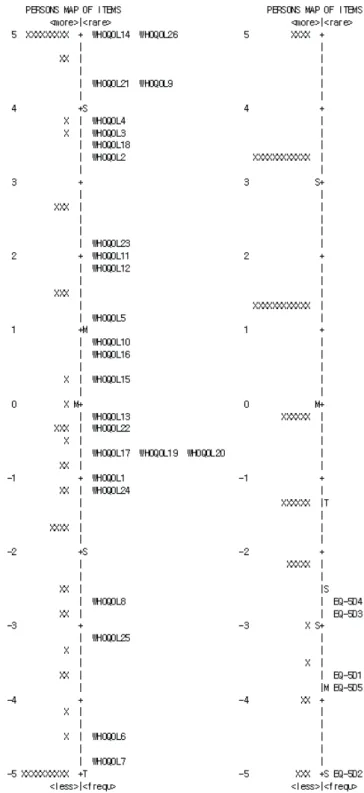
ing scale model [23,24]. Rasch fit statistics and item difficulty calibrations were examined to determine the dimensionality of the Korean version of the WHOQOLBREF. The construct validity of the Korean version of the WHOQOLBREF was visu
ally examined using the personitem map. The Rasch model
transforms raw scores into the estimate of person ability (i.e., the level of HRQOL) and item difficulty (i.e., more or less chal
lenging items) in logits. All descriptive statistics were calculated using the SPSS software version 25.0 (IBM Co., Armonk, NY, USA).
The Winsteps software program provides goodnessoffit statistics for each item and subject. These fit statistics were examined to detect items that did not fit the Rasch rating scale model criterion of dimensionality (or unidimensionality). The Infit and outfit mean square (MnSq) ≥ 1.4 and ≤ 0.6 and a standardized score greater than 2.0 were considered to be mis
fit, which is an indication that the particular item or survivor responded in unexpected ways [23]. The unexpected response indicated by the fit statistics suggests that the particular item is measuring another construct rather than the HRQOL. The pro
gram also generates a log odds unit (i.e., logit) scale to present the survivor’s level of HRQOL and item difficulty. The logit scale is based on the probability of getting success over the probability of getting failure on a response category of each item. The logical fashion of the analysis places test items along a continuum of the most to the least in difficulty. The hierar
Table 1.
Table 1. Fit statistics of the WHOQOLBREF in descending order of difficulty
Items Difficulty (logits) Infit MnSq ZSTD Outfit MnSq ZSTD
WHOQOL 26 negative feeling 0.76 2.42 5.3 2.55 5.7
WHOQOL 14 leisure activity 0.70 0.92 –0.4 0.92 –0.4
WHOQOL 21 sex life 0.45 0.89 –0.4 0.98 0
WHOQOL 9 healthy environment 0.44 0.95 –0.2 1.00 0.1
WHOQOL 4 need treatment to function 0.37 1.82 3.9 2.20 5.2
WHOQOL 3 pain prevent activity 0.36 2.51 5.5 3.21 6.9
WHOQOL 18 work capacity 0.34 0.64 –2.2 0.63 –2.1
WHOQOL 2 general health 0.32 1.06 0.4 1.06 0.6
WHOQOL 23 living place 0.15 0.86 –0.7 0.86 –0.7
WHOQOL 11 bodily appearance 0.13 0.73 –1.4 0.73 –1.4
WHOQOL 12 enough money 0.12 1.05 0.3 1.16 0.7
WHOQOL 5 enjoy life 0.03 0.73 –1.5 0.75 –1.4
WHOQOL 10 energy for daily life –0.01 0.69 –1.6 0.61 –1.7
WHOQOL 16 sleep –0.04 1.29 1.6 1.31 1.7
WHOQOL 15 get around –0.10 0.70 –1.9 0.67 –2.0
WHOQOL 13 available information –0.14 0.76 –1.4 0.75 –1.4
WHOQOL 22 support from friend –0.16 0.98 0 0.98 0
WHOQOL 17 satisfaction on daily life –0.22 0.69 –1.8 0.69 –1.8
WHOQOL 19 selfsatisfaction –0.22 0.75 –1.3 0.75 –1.4
WHOQOL 20 personal relationship –0.23 0.78 –1.3 0.77 –1.3
WHOQOL 1 overall quality of life –0.26 0.85 –0.7 0.87 –0.7
WHOQOL 24 health service –0.28 0.84 –0.8 0.81 –1.0
WHOQOL 8 feel safe for daily life –0.47 0.71 –1.6 0.72 –1.5
WHOQOL 25 transport –0.54 0.80 –1.0 0.79 –1.1
WHOQOL 6 meaningful life –0.72 0.83 –0.8 0.83 –0.8
WHOQOL 7 ability to concentrate –0.78 0.83 –0.9 0.83 –0.8
WHOQOLBREF, brief version of the World Health Organization Quality of Life; MnSq, mean square standardized residuals; ZSTD, Z score standardized.
chical order of item difficulty provides a means to examine the construct validity of the instrument [23].
To determine how well the EQ5D and the WHOQOLBREF represent the construct of HRQOL, data were analyzed by ex
ploratory factor analysis. A correlation matrix in which inter
correlations between individual test items was used respectively.
The dimensionality of the matrix can be reduced by inspecting the items highly correlating with a group of other items. How
ever, the matrix may represent low correlations with items out
side of that group [25]. In a nutshell, these items with high cor
relations could measure the trait being measured well, which is called a “factor”. The obtained factor creates a new dimension
visualizing classification axes along with test items can be plot
ted. This projection of the scores of the original test items on the factor leads to two concepts: factor score and loadings.
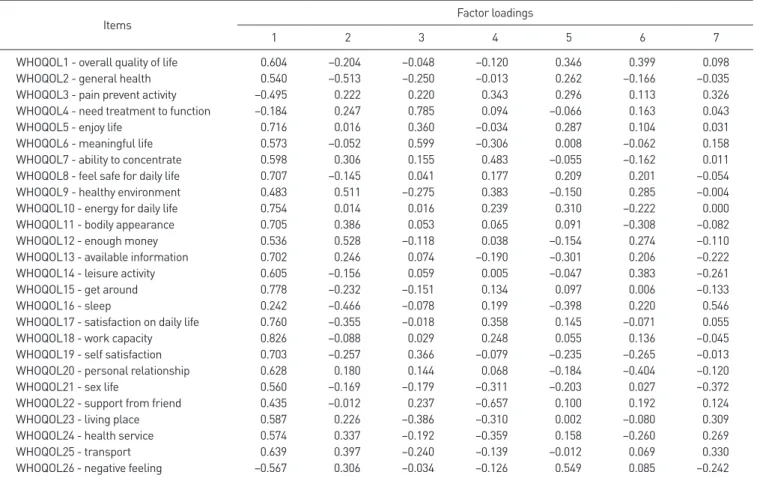
Factor scores are the scores of a subject on a particular factor, while the loadings are the correlations of the original test items with a factor. The factor loadings are now especially useful in determining the substantive importance of a particular item to a factor [25]. A rotated factor analysis was used to compute maximizing the loadings from the original factor matrix with eigenvalues greater than 1. In addition, greater than 0.40 as a significant loading was used.
Table 2.
Table 2. Fit statistics of the EQ5D in descending order of difficulty
Items Difficulty (logits) Infit MnSq ZSTD Outfit MnSq ZSTD
EQ5D 4 pain/discomfort 0.72 0.95 –0.1 1.22 0.9
EQ5D 3 usual activities 0.61 0.62 –1.9 0.52 –2.2
EQ5D 1 mobility 0.06 0.82 –0.6 1.04 0.2
EQ5D 5 anxiety/depression 0.02 1.65 2.7 1.69 2.2
EQ5D 2 selfcare –1.41 0.38 –2.2 0.22 –1.4
EQ5D, EuroQOL5 dimension; MnSq, mean square standardized residuals; ZSTD, Z score standardized.
Table 3.
Table 3. Factor loadings for the WHOQOLBREF
Items Factor loadings
1 2 3 4 5 6 7
WHOQOL1 overall quality of life 0.604 –0.204 –0.048 –0.120 0.346 0.399 0.098
WHOQOL2 general health 0.540 –0.513 –0.250 –0.013 0.262 –0.166 –0.035
WHOQOL3 pain prevent activity –0.495 0.222 0.220 0.343 0.296 0.113 0.326
WHOQOL4 need treatment to function –0.184 0.247 0.785 0.094 –0.066 0.163 0.043
WHOQOL5 enjoy life 0.716 0.016 0.360 –0.034 0.287 0.104 0.031
WHOQOL6 meaningful life 0.573 –0.052 0.599 –0.306 0.008 –0.062 0.158
WHOQOL7 ability to concentrate 0.598 0.306 0.155 0.483 –0.055 –0.162 0.011
WHOQOL8 feel safe for daily life 0.707 –0.145 0.041 0.177 0.209 0.201 –0.054
WHOQOL9 healthy environment 0.483 0.511 –0.275 0.383 –0.150 0.285 –0.004
WHOQOL10 energy for daily life 0.754 0.014 0.016 0.239 0.310 –0.222 0.000
WHOQOL11 bodily appearance 0.705 0.386 0.053 0.065 0.091 –0.308 –0.082
WHOQOL12 enough money 0.536 0.528 –0.118 0.038 –0.154 0.274 –0.110
WHOQOL13 available information 0.702 0.246 0.074 –0.190 –0.301 0.206 –0.222
WHOQOL14 leisure activity 0.605 –0.156 0.059 0.005 –0.047 0.383 –0.261
WHOQOL15 get around 0.778 –0.232 –0.151 0.134 0.097 0.006 –0.133
WHOQOL16 sleep 0.242 –0.466 –0.078 0.199 –0.398 0.220 0.546
WHOQOL17 satisfaction on daily life 0.760 –0.355 –0.018 0.358 0.145 –0.071 0.055
WHOQOL18 work capacity 0.826 –0.088 0.029 0.248 0.055 0.136 –0.045
WHOQOL19 self satisfaction 0.703 –0.257 0.366 –0.079 –0.235 –0.265 –0.013
WHOQOL20 personal relationship 0.628 0.180 0.144 0.068 –0.184 –0.404 –0.120
WHOQOL21 sex life 0.560 –0.169 –0.179 –0.311 –0.203 0.027 –0.372
WHOQOL22 support from friend 0.435 –0.012 0.237 –0.657 0.100 0.192 0.124
WHOQOL23 living place 0.587 0.226 –0.386 –0.310 0.002 –0.080 0.309
WHOQOL24 health service 0.574 0.337 –0.192 –0.359 0.158 –0.260 0.269
WHOQOL25 transport 0.639 0.397 –0.240 –0.139 –0.012 0.069 0.330
WHOQOL26 negative feeling –0.567 0.306 –0.034 –0.126 0.549 0.085 –0.242
WHOQOLBREF, brief version of the World Health Organization Quality of Life.
RESULTS
Rasch fit statistics were examined to determine the dimen
sionality of the Korean version of WHOQOLBREF and EQ5D.
Using the criterion of misfit as MnSq > 1.4 and ZSTD > 2.0, the Table 1 presents item measures, infit/outfit statistics for the 26 WHOQOLBREF items. All items, except the negative feel
ing, need treatment function and pain prevent activity items, show acceptable fit statistics (Table 1). For the EQ5D items, all items, except the anxiety/depression and selfcare items being slightly misfit, present acceptable fit statistics (Table 2).
To further examine the dimensionality of the WHOQOL
BREF, exploratory factor analysis was applied to the WHO
QOLBREF questionnaires. Table 3 presents factor loadings of the WHOQOLBREF with a total of 7 constructs addressing HRQOL domains. Furthermore, the factor analysis revealed that a total of 22 items loaded on factor 1 and other items loaded either one or two factors (Table 3). Unlike the underly
ing 4 constructs originally designed, the factor analysis did not support the 4 constructs for the WHOQOLBREF.
The personitem match analysis presents the relationship between the survivors’ various levels of HRQOL and item dif
ficulty measures in logits for the two questionnaires. For the WHOQOLBREF questionnaire, item difficulty calibrations were fairly well matched to the survivors’ levels of HRQOL throughout the whole range with some ceiling and floor ef
fects. However, the EQ5D showed a serious gap which was unable to effectively measure most cancer survivors at the medium and high levels of HRQOL. The items of the EQ5D were only able to measure the individuals at the lower levels of HRQOL (Figure 1).
DISCUSSION
Construct validity of two wellestablished HRQOL question
naires was tested using the Raschfit statistics and exploratory factor analysis. Overall, the Korean version of the WHOQOL
BREF showed acceptable construct validity except for few er
ratic items (i.e., negative feeling, need treatment function and pain prevent activity items of the WHOQOLBREF, Anxiety/de
pression and selfcare items of the EQ5D with slight high/low fit). The exploratory factor analysis revealed that a total of 24 items loaded on factor 1 and other items loaded either one or two factors. Consequently, the WHOQOLBREF showed nearly
a single underlying construct. Furthermore, item difficulty hierarchy of the WHOQOLBREF was fairly well matched to the HRQOL levels of the survivors throughout the whole range Figure 1.
Figure 1. Personitem match of the Korean version of the WHOQOL