• 검색 결과가 없습니다.

Vitamin D Inhibits Expression and Activity of Matrix Metalloproteinase in Human Lung Fibroblasts (HFL-1) Cells

N/A
N/A
Protected

Academic year: 2021

Share "Vitamin D Inhibits Expression and Activity of Matrix Metalloproteinase in Human Lung Fibroblasts (HFL-1) Cells"

Copied!
8
0
0

로드 중.... (전체 텍스트 보기)

전체 글

(1)

Vitamin D Inhibits Expression and Activity of Matrix Metalloproteinase in Human Lung Fibroblasts (HFL-1) Cells

Seo Hwa Kim, M.D., Moon Seong Baek, M.D., Dong Sik Yoon, M.D., Jong Seol Park, M.D., Byoung Wook Yoon, M.D., Byoung Su Oh, M.D., Jinkyeong Park, M.D. and Hui Jung Kim, M.D.

Department of Internal Medicine, Wonkwang University Sanbon Hospital, Wonkwang University College of Medicine, Gunpo, Korea

Background: Low levels of serum vitamin D is associated with several lung diseases. The production and activation of matrix metalloproteinases (MMPs) may play an important role in the pathogenesis of emphysema. The aim of the current study therefore is to investigate if vitamin D modulates the expression and activation of MMP-2 and MMP-9 in human lung fibroblasts (HFL-1) cells.

Methods: HFL-1 cells were cast into three-dimensional collagen gels and stimulated with or without interleukin-1β (IL- 1β) in the presence or absence of 100 nM 25-hydroxyvitamin D (25(OH)D) or 1,25-dihydroxyvitamin D (1,25(OH)

2

D) for 48 hours. Trypsin was then added into the culture medium in order to activate MMPs. To investigate the activity of MMP- 2 and MMP-9, gelatin zymography was performed. The expression of the tissue inhibitor of metalloproteinase (TIMP- 1, TIMP-2) was measured by enzyme-linked immunosorbent assay. Expression of MMP-9 mRNA and TIMP-1, TIMP-2 mRNA was quantified by real time reverse transcription polymerase chain reaction.

Results: IL-1β significantly stimulated MMP-9 production and mRNA expression. Trypsin converted latent MMP- 2 and MMP-9 into their active forms of MMP-2 (66 kDa) and MMP-9 (82 kDa) within 24 hours. This conversion was significantly inhibited by 25(OH)D (100 nM) and 1,25(OH)

2

D (100 nM). The expression of MMP-9 mRNA was also significantly inhibited by 25(OH)D and 1,25(OH)

2

D.

Conclusion: Vitamin D, 25(OH)D, and 1,25(OH)

2

D play a role in regulating human lung fibroblast functions in wound repair and tissue remodeling through not only inhibiting IL-1β stimulated MMP-9 production and conversion to its active form but also inhibiting IL-1β inhibition on TIMP-1 and TIMP-2 production.

Keywords: Vitamin D; Matrix Metalloproteinase 9; Fibroblasts

Copyright © 2014 The Korean Academy of Tuberculosis and Respiratory Diseases. All rights reserved.

Address for correspondence: Hui Jung Kim, M.D.

Division of Pulmonary and Critical Care Medicine, Department of Internal Medicine, Wonkwang University Sanbon Hospital, 327 Sanbon-ro, Gunpo 435- 040, Korea

Phone: 82-31-390-2300, Fax: 82-31-390-2999, E-mail: [email protected] Received: Mar. 5, 2014

Revised: Mar. 21, 2014 Accepted: Jun. 23, 2014

cc It is identical to the Creative Commons Attribution Non-Commercial License (http://creativecommons.org/licenses/by-nc/3.0/).
(2)

Introduction

The role of vitamin D in calcium and bone homeostasis is well described. In the last years, it has been recognized that in addition to this classical function, vitamin D modulates a variety of processes and regulatory systems including host de- fense, inflammation, immunity, and repair

1,2

.

Low levels of serum vitamin D is associated with impaired pulmonary function, increased incidence of inflammatory, infectious or neoplastic diseases. Several lung diseases, all inflammatory in nature, may be related to activities of vitamin D including asthma, chronic obstructive pulmonary disease (COPD) and cancer

3-5

. The exact mechanisms underlying these data are unknown, however, vitamin D appears to im- pact on the function of inflammatory and structural cells of lung.

The aim of the current study therefore is to investigate if vitamin D modulates expression and activation of matrix me- talloproteinase (MMP)-9 in human lung fibroblasts (HFL-1) cells, and study the functions of vitamin D on inflammatory and structural cells of lung.

Materials and Methods

1. Materials

25-Hydroxyvitamin D (25(OH)D) or 1,25-dihydroxyvitamin D (1,25(OH)

2

D) were purchased from TOCRIS Bioscience (Ellisville, MO, USA). Interleukin-1β (IL-1β) was purchased from R&D Systems (Minneapolis, MN, USA). Tissue culture supplements and medium were purchased from GIBCO BRL (Life Technologies, Grand Island, NY, USA). Fetal calf serum (FCS) was purchased from BioFluids (Rockville, MD, USA).

2. Cell culture

Human fetal lung fibroblasts (HFL-1) were obtained from the American Type Culture Collection (Manassas, VA, USA).

The cells were cultured in 100-mm tissue culture dishes (Fal- con; Becton Dickinson Labware, Lincoln Park, NJ, USA) with Dulbecco’s modified Eagle’s medium (DMEM) supplemented with 10% FCS, 50 mg/mL of penicillin, 50 mg/mL of strepto- mycin, and 0.25 mg/mL of Fungizone. The fibroblast were passaged every 3−5 days. Subconfluent fibroblasts were tryp- sinized (trypsin-EDTA; 0.05% trypsin, and 0.53 mM EDTA- 4 Na) and used for collagen gel culture. Fibroblasts used in these experiments were between cell passages 15 and 20.

To assess the effect of vitamin D on fibroblast release of MMPs and tissue inhibitors of metalloproteinases (TIMPs), HFL-1 cells were cast into collagen gels and released into me- dium. HFL-1 cells in gels then treated with 1 mL per well se- rum-free DMEM (SF-DMEM), vitamin D, 25(OH)D (100 nM),

or 1,25(OH)

2

D (100 nM) and IL-1β. On day 2, 2 mg trypsin was added into 5 mL gel floating medium to activate MMPs. The gel size of third day was measured in 24 hours after adding trypsin on the cell, media were harvested for enzyme-linked immunosorbent assay (ELISA) (TIMPs) or gelatin zymogra- phy EIA (MMPs) as described below. Cells were trypsinized and counted with a Coulter Counter.

3. Preparation of collagen

Type I collagen was extracted from rat tail tendons by a previously published method

6,7

. Briefly, tendons were excised from rat tails, and the tendon sheath and other connective tis- sues were carefully removed. After repeated washes with Tris- buffered saline and 95% ethanol, type I collagen was extracted in 4 mM acetic acid at 4

o

C for 24 hours. Protein concentration was determined by weighing a lyophilized aliquot from each lot of collagen solution. Sodium dodecyl sulfate polyacryl- amide gel electrophoresis routinely demonstrated no detect- able proteins other than type I collagen.

4. Preparation of collagen gels

Collagen gels were prepared by mixing the appropriate amounts of rat tail tendon collagen, distilled water, 4× concen- trated DMEM, and cell suspension so that the final mixture resulted in 0.75 mg/mL of collagen, 4.5×10

5

cells/mL, and a physiological ionic strength.

Fibroblasts were always added last to minimize damage during the preparation of the collagen gels. The mixture (0.5- mL aliquots) was cast into each well of 24-well tissue culture plates (Falcon, Franklin Lakes, NJ, USA). Gelation occurred in 20 minutes at room temperature, after which the gels were released and transferred to 60-mm tissue culture dishes con- taining 5 mL of SF-DMEM and cultured at 37

o

C in 5% CO

2

for 4−5 days. To demonstrate the effects of cytokines on collagen gel contraction and collagen degradation, cytokines (5 ng/

mL of IL-1β), vitamin D, 25(OH)D (100 nM), or 1,25(OH)

2

D (100 nM) or a combination of both was added to the culture medium. Gel area was measured daily with an image analysis system (Optimax V, Burlington, MA, USA).

5. Hydroxyproline assay

Hydroxyproline, which is directly proportional to type I

collagen content, was measured by spectrophotometric de-

termination

8,9

. Briefly, the medium surrounding the gels was

completely removed, and the gels were transferred to a glass

tube (KIMAX; Fisher Scientific, St. Louis, MO, USA) with 2

mL of 6N HCl. O

2

was removed by ventilation with N

2

for 30

seconds. The gels were hydrolyzed at 110

o

C for 12 hours. The

samples were dried with a vacuum centrifuge and redissolved

in distilled H

2

O before measurement. Hydroxy-proline in the

(3)

samples was reacted with oxidant (1.4% chloramines T in ace- tate-citric acid buffer; Sigma, St. Louis, MO, USA) and Ehrlich’s reagent (0.4% p-dimethylaminobenzaldehyde; Sigma) in 60%

perchloric acid (Fisher Chemical, Fair Lawn, NJ, USA) at 65

o

C for 25 minutes, and hydroxyproline content was determined by spectrophotometer at 550 nm.

6. Gelatinase activity assay

To investigate the activity of gelatinase, gelatin zymogra- phy was performed. The supernatant-conditioned media were concentrated 10-fold by lyophilization and dissolved in distilled water. Gelatin zymography was performed with a modification of a previously published procedure

10,11

. Samples were dissolved in 23 electrophoresis sample buffer (0.5 M Tris·HCl, pH 6.8, 10% sodium dodecyl sulfate, 0.1% bromphe- nol blue, and 20% glycerol) and heated for 5 minutes at 95

o

C.

Forty microliters of each sample were then loaded into each lane, and electrophoresis was performed at 45 mA/gel. After electrophoresis, the gels were soaked with 2.5% (vol/vol) Tri- ton X-100 and gently shaken at 20

o

C for 30 minutes. After this, the gels were incubated in the metalloproteinase buffer (0.06 M Tris·HCl, pH 7.5, containing 5 mM CaCl

2

and 1 mM ZnCl

2

) for 18 hours at 37°C. The gels were then stained with 0.4% (wt/

vol) Coomassie blue and rapidly destained with 30% (vol/vol) methanol, and 10% (vol/vol) acetic acid.

7. ELISA

The amount of TIMP-1 and TIMP-2 in the cultures was determined by ELISA. Floating collagen gels containing fibro- blasts were cultured with or without IL-1β, vitamin D, 25(OH) D (100 nM), or 1,25(OH)

2

D for 3 days. After incubation, the supernatants surrounding the gels were collected and the concentration of TIMP-1 and TIMP-2 in culture media was also determined by ELISA technique. Ninety-six-well ELISA plates were coated overnight at 4

o

C with 100 μL of anti- human TIMP-1 or TIMP-2 antibodies (R&D Systems) diluted in Voler’s buffer (pH 9.6). Plates were then washed three times in phosphate buffered saline (PBS) with 0.05% Tween 20 (pH 7.2−7.4) and 100 μL of recombinant human TIMP-1 standards (31.25−4,000 pg/mL) or TIMP-2 standards (15.62−2,000 pg/

mL) were added in duplicate. Samples (diluted 1:100 in PBS for TIMP-1 and 1:20−1:50 for TIMP-2) were added in duplicate to individual wells and incubated at room temperature for 2 hours. After three washes, 100 mL of biotinylated anti-human TIMP-1 antibody (R&D Systems) or biotinylated anti human TIMP-2 (R&D Systems) diluted in PBS-Tween were added for 1 hour. After another three washes, 100 mL of horseradish per- oxidase-avidin conjugate (Zymed, San Francisco, CA, USA), diluted 1:20,000 in PBS-Tween, were added and incubated for 1 hour in room temperature. After the final three washes, 200 mL of tetramethyl benzidine substrate were added, and

color was developed for 30 minutes at room temperature. The reaction was stopped by adding 50 mL of stop solution (1 M H

2

SO

4

), and the degree of color generated was determined by measuring the optical density at 450 nm in a microplate reader (Bio-Rad, Hercules, CA, USA).

8. Real-time reverse transcription polymerase chain reaction (RT-PCR)

Fibroblasts were plated into 60-mm dishes and cultured until nearly confluent. Cells were then treated with SF-DMEM ethanol (EOH, 1:1,000), vitamin D, 25(OH)D, or 1,25(OH)

2

D in the presence or absence of IL-1β. After 24 hours of treat- ment, total RNA was extracted using Trizol (Invitrogen, Grand Island, NY, USA) following the manufacturer’s instructions. Re- verse transcription was performed using a commercial kit fol- lowing the manufacturer’s instructions (High Capacity cDNA Reverse Transcription Kit; Applied Biosystems, Invitrogen).

Real-time polymerase chain reaction (PCR) was conducted using presynthesized probe and primer sets purchased from Applied Biosystems (Invitrogen) following the manufacturer’s instructions. PCR with total volume of 25 mL for each reaction in duplicated assays for each sample was performed with a 7500 Real Time PCR Instrument (Invitrogen).

rRNA was simultaneously tested using TaqMan Ribosomal RNA Control Reagents (Applied Biosystems). Data were nor- malized by the internal control and expressed as fold change versus ethanol treatment.

9. Statistical analysis

All data are expressed as mean±standard error of the mean (SEM). Statistical comparison of paired data was performed using Student’s t-test, whereas multigroup data were analyzed by ANOVA followed by the Tukey’s (one-way) or Bonferroni’s (two-way) post-hoc analysis using PRISM4 software (Graph- Pad Prism, San Diego, CA, USA). p<0.05 was considered sig- nificant.

Results

1. Effect of vitamin D on collagen gel contraction in the presence of IL-1β

Human lung fibroblasts (HFL-1) cells were cast into three-

dimensional collagen gels and stimulated with or without IL-

1β (0.5 ng/mL) in the presence or absence of 100 nM 25(OH)

D or 1,25(OH)

2

D for 48 hours. Trypsin was then added into

the culture medium in order to activate MMPs. Gel size was

measured by an image analyzer. The gel size of third day was

measured in 24 hours after adding trypsin on the cell. IL-

1β induced collagen gel degradation completely (Figure 1),

(4)

vitamin D, 25(OH)D, and 1,25(OH)

2

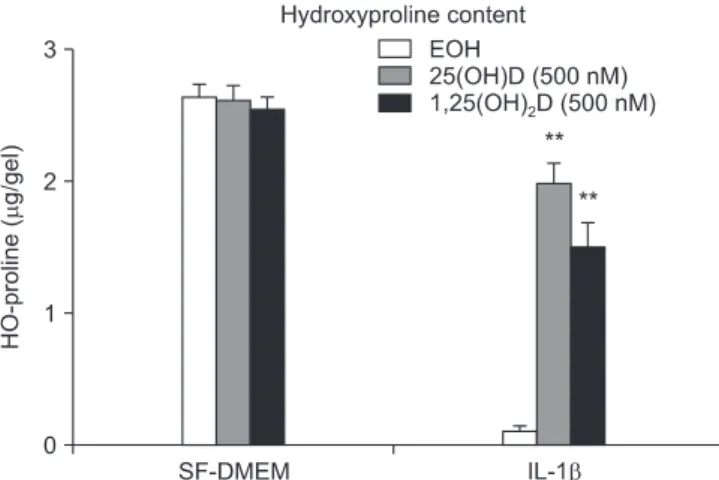
D significantly inhibited collagen degradation by IL-1β+trypsin as determined by hy- droxyproline (0.12±0.07 mg/gel of IL-1β+trypsin vs. 2.00±0.08 mg/gel of IL-1β+trypsin+25(OH)D vs. 1.55± 0.35 mg/gel of IL- 1β+trypsin+1,25(OH)D; p<0.01) (Figure 2).

2. Effect of vitamin D on IL-1β induced production of MMP-9 and MMP-2 in the HFL-1 cells

Expression and activity of MMP-2 and MMP-9 (92 kDa) were assessed by gelatin zymography with culture media of collagen gel of fibroblasts in each condition. IL-1β stimulates MMP-2 and MMP-9, trypsin converts latent form of MMP- 2 and MMP-9 into active form within 24 hours, vitamin D, 25(OH)D, and 1,25(OH)

2

D inhibit MMP-2 and MMP-9 pro- duction in response to IL-1β, and also inhibits activation of MMPs in induced by trypsin (Figure 3).

This conversion was significantly inhibited by 25(OH)D (100 nM) and 1,25(OH)

2

D (100 nM) (62.6±6.5% inhibition by

Figure 1. Vitamin D inhibits collagen degradation. HFL-1 cells were cast into collagen gels and released into medium, as shown. On day 2, 2 mg trypsin was added into a 5 mL gel floating medium in order to activate matrix metalloproteinases. After 24 hours of adding tryp- sin, that is, on day 3, gel size was measured, as shown. Interleukin- 1β (IL-1β) induced collagen gel degradation completely, and vita- min D, 25(OH)D, and 1,25(OH)

2

D inhibited collagen degradation.

**p<0.01 compared to IL-1β alone by one-way ANOVA followed by Tukey test. SF-DMEM: serum-free Dulbecco’s modified Eagle’s me- dium.

Figure 2. Gels were harvested and HO-proline amount was quanti- fied, as described. **p<0.01 compared to interleukin-1β (IL-1β) alone by two-way ANOVA followed by Bonferroni test. SF-DMEM:

serum-free Dulbecco’s modified Eagle’s medium.

Figure 3. Interleukin-1β (IL-1β) stimulates matrix metallopro- teinase (MMP)-9 and MMP-2, and trypsin converts latent form of MMP-2 and -9 into active form. Vitamin D, 25(OH)D, and 1,25(OH)

2

D inhibit MMP-2 and MMP-9 production in response to IL-1β, and also inhibits activation of MMPs induced by trypsin. SF- DMEM: serum-free Dulbecco’s modified Eagle’s medium.

Figure 4. Active matrix metalloproteinase (MMP)-9 (82 kDa)

was determined by scanning densitometry. Interleukin-1β (IL-

1β) stimulates MMP-9 and MMP-2, and trypsine converts latent

form of MMP-2 and -9 into active form. Vitamin D, 25(OH)D, and

1,25(OH)

2

D inhibit the activation of MMP induced by trypsin.

(5)

25(OH)D, and 67.7±9.1% inhibition by 1,25(OH)

2

D) (Figure 4).

We next examined if vitamin D could inhibit MMP-9 pro- duction in response to IL-1β using real-time RT-PCR. HFL-1 cells were treated with vitamin D in presence or absence IL- 1β for 24 hours. Total RNA extracted with Trizol. IL-1β signifi- cantly stimulated MMP-9 mRNA expression which was par- tially but significantly blocked by 25(OH)D and 1,25(OH)

2

D (3.70±0.67 fold vs. ethanol control of IL-1β vs. 1.76±0.31 fold vs.

ethonol control of IL-1β+25(OH)D, 1.97±0.35 fold vs. ethanol control of IL-1β+1,25(OH)

2

D; p<0.05) (Figure 5).

3. Effect of vitamin D on TIMP-1 and TIMP-2 production in the presence of IL-1β from HLF-1 cells

Expression of TIMP-1 and TIMP-2 were assessed by ELISA with culture media of collagen gel of fibroblasts in each con- dition. IL-1β inhibits TIMP-1 and TIMP-2 production, and vitamin D, 25(OH)D and 1,25(OH)

2

D significantly blocked IL-1β inhibition on TIMP-1 (161.50±6.51 ng/day/106 cells of IL-1β vs. 194.51±2.06 ng/day/10

6

cells of IL-1β+25(OH)D, 232.20±11.23 ng/day/10

6

cells of IL-1β+1,25(OH)

2

D; p<0.05) (Figure 6A), and TIMP-2 production (2.42±0.32 ng/day/10

6

cells of IL-1β vs 4.275±0.195 ng/day/10

6

cells of IL-1β+25(OH) D, 3.82±0.04 ng/day/10

6

cells of IL-1β+1,25(OH)

2

D, p<0.05) (Figure 6B).

We next examined if vitamin D could inhibit TIMP-1 and TIMP-2 production in response to IL-1β using real-time RT- PCR. HFL-1 cells were treated with vitamin D in presence or absence IL-1β for 24 hours. Total RNA extracted with Trizol.

IL-1β inhibits TIMP-1 and TIMP-2 mRNA expression, and vitamin D, 25(OH)D, and 1,25(OH)

2

D significantly blocked IL- 1β inhibition on TIMP-1(0.59±0.04 fold vs. ethanol control of IL-1β vs. 1.705±0.21 fold vs. ethanol control of IL-1β+25(OH)D, 1.74±0.08 fold vs. ethanol control of IL-1β+1,25(OH)

2

D; p<0.01) (Figure 7A) and TIMP-2 mRNA expression (0.48±0.08 fold vs.

ethanol control of IL-1β vs. 2.76±0.37 fold vs. ethanol control of IL-1β+25(OH)D, 2.07±0.19 fold vs. ethanol control of IL- 1β+1,25(OH)

2

D; p<0.01) (Figure 7B).

Discussion

This study demonstrates vitamin D play a role in regulating human lung fibroblast functions in wound repair and tissue remodeling through inhibiting IL-1β stimulated the MMP- Figure 5. HFL-1 cells were treated with interleukin-1β (IL-1β) or

vitamin D for 24 hours. Total RNA extracted with Trizol. mRNA was measured by real-time reverse transcription polymerase chain reaction. *p<0.05 compared to IL-1β alone by two-way ANOVA fol- lowed by Bonferroni test. SF-DMEM: serum-free Dulbecco’s modi- fied Eagle’s medium. MMP-9: matrix metalloproteinase-9.

Figure 6. Interleukin-1β (IL-1β) inhibits tissue inhibitor of metalloproteinase (TIMP)-1 (A) and TIMP-2 (B) production, and 25(OH)D and

1,25(OH)

2

D significantly block IL-1β inhibition on TIMP-1 (A) and TIMP-2 (B) production. *p<0.05, **p<0.01 compared to IL-1β alone by one

way ANOVA followed by Tukey test. SF-DMEM: serum-free Dulbecco’s modified Eagle’s medium.

(6)

2 and MMP-9 production from fibroblasts and inhibiting conversion from latent to active form of MMP-2 and MMP-9.

Consistently, vitamin D, 25(OH)D, and 1,25(OH)

2

D signifi- cantly inhibited collagen degradation by IL-1β+trypsin as determined by hydroxyproline assay. Vitamin D, 25(OH)D, and 1,25(OH)

2

D also significantly blocked IL-1β inhibition on TIMP-1 and TIMP-2 production from fibroblasts.

Emphysema has been believed to develop when media- tors of tissue injury exceed protective mechanisms within the lung. Evidence also supports the concept that tissue destruc- tion represents a balance between tissue injury and tissue repair

12

. If these repair responses can restore normal tissue architecture, function can be preserved. Efforts at repair, how- ever, may result in disruption of normal tissue. In COPD, both in the airways and in the alveolar structures, tissue dysfunc- tion likely results from altered structure due to incompletely effective repair responses

13

. The net tissue destruction that characterizes emphysema represents an imbalance between tissue destruction and tissue repair processes, analogous to the protease-antiprotease balance. Therefore, the levels and activities of MMPs and TIMPs that are potentially involved in alveolar destruction (emphysema) and extracellular matrix remodeling.

A parallel regulation of IL-1β-induced expression of MMPs and TIMPs was observed in human fibroblasts

14

and rat me- sangial cells

15

. An elevated level of IL-1 is one of the key me- diators that greatly enhances the biosynthesis and secretion of precursors of these MMPs (pro-MMPs) and prostaglandin E2 from mesenchymal cells at inflammatory sites

16

. The promo- tion of wound healing and tissue degradation is considered to be in part due to the production of MMPs by cells stimulated with IL-1

17

.

Fibroblasts play a critical role in tissue repair and remodel- ing, which is a key feature of COPD and asthma. Fibroblasts modulate tissue repair by producing and modifying extracel-

lular matrix components and by releasing mediators that act as autocrine or paracrine modulators of tissue remodeling

18,19

.

The culture of fibroblasts in three-dimensional collagen gels has been utilized as an in vitro system to evaluate tissue repair and remodeling

20,21

. When cultured in three-dimensional gels composed of native type I collagen, fibroblasts orient them- selves along the collagen fibers. Both fibroblast proliferation and protein production in three-dimensional collagen gel cul- ture differ markedly from those in routine tissue culture con- ditions

20

. Through interactions that depend in part on α

2

β

1

- integrins, fibroblasts can exert a tensile force on the collagen fibers. If the gels are unrestrained, for example in floating gel culture, the fibroblasts cause the gels to contract. This contrac- tion can be modified by a variety of exogenous agents, which can either stimulate or inhibit collagen gel contraction

22,23

.

A recent study showed that vitamin D deficiency is highly prevalent in COPD and correlates with variants in the vitamin D binding gene

24

. There are several factors that could account for vitamin D deficiency in COPD patients: poor diet, a re- duced capacity of aging skin for vitamin D synthesis, reduced outdoor activity and therefore sun exposure, an increased catabolism by glucocorticoids, impaired activation because of renal dysfunction, and a lower storage capacity in muscles or fat due to wasting

25

. Many steps of the vitamin D pathway (intake, synthesis, storage, metabolism) can potentially be dis- turbed in COPD patients.

Vitamin D belongs to a steroid hormone superfamily of nuclear receptors that has pleiotropic protective effects on sev- eral diseases and disorders including asthma and COPD

26-28

. 1,25(OH)

2

D

3

(1,25-dihydroxyvitamin D

3

) an active metabolite of vitamin D (which binds with nuclear receptor vitamin D receptor [VDR] and interacts other steroid hormone recep- tors), is a potent regulator of the immune response in Th1 cell- directed diseases

29,30

.

Vitamin D is a ligand for nuclear hormone VDR, and upon

Figure 7. (A) TIMP-1 mRNA. (B) TIMP-2 mRNA: **p<0.01 compared to interleukin-1β (IL-1β) treatment by two-way ANOVA followed by

Bonferroni test. SF-DMEM: serum-free Dulbecco’s modified Eagle’s medium.

(7)

binding it modulates various cellular functions. Vitamin D or VDR deficiency would invoke lung inflammation and altera- tion in lung function by proteinase/antiproteinase imbalance.

Deletion of VDR leads to premature emphysema/COPD by increased matrix metalloproteinases and lymphoid aggre- gates formation

31

.

Vitamin D also to attenuates tumor necrosis factor-α in- duced upregulation of MMP-9 in keratinocytes

32

. Vitamin D deficiency may lead to a reduced attenuation of MMP-9 activ- ity resulting in enhanced degradation of lung parenchyma.

In the current study, we have demonstrated that the latent form of MMP-2 and MMP-9 produced in fibroblasts in three- dimensional collagen gels with response to cytokines. Tryp- sin have a clear effect in converting the MMP-2 and MMP-9 to lower molecular mass forms that corresponded to active MMP-2 and MMP-9. Active form of MMP-2 and MMP-9 from fibroblasts in collagen gel, cultured with IL-1β+trypsin, in- duced degradation collagen gel completely, however, vitamin D, 25(OH)D, and 1,25(OH)

2

D significantly inhibited collagen degradation by IL-1β+trypsin (Figure 1) as determined by hy- droxyproline assay. Thus the current study supports the con- cept that cytokines such as IL-1β can induce the production of MMPs but that maximal collagen degradation is achieved only in the presence of an activator such as trypsin.

Vitamin D, 25(OH)D, and 1,25(OH)

2

D inhibit MMP-2 and MMP-9 production in response to IL-1β, and also inhibits acti- vation of MMPs in induced by trypsin (Figures 3, 4) as a func- tion of modulator of extracellular matrix homeostasis. Using real-time RT-PCR, this study also showed IL-1β significantly stimulated MMP-9 mRNA expression which was partially but significantly blocked by vitamin D, 25(OH)D, and 1,25(OH)

2

D in real-time RT-PCR (Figure 5). IL-1β inhibits TIMP-1 and TIMP-2 production from fibroblasts and vitamin D, 25(OH)D, and 1,25(OH)

2

D also significantly blocked IL-1β inhibition on TIMP-1 and TIMP-2 production in ELISA assay (Figure 6). IL- 1β inhibits TIMP-1 and TIMP-2 mRNA expression, and vita- min D, 25(OH)D, and 1,25(OH)

2

D significantly blocked IL-1β inhibition on TIMP-1 and TIMP-2 mRNA expression (Figure 7).

In summary, we have demonstrated that vitamin D, 25(OH) D, and 1,25(OH)

2

D play a role in regulating human lung fi- broblast functions in wound repair and tissue remodeling through not only inhibiting IL-1β stimulated MMP-2 and MMP-9 production and conversion from latent to active form of MMP-2 and MMP-9, but also inhibiting IL-1β inhibition on TIMP-1 and TIMP-2 production.

Our findings that vitamin D modulates cytokine induced MMP synthesis and collagen degradation by human lung fibroblasts, suggest that vitamin D may regulate fibroblast- mediated lung tissue repair and remodeling. This provides a potential mechanism whereby vitamin D could modify lung structure and function related to inflammation such as COPD.

Conflicts of Interest

No potential conflict of interest relevant to this article was reported.

Acknowledgements

This paper was supported by Wonkwang University in 2012.

References

1. Provvedini DM, Tsoukas CD, Deftos LJ, Manolagas SC.

1,25-dihydroxyvitamin D3 receptors in human leukocytes.

Science 1983;221:1181-3.

2. Provvedini DM, Tsoukas CD, Deftos LJ, Manolagas SC. 1 alpha,25-Dihydroxyvitamin D3-binding macromolecules in human B lymphocytes: effects on immunoglobulin produc- tion. J Immunol 1986;136:2734-40.

3. Litonjua AA, Weiss ST. Is vitamin D deficiency to blame for the asthma epidemic? J Allergy Clin Immunol 2007;120:1031- 5.

4. Sutherland ER, Goleva E, Jackson LP, Stevens AD, Leung DY.

Vitamin D levels, lung function, and steroid response in adult asthma. Am J Respir Crit Care Med 2010;181:699-704.

5. Black PN, Scragg R. Relationship between serum 25-hy- droxyvitamin d and pulmonary function in the third na- tional health and nutrition examination survey. Chest 2005;

128:3792-8.

6. Elsdale T, Bard J. Collagen substrata for studies on cell behav- ior. J Cell Biol 1972;54:626-37.

7. Mio T, Adachi Y, Romberger DJ, Ertl RF, Rennard SI. Regula- tion of fibroblast proliferation in three-dimensional collagen gel matrix. In Vitro Cell Dev Biol Anim 1996;32:427-33.

8. Bergman I, Loxley R. Two improved and simplified methods for the spectrophotometric determination of hydroxyproline.

Anal Chem 1963;35:1961-5.

9. Edwards CA, O’Brien WD Jr. Modified assay for determina- tion of hydroxyproline in a tissue hydrolyzate. Clin Chim Acta 1980;104:161-7.

10. Kleiner DE, Stetler-Stevenson WG. Quantitative zymography:

detection of picogram quantities of gelatinases. Anal Bio- chem 1994;218:325-9.

11. Zhang Y, McCluskey K, Fujii K, Wahl LM. Differential regu- lation of monocyte matrix metalloproteinase and TIMP-1 production by TNF-alpha, granulocyte-macrophage CSF, and IL-1 beta through prostaglandin-dependent and -indepen- dent mechanisms. J Immunol 1998;161:3071-6.

12. Snider GL, Failing LJ, Rennard SI. Chronic bronchitis and em- physema. In: Murray JF, Nadel JA, editors. Textbook of respira- tory medicine. 2nd ed. Philadelphia: W.B. Saunders; 1994. p.

1331-97.

(8)

13. Niewoehner DE. Anatomic and pathophysiological correla- tions in COPD. In: Baum GL, Crapo JD, Celli BR, Karlinsky JB, editors. Textbook of pulmonary diseases. Philadelphia:

Lippincott-Raven; 1998. p. 823-42.

14. Murphy G, Reynolds JJ, Werb Z. Biosynthesis of tissue inhibi- tor of metalloproteinases by human fibroblasts in culture.

Stimulation by 12-O-tetradecanoylphorbol 13-acetate and interleukin 1 in parallel with collagenase. J Biol Chem 1985;260:3079-83.

15. Eberhardt W, Beeg T, Beck KF, Walpen S, Gauer S, Bohles H, et al. Nitric oxide modulates expression of matrix metallopro- teinase-9 in rat mesangial cells. Kidney Int 2000;57:59-69.

16. Woessner JF Jr. Matrix metalloproteinases and their inhibitors in connective tissue remodeling. FASEB J 1991;5:2145-54.

17. Dinarello CA. The biology of interleukin-1. Chem Immunol 1992;51:1-32.

18. Togo S, Holz O, Liu X, Sugiura H, Kamio K, Wang X, et al. Lung fibroblast repair functions in patients with chronic obstruc- tive pulmonary disease are altered by multiple mechanisms.

Am J Respir Crit Care Med 2008;178:248-60.

19. Rennard SI, Wachenfeldt K. Rationale and emerging ap- proaches for targeting lung repair and regeneration in the treatment of chronic obstructive pulmonary disease. Proc Am Thorac Soc 2011;8:368-75.

20. Bell E, Ivarsson B, Merrill C. Production of a tissue-like struc- ture by contraction of collagen lattices by human fibroblasts of different proliferative potential in vitro. Proc Natl Acad Sci U S A 1979;76:1274-8.

21. Grinnell F. Fibroblasts, myofibroblasts, and wound contrac- tion. J Cell Biol 1994;124:401-4.

22. Dans MJ, Isseroff R. Inhibition of collagen lattice contraction by pentoxifylline and interferon-alpha, -beta, and -gamma. J Invest Dermatol 1994;102:118-21.

23. Zhang HY, Gharaee-Kermani M, Phan SH. Regulation of lung fibroblast alpha-smooth muscle actin expression, contractile phenotype, and apoptosis by IL-1beta. J Immunol 1997;158:

1392-9.

24. Janssens W, Bouillon R, Claes B, Carremans C, Lehouck A, Buysschaert I, et al. Vitamin D deficiency is highly prevalent in COPD and correlates with variants in the vitamin D-bind- ing gene. Thorax 2010;65:215-20.

25. Holick MF. Vitamin D deficiency. N Engl J Med 2007;357:266- 81.

26. Janssens W, Lehouck A, Carremans C, Bouillon R, Mathieu C, Decramer M. Vitamin D beyond bones in chronic obstructive pulmonary disease: time to act. Am J Respir Crit Care Med 2009;179:630-6.

27. Gilbert CR, Arum SM, Smith CM. Vitamin D deficiency and chronic lung disease. Can Respir J 2009;16:75-80.

28. Tsiligianni IG, van der Molen T. A systematic review of the role of vitamin insufficiencies and supplementation in COPD.

Respir Res 2010;11:171.

29. Cantorna MT. Vitamin D and autoimmunity: is vitamin D status an environmental factor affecting autoimmune disease prevalence? Proc Soc Exp Biol Med 2000;223:230-3.

30. Bikle DD. Vitamin D: newly discovered actions require recon- sideration of physiologic requirements. Trends Endocrinol Metab 2010;21:375-84.

31. Sundar IK, Hwang JW, Wu S, Sun J, Rahman I. Deletion of vita- min D receptor leads to premature emphysema/COPD by in- creased matrix metalloproteinases and lymphoid aggregates formation. Biochem Biophys Res Commun 2011;406:127-33.

32. Bahar-Shany K, Ravid A, Koren R. Upregulation of MMP-9

production by TNFalpha in keratinocytes and its attenuation

by vitamin D. J Cell Physiol 2010;222:729-37.

수치

Figure 4. Active matrix metalloproteinase (MMP)-9 (82 kDa)  was determined by scanning densitometry
Figure 6. Interleukin-1β (IL-1β) inhibits tissue inhibitor of metalloproteinase (TIMP)-1 (A) and TIMP-2 (B) production, and 25(OH)D and  1,25(OH) 2 D significantly block IL-1β inhibition on TIMP-1 (A) and TIMP-2 (B) production

참조

관련 문서

 &gt;MN d#  d#t f fT ;u FFFFFFFFFFFFFFFF .  &gt;MN d#  d#t f fT ;u B*A

Objective: This study was conducted to identify the association between vitamin D and osteosarcopenia among all adults in Korea using data from the Korea National Health

Effects of phase I periodontal treatment on gingival crevicular fluid levels of matrix metalloproteinase-3 and tissue inhibitor of metalloproteinase-1.

Activated H-Ras expression in human fibroblast cell lines increases the activity of Ku80 to bind injuried DNA, reduces γ-H2AX expression by UV irradiation,

However, the mean 25(OH)D values were decreased significantly with decreasing eGFR levels in moderate and severe chronic kidney disease stages.. Also, the mean ACR

One might try to solve the problem by copying the first d elements of x to a temporary array, moving the remaining n − d elements left d places, and then copying the first d

Function description 1) By turning ON FB_EN (Execution command), A/D conversion data of the specified channel is read. 2) The read A/D conversion data depends on the

(바) “액체 밀봉드럼 (Liquid seal drum)”이라 함은 플레어스택의 화염이 플레어시 스템으로 거꾸로 전파되는 것을 방지하거나 또는 플레어헤더에