Abstract
Objectives: We aimed to compare the possible
outcomes of the current (opt-in) system and an opt- out system for organ donation in South Korea using a mathematical model.
Materials and Methods: A structured questionnaire was
used to investigate the decision on organ donation and family consent after brain death under the current system and an opt-out system. The survey was conducted in August 2018 by means of a voluntary survey of 100 opposite-sex married couples.
Results: Sixty-three percent of participants wished to
self-donate their organs after brain death: 69.5% were positive and 30.5% were negative regarding the implementation of the opt-out system. Among 200 participants, the total number of possible donors increased from 110 (55.0%) in the current system to 139 (69.5%) in the opt-out system. Positive autonomy was defined as obtainment of consent from the donor and the spouse, and negative autonomy was defined as concordaence of refusal between the donor and the spouse. Comparisons between the systems showed that the rate of autonomy increased from 57.0% in the current system to 61.5% in the opt-out system.
Although the achievement of positive autonomy increased from 59.5% in the current system to 74.6% in the opt-out system, the achievement of negative autonomy decreased from 52.7% in the current system to 39.2% in the opt-out system.
Conclusions: An opt-out system can increase the
number of organ donors; however, achievement of negative autonomy can decrease.
Key words: Autonomy Introduction
A persistent shortage of transplantable organs is a major health problem worldwide. Policy debates are underway in many countries regarding these shortages of organs for transplant. Broadly, there are 2 different systems: explicit consent (opt-in system) and presumed consent (opt-out system). In an opt-in system, the default condition is that no one is a donor. In an opt-out system, every adult citizen is regarded, by default, as an organ donor unless he or she chooses to opt out of the system.
The concept of presumed consent for organ donation is not new and dates back to an idea first mooted by Dukeminier and Sanders.
1There have been numerous studies regarding the effects of an opt-out system; however, the efficacy of an opt-out system is not yet clear.
2,3Opt-out countries such as Spain, Austria, and Belgium have high donation rates, but other countries, such as Bulgaria and Luxemburg, have lower donation rates.
2However, we note that the motivation to increase the organ donation rate may not be the only value to consider.
Ethical arguments related to the presumption of consent are ongoing, and ethical weaknesses in an opt-out system have been indicated. The biggest obstacle is that there is not, at present, an established scientific method with which to obtain conclusive evidence that could justify a specific social system for organ donation. In the United Kingdom, the Organ Donation Taskforce was created in 2006 to examine the question of whether presumed consent is ethically acceptable.
4One approach by this taskforce was to use
Copyright © Başkent University 2020 Printed in Turkey. All Rights Reserved.
Effect of Opt-out System for Organ Donation After Brain Death on Ethical Legitimacy and Potential
Efficacy in a Mathematical Model
Sang Woo Kim,
1Hyun Yong Lee,
2Ui Jun Park,
2Hyoung Tae Kim,
2Young-Nam Roh
2From the 1Department of Surgery, Keimyung University Dongsan Medical Center, Daegu, Republic of Korea; and the 2Division of Transplantation and Vascular Surgery, Department of Surgery, Keimyung University Dongsan Medical Center, Daegu, Republic of Korea Acknowledgements: This research was supported by the Keimyung University Research Grant of 2018. The authors have no other potential declarations of interest.
Author contributions: Data interpretation: S. Kim, H. Lee, Y. Roh. Preparation of manuscript:
S. Kim, Y. Roh. Literature analysis: S. Kim, Y. Roh. Data collection: U. Park, H. Kim, Y. Roh.
Study design: Y. Roh. Data analysis: Y. Roh.
Corresponding author: Young-Nam Roh, Division of Transplantation and Vascular Surgery, Department of Surgery, Keimyung University Dongsan Medical Center, 56 Dalseong-Ro, Jung- Gu, Daegu, 41931, Republic of Korea
Phone: +82 53 250 7325 E-mail: [email protected]
Experimental and Clinical Transplantation (2020) 5: 626-632
DOı: 10.6002/ect.2019.0420
a mathematical model to predict autonomy in certain systems, as reported by Rieu.
4With this method, the specific number of potential organ donors and the achievement of autonomy were reported.
4This mathematical model is useful because investigations of both ethical legitimacy and resultant efficacy are possible.
Fundamentally, South Korea follows the explicit consent (opt-in) system, which is the most widely used organ donation system in the world. Because a mandatory registration system for organ donation (eg, similar to the American driver’s license registration system) does not yet exist in South Korea, most potential donors in the country are not listed in the donor registry. Therefore, the current practice in all medical centers, where actual organ donation is decided, entails asking family members to consent on behalf of the patient regarding donation, contingent on approval by the primary physician. The consultation about organ donation for patients after brain death may be facilitated by the active participation of the patient’s first-line family members. The major drawback of this system is that the number of actual donors is much smaller than the number of people willing to donate, as a result of factors such as procrastination and indecision on the part of medical staff or families. There remains a lack of public awareness regarding this topic, and educational interventions to encourage organ donation by the general public are not well established in Korea. The number of organ donations per million people in Korea remains at 5 to 10, which is significantly lower than in the West. A social scientific approach concerning the acceptability of the opt-out system has not been implemented in Korea.
In this study, we used a mathematical model to compare the possible outcomes of the current (opt-in) system of organ donation versus the opt-out system.
Materials and Methods
Study design
We used a mathematical model to predict the extent of autonomy under the current system and an opt- out system.
4We created a structured questionnaire to investigate decisions on organ donation and family consent after brain death of a patient in each system. There were 100 married couples (200 people) enrolled in this survey. In South Korea, the consent from all first-line family members is needed for organ
donation in principle. However, if there is disagreement among family members, then the priority for the decision is assigned to the spouse, followed by descendants, parents, and siblings, in that order. After family discussion, the family member with the highest priority signs the consent document. To consider this consent system and simplify the mathematical model for the family decision, the default position for the medical staff is that the next-of-kin decision is to be made by the spouse. Voluntary participants were recruited on the internet, and the survey was conducted in August 2018 by a professional survey expert by means of face-to-face interviews. All participants were isolated from each other during the interview.
Methods and details of the survey
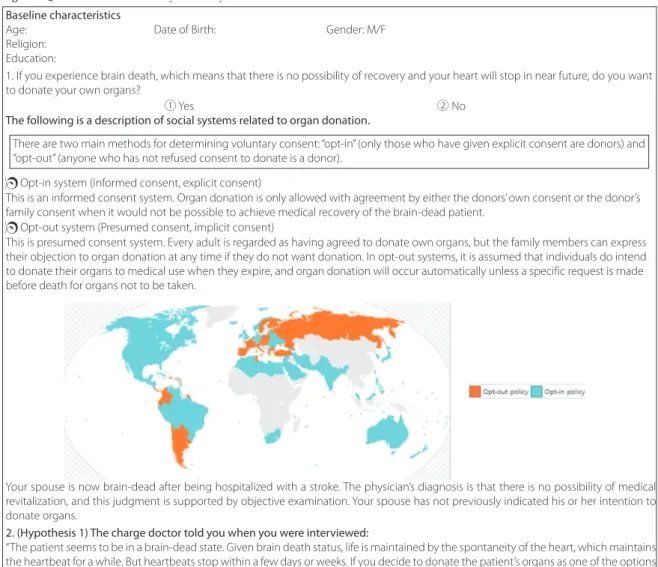
Before the survey, participants were apprised of the importance of frank responses without prejudice or psychological pressure. The participants were encouraged to respond according to personal opinion and to ignore any other factors. The participants were free to withdraw from the survey at any time. The detailed questionnaire shown in Figure 1 consisted of 4 questions pertaining to decisions on self-donation of organs, as well as the donation of a spouse’s organs, after brain death according to the 2 systems.
Question 1 describes the preference for self-donation in the event of brain death. The interviewer explained the distinctive elements of both the opt-in and the opt-out systems. For our hypothesis, we conceived a “soft” opt-out system in which consent from the family member(s) is necessary for the donation process. Participants were allowed to freely ask questions about the 2 systems. Subsequently, a hypothetical situation in which the patient’s spouse experiences brain death was provided, and the decision regarding donation of the spouse’s organs was framed in the context of the current system (question 2) and an opt-out system (question 3).
Question 4 was about opinions on implementing an opt-out system. The design of the questions was completed with the help of the Korean Policy and Research Groups (https://www.kprg.re.kr).
Data analyses
The rate of achieving autonomy was compared
between the 2 systems by defining autonomy as
consistency between one’s own wishes and the final
family decision on organ donation. We defined the
achievement of “positive” autonomy as the percentage of final family consent given to those who were in favor of self-donation; achievement of “negative”
autonomy was defined as the percentage of final
family refusals among those who did not agree to self- donation. The achievement of positive autonomy and negative autonomy was also compared in the 2 systems.
Baseline characteristics
Age: Date of Birth: Gender: M/F
Religion:
Education:
1. If you experience brain death, which means that there is no possibility of recovery and your heart will stop in near future, do you want to donate your own organs?
① Yes ② No
The following is a description of social systems related to organ donation.
Opt-in system (Informed consent, explicit consent)
This is an informed consent system. Organ donation is only allowed with agreement by either the donors’ own consent or the donor’s family consent when it would not be possible to achieve medical recovery of the brain-dead patient.
Opt-out system (Presumed consent, implicit consent)
This is presumed consent system. Every adult is regarded as having agreed to donate own organs, but the family members can express their objection to organ donation at any time if they do not want donation. In opt-out systems, it is assumed that individuals do intend to donate their organs to medical use when they expire, and organ donation will occur automatically unless a specific request is made before death for organs not to be taken.
Your spouse is now brain-dead after being hospitalized with a stroke. The physician’s diagnosis is that there is no possibility of medical revitalization, and this judgment is supported by objective examination. Your spouse has not previously indicated his or her intention to donate organs.
2. (Hypothesis 1) The charge doctor told you when you were interviewed:
“The patient seems to be in a brain-dead state. Given brain death status, life is maintained by the spontaneity of the heart, which maintains the heartbeat for a while. But heartbeats stop within a few days or weeks. If you decide to donate the patient’s organs as one of the options for terminal care, you can save many lives by transplanting the organs which are still functioning. About donation of organs, this country is implementing “Opt-in system.” According to this system, brain death patients are basically considered not to have agreed on organ donation. If you agree with organ donation and express consent to organ donation, the organ donation procedure will be performed.
If you do not agree with organ donation, medical staff will only continue with the existing life-supporting treatment until cardiac arrest.”
In this situation, will you donate your spouse’s organs by consenting to organ donation?
① Yes ② No
3. (Hypothesis 2) The charge doctor told you when you were interviewed:
“The patient seems to be in a brain-dead state. Given brain death status, life is maintained by the spontaneity of the heart, which maintains the heartbeat for a while. But heartbeats stop within a few days or weeks. If you decide to donate the patient’s organs as one of the options for terminal care, you can save many lives by transplanting the organs which are still functioning. About donation of organs, this country is implementing “Opt-out system.” According to this system, brain death patients are basically considered to have agreed to organ donation. However, if the family does not wish to donate organs, they may object to organ donation at any time. So if you are against organ donation, medical staff will not carry out the donation process and will only continue with the existing life-supporting treatment until cardiac arrest. If you do not object to the patient’s organ donation, the patient will be subject to the organ donation procedure according to “opt-out system.”
If this is situation, will you donate your spouse’s organs by not objecting to organ donation?
① Yes ② No
4. Currently, Korea is following “Opt-in” system. What do you think about the introductionof “Opt-out” in Korea?
① Very positive ② Positive ③ Negative ④ Very negative
There are two main methods for determining voluntary consent: “opt-in” (only those who have given explicit consent are donors) and
“opt-out” (anyone who has not refused consent to donate is a donor).
Figure 1. Questionnaire for the Survey in the 2-System Model
Results
All participants completed the survey. The mean age was 45.9 years (standard deviation, 8.3 years), and sex distribution was even. Fifty-five percent of participants were religious (Christian, 19.5%; Catholic, 16.0%; Buddhist, 19.0%), and 70.5% were college graduates. Table 1 summarizes the characteristics of the participants.
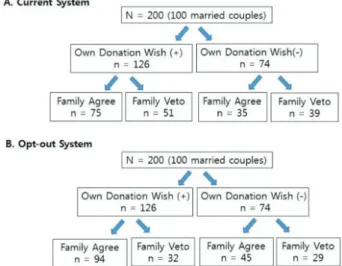
Responses to the survey questions and the results of the final decision on organ donation under the current system and the opt-out system are illustrated in Figure 2. Of the 200 participants surveyed, 126 (63.0%) volunteered to self-donate organs in the event of brain death, and 74 (37.0%) declined self-donation of organs. For the opt-in system, of the 126 participants who volunteered to self-donate organs, the spouses of 75 participants (59.5%) agreed with the decision, and 51 spouses (40.5%) disagreed. For the opt-in system, of the 74 participants who declined the option to self- donate organs, 35 spouses (47.3%) agreed and 39 spouses (52.7%) disagreed. Finally, family consent was obtained on behalf of 110 participants (55.0%), and these were the people whose organs could be donated in the opt-in system. Among the 126 participants who volunteered for self-donation of organs in the opt-out system, 94 spouses (74.6%) agreed and 32 spouses (25.4%) disagreed. Among the 74 participants who declined to self-donate organs, 45 spouses (60.8%) agreed and 29 spouses (39.2%) disagreed. Finally, family consent was obtained for 139 participants (69.5%), and these were the people whose organs could be donated in the opt-out system.
In question 4, which asked about the positivity to implement the opt-out system, 69.5% were positive (30.0% responded “very positive”; 39.5% responded
“positive”) and 30.5% were negative (20.0% responded
“negative”; 10.5% responded “very negative”).
With regard to the consistency between the self- donation decision and the final family decision on donation, the comparison between the 2 systems showed that the rate of autonomy increased from 57.0% in the current system to 61.5% in the opt-out system. In addition, the rate of positive autonomy increased from 59.5% in the current system to 74.6%
in the opt-out system. However, the rate of negative autonomy markedly decreased from 52.7% in the current system to 39.2% in the opt-out system. The total number of donors and results on autonomy are shown in Table 2.
Discussion
The opt-out organ donor registration policies do not place high value on securing actual consent of patients for donation and thus fail to respect the autonomous rights of patients to decide the fate of their organs after death.
5Gill argues that opt-out
table 1. Characteristics of Participants (N = 200)
Variable No. of Patients (%)
Mean age, y 45.9 ± 8.3
Age range, y 27-64
20-30 y 7 (3.5%)
30-40 y 37 (18.5%)
40-50 y 77 (38.5%)
50-60 y 73 (36.5%)
≥ 60 y 6 (3.0%)
Sex
Male 100 (50%)
Female 100 (50%)
Religion
Catholic 32 (16.0%)
Christian 39 (19.5%)
Buddhist 38 (19.0%)
None 91 (45.5%)
Education
College graduate 141 (70.5%)
No college degree 59 (29.5%)
Figure 2. Mathematical Model To Predict Outcomes of 2 Organ Donation Systems
In the chart, the plus symbol (“+”) indicates willingness to self-donate, and the minus symbol (“-”) indicates unwillingness.
table 2. Comparison of Outcomes Between the Current Opt-In System and the Opt-Out System
Current System Opt-Out System
Total donors, No. (%) 110 (55.0%) 139 (69.5%)
Achievement of autonomy 57.0% 61.5%
Achievement of positive autonomy 59.5% 74.6%
Achievement of negative autonomy 52.7% 39.2%
Positive autonomy is defined as obtainment of consent from the donor and the spouse; negative autonomy is defined as concordance of refusal between the donor and the partner.
policies fail to respect the rights of a family to consider the donation of the patient’s organs in the context of family agreement.
6However, Saunders argues that opt-out policies do secure actual, if not explicit, consent of the person regarding self- donation.
7Countries in Europe operate different organ donation systems in situations where these conflicts exist; importantly, there is no universally acceptable organ donation system anywhere in the world. Therefore, the justification of a system should be established on the basis of scientific evidence regarding cultural differences, public perception, and infrastructure at a country level. Minimally, an opt- out system should not be justified solely for the purpose of increasing organ donation because this system has shown different levels of efficacy in increasing rates of organ donation according to country.
2East Asia, especially, has a historical background and culture distinct and different from Western countries, and these differences are based on Confucianism and Buddhism. The public perception regarding the deceased person’s organ donation is not well understood in East Asian countries despite economic development, social maturity, and the high number of organ transplants.
8,9Evidence concerning the opt-out system has not been reported in East Asia; although this study is based on a small sample, this is the first of its kind. Here, despite the fact that the opt-out system is unfamiliar to the South Korean public and remains unaddressed as a social issue, public opinion on implementation of an opt-out system was positive (69.5%). Moreover, the percentage of patients who volunteered to self-donate organs was 63.0% (126/200), which was comparable to the 80%
reported in a study in the United Kingdom.
4Traditionally, in East Asia, especially in Korean, Japanese, Taiwanese, and Chinese cultures, there is a belief that the body should not be disrupted after death; this belief originates from a Confucian tradition.
10,11This tradition may be the main barrier for the promotion of organ donation in East Asian countries. However, the high percentage of self- donation decisions and the high positivity regarding the opt-out system in this study suggest that public perception regarding organ donation is not yet systemically established in East Asia and that the low donation rate no longer represents Asian cultural beliefs. Therefore, each East Asian country may benefit from educational intervention and enhancement of
social infrastructure to establish a systematic and tailored organ donation registration system or a consent system to promote organ donation.
The ethical legitimacy of the opt-out system was the main issue in this study. Despite the general affirmation of this system, the implementation of the opt-out system was not justified. The lower achievement of negative autonomy (39.2%) clearly showed the ethical limitations of the opt-out system.
The organ donation systems in many countries are not uniformly standardized, and a mixture of different systems is needed. To fulfill this need for a mixture of systems, one possible solution is the “modified mandatory choice system,” for which all adults of the general public are offered the opportunity to choose
“deferred registration” for self-donation.
12Deferred registration is a system in which the next-of-kin is consulted in the event of the death of a patient who had not previously confirmed a decision for self- donation of organs. Regardless of the organ donation system, in the absence of evidence of a previous decision by the patient, a policy of presumed consent or presumed refusal may critically influence the decision by the next-of-kin. Although the hypothetical situation of this study, ie, the donation option is simply divided into 2 options, is very different from real-world systems that may include multilevel choices or deferred registration, there remains a fundamental ethical controversy regarding that a presumed decision exists in every donation system.
“Nudge theories” are thought to underlie the use of presumed consent in organ donor registration policy.
13There is clear evidence in the domain of behavioral economics to demonstrate that, when presented with alternatives, people without firm conviction will tend toward the default.
14Most opt-out systems are, in practice, soft opt-out
systems, for which consent from the next-of-kin is
necessary to proceed with donation. The main
practical difference between an opt-in system and a
soft opt-out system is the manner of inquiry. In an
opt-in system, the patient’s relatives are asked to rule
against the presumption that the donor would have
declined the opportunity for self-donation of
organs.
13However, in an opt-out system, the relatives
are asked to favor the presumption that the donor
would have volunteered to donate. In the design of
our survey questions, we considered elements that
would best reflect this practical and delicate
difference between presumption in favor of donation
and presumption against donation. Given the perspective of organ donation as a gift for the greater good of society, regardless of whether the decision to donate is confirmed or refused, there is no ethical conflict on the part of people who may choose to self- donate; rather, the ethical issue should be focused on what may happen to those who may have declined to offer the gift of organ donation. We found that the opt-out presumption among these participants was present in 63.0% (126/200) of cases, and the family veto decreased from 52.7% (39/74) to 39.2% (29/74) among those patients who did not choose organ self- donation in the opt-out system.
It is apparent that the system is incomplete with regard to granting decision-making power to the patient’s family/relatives. Even in the current opt-in system, about one-half of those who did not want to volunteer for self-donation of organs did, in fact, become organ donors at the subsequent consent from the family. The presumption, whether in the opt-in system or the opt-out system, creates a risk of imposing the aforementioned nudged decision, and this may create a bias that erodes ethical integrity. To overcome this ethical limitation, it is necessary to consider how best to design the system to favor mandatory decisions and to establish systemic countermeasures to promote the reduction in the number of granted or deferred decisions. In the absence of unequivocal evidence that the majority of individuals will volunteer to self-donate organs in the event of death, we suggest that the morally justified solution must include the establishment of, and adherence to, an explicit consent policy.
13As Asian countries continue on the course of social maturation, the number of transplants is increasing.
8,9However, a high proportion of transplants are from living donors, and this is not common in the West.
8Presently, transplantable organs from deceased donors are underutilized, and the cause of this problem is the lack of an organized social system for deceased donor organs. Most importantly, scientific studies are needed to discover a basis for reasonable, ethically justifiable, and effective social systems for organ donation in Asian countries. So far, the well- established laws and policies in the transplantation field have been adapted from Western societies;
however, the evidence for justification of a system should be made on the basis of a country’s specific cultural elements, its scope of public awareness of the issues, and its social infrastructure. If we truly believe
in the importance of organ donation, then we should develop a social scientific approach through large- scale national research to resolve the moral problems that remain, in addition to the introduction of policies aimed at improving the rate of organ donation. The question of whether an opt-out system is right or wrong has no absolute answer. We are in constant pursuit of the most effective measures within the realm of compromise, supported by maximum scientific evidence on the ethical controversies, to the extent that we are able.
This study had many limitations. First, regarding the small number of participants, there are limits to the generalization of the results of this study. Second, it was assumed that family motivation would be simplified by the decision of the spouse; however, this may be a questionable assumption because there is a dynamic relationship between family members that may increase the complexity of the decision process. Third, the hypothetical mathematical model that we used to predict outcomes has limited value.
In real situations of families considering organ donation, the potential emotional shock of the associated events may affect the decision beyond the predictive scope of the mathematical model.
11Despite these limitations, we believe that the findings of this study may be used as an important reference for adopting a new system with which to persuade politicians and lawmakers of the crucial importance of organ donation.
Conclusions
The total number of donors markedly increases in an opt-out system, and this system can achieve more positive autonomy for the decision to proceed with organ donation; however, achievement of negative autonomy markedly decreases in the opt-out system.
The opt-out system has inherent critical ethical limitations; therefore, a systemic complementary tool is necessary to achieve both an ethical justification and the resultant efficacy in promotion of organ donations.
References
1. Dukeminier J Jr, Sanders D. Organ transplantation: a proposal for routine salvaging of cadaver organs. N Engl J Med. 1968;279(8):413- 419. doi:10.1056/NEJM196808222790807
2. Willis BH, Quigley M. Opt-out organ donation: on evidence and public policy. J R Soc Med. 2014;107(2):56-60. doi:10.1177/0141 076813507707
3. English V, Johnson E, Sadler BL, Sadler AM Jr. Is an opt-out system likely to increase organ donation? BMJ. 2019;364:l967. doi:10.113 6/bmj.l967
4. Rieu R. The potential impact of an opt-out system for organ donation in the UK. J Med Ethics. 2010;36(9):534-538. doi:10.
1136/jme.2009.031757
5. MacKay D. Opt-out and consent. J Med Ethics. 2015;41(10):832-835.
doi:10.1136/medethics-2015-102775
6. Gill MB. Presumed consent, autonomy, and organ donation. J Med Philos. 2004;29(1):37-59. doi:10.1076/jmep.29.1.37.30412 7. Saunders B. Opt-out organ donation without presumptions. J Med
Ethics. 2012;38(2):69-72. doi:10.1136/medethics-2011-100039 8. Lo CM. Deceased donation in Asia: challenges and opportunities.
Liver Transpl. 2012;18 Suppl 2:S5-S7. doi:10.1002/lt.23545 9. Woo KT. Social and cultural aspects of organ donation in Asia. Ann
Acad Med Singapore. 1992;21(3):421-427.
10. Han SY, Kim JI, Lee EW, et al. Factors associated with a family’s delay of decision for organ donation after brain death. Ann Transplant. 2017;22:17-23. doi:10.12659/aot.901616
11. Park UJ, Han SY, Han KH, et al. Effects of phased education on attitudes toward organ donation and willingness to donate after brain death in an Asian country. Asian J Surg. 2019;42(1):256-266.
doi:10.1016/j.asjsur.2018.04.007
12. Chouhan P, Draper H. Modified mandated choice for organ procurement. J Med Ethics. 2003;29(3):157-162. doi:10.1136/jme.
29.3.157
13. Prabhu PK. Is presumed consent an ethically acceptable way of obtaining organs for transplant? J Intensive Care Soc. 2019;20(2):92- 97. doi:10.1177/1751143718777171
14. Hallsworth M, Snijders V, Burd H, et al. Applying Behavioral Insights:
Simple Ways to Improve Health Outcomes: a Report of the WISH Behavioural Insights Forum. Doha, Qatar: World Innovation Summit for Health; 2016.