*Corresponding Author: [email protected]
Manuscript received July 14, 2020 / revised August 07, 2020/ accepted August 08, 2020
1) 단국대학교 경영경제학과 제1저자
지방 자치 기관의 운영 효율성과 품질 향상을 위한 린식스시그마 방식의 채택사례
(Implementation of Lean Six Sigma in Municipal Government Operations to Improve Efficiency and Quality: A Case Study)
김 카 이
1)
*(Kai Kim)
요 약 오늘날 지방 자치 기관은 재원이 계속 줄어들고 시민의 서비스 품질 기대치가 높아지면서
복잡한 문제에 직면하고 있어 문제해결을 효율적으로 관리할 수 있는 도구를 개발하고 실행해야 한 다. 문제해결을 위해 린식스시그마 이론과 도구들이 영리 집단에는 광범위하게 사용되고 있지만, 공공 기관에 사용된 사례는 희박하다. 본 연구는 린식스시그마 방식과 도구들을 미국의 한 소도시 산하 지 방자치단체의 효율적인 운영 프로세스와 서비스 품질 그리고 시민의 고객 만족을 향상하기 위하여 사 용된 사례를 다룬다. 본 사례 연구는 DMAIC (Define, Measure, Analyze, Implement, and Control) 방 식을 채택하여 문제를 파악하고 수행지표를 개발 및 측정하여 시행할 수 있는 계획을 제안한다. 본 사례 연구의 결과 지방 정부 공공 업무에 린식스시그마의 이론과 방법을 적용하는 것이 서비스를 제 공하는 프로세스의 효율성과 서비스 품질을 개선할 수 있는 훌륭한 방법이 될 수 있음을 보여준다.
핵심주제어: 지방 자치기관, 린식스시그마, 공정 효율성, 품질경영, 고객 만족, DMAIC
Abstract Municipal governments today are facing increasingly complex issues while resources continue to be constraint but the service quality expectation from citizen is more demanding. They must develop and implement tools that help manage operations more efficiently. While Lean Six Sigma principle and tools have been widely applied to profit organizations, the extant literature has not provided many cases of such application to local governments. This research presents a case study of applying Lean Six Sigma approaches and tools to a municipal government of a small town in USA to improve process efficiency, quality performance, and citizen satisfaction. In this case study, DMAIC (Define, Measure, Analyze, Implement, and Control) is used as a tool to define current issues, develop, and measure performance metrics, and recommend action plans. The result of this case study shows that applying the principles and tools of Lean Six Sigma provides an excellent way to improve the process efficiency and quality of providing public work services at a local government.
Keywords: Municipal government, Lean Six Sigma, Process efficiency, Quality management, Customer satisfaction, DMAIC
1. Introduction
1.1 Background
All types of companies must strive to reduce unnecessary operating expenses and increase revenues by improving operation efficiency and quality performance as the primary purpose of doing business is making a profit. Non-profit organizations including government type organizations are not an exception. They must perform to the expectation standard under the budget constraints and other complex circumstances.
The labor force is highly unionized, many times advancement is based on not skills but seniority. One of the most common answers heard when asked why something is done in a particular manner is because “it has always been done this way.”
The public can be highly critical of failures, so staff is resistant to change in that should a new process or action not be a success.
Additional resistant is caused by the adversarial role between management and the unions with the fear that such change will result in a reduction of the workforce.
Therefore, municipal governments also need to consider adopting operations management concepts and tools that are proven to work in profit-oriented organizations in order to meet or exceed citizen’s expectation of the service performance.
The author was appointed as a consultant to improve the operation performance of the town government which was growing fast and considered implementing the operation management concepts and tools to enable the government employee to perform better. The purpose of this case study is to present the consulting project case which analyzed two major operations under the public work
department of a municipal government unit of a small town in USA and recommended attainable action plans. The project goal was to identify the performance and efficiency of each task to determine which areas required improvement. Through outside research and constant communication with the clients, Lean Six Sigma (LSS) approach was chosen to be applied and DMAIC (Define, Measure, Analyze, Implement, and Control) analysis to identify appropriate performance measures, determine how to track those measures and understand why those measures are important.
1.2 Lean System and Six Sigma
Among many operations management concepts and techniques, lean system approach and Six Sigma are considered most known and pervasive ones by industry over many decades (Furterer and Elshennawy, 2005). The term ‘Lean System’ is originated from Toyota Production System (TPS) and evolved along with Just In Time (JIT) inventory system and popularized in 1990s by James P. Womack and Daniel T. Jones called
“The Machine that Changed the World”
(Womack et al., 1990).
Lean system is built on lean thinking, which was coined by James P. Womack and Daniel T. Jones in their book, Lean Thinking (Womack and Jones, 1996) and applied to an organization as lean enterprise. The lean enterprise a lean methodology to reduce waste and variability, which can be implemented as a whole company basis to embrace all scope of operations within the entire organization (Alukal, 2003).
Six Sigma is a quality management
philosophy and technique that help improve
quality of products, processes, and services
by systematically and statistically measuring and analyzing the root causes of variations and reducing defects (Bossert and Grayson, 2002). Six Sigma was first developed by Motorola in the early 1980s and became an outstanding quality improvement tool by GE in late 1990s (Furterer and Elshennawy, 2005).
LSS is a synergetic and collaborative managerial concept of lean thinking/lean enterprise and Six Sigma, and provides tools to systematically eliminate defects and eight kinds of waste (George et al., 2003), to reduce variability, and to improve quality. LSS combines concepts from both Lean and Six Sigma and offers a balanced and organized solution to reduce operation costs, speed up the process, and improve quality. It also changes organizational culture (Summers, 2011) and employees’ attitude and mindset to focusing on growth and continuous improvement which gear to increased process efficiency and quality excellence. The benefits of implementing LSS includes profit increase, standardized and simplified process, error reduction, better employee performance, and more value creation to customer leading to higher customer satisfaction (Alessandro and Jiju, 2011).
2. Literature Review
There is considerable amount of both academic and industry practical literature about lean thinking or lean production as a manufacturing management concept or lean enterprise as a company overall management strategy (Krizner, 2001; Bhasin and Burcher, 2006). Most of the literature on the application of LSS have been in the private sector, mainly in large and multinational manufacturing companies (Radnor and Boaden, 2008). BAE Systems Controls implemented Lean-manufacturing principles
with Six Sigma quality tools (Sheridan, 2000).
Maytag Corporation designed a new production line using the concepts of Lean and Six Sigma (Dubai Quality Group, 2003). Northrop Grumman implemented an integrated approach of Six Sigma, lean thinking tools, and Kaizen concepts (McIlroy and Silverstein, 2002). However, until recently very few literature are found that deal with the application of LSS to the governmental entities, especially municipal government that provides goods and services to the public, residents and citizens in the local district (Barraza et al., 2009) although many industry professionals argue that the same concepts and tools applied in the manufacturing industry can be benchmarked to service industries or administrative process including public administration services (Bossert
& Grayson, 2002).
There has been remarkable development of research on LSS approach applied to local governments. One of the recent articles that attempts to debate about the use of LSS and its potential applications in the public sector context indicates that LSS approach will grow and be prevalent in many public entities and the success of its implementation depends on the leadership and success of execution and the savings can be tremendous (Anthony et al., 2017).
Kregels and Coners (2018) represented the
first academic report of an LSS program in a
German municipality, which provides insights
into practical implementation experience and
emphasized the importance of scientific
support of the LSS initiatives in other
municipal governments. One article indicates
that using Lean and Six Sigma principles in
sustainability studies is getting popularity in
research and practice because the LSS tools
can help identify a current state sustainability
performance assessment and provide a
systematic framework to improve the
sustainability performance (Erdil et al., 2018).
Some of the successful examples of the Six Sigma application to city governments include:
The City of Fort Wayne, Indiana, which improved customer service effectiveness (City of Fort Wayne, 2002), The City of Coral Springs, Florida, which application won the Florida Governor’s Sterling Award in 2003 (City of Coral Springs, 2003), The City of Cincinnati, Ohio, which reduced the recruitment processing time (Krings et al., 2006).
Some studies were made to investigate the effectiveness of lean system approach or quality programs implemented in public sectors. A study of applying lean thinking principle in public sectors found that some potential benefits were shown in the improvement of work processes in public services. (Yasin et al., 2001).
Bhatia and Drew (2006) conducted a study of implementing operational lean approach to improve productivity and customer satisfaction in local governments and indicated that the quality of the service depends on the context of the public sector.
Hasenjager (2006) wrote a case study of the application of lean techniques to tax collection process of a local council which improved the cycle time. Hellein and Bowman (2002) conducted a study of the impact of the implementation of quality management in four Florida state government agencies and found that the quality program could work if the resistance to change be managed. One study examined the effectiveness of TQM on performance improvement in public organizations (Boyne and Walker, 2002). Redman et al. (1995) compared the use of quality management between the public sector and the private service sector and found that the quality management effort was necessary and must be made in the public sectors in UK.
It can be concluded that the application of LSS is still in early stage in the public sector
and argued that whether the result is as effective as in the private sector as there are some practitioners who are uncertain about the viability of the application. Therefore, this case study contributes to a closer step to understanding of the effectiveness of applying LSS approach in local government to improve the processes and services provided to the public.
3. A Case Study Using LSS Approach (DMAIC)
3.1 Background
The Department of Public Works (DPW) in a small-town municipal government in the US is responsible for providing high quality and responsive public services to residents.
However, the service operations have been just about same as past in terms of service improvement and quality standard. The DPW has never been actively measuring the service quality level as there are no systematic methods to collect data for such measurement. The employees are not motivated to explore better ways to do service as they are not appraised based on performance or paid on meritocracy basis.
They are not willing to accept the changes as they are told to do by the same way as how things have been done in the past. The residents, who are major customers, are not always happy with the service and the complaints have been increasing related to the quality level of the service. Another major complaint was the poor website of the DPW.
The website of the DPW is outdated and not
informative or interactive but just posts town
news. It is known that the service quality of
website of nonprofit organization including
public university can have impact on user satisfaction, especially in responsiveness, reliance, and tangible aspects of service quality (Yoo et al., 2000).
The DPW is not meeting the acceptable service quality standard in many ways. One research found that both functional and technical aspects of service can influence customer satisfaction and trust (Lee et al., 2012). Therefore, the DPW must do something to improve the service quality and customer satisfaction. The DPW should be able to achieve this mission through the improvement and maintenance of town owned property and infrastructures regarding interdepartmental relationships, positive interactions, and cost-effective management.
The author was asked to set up a project team who will take the assignment to analyze specific areas of work regarding performance, cost, and feasibility.
The DPW has many operations including fuel management, trash management, street sweeping, tree pruning and pick up, snow plowing, sand salt spraying, mosquito and catch basin clean-up, and grass cutting. It is determined after analyzing the priority and the impact of work two of the operations are chosen to be included in the project: fuel management and trash management. There are always room for improvement within an organization, and by analyzing the opportunity of improvement the project team was able to determine the critical areas that can help to improve the DPW’s efficiency and cost of overall operations.
In applying LSS concepts and tools to measure how these areas are monitored, and the efficiency level of the current operations, we used the Six Sigma problem solving approach (DMAIC), along with quality and Lean tools were used to determine root causes of
inefficiencies and find areas for improvement.
The DMAIC is dominantly used in many quality management programs as Juliania and Olivieria (2019) proposed that waste elimination can direct the Six Sigma projects, while the DMAIC approach can provide structure and the framework of the project. Another recent research conducted by Kuvvetli and Firuzan (2019) presents a case study of implementing Six Sigma DMAIC methodology in the urban public transport sector. The application of DMAIC methodology and Six Sigma tools and principles were used to identify areas of improvements. The result of the case study showed the improvement approximately at a rate of 20%, indicating that the application of systematic and data-driven quality improvement approaches such as LSS can improve the service quality of public firms. To improve the process and monitor for improvements, we have developed a plan for each department’s activities that are currently under-performing or being inefficient.
3.2 Define
The goal is to define the need for improving the current process of the fuel management and trash management departments. The objectives are to understand the customer requirements and clarify the critical to quality (CTQ) issues, determine the methods to monitor and evaluate the data.
Our team began our analysis by first meeting
with the project sponsor and operation
managers, who were able to provide us with an
extensive amount of information regarding the
DPW’s current operations. This allowed our
team to identify the goal, the project scope, the
objectives and the project plan with activities,
the timeline, and the resources of the two
departments. After our team discussed how to
manage analysis, we set up a list of tasks and
assign who is responsible for each task. We
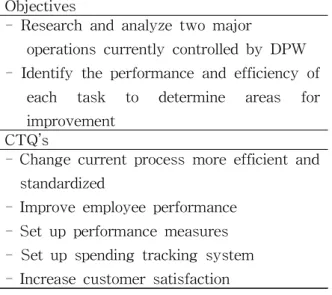
decided that our overall goal was to find as much information available regarding current practices, best practices, and benchmarks. This would help with determining an overall recommendation regarding how the DPW can become more efficient for the two areas. Table 1 below summarizes the objectives and CTQ’s for the project.
Objectives
- Research and analyze two major
operations currently controlled by DPW - Identify the performance and efficiency of
each task to determine areas for improvement
CTQ’s
- Change current process more efficient and standardized
- Improve employee performance - Set up performance measures - Set up spending tracking system - Increase customer satisfaction
Table 1 Project Objectives and CTQ’s
3.3 Measure
The goal is to understand and document what needs to be improved, identify the issues and problems that are causing inefficiency and errors, and determine the metrics to measure the specification of problem. The objectives are to understand and document the current processes for improvement and determine what should be measured and how to collect the data to validate the metrics.
Once these areas of focus and project goals were determined and shared with the operation employees, our team began formulating specific questions to help gauge the type of data that would be required from
the department.
During this time, our team also began to reach out to other surrounding cities and towns that are similar in geographical coordinates and responsibilities. It became very evident that other cities and towns were not willing to speak with our team and/or send any data about how their DPW department currently runs. This setback made it very difficult since one of our team’s goals was to compare the town government against similar cities/towns within the same state. To accommodate for the lack of response, team members conducted further research from other state’s DPW. As a result of these setbacks, our team remained in this stage for most of the duration of the project since constant research was being conducted to help provide a strong analysis.
To identify problems causing inefficient processes and low performance, our project team used the process flow charts and the 5S’s (a housekeeping tool) to eliminate waste tasks and standardize the process.
3.3.1 Fuel Management
The DPW currently utilizes a software called Fuelmaster 3505, provided by Service Station Equipment, Inc. This company is currently the second largest Fuelmaster provider in the region. The DPW is currently lacking a system that provides more integrated data collection and a GPS tracking system to help monitor idle time and location.
These practices typically allow departments to
save on fuel and track worker’s usage of
vehicles and gas pumps. This system has an
AIM module which according to the sources
provided, keeps the driver out of the data
collection process. However there has been
concern that it is not user friendly for drivers
and other people. This often results in extensive training to help workers learn and understand how to efficiently operate the software.
The cost of this equipment is $49,000. Fuel management is not efficiently tracked in the DPW. The information that is provided on excel sheets regarding the amount of gasoline utilized and the miles traveled are not accurate and we found that some entries were duplicated, which raised concerns of not having accurate data. The lack of a GPS system and integrated data in the Fuelmaster 3505 makes it difficult for DPW to track information in real time as well as idle time.
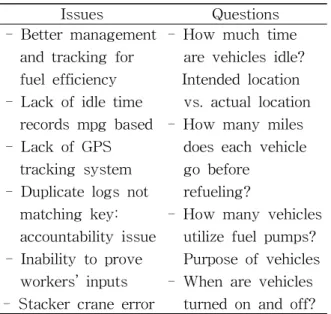
Table 2 summarizes the issues identified and questions to analyze factors causing the problems within the fuel management department.
Tracking fuel management is not easy with the current Fuelmaster 3505 program that the DPW is using. Their current metrics include deliveries, transfers, adjustments, fuel transactions by hose number, fuel transaction totals by tank and oil check transactions;
however, all these metrics are not interrelated to a GPS system. As mentioned by the DPW, there is a lack of GPS system that can also track idle times. Fuelmaster, their current program also tracks the following metrics:
from which tank a product is being withdrawn, number of month-to-date and year-to-date deliveries, adjustments, and transfers, whether a hose is activated or unused, type of product being dispensed, unit equivalents, etc.
The main issue with these metrics is that more trainings are required for the DPW personnel to be able to manage them properly and the program does not seem to be straight-forward and easy to read. The excel spreadsheets are inconsistent sometimes and
the data is vague as it does not show locations or idle times, which ultimately can be a source of higher fuel costs.
3.3.2 Trash Management
The town has 106 55-gallon trash barrels that need to be emptied every week due to the level of waste. In the summer, two men from the DPW empty each trash barrel twice per week. In the winter, two men from the DPW empty each trash barrel once per week, however, the DPW reduces the number of trash barrels that need to be emptied during the winter months in order to reduce costs as well as allocate time to other higher priority jobs and projects for the season. When there is a severe weather condition, the trash management can be disrupted as collecting trash can be either dangerous or time consuming, which can cause supply operation uncontrollable (Lee, 2018). In this situation, past data and experience in similar situation can help mitigate operation disruption.
However, the costs associated with trash
Issues Questions
- Better management and tracking for fuel efficiency - Lack of idle time
records mpg based - Lack of GPS
tracking system - Duplicate logs not
matching key:
accountability issue - Inability to prove
workers’ inputs - Stacker crane error
- How much time are vehicles idle?
Intended location vs. actual location - How many miles
does each vehicle go before
refueling?
- How many vehicles utilize fuel pumps?
Purpose of vehicles - When are vehicles
turned on and off?
Table 2 Issues and Questions to Analyze
(Fuel Management Department)
collection are not currently tracked by the DPW, as well as the number of tons collected from street cleaning or public places such as parks, as there is no weigh station.
Additionally, the DPW reports occasionally receiving complaints because the trash barrels are overflowing with unsightly waste.
One of the main issues with trash collection is with respect to the barrels overflowing and causing citizens to complain about the unsightly mess. The DPW reports that trash barrels need to be emptied every week due to the amount of waste in each one, but no costs associated with trash collection or amount of waste collected is recorded each week. The DPW reports that barrels are eliminated from trash collection in the winter months due to there being less waste, but there is not a concrete number associated with this reduction in barrels and therefore it is difficult to track and associate costs with winter trash collection.
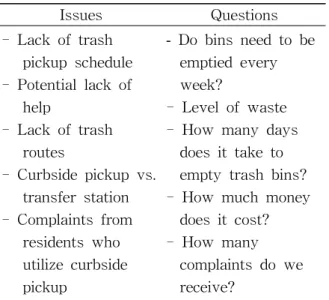
If all 106 barrels are being used in the summer months, presumably that takes working hours away from other high priority projects around town. However, since there is no tracking of the costs associated with summer trash collection either, it is difficult to discern the true trade-off cost here as well. Table 3 summarizes the issues identified and questions to analyze factors causing the problems within the trash management department.
The number of trash barrels emptied each season as well as the costs associated with trash collection need to be tracked and archived.
The number of barrels actually overflowing with waste, by district of the town, need to be recorded each week so that the DPW can determine if certain barrels need to be emptied more or less and if working hours can be allocated to other tasks as a result.
Issues Questions
- Lack of trash pickup schedule - Potential lack of
help
- Lack of trash routes
- Curbside pickup vs.
transfer station - Complaints from
residents who utilize curbside pickup
- Do bins need to be emptied every week?
- Level of waste - How many days
does it take to empty trash bins?
- How much money does it cost?
- How many complaints do we receive?
Table 3 Issues and Questions to Analyze (Trash Management Department)
In addition, if the amount of waste collected each week could be measured without the use of a weigh station, but by number of barrels or another unit of measurement, the relative costs associated with trash collection could be measured and recorded. Once the data pertaining to the frequency and number of barrels emptied each week is compiled, it can be measured and used comparatively each season to determine costs associated with trash collection and help the town to determine either a more cost-effective alternative or address the issue with frequent necessary collection and barrel overflows each week.
3.4 Analyze
The goal is to analyze the process
problems and issues related to inefficient
operations and low performance, identify,
validate, and select root causes for such
problems and issues. The goal also includes
identifying improvement opportunities and
performing cost-benefit analysis. The
objectives are to perform cause and effect analysis to identify root causes for inefficient process and low performance and to analyze the gap between the current practice and the best practices of other town to identify alternatives for the process changes, prioritize the potential issues of current department operations, and analyze the pros and cons of as-is operations versus should-be operations.
Once we determined that we had enough information gathered from the department and other benchmarking departments, we began analyzing the collected data. The purpose of this stage was to determine root causes of current inefficiencies of the operations. Our team quickly learned that there was a significant lack of data collection on several of the areas. To accommodate for this bottleneck, our team remained in constant communication with the project sponsor and the operation managers and by sending questions to gather more data for analysis.
3.4.1 Cause-Effect Analysis
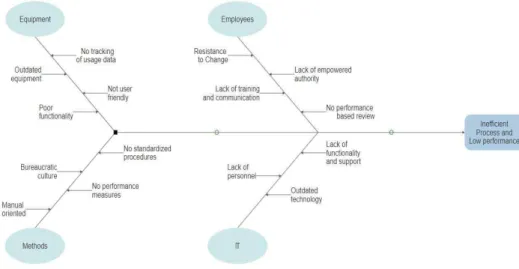
Our team conducted a cause and effect analysis for both fuel management team and
trash management team to identify common root causes related to employees, methods, information technology, and equipment. The cause and effect diagram is presented in Fig. 1.
Main critical root causes we determined from the analysis include lack of data tracking the process performance, antiquated equipment, lack of IT support, bureaucratic culture in the methods of carrying out tasks, and no employee appraisal based on meritocracy.
Another typical issue with the employees in most of non-profit organizations is the employees’ reluctance to change in the way they work and the rules they follow.
Employee motivation and training along with the leadership for the project were necessary to reduce any frustrations among employees for participating the project.
3.4.2 Best Practices
Our team also researched best practices of other town municipal governments to analyze the gaps between the current process of the two departments and other best practices and identify improvement opportunities and alternatives for the process changes.
Fig. 1 Cause and Effect Diagram
3.4.2.1 Fuel Management
AssetWorks has worked with larger cities than town in terms of population and density, however it has been successful with two medium sized cities such as Oxnard, CA, and the city of Chesapeake, VA; as well as a case in Columbus, Ohio, which reflects how their GPS systems worked in their favor.
Oxnard, California: In 2008, Government Fleet magazine recognized Oxnard as #3 public sector fleet in the country. Due to the 26-key metrics on technician and customer dashboards; reduced repair cycle times and enhanced diagnostics through the deployment of wireless laptop computers to technicians;
and enhanced employee performance due to Fleet Focus. Oxnard’s fleet has been growing and with that, expenses as well, so the efficiency provided by the software has helped them reduce expenses by analyzing their fleet data effectively, their fleet consisted of around 935 vehicles.
City of Chesapeake: “By utilizing the performance and auditing features of the FleetFocus solution, the City can remain competitive while also realizing improvements in efficiency that will allow more value for the taxpayer dollar. Despite fluctuations and even decrease in the Central Fleet Management division budget over the years, the Fleet Services Team has consistently met operational demand. Fleet Focus is one of the tools that the City uses to learn to do more with less effort. Fleet Focus provided the city with a user-friendly software that led overall customer satisfaction increase from less than 25% to more than 75%.
3.4.2.2 Trash Management
BigBelly Trash Compactors are not only
the waste collection trend around the world, but also a cost-effective and environmentally friendly alternative to the standard 55-gallon trash barrels that most cities have, including the town. Emptying trash barrels is presented as a time and resource waste and at times during the year, the amount of barrels emptied is reduced by the DPW in order to free up workers to other more important projects as well as save money. Since emptying 106 55-gallon trash barrels seems have several activities that could be categorized as non-value added, eliminating this waste from the trash collection process and looking into lean management practices that will streamline the trash collection process could be more time and cost effective.
Examples of this are visually observing whether trash barrels are in unnecessary places and if some that are not used as often could be removed due to their under-utilization. Additionally, tracking the number and frequency of complaints for which trash barrel could help the DPW to find an alternative solution that would eliminate the waste overflow. Furthermore, if emptying certain trash barrels or emptying trash barrels in general is a bottleneck activity that prevents workers from getting to more important activities, utilizing GIS to create a route plan to maximize the time it takes to empty the trash barrels could be more time and cost effective.
An example of best practices the City of
Boston, who saved an average of $3 million
dollars by implementing GIS and offered
citizens and visitors a more environmentally
friendly incentive to throw away their waste
and recycle their bottles and cans, which
eventually contributed to the cleanliness and
eco-friendliness of the city.
3.5 Improve
The goal is to implement the recommended action plans, measure the results and evaluate the impact of the improvements. The objectives are to document manuals and procedures, train the employees, monitor and check for improvement after the process change, and develop improvement plan for department areas that are under-performing or inefficient.
The purpose of this stage is to improve process performance by addressing and eliminating root causes. For this stage, our team determined best practices and recommendations for the target operation areas. It was decided that an overall recommendation of implementing a Geographic Information System (GIS) would severely benefit the department as well as other areas within the town. We also provided other recommendations specific to other general administration area.
3.5.1 Recommendations 3.5.1.1 Fuel Management
Our recommendation is to implement a GIS, a digital mapping system, to help the DPW solve the current inefficiency problems. To make that recommendation, we researched some review and articles regarding the GIS.
One study (Ghose et al., 2006) recommended the use of a GIS optimal routing model to determine the minimum cost and distance collection path for transporting the solid wastes to the landfill. The proposed model can be used as a decision support tool by municipal authorities for efficient management of the daily operations for transporting solid wastes, load balancing within vehicles,
managing fuel consumption, and generating work schedules for the workers and vehicles.
The GPS monitoring ensures that the driver stays within the zone the GIS has mapped for the driver on that day. If a driver is to leave their zone, management can address this issue with the driver. (Akuoko, 2011).
This can improve the communication between employees within the DPW, further improving the productivity of the department.
The GIS program will allow the DPW to record all their current assets and locations to allow for continuous monitoring and improvement. Having a specific schedule and route integrated with the DPW’s core activities, the GIS system will provide them with the ability to monitor and update in order to properly service the various needs within each department. The GIS system will also enable the DPW to improve its fuel management, as all activities that pertain the use of vehicles will be closely regulated. It is proven to be user friendly and has been proven in larger cities in California, Ohio, and Pennsylvania. It also eliminates duplicate data entry and redundant data, which is one of the problems that the current Fuelmaster 3505 Problem has not been able to solve. Among the benefits of implementing this GPS to the DPW department are the following: it will reduce vehicle ownership costs, extend the useful life of vehicles, tracks vehicles in real-time, increases driver safety standards.
3.5.1.2 Trash Management
Our recommendation to address the trash
collection issues comes in the form of a
BigBelly Trash Compactor. The advantages of
the BigBelly Compactor are extensive both
economically for the DPW and the town as
well as environmentally and aesthetically for
the citizens and visitors of the town. BigBelly Trash Compactors will save the town money, reduce litter, eliminate waste overflow, free up working hours for the DPW to allocate to other higher priority works, and solve the coyote problem in the town.
The solution will also increase the likelihood of citizens and visitors alike to recycle, as well as provide the invaluable operations data that the DPW is currently lacking. Although there is an initial cost of the compactor of $7,000, long-term savings coupled with the additional benefits prove that BigBelly Trash Compactors would be a viable option for the DPW. The simple cost comparison analysis demonstrates a savings of almost $2,000 every year in waste collection and could be even more than that depending on the actual costs associated with waste collection in the town and the assessment that BigBelly representatives can give the town on their actual needs in terms of waste collection. If the DPW chooses to not look into BigBelly Trash Compactors as an option, our team also recommends utilizing GIS to create a route plan and to track how often specific trash barrels need to be emptied compared to ones that are barely full in order to decide if some could be eliminated and if others needed to be emptied sooner.
Using GIS would help workers to know exactly where each trash barrel is in relation to each other and other landmarks, as well as help to maximize the time it takes to empty each one by creating a viable route plan that workers would follow instead of randomly deciding which trash barrels would be emptied first.
3.5.2 Expected Results and Benefits
Upon the implementation of the recommendation, the DPW will see several
improved results and benefits on process and performance of both fuel and trash management team. The tracking system of key metrics will be more effective as all data will be available in one central location and real time data regarding road conditions, equipment maintenance and areas that require attention, etc. are accessible to all workers to understand what is going on.
There will be accurate performance measures of performance giving accountability and ownership of work. The operations will be more efficient from less lead time and reduced operation costs as there will be less idle times of trucks and equipment and more allocation of resources to other high priority projects. Technology advancement is another huge result. All workers will have a tablet with access to GIS system to take pictures of repair, write-up reports, access road maps, and collect real-time data with ease. The benefits are summarized in Table. 4 for both fuel and trash management as most benefits are common to both teams.
3.5.3 Challenges and Risks
Our team anticipate that there are some
challenges and risks associate with major
changes to the new process and new
equipment. Employees need to be well
informed and effectively communicated with
the benefits to not only the organization but
also to each and every employee as well to
reduce inborn reluctance to such changes and
push back from employees regarding learning
a new system. There will be an increasing
tension between the management and labor
union. The team should have capability to
manage the implementation process with full
support from the leadership team. Citizens of
the town will challenge the cost justification
of the investment as the project will be funded by the taxpayer’s money.
Timely and frequent announcement and communication with the town residents and other stakeholders are critical to earn rapport for the project. The success of the project depends on how well the challenges and risks are identified, addressed, and resolved with strong leadership and full support from the employees and citizens.
3.6 Control
The goal is to track down the performance measures and other indicators to control and continuously improve the process. The objective is to ensure that the process improvement is kept on track.
Our team and the operation managers worked together to design and implement process performance measures to help assess the efficiency and quality of the two operations. We also applied the Kaizen approach to set up a procedure and culture of continuous improvement process so that the process will be continue if staff turnover occurs. The project team and the employees of the government who were involved in this project celebrated the completion of the project and successes, reward and recognize the project team members. This reward and recognition program becomes a regular part of the Kaizen process to accommodate continuous improvement and encourage the employees.
4. Conclusion
LSS is proven to be an effective solution to improve operation efficiency, service quality, and customer satisfaction. This case study adopted LSS approach and its tools to achieve
such goals for a local government. As a result, the processes are streamlined and some of the issues are resolved. Despite the necessity of change for the process improvement, there is still a resistance to change from the employees.
The DMAIC approach used in this case was particularly effective in evaluating the old process systematically with data to find ways to improve productivity and quality. It also contributed to educating employees how important it is to accept the new change and continuously strive to improve the process for quality service and customer satisfaction even in private sector. It is only relatively recently that software and advanced technology have been applied to municipalities and their management.
These new methods are necessary to measure inefficiencies in local public services and the determinants of local public sector efficiency. Our team was able to make recommendations that are involved different technology and software to both solve problems and help manage departments in the future. Hopefully, there will be a trend toward greater integration of technology and software not only in the town government, but municipalities in other districts. Although the majority of LSS applications have been in private sectors, this case study can add an example of how LSS tools can be applied in a nonprofit organization, particularly, a municipal government of a small town.
This case study also has an implication as
a reference to the managers of non-profit
organization who are seeking ways to
improve their stagnant process and exceed
their citizen satisfaction. This case also
provides some value to both research scholars
and practitioners who consider adopting LSS
as a process improvement strategy to achieve
high quality service.
References