1. 서론
의생명공학기술은 인간의 건강을 증진시키고 생명을 연장하며, 인간의 고통을 경감시키는 긍정적인 역할을 한 반면, 기술의 적용과정에서 오용 및 남용문제, 생명 윤리의 침범문제 등 생명 윤리적 문제들을 야기하였다 [1]. 생명의료윤리의식은 의료상황에서 직면하는 윤리 문제 해결과정에 기준이 되고, 이에 대한 도덕적 판단
의 기준은 윤리적 딜레마에 직면했을 때 바람직한 의사 결정을 이끌어내어 대상자의 옹호자로서 역할을 수행 하는데 있어 중요한 개념으로 작용한다[2]. 그러나 생명 의료윤리에 대한 의료종사자들의 관심이 높지 않고 교 육을 체계적으로 받지 못해 생명의료윤리에 대한 개념 인식이 강화되기 쉽지 않다[3,4]. 실제 임상에서 근무하 는 간호사도 임상현장에서 대상자의 생명의료와 관련 된 여러 윤리적 딜레마를 경험하고 있으며, 그러한 상
간호대학생의 생명의료윤리에 관한 문헌연구
백석문화대학교 간호학과 교수
원효진
A review of research on biomedical ethics of nursing college students
Hyojin Won
Professor, Dept. of Nursing, Baekseok Culture University
요 약 본 연구는 간호대학생을 대상으로 생명의료윤리에 대하여 분석한 국내연구의 동향을 파악하고자 하였다.
문헌조사에 사용된 검색엔진은 KISS, NDSL, RISS이었으며, ‘간호대학생’과 ‘생명의료윤리’를 주요어로 선정기준에 적합한 26편의 논문을 분석하였다. 생명의료윤리를 분석한 주요개념은 생명의료윤리의식이었으며, 태아생명권, 인 공수정, 장기이식 등의 내용을 포함하였다. 또한 생명의료윤리의식은 대상자의 윤리교육경험(유무), 학년, 임상실습 경험, 윤리교육 참여의사에 따라 차이가 있었으며, 생명의료윤리의식과 함께 분석된 주요 개념으로는 연명치료중단, 윤리적 가치관, 비판적사고, 성태도, 간호전문직관, 죽음에 대한 인식 등으로 나타났다. 이러한 결과는 향후 간호윤 리교육 마련을 위한 기초 자료로 활용될 수 있을 것이다.
키워드 : 대학생, 간호, 생명의료윤리, 문헌연구, 윤리교육
Abstract This study attempted to review the research on biomedical ethics of nursing students published in Korea. Keywords included ‘nursing students’, and ‘biomedical ethics’, and a total of 26 studies were collected via databases such as KISS, NDSL, RISS. The biomedical ethics awareness was the main concept of biomedical ethics, consisted of right to life of fetus, artificial insemination, organ transplantation, and so on. There were differences in biomedical ethics awareness by ethical education experience, grade, clinical practice experience, and ethical education willingness to attend. Also, major keywords analysed with biomedical ethics were withdrawal of life-sustaining treatment, critical thinking, sexual attitude, nursing professionalism, and death perception. Study results can be used to provide basic data for preparing nursing ethics education in the future.
Key Words : College students, Nursing, Biomedical ethics, Research review, Ethical education
*
Corresponding Author : Hyojin Won([email protected]) Received June 1, 2021
Accepted August 20, 2021
Revised July 15, 2021
Published August 31, 2021
황에서 최상의 의사결정을 내리기 위해 올바른 생명의 료윤리의식은 필수적이다[5].
생명의료윤리는 의료 분야 학생들이 임상 실습에서 윤리적 문제를 식별, 평가 및 해결하기 위해 필요한 기 술을 개발하는데 중요한 관련성이 있다[6]. 특히 간호대 학생들의 경우 간호사가 되기 전 임상실습을 통하여 환 자의 생명과 관련된 활동을 관찰, 수행하게 되고, 죽음 을 앞둔 대상자와 가족들을 접하게 되기도 한다. 이때 환자의 생명과 관련된 활동을 수행해야 하는 현실에 직 접 마주하면서 불안감과 어려움을 느낄 수 있고, 실제 로 임종 환자를 간호하게 될 때 갖게 되는 죽음에 대한 생각은 대학생의 발달단계에 영향을 미칠 수 있다. 임 상실습경험에 따라 생명의료윤리의식에 차이가 있다고 하였으며[7], 확고한 윤리적 가치관을 갖추지 못한 상황 일때 다양한 임상실습에서 직면하게 되는 윤리적 문제 에 따라 간호대학생의 생명의료윤리의식의 정도는 변 화될 수 있다고 하였다[8].
그러므로 간호학생에게 있어 인간 생명에 대한 존엄 과 생명의료윤리에 대한 관심은 졸업 후 간호사로서 올 바른 윤리의식 정립에 영향을 미칠 수 있다. 또한 인간 의 생명이 무엇보다 중요시되는 간호학을 전공하는 대 학생들의 생명의료윤리 의식은 향후 임상실무에서 간 호행위를 하는데에도 필수적일 것이다[9]. 그러나 수년 간의 경험을 통해 특정한 교육적 방법론을 개발한 영국 및 미국 등[10]과 달리 국내 생명의료윤리교육을 위한 기준과 지침은 없다. 이에 본 연구는 간호대학생을 대 상으로 생명의료윤리에 대한 연구동향을 파악하여 향 후 연구방향과 간호교육의 개선방안을 마련하는데 기 초자료를 제공하고자 실시되었다.
2. 연구방법
2.1 연구설계본 연구는 간호대학생을 대상으로 생명의료윤리에 대하여 국내에서 발표된 연구결과를 종합하기 위해 수 행된 문헌연구이다.
2.2 문헌 검색 및 선정
본 연구는 간호대학생을 대상으로 생명의료윤리에 대하여 분석된 2017년부터 2019년까지의 국내 학술지 게재논문을 선정 대상으로 하였다. 문헌조사에 사용된 검색엔진은 한국학술정보(Korean studies Information Service System, KISS), 국가과학기술 정보센터(National Digital Science Library, NDSL), 한국교육학술정보원(Research Information Sharing Service)을 사용하여 ‘간호대학생’, ‘생명의료윤리’를 검 색어로 하였다. KISS 3편, NDSL 26편, RISS 23편이 검색되었고, 이중 회색문헌(연구보고서, 학위논문, 구술 발표 등), 중복으로 게재된 논문, 원문이 확인되지 않는 논문, ‘간호사’를 대상으로 한 논문은 제외하고 최종 분 석에 사용된 문헌은 26편이었다.
3. 연구결과
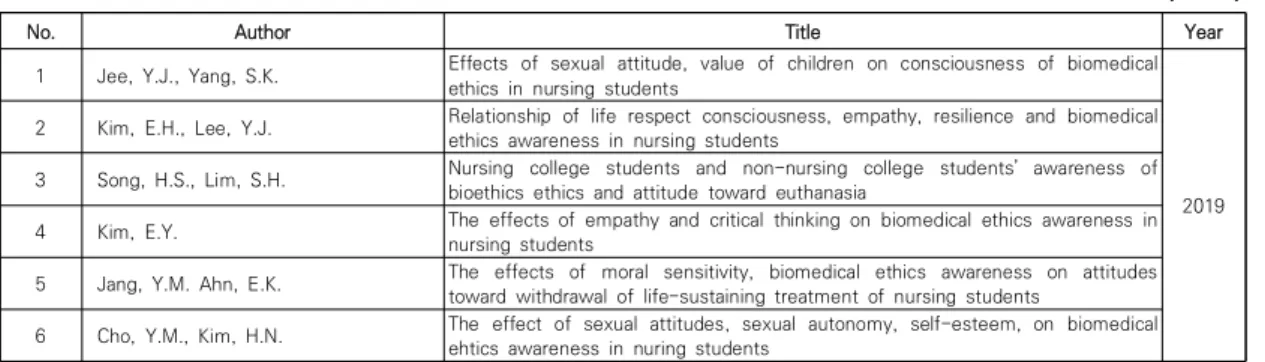
3.1 연구현황연도별 연구현황은 Table 1과 같다. 2019년 8편 (30.8%), 2018년 13편(50%), 2017년 5편(19.2%)이었 다. 이중 양적연구가 25편(96.2%), 질적연구가 1편 (3.8%)이었다.
Table 1. List of Reviewed Articles (N=26)
No. Author Title Year
1 Jee, Y.J., Yang, S.K. Effects of sexual attitude, value of children on consciousness of biomedical ethics in nursing students
2019 2 Kim, E.H., Lee, Y.J. Relationship of life respect consciousness, empathy, resilience and biomedical
ethics awareness in nursing students
3 Song, H.S., Lim, S.H. Nursing college students and non-nursing college students’ awareness of bioethics ethics and attitude toward euthanasia
4 Kim, E.Y. The effects of empathy and critical thinking on biomedical ethics awareness in nursing students
5 Jang, Y.M. Ahn, E.K. The effects of moral sensitivity, biomedical ethics awareness on attitudes toward withdrawal of life-sustaining treatment of nursing students
6 Cho, Y.M., Kim, H.N. The effect of sexual attitudes, sexual autonomy, self-esteem, on biomedical
ehtics awareness in nuring students
Table 1. Continued
No. Author Title Year
7 Kim, J.Y. The nursing student’s consciousness of biomedical ethics before and after
their clinical practice 2019
8 Kim, K.A., Jeong, G.S. Effects of biomedical ethics education on moral sensitivity, critical thinking and biomedical ethics awareness of nursing students
9 Cha, N.H. The relationships between the perception of biomedical ethics and nursing ethics in nursing students
2018 10 Kim, E.Y. Effects of consciousness of biomedical ethics and critical thinking disposition on
attitude toward withdrawal of life-sustaining treatment among nursing students 11 Lee, J.O. Oh, E.Y. A study on the recognition of organ donation of nursing students in
convergence and integration time
12 Kim, M.S., Jeon, M.K. Influence of perception of patient rights and ethical values on biomedical ethic awareness in nursing students
13
*Chu, M.S. Hwang, Y.Y. Subjectivity about bioethics among nursing students with experience volunteering in elderly care facilities
14 Jeong, G.S.
The differences of nurses’ perception of the code of ethics, degree of application of nursing ethics and biomedical ethical consciousness according to nursing students’ clinical practice experience, ethical values and biomedical ethics education
15 Kim, T.K., Bak, Y.G. Influence of nursing professionalism and consciousness of biomedical ethics on satisfaction in major of nursing student
16 Moon, M.Y. Effects of ethical values and nursing professionalism on the consciousness of biomedical ethics before applying nursing ethics education in nursing college students 17 Park, M.R., Je, N.J. The difference of biomedical ethics consciousness, related knowledge,
awareness, and attitude of nursing college students according to the completion of biomedical ethics education
18 Kim, M.Y., Mun, M.Y. Impact of biomedical ethics awareness and ethical values in nursing student on their attitudes towards DNR
19 Lee, O.S., Kim, E.J. Mediating effect of nursing professionalism on the relationship between critical thinking disposition and consciousness of bioethics in nursing students 20 Choi, E.J., Jeong, H.S. The effect of nursing students’ consciousness of biomedical ethics, good death
recognition, and self-esteem on the attitude toward withdrawal of life-sustaining treatment
21 Kwon, K.E., Yoo, M.S. Biomedical ethics awareness and attitudes toward dignified death and advance directives among nursing students
22 Kim, M.J., Park, S.Y., Park, S.J., et.
al.
Comparative study of nursing students consciousness of biomedical ethics and attitudes toward human tissue donation and transplantation according to participation in anatomy camp program
2017 23 Kim, G.M., Sung, K.S., Kim E.J. Awareness of nursing students’ biomedical ethics and attitudes toward
withdrawal of life-sustaining treatment
24 Lee, K.J., Lee, E., Park Y.S. Comparison on influencing factors on consciousness of biomedical ethics in nursing students and general students
25 Cho, Y.H. Factors affecting the consciousness of biomedical ethics of the nursing students before clinical practice in convergence era
26 Lee, Y.J., Kim, Y.S. The difference of the death perception, death attitude and the awareness of biomedical ethics of nursing students according to the completion of bioethics education
* qualitative study
Table 2. Instruments of biomedical ethics (N=25)
Developmented
Author (year) Revised
Author (year) Factors No.
Items of Likert
scale
Use
n Author(year)
Lee (1990) K w o n (2002)
Right life of fetus(5), Artificial abortion(6), Artificial insemination(7), Prenatal diagnosis of fetus(5), Right to life of newborn(5), Euthanasia(5), Organ transplantation(4), Brain death(5), Human biotechnology(7)
49 4 17
Kim & Lee / Song & Lim / Kim / Jang & Ahn / Cho & Kim / Kim (2019), Cha / Kim / Lee & Oh / Kim & Jeon / Kim & Bak / Park &
Je / Kim & Mun / Choi & Jeong / Kwon & Yoo (2018), Cho / Lee &
Kim (2017) Right life of fetus(5), Artificial abortion(6), Artificial
insemination(7), Prenatal diagnosis of fetus(5), Right to life of newborn(5), Euthanasia(6), Organ transplantation(4), Brain death(5), Human biotechnology(7), Death with dignity(1), DNR(1)
52 4 2 Kim & Jeong (2019), Jeong
(2018)
Table 2. Continued
Developmented
Author (year) Revised
Author (year) Factors No.
Items of Likert
scale
Use
n Author(year)
Lee (1990) K w o n (2002)
Right life of fetus(5), Artificial abortion(6), Artificial insemination(7), Prenatal diagnosis of fetus(5), Right to life of newborn(5), Euthanasia(6), Organ transplantation(4), Brain death(4), DNR(5), Hospice(3)
50 4 1 Moon (2018)
Lee (1990) K w o n (2002)
Right life of fetus(5), Artificial insemination(7), Human biotechnology(6), Euthanasia(5), Organ
transplantation(3), Brain death(5) 32 4 1 Kim et al. (2017)
Lee (1990) K w o n (2002)
Generative ethics(21) Medical ethics(14)
Mortality ethics(14) 49 4 1 Kim et al. (2017)
Lee (1990) K w o n (2002)
Right life of fetus(5), Artificial abortion(6), Artificial insemination(7), Prenatal diagnosis of fetus(5), Right to life of newborn(5), Euthanasia(5), Organ transplantation(4), Brain death(5)
42 5 1 Lee & Kim (2018)
Lee (2002)
- Right life of fetus(5), Artificial abortion(8), Artificial insemination(6), Prenatal diagnosis of fetus(5), Right
to life of newborn(5) 29 4 1 Jee & Yang (2019)
Lee et al.
(2017)
Right life of fetus, Artificial abortion, Artificial insemination, Prenatal diagnosis of fetus, Right to life
of newborn 21 4 1 Lee et al. (2017)
Table 3. General Characteristics related to biomedical ethics (N=26)
Variables Author(year) n
Ethical education experience Kim (2019), Cho & Kim (2019), Lee & Oh (2018), Cha (2018), Kim & Jeon (2018),
Kwon & Yoo (2018), Kim & Mun (2018) 7
Grade Kim & Lee (2019), Cho & Kim (2019), Kim (2018), Lee & Kim (2017) 4 Clinical practice experience Kim & Lee (2019), Kim & Jeon (2018), Jeong (2018) 3 Ethical education
participation need Kwon & Yoo (2018), Kim & Mun (2018), Cho (2017) 3
College life satisfaction Kim (2019), Kim (2018) 2
Major satisfaction Lee & Kim (2018), Cho (2017) 2
Table 4. Factors correlated with biomedical ethics (N=26)
Related variables Author(year) n
Withdrawal of life-sustaining
treatment Jang & Ahn (2019), Kim (2018), Park & Je (2018), Choi & Jeong (2018),
Kim, Sung & Kim (2017), Cho (2017) 6
Ethical value Cha (2018), Kim & Jeon (2018), Moon (2018), Kim & Mun (2018), Lee, Lee & Park (2017),
Cho (2017) 6
Critical thinking Kim (2019), Kim & Jeong (2019), Kim (2018), Lee & Kim (2018) 4 Death perception Park & Je (2018), Choi & Jeong (2018), Lee & Kim (2017) 3 Sexual attitude Jee & Yang (2019), Cho & Kim (2019), Lee, Lee & Park (2017) 3
Nursing professionalism Kim & Bak (2018), Moon (2018), Lee & Kim (2018) 3
Human tissue donation and
attitude toward transplantation Lee & Oh (2018), Park & Je (2018), Kim et al. (2017) 3
Children’s value Jee & Yang (2019), Lee, Lee & Park (2017) 2
Empathy Kim & Lee (2019), Kim (2019) 2
Respects for life Kim & Lee (2019), Lee, Lee & Park (2017) 2
Moral sensitivity Jang & Ahn (2019), Kim & Jeong (2019) 2
Self-esteem Cho & Kim (2019), Choi & Jeong (2018) 2
Death attitude Kwon & Yoo (2018), Lee & Kim (2017) 2
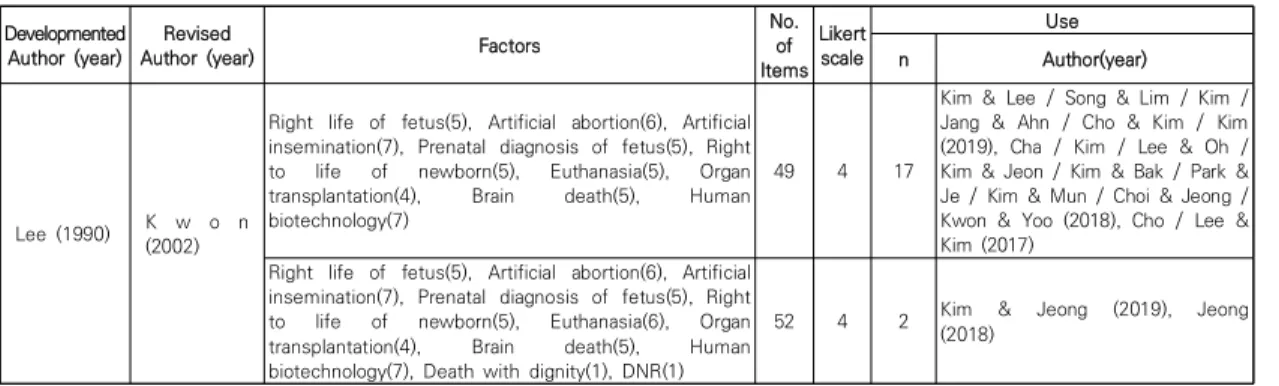
3.2 생명의료윤리 개념 분석을 위해 사용된 도구 본 연구의 분석대상문헌 26편 중 Q방법론을 적용한 질적연구 1편을 제외하고, 생명의료윤리의 개념을 측정 하기 위한 25편의 양적연구에 사용된 측정도구를 분석 하였으며 그 결과는 Table 2와 같다. Lee[11]가 개발 하고 Kwon[12]이 수정 보완한 태아생명권, 인공수정, 인공임신중절, 신생아 생명권, 태아진단, 장기이식, 안 락사, 뇌사, 인간생명공학의 9개 하위요인으로 총 49문 항으로 구성된 생명의료윤리의식 도구를 사용한 문헌 이 18편(69.2%)으로 가장 많았다. 그 외 일부 하위요인 과 문항을 조정하거나 존엄사, DNR 등의 개념을 추가 하여 도구를 구성한 논문이 있었으며, 연구자가 요인분 석을 통하여 하위요인을 재분류하여 생식윤리, 진료윤 리, 죽음의 윤리로 구분한 논문이 있었다.
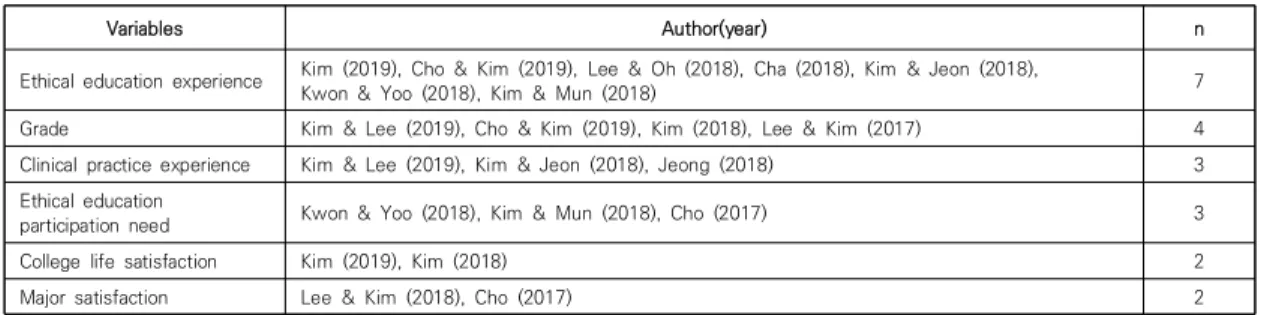
3.3 일반적특성에 따른 생명의료윤리의식의 차이 일반적 특성에 따른 생명의료윤리의식의 차이는 Table 3과 같다. 윤리교육경험(유무) 7편(27%), 학년 4 편(15.4%), 임상실습경험 3편(11.5%), 윤리교육 참여의 사(필요성) 3편(11.5%), 대학생활 만족도 2편(7.7%), 전공만족도 2편(7.7%) 으로 나타났다. 그 외 종교, 학과 선택동기, 연령, 성별, 주관적인 건강상태, 가족구성원 중 환자 또는 사망자가 있는 경우 등이 있었다.
3.4 생명의료윤리의식 개념과 관련된 변수 요인 생명의료윤리의식과 관련된 변수요인으로는 Table 4와 같다. 연명치료중단 6편(23.0%), 윤리적 가치관 6 편(23.0%), 비판적사고 4편(15.4%), 성태도 3편 (11.5%), 간호전문직관 3편(11.5%), 죽음에 대한 인식 3편(11.5%), 인체조직기증 및 이식에 대한 태도 3편 (11.5%), 자녀관 2편(7.7%), 공감 2편(7.7%), 생명존중 의식 2편(7.7%), 도덕적 민감성 2편(7.7%), 자아존중감 2편(7.7%), 죽음 태도 2편(7.7%) 이었다. 그 외 생명의 료윤리지식, 안락사, 회복탄력성, 성적자율성, 성지식, 환자권리, 윤리강령인식, 심폐소생술 금지, 호스피스 완 화의료 지식 및 인식, 사전연명의료의향서에 대한 태도 등이 있었다.
4. 논의
본 연구는 ‘간호대학생’, ‘생명의료윤리’를 검색어로
적용하여 2017년부터 2019년까지 국내학술지에 게재 된 총 26편의 문헌을 분석하였다. 본 연구에서 분석된 26편의 논문 중 대다수(96.2%)가 양적연구였고, 질적 연구는 노인요양시설 봉사경험 간호대학생을 대상으로 생명윤리 주관성을 분석한 Q방법론 연구[13]가 유일하 였다. 1980년대부터 2000년까지 생명의료윤리에 관한 간호연구를 분석한 Kim[14]의 연구에서는 질적연구가 10.2%이었으나, 1980년대부터 2008년까지 간호윤리 연구에 대해 분석한 Ahn[15]의 연구에서는 양적연구가 66.5%, 질적연구가 32.4%로 2000년대 이후 질적연구 의 수가 많아졌다. 이는 Kim[14]과 Ahn[15]의 연구에 서 분석대상은 간호사, 간호학생, 환자, 보호자 등을 모 두 포함하였으나, 본 연구의 대상은 간호대학생으로만 한정하여 질적연구의 수가 적은 이유도 있으리라 생각 된다.
생명의료윤리의식에 대한 조사도구는 Lee[11]가 개 발하고 Kwon[12]이 수정 보완한 49문항의 도구가 가 장 많이 사용되었으며(69.2%), 이 도구에서 심폐소생술 금지, 호스피스, 존엄사 등의 하위영역을 추가 또는 삭 제하거나 문항수를 수정하여 사용한 문헌이 3편이었다.
또한 Lee[16]이 개발한 29문항의 도구를 사용한 문헌 이 1편이었고, 하위영역으로는 태아생명권, 인공수정, 인공임신중절, 신생아 생명권, 태아진단이었으며, 이 도 구의 문항수를 수정하여 사용한 문헌이 1편 있었다. 종 합하여 보면 간호대학생을 대상으로 생명의료윤리의식 에 관하여 조사한 도구는 주로 태아생명권, 인공수정, 인공임신중절, 신생아 생명권, 태아진단에 대한 내용임 을 알 수 있었다. 이는 간호대학생을 대상으로 생명의 료윤리교육을 실시하고 프로그램을 계획할 때 적절한 내용을 포함시키는데 활용할 수 있을 것이다.
일반적 특성에 따른 생명의료윤리의식의 차이는 윤 리교육경험(유무) 7편(27%), 윤리교육 참여의사(필요 성) 3편(11.5%)이었다. 학년에 따라 차이가 있는 문헌 이 4편(15.4%)이었는데, Kim[17]의 연구만 제외하고 는 학년이 높을수록 생명의료윤리의식의 점수가 높았 고, 임상실습경험이 있는 경우 생명의료윤리의식의 점 수가 높다는 연구가 3편(11.5%) 이었다. 이러한 결과는 간호학과의 임상실습이 3학년부터 이루어지고 있고 학 년이 올라갈수록 윤리교육경험의 기회가 많아진다는 것을 볼 때, 결국 윤리교육의 참여 유무가 생명의료윤 리의식에 지대한 영향을 미친다 하겠으며, 이는 간호윤
리교육에 대한 탐구가 필요함을 제기시키는 것이다. 또 한 대학생활 만족도 2편(7.7%), 전공만족도 2편(7.7%) 에 따라 생명의료윤리의식에 차이가 있었던 만큼 학생 들의 대학 및 학과만족도를 향상시키는 것이 중요하다 하겠다.
생명의료윤리의식과 관련된 변수요인으로는 연명치 료중단, 윤리적 가치관, 비판적사고, 성태도, 간호전문 직관, 죽음에 대한 인식 등으로 나타났다. 2003년부터 2017년까지 생명윤리의식에 관한 30편의 간호연구를 분석한 Choi[18]의 연구에서 분석된 연구주제로는 생 명의료윤리, 도덕적 민감성, 비판적 사고성향, 도덕 판 단력 등이었으며, Ahn[15]의 연구에서는 말기환자의 치료중단, 심폐소생술, 윤리적 딜레마, 전문직 윤리, 장 기이식, 안락사 등 생명의료윤리와 관련된 연구주제가 다양해짐을 알 수 있었다. 이러한 결과는 생명의료윤리 와 관련한 가치관이 사회적으로 중요한 이슈가 되고 있 으며, 실무현장에서 쟁점화되는 윤리적 상황들에 끊임 없는 관심이 필요함을 말해주는 것이라 하겠다.
간호대학생은 생명에 대해 올바르게 인식하고 향후 의료인으로서 생명의료윤리에 대해 책임감을 갖고 간 호전문성을 향상시킬 수 있도록 준비되어야 한다. 이상 의 결과로 간호대학생의 생명의료윤리의식을 함양하기 위하여 생명과 죽음의 윤리적 문제를 포함한 간호윤리 교육을 마련하고, 이를 위한 연구가 활발히 이루어져야 할 것이다.
5. 결론
본 연구는 국내에서 발표된 간호대학생의 생명의료 윤리 관련 연구들을 고찰하여 간호윤리교육의 필요성 을 제고하고자 실시되었다. 2017년부터 2019년 사이 에 발표된 논문들을 검색하여 최종 26편의 논문을 분 석하였다. 양적연구가 대다수였으며, 생명의료윤리의식 에 대한 조사도구는 Lee가 개발하고 Kwon이 수정 보 완한 49문항의 도구가 가장 많이 사용되었다. 일반적 특성에 따른 생명의료윤리의식의 차이는 윤리교육경험 (유무), 학년, 임상실습경험, 윤리교육 참여의사(필요 성), 대학생활 만족도, 전공만족도로 나타났다. 생명의 료윤리의식과 관련된 변수요인으로는 연명치료중단, 윤 리적 가치관, 비판적사고, 성태도, 간호전문직관, 죽음 에 대한 인식, 인체조직기증 및 이식에 대한 태도가 있 었다. 본 연구결과를 볼 때 생명의료윤리 교육에 대한
학생들의 긍정적인 태도와 관심 및 참여가 생명의료윤 리의식에 영향을 미치므로 학생들의 학습과정에 국내 실정이 고려된 교육체계 수립이 필요하다 할 것이다.
REFERENCES
[1] J. W. Lee. (2012). The Ethical Problems on Defining Brain Death and Organ Transplantation.
Journal of the New Korean Philosophical Association, 69,
271-295.
[2] M. S. Yoo & K. C. Shon. (2012). Effects of nursing ethics education on biomedical ethics awareness, moral sensitivity and moral judgement of nursing students,
Journal of the Korean Bioethics Association, 12(2),61-76.
[3] M. S. Yoo & H. S. Park. (2010). Effects of nursing ethics education on bioethics awareness and critical thinking dispositions of nurses.
The Journal of Korean Bioehics Association, 11(1),51-60.
[4] J. Y. Ha, D. H. Kim & S. K. Hwang. (2009). The perception of Biomedical Ethics in Nurses.
The Journal of Korean Academic Society of Nursing Education, 15(2),216-224.
DOI: 10.5977/JKASNE.2009.15.2.216
[5] J. H. Park, Y. S. Kim & W. O. Kim. (2009). The Present Status and Future Directions of Nursing Ethics Education.
Korean Journal of Medical Ethics, 12(3),251-260.
[6] S. El Tarhouny, T. M. Mansour, G. A. Wassif & M.
K. Desouky. (2017). Teaching bioethics for undergraduate medical students.
Biomedical Research, 28(22).
[7] G. S. Jeong. (2018). The differences of nurses’
perception of the code of ethics. degree of application of nursing ehtics and biomedical ethical consciousness according to nursing students’ clinical practice experience, ethical values and biomedical ethics education.
The Journal of Korean Academic Society of Nursing Education, 24(3),300-310.
DOI: 10.5977/jkasne.2018.24.3.300
[8] K. A. Kim & G. S. Jeong. (2019). Effects of
biomedical ethics education on moral sensitivity,
critical thinking and biomedical ethics awareness
of nursing students.
Journal of the Korea Academia-industrial cooperation, Society, 20(2),240-249.
[9] E. J. Seo & N. H. Cha. (2017). Relationships among Nursing Professional Values, Bioethics and Death Ethic Perception in Nursing Students.
Journal of Digital Convergence, 14(5),
349-358.
DOI : 10.14400/JDC.2016.14.5.349
[10] Henk A. M. J. ten Have. (2014).
Bioethics Education in a global perspective: Challenges in global bioethics.Pittsburgh : Springer.
[11] Y. S. Lee. (1990). A study of the ethical values of Korean nurses.
Journal of Korean Academy of Nursing, 20(2),249-270.
[12] S. J. Kwon. (2002).
A study on the consciousness of biomedical ethics of the nursing students and medical students.Unpublished master’s thesis, Keimyung University of Daegue.
[13] M. S. Chu & Y. Y. Hwang. (2018). Subjectivity about Bioethics among Nursing Students with Experience Volunteering in Elderly Care Facilities.
Journal of Korean Academy Society Nursing Education, 24(1),50-60.
[14] M. J. Kim. (2000). Analysis of Nursing Research on Ethics Conducted in Korea.
Journal of the Korean Biothics Association, 1(2),3-13
[15] S. H. Ahn. (2009). Quantitative Analysis of Ethics Research within the Korean Nursing Community.
Korean Journal Medi Ethics, 12(3),
261-274.
[16] G. S. Lee. (2002).
A comparative study on the consciousness of bio-medical ethics of health care professionals and non health care professionals.Unpublished master’s thesis, Kyunghee University of Seoul.
[17] E. Y. Kim. (2018). Effects of Consciousness of Biomedical Ethics and Critical Thinking Disposition on Attitude toward Withdrawal of Life-Sustaining Treatment among Nursing Students.
Journal of Digital Convergence, 16(9),453-463.
[18] M. S. Choi. (2018). Nursing Research Trends for the Consciousness of Bioethics Published in Korea.
The Journal of the Convergence on Culture Technology, 4(1),207-217.
DOI : 10.1177/0363546507303560
원 효 진(Hyojin Won) [정회원]
․ 2014년 8월 : 서울대학교 간호학과 (간호학박사)
․ 2015년 3월~현재 : 백석문화대학교 간호학과 교수
․ 관심분야 : 간호조직, 간호교육
․ E-Mail : [email protected]