2003, Vol. 14, No.3 pp. 631∼639
Bayes Estimation of Stress-Strength System Reliability under Asymmetric Loss Functions
Yeon Woong Hong1)
Abstract
Bayes estimates of reliability for the stress-strength system are obtained with respect to LINEX loss function. A reference prior distribution of the reliability is derived and Bayes estimates of the reliability are also obtained. These Bayes estimates are compared with corresponding estimates under squared-error loss function.
Keywords : Bayes estimator, LINEX loss, stress-strength syetem, reliability
1. Introduction
In the Bayesian estimation of reliability function, symmetric loss function may be inappropriate. Overestimation of reliability function or average failure time is usually much more serious than underestimation. Also, an underestimation of the failure rate results in more serious consequences than an overestimation. For example, in the 1986 disaster of the space shuttle Challenger, NASA underestimated the failure rate and therefore overestimated the reliability of solid-fuel rocket booster(see Feynman, 1987). In dam construction, an underestimation of the peak water level is usually much more serious than an overestimation. For examples of the problem of Bayes estimation with asymmetric loss functions, see Ferguson(1967), Zellner and Geisel(1968), Canfield(1970), Aitchson and Dunsmore(1975), and Zellner(1986). Varian(1975) introduced a very useful asymmetric LINEX loss function that rises approximately exponentially on one side of zero and approximetely linearly on the other side of zero. Varian's LINEX loss function is
1) 경북 영주시 풍기읍 동양대학교 인터넷산업공학부 교수, E-mail :[email protected]
L(Δ) = b exp (aΔ) -cΔ-b, (1a) where Δ denotes the estimation error, and a, c ≠ 0 and b 〉 0 are constants.
Enis and Geisser(1971) obtained a Bayes estimator of R in the exponential case.
Gupta and Gupta(1988) obtained a Bayes estimator of R in the case of different location parameters and a common scale parameter under symmetric loss function.
In this paper Bayes estimators of R = P( X < Y) are obtained for two independent exponential distributions. In Section 2, LINEX loss functions are introduced. In Section 3, a reference prior distribution is derived and Bayes estimators of R are obtained under LINEX loss function.
2. LINEX Loss Functions
Let Δ = θˆ -θ denote the estimation error in using θˆ to estimate θ. From (la), it is clear that L( 0) = 0. Also, for a minimum to exist at Δ = 0, we must have
ab = c, and thus, (la) can be rewritten as
L(Δ) = b( exp (aΔ) -aΔ-1), (1b) where a≠0 is a shape parameter, and b 〉 0 is a scale parameter. The sign of the shape parameter a reflects the direction of the asymmetry, a > 0(a < 0) if overestimation is more(less) serious than underestimation; and the magnitude of a reflects the degree of asymmetry. For small values of |a|, the loss function is almost symmetric and not far from a squared error loss function.
Indeed, on expanding eaΔ≃1 + aΔ + a2Δ2/2, L(Δ) = a2Δ2/2, a squared error loss function. However, when ∣a∣ assumes appreciable values, optimal point estimates will be quite different from those obtained with a symmetric squared error loss function. See Varian(1975), Zellner(1986) and Parsian(1990) for more details on point estimation under LINEX loss function.
It is well known that for a squared error loss function, the Bayes estimator is obtained as posterior mean. Let p(θ|D) denote the posterior density function of θ where D denotes the observed data. Let Eθ denote the posterior expectation with respect to p( θ|D). The Bayes estimator under LINEX loss function is then given by(see Varian(1975)),
θˆ =- 1
a log Eθ[ exp ( - aθ)|D]. (2)
3. Bayes Estimation of R = P( X < Y)
Let X1,X2,…,Xn1 and Y1,Y2,…,Yn2 be two independent samples from exponantial distributions with means θ1 and θ2, respectively. In this section we consider Bayes estimators of R = θ2/( θ1+ θ2) with under LINEX loss function.
Attempts to obtain concise closed-form Bayes estimates for the reliability of exponential stress-strength models have historically been unsuccessful. Typically these estimates involve unresolved integrals or infinite series. Such estimates must be calculated by numerical methods.
The results presented in this section do not include closed-form estimates of R.
These results provide posterior densities for R corresponding to inverted gamma, noninformative, and reference priors. Using these posterior densities, and numerical methods, a Bayes estimate of R corresponding to any loss function can be obtained.
3.1 Case of inverted gamma prior
Suppose that given the hyperparameter αi,βi,i= 1,2, expected stress θ1 and expected strength θ2 have independent prior distributions θi∼IG(αi,βi), where IG( a,b) denotes the the inverted gamma distribution whose probability density function(pdf) is given by
g(θ;a,b) = ba
Γ(a) θ- ( a + 1)e- b/θ, θ > 0.
Then the posterior density of ψ(= R) is given by
πc( ψ∣s1,s2) = π( ψ;α1+ n1,β1+ s1,α2+ n2,β2+ s2), (3) where
π( ψ;a, b, c, d) = ( b/d)a
B( a,c) ・ ψa - 1( 1 - ψ)c - 1
[ 1 - (1 - b/d )ψ]a + c ,0 < ψ < 1, (4) s1=∑
n1
i= 1xi and s2=∑
n2
i= 1yi, and B( a,c) = Γ( a)Γ( c)/Γ( a + c). See Enis and Geisser(1971). Therefore the Bayes estimate of R under LINEX loss function is given by
RL
ˆ=- 1a log ∑∞
i = 0
(-a)i Γ( i + 1) ・ ⌠
⌡
1
0 π( ψ;α1+n1+i, β1+ s1,α2+ n2,β2+ s2)dψ. (5) 3.2 Case of noninformative prior
The posterior density of ψ with respect to noninformative prior is
πJ( ψ∣s1,s2) = π( ψ;n1,s1,n2,s2), (6)
which can be obtained by putting αi i
(4). Appendix A also shows Jeffreys approach for obtaining noninformative prior.
3.3 Case of reference prior given a nuisance parameter
Marginalization paradoxes such as those of Dawid et al.(1973) suggest that any prior obtained for simultaneous estimation about several parameters is in general inappropriate whenever only one of these parameters is of interest. A procedure proposed by Bernardo(1979) and refined by Berger and Bernardo(1989, 1992) is employed to derive a posterior for ψ = θ2/( θ1+ θ2) and ω = θ1+ θ2 when ω is regarded as a nuisance parameter.
Theorem 1
The posterior density of ψ with respect to reference prior is given by
πB( ψ∣D) = π( ψ;n1,s1,n2,s2). (7) Proof. See Appendix B.
We note that reference prior corresponds to the noninformative prior. It is known that the posterior (7) does not depend on the form chosen for the nuisance parameters. See Bernardo and Smith(1994, p.325).
Example
Independent random samples of stresses(X) and strengths(Y) of sizes n1= 8 and n2= 7 were generated from two exponential distributions with E [ X ] = θ1= 1.0 and E [ Y ] = θ2= 4.0. These are;
Stresses : 0.034, 1.344, 0.266, 0.563, 0.168, 3.117, 0.508, and 0.965, Strengths : 1.525, 0.328, 2.896, 12.409, 1.597, 2.147, and 5.332.
These yield R = 0.8, s1=∑
n1
i= 1xi= 6.965 and s2=∑
n2
i= 1yi= 26.234, and the posterior density with respect to noninformative prior
πJ( ψ∣s1,s2) = 0.5931ψ7(1- ψ)6
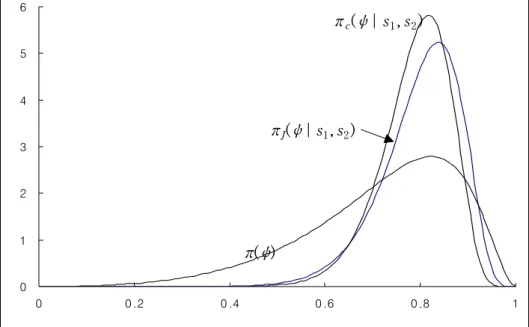
(1-0.7345ψ)15 ,0 <ψ < 1. (8) If priors about θ1 and θ2 are IG( 3,2) and IG(3,6) then the marginal prior density of ψ is
π( ψ) = 1.1111ψ2(1- ψ)2
(1-0.6667ψ)6 ,0<ψ < 1, (9)
and the posterior density is
πc( ψ∣s1,s2) = 1.4230ψ10(1- ψ)9
(1-0.7219ψ)21 ,0 <ψ < 1. (10) Graphs of (8), (9), and (10) are displayed in Figure 1. Table 1 lists Bayes estimates of R obtained from these densities under squared-error loss and LINEX loss. From Table 1, as expected, the Bayes estimates of R decrease as a increase. The estimate obtained with respect to (8) is found to be smaller than the estimates with respect to (9) and (10).
Table 1. Bayes Estimates of R under squared error loss and LINEX loss
a π( ψ) πc( ψ∣s1,s2) πJ( ψ∣s1,s2)
-2 -1 0 1 2
0.9550 0.9245 0.8986 0.8734 0.8455
0.8858 0.8762 0.8668 0.8575 0.8482
0.8253 0.8099 0.7964 0.7831 0.7685 (Note: For a = 0, LINEX loss and squared error loss are identical)
0 1 2 3 4 5 6
0 0.2 0.4 0.6 0.8 1
Figure 1. Prior and Posterior Densities of ψ
Appendix A : Derivation of Jeffreys Prior The likelihood function of (θ1,θ2) is
l( θ1,θ2|S1,S2)∝ exp ( - ( S1/θ1+ S2/θ2))
θ1n1θ2n2 , θi> 0,
from which the likelihood function of ψ = θ2/( θ1+ θ2) and ω = θ1+ θ2 is given by
l( ψ,ω|S1,S2)∝ exp ( - ( S1/( ( 1 - ψ)ω) + S2/ψ))
ψ n2(1- ψ)n1ωn . (A.1) The Fisher information matrix for ψ and ω is obtained by taking expectations of the negative of second partial derivatives of the log-likelihood function (A.1).
Observe
l( ψ,ω|S1,S2) = constant - n2logψ - n1log ( 1 - ψ) - n log ω - 1
ω
(
(1-ψ)S1 + Sψ2)
.Hence,
I11(ψ, ω) =- Eψ,ω
{
∂ψ∂22 log ( ψ, ω|S1,S2)}
= n2
ψ2 + n1 (1-ψ)2 ,
πc( ψ∣s1,s2)
πJ( ψ∣s1,s2)
π( ψ)
I12(ψ, ω) = 1
ω
(
nψ2 - 1-ψn1)
,and I22(ψ, ω) = ωn2 . The Fisher information matrix for ψ and ω is thenI( ψ,ω) = ( Iij)( ψ, ω) = ꀎ
ꀚ
︳︳
︳︳
︳︳
︳︳
︳︳
︳︳
ꀏ
ꀛ
︳︳
︳︳
︳︳
︳︳
︳︳
︳︳ n2
ψ2+ n1 (1-ψ)2
1
ω
(
nψ2 - 1-ψn1)
1
ω
(
nψ2 - 1-ψn1)
ωn2, (A.2)
and therefore,
|I( ψ,ω)| = n1n2 ψ2(1-ψ)2ω2 ,
where |I| denotes the determinant of the matrix I. Hence, the Jeffreys prior for ( ψ, ω) is
π( ψ,ω) ∝ {|I( ψ,ω)| }1/2
∝ 1
ψ( 1 - ψ)ω , 0 < ψ < 1, ω > 0.
Appendix B : Proof of Theorem 1
The procedure, described in Berger and Bernardo(1989), and Bernardo and Smith(1994, p.326) proceeds as follows:
1. Let π( ω|ψ) be the Jeffreys prior for ω with ψ given, defined by π(ω|ψ)∝( I22(ψ, ω))1/2. Observe, from (A.2),
I22(ψ, ω) = n ω2 . This implies that
π( ω|ψ)∝ 1 ω, ω > 0.
2. Choose an increasing sequence {Λi} of subsets of the parameter space Λ for ( ψ, ω), such that ∪
i Λi= Λ and π( ω|ψ) has finite mass on Ωi(ω) = {ω;( ψ, ω)∈Λi} for all ψ. Then normalize πi(ω| ψ) on each Ωi(ω), obtaining πi(ω| ψ) = ci(ψ) ⋅π(ω|ψ)⋅I[ ω∈Ωi(ω) ], where ci(ψ) = 1/ ⌠⌡Ωi(ω)π(ω|ψ)dω and I[⋅] is denotes an usual indicator function. Let Λ = ( 0, 1)×( 0, ∞) and Λi= ( 0, 1)×( 1/i, i). Let Ωi(ω) = {ω;1/i < ω < i }, i = 1,2,…, be a suitable sequence of subsets of Λ not depending on ψ, over which π(ω|ψ) can be normalized. It follows that
ci(ψ) = 1/ ⌠⌡1/i1/ωdω = 1 2 log i , and
πi(ω| ψ) = 1
2ω log i, 1/i < ω < i.
3. Find the marginal reference prior for ψ with respect to πi( ω|ψ). This is πi(ψ) ∝ exp
{
⌠⌡Ωi(ω)πi(ω|ψ) ⋅ log[
I|I( ψ,ω)|22(ψ, ω)]
dω}
.Assuming the integral exists,
πi(ψ) ∝ exp
{
⌠⌡1/ii 2ω log i1 log[
ω2ψ2(1-ψ)ω2 2]
1/2dω}
= 1
ψ( 1 - ψ) .
4. Define the prior for ( ψ, ω) when ω is a nuisance parameter by π( ψ, ω)∝π( ω |ψ)⋅ lim
i→∞
{
cci( ψi( ψ)π0)πii( ψ)( ψ0)}
,where ψ0 is any fixed point. Assuming the limit exists π( ψ, ω) ∝ 1
ω ⋅ lim
i→∞
{
2( log i)ψ2( log i)ψ( 1 - ψ )0(1-ψ0)}
∝ 1
ψ( 1 - ψ)ω , 0 <ψ < 1, ω > 0.
REFERENCES
1. Aitchison, J. and Dunsmore, I.R.(1975). Statistical Prediction Analysis, London: Cambridge University Press.
2. Berger J.O. and Bernardo, J.M.(1989). "Estimating a Product of Means:
Bayesian Analysis with Reference Priors", J. Amer. Stat. Assn, 84, 200-207.
3. Berger J.O. and Bernardo, J.M.(1992). "Ordered Group Reference Priors with Applications to Multinomial Problem", Biometrika, 79, 25-37.
4. Bernardo, J.M.(1979). "Reference Posterior Distribution for Bayesian Inference," J. Royal Stat. Society, B-41, 113-147.
5. Bernardo, J.M. and Smith A.F.M.(1994). Bayesian Theory, NY, John Wiley & Sons.
6. Canfield, R.V.(1970). "A Bayesian Approach to Reliability Estimation Using a Loss Function", IEEE Tr. Rel., 19, 13-16.
7. Dawid, A.P., Stone, N., and Zidek, J.V.(1973). "Marginalization Paradoxes in Bayesian and Structural Inference", J. Royal Stat. Society, B-35,
189-233.
8. Enis, P. and Geisser, S.(1971). "Estimation of Probability that Y <X" , J.
Amer. Stat. Assn, 66,162-168.24.
9. Ferguson, T.S.(1967), Mathematical Statistics: A Decision Theoretic Approach, NY: Academic Press.
10. Feynman, R.P.(1987). "Mr. Feynman goes to Washington", Engineering and Science, California Institute of Technology", CA, 6-22.
11. Gupta, R.D. and Gupta, R.C.(1988). "Estimation of
P( Yp> Max( Y1,Y2,…,Yp - 1)) in the Exponential Case", Comm.
Stat-Theory & Methods, 17, 911-924
12. Varian, H.R.(1975). "A Bayesian Approach to Real Estate Assessment.
S.E.Feinberg and A. Zellner, Eds.", Studies in Bayesian Econometrics and Statistics in Honor of L.J.Savage, NY:North-Holland, Pub.
Co.,195-208.
13. Zellner, A.(1986). "Bayesian Estimation and Prediction Using Asymmetric loss Function", J. Amer. Stat. Assn., 81,446-451.
14. Zellner, A. and Geisel, M.S.(1968). "Sensitivity of Control to Uncertainty and Form of the Criterion Function", in the Future of Statistics, ed.
Donald, G. W. NY, Academic Press, 269-289.
[ received date : Apr. 2003, accepted date : Jul. 2003 ]