Assessing educational needs in the development of a
simulation-based convergence training program on mental health nursing
Sun-Kyung Kim
Assistant Professor, Department of Nursing, and Department of Biomedicine, Health & Life Convergence Sciences, BK21 Four, Mokpo National University
시뮬레이션 융합 프로그램 개발을 위한 정신건강간호 교육요구도 조사
국립 목포대학교 간호학과, BK21 4단계 바이오의약보건생명융합학과 조교수 김선경
Abstract This study was to identify the educational needs for mental health nursing among undergraduate nursing students, prioritizing the areas where require extensive convergence learning via simulation. One hundred and forty students completed the survey where data accrued from between March–May 2020. The educational needs for mental health nursing and nursing care schizophrenia patients were assessed using a self-reporting questionnaire, which included 19 and 15 items, respectively. Additional three essay questions were used to obtain information regarding previous simulation education experience. Higher educational needs in nursing care for schizophrenia were identified and the highest-priority need is communication skills. Factors, including realistic experience with standardized patients, teamwork, and feedback from the lecturers, affect positive experiences in mental health nursing simulation. The findings suggest that educational programs to improve communication skills are necessary for better mental health nursing competency. Well-designed and convergence based simulation programs providing real-like clinical experience would ensure optimal learning outcomes.
Key Words : Simulation, Mental health nursing, Educational need, Undergraduate nursing, Convergence education
요 약 본 연구는 간호대학생들의 정신건강간호에 대한 교육요구도를 알아보고, 특별히 시뮬레이션으로 융합 교육이 필요한 영역에 대한 우선순위를 확인하고자 진행되었다. 140명의 간호대학생들에게 설문을 통한 조사가 2020년 3 월~5월 사이에 이루어 졌다. 정신건강간호학에 대한 교육요구도와 조현병 환자간호에 대한 교육요구도는 각각 19문항 과 15문항의 자가응답설문을 통해 이루어졌다. 추가적으로 3개의 서술형 질문을 통해 이전 시뮬레이션 경험에 대한 조사가 이루어 졌다. 조현병환자 간호에 대해 높은 교육요구도가 확인되었으며, 의사소통능력에 대한 교육요구도가 정 신건강간호학과 조현병 환자간호 모두에서 가장 높게 나타났다. 표준화환자, 팀워크, 교수자로부터 피드백이 정신건강 간호학 시뮬레이션 교육의 긍정적 경험을 이끌어낸 것으로 확인되었다. 본 연구결과, 의사소통기술 향상을 위한 간호교 육이 가장 우선시 할 필요가 있다. 잘 설계되고 실제와 같은 임상경험을 제공할 수 있는 시뮬레이션을 통한 융합교육이 최상의 학습성과를 만들어낼 것이다.
주제어 : 시뮬레이션, 정신건강간호, 교육요구도, 간호대학생, 융합교육
This work was supported by the National Research Foundation of Korea(NRF) grant funded by the Korea government(MSIT) (No. NRF-2019R1G1A1006737).
*Corresponding Author : Sun Kyung Kim([email protected]) Received August 13, 2020
Accepted September 20, 2020 Revised September 10, 2020
Published September 28, 2020
1. Introduction
Mental health is recognized as a global issue;
the World Health Organization (WHO) reported an increase in mental disorders and insufficient quality care[1]. Schizophrenia affects 20 million people worldwide, which causes significant disability affecting educational and occupational performance[2]. The adverse consequences of disease are related to quality of care (i.e., negative attitude and discriminatory behaviors of nurses)[3]. The evidence clearly supports the
effectiveness of a well-designed educational program involving knowledge acquisition and therapeutic interaction with individuals with schizophrenia and other mental disorders[4,5].
Mental health nursing education aims to produce professional nurses who provide safe and quality nursing care via curriculum-balanced theory-based lectures and clinical practice.
Current nursing education aims to generalize undergraduate education while raising concerns due to decreased and fragmented mental health components in nursing curriculum[6]. At present, the technology development increased the complexity in nursing care where the severity and complexity of patients’ disease have never been higher[7]. Nursing students have a growing need for nursing curriculum to offer more opportunity for students to experience diverse patient cases. However, most clinical placement is limited to observation due to safety issues of both patients and students.
Clinical practice for psychiatric nursing education is more problematic so that student anxiety and disease complexity prevent students’
individualized approach to patients. Previous studies reported that undergraduate nursing students have a stigmatized attitude toward mentally ill patients, which keeps students from learning[8]. As a matter of fact, students experience high levels of stress and feelings of fear occur when facing patients appearing to
have problematic behavior.
Simulation is regarded as an effective educational approach that can provide clinical experience for undergraduate nursing students;
the quality of clinical experience with a well-designed simulation is key to learning[9].
Simulation programs are used in nursing education to construct clinical environments for students to improve their problem-solving abilities, critical thinking, and nursing skills.
Previously, a number of strategies have been continuously developed for mental health nursing simulation such as role playing, use of high-fidelity simulators, or standardized patients and virtual reality (VR)[10]. The effectiveness of the simulation program proves that simulation programs pose high potential for improving knowledge and nursing competency as well as reducing anxiety toward treating patients.
At present, technology development and teaching methods enable instructors to create various educational approaches to meet nursing students’ needs. For example, VR allows the realization of diverse clinical situations[11].
Along with reinforcing clinical placement of nursing curriculum, simulation aims to train nurses and nursing students for better adaptation in their clinical practice. Therefore, thorough research on both nursing students and nurses working in mental health units enables educators to create an adequate program that benefits the majority of students.
A comprehensive needs assessment ensures
the effectiveness of a program to improve
knowledge and skill[12,13]. In the first phase of a
program’s development, conducting a needs
assessment for the potential audience and
relevance of a program may provide the essential
elements for educational content to lead active
participant engagement. Thus, a thorough
investigation is essential prior to developing an
educational program. An educational program’s
effectiveness can be maximized when identifying
the area for additional education. In this study, we conducted an educational needs assessment of nursing students in regards to mental health nursing care that provides the fundamental information for future educational program development in mental health nursing.
2. Method
We used a mixed-method design in this study, including a quantitative self-reporting questionnaire and essay questions to identify educational needs and students’ previous experience and perception of psychiatric nursing simulation.
2.1 Sample
We used convenience sampling to recruit 140 participants from four different nursing schools in Korea. The inclusion criteria were nursing students who completed clinical placement in psychiatric wards during the school’s nursing curriculum, in their 3
rdand 4
thyear. The purpose and procecss of study was explained and all the participants were agreed to participate and signed on informed consent.
2.2 Instrument
2.2.1 Educational needs of mental health nursing
The educational needs assessment tool for mental health nursing was a 19-item self-reporting questionnaire, which developed from previous research[14-15]. The questionnaire was given to participants to investigate the educational needs among nurses who work for psychiatric wards for adolescent patients with psychiatric illness. We used a 4-point Likert scale, from 1 (not at all) to 4 (very much needed), where the higher score indicates greater educational need. The Cronbah’s alpha was .926
in this study.
2.2.2 Educational needs of mental health nursing for schizophrenia disorder The educational needs tool to assess mental health nursing for patients with schizophrenia disorder was developed based on learning objectives established by the Korean Academy of Psychiatric and Mental Health Nursing[16]. Of 303 learning objectives, 15 items were selected under the schizophrenia section, which were achievable via simulation education[17]. A 4-point Likert scale (1=not at all; 4=very much needed) consisting of four domains, therapeutic communication (3 items), mental health assessment (3 items), nursing practice for schizophrenia disease-related symptoms (6 items), and medication (3 items) was used and the higher score indicates the greater educational need. The Cronbah’s alpha was .924 in this study.
2.2.3 Essay questions
Three essay questions asked 1) What are the most difficult cases observed in a psychiatric ward? 2) Do you have experience with mental health nursing education? And was the experience effective? 3) What kinds of competency do you want to develop via mental health nursing simulation?
2.3 Statistical analysis
We used SPSS (version 25) to conduct statistical data analysis. We used descriptive statistics to describe the study participants’
demographical characteristics and their
educational needs of mental health nursing and
educational needs of mental health nursing for
schizophrenia disorder. Chi-square tests were
used to examine how learning satisfaction in
clinical placement of mental health nursing,
communication competency, and academic
ability associate with the degree of educational need. Statistical significance was determined at p<.05.
2.4 Ethical consideration
This study was conducted after obtaining ethical approval from one university in Korea (IRB no. MNUIRB-20190722-SB-005-01).
Participation in the survey was voluntary and the study details were explained to all participants who then provided informed consent via signature.
3. Results
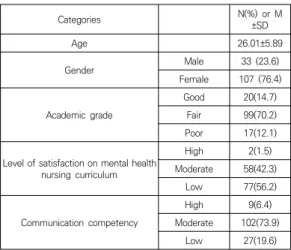
3.1 General characteristics of study participants The study participants’ mean age totaled 26.01±5.89 and the majority were female (76.4%).
Only two respondents (1.5%) reported high levels of satisfaction on mental health nursing curriculum and 93.6% had moderate-to-low communication competency (see Table 1).
3.2 Educational needs in mental health nursing and nursing care for patients with schizophrenia.
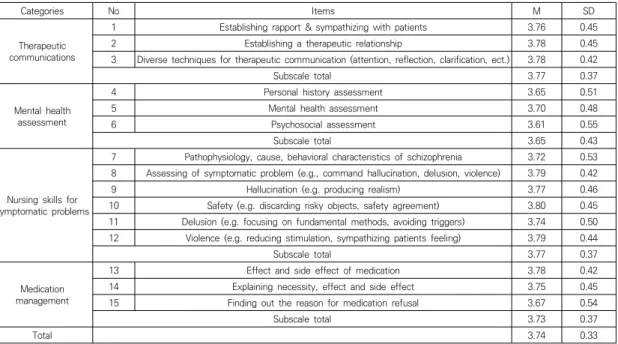
The mean score of educational needs on mental health nursing was 3.62±0.35 out of 5 (see Table 2). Of the six subscales, therapeutic communication (3.71±0.42) has the highest educational need, followed by reducing stigma (3.66±0.45), and nursing care in general (3.61±0.37). The mean score of educational need for nursing care for schizophrenia was 3.74±0.33 (see Table 3). The highest educational needs were on the subscales of therapeutic communications (3.77±0.37) and nursing skills for symptomatic problems (3.77±0.37), followed by medication management (3.73±0.37) and mental health assessment (3.65±0.43).
3.3 Essay question
3.3.1 Clinical cases difficult to experience One out of ten students (n=22) reported that schizophrenia is the rarest case they experience during their clinical placement, followed by dissociative disorders (n=10) and depression (n=6).
Categories N(%) or M
±SD
Age 26.01±5.89
Gender Male 33 (23.6)
Female 107 (76.4) Academic grade
Good 20(14.7)
Fair 99(70.2)
Poor 17(12.1)
Level of satisfaction on mental health nursing curriculum
High 2(1.5)
Moderate 58(42.3)
Low 77(56.2)
Communication competency
High 9(6.4)
Moderate 102(73.9)
Low 27(19.6)
Table 1. General characteristic of study participants
(n=140)3.3.2 Previous experience of simulation Approximately 54.5% of participants had previous simulation experience and all reported positive perceptions of their experience (n=66).
The factors affecting perceived benefits of simulation were interactions with standardized patients (n=26), feedback from faculties (n=11), and teamwork (n=4). Some recommendations involve lack of time and space for sufficient training (n=22) and low levels of realism compared to their expectation.
3.3.3 Nursing competency via simulation
Students reported that communication is the
most crucial skill to learn; 68.0% of participants
are required to learn communication skills within
simulation education (n=83), followed by nursing
intervention (n=29), and nursing diagnosis (n=10).
Categories No Items M SD
Nursing care
1 Knowledge (Pathophysiology of mental illness) 3.65 0.50
2 Knowledge (Mental health nursing) 3.75 0.43
3 Nursing goal setting 3.55 0.54
4 Patient-centered nursing care 3.69 0.50
5 Nursing care for multiple disorders 3.72 0.49
Subscale total 3.61 0.37
Intervention technique
6 Promoting patients' self-confidence 3.61 0.52
7 Relaxation and stress management care technique 3.70 0.48
8 Promoting patients to establish relationships with others 3.66 0.51
9 Techniques to engage patients in group activities 3.62 0.50
10 Promoting patients' positive thinking 3.63 0.57
Subscale total 3.64 0.38
Therapeutic communication
11 Proper response to patient psychology 3.68 0.48
12 Communication skill 3.73 0.46
Subscale total 3.71 0.42
Team work
13 Improving teamwork 3.52 0.56
14 Working staff of other department/specialty 3.54 0.60
15 Learning and applying skills of other staff 3.43 0.65
Subscale total 3.50 0.50
Social resources
16 Related law 3.36 0.67
17 Social resources available 3.55 0.57
Subscale total 3.46 0.53
Reducing stigma
18 Improving confidence (overcoming fear) 3.57 0.55
19 Controlling negative feelings 3.74 0.50
Subscale total 3.66 0.45
Total 3.62 0.35
Table 2. Educational needs score on mental health nursing
(n=140)Categories No Items M SD
Therapeutic communications
1 Establishing rapport & sympathizing with patients 3.76 0.45
2 Establishing a therapeutic relationship 3.78 0.45
3 Diverse techniques for therapeutic communication (attention, reflection, clarification, ect.) 3.78 0.42
Subscale total 3.77 0.37
Mental health assessment
4 Personal history assessment 3.65 0.51
5 Mental health assessment 3.70 0.48
6 Psychosocial assessment 3.61 0.55
Subscale total 3.65 0.43
Nursing skills for symptomatic problems
7 Pathophysiology, cause, behavioral characteristics of schizophrenia 3.72 0.53 8 Assessing of symptomatic problem (e.g., command hallucination, delusion, violence) 3.79 0.42
9 Hallucination (e.g. producing realism) 3.77 0.46
10 Safety (e.g. discarding risky objects, safety agreement) 3.80 0.45
11 Delusion (e.g. focusing on fundamental methods, avoiding triggers) 3.74 0.50 12 Violence (e.g. reducing stimulation, sympathizing patients feeling) 3.79 0.44
Subscale total 3.77 0.37
Medication management
13 Effect and side effect of medication 3.78 0.42
14 Explaining necessity, effect and side effect 3.75 0.45
15 Finding out the reason for medication refusal 3.67 0.54
Subscale total 3.73 0.37
Total 3.74 0.33