*Corresponding author. E-mail : [email protected]
Assessment on Antioxidant Potential and Enzyme Activity of Some Economic Resource Plants
Hee-Ock Boo
1*, Jeoung-Hwa Shin
2, Ji-San Shin
1, Eui-Su Choung
3, Mi-Ae Bang
4, Kyung-Min Choi
5and Won-Seob Song
61
PHYTO M&F Co. Ltd., BI Center, Chosun University, Gwangju 501-759, Korea
2
Korea Basic Science Institute, Seoul 136-701, Korea
3
Danjoung Co. Ltd., Wonju-City 220-842, Korea
4
Jeonnam Biofood Technology Center, Naju-City 520-330, Korea
5
Institute of JinAn Red Ginseng, Jinan-Gun 567-801, Korea
6
Department of Horticulture, Sunchon National University, Suncheon 540-742, Korea
Abstract - The antioxidant potential and enzyme activities in Salicornia herbacea, Corylopsis coreana, Erythronium japonicum, Phragmites communis, Momordica Charantia, Nelumbo nucifera, Salvia plebeia, Portulaca oleracea, Ficus carica, Citrus junos and Cornus officinalis were determined. Their antioxidant activities were measured using DPPH radical scavenging and nitrite scavenging activity. Enzyme activities in investigated plants were evaluated as superoxide dismutase (SOD), catalase (CAT), peroxidase (POD), and ascorbate peroxidase (APX). The DPPH scavenging rate from 100 to 2500 mgL
-1was the highest in the flower of Corylopsis coreana. However, it was not detected in most of the samples at concentration below 100 mgL
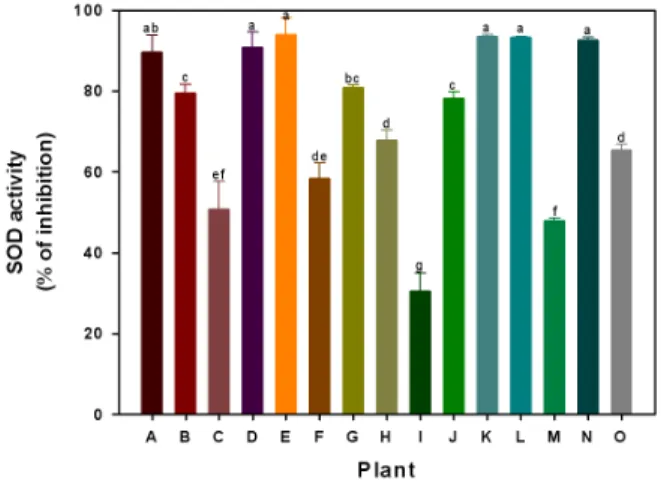
-1. The nitrite scavenging activity according to each kind of resource plants was significantly higher in the stem of Corylopsis coreana and leaf of Nelumbo nucifera.. The root extract of Erythronium japonicum had the highest SOD enzyme activity of 94.0% while leaf of Salvia plebeia showed the lowest SOD enzyme activity of 30.4%. The activity of CAT and APX showed higher values in the stem of Corylopsis coreana, root of Erythronium japonicum and root of Phragmites communis in comparison with other plants. The activity of POD showed significantly high values in stem of Corylopsis coreana, Momordica Charantia and pericarp of Citrus junos extracts. The antioxidant enzyme activities differ significantly in different plants. In conclusion, we showed that Corylopsis coreana, Erythronium japonicum Cornus officinalis, and Momordica Charantia had the potent biological activities. Therefore, these plant resources showing antioxidant activity could be good materials for development of source of functional healthy food.
Key words - Economic resource plant, DPPH radical scavenging activity, Nitrite scavenging activity, SOD, CAT, POD, APX
Introduction
Recently, plant and plant-derived products are treated a part of the healthcare system by applying the bioactive phytochemicals. Antioxidant compounds in food play an important role as a health protecting factor. Scientific evidence suggests that antioxidants reduce the risk for chronic diseases including cancer and heart disease. Most of the antioxidant compounds in a typical diet are derived from plant sources and belong to various classes of compounds with a wide variety of physical and chemical properties. The main char- acteristic of an antioxidant is its ability to trap free radicals.
Highly reactive free radicals and oxygen species are present
in biological systems from a wide variety of sources. These
free radicals may oxidize nucleic acids, proteins, lipids or
DNA and can initiate degenerative disease. Antioxidant
compounds like phenolic acids, polyphenols and flavonoids
scavenge free radicals such as peroxide, hydroperoxide or
lipid peroxyl and thus inhibit the oxidative mechanisms that
lead to degenerative diseases (Prakash et al., 2001). Plant
have antioxidant enzyme to keep the increase generation of
ROS (reactive oxygen species) which includes superoxide
dismutase (SOD), catalase (CAT), peroxidase (POD), and
ascorbate peroxidase (APX) (Zhou et al., 2005). The production
of activated oxygen species occurs when plants are subjected
to stress conditions (Dionisio-Sese and Tobita, 1998). Higher
levels of SOD, CAT, APX and POD activity may be correlated with a higher stress condition. Both enzymatic and non- enzymatic antioxidant systems are present in plants. Superoxide radicals are detoxified by SOD and hydrogen peroxide is destroyed by CAT and different kinds of peroxidases [e.g.
guaiacol peroxidase (GPX)] (Kang and Saltveit, 2002). A major hydrogen peroxide-detoxifying system in plant is the ascorbate-glutathione cycle that includes APX and glutathione reductase (GR) (Asada, 1994). In plant cells chloroplasts, mitochondria and peroxisomes are important intracellular generators of ROS (Rich and Bonner, 1978). It is now widely accepted that reactive oxygen species (ROS) are responsible for various stress-induced damage to macromolecules and ultimately to cellular structure (Moftah and Michel, 1987;
Kandpal et al., 1981), and needs to be scavenged for mainte- nance of normal growth. Ascorbate peroxidase, catalase and peroxidase, together with low-molecular mass scavengers such as ascorbate, glutathione and proline, act as the main defense against ROS produced in various parts of plant cells (Apel and Hirt. 2004). Catalase, which is located in peroxisomes, glyoxysomes and mitochondria, and is apparently absent in the chloroplast, dismutates mostly photorespiratory or respi- ratory H
2O
2into water and molecular O
2(Apel and Hirt, 2004), Peroxidases (POD) decomposes H
2O
2by oxidation of co-substrates such as phenolic compounds and/or antioxidants.
The induction of ROS-scavenging enzymes, such as SOD, POXs and CAT, is the most common mechanism for detox- ifying ROS synthesized during stress responses (Wojtaszek, 1997; Mittler, 2002). In response to the increased production of oxygen radicals the capacity of the antioxidant defence system is increased but in most situations the response is moderate (Foyer et al., 1994). Plant root cells differ in their capacity for nutrient absorption, storage, translocation and assimilation (Lazof et al., 1992; Cruz et al., 1995). Cell expansion and differentiation in higher plant tissues is accompanied by a quantitative rearrangement of protein that may be associated with changes in functional activities (Zeleneva et al., 1982). Antioxidant enzymes play important roles in adaptation to stress conditions. In this study, the antioxidant activity and the antioxidative defence system enzymes SOD, CAT, APX and POD were measured in extracts of the stem, root, fruit and leaf of various economic resource plants containing medicinal plants.
Materials and Methods
Experimental materials
In this experiment, 11 kinds of plant materials (Salicornia herbacea, Corylopsis coreana, Erythronium japonicum, Phragmites communis, Momordica Charantia, Nelumbo nucifera, Salvia plebeia, Portulaca oleracea, Ficus carica, Citrus junos and Cornus officinalis) of economic resource plants were used.
These plants were chosen because of the possibility to obtain various physiological functionalities. Each sample was freeze- dried and then ground. Each plant powder was stored at -20℃
for further experiments.
DPPH radical scavenging assay
100 μL of various concentrations (100, 250, 500, 1000 and 2500 mg L
-1) of extracts of the investigated plants were added to 900 μL of 100% methanol containing 100 μM DPPH, and the reaction mixture was shaken vigorously. After storage at room temperature for 30 min in darkness, the absorbance of DPPH was determined by spectrophotometer at 517 nm. The DPPH radical-scavenging activity was calculated according to the following equation: Scavenging effect on DPPH radical (%) = [(A−B)/A]×100, Where A is the absorbance at 517 nm without pigment compositions and B is the change in absorbance at 517 nm with pigment compositions incubation (Brand-Williams et al., 1995).
Nitrite scavenging assay
The nitrite scavenging activity (NSA) was determined according to a method using Griess reagent (Kato et al., 1987). First, 40 μL of each sample was mixed with 20 μL of 1 mM nitrite sodium. Then the mixture was added to 140 μL of 0.2 M citrate buffer (pH 3.0, 4.2, or 6.0). The final volume of each sample wad adjusted to 200 μL. After the mixtures had been incubated for 1 h at 37℃, and added to 1000 μL of 2%
acetic acid and 80 μL of Griess reagent (1% sulfanilic acid and 1% naphthylamine in a methanol solution containing 30% acetic acid). After vigorous mixing with a vortex, the mixture was placed at room temperature for 15 min, and absorbance was measured at 520 nm. The nitrite scavenging activity was determined based on the following formula:
NSA (%) = ((1-A-C)/B)*100. Where A is the absorbance of
the mixture sample during a reation with 1 mM NaNO
2after a 1 h reaction, B is the absorbance of a mixture of distilled water and 1 mM NaNO
2after a 1 h reaction and C is the absorbance of the sample.
Enzyme assay - SOD activity
The superoxide dismutase (SOD) activity was measured using SOD assay Kit-WST purchased from Sigma-Aldrich.
This assay is based on the colorimetric assay for the measurement of total antioxidant capacity of crude aqueous fractions. The 60 μL of sample solution (sample and blank2) or double- distilled water (blank1 and blank3) was mixed with 600 μL of WST working solution. For Blank2 and Blank3, 60 μL of dilution buffer was added. Then, 60 μL of enzyme working solution was added to each sample and blank1. The plate was incubated at 37℃ for 20 min, and the OD was determined at 450 nm using a spectrophotometer. SOD activity (inhibition rate percent) was calculated using the following equation:
SOD activity={[(A
blank1–A
blank3)–(A
sample–A
blank2)]/(A
blank 1– A
blank 3)} ×100.
- CAT activity
Catalase (CAT) activity was assayed by the method of Mishra et al. (1993). The reaction mixture contained 50 mM potassium phosphate buffer (pH 7.0), 11 mM H
2O
2, and the crude enzyme extract. The reaction was initiated by addition of H
2O
2to the mixture, and enzyme activity was determined by monitoring the decline in absorbance at 240 nm (ε=36 M
−1cm
−1), because of H
2O
2consumption.
- APX activity
Ascorbate peroxidase (APX) activity was determined by monitoring the decline of absorbance at 290 nm as ascorbate (ε=2.8 mM
−1cm
−1) was oxidized, by the method of Chen and Asada (1989). The reaction mixture contained 100 mM potassium phosphate buffer (pH 7.5), 0.5 mM ascorbate, and 0.2 mM H
2O
2.
- POD activity
Peroxidase (POD) activity was determined specifically with guaiacol at 470 nm (ε=26.6mM
−1cm
−1), following the
method of Egley et al. (1983). The reaction mixture contained 40 mM potassium phosphate buffer (pH 6.9), 1.5 mM guaiacol, and 6.5 mM H
2O
2in 1 ml with crude enzyme extract. Control assays in which the enzyme extracts or substrates were replaced by buffer were performed.
Data analysis
The statistical analysis was performed using the procedures of the Statistical Analysis System. ANOVA procedure followed by Duncan test was used to determine the significant difference (p < 0.05) between treatment means.
Results and Discussion
DPPH radical scavenging activity
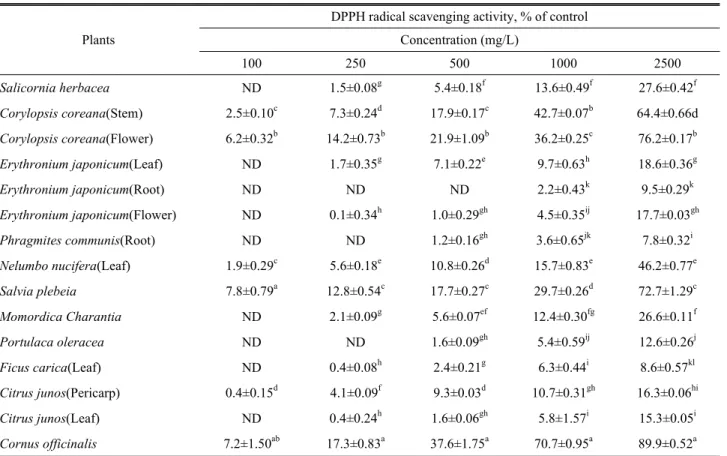
The measurement results of free radical scavenging activity are shown in Table 1 of the investigated samples. The investigation of the antioxidant activity of natural substances is based on the measuring of the electron donor capacity of DPPH with the ability to inhibit the oxidation by donating electrons in free radicals causing this lipid peroxidation.
Active oxygen caused by in vivo metabolism removed by the
body's antioxidant system, but excessive free radicals induced
stress, causing the lipid peroxidation by combining with
unsaturated fatty acids in the cell membrane, and brought
intracellular structural and functional damage. Looking at the
results, the antioxidant capacity of the economic resource
plants, showed relatively high scavenging activity in Corylopsis
coreana, Salvia plebeia and Cornus officinalis, but it was not
detected in most of the samples at concentration below 100
mg/L. Overall, the DPPH radical scavenging activity showed
that the increase was proportional to the concentration. Cells
are oxidized and damaged by the free radical, depending on
the growth of cells. It has been reported that phenolic
compounds have antioxidant capacity to inhibit the oxidation
by donating electrons to the free radical due to strong
reduction (Sanchez et al., 2007; Saija et al., 1998). The content
of phenolic compounds increases the radical scavenging
activity, which also is reported to be increased (Boo et al.,
2011; Chon et al., 2012; Oki et al,. 2002). In our study, the
DPPH radical scavenging activity appeared to concentration-
dependent, and depending on the kind of plants, there were
Table 1. DPPH radical scavenging activities according to each kind of several economic resource plants Plants
DPPH radical scavenging activity, % of control Concentration (mg/L)
100 250 500 1000 2500
Salicornia herbacea ND 1.5±0.08
g5.4±0.18
f13.6±0.49
f27.6±0.42
fCorylopsis coreana(Stem) 2.5±0.10
c7.3±0.24
d17.9±0.17
c42.7±0.07
b64.4±0.66d Corylopsis coreana(Flower) 6.2±0.32
b14.2±0.73
b21.9±1.09
b36.2±0.25
c76.2±0.17
bErythronium japonicum(Leaf) ND 1.7±0.35
g7.1±0.22
e9.7±0.63
h18.6±0.36
gErythronium japonicum(Root) ND ND ND 2.2±0.43
k9.5±0.29
kErythronium japonicum(Flower) ND 0.1±0.34
h1.0±0.29
gh4.5±0.35
ij17.7±0.03
ghPhragmites communis(Root) ND ND 1.2±0.16
gh3.6±0.65
jk7.8±0.32
iNelumbo nucifera(Leaf) 1.9±0.29
c5.6±0.18
e10.8±0.26
d15.7±0.83
e46.2±0.77
eSalvia plebeia 7.8±0.79
a12.8±0.54
c17.7±0.27
c29.7±0.26
d72.7±1.29
cMomordica Charantia ND 2.1±0.09
g5.6±0.07
ef12.4±0.30
fg26.6±0.11
fPortulaca oleracea ND ND 1.6±0.09
gh5.4±0.59
ij12.6±0.26
jFicus carica(Leaf) ND 0.4±0.08
h2.4±0.21
g6.3±0.44
i8.6±0.57
klCitrus junos(Pericarp) 0.4±0.15
d4.1±0.09
f9.3±0.03
d10.7±0.31
gh16.3±0.06
hiCitrus junos(Leaf) ND 0.4±0.24
h1.6±0.06
gh5.8±1.57
i15.3±0.05
iCornus officinalis 7.2±1.50
ab17.3±0.83
a37.6±1.75
a70.7±0.95
a89.9±0.52
az
Data represent the mean values±SE of three independent experiments. Means with the same letter in column are not significantly different at p<0.05 level by Duncan’s multiple range test.
N.D. : Not detected.
significant differences in the results. The effective source of the resource plants could be employed in all medicinal preparation to combat myriad diseases associated with oxidative stress, including cancer and related disorders.
Nitrite scavenging activity
Nitrite ions in the acidic environment of the stomach induce mutagenic and cell-damaging reactions (Kato and Puck, 1971). Exposure to excess nitrite from the diet is implicated as a potential etiological factor in the development of stomach and colorectal cancers (Lee et al., 2006). Nitrite reacts with second and third grade amines to form nitrosamine in protein-rich foods, medicines, and residual pesticides. It is also present in large quantities in meat and both leafy and root vegetables. Nitrosamine is converted to diazoalkane (alkane nucleic acid), proteins, and intracellular components, which can increase the risk for cancer (Choi et al., 2008). In order to
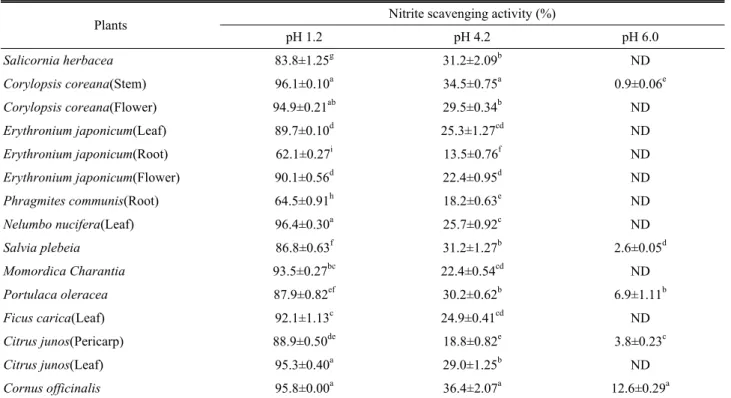
investigate the nitrite scavenging activity in the several resource plants, various acidic conditions were tested. The results are shown in Table 2. The maximum nitrite scavenging activity was obtained at pH of 1.2. The nitrite scavenging activities were affected by changes in pH. The nitrite scavenging activity according to each kind of resource plants was significantly higher in the stem of Corylopsis coreana and leaf of Nelumbo nucifera.. The results of the nitrite scavenging activity varied depending on the kind of plant from 62.1 to 96.4% at pH of 1.2. However, the nitrite scavenging activity at pH of 6.0 was not almost detected.
These results were consistent with other findings that had the
highest the nitrite scavenging at pH of 1.2 in fermented pine
extract (Hong et al., 2004) and extracts from different parts of
citron (Shin et al., 2005). The fact that the nitrite scavenging
activity was high at pH 1.2 suggests that nitrosamine
production can be inhibited in vivo (Choi et al., 2008).
Table 2. Nitrite scavenging activities according to each kind of several economic resource plants
Plants Nitrite scavenging activity (%)
pH 1.2 pH 4.2 pH 6.0
Salicornia herbacea 83.8±1.25
g31.2±2.09
bND
Corylopsis coreana(Stem) 96.1±0.10
a34.5±0.75
a0.9±0.06
eCorylopsis coreana(Flower) 94.9±0.21
ab29.5±0.34
bND
Erythronium japonicum(Leaf) 89.7±0.10
d25.3±1.27
cdND
Erythronium japonicum(Root) 62.1±0.27
i13.5±0.76
fND
Erythronium japonicum(Flower) 90.1±0.56
d22.4±0.95
dND
Phragmites communis(Root) 64.5±0.91
h18.2±0.63
eND
Nelumbo nucifera(Leaf) 96.4±0.30
a25.7±0.92
cND
Salvia plebeia 86.8±0.63
f31.2±1.27
b2.6±0.05
dMomordica Charantia 93.5±0.27
bc22.4±0.54
cdND
Portulaca oleracea 87.9±0.82
ef30.2±0.62
b6.9±1.11
bFicus carica(Leaf) 92.1±1.13
c24.9±0.41
cdND
Citrus junos(Pericarp) 88.9±0.50
de18.8±0.82
e3.8±0.23
cCitrus junos(Leaf) 95.3±0.40
a29.0±1.25
bND
Cornus officinalis 95.8±0.00
a36.4±2.07
a12.6±0.29
az