Introduction
Cordyceps are Ascomycota, Sordariomycetes, Hypocreales, and Clavicipitaceae mushrooms and there are more than 500 varieties. Currently, it is classified into Cordycipitaceae, Ophi- ocordycipitaceae, and Clavicipitaceae. Of these, it is known that about 80 species were collected and classified in Korea (Lee et al., 2017). Ophiocordyceps sinensis and Cordyceps militaris are currently widely used in oriental medicine (Shrestha et al., 2012; Tuli et al., 2013). A wild Ophiocordy- ceps sinensis is very expensive because its specific hosts and conditions are required for growth and is difficult to find it in nature. Cordyceps militaris is a fungus belonging to Cordy- cipitaceae and Cordyceps that is widely used as a traditional medicinal mushroom in China, Korea, Japan and Asian countries (Sung et al., 2007). However, Cordyceps militaris
is gaining widespread attention in the fields of food, medicine and cosmetics as artificial cultivation becomes possible.
Cordycepin (3'-deoxyadenosine) and adenosine, the main physiologically active ingredients in, are analogues of nucleoside, Various functions have been reported, such as immunomodulation (Kim et al., 2012; Lee et al., 2004), antioxidant (Hong et al., 2016), anti-cancer (Park et al., 2002), anti-inflammatory (Choi et al., 2012; Seo et al., 2018), anti-diabetes (Kim et al., 2005), anti-hyperlipidemia (Lee et al., 2006), antithrombosis (Ahn et al., 2012), cognitive function (Cai et al., 2013), anti-viral (Ohta et al., 2007), anti-bacterial (Tran and Tran, 2019), anti-pest (Kim et al., 2002), and skin whitening (Chin et al., 2006). Cordycepin is generally known as a main ingredient in Cordyceps militaris, but the amount contained in wild Cordyceps is less than 0.5%
based on dry weight. However, Cordyceps militaris has the advantage of enhancing the production of secondary meta- bolites from them as artificial culture succeeds in solid medium.
Isolation of New Strain of Cordyceps militaris HB8 and Optimal Condition for Production of Adenosine and Cordycepin in Fruit Body
Jin Feng Li
1†, Van An Hoang
2†, Jong Chan Ahn
3, Dong Uk Yang
4, Dong Wook Lee
5and Deok Chun Yang
6*
1
Graduate Student, Department of Oriental Medicinal Biotechnology, Kyung Hee University, Yongin 17104, Korea
2
Researcher,
4Manager,
5Research Director and
6CEO, HanbangBio Inc. Kyung Hee University Holdings, Yongin 16954, Korea
3
Graduate Student and
6Professor, Graduate School of Biotechnology, Kyung Hee University, Yongin 17104, Korea
Abstract - Cordyceps has been used in traditional Chinese medicine more than 2000 year ago. In this study, the new Cordyceps militaris was founded and isolated from O-dae mountain in Korea, and was identified its genetic characteristics.
The newly isolation strain HB8 was most closet to Cordyceps militaris W141449 (99.82%), Cordyceps militaris JLCY-LI819 (99.82%) and Cordyceps militaris 4642 (99.81%), respectively. the genotypic result was show that train HB8 was belonging to the Cordyceps militaris genus, therefore, Cordycep militaris HB8 proposed with accession number MT835161. This study we find the optimal condition for production of cordycepin from Cordyceps militaris HB8 was 8 ㎎ /g (200 g of pupa, 1 g of KH
2PO
4, 0.5 g of K
2HPO
4, 20 g of glucose, 1 g of MgSO
4, 0.05 g of vitamin B1, and 1 ㎎ of NAA per liter; light condition 300-700 Lux and day/night was 14 h/10 h) and the optimum condition for the production of adenosine was 2.6 ㎎/g (15 g of skim milk powder, 1 g of KH
2PO
4, 0.5 g of K
2HPO
4, 20 g of glucose, 1 g of MgSO
4, 0.05 g of vitamin B1, and 1 ㎎ of NAA per liter; light condition 300-700 Lux and day/night was 14 h/10 h).
Key words – Adenosine, Cordycepin, Cordyceps militaris, Fruiting-body
*Corresponding author. E-mail : [email protected] Tel. +82-31-205-2688
†These authors contributed equally to this work.
Original Research Article
Several researchers have focused on finding the optimal conditions for producing useful ingredients such as cordycepin and adenosine at high concentrations under artificial culture conditions (Cha et al., 2004; Kim et al., 2003). It is known that the production of secondary metabolites from Cordyceps militaris requires specific amino acids, nitrogen sources, carbon sources, minerals, growth enhancer and special culture conditions (Choi et al., 1999).
This study was carried out to investigate the genetic characteristics of the strain Cordyceps militaris HB8 isolated by the authors, and estalish the optimal solid culture con- ditions to increase the fruiting body yield, contents of cordy- cepin and adenosin from Cordyceps militaris HB8 based on the nutrient factors and culture environment of the medium.
Materials and Methods
Collecting Cordyceps fungus and investigation of genetic characteristics
The Cordyceps used in this study was a new strain collected from Odaesan, Gangwon-do. The fruiting bodies were washed with sterile water, immersed in 1% sodium hypochlorite (NaClO) solution for 1 minute, and washed again with sterile water thoroughly. The well-washed fruiting bodies were cut into about 5 mm length and cultured in PDA (potato dextrose agar; potato 15 g, glucose 20 g, agar 20 g/L) medium. The newly isolated Cordyceps fungus was named Cordyceps militaris HB8, and the cultured stock culture was subdivided into 10% glycerol solution and stored at -80℃.
DNA extraction, PCR and sequencing
The DNA was extracted by minor modifying the CTAB method of Sung et al. (1999). The rRNA genes in the internal transcribed spacer 1 (ITS1) and (ITS2) regions were amplified using a universal primer (ITS-1:5'-TCCGTAGGT- GAACCTGCGG-3'; ITS-4: 5'-TCCTCCGCTTATTGATA- TGC-3'). PCR conditions were set at 94℃ for 4 minutes, 9 4℃ for 1 minute and 58℃ for 1 minute (30 cycles), 72℃ for 1 minute, and the final extension at 72℃ for 10 minutes. The PCR products amplified for sequencing of ITS1 and ITS2 regions were sent to Genotech (Daejeon, Korea). The DNA sequence of the analyzed strain HB8 was modified using
LASERGENE software (version 6.0; DNASTAR, Madison, WI, USA), and compared with the fungal sequence available in the NCBI database.
The full sequence was compared with BLAST searches on NCBI (https://blast.ncbi.nlm.nih.gov/Blast.cgi). The ITS1/2 gene regions of strain HB8 and closely related strains were complete alignment by using the CLUSTAL_X program (Thompson et al., 1997) and the Kimura two-parameter model (Kimura, 1983). Phylogenetic tree was constructed by the neighbor-joining (Saitou and Nei, 1987), by using the Bioedit (Hall, 1999) and MEGA 5 program (Tamura et al., 2011).
Bootstrap analysis based on 1000 replicates was also conducted. The closest strains with the candidate strain were included in the phylogenetic tree construction.
Parent strain and mycelium culture
Cordyceps militaris HB8 was active from stock vial on PDA medium for 10 day and then used for parental culture. The mycelium seed culture was growth in 250 mL conical flask with 100 PDB medium and punching 10 pieces about 0.8 ㎝ was added from active parent culture plate. The flask was incubated at 23℃ with rotating shaking (110 rpm) for 3 days in dark conditions. Large scale culture was grown in a 2000 mL flask containing 1000 mL of a liquid culture solution (10 g of peptone, 1 g of KH
2PO4, 0.5 g of K
2HPO4, 20 g of glucose, 0.01 g vitamin B1 and 1 g of MgSO
4per L, 100 mL of seed culture was added. The flask was incubated at 23℃ with rotating shaking (110 rpm) for 5 days in dark conditions.
The solid culture was carry out with 30 g of each solid
substrate was separately poured into the culture bottle (10 ㎝
diameter, 19 ㎝ height) with 45 mL of basic nutrients medium
content: 2 g of yeast extract, 8 g of peptone, 1 g of KH
2PO
4,
0.5g of K
2HPO
4, 20g of glucose, and 1 g of MgSO
4per L, and
then sterilized at 121℃ for 20 minutes. 10 mL of seed culture
was inoculation to each bottle. The culture bottle was trans-
ferred to dark condition for 3 days and then transfer to light
intensity of 400 to 700 lux condition still 60 day. The light
and dark conditions were 14 hours in the light and 10 hours in
the dark. At the end of the incubation period, the fruiting
bodies of Cordyceps militaris were separated from the solid
medium and dried at 40℃. Each experiment was carried out
three times.
Establishment of optimal culture conditions
The effect of light
Ten mL of the seed culture solution was inoculated into a sterilized culture bottle containing a solid substrate. The culture bottle was cultured for 3 days under dark room conditions, and then transfer to different light condition: light intensity of 400 to700 lux, 100 lux or less, and 1200 lux or more, respectively. The light and dark conditions were 14 hours in the light and 10 hours in the dark. After 60 days’
culture fruit body was collected and dry at 40℃ for 1 day. The sample was store in -20℃ for further test.
The effect of substrates in the medium
In order to observe the effect of the substrate on the culture for fruiting body of Cordyceps, the effect of the composition of the medium, the type of grain, and the mixing ratio were investigated. That is, The mixing ratio of brown rice (R), millet (M), oats (O) and black beans (B) among the grains in the medium were O : M=25 : 5, R : O=15 : 15, R : O : M = 15 : 10 : 5, and R : O : B : M = 10 : 10 : 5 : 5. 30 g of each solid substrate was separately poured into the culture bottle (10 ㎝ diameter, 19 ㎝ high), 45 mL of nutrients (content: 2 g of yeast extract, 8 g of peptone, 1 g of KH
2PO
4, 0.5 g of K
2HPO
4, 20 g of glucose, and 1 g of MgSO
4per L) were added to the culture bottle, and then sterilized at 121℃ for 20 minutes. 10 mL of seed culture was inoculation to each bottle. The culture bottle was transferred to dark condition for 3 days and then transfer to light intensity of 400 to 700 lux condition still 60 days. The light and dark conditions were 14 hours in the light and 10 hours in the dark. Each experiment was carried out in 32 culture bottles. Fruit body was collected and dry at 40℃
for 1 day. The sample was store in -20℃ for further test.
The effect of nitrogen sources
Effect of nitrogen source on the production of cordycepin and adenosine in Cordyceps fruiting bodies, experiments were performed under the same basic medium conditions. Six different nitrogen sources such as yeast extract, soybeans, skim milk powder, egg yolk, fresh pupa, and dry pupa were used. And all experiments were performed triplicate.
The effect of carbon sources
Effect of carbon source on the production of cordycepin and adenosine by Cordyceps cultivation, 20 g/L of different carbon sources such as glucose, sucrose, lactose, maltose and mannose was used as the carbon source in the basic medium, respectively, and performed as a substitute sugar for glucose.
The pH of the culture solution was adjusted to 6.0, and the culture conditions were the same under the basic culture conditions, and the experiment was performed triplicate.
The effect of growth factors
To observe the effect of growth factors on the production of cordycepin and adenosine, the fruiting body of Cordyceps, 30 g of rice and 45 mL of nutrient solution (glucose 20 g/L, peptone 10 g/L, MgSO
41 g/L; KH
2PO
41g/L and 0.01 g/L vitamin B1) as basic culture were mixed to prepare a medium.
After dissolving 1 ㎎ each of growth factors 2,4-Chloro- phenoxy acetic acid (2,4-D), α-Naphthyl acetic acid (NAA), and Indol-3-butylic acid (IBA) in 1,000 mL distilled water (pH 6.0), it was transferred into plastic bottles and used after autoclaving at 121℃ for 20 minutes.
Quantification of adenosine and cordycepin
Standard materials of cordycepin and adenosine were purchased from Sigma Aldrich, Co., (USA). The series of standard solutions of cordycepin and adenosine were prepared at 12.5, 25.0, 50.0, 75.0, 100.0 and 125 ㎍/mL. Extraction of cordycepin and adenosine from fruiting bodies: 1 g of dried fruiting body powder was suspended in 20 mL of deionized water and sonicated at 42 kHz, 70 W (08890-06, Cole-Parmer, USA) at 60℃ for 1 hour. The supernatant was obtained by centrifugation at 9000 rpm for 10 min.1 mL of supernatant was filtered through a 0.45 μm membrane filter, and then subjected to high performance liquid chromatography (HPLC) analysis.
High performance liquid chromatography (HPLC)
analysis was performed on an Aglient infility 1260 HPLC
system. The column used was a reversed phase Aglient C18
(4.6 ㎜ × 250 ㎜, 5 μm particle size). Separation of adenosine
and cordycepin from the extract was performed using a
mobile phase consisting of deionized water and HPLC grade
methanol (Merck, Germany) at a column temperature of 25℃
in a relative ratio of 85:15 on a volume basis. The flow rate was 1.0 mL per minute and UV-visible detection was performed at 260 ㎚.
Statistical Analysis
Fresh weight, dry weight, adenosine and cordycepin production are expressed as means ± SD (n=3). An analysis of variance (ANOVA) followed by Tukey’s test was applied for multiple comparisons of significant analyses at P-value < 0.05.
Results
Isolation and Genetic Characterization of Cordyceps militaris HB8
The mycelium on PDA medium of Cordyceps militaris HB8 was isolated from nature specimen was showed on Fig. 1 A ~ C. The result of nucleotide sequence analysis using the universal primer of the internal transcribed spacer (ITS) rDNA of HB8 is published on NCBI with accession number
is MT835161. The morphology of fruit body on brown substrate was showed on Fig. 1D.
The isolated Cordyceps militaris HB8 (MT835161) was identified as Cordyceps militaris by ITS sequencing. It was most closeted to Cordyceps militaris 4642 (99.81%), Cordyceps militaris JLCY-LI819 (99.82%) and Cordyceps militaris W141456 (99.82%) (Fig. 2).
Optimal culture conditions of Cordyceps militaris HB8
The effect of light
The best light conditions for the growth of Cordyceps militaris HB8 were treatment with 400 to700 lux. In the best conditions, the length of the fruiting body was 7 to14 ㎝, which was longer than 5 to 9 ㎝ at less than 100 lux and 5 to 9 ㎝ at more than 1200 lux (Table 1, Fig. 3). The fresh weight and dry weight of fruiting bodies under light condition 400 to 700 lux was 37.7 g and 6.0 g per bottle, respectively, which was higher than 27.9 g and 4.1 g at 1,200 lux and 24.0 and 3.3
Fig. 1. Morphological characteristic of Cordyceps militaris. A, wild Cordyceps militaris; B, mycelium of Cordyeps militaris HB8 on
PDA agar; C, liquid culture Cordyceps militaris HB8 on PDB after 5 day, D, fruit body artificial culture of Cordyceps militaris on
rice medium.
g at 100 lux or less. The adenosine content was the highest at 1,369 ㎍ at less than 100 lux, and the content of cordycepin was 3,586 ㎍ per g of dried fruiting body at 400-700 lux, which was higher than when treated with more than 1,200 lux or less than 100 lux.
The effect of substrates in the medium
In this study, brown rice (R), millet (M), oats (O), black beans (B) were tested by different ratio such as O : M=25 : 5, R : O
= 15 : 15, R : O : M = 15 : 10 : 5 and R : O : B : M = 10 : 10 : 5 : 5. Mixture of 15 : 15 ratio with brown rice and oats was found to be a relatively good basic substrate for fruiting Fig 2. Phylogenetic tree derived from ITS1/2 gene sequences of strain HB8 and its taxonomic neighbors, reconstructed with neighbor-joining method.
Table 1. Effect of light condition on growth of Cordyceps militaris HB8 Different light condition
treatment
Length of body Fresh weight of fruit
body (g) Dry weight of fruit
body (g) Adenosine
(㎍/g DW) Cordycepin
(㎍/g DW) (㎝)
400-700 Lux 7 - 14 37.7 ± 0.5
a,Z6.0 ± 0.2
a+1,248.3 ± 27.5
a*3,584.6 ± 14.0
a**> 1200 Lux 5 - 9 27.9 ± 0.4
b4.1 ± 0.1
b+886.3 ± 24.5
b*635.0 ± 6.1
b**< 100 Lux 5 - 9 24.0 ± 0.6
c3.3 ± 0.1
c+1,367.6 ± 17.5
c*1,289.0 ± 18.0
c**Z
Values are mean ± SD (n = 3). Different uppercase letters (a, b, c), (+, Dry fruit body; *, adenosine; **, Cordycepin) in column show statistically significant differences (P ≤ 0.05, Tukey’s test).
Fig. 3. The length of fruit body of Cordyceps militaris HB8 according to different light condition.
growth, The highest yield of fruiting bodies was 44.1 g per bottle. Grains rich in amylopectin, including millet, were not good substrates for the production of fruiting bodies (Table 2). Oats substrate only were showed highest cordyepin pro- duction. C. militaris may find it difficult to utilize Amylopectin.
The results obtained in our study differ from those using optimum solid substrates to produce C. militaris fruiting bodies and cordycepin which found wheat (Dong et al., 2012).
The effect of carbon sources
Carbohydrates are one of the important elements in cultured cells. Glucose, sucrose, lactose, maltose and mannose were tested to investigate the effect of carbon sources on the production of fruiting bodies and cordycepin in Cordyceps.
Glucose medium showed the highest yield and length of fruiting body. Meanwhile, glucose was relatively excellent in the production of adenosine and cordycepin (Table 3). The
glucose medium produced the highest fruiting body yield and length of fruit body. Therefore, the use of glucose as a carbon source is considered desirable for the industrial production of Cordyceps fruiting bodies, adenosine and cordycepin.
The effect of nitrogen sources
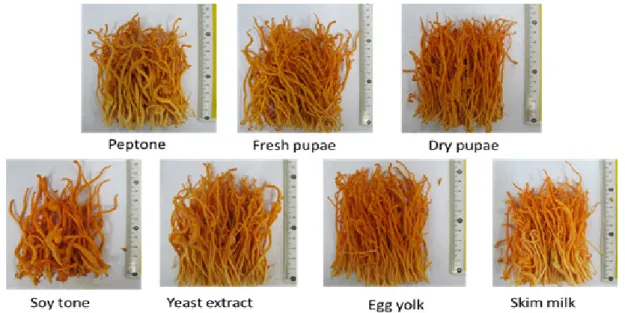
The results of different nitrogen sources in this study are shown in Table 4. Fresh pupa was best nitrogen source for the length and yield of fruiting bodies production (Fig. 4). On the other hand, skim milk powder was the best nitrogen source for produce adenosine, and the dry pupa was the best source of nitrogen to produce cordycepin. This report was similar with other research on Cordyceps spp. (Kang et al., 2017).
The effect of growth factor
Plant growth factor is one of the important factors in the in vitro culture of cells. In order to find suitable growth factors for growth of fruiting body, production of adenosine and Table 2. Effect of different basal substrates on fruiting body, and cordycepin and adenosine production
Grain (g) Fresh weight of body (g) Dry weight of body (g) Adenosine (㎍/g) Cordycepin (㎍/g) Rice 38.2 ± 0.9
c,d,Z4.1 ± 0.2
d+1,303.0 ± 12.5
c*1,861.7 ± 10.0
a**O = 30 22.0 ± 0.75
b2.3 ± 0.15
b+1,311.7 ± 15.6
c*8,250.0 ± 26.5
h**B = 30 10.2 ± 0.7
a1.4 ± 0.2
a+1,306.0 ± 14.9
c*7,893.0 ± 17.5
g**M = 30 23.8 ± 0.6
b3.0 ± 0.2
c+1,218.6 ± 10.5
b*2,666.7 ± 13.1
a**O:M = 25:5 42.2 ± 0.7
e,f5.5 ± 0.2
f+1,132.3 ± 12.1
a*4,112.0 ± 24.6
e**R:O = 15:15 44.1 ± 1.0
f5.7 ± 0.1
f+1,139.0 ± 13.0
a*3,738.0 ± 26.5
d**R:O:M = 15:10:5 40.5 ± 1.2
d,e5.2 ± 0.2
e+,f+1,253.0 ± 14.1
b*4,680.0 ± 40.2
f**R:O:B:M = 10:10:5:5 37.3 ± 1.3
c4.8 ± 0.3
e+1,425.7 ± 13.5
e*3,653.0 ± 27.7
c**Z
Values are mean ± SD (n = 3). Different uppercase letters (a, b, c, d, e, f, g), (+, Dry fruit body; *, adenosine; **, Cordycepin) in column show statistically significant differences (P ≤ 0.05, Tukey’s test).
Table 3. Effect of carbon sources on the fruiting body, adenosine and cordycepin production by Cordyceps militaris HB8 Carbon
source
Amount
Fresh weight of body (g) Dry weight of body (g) Adenosine (㎍/g) Cordycepin (㎍/g) Length (㎝) g/L
Glucose 20 32.3 ± 1.1
f,Z5.5 ± 0.1
d+957.3 ± 19.6
d*3,214.6 ± 20.3
d**7 - 13
Sucrose 20 26.2 ± 0.8
e4.8 ± 0.3
c+821.7 ± 20.8
c*2,119.3 ± 34.5
b**5 - 11
Lactose 20 17.5 ± 1.6
b2.5 ± 0.3
b+565.3 ± 23.5
b*2,304.3 ± 41.3
c**4 - 9
Maltose 20 14.3 ± 1.2
a1.4 ± 0.1
a+214.0 ± 21.6
a*1,330.3 ± 23.4
a**4 - 6
Mannose 20 22.3 ± 0.7
c2.2 ± 0.2
b+838.3 ± 10.5
c*2,318.3 ± 32.1
c**5 - 9
Z
Values are mean ± SD (n = 3). Different uppercase letters (a, b, c, d), (+, Dry fruit body; *, adenosine; **, Cordycepin) in column
show statistically significant differences (P ≤ 0.05, Tukey’s test).
cordycepin, different plant growth factors, namely, NAA, 2,4-D, and IBA were selected and cultured in basal medium
after adding each of them. As a result, growth factors did not significantly affect the size and weight of fruiting bodies, and Table 4. Effect of nitrogen sources on the fruiting body and cordycepin production by Cordyceps militaris HB8
Nitrogen source Amount Fresh weight of fruit
body (g) Dry weight of fruit
body (g) Adenosine (㎍/g) Cordycepin (㎍/g) Length (㎝) g/L
Peptone 15g/l 31.5 ± 1.3
cZ5.4 ± 0.2
b+946.3 ± 20.7
b*3,024.0 ± 24.7
c**7 - 13 Fresh pupa 10g/box 38.1 ± 1.3
d6.4 ± 0.1
c+1,736.0 ± 27.4
e*5492 ± 28.8
f**10 - 14
Dry pupa 5g/box 30.2 ± 1.0
c5.2 ± 0.2
b+1,548.0 ± 30.5
d*6,850.3 ± 22.5
g**6 - 11 Soy tone 15g/L 29.4 ± 1.2
b,c5.5 ± 0.2
b+863.0 ± 12.0
a*3427 ± 26.1
d**7 - 11 Yeast extract 15g/L 23.0 ± 0.5
a4.5 ± 0.2
a+1,151.6 ± 22.3
c*3,995.3 ± 20.2
e**6 - 11 Egg yolk 25g/L 30.3 ± 0.8
c5.2 ± 0.1
b+1,173.7 ± 19.8
c*2,151.7 ± 11.7
b**7 - 10 Skim milk 15g/L 27.2 ± 0.9
b4.6 ± 0.1
a+2,598.3 ± 21.0
f*1,974.3 ± 17.4
a**7 - 13
Z
Values are mean ± SD (n = 3) . Different uppercase letters (a, b, c, d, e, f) , (+, Dry fruit body; *, adenosine; **, Cordycepin) in column show statistically significant differences (P ≤ 0.05, Tukey’s test).
Fig. 4. The phenotype of fruits in Cordyceps militaris HB8 according to different protein sources.
Table 5. Effect of different growth factors on fruiting body, adenosine and cordycepin production Growth factor Concentration Fresh body
(g) Dry body
(g) Adenosine
(㎍/g) Cordycepin
(㎍/g) Length
(㎝) Control 0 32.0 ± 0.5
bZ5.5 ± 0.3
a+,b+972.3 ± 19.4
d*3,218.3 ± 19.7
c**7 - 13 α-Naphthylacetic acid (NAA)1 ㎎/L 35.1 ± 0.5
c5.7 ± 0.1
c+562.0 ± 17.8
a*3,421.0 ± 12.8
d**7 - 13 2,4-Dichlorophenoxyacetic acid
(2,4-D) 1 ㎎/L 30.0 ± 0.7
a5.2 ± 0.1
a+891.0 ± 20.5
c*2,936.0 ± 19.0
b**6 - 11 Indole-3-butytric acid (IBA)1 ㎎/L 35.0 ± 0.6
c5.3 ± 0.2
a+, b+802.3 ± 20.3
b*2,737.3 ± 14.6
a**5 - 11
Z