J Vet Sci 2018, 19(3), 426-433ㆍhttps://doi.org/10.4142/jvs.2018.19.3.426 JVS
Received 15 May 2017, Revised 26 Aug. 2017, Accepted 16 Nov. 2017
*Corresponding author: Tel: +82-42-821-6763; Fax: +82-42-821-6703; E-mail: [email protected]
Journal of Veterinary Scienceㆍⓒ 2018 The Korean Society of Veterinary Science. All Rights Reserved.This is an Open Access article distributed under the terms of the Creative Commons Attribution Non-Commercial License (http://creativecommons.org/licenses/
by-nc/4.0) which permits unrestricted non-commercial use, distribution, and reproduction in any medium, provided the original work is properly cited.
pISSN 1229-845X eISSN 1976-555X
Comparison of the effects of isoflurane versus propofol- remifentanil anesthesia on oxygen delivery during thoracoscopic lung lobectomy with one-lung ventilation in dogs
Jiyoung Park, Hae-Beom Lee, Seong Mok Jeong*
Department of Veterinary Surgery, College of Veterinary Medicine, Chungnam National University, Daejeon 34134, Korea
This study compared effects of isoflurane inhalation (ISO) and propofol-remifentanil combined total intravenous anesthesia (TIVA) on oxygenation during thoracoscopic lung lobectomy with 30-min one-lung ventilation (1LV). Thoracoscopic right middle lung lobectomy was performed in ten dogs divided into ISO and TIVA groups, and cardiopulmonary parameters were measured with blood gas analysis.
Throughout the study, isoflurane was inhaled up to 1.5%, and the infusion rates of propofol and remifentanil were 0.2 to 0.4 mg/kg/min and 6 to 11 g/kg/h, respectively. Cardiac index was not affected in the ISO group, but it increased during 1LV in the TIVA group. There were significant alterations in arterial oxygen pressure, arterial oxygen saturation, oxygen content, and shunt fraction associated with 1LV in each group. However, oxygen delivery did not decrease significantly due to open chest condition, 1LV, or surgical maneuver in either group, rather it increased during 1LV in the TIVA group. All parameters showed no significant difference between groups. Pulmonary vascular resistant index was unaffected in both groups, and there was no difference between groups except in re-ventilation phase. Accordingly, the effect of both anesthetic regimens on oxygenation was not different between groups and can be used with short-term 1LV for thoracoscopic lung lobectomy in dogs.
Keywords: dogs, isoflurane, one-lung ventilation, propofol-remifentanil, thoracoscopic lung lobectomy
Introduction
As the field of minimally invasive surgery has been expanding in veterinary medicine, one-lung ventilation (1LV) is often accompanied in thoracoscopic lung surgery to facilitate motionless surgical approach with a benefit of optimal hilar visualization. During 1LV, however, collapse of the operated lung area blocks its ventilation completely, and there is a potential risk for considerable intrapulmonary right to left shunt of deoxygenated blood through the non-ventilated lung [15,16].
This theoretical ventilation-perfusion (V/Q) mismatch may result in hypoxemia and decreased oxygen saturation [2,15,16,18,28,30,31].
Hypoxic pulmonary vasoconstriction (HPV), a critical physiologic homeostatic mechanism, is activated in hypoxic condition, and pulmonary blood flow is diverted away from collapsed, hypoxic areas to better-oxygenated areas of the pulmonary vascular bed to match regional ventilation and perfusion [18,19,31]. This phenomenon decreases shunt fraction
and accordingly improves patients’ oxygenation [25,27]. In clinic, most indications of lung lobectomy are in pathologic status of impaired oxygenation inducing poor alveolar distension- contraction such as pulmonary abscess, bullous emphysema, consolidation, neoplasia, or lung lobe torsion [22]. Associated hypoventilation, V/Q mismatching, shunt fraction, and dead space may deteriorate hypoxemia and hemoglobin desaturation.
Moreover, 1LV in these patients might induce further risk potential with an artificially increased shunt fraction [15].
Under such conditions, attenuation of HPV could result in fatal intraoperative hypoxemia [2,3,6,18,27].
In general, it has been accepted that volatile anesthetics are
known to inhibit HPV with a vasodilative effect counteracting
the protective mechanism of HPV, while intravenous anesthetics
do not depress HPV [7,25,27]. However, various authors have
reported a variety of results, and there is no consensus currently
[5,10,32]. According to previous reports, in vitro study in rat
lung showed a negative effect with a median effective dose
(ED50) of 0.6 minimum alveolar concentration (MAC)
isoflurane inhalation [20], and in vivo study in chloralose-based intravenous anesthetized rabbit with 1LV reported increased regional blood flow to non-ventilated lung fields after conversion to 1.5% (0.75 MAC) isoflurane inhalation [7]. In human medicine, propofol improved oxygenation and shunt fraction during 1LV in an open chest condition for esophageal surgery compared with isoflurane and sevoflurane [1], and a three-fold greater shunt fraction with isoflurane compared with propofol was also reported [12]. On the other hand, a neutral to weak inhibitive action on HPV was observed with modern inhalants of isoflurane, sevoflurane, and desflurane in human medicine [4,18,27,31], whereas a total intravenous anesthesia (TIVA) of propofol-alfentanil combination in another human study did not decrease the risk of hypoxemia compared with 1 MAC isoflurane during 30-minute 1LV [26].
These results are inconsistent and depend on conditions of the study such as method of induction of hypoxic condition (hypoxic gas inhalation vs. 1LV), assessment of HPV (arterial blood gas analysis, pulmonary arterial catheterization, colored microsphere technique), type and dose of anesthetics, experimental animals, or in vivo vs. in vitro study [5,10,32]. Moreover, some studies excluded surgical maneuver and evaluated only under 1LV [3,14,17]. Consequently, it is inappropriate to compare results among studies, thus effects under real surgical condition remain unpredictable in dogs.
Considering these aspects, this study investigated the effects of two anesthetic regimens, isoflurane inhalation and propofol- remifentanil combined TIVA, on HPV and oxygenation during thoracoscopic lung lobectomy with 1LV in Beagle dogs. The aims of this study were (1) to evaluate the effect of each anesthetic encountered during the overall steps of thoracoscopic lung lobectomy with 1LV, and (2) to determine differences between the two anesthetic groups.
Materials and Methods
Experimental animals
This study was performed under the guidance of the Chungnam National University Institutional Animal Care and Use Committees (CNU-00413). Ten 3-year-old, purpose-bred intact male Beagle dogs weighing 8.88 ± 0.75 kg (range, 8.0–
10.0 kg; body condition score, 4/9–6/9) were included. All dogs were clinically healthy based on physical examination, complete blood count, serum biochemistry, electrolytes panel, and thoracic radiography. The dogs were randomly allocated into one of two groups of anesthetic regimens (isoflurane inhalation, ISO group; propofol-remifentanil combined TIVA, TIVA group).
Anesthetic regimen
All dogs were oxygenated for 5 min prior to anesthetic induction. Normal saline was administered at 10 mL/kg/h.
Glycopyrrolate (Mobinul, 0.011 mg/kg intravenous [IV];
Myungmoon Pharm, Korea) and diazepam (Diazepam, 0.1 mg/kg IV; Samjin Pharm, Korea) were used in the premedication of each dog. Anesthesia in five dogs (ISO group) was induced with propofol (Provive, 4 mg/kg IV; Myungmoon Pharm) and maintained with isoflurane (up to 2%, 1.5 MAC) after endotracheal intubation. In the other five dogs (TIVA group), propofol and remifentanil (Ultiva; GlaxoSmithKline, UK) were administered for induction (4 mg/kg IV, 4 g/kg IV) and infused for maintenance (up to 0.6 mg/kg/min constant rate infusion [CRI] and 6–20 g/kg/h CRI) after endotracheal intubation.
Rates of inhalation and infusion were controlled in response to patient monitoring parameters and recorded. Meloxicam (Metacam, 0.2 mg/kg IV; Boehringer Ingelheim Vetmedica, Germany) was administered immediately prior to anesthetic induction, and pure oxygen (FiO
2= 1) was used throughout the procedure.
Anesthetic phases
Total anesthetic duration was divided into the following five phases according to the surgical process. (A) Pre: after anesthetic induction, two-lung ventilation with a closed chest, 10 min; (B) O2LV: after portal placements, two-lung ventilation with open chest, 20 min; (C) O1LV: after bronchial block, 1LV with open chest, 20 min; (D) LOBEC: thoracoscopic right middle lung lobectomy under 1LV, 10 min; and (E) REVENT: re-ventilation and expansion of the collapsed lung, 5 min. Each dog served as its own control. The durations of total anesthesia and 1LV (phase O1LV and LOBEC) were 65 min and 30 min, respectively.
In phase Pre, all dogs were placed in left lateral recumbency, and the right hemithorax was surgically prepped. The dorsal pedal artery was catheterized for systemic blood pressure monitoring and arterial blood sampling. A pulmonary artery catheter (Swan Ganz Catheter, 132F5, 110 cm; Edwards Lifesciences, USA) was introduced through the right external jugular vein using the Seldinger technique with characteristic monitoring pressure tracking to measure the pulmonary arterial pressure and cardiac output (CO) and to obtain mixed venous blood sample. Atracurium besylate (Atra, 0.2 mg/kg IV; Hana Pharm, Korea) was administrated and the lungs were mechanically ventilated with a volume- and time-controlled ventilator after spontaneous respiration disappeared; Royal 77 (Royal Medical, Korea), tidal volume = 15 mL/kg, respiratory rate = 20 breaths/min, I/E ratio = 1:2, peak inspiratory pressure limit = 20 cmH
2O.
During phase O2LV, an open chest condition was obtained by taking an 8-6-5 intercostal approach with three soft threaded trocars (Thoracoport; Covidien, USA) as described previously [23]. Three openings were created for the 5 mm telescope, 12 mm stapler and specimen retrieval pouch, and 5 mm grasper, respectively.
Phase O1LV followed. 1LV was initiated with an endobronchial
Table 1. Equations of hemodynamic parameters [13]
Hemodynamic calculations
CI = CO
(L min−1 m−2) body surface area
CaO2 = (1.36 × Hb × SaO2) + 0.003 × PaO2 (mL dL−1) PVRI = (MPAP − PAWP)
× 80 (dynes sec cm−5 m−2) CI
DO2I = CaO2 × CI × 10 (mL min−1 m−2) Qs/Qt = Cc’O2* − CaO2
× 100 (%) Cc’O2 − CvO2†
CI, cardiac index; CO, cardiac output; CaO
2, arterial oxygen content; Hb, hemoglobin; SaO
2, arterial oxygen saturation; PaO
2, arterial oxygen pressure; PVRI, pulmonary vascular resistance index; MPAP, mean pulmonary arterial pressure; PAWP, pulmonary arterial wedge pressure;
DO
2I, oxygen delivery index; Q
s/Q
t, shunt fraction. *Cc′O
2(pulmonary capillary blood oxygen content) = (1.36 × Hb × 100/100) + 0.003 × P
AO
2‡(mL dL
−1).
†CvO
2(mixed venous oxygen content) = (1.36 × Hb × SvO
2) + 0.003 × PvO
2(mixed venous oxygen pressure) (mL dL
−1).
‡P
AO
2(alveolar oxygen tension) = [FiO
2× (P
B− P
H2O)] – 1.2 PaCO
2(mmHg).
blocker (Arndt Endobronchial Blocker Set, 5 Fr; Cook Critical Care, USA) occluding a main bronchial opening to the entire right lung field with guidance via a fiber-optic bronchoscope (EPK-700; Pentax Medical, Japan). Tidal volume was reduced by half of baseline during the O1LV and LOBEC phases. Each dog was vigilantly monitored, and the atelectasis of the right lung field was confirmed via thoracoscopy. Dislodging of the endobronchial blocker was monitored also.
In the LOBEC phase, thoracoscopic right middle lung lobectomy was performed with an endoscopic stapler and the resected lung lobe was retrieved with a specimen retrieval pouch. The surgical field was re-explored for hemorrhage, air leakage, or pedicle tearing.
In the REVENT phase, the collapsed lung lobes were re-expanded 10 times after the deflation of the endobronchial blocker by applying 5 cmH
2O positive end-expiratory pressure ventilation with 20 cmH
2O peak inspiratory pressure. The tidal volume restored to baseline, and ventilation was continued for additional 5 min.
After termination of all phases, dogs were humanely euthanatized under anesthesia.
Evaluation
Patient monitoring included electrocardiogram, heart rate (HR), respiratory rate, capnogram, end-tidal carbon dioxide concentration, tidal volume, rectal temperature, core temperature, arterial blood pressure (systolic [SAP], mean [MAP], and diastolic), and pulse oximetry (SpO
2). These parameters were monitored and recorded by using a Datex S/5 system (Datex Ohmeda, Finland).
Hemodynamic changes, pulmonary arterial pressures (systolic, mean [MPAP], diastolic, and wedge [PAWP]) and CO with a thermodilution technique were measured and recorded at the following times of each phase: Pre-10 min (PRE), O2LV-20 min, O1LV-10 min, O1LV-20 min, LOBEC-10 min (LOBEC), and REVENT-5 min (REVENT). The mean value of three consecutive CO measurements was used for each datum.
Arterial and mixed venous blood samples were collected anaerobically and analyzed (i-STAT Portable Clinical Analyzer;
Heska, USA) simultaneously. Data were calculated using following standard formulae (Table 1); cardiac index (CI), shunt fraction (Q
s/Q
t), arterial oxygen content (CaO
2), oxygen delivery index (DO
2I), pulmonary vascular resistance index (PVRI).
Statistical analysis
All continuous variable data are presented as mean ± SD values. Normality of data distribution was examined by the Shapiro-Wilk test, and non-parametric methods were selected for non-normal distributions. For a comparison among all phases in each group, data were analyzed using Friedman’s test which is related to non-parametric ANOVA with repeated
measures, and further multiple comparisons were performed with a Wilcoxon signed rank test when any significant difference was identified (p < 0.05). For differences between two independent groups in the same phase, data were compared by using the Mann-Whitney test. All analyses were performed with IBM SPSS Statistics (ver. 21.0; IBM, USA) and p < 0.05 was considered to indicate a significant difference.
Results
The anesthetic concentrations for maintenance were lower than that of the pre-planned protocol. In the ISO group, isoflurane was inhaled up to 1.5%, which was equivalent to approximately 1.125 MAC in dogs. In the TIVA group, the range of infusion rates of propofol and remifentanil were 0.2 to 0.4 mg/kg/min and 6 to 11 g/kg/h, respectively.
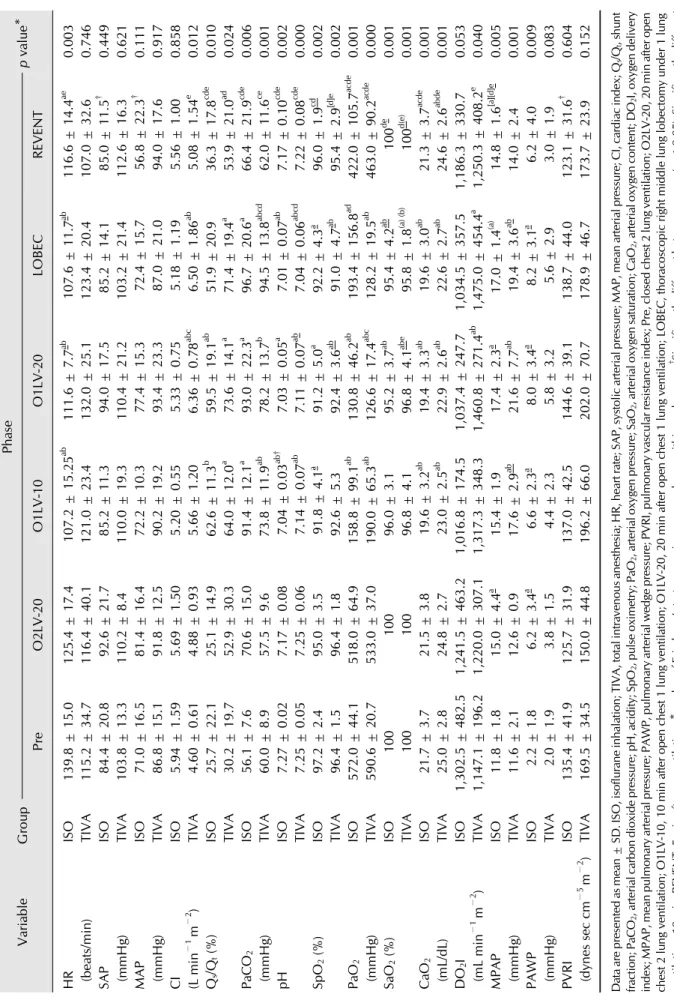
Intraoperative blood gas analysis and cardiopulmonary variable data at every assessment time in each group are shown in Table 2. HR in the ISO group significantly decreased after 1LV, while there was no significant difference among phases in the TIVA group or between the two groups. SAP and MAP increased with open chest and 1LV but it was not significantly different among phases in each group. In the REVENT phase, SAP (p = 0.032) and MAP (p = 0.016) in the ISO group were lower than that of the TIVA group.
CI levels did not differ between groups or among the phases in the ISO group; however, it was significantly higher in phases of O1LV-20 and LOBEC than that of PRE and O2LV-20 phases in TIVA. During 1LV, Q
s/Q
tincreased significantly in each group, but there was no significant difference between groups.
As for PaCO
2and pH, PaCO
2increased while pH decreased
Table 2. Changes of hemodynamic and cardiopulmonary parameters in the ISO and TIVA groups during thoracoscopic right middle lung lobectomy with 1LV in dogs VariableGroupPhase p value* PreO2LV-20O1LV-10O1LV-20LOBECREVENT HR (beats/min)ISO139.8 ± 15.0125.4 ± 17.4 107.2 ± 15.25ab 111.6 ± 7.7ab 107.6 ± 11.7ab 116.6 ± 14.4ae 0.003 TIVA115.2 ± 34.7116.4 ± 40.1 121.0 ± 23.4132.0 ± 25.1123.4 ± 20.4107.0 ± 32.60.746 SAP (mmHg)ISO 84.4 ± 20.8 92.6 ± 21.7 85.2 ± 11.3 94.0 ± 17.585.2 ± 14.1 85.0 ± 11.5† 0.449 TIVA103.8 ± 13.3110.2 ± 8.4 110.0 ± 19.3110.4 ± 21.2103.2 ± 21.4112.6 ± 16.30.621 MAP (mmHg)ISO 71.0 ± 16.5 81.4 ± 16.4 72.2 ± 10.3 77.4 ± 15.372.4 ± 15.7 56.8 ± 22.3† 0.111 TIVA 86.8 ± 15.1 91.8 ± 12.5 90.2 ± 19.2 93.4 ± 23.387.0 ± 21.094.0 ± 17.60.917 CI (L min−1 m−2 )ISO 5.94 ± 1.59 5.69 ± 1.50 5.20 ± 0.55 5.33 ± 0.755.18 ± 1.195.56 ± 1.000.858 TIVA 4.60 ± 0.61 4.88 ± 0.93 5.66 ± 1.20 6.36 ± 0.78abc 6.50 ± 1.86ab 5.08 ± 1.54e 0.012 Qs/Qt (%)ISO 25.7 ± 22.1 25.1 ± 14.9 62.6 ± 11.3b 59.5 ± 19.1ab 51.9 ± 20.9 36.3 ± 17.8cde 0.010 TIVA 30.2 ± 19.7 52.9 ± 30.3 64.0 ± 12.0a 73.6 ± 14.1a 71.4 ± 19.4a 53.9 ± 21.0ad 0.024 PaCO2 (mmHg)ISO56.1 ± 7.6 70.6 ± 15.0 91.4 ± 12.1a 93.0 ± 22.3a 96.7 ± 20.6a 66.4 ± 21.9cde 0.006 TIVA60.0 ± 8.957.5 ± 9.6 73.8 ± 11.9ab 78.2 ± 13.7b 94.5 ± 13.8abcd 62.0 ± 11.6ce 0.001 pHISO 7.27 ± 0.02 7.17 ± 0.08 7.04 ± 0.03ab† 7.03 ± 0.05a 7.01 ± 0.07ab 7.17 ± 0.10cde 0.002 TIVA 7.25 ± 0.05 7.25 ± 0.06 7.14 ± 0.07ab 7.11 ± 0.07ab 7.04 ± 0.06abcd 7.22 ± 0.08cde 0.000 SpO2 (%)ISO97.2 ± 2.495.0 ± 3.5 91.8 ± 4.1a 91.2 ± 5.0a 92.2 ± 4.3a 96.0 ± 1.9cd 0.002 TIVA96.4 ± 1.596.4 ± 1.8 92.6 ± 5.3 92.4 ± 3.6ab 91.0 ± 4.7ab 95.4 ± 2.9[d]e 0.002 PaO2 (mmHg)ISO572.0 ± 44.1518.0 ± 64.9 158.8 ± 99.1ab 130.8 ± 46.2ab 193.4 ± 156.8ad 422.0 ± 105.7acde 0.001 TIVA590.6 ± 20.7533.0 ± 37.0 190.0 ± 65.3ab 126.6 ± 17.4abc 128.2 ± 19.5ab 463.0 ± 90.2acde 0.000 SaO2 (%)ISO100100 96.0 ± 3.1 95.2 ± 3.7ab 95.4 ± 4.2ab 100de 0.001 TIVA100100 96.8 ± 4.1 96.8 ± 4.1abe 95.8 ± 1.8(a) (b) 100d(e) 0.001 CaO2 (mL/dL)ISO21.7 ± 3.721.5 ± 3.8 19.6 ± 3.2ab 19.4 ± 3.3ab 19.6 ± 3.0ab 21.3 ± 3.7acde 0.001 TIVA25.0 ± 2.824.8 ± 2.7 23.0 ± 2.5ab 22.9 ± 2.6ab 22.6 ± 2.7ab 24.6 ± 2.6abde 0.001 DO2I (mL min−1 m−2 )ISO1,302.5 ± 482.51,241.5 ± 463.21,016.8 ± 174.51,037.4 ± 247.71,034.5 ± 357.51,186.3 ± 330.70.053 TIVA1,147.1 ± 196.21,220.0 ± 307.11,317.3 ± 348.3 1,460.8 ± 271.4ab 1,475.0 ± 454.4a 1,250.3 ± 408.2e 0.040 MPAP (mmHg)ISO11.8 ± 1.8 15.0 ± 4.4a 15.4 ± 1.9 17.4 ± 2.3a 17.0 ± 1.4(a) 14.8 ± 1.6[a][d]e 0.005 TIVA11.6 ± 2.112.6 ± 0.9 17.6 ± 2.9ab 21.6 ± 7.7ab 19.4 ± 3.6ab 14.0 ± 2.40.001 PAWP (mmHg)ISO 2.2 ± 1.8 6.2 ± 3.4a 6.6 ± 2.3a 8.0 ± 3.4a 8.2 ± 3.1a 6.2 ± 4.00.009 TIVA 2.0 ± 1.9 3.8 ± 1.5 4.4 ± 2.3 5.8 ± 3.25.6 ± 2.93.0 ± 1.90.083 PVRI (dynes sec cm−5 m−2 )ISO135.4 ± 41.9125.7 ± 31.9 137.0 ± 42.5144.6 ± 39.1138.7 ± 44.0123.1 ± 31.6† 0.604 TIVA169.5 ± 34.5150.0 ± 44.8 196.2 ± 66.0202.0 ± 70.7178.9 ± 46.7173.7 ± 23.90.152 Data are presented as mean ± SD. ISO, isoflurane inhalation; TIVA, total intravenous anesthesia; HR, heart rate; SAP, systolic arterial pressure; MAP, mean arterial pressure; CI, cardiac index; Qs/Qt, shunt fraction; PaCO2, arterial carbon dioxide pressure; pH, acidity; SpO2, pulse oximetry; PaO2, arterial oxygen pressure; SaO2, arterial oxygen saturation; CaO2, arterial oxygen content; DO2I, oxygen delivery index; MPAP, mean pulmonary arterial pressure; PAWP, pulmonary arterial wedge pressure; PVRI, pulmonary vascular resistance index; Pre, closed chest 2 lung ventilation; O2LV-20, 20 min after open chest 2 lung ventilation; O1LV-10, 10 min after open chest 1 lung ventilation; O1LV-20, 20 min after open chest 1 lung ventilation; LOBEC, thoracoscopic right middle lung lobectomy under 1 lung ventilation, 10 min; REVENT, 5 min after re-ventilation.
* p value of Friedman’s test comparing among phases within each group.† Significantly different between groups (p < 0.05). Significantly differen froma Pre,b O2LV-20,c O1LV-10, d O1LV-20, and e LOBEC (p < 0.05). Superscripts expressed as x, x, [x], (x) indicate p values of 0.043, 0.042, 0.041, 0.039, respectively.
with 1LV significantly, but they restored in the REVENT phase.
PaCO
2was not different between groups, but a significantly lower pH level was identified in the ISO group than that of the TIVA group in O1LV-10 phase (p = 0.008).
Regarding intraoperative oxygenation, SpO
2, arterial oxygen pressure (PaO
2), arterial oxygen saturation (SaO
2), and CaO
2in both groups decreased significantly during 1LV but restored in the REVENT phase to the level of PRE (SpO
2, SaO
2), O2LV-20 (PaO
2, CaO
2in ISO), and O1LV-10 (CaO
2in TIVA). DO
2I in the ISO group showed no significant change among phases although there was a tendency of decrease during 1LV. In the TIVA group, on the other hand, significantly higher DO
2I were identified in O1LV-20 and LOBEC phases than that in the PRE phase, and the level decreased in the REVENT phase. None of these 5 parameters showed a significant difference between the two groups.
There were significant increases of MPAP and PAWP in the ISO group and MPAP in the TIVA group during 1LV, but there was no difference between groups. PVRI values were not significantly different in either group and also between groups except in the REVENT phase (p = 0.032).
Discussion
This study attempted to answer the question of how we can reduce burden on canine patients for lung lobectomy while mitigating the risk of hypoxia. In lateral recumbency, an intercostal thoracotomy enables over-inflation of the non- dependent lung as the thoracic wall does not limit its expansion, while ventilation of the dependent lung is impaired because the loss of negative intra-thoracic pressure induces compression of the lower lung via the weight of the heart, mediastinum, and abdominal organs. However, lung perfusion is more concentrated on the dependent side due to the gravity [13,18], and these complicated conditions contribute to V/Q mismatch.
Contrary to the approach in thoracotomy, the thoracic wall is intact during thoracoscopy and it prevents the over-inflation of the non-dependent lung. Therefore, a higher proportion of ventilation occurs in the dependent lung, resulting in a smaller Q
s/Q
tand a lower reduction in PaO
2, SaO
2, and CaO
2. Previously, a 19% reduction in PaO
2with unaffected SaO
2was reported during thoracoscopic cannulae placement, whereas a 29% to 39% reduction in PaO
2accompanied by a significant decrease in SaO
2was induced by intercostal thoracotomy [13].
Thus, we selected a thoracoscopic procedure for lung lobectomy and included 1LV, which could be decisive in some cases. With 1LV, the non-dependent lung is excluded from the ventilatory circuit completely, thus it becomes a true shunt [18].
In this scenario, ventilation is restricted to the dependent lung, although Q
s/Q
tincreases. At this moment, a concentrated blood flow to the region where the gas exchange occurs is key to improve patients’ oxygenation; this is why HPV should be
optimized with 1LV. HPV can reduce shunt flow through the operative lung by 40% approximately [18].
The mechanism of HPV has not been fully described. It is thought of as a local constriction of vascular smooth muscle in the pulmonary circulation in response to regional hypoxia; an initial decrease in alveolar oxygen pressure (P
AO
2) followed by a mixed venous oxygen pressure (P
vO
2) [18,19,33]. HPV occurs within a few seconds and reaches an initial peak in 15 to 20 min (phase 1) and can be prolonged for 2 to 4 h (phase 2) as a peak effect [18,19]. HPV may be assessed with oxygenation and PVRI indirectly or via a microsphere technique to measure the direct regional blood flow [3,17,18]. The net effect of the hemodynamic and respiratory changes of any treatment can be assessed through the evaluation of DO
2I [14]. The incidence of hypoxemia associated with 1LV was recently reported as 5%;
that rate has decreased from 25% in the 1970s owing to improvement of lung isolation technique, anesthetic agents, and better comprehension of the physiology of 1LV [19].
HPV is influenced by several factors such as general anesthesia, surgical manipulation, trauma, size of the hypoxic segment, intensity of the hypoxic stimulus, or temperature and age [2,3,6,18,27]. Whereas surgical manipulation in lateral recumbency reduces blood flow to the non-dependent lung with gravity passively [18], the anesthetic agents, muscle paralysis and mechanical ventilation, lateral recumbency, and atelectasis can deteriorate Q
s/Q
t, V/Q mismatch, and arterial hypoxemia [13]. However, these changes might be inevitable during practical surgery, and there is a need to evaluate anesthetic effects under the actual surgical conditions. This study was conducted under the most extreme hypoxic condition of left-sided 1LV, which excludes the right lung area that occupies 58% of the total lung volume [8]. Efforts were focused on maintaining anesthetic techniques and surgical procedures relevant to real clinical practice. The experimental phases followed the same courses as those of thoracoscopic lung lobectomy, and anesthetic depth was controlled to be just suitable for surgery.
In this study, obvious impairments in gas exchange were induced during 30 min 1LV in both anesthetic groups. There were significant decreases in PaO
2, SaO
2, and CaO
2, whereas PaCO
2increased and respiratory acidosis was intensified.
However, neither hypoxemia nor desaturation that were unacceptable (i.e., PaO
2< 60 mmHg, SpO
2< 90, SaO
2< 91% [9,29]) did not develop in either group. In addition, despite CaO
2decreasing numerically during 1LV, it was relatively well maintained in all phases and in both groups within or over the normal range (16–20 mL/dL) [9]. Moreover, none of the assessment times showed significantly lower CaO
2compared to that of the PRE phase.
When we consider the insignificant change in PVRI despite
significant increases in MPAP or PAWP, as well as the
unaffected oxygen delivery regardless of significantly increased
shunt fractions, neither anesthetic regimen in this study appeared sufficient to impair oxygenation. Q
s/Q
tincreased significantly after initiation of 1LV in both groups but did not show a significant decrease until end of 30 min 1LV. Oxygen delivery was maintained regardless of any of open thorax, 1LV, or surgical maneuver, and it was not different between groups.
This might be attributed to the high fraction of inspired oxygen (FiO
2= 1.0) or low anesthetic concentration, and the latter could be a reflection of the characteristics of minimally invasive surgery; a smaller incision and less pain. It is also possible that the overall effects of complicated in vivo compensation mechanisms avoided hypoxemia in advance of HPV. The effects of HPV seem to be maximized in conditions of low P
AO
2from 25 to 50 mmHg, low V/Q with hypoxic lung area between 30% and 70%, and hyperthermia [19].
In several reports, HPV was reported to be decreased by volatile anesthetics under in vitro and in vivo conditions. The attenuation appeared in a dose-dependent manner, especially with old agents [5], and some authors suggested that the clinical relevance of this effect is negligible [18]. Suppressive effects of volatile anesthetics are more potent when the pulmonary vascular region of HPV is exposed through the alveolus rather than via mixed venous blood [19]. If 1LV is stable, the agent is delivered by mixed venous blood. The anesthetic concentration in this study was even lower than that in a previous study that reported non-affected DO
2I by 1LV under 1.5 MAC isoflurane inhalation; in that study, oxygenation was evaluated in the same manner as in present study, but it was not accompanied by surgical procedure [14]. Although respiratory acidosis was more severe in the ISO group than in the TIVA group after initiation of 1LV, it might be less influential on HPV. As mentioned above, HPV is a response to the oxygen pressure (hypoxia) rather than that of carbon dioxide. Indeed, HPV is less associated with hypercapnia or respiratory acidosis but is attenuated by hypocapnia, instead [19].
During 1LV, CI increased significantly in the TIVA group, which is counter to the general characteristic of propofol anesthesia presenting a decrease in CO. It seemed to be associated with an increase in HR for a decrease in PaO
2, although that change was insignificant. It is followed by an increase in DO
2I because DO
2I is determined by both CO and CaO
2. Even though CaO
2declined, the degree of change in CO was relatively greater than that of CaO
2at the end of 1LV.
Nevertheless, it did not result in a significant change in PVRI.
On the other hand, in the ISO group, there was a significant decrease of HR after initiation of 1LV, which was accompanied by a non-significant decrease in CI and DO
2I. With significant increases in MPAP or both MPAP and PAWP associated with 1LV in both groups, PVRI values during the phases with 1LV were higher than those of the other phases in both groups, but the differences were not significant. Similarly, there was a tendency to higher values in the TIVA group than in the ISO
group in every phase, but there was no significant difference between two groups other than in the REVENT phase.
Previous canine studies with 1LV usually did not include surgical procedures [3,10,14,32]. Recent retrospective research in human medicine investigated during thoracic surgeries with 1LV but evaluated mainly only PaO
2, blood pressure, or HR [5,24,27,29]. Our results are supported by these human studies, which concluded there were no significant differences in PaO
2, MAP, or HR between propofol-based TIVA and volatile anesthetics using isoflurane [26,29] or sevoflurane [24].
Regarding thoracoscopic lung lobectomy in human medicine, a propofol-remifentanil combination was suitable and did not alter PaO
2[5,27], and one study reported that combination provided better oxygenation than a desflurane-remifentanil combination [5]. A previous study on thoracoscopic subphrenic pericardiectomy with 1LV was performed under isoflurane inhalation (up to 2.0%) in normal dogs. The authors monitored only PaO
2, PaCO
2, and SpO
2and reported relatively acceptable ventilation and oxygenation, although they did report a significant decrease in PaO
2during 1LV [21]. In another case report of thoracoscopic pericardial fenestration in a dog with a heart base tumor showed slight respiratory acidosis and considerable impairment in oxygenation parameters on arterial blood analysis; minimal PaO
2was 96 mmHg at 170 min [2].
That study was performed under sevoflurane inhalation with 1LV excluding the right lung field as in the present study.
When interpreting our results, the following limitations should be considered. First, this study included a small number of healthy dogs, and there was a lack of data after anesthetic recovery when patients might be in unstable cardiovascular/
hemodynamic status with reduced ability of compensation and impaired immunity. Further study of a large number of clinical patients with impaired gas exchange with long-term tracking after recovery from anesthesia is warranted. Second, the experimental conditions might be not controlled completely among phases with serial intervention of a surgical procedure.
In addition, the concentration of anesthetics was not fixed, which was because the study was performed to act as a replication of real surgery. Third, the duration of 30 min 1LV could be too short to monitor the further effects of HPV, although it might be enough for the surgical procedure. According to a previous review, PaO
2level reaches its lowest 20 to 30 min after 1LV and then increases gradually over the next 1 to 2 h [19]. Fourth, anesthesia and measurements were not carried out in a blind manner throughout the study, and the net effect of oxygenation was evaluated via an indirect method. Although a direct determination of blood flow with colored microsphere technique in pulmonary artery could provide further information on alteration in the distribution of blood flow at the level of capillaries in each phase, it was impractical to perform this technique in our clinic.
In summary, both 1.5% (1.125 MAC) isoflurane inhalation
anesthesia and propofol-remifentanil combined TIVA did not affect patients’ overall oxygenation throughout the thoracoscopic lung lobectomy procedure with 30-minute left-sided 1LV in dogs. Therefore, both anesthetic regimens can be used according to the surgeon’s preference for thoracoscopic procedures with ILV. However, observations of 1) severe hypercapnia and respiratory acidosis with 1LV in ISO group than TIVA group, 2) an increase in DO
2I with CI during 1LV in TIVA group, and 3) a highly maintained SAP and MAP in the TIVA group before end of the study should be considered during case selection.
TIVA could be safer in patients with cardiovascular instability concerns. This study recommends vigilant anesthetic monitoring in patients with cardiopulmonary disease as significant alterations in gas exchange associated with ILV were induced regardless of the anesthetic regimen. Normocapnia and normothermia should be maintained during surgery, as HPV could be attenuated by hypocapnia and hypothermia [19]. Life-threatening hypoxemia during 1LV should be prevented by checking for the location of endobronchial blockers or double lumen tubes, increasing FiO
2, applying 5 cmH
2O positive end-expiratory pressure, re-expansion of the non-ventilated lung, or by administration of respiratory stimulants such as almitrine [11,15,18].
Acknowledgments
This research was supported by Basic Science Research Program through the National Research Foundation of Korea (NRF) funded by the Ministry of Education, Science and Technology (2017R1D1A1B03035022).
Conflict of Interest
The authors declare no conflicts of interest.
References
1. Abe K, Shimizu T, Takashina M, Shiozaki H, Yoshiya I. The effects of propofol, isoflurane, and sevoflurane on oxygenation and shunt fraction during one-lung ventilation.
Anesth Analg 1998, 87, 1164-1169.
2. Bauquier SH, Culp WT, Lin RC, Larenza MP. One-lung ventilation using a wire-guided endobronchial blocker for thoracoscopic pericardial fenestration in a dog. Can Vet J 2010, 51, 1135-1138.
3. Cantwell SL, Duke T, Walsh PJ, Remedios AM, Walker D, Ferguson JG. One-lung versus two-lung ventilation in the closed-chest anesthetized dog: a comparison of cardiopulmonary parameters. Vet Surg 2000, 29, 365-373.
4. Carlsson AJ, Bindslev L, Hedenstierna G. Hypoxia-induced pulmonary vasoconstriction in the human lung. The effect of isoflurane anesthesia. Anesthesiology 1987, 66, 312-316.
5. Cho YJ, Kim TK, Hong DM, Seo JH, Bahk JH, Jeon Y.
Effect of desflurane-remifentanil vs. Propofol-remifentanil anesthesia on arterial oxygenation during one-lung ventilation
for thoracoscopic surgery: a prospective randomized trial.
BMC Anesthesiol 2017, 17, 9.
6. Fujiwara M, Abe K, Mashimo T. The effect of positive end-expiratory pressure and continuous positive airway pressure on the oxygenation and shunt fraction during one-lung ventilation with propofol anesthesia. J Clin Anesth 2001, 13, 473-477.
7. Groh J, Kuhnle GE, Ney L, Sckell A, Goetz AE. Effects of isoflurane on regional pulmonary blood flow during one-lung ventilation. Br J Anaesth 1995, 74, 209-216.
8. Hsia CC, Dane DM, Estrera AS, Wagner HE, Wagner PD, Johnson RL Jr. Shifting sources of functional limitation following extensive (70%) lung resection. J Appl Physiol (1985) 2008, 104, 1069-1079.
9. Irizarry R, Reiss A. Beyond blood gases: making use of additional oxygenation parameters and plasma electrolytes in the emergency room. Compend Contin Educ Vet 2009, 31, E1-5.
10. Ishibe Y, Umeda T, Shiokawa Y, Izumi T, Nakamura M, Uno H, Suekane K. [Evaluation of halothane induced HPV inhibition with analysis of pressure-flow curve]. Masui 1992, 41, 586-594. Japanese.
11. Karzai W, Schwarzkopf K. Hypoxemia during one-lung ventilation: prediction, prevention, and treatment.
Anesthesiology 2009, 110, 1402-1411.
12. Kellow NH, Scott AD, White SA, Feneck RO. Comparison of the effects of propofol and isoflurane anaesthesia on right ventricular function and shunt fraction during thoracic surgery. Br J Anaesth 1995, 75, 578-582.
13. Kudnig ST, Monnet E, Riquelme M, Gaynor JS, Corliss D, Salman MD. Cardiopulmonary effects of thoracoscopy in anesthetized normal dogs. Vet Anaesth Analg 2004, 31, 121-128.
14. Kudnig ST, Monnet E, Riquelme M, Gaynor JS, Corliss D, Salman MD. Effect of one-lung ventilation on oxygen delivery in anesthetized dogs with an open thoracic cavity.
Am J Vet Res 2003, 64, 443-448.
15. Kudnig ST, Monnet E, Riquelme M, Gaynor JS, Corliss D, Salman MD. Effect of positive end-expiratory pressure on oxygen delivery during 1-lung ventilation for thoracoscopy in normal dogs. Vet Surg 2006, 35, 534-542.
16. Lansdowne JL, Monnet E, Twedt DC, Dernell WS.
Thoracoscopic lung lobectomy for treatment of lung tumors in dogs. Vet Surg 2005, 34, 530-535.
17. Loeb V, Preussler NP, Gaser E, Schreiber T, Hueter L, Karzai W, Schubert H, Schwarzkopf K. The effects of sevoflurane and propofol on oxygenation and lung perfusion during one-lung ventilation in an animal model. Adv Clin Exp Med 2011, 20, 249-253.
18. Lohser J. Evidence-based management of one-lung ventilation. Anesthesiol Clin 2008, 26, 241-272, v.
19. Lumb AB, Slinger P. Hypoxic pulmonary vasoconstriction:
physiology and anesthetic implications. Anesthesiology 2015, 122, 932-946.
20. Marshall C, Lindgren L, Marshall BE. Effects of halothane, enflurane, and isoflurane on hypoxic pulmonary vasoconstriction in rat lungs in vitro. Anesthesiology 1984, 60, 304-308.
21. Mayhew KN, Mayhew PD, Sorrell-Raschi L, Brown DC.
Thoracoscopic subphrenic pericardectomy using double- lumen endobronchial intubation for alternating one-lung ventilation. Vet Surg 2009, 38, 961-966.
22. Monnet E. Lungs. In: Tobias KM, Johnston SA (eds.).
Veterinary Surgery: Small Animal. pp. 1752-1768, Elsevier Saunders, St. Louis, 2012.
23. Park JY, Lee HB, Jeong SM. Portal placement for thoracoscopic right middle lung lobectomy with one-lung ventilation in beagle dogs. J Vet Clin 2015, 32, 9-15.
24. Pruszkowski O, Dalibon N, Moutafis M, Jugan E, Law-Koune JD, Laloë PA, Fischler M. Effects of propofol vs sevoflurane on arterial oxygenation during one-lung ventilation. Br J Anaesth 2007, 98, 539-544.
25. Purugganan RV. Intravenous anesthesia for thoracic procedures. Curr Opin Anaesthesiol 2008, 21, 1-7.
26. Reid CW, Slinger PD, Lenis S. A comparison of the effects of propofol-alfentanil versus isoflurane anesthesia on arterial oxygenation during one-lung ventilation. J Cardiothorac Vasc Anesth 1996, 10, 860-863.
27. Ryu CG, Min SW, Kim J, Han SH, Do SH, Kim CS. Effect of remifentanil on arterial oxygenation during one-lung ventilation. J Int Med Res 2010, 38, 1749-1758.
28. Schilling T, Kozian A, Kretzschmar M, Huth C, Welte T, Bühling F, Hedenstierna G, Hachenberg T. Effects of
propofol and desflurane anaesthesia on the alveolar inflammatory response to one-lung ventilation. Br J Anaesth 2007, 99, 368-375.
29. Sharifian Attar A, Tabari M, Rahnamazadeh M, Salehi M. A comparison of effects of propofol and isoflurane on arterial oxygenation pressure, mean arterial pressure and heart rate variations following one-lung ventilation in thoracic surgeries. Iran Red Crescent Med J 2014, 16, e15809.
30. Sugasawa Y, Yamaguchi K, Kumakura S, Murakami T, Suzuki K, Nagaoka I, Inada E. Effects of sevoflurane and propofol on pulmonary inflammatory responses during lung resection. J Anesth 2012, 26, 62-69.
31. Taleska G, Trajkovska T. The effect of one lung ventilation on intrapulmonary shunt during different anesthetic techniques. In: Guerreiro Cardoso PF (ed.). Topics in Thoracic Surgery. Chapter. 3. InTech, Rijeka, 2012.
32. Uno H, Ishibe Y, Umeda T, Shiokawa Y, Izumi T, Tanaka K, Suekane K. [Evaluation of inhibitory effect of isoflurane on the hypoxic pulmonary vasoconstriction response in dogs].
Masui 1994, 43, 1288-1296. Japanese.
33. Weissmann N, Sommer N, Schermuly RT, Ghofrani HA, Seeger W, Grimminger F. Oxygen sensors in hypoxic pulmonary vasoconstriction. Cardiovasc Res 2006, 71, 620-629.
![Table 1. Equations of hemodynamic parameters [13]](https://thumb-ap.123doks.com/thumbv2/123dokinfo/5444717.651747/3.892.467.824.803.986/table-equations-of-hemodynamic-parameters.webp)