Association between Fibrinogen and Carotid Atherosclerosis According to Smoking Status in a Korean Male Population
Hye Min Cho,
1,2* Dae Ryong Kang,
3* Hyeon Chang Kim,
4Sun Min Oh,
4,5Byeong-Keuk Kim,
6and Il Suh
41Department of Public Health, Yonsei University Graduate School, Seoul;
2Department of Family Medicine, Seoul Medical Center, Seoul;
3Department of Medical Humanities and Social Medicines, Ajou University School of Medicine, Suwon;
4Department of Preventive Medicine, Yonsei University College of Medicine, Seoul;
5Medical Affairs, Novartis Korea Oncology, Seoul;
6Yonsei Cardiovascular Center, Yonsei University College of Medicine, Seoul, Korea.
Received: September 29, 2014 Revised: December 24, 2014 Accepted: January 27, 2015
Corresponding author: Dr. Hyeon Chang Kim, Department of Preventive Medicine, Yonsei University College of Medicine, 50-1 Yonsei-ro, Seodaemun-gu, Seoul 120-752, Korea.
Tel: 82-2-2228-1868, Fax: 82-2-392-8133 E-mail: [email protected]
*Hye Min Cho and Dae Ryong Kang contributed equally to this work.
∙ The authors have no financial conflicts of interest.
© Copyright:
Yonsei University College of Medicine 2015 This is an Open Access article distributed under the terms of the Creative Commons Attribution Non- Commercial License (http://creativecommons.org/
licenses/by-nc/3.0) which permits unrestricted non- commercial use, distribution, and reproduction in any medium, provided the original work is properly cited.
Purpose: Although inconsistent, reports have shown fibrinogen levels to be associ- ated with atherosclerosis. Accordingly, since cigarette smoking is associated with increased levels of fibrinogen and atherosclerosis, it may also affect the association between fibrinogen and atherosclerosis. We investigated the associations between fibrinogen and carotid intima-media thickness (IMT) according to smoking status in a Korean male population. Materials and Methods: Plasma fibrinogen levels were measured in 277 men aged 40‒87 years without a history of myocardial in- farction or stroke. High-resolution B-mode ultrasonography was used to examine the common carotid arteries. IMT level was analyzed both as a continuous (IMT- max, maximum value; IMT-tpm, 3-point mean value) and categorical variable (higher IMT; presence of plaque). Serial linear and logistic regression models were employed to examine the association between fibrinogen and IMT according to smoking status. Results: Fibrinogen levels were positively associated with IMT- max (standardized β=0.25, p=0.021) and IMT-tpm (standardized β=0.21, p=0.038), even after adjusting for age, body mass index, systolic blood pressure, fasting glu- cose, and total cholesterol to high-density lipoprotein cholesterol ratio in current smokers (n=75). No significant association between fibrinogen and IMT, however, was noted in former smokers (n=80) or nonsmokers (n=122). Adjusted odds ratios (95% confidence interval) for having plaque per one standard deviation higher fi- brinogen level were 2.06 (1.09‒3.89) for current smokers, 0.68 (0.43‒1.10) for for- mer smokers, and 1.06 (0.60‒1.87) for nonsmokers. Conclusion: Our findings sug- gest that cigarette smoking may modify the association between fibrinogen and carotid atherosclerosis. Further studies are required to confirm this finding in differ- ent populations.
Key Words: Fibrinogen, smoking, atherosclerosis, intima-media thickness
INTRODUCTION
As a hemostatic marker, plasma levels of fibrinogen are associated with the inci- dence of and mortality from cardiovascular disease.1,2 Fibrinogen levels have also
ing. Former smokers comprised those who had smoked greater than 100 cigarettes in their lifetime but did not smoke recently. Nonsmokers included those who had smoked fewer than 100 cigarettes in their lifetime. The height and weight of each participant were measured and body mass index was cal- culated as weight divided by height squared (kg/m2). Partic- ipants were seated for at least five minutes before blood pres- sure measurement, and two measurements at least 5-minute intervals were obtained by an automatic sphygmomanometer (Dinamap 1846 SX/P; GE Healthcare, Waukesha, WI, USA).
If the two measurements differed by ≥10 mm Hg, for either systolic or diastolic blood pressure, an extra measurement was taken after 5 minutes; the last two measurements were aver- aged for analysis. Venous blood samples were collected after a minimum 8-hour fast. Enzymatic methods (ADVIA 1800;
Siemens, New York, USA) were used to measure glucose, al- anine transaminase, aspartate transaminase, total cholester- ol, high-density lipoprotein (HDL) cholesterol, and triglycer- ide levels. Friedewald, et al.’s20 formula was used to calculate the level of low-density lipoprotein cholesterol. Turbidimet- ric immunoassay (ADVIA 1800; Siemens, New York, USA) was used to measure high-sensitivity C-reactive protein. White blood cell counts were measured by the impedance method with an automatic analyzer (ADIVA120; Siemens, New York, USA). Fibrin d-dimer was measured via an enzyme linked fluorescent assay (Mini vidas; BioMerieux SA, Lyon, France).
Plasma fibrinogen level was measured by turbidimetric immu- noassay (Sta-R; Diagnostica Stago, Asnieres, France). Intra- and inter-assay coefficients for fibrinogen were less than 5%.
Carotid artery evaluation
Right and left common carotid arteries were assessed with high-resolution B-mode ultrasonography (SSAD-3500SV;
Aloka, Tokyo, Japan) and a 7.5 MHz linear array transduc- er. Each participant was placed in the supine position with the head turned at a 45° angle contralateral to the scanning side. Carotid IMT was measured at the end-diastolic phase along the vertical distance between the leading edge of the first and second echogenic lines of the far wall of the com- mon carotid artery (IntimaScope; MediaCross, Tokyo, Ja- pan). IMT was measured at three points (IMT-tpm) along the roughly 20-mm region: both ends and the midpoint of the re- gion. The maximal IMT value was defined as the greatest IMT value along the region. For statistical analysis, IMT-tpm was defined as the average value of the right and left sides of the common carotid artery; IMT-max comprised the high- est value for both sides; and higher IMT was operationally been shown to be associated with carotid intima-media thick-
ness (IMT),3-6 which is a marker of early atherosclerosis and a predictor of atherosclerotic cardiovascular disease.7 Some studies, however, have not found a significant association be- tween fibrinogen level and carotid IMT.8-10 Cigarette smok- ing, an established risk factor for atherosclerosis, is also linked to increased fibrinogen levels.11-13 Possible mechanisms for the association between smoking and atherosclerosis include endothelial dysfunction, vessel wall injury, oxidative stress, platelet activation, and inflammation.14,15 Most of these mech- anisms are also related to the association between fibrinogen level and atherosclerotic cardiovascular disease.16 In this context, some studies have proposed that smoking may in- fluence the association between fibrinogen and cardiovascu- lar risk.17-19 Therefore, to determine whether smoking status may explain the inconsistent relationship between fibrino- gen levels and atherosclerosis reported in the literature, we aimed to assess the association between plasma fibrinogen level and carotid IMT according to smoking status in a mid- dle-aged Korean population.
MATERIALS AND METHODS
Study participants
This study was designed as a cross-sectional analysis of a subsample cohort within an ongoing community-based co- hort study. Between July and August 2010, a fibrinogen an- cillary study was performed for 796 permanent residents (311 men, 485 women) of Ganghwa Island, Incheon, Korea.
Because only a small number of female participants (2.08%) were current smokers, the analysis was limited to male par- ticipants. Among the 311 men with available fibrinogen lev- els, 34 individuals were excluded because no carotid IMT measurement was available (n=6) or there was a history of myocardial infarction or stroke (n=28). A total of 277 men were eligible for this study. Informed consent was obtained from each participant, and the study protocol was approved by the Institutional Review Board of Severance Hospital at Yonsei University College of Medicine.
Data collection
A standardized questionnaire administered by trained inter- viewers was used to collect data on the participants’ age, sex, medical history, and smoking status. Current smokers were defined as those who had smoked more than 100 cigarettes in their lifetime and reported that they were presently smok-
was used as a marker of dyslipidemia, because it reflects the balance between atherogenic and antiatherogenic lipopro- teins and is known to be associated with the risk of athero- sclerotic cardiovascular disease.23 Moreover, the ratio ex- plained IMT variation more than the other markers of dyslipidemia in our current analysis, as well as in our previ- ous reports.24,25 All statistical tests were performed with SAS version 9.2 (SAS Inc., Cary, NC, USA). All analyses were two-sided and p-values less than 0.05 were regarded as statistically significant.
RESULTS
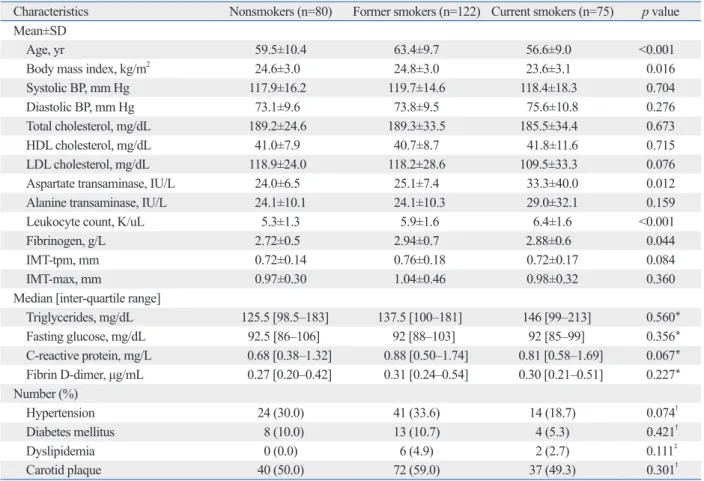
The mean age of study participants (n=277) was 60.4 years, and the mean fibrinogen level was 2.9 g/L. Compared with current smokers and nonsmokers, former smokers were older and had higher fibrinogen levels (Table 1). However, there was no significant difference in blood pressure, cholesterol, defined as the upper 25% of IMT-tpm measurements. Carot-
id artery plaque was defined as an IMT-max>1.0 mm or an area of focal wall thickening that was 100% or greater than the IMT of neighboring sites.21,22
Statistical analysis
Clinical characteristics were compared according to smoking status. Differences were assessed with analysis of variance, the Kruskal-Wallis test, or the chi-square test. Fisher’s exact test was applied if there were less than five observations per cell. Linear regression analysis was performed to assess the relationship between fibrinogen and continuous IMT values.
Logistic regression analysis was performed to estimate the odds ratio for atherosclerosis (higher IMT or presence of ca- rotid plaque) per one standard deviation (SD) increase in fi- brinogen level. All regression analyses were performed be- fore and after adjusting for age, body mass index, systolic blood pressure, fasting glucose, and ratio of total cholesterol to HDL cholesterol. The ratio of total to HDL cholesterol
Table 1. Characteristics of the Participants According to Smoking Status
Characteristics Nonsmokers (n=80) Former smokers (n=122) Current smokers (n=75) p value Mean±SD
Age, yr 59.5±10.4 63.4±9.7 56.6±9.0 <0.001
Body mass index, kg/m2 24.6±3.0 24.8±3.0 23.6±3.1 0.016
Systolic BP, mm Hg 117.9±16.2 119.7±14.6 118.4±18.3 0.704
Diastolic BP, mm Hg 73.1±9.6 73.8±9.5 75.6±10.8 0.276
Total cholesterol, mg/dL 189.2±24.6 189.3±33.5 185.5±34.4 0.673
HDL cholesterol, mg/dL 41.0±7.9 40.7±8.7 41.8±11.6 0.715
LDL cholesterol, mg/dL 118.9±24.0 118.2±28.6 109.5±33.3 0.076
Aspartate transaminase, IU/L 24.0±6.5 25.1±7.4 33.3±40.0 0.012
Alanine transaminase, IU/L 24.1±10.1 24.1±10.3 29.0±32.1 0.159
Leukocyte count, K/uL 5.3±1.3 5.9±1.6 6.4±1.6 <0.001
Fibrinogen, g/L 2.72±0.5 2.94±0.7 2.88±0.6 0.044
IMT-tpm, mm 0.72±0.14 0.76±0.18 0.72±0.17 0.084
IMT-max, mm 0.97±0.30 1.04±0.46 0.98±0.32 0.360
Median [inter-quartile range]
Triglycerides, mg/dL 125.5 [98.5‒183] 137.5 [100‒181] 146 [99‒213] 0.560*
Fasting glucose, mg/dL 92.5 [86‒106] 92 [88‒103] 92 [85‒99] 0.356*
C-reactive protein, mg/L 0.68 [0.38‒1.32] 0.88 [0.50‒1.74] 0.81 [0.58‒1.69] 0.067*
Fibrin D-dimer, μg/mL 0.27 [0.20‒0.42] 0.31 [0.24‒0.54] 0.30 [0.21‒0.51] 0.227*
Number (%)
Hypertension 24 (30.0) 41 (33.6) 14 (18.7) 0.074†
Diabetes mellitus 8 (10.0) 13 (10.7) 4 (5.3) 0.421†
Dyslipidemia 0 (0.0) 6 (4.9) 2 (2.7) 0.111‡
Carotid plaque 40 (50.0) 72 (59.0) 37 (49.3) 0.301†
SD, standard deviation; BP, blood pressure; HDL, high-density lipoprotein; LDL, low-density lipoprotein; IMT, intima-media thickness; IMT-tpm, mean value of IMT at three points; IMT-max, maximum IMT value.
*Kruskal-Wallis test.
†Chi-square test.
‡Fisher’s exact test.
Similarly to the findings for IMT-tpm, fibrinogen levels showed a positive association with IMT-max in current smok- ers (p=0.012), but not in former smokers or nonsmokers.
Table 2 shows the relationship between fibrinogen level and continuous measures of IMT, before and after adjusting for age, body mass index, blood pressure, fasting glucose, and total to HDL cholesterol ratio. In nonsmokers and for- mer smokers, fibrinogen level was not linearly associated with IMT-tpm or IMT-max. This null finding was consistent before and adjustment for potential confounders. However, in current smokers, fibrinogen level was positively associated with IMT-tpm (p=0.029) and IMT-max (p=0.012). Even af- ter adjustment for potential confounders, fibrinogen level fasting glucose, or C-reactive protein levels according to smok-
ing status. Former smokers had higher IMT-tpm levels than nonsmokers and current smokers, although the difference was of borderline statistical significance (p=0.084). There were no significant differences in IMT-max or the presence of carotid plaque between nonsmokers, former smokers, and current smokers.
Fig. 1 displays the relationship between fibrinogen level and IMT-tpm according to smoking status. In contrast with nonsmokers and former smokers, as fibrinogen levels in- creased, a significant increase in IMT-tpm was noted in current smokers (p=0.029). Fig. 2 depicts the relationship between fi- brinogen levels and IMT-max according to the smoking status.
IMT-max IMT-max IMT-max
Fib Fib Fib
3.0 4.5 2.50
4.0
3.0 1.75
2.5 3.5
2.25 2.00
2.0 1.50
1.25 1.00 0.75 0.50
1.5 2.02.5
1.0 1.5
0.5 1.0
0.5
1.501.752.002.252.502.753.003.253.503.754.004.25 1.5 2.0 2.5 3.0 3.5 4.0 4.5 5.0 5.5 6.0 6.5 1.752.002.252.502.753.003.253.503.754.004.25 4.50 4.75
A B C
Fig. 2. Relationship between fibrinogen and IMT-max according to smoking status. (A) Nonsmokers. IMT-max=0.9395+0.0115×fibrinogen, p=0.8594. (B) Former smokers. IMT-max=0.9893+0.0183×fibrinogen, p=0.7532. (C) Current smokers. IMT-max=0.5245+0.1596×fibrinogen, p=0.0119. IMT, intima-media thick- ness; IMT-max, maximum IMT value.
Table 2. Association between Fibrinogen Level and Continuous Measure of IMT According to Smoking Status
Smoking status IMT-tpm IMT-max
Standardized β R2 p value Standardized β R2 p value
Unadjusted
Nonsmokers (n=80) 0.017 0.0003 0.880 0.020 0.0004 0.859
Former smokers (n=122) 0.084 0.007 0.359 0.029 0.001 0.753
Current smokers (n=75) 0.252 0.064 0.029 0.289 0.084 0.012
Adjusted*
Nonsmokers (n=80) -0.043 0.208 0.692 -0.006 0.196 0.955
Former smokers (n=122) -0.044 0.285 0.605 -0.074 0.168 0.421
Current smokers (n=75) 0.207 0.394 0.038 0.245 0.325 0.021
IMT, intima-media thickness; IMT-tpm, mean value of IMT at three points; IMT-max, maximum IMT value.
*Adjusted for age, body mass index, blood pressure, fasting glucose, total cholesterol/high-density lipoprotein cholesterol ratio.
IMT-tpm mean IMT-tpm mean IMT-tpm mean
Fib Fib Fib
1.4 1.8 1.6
1.3 1.6
1.1 1.2 1.2
1.2 1.4 1.4
1.0 1.0
0.8 0.8 0.8
0.9 1.0
0.6 0.6 0.6
0.7
0.5 0.4 0.4
1.50 2.00 2.50 3.003.253.503.754.004.25 1.5 2.0 2.5 3.0 3.5 4.0 4.5 5.0 5.5 6.0 6.5 1.752.002.252.502.753.003.253.503.754.004.25 4.50 4.75
A B C
Fig. 1. Relationship between fibrinogen and IMT-tpm according to smoking status. (A) Nonsmokers. IMT-tpm=0.7056+0.0046×fibrinogen, p=0.8802. (B) Former smokers. IMT-tpm=0.7023+0.021×fibrinogen, p=0.3592. (C) Current smokers. IMT-tpm=0.5077+0.0734×fibrinogen, p=0.0291. IMT, intima-media thick- ness; IMT-tpm, mean value of IMT at three points.
1.75 2.25 2.75
rosis can be explained in several ways: first, oxidative stress from cigarette smoking can modulate the function of fibrin- ogen and fibrin architecture. Previous studies have suggest- ed that smoking can contribute to increasing clot strength related to the kinetics of clot formation and the rapidity of fi- brin build up. After exposure to cigarette smoke, fibrin clots exhibit thinner fibrin fibers, increased fibrin fiber density, and more uniform fiber distribution, compared with pre- smoking and non-smoking samples.28 These alterations in fi- brin architecture may contribute to premature coronary ath- erothrombosis.29 A fibrin clot with a high fiber density would cause delayed clot lysis and thrombotic disease.30 Second, smoking can affect fibrinolysis via alteration of plasmino- gen activator inhibitor type 1 (PAI-1).31 Smokers have high- er levels of PAI-1 than nonsmokers.32 PAI-1 inhibits the fibri- nolytic pathway by binding both urinary-type plasminogen activator and tissue plasminogen activator, which are activa- tors of plasminogen for fibrin clot lysis. It has been suggest- ed that high plasma PAI-1 level in smokers can contribute to the formation of thrombi.33 In this context, alteration of PAI-1 levels due to smoking may be related to carotid ath- erosclerosis. Finally, serum fibrinogen levels might be an in- dicator of chronic exposure to cigarette smoke and/or indi- vidual susceptibility to cigarette smoke. Studies have shown that cigarette smoking can increase the fibrinogen levels and arterial wall thickness.11,12,34
Interestingly, in the present study, although fibrinogen lev- els were significantly higher in former smokers than in cur- rent or nonsmokers, there was no significant association be- tween fibrinogen and IMT among former smokers. The higher fibrinogen concentrations of former smokers were largely explained by age distribution. It is known that ageing is positively associated with fibrinogen level and other pro- was significantly associated with both IMT-tpm (p=0.038)
and IMT-max (p=0.021). In current smokers, fibrinogen level explained the variations in IMT-tpm and IMT-max by approximately 6% and 8%, respectively.
Table 3 lists the odds ratios for carotid atherosclerosis (de- fined as higher IMT or presence of carotid plaque) for one SD increase in fibrinogen level for nonsmokers, former smokers, and current smokers. Fibrinogen level was signifi- cantly associated with the presence of carotid atherosclerosis only in current smokers. This result was consistent before and after adjustment for potential confounders.
DISCUSSION
In this community-based study, the association between fi- brinogen level and atherosclerosis differed according to smoking status. Among current smokers, there was a signifi- cant positive association between fibrinogen level and carotid IMT, even after adjusting for potential confounders. This as- sociation was not present for nonsmokers or former smokers.
Some studies have suggested a positive association between fibrinogen and atherosclerosis.3-5 However, this positive asso- ciation has been inconsistently demonstrated.8-10 Our results suggest that cigarette smoking might be an effect modifier on the association between fibrinogen and atherosclerosis. This effect modification by cigarette smoking may at least partial- ly explain the inconsistent reports of an association between fibrinogen and atherosclerosis.
Studies have proposed that an association between fibrin- ogen and atherosclerotic cardiovascular disease might be af- fected, at least in part, by smoking.26,27 The effect of smoking on the relationship between fibrinogen level and atheroscle-
Table 3. Association between Fibrinogen Level and Categorical Measure of IMT According to Smoking Status Smoking status
Higher IMT, upper quartile Presence of plaque No. of
cases Odds ratio (95% CI) for one
SD increase in fibrinogen No. of
cases Odds ratio (95% CI) for one SD increase in fibrinogen Unadjusted
Nonsmokers (n=80) 13 1.07 (0.59 to 1.93) 40 1.24 (0.79 to 1.93)
Former smokers (n=122) 38 1.18 (0.81 to 1.72) 72 0.995 (0.69 to 1.43)
Current smokers (n=75) 19 2.01 (1.14 to 3.55) 37 2.00 (1.17 to 3.40)
Adjusted*
Nonsmokers (n=80) 13 0.86 (0.42 to 1.79) 40 1.06 (0.60 to 1.87)
Former smokers (n=122) 38 0.93 (0.58 to 1.50) 72 0.68 (0.43 to 1.10)
Current smokers (n=75) 19 3.59 (1.41 to 9.12) 37 2.06 (1.09 to 3.89)
IMT, intima-media thickness; CI, confidence interval.
*Adjusted for age, body mass index, blood pressure, fasting glucose, total cholesterol/high-density lipoprotein cholesterol ratio.
ing may modify the association between fibrinogen and ca- rotid atherosclerosis. The study findings were consistent for continuous and categorical measures of atherosclerosis, and after adjustment for the potential confounding effects of age, obesity, blood pressure, fasting glucose, and cholester- ol. Further studies of different populations are required to confirm the noted interactions between cigarette smoking, fibrinogen level, and atherosclerosis.
ACKNOWLEDGEMENTS
This work was supported by the Global Research Network (GRN) Program, National Research Foundation of Korea (NRF), Ministry of Education, Science and Technology (Grant No. 220-2009-1-E00023) and by a grant of the Kore- an Health Technology R&D Project, Ministry of Health &
Welfare, Republic of Korea (Grant No. HI13C0715).
REFERENCES
1. Fibrinogen Studies Collaboration, Danesh J, Lewington S, Thomp- son SG, Lowe GD, Collins R, et al. Plasma fibrinogen level and the risk of major cardiovascular diseases and nonvascular mortali- ty: an individual participant meta-analysis. JAMA 2005;294:1799- 2. de Moerloose P, Boehlen F, Neerman-Arbez M. Fibrinogen and 809.
the risk of thrombosis. Semin Thromb Hemost 2010;36:7-17.
3. Green D, Foiles N, Chan C, Schreiner PJ, Liu K. Elevated fibrino- gen levels and subsequent subclinical atherosclerosis: the CAR- DIA Study. Atherosclerosis 2009;202:623-31.
4. Páramo JA, Beloqui O, Roncal C, Benito A, Orbe J. Validation of plasma fibrinogen as a marker of carotid atherosclerosis in subjects free of clinical cardiovascular disease. Haematologica 2004;89:
1226-31.
5. Grebe MT, Luu B, Sedding D, Heidt MC, Kemkes-Matthes B, Schaefer CA, et al. Fibrinogen promotes early atherosclerotic changes of the carotid artery in young, healthy adults. J Atheroscler Thromb 2010;17:1003-8.
6. Green D, Chan C, Kang J, Liu K, Schreiner P, Jenny NS, et al.
Longitudinal assessment of fibrinogen in relation to subclinical cardiovascular disease: the CARDIA study. J Thromb Haemost 2010;8:489-95.
7. Lorenz MW, Markus HS, Bots ML, Rosvall M, Sitzer M. Predic- tion of clinical cardiovascular events with carotid intima-media thickness: a systematic review and meta-analysis. Circulation 2007;
115:459-67.
8. Hayashi S. Significance of plasma D-dimer in relation to the se- verity of atherosclerosis among patients evaluated by non-invasive indices of cardio-ankle vascular index and carotid intima-media thickness. Int J Hematol 2010;92:76-82.
9. Sekikawa A, Ueshima H, Kadowaki T, El-Saed A, Okamura T, Takamiya T, et al. Less subclinical atherosclerosis in Japanese
inflammatory biomarkers.35 In our dataset, former smokers were older than current smokers or nonsmokers, and fibrino- gen levels were not statistically different according to smok- ing status after adjusting for age. Not only current smoking but also past smoking can interact with fibrinogen and con- tribute to the development of carotid atherosclerosis, because atherosclerosis is a chronic progressive condition. However, we could not observe an association between fibrinogen and atherosclerosis among former smokers. The former smok- ers in our study were not entirely homogeneous, as some of them might have smoked cigarettes for a long period and only recently quit, while others may not have smoked for a long time. It has been reported that cardiovascular risk gradually decreases after smoking cessation and that fibrinogen and other metabolic risk profiles among quitters differ by the length of non-smoking period.36-38 Notwithstanding, we were unable to further classify former smokers according to smok- ing and non-smoking periods. Since the association between fibrinogen and carotid atherosclerosis was heterogeneous be- tween former smokers and current smokers, we analyzed former smokers and current smokers separately rather than pooling the two smoker groups. However, as a further anal- ysis, we developed multiple logistic regression models to as- sess the effects of fibrinogen on the risk of higher IMT and presence of plaque in the pooled smokers. The associations between fibrinogen and carotid atherosclerosis in the pooled smokers were much weaker than in those among current smokers: the adjusted odds ratio per 1 SD increase in fibrin- ogen was 1.42 (95% confidence interval, 0.98 to 2.07) for higher IMT and 1.19 (95% confidence interval, 0.85 to 1.68) for carotid plaque.
Our study has several limitations that warrant consider- ation. First, we could not observe time dependent changes in fibrinogen level or carotid IMT because of the cross-sectional study design. Thus, we could not evaluate causal relation- ships between cigarette smoking, fibrinogen level, and devel- opment of atherosclerosis. Second, we could not rule out the possibility that our findings were due to chance, partly be- cause the number of current smokers was relatively small.
Third, we could not assess the effects of smoking cessation and non-smoking period on the association between fibrino- gen and atherosclerosis due to the small sample size. Further studies are required to address this issue. Finally, our results cannot be applied to other populations because the analysis was limited to a male population of a single rural community in Korea.
In conclusion, our findings suggest that cigarette smok-
2007;40:411-7.
25. Kim HC, Kim DJ, Huh KB. Association between nonalcoholic fatty liver disease and carotid intima-media thickness according to the presence of metabolic syndrome. Atherosclerosis 2009;204:
521-5.
26. Fowkes FG, Lee AJ, Lowe GD, Riemersma RA, Housley E. Inter- relationships of plasma fibrinogen, low-density lipoprotein choles- terol, cigarette smoking and the prevalence of cardiovascular dis- ease. J Cardiovasc Risk 1996;3:307-11.
27. Tuut M, Hense HW. Smoking, other risk factors and fibrinogen levels. evidence of effect modification. Ann Epidemiol 2001;11:
232-8.
28. Barua RS, Sy F, Srikanth S, Huang G, Javed U, Buhari C, et al. Ef- fects of cigarette smoke exposure on clot dynamics and fibrin struc- ture: an ex vivo investigation. Arterioscler Thromb Vasc Biol 2010;
30:75-9.
29. Collet JP, Allali Y, Lesty C, Tanguy ML, Silvain J, Ankri A, et al.
Altered fibrin architecture is associated with hypofibrinolysis and premature coronary atherothrombosis. Arterioscler Thromb Vasc Biol 2006;26:2567-73.
30. Lord ST. Molecular mechanisms affecting fibrin structure and sta- bility. Arterioscler Thromb Vasc Biol 2011;31:494-9.
31. Yanbaeva DG, Dentener MA, Creutzberg EC, Wesseling G, Wout- ers EF. Systemic effects of smoking. Chest 2007;131:1557-66.
32. Yarnell JW, Sweetnam PM, Rumley A, Lowe GD. Lifestyle and hemostatic risk factors for ischemic heart disease: the Caerphilly Study. Arterioscler Thromb Vasc Biol 2000;20:271-9.
33. Kohler HP, Grant PJ. Plasminogen-activator inhibitor type 1 and coronary artery disease. N Engl J Med 2000;342:1792-801.
34. Howard G, Burke GL, Szklo M, Tell GS, Eckfeldt J, Evans G, et al. Active and passive smoking are associated with increased carot- id wall thickness. The Atherosclerosis Risk in Communities Study.
Arch Intern Med 1994;154:1277-82.
35. Ferrucci L, Corsi A, Lauretani F, Bandinelli S, Bartali B, Taub DD, et al. The origins of age-related proinflammatory state. Blood 2005;
105:2294-9.
36. Kramer A, Jansen AC, van Aalst-Cohen ES, Tanck MW, Kastelein JJ, Zwinderman AH. Relative risk for cardiovascular atheroscle- rotic events after smoking cessation: 6-9 years excess risk in indi- viduals with familial hypercholesterolemia. BMC Public Health 2006;6:262.
37. Dobson AJ, Alexander HM, Heller RF, Lloyd DM. How soon af- ter quitting smoking does risk of heart attack decline? J Clin Epi- demiol 1991;44:1247-53.
38. Hur NW, Kim HC, Nam CM, Jee SH, Lee HC, Suh I. Smoking cessation and risk of type 2 diabetes mellitus: Korea Medical In- surance Corporation Study. Eur J Cardiovasc Prev Rehabil 2007;
14:244-9.
men in Japan than in White men in the United States in the post- World War II birth cohort. Am J Epidemiol 2007;165:617-24.
10. Choi H, Cho DH, Shin HH, Park JB. Association of high sensitiv- ity C-reactive protein with coronary heart disease prediction, but not with carotid atherosclerosis, in patients with hypertension.
Circ J 2004;68:297-303.
11. Kannel WB, D’Agostino RB, Belanger AJ. Fibrinogen, cigarette smoking, and risk of cardiovascular disease: insights from the Framingham Study. Am Heart J 1987;113:1006-10.
12. Meade TW, Imeson J, Stirling Y. Effects of changes in smoking and other characteristics on clotting factors and the risk of isch- aemic heart disease. Lancet 1987;2:986-8.
13. Bazzano LA, He J, Muntner P, Vupputuri S, Whelton PK. Rela- tionship between cigarette smoking and novel risk factors for car- diovascular disease in the United States. Ann Intern Med 2003;138:
891-7.
14. Leone A. Smoking, haemostatic factors, and cardiovascular risk.
Curr Pharm Des 2007;13:1661-7.
15. Unverdorben M, von Holt K, Winkelmann BR. Smoking and ath- erosclerotic cardiovascular disease: part II: role of cigarette smok- ing in cardiovascular disease development. Biomark Med 2009;3:
617-53.
16. Borissoff JI, Spronk HM, ten Cate H. The hemostatic system as a modulator of atherosclerosis. N Engl J Med 2011;364:1746-60.
17. Ernst E. Fibrinogen as a cardiovascular risk factor--interrelationship with infections and inflammation. Eur Heart J 1993;14 Suppl K:82-7.
18. Woodward M, Lowe GD, Rumley A, Tunstall-Pedoe H. Fibrino- gen as a risk factor for coronary heart disease and mortality in mid- dle-aged men and women. The Scottish Heart Health Study. Eur Heart J 1998;19:55-62.
19. Kannel WB. Overview of hemostatic factors involved in athero- sclerotic cardiovascular disease. Lipids 2005;40:1215-20.
20. Friedewald WT, Levy RI, Fredrickson DS. Estimation of the con- centration of low-density lipoprotein cholesterol in plasma, with- out use of the preparative ultracentrifuge. Clin Chem 1972;18:
499-502.
21. Yanase T, Nasu S, Mukuta Y, Shimizu Y, Nishihara T, Okabe T, et al. Evaluation of a new carotid intima-media thickness measure- ment by B-mode ultrasonography using an innovative measurement software, intimascope. Am J Hypertens 2006;19:1206-12.
22. Lemne C, Jogestrand T, de Faire U. Carotid intima-media thick- ness and plaque in borderline hypertension. Stroke 1995;26:34-9.
23. Castelli WP, Abbott RD, McNamara PM. Summary estimates of cholesterol used to predict coronary heart disease. Circulation 1983;
67:730-4.
24. Chang HS, Kim HC, Ahn SV, Hur NW, Suh I. Impact of multiple cardiovascular risk factors on the carotid intima-media thickness in young adults: the Kangwha Study. J Prev Med Public Health