Vol.20, No.4, (2018), pp.60~64 https://doi.org/10.9714/psac.2018.20.4.060
```
1. INTRODUCTION
The application of wind energy and especially offshore wind energy is a keystone in the policy of several countries for large-scale use of renewable energy. The realization and the grid connection of offshore wind farms are receiving much attention [1].
As high temperature superconducting (HTS) power cables have some merits over conventional cables, several demonstration projects on the HTS cable system are presently under way around the world [2]. All HTS cables have a much higher power density than copper-based cables at similar voltage levels. Moreover, because they are actively cooled and thermally independent of the surrounding environment, they can fit into much more compact installations than conventional copper cables. In addition, HTS cables exhibit much lower resistive losses than conventional copper or aluminum conductors [3].
We analyzed and compared the economic feasibility of the offshore wind farm using the HTS power cable and the AC power cable. The HTS power cable used the 22.9 kV superconducting cable of LS cable&system. The economics of cable were analyzed by calculating capital expenditure (CAPEX) and operating expense (OPEX).
This paper compares three cases: 1) 22.9 kV AC power inter-array and export cables of the offshore wind farm 2) 22.9 kV AC power inter-array cables of the offshore wind
farm and 22.9 kV HTS power 22.9 kV AC power inter-array cables of the offshore wind farm and 22.9 kV HTS power export cable of the offshore wind farm to the coast and 3) 22.9 kV AC power inter-array cables of the offshore wind farm and 70 kV AC power export cable of the offshore wind farm to the coast.
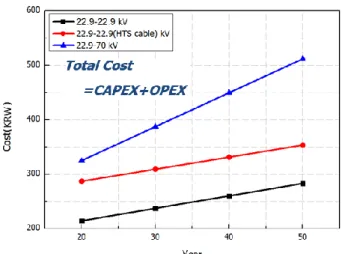
For all the case studies, the case 2 is more expensive than the case 1, because of higher HTS power cable cost and cheaper than the case 3. These results can be used to economic analysis of the HTS power cable for the offshore wind farm.
2. CONFIGURATIONS OF THE OFFSHORE WIND FARM
2.1. Cable Model of the Offshore Wind Farm
The offshore wind farm submarine cable can be divided into two types of inter-array cables and export transmission cables as shown in Fig. 1.
Fig. 1. Configuration of the offshore wind farm.
Economic analysis of a 22.9 kV HTS power cable and conventional AC power cable for an offshore wind farm connections
Ga-Eun Jung, Minh-Chau Dinh, Hae-Jin Sung, Minwon Park
*, and In-Keun Yu Changwon National University, Changwon, Korea
(Received 30 November 2018; revised or reviewed 23 December 2018; accepted 24 December 2018)
Abstract
As the offshore wind farms increase, interest in the efficient power system configuration of submarine cables is increasing.
Currently, transmission system of the offshore wind farm uses almost AC system. High temperature superconducting (HTS) power cable of the high capacity has long been considered as an enabling technology for power transmission. The HTS cable is a feasible way to increase the transmission capacity of electric power and to provide a substantial reduction in transmission losses and a resultant effect of low CO2 emission. The HTS cable reduces its size and laying sectional area in comparison with a conventional XLPE or OF cable. This is an advantage to reduce its construction cost. In this paper, we discuss the economic feasibility of the 22.9 kV HTS power cable and the conventional AC power cables for an offshore wind farm connections. The 22.9 kV HTS power cable cost for the offshore wind farm connections was calculated based on the capital expenditure and operating expense. The economic feasibility of the HTS power cable and the AC power cables were compared for the offshore wind farm connections. In the case of the offshore wind farm with a capacity of 100 MW and a distance of 3 km to the coast, cost of the 22.9 kV HTS power cable for the offshore wind farm connections was higher than 22.9 kV AC power cable and lower than 70 kV AC power transmission cable.
Keywords: AC cable, economic analysis, offshore wind farm, superconducting cable
* Corresponding author: [email protected]
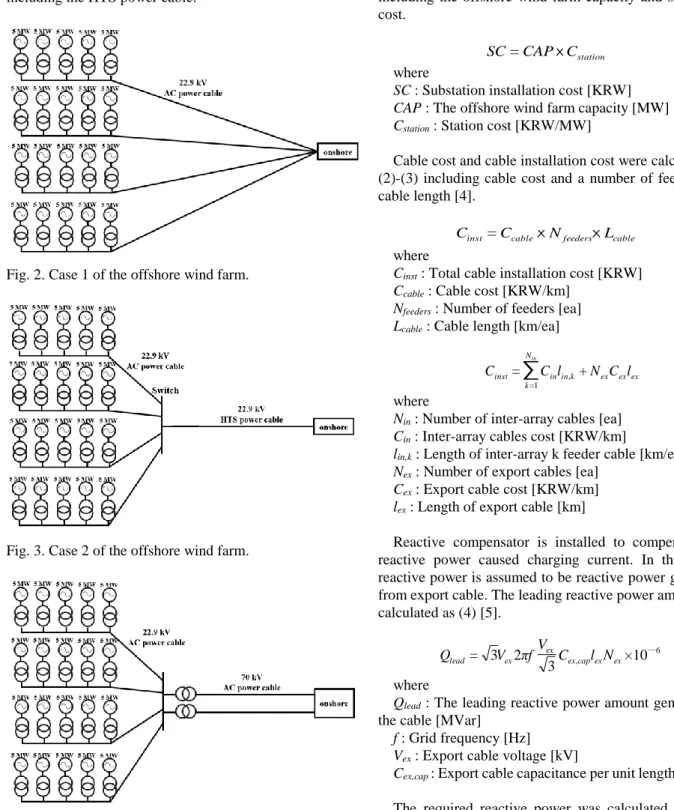
The offshore wind farm is connected to 20 wind turbines of 5 MW and the total capacity of the offshore wind farm is 100 MW. The export cable was selected as 3 km. The inter-array cables were fixed with the 22.9 kV AC power cable. Economic analysis was performed with three cases of export cable.
2.2. Three Cases of the Offshore Wind Farm
The export cable of case 1 is the 22.9 kV AC power cable and case 2 is the 22.9 kV HTS power cable and case 3 is the 70 kV AC power cable. Fig. 2-4 show three cases including the HTS power cable.
Fig. 2. Case 1 of the offshore wind farm.
Fig. 3. Case 2 of the offshore wind farm.
Fig. 4. Case 3 of the offshore wind farm.
3. COST MODELLING OF THE OFFSHORE WIND FARM
3.1. The CAPEX of the Offshore Wind Farm
The CAPEX is the money a company spends to buy, maintain, or improve its fixed assets. The CAPEX of the offshore wind farm covered substation installation cost, cable cost, cable installation cost and reactive compensator cost. The CAPEX of the offshore wind farm using HTS power cable is added cooling system installation cost.
Substation installation cost was calculated as (1) including the offshore wind farm capacity and substation cost.
station
C CAP
SC = ⅹ (1) where
SC : Substation installation cost [KRW]
CAP : The offshore wind farm capacity [MW]
C
station: Station cost [KRW/MW]
Cable cost and cable installation cost were calculated as (2)-(3) including cable cost and a number of feeders and cable length [4].
cable feeders cable
inst
C N L
C = ⅹ ⅹ (2)
where
C
inst: Total cable installation cost [KRW]
C
cable: Cable cost [KRW/km]
N
feeders: Number of feeders [ea]
L
cable: Cable length [km/ea]
∑
Nink
ex ex ex k in in
inst
C l N C l
C
1
=
,
+
= (3) where
N
in: Number of inter-array cables [ea]
C
in: Inter-array cables cost [KRW/km]
l
in,k: Length of inter-array k feeder cable [km/ea]
N
ex: Number of export cables [ea]
C
ex: Export cable cost [KRW/km]
l
ex: Length of export cable [km]
Reactive compensator is installed to compensate for reactive power caused charging current. In this paper, reactive power is assumed to be reactive power generated from export cable. The leading reactive power amount was calculated as (4) [5].
6
,
× 10
2 3 3
=
ex ex excapex ex ㅡlead
V C l N
π f V
Q (4)
where
Q
lead: The leading reactive power amount generated in the cable [MVar]
f : Grid frequency [Hz]
V
ex: Export cable voltage [kV]
C
ex,cap: Export cable capacitance per unit length [μF/km]
The required reactive power was calculated as (5), a
reactor is installed at both ends of the cable, and half of the
required reactive power is divided between reactor and STATCOM. The installation cost of the reactive power compensator is calculated as (6) [5].
θ P
Q
req=
OW Ptan (5)
) 2 +
( +
=
reactor lead reactor STATCOM req exQ
N Q C
C Q C
C (6)
where
Q
req: The required reactive power [Mvar]
P
OWP: Capacity of the offshore wind farm [MW]
θ : Power factor angle at 0.95 power factor [deg]
C
Q: Total installation cost of reactive power compensator [KRW]
C
STATCOM: STATCOM installation cost [KRW/MVar]
C
reactor: Reactor installation cost [KRW/MVar]
The cooling system installation cost was calculated to economic analysis of the HTS power cable for the offshore wind farm (7).
cryo inst cryo
inst
C C N
Ct = ( + ) × (7) where
Ct
inst: The total cooling system installation cost [KRW]
C
cryo: The cryocooler cost [KRW/ea]
C
inst: Cooling system installation cost [KRW/ea]
N
cryo: The number of cryocoolers [ea]
3.2. The OPEX of the offshore Wind Farm
The OPEX is an ongoing cost for running a product, business, or system. The OPEX of the offshore wind farm covered substation loss cost, cable loss cost, operation and maintenance (O&M) cost. The OPEX of the offshore wind farm using HTS power cable is added cooling system loss cost and cooling system O&M cost with excepted cable loss cost.
Substation loss cost was calculated as (8) including active power, loss factor, transmission time and electricity price. The loss factor was selected as 0.8% and transmission time was selected as 6000 hours [6].
E loss
sub
P lf Tt C
C
,= × × × (8) where
C
sub,loss: Substation loss cost [KRW]
P : Active power [MW]
lf : loss factor
Tt : transmission time [hrs]
C
E: Energy generation cost per kWh [KRW/kWh]
Cable loss cost was calculated as (9)-(12) including power loss equation [4].
∑
Nink
k in in in
k avg E
loss
in
R l
pf V C P
C
1
=
, , 2
5
,
)
( 3 3
× 10
× 8760
×
=
ㅡ(9)
ex ex ex ex
ex AVG E
loss
ex
R l N
pf V
N C P
C
, 5)
23 ( / 3
× 10
× 8760
×
=
ㅡ(10)
k Feeder k
avg
CF P
P
,= ×
,(11)
OW P
AVG
CF P
P = × (12) where
C
in,loss: Inter-array cable annual loss cost [KRW]
C
ex,loss: Export cable annual loss cost [KRW]
P
avg,k: Average power of k feeder [MW]
P
AVG: Average power of the offshore wind farm [MW]
V
in: Voltage level of inter-array cable [kV]
V
ex: Voltage level of export cable [kV]
pf : Power factor
R
in: Resistance per length of inter-array cable [Ω/km]
R
ex: Resistance per length of export cable [Ω/km]
CF : Capacity factor [%]
P
Feeder,k: Total capacity of k feeder wind turbines [MW]
O&M cost was calculated as (13) including annual fault rate [4].
∑
Nink
ex ex ex k in in repair t
m
C λ l λ l N
C
1
= ,
.
= ( + ) (13) where
C
m.t: O&M cost of the inter-array and export cable cost [KRW]
λ
in: Annual fault rate of the inter-array cable [times/year·km]
λ
ex: Annual fault rate of the export cable [times/year·km]
C
repair: Repair cost of cable at one time [KRW/times]
The cooling system loss cost was defined 20% of the submarine cable loss cost to economic analysis of the HTS power cable for the offshore wind farm.
The O&M cost of the cooling system for the offshore wind farm was calculated as (14).
cooling inst, cooling
OM
1% C
C
,= × (14) where
C
OM,cooling: O&M cost of the cooling system [KRW]
C
inst,cooling: The cooling system installation cost [KRW]
3.3. Parameters of the 22.9 kV HTS Power Cable
The HTS power cable used 22.9 kV LS cable&system data as shown in table I. The capacity of 22.9 kV HTS power cable is 120 MVA. Therefore, a 100MW offshore wind farm can be transmitted with one superconducting cable. 70kV AC cable can transmit with two cables because 70kV AC cable capacity is smaller than 100 MW.
TABLE
I22.9
KV HTS P
OWERC
ABLE OFLS C
ABLE& S
YSTEM.
Parameters Value Unit
Cable capacity 120 MVA
Short circuit capability 40 kA /0.5s Cross section of stabilizer 260 mm
2Cross section of the HTS conductor 34 mm
2Insulation thickness 4.6 mm
Cross section of the HTS shield 27.7 mm
2Cable resistance 0.0049 μΩ/km
Cable capacitance 0.26 mF/km
The cable terminations install at both ends of the cable to install the HTS power cable. Superconducting cables can not exceed 1 km in current technology. Therefore, connecting a superconducting cable using a joint box is necessary to create a long transmission line. The HTS power cable installation cost parameters including the cable terminations and the joint boxes are shown in table II.
3.4. Parameters of the AC Power Cable and Offshore Wind Farm
The AC power cable and offshore wind farm parameters are shown in table III-V. Reference of the energy generation unit price is KEPCO industry power cost.
TABLE
IIT
HEH
TSP
OWERC
ABLEI
NSTALLATIONC
OST.
Parameters Value Unit
HTS power cable price 4,090,000,000 KRW/km
Superconducting wire price20,000 KRW/m
Required superconducting wires600,000,000 KRW/km
Number of cables