Veterinary Science
http://dx.doi.org/10.4142/jvs.2014.15.3.443
Received: 30 Dec. 2013, Revised: 12 Mar. 2014, Accepted: 13 Mar. 2014
Short Communication
*Corresponding author: Tel: +82-62-530-2850; Fax: +82-62-530-2857; E-mail: [email protected]
†The first two authors equally contributed to this work.
‡Present address: Center for Pulmonary and Infectious Disease Control, University of Texas Health Science Center at Tyler, Tyler, TX 75708-3154, USA
ⓒ 2014 The Korean Society of Veterinary Science.
This is an Open Access article distributed under the terms of the Creative Commons Attribution Non-Commercial License (http://creativecommons.org/licenses/by-nc/3.0) which permits
unrestricted non-commercial use, distribution, and reproduction in any medium, provided the original work is properly cited.
Dietary germanium biotite supplementation enhances the induction of antibody responses to foot-and-mouth disease virus vaccine in pigs
Jin-A Lee
1,†, Bock-Gie Jung
1,†,‡, Myunghwan Jung
2, Tae-Hoon Kim
1, Han Sang Yoo
2, Bong-Joo Lee
1,*
1
Department of Veterinary Infectious Disease, College of Veterinary Medicine, Chonnam National University, Gwangju 500-757, Korea
2
Department of Infectious Diseases, College of Veterinary Medicine, Seoul National University, Seoul 151-742, Korea
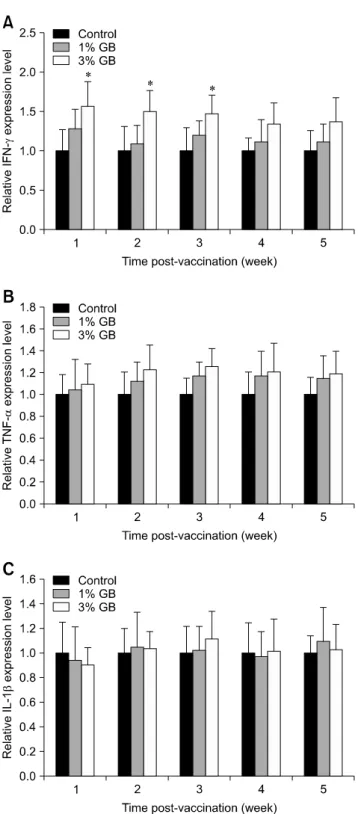
We evaluated the potential ability of germanium biotite (GB) to stimulate the production of antibodies specific for foot-and-mouth disease virus (FMDV). To this aim, we measured the total FMDV-specific antibody responses and IgM production after vaccination against FMD both experimentally and in the field. GB supplementation with FMDV vaccination stimulated the production of anti-FMDV antibodies, and effectively increased IFN-γ and TNF-α levels. These results suggest that GB may be a novel alternative feed supplement that can serve as a boosting agent and an immunostimulator for increasing the efficacy of FMDV vaccination in pigs.
Keywords: adjuvant-like effect, foot-and-mouth disease virus, germanium biotite
Foot-and-mouth disease (FMD) is an acute and highly contagious viral disorder of cloven-hoofed animals such as cattle, sheep, and pigs. FMD causes extensive financial loss, and has a devastating effect on national and international live animal populations as well as the animal product trade [1]. A severe outbreak of FMD in Korea occurred during 2010∼2011 [10]. Following this outbreak, emergency vaccination was carried out as a control measure and a routine vaccination program is still ongoing to further regulate FMD infection. Inactivated foot and mouth disease virus (FMDV) vaccine typically used in Korea contains intact FMDV delivered with incomplete oil-based adjuvants. This combination is effective for reducing disease incidence and has been successfully used for controlling FMD in Korea [10].
However, this vaccine has numerous disadvantages
including a poor cell-mediated immune (CMI) response and a short duration of immunity compared to that conferred by natural FMDV infection [5]. Hao et al. [6]
found that only 31.9% of the serum samples from 91 pigs vaccinated against FMDV had antibody titers required for protection against FMD infection. Therefore, a new approach for improving FMD vaccines that can generate a more robust and longer lasting immune response is needed.
Germanium biotite (GB) is an aluminosilicate mineral with numerous biological activities in animals. In particular, this compound has been found to improve host immune function. Our previous study showed that dietary supplementation with GB enhances the proliferative activity of lymphocytes and monocytes in pigs [3]. In addition, Jung et al. [8] demonstrated that continuous ingestion of GB promotes the expression of several cytokines such as interferon-gamma (IFN- γ), interleukin (IL)-4, and tumor necrosis factor-alpha (TNF- α). GB also increases the production of antibody against Pasteurella multocida in mice in a dose-dependent manner. Similarly, dietary supplementation with GB accelerates lymphocyte proliferation and CD8
+ T lymphocyte production induced by concanavalin A (Con A; a T cell mitogen) in mice [7].
Taken together, these findings suggest that humoral immune responses, particularly ones involving the production of anti-FMDV antibodies, could be stimulated by a feed supplementation with GB. However, little is known about the effect of GB on FMDV-specific antibody generation.
Therefore, the purpose of the present investigation was to
evaluate the impact of dietary GB administration on
humoral immune responses in swine specifically focusing
on the adjuvant-like effect of GB after FMD vaccination.