http://e-nrp.org
Analysis of food irradiation education for elementary, middle, and high school students for three years in South Korea
Yoonseok Choi, Jaerok Kim and Eunok Han
§Department of Education and Research, #307 Korea Academy of Nuclear Safety, 22 Teheran-ro 7-gil, Gangnam-gu, Seoul 06130, Korea
BACKGROUND/OBJECTIVES: The current South Korean government policy on food irradiation technology should be reformed based on an in-depth investigation of the communications aspect, because the issue is no longer of a technological nature, given the proven safety and efficacy of the processes.
SUBJECTS/METHODS: The target population of the education program consisted of elementary, middle, and high school students attending 310 schools in South Korea (2013: 63 schools, 2014: 104 schools, 2015: 143 schools). Data subjected to analysis were 13,327 pre-education and 12,641 post-education questionnaires received from 7,582 elementary, 2,671 middle, and 3,249 high school students who participated in the education program from May 2012 to April 2015 (n = 12,831), after the exclusion of inadequately filled-in questionnaires.
RESULTS: Analysis of the three-year educational effect trend was conducted by comparing levels of variables before and after food radiation education. The analysis yielded the finding that the post-education levels were significantly higher for all variables.
That is, for interest in education, perception (necessity, safety, subjective knowledge, and information acquisition), objective knowledge, and attitude, with the sole exception of objective knowledge in 2013.
CONCLUSIONS: Given that post-education levels of perception, knowledge, and attitude concerning irradiated foods increased considerably compared to pre-education levels, behavior change should be induced by providing continuous education to enhance, these primary variables.
Nutrition Research and Practice 2016;10(2):237-244; doi:10.4162/nrp.2016.10.2.237; pISSN 1976-1457 eISSN 2005-6168
Keywords: Irradiated food, radiation, trend analysis, perception
INTRODUCTION
*Food irradiation has been strongly recommended and asserted to be the most effective technology with the potential to replace chemical preservatives and fumigants. Its safety has been proved over the past decades by important international organizations, such as WHO, FAO, and WTO, and relevant international academic societies [1]. Irradiated foods are foods processed by exposing them to pre-determined doses of ionizing radiation depending on the purpose (germination inhibition, insecticide degradation, sterilization, or maturity control) [2,3]. Given the current situation of international trade, in which the food irradiation standards specified by the Codex Alimentarius Commission are not merely recommended, but mandatory for all foodstuffs traded in the OECD countries, there is a need for more aggressive promotional consumer education on the use of food irradiation technology in some countries, including South Korea [4,5].
However, despite the obvious advantages of food irradiation, this method has not yet found wide applications in the domestic
Korean food industry. One of the reasons is the uncertainty about its acceptability to consumers, which is ascribable to the tepidity of the government commitment to raising awareness and encouraging a positive perception of irradiated foods among consumers [5,6]. For lack of opportunity to become accurately informed about irradiated foods, consumers cannot make informed choices; coupled with concerns about health- related safety, this means that they face difficulties making food selection and purchase decisions [7-11]. One survey estimated the percentage of Korean consumers who are uninformed about food irradiation at 90% [12], which implies that the general public is largely not familiar with irradiated foods [13].
Furthermore, although food contamination caused by radioactive materials and food irradiation are based on two fundamentally different principles [14], irradiated foods are still perceived negatively among the public [15], influenced by negative media coverage on the occasion of the Fukushima nuclear power plant accident in Japan about radioactive pollution of marine products, radioactivity concentrations in the atmosphere, and the conse- quences for food security for future generations [16].
This work was supported by the Promotion of Radiation Safety Culture Project coordinated by the Nuclear Safety Research and Development of Nuclear Safety
& Security Commission in Korea.
§Corresponding Author: Eunok Han, Tel. 82-2-554-7336, Fax. 82-2-508-7941, Email. [email protected] Received: August 13, 2015, Revised: January 12, 2016, Accepted: January 12, 2016
This is an Open Access article distributed under the terms of the Creative Commons Attribution Non-Commercial License (http://creativecommons.org/licenses/by-nc/3.0/) which permits unrestricted non-commercial use, distribution, and reproduction in any medium, provided the original work is properly cited.
Education program design Administration Education
Education program setup (expert consultation)
⇨
Questionnaire development (expert consultation, preliminary survey)
⇨
1) Official announcement through Departments of Education of municipal and provincial governments 2) Registration of
participating schools and selection of program participants
⇨
1) Lecturer training 2) School visit
education ⇨
1st Class (theory, 45 min):
1) Orientation 2) Pre-education
questionnaire survey 3) Video clip
(Radioactivity in everyday life, 10 min) 4) Irradiated foodstuffs
(textbook)
⇨
2nd Class (practice, 45 min):
1) Formation of teams 2) Distribution of radio
scopes and practice sheets
3) Method briefing 4) Measurement of natural
radioactivity by team 5) Filling in the practice
sheet 6) Post-education
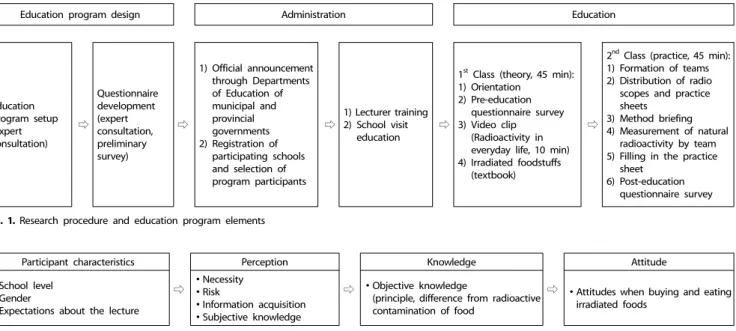
questionnaire survey Fig. 1. Research procedure and education program elements
Participant characteristics
⇨
Perception
⇨
Knowledge
⇨
Attitude
∙School level
∙Gender
∙Expectations about the lecture
∙Necessity
∙Risk
∙Information acquisition
∙Subjective knowledge
∙Objective knowledge
(principle, difference from radioactive contamination of food
∙Attitudes when buying and eating irradiated foods
Fig. 2. Composition of the questionnaire
These circumstances have made it irrational to blithely predict progress in industrial society, since human actions and reactions in relation to these issues are quite uncertain [17]. Tomas &
Durant [18] noted that enhancement of the scientific understan- ding of the public leads to consolidation of positive attitudes towards science and a supportive frame for leading in turn not only to the development of scientific research, growth of the national economy, and expansion of national power, but also contributing to social integrity and individual benefit via more rational, evidence-based - consumer behavior and decision- making. This also applies to the issue of food irradiation, because accurate perception of health risks related to irradiated food is a determinant factor for the future of food irradiation technology and related industries. Futurology is an academic discipline that predicts events in the near and far future, ranging from 50-100 years to 1,000 years or more [19]. The current South Korean government policy on food irradiation technology should be reformed based on an in-depth investigation of the communications aspect, because the issue is no longer of a technological nature, given the proven safety and efficacy of the processes. From the futurological perspective, if future generations of Koreans experience food supply problems due to a current lack of consumer education, it will be a loss at a national level. In this context, the present study was designed as part of a large-scale communication strategy for the enhancement of public understanding through the creation of a national consensus about irradiated foodstuffs. In order to provide basic data required to formulate such a strategy, elementary, middle, and high school students were selected as the research population in this study, in consideration of the high ripple effects expected in this population group. Analyzed were differences in perception, knowledge, and attitude regarding irradiated foods as a result of the implementation of an education program designed to enhance the understanding of food irradiation, between the baseline (pre-education) level and the post-education level.
SUBJECTS AND METHODS
Research procedureThe research was carried out in the following steps: Step 1) research and education program design, Step 2) official announ- cement of education program via the Departments of Education of each municipal or provincial government, Step 3) selection of final program participants from elementary, middle, and high school interested in participation, Step 4) pre-education survey, Step 5) implementation of the education program (theory and practice; 45 min each), and Step 6) post-education survey. The education program consists of theory and practice parts. The theory part included watching a video clip explaining the concepts of radiation application, including food irradiation (10 min), and heard a subsequent lecture on the topic (25 min).
In the practice part, the participants formed teams and measured natural radioactivity (Fig. 1). The educational content of the video and lecture included the history, principles, and current status of food irradiation.
Research tool
As a research tool, we used a questionnaire with items covering perceptions of, knowledge of, and attitude toward food irradiation; these are major variables influencing behavior in a traditional learning paradigm (Fig. 2). The category “perception”
was divided into subcategories covering necessity, safety,
information acquisition, and subjective knowledge of food
irradiation and irradiated foods; these variables are understood
to exert direct influence on human actions and reactions. The
category “objective knowledge” included items on the principles
of food irradiation and on the difference between irradiated
foods and foods contaminated by radioactivity. Finally, the
category “attitude” contained items on intention regarding
irradiated food purchase and consumption.
Category
2013 2014 2015
Pre-education
n (%) Post-education
n (%) Pre-education
n (%) Post-education
n (%) Pre-education
n (%) Post-education
n (%)
Grade
Elementary 2,029 (59.7) 1,827 (57.9) 2,107 (52.7) 2,057 (52.5) 3,328 (56.0) 3,102 (55.7)
Middle 430 (12.7) 419 (13.3) 777 (19.4) 793 (20.3) 1,421 (24.0) 1,332 (23.9)
High 940 (27.7) 911 (28.9) 1,114 (27.9) 1,064 (27.2) 1,181 (20.0) 1,136 (20.4)
Total 3,399 (100.0) 3,157 (100.0) 3,998 (100.0) 3,914 (100.0) 5,930 (100.0) 5,570 (100.0)
Gender
Male 1,785 (52.5) 1,652 (52.3) 2,147 (53.7) 2,072 (52.9) 2,902 (48.9) 2,665 (47.8)
Female 1,537 (45.2) 1,390 (44.0) 1,832 (45.8) 1,822 (46.5) 3,028 (51.1) 2,905 (52.2)
No response 77 (2.3) 115 (3.6) 19 (0.4) 20 (0.5) 0 (0.00) 0 (0.00)
NB: The periods covered by "2013," "2014," and "2015" are May 2012–April 2013, May 2013–April 2014, and May 2014–April 2015, respectively.
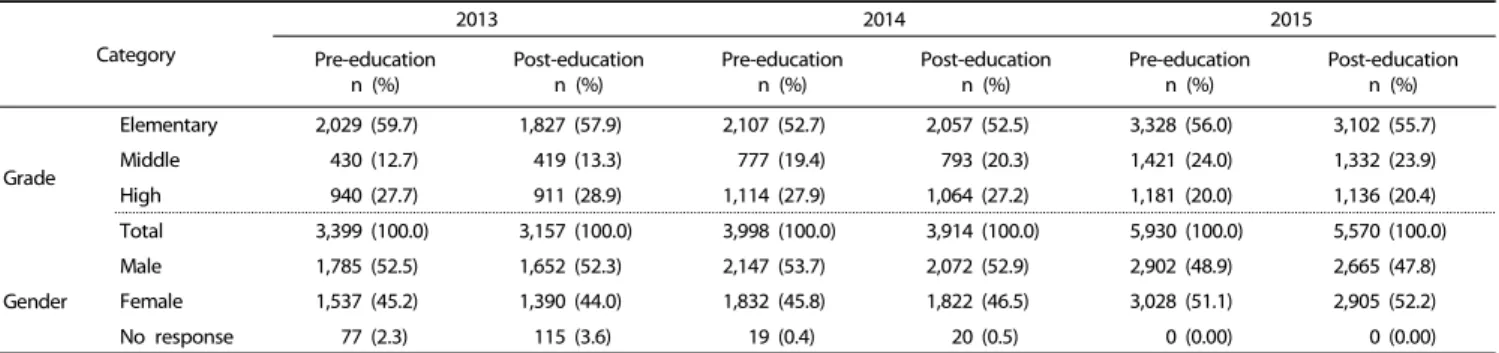
Table 1. Grade and gender of the participants in the education program for three years
Category
2013 2014 2015
Elementary Middle High Elementary Middle High Elementary Middle High
(Mean ± SD) t
(P-value)(Mean ± SD) t
(P-value)(Mean ± SD) t
(P-value)(Mean ± SD) t
(P-value)(Mean ± SD) t
(P-value)(Mean ± SD) t
(P-value)(Mean ± SD) t
(P-value)(Mean ± SD) t
(P-value)(Mean ± SD) t (P-value) Interest
in edu.
Pre 1.81 ± .39 .893 (0.372)
1.79 ± .41 -3.166 (0.002)
1.83 ± .38 -3.352 (<.001)
1.81 ± .39 -2.130 (0.033)
1.78 ± .42 -4.931 (<.001)
1.83 ± .38 -2.502 (0.012)
1.75 ± .43 -9.208 (<.001)
1.68 ± .47 -8.206 (<.001)
1.82 ± .39 -4.462 (<.001)
Post 1.82 ± .38 1.87 ± .34 1.88 ± .32 1.84 ± .37 1.87 ± .33 1.87 ± .34 1.85 ± .36 1.81 ± .39 1.89 ± .32
Perception
NecessityPre 3.73 ± 1.02 10.054
(<.001) 3.70 ± 1.03 5.285 (<.001)
3.75 ± .95 6.343
(<.001) 3.81 ± 1.05 11.356
(<.001) 3.58 ± 1.06 7.571
(<.001) 3.70 ± 1.01 5.579
(<.001) 3.90 ± 1.03 11.700
(<.001) 3.78 ± 1.02 6.851 (<.001)
3.74 ± .95 6.228 (<.001)
Post 4.05 ± .91 4.05 ± .90 4.01 ± .82 4.15 ± .87 3.96 ± .92 3.92 ± .85 4.17 ± .82 4.02 ± .87 3.96 ± .79
Safety Pre 3.34 ± .98 -10.108
(<.001) 2.96 ± .98 -10.112
(<.001) 2.85 ± .99 -14.689
(<.001) 3.31 ± 1.01 -14.726
(<.001) 2.85 ± 1.02 -12.259
(<.001) 2.83 ± .98 -12.904
(<.001) 3.30 ± 1.03 -17.997
(<.001) 2.96 ± 1.02 -13.783
(<.001) 2.78 ± .97 -15.151 (<.001)
Post 3.66 ± .94 3.61 ± .91 3.50 ± .91 3.75 ± .92 3.46 ± .96 3.35 ± .90 3.73 ± .89 3.47 ± .94 3.37 ± .91
Info. acq.Pre 2.27 ± 1.12 19.120
(<.001) 2.15 ± 1.02 14.513
(<.001) 2.31 ± 1.01 15.312
(<.001) 2.24 ± 1.15 23.819
(<.001) 2.24 ± 1.04 17.244
(<.001) 2.32 ± 1.01 17.192
(<.001) 2.17 ± 1.12 -32.225
(<.001) 2.19 ± 1.05 24.078
(<.001) 2.32 ± .98 21.256 (<.001)
Post 2.95 ± 1.10 3.11 ± .88 2.98 ± .84 3.04 ± 1.02 3.06 ± .84 3.00 ± .83 3.00 ± .96 3.08 ± .90 3.09 ± .75
Subj. kn.Pre 2.47 ± 1.01 20.299 (<.001)
2.45 ± .91 12.981 (<.001)
2.43 ± .84 18.842 (<.001)
2.49 ± 1.03 27.026 (<.001)
2.43 ± .91 17.854 (<.001)
2.40 ± .84 20.114 (<.001)
2.45 ± 1.01 -35.855 (<.001)
2.40 ± .93 23.906 (<.001)
2.42 ± .85 23.192 (<.001)
Post 3.15 ± 1.02 3.25 ± .87 3.15 ± .79 3.31 ± .95 3.22 ± .84 3.11 ± .82 3.31 ± .90 3.21 ± .86 3.20 ± .77
Obj. kn. Pre 23 ± 4.20 1.323 (0.186)
28 ± 4.50 -.389
(0.697) 27 ± 4.50 -1.301
(0.193) 25 ± 4.30 24.176
(<.001) 25 ± 4.40 11.663
(<.001) 27 ± 4.50 13.333
(<.001) 19 ± 3.90 30.576
(<.001) 22 ± 4.20 12.760
(<.001) 22 ± 4.20 13.825 (<.001)
Post 21 ± 4.10 29 ± 4.50 30 ± 4.60 59 ± 4.90 53 ± 5.00 54 ± 5.00 53 ± 5.00 44 ± 5.00 48 ± 5.00
Attitude Pre 3.20 ± 1.02 -15.217
(<.001) 2.95 ± 1.00 -9.935
(<.001) 2.84 ± .95 15.941
(<.001) 3.19 ± 1.11 -19.886
(<.001) 2.81 ± 1.06 -12.299
(<.001) 2.85 ± .99 -14.813
(<.001) 3.12 ± 1.11 26.832
(<.001) 2.86 ± 1.04 -15.914
(<.001) 2.81 ± .94 -14.529 (<.001)
Post 3.71 ± 1.44 3.63 ± .99 3.56 ± .98 3.84 ± 1.00 3.46 ± 1.05 3.47 ± .98 3.82 ± .98 3.49 ± 1.07 3.39 ± .96
NB: * Interest in education, perception of irradiated foods (necessity, safety, information acquisition, subjective knowledge), and attitude toward irradiated foods are assessed on a scale of 1–5. Objective knowledge of irradiated foods is assessed on a scale of 1–100.
* Higher scores on perception of necessity and of safety, information acquisition, and subjective knowledge respectively mean higher levels of perception that irradiated foods are necessary and safe, acquired information about irradiated foods, and information status. Higher scores on attitude mean more positive attitudes towards the purchase and consumption of irradiated foods.
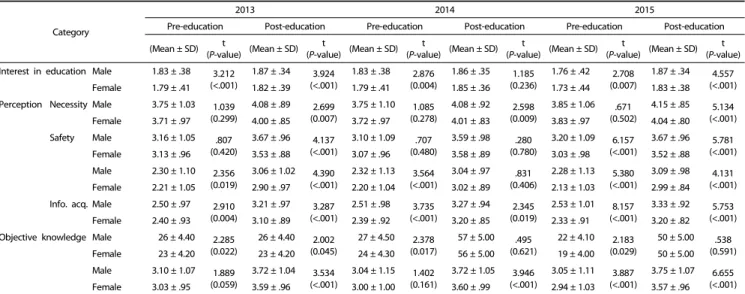
Table 2. Analysis of trends in educational effects for three years
Research participants
The target population of the education program consisted of elementary, middle, and high school students attending 310 schools in South Korea (2013: 63 schools, 2014: 104 schools, 2015: 143 schools). Data subjected to analysis were 13,327 pre-education and 12,641 post-education questionnaires received from 7,582 elementary (from fourth-grade to sixth-grade students), 2,671 middle (from first-grade to third-grade students), and 3,249 high school students (from first-grade to third-grade students) who participated in the education program from May 2012 to April 2015 (n = 12,831), after the exclusion of inade- quately filled-in questionnaires (Table 1) from first-year to third- year students. Limitations of the study is not the same as a follow-up students for three years.
Statistical analysis
SPSS/WIN 15.0 was used to analyze the data in terms of frequency and percentage, mean and standard deviation, Pearson’s correlation coefficient, t-test, one-way ANOVA, and multiple regression.
RESULTS
Educational effect trend analysis
Analysis of the three-year educational effect trend was conducted by comparing levels of variables before and after food radiation education. The analysis yielded the finding that the post-education levels were significantly higher for all variables, that is, for interest in education, perception (necessity, safety, subjective knowledge, and information acquisition), objective knowledge, and attitude, with the sole exception of objective knowledge in 2013. This implies that perception of and attitude towards irradiated foods can change through education. The lack of change in the level of objective knowledge in 2013 was attributed to the excessive difficulty of the theory part, which was understood to have failed to enhance students’
theoretical knowledge as a result. Subsequent to that, the
educational content was modified to facilitate understanding,
and the level of objective knowledge was found to have
improved after the implementation of the education program
in 2014 and 2015 (Table 2). There was no significant difference
each year.
Category
2013 2014 2015
Pre-education Post-education Pre-education Post-education Pre-education Post-education
(Mean ± SD) F
(P-value) (Mean ± SD) F
(P-value) (Mean ± SD) F
(P-value) (Mean ± SD) F
(P-value) (Mean ± SD) F
(P-value) (Mean ± SD) F (P-value) Interest in education Elementary 1.81 ± .39
1.953 (0.142)
1.82 ± .38 10.427 (<.001)
1.81 ± .39 4.002 (0.018)
1.84 ± .37 3.648 (0.026)
1.75 ± .43 36.701 (<.001)
1.85 ± .36 13.102 (<.001)
Middle 1.79 ± .41 1.87 ± .34 1.78 ± .42 1.87 ± .33 1.68 ± .47 1.81 ± .39
High 1.83 ± .38 1.88 ± .32 1.83 ± .38 1.87 ± .34 1.82 ± .38 1.89 ± .32
Perception Necessity Elementary 3.73 ± 1.02 .369 (0.692)
4.05 ± .91 .557 (0.573)
3.81 ± 1.05 15.002 (<.001)
4.15 ± .87 29.658 (<.001)
3.90 ± 1.03 14.762 (<.001)
4.17 ± .82 32.637 (<.001)
Middle 3.70 ± 1.03 4.05 ± .90 3.58 ± 1.06 3.96 ± .92 3.78 ± 1.02 4.02 ± .87
High 3.75 ± .95 4.01 ± .82 3.70 ± 1.01 3.92 ± .85 3.74 ± .95 3.96 ± .79
Safety Elementary 3.34 ± .98 89.901 (<.001)
3.66 ± .94 8.683 (<.001)
3.31 ± 1.01 112.452
(<.001)
3.75 ± .92 76.603 (<.001)
3.30 ± 1.03 136.981
(<.001)
3.73 ± .89 83.093 (<.001)
Middle 2.96 ± .98 3.61 ± .91 2.85 ± 1.02 3.46 ± .96 2.96 ± 1.02 3.47 ± .94
High 2.85 ± .99 3.50 ± .91 2.83 ± .98 3.35 ± .90 2.78 ± .97 3.37 ± .91
Info. acq. Elementary 2.27 ± 1.12 3.217 (0.040)
2.95 ± 1.10 4.086 (0.017)
2.24 ± 1.15 2.266 (0.104)
3.04 ± 1.02 1.215 (0.297)
2.17 ± 1.12 9.064 (<.001)
3.00 ± .96 5.971 (0.003)
Middle 2.15 ± 1.02 3.11 ± .88 2.24 ± 1.04 3.06 ± .84 2.19 ± 1.05 3.08 ± .90
High 2.31 ± 1.01 2.98 ± .84 2.32 ± 1.01 3.00 ± .83 2.32 ± .98 3.09 ± .75
Subj. kn. Elementary 2.47 ± 1.01 .769 (0.463)
3.15 ± 1.02 2.036 (0.131)
2.49 ± 1.03 2.909 (0.055)
3.31 ± .95 17.846 (<.001)
2.45 ± 1.01 1.745 (0.175)
3.31 ± .90 9.327 (<.001)
Middle 2.45 ± .91 3.25 ± .87 2.43 ± .91 3.22 ± .84 2.40 ± .93 3.21 ± .86
High 2.43 ± .84 3.15 ± .79 2.40 ± .84 3.11 ± .82 2.42 ± .85 3.20 ± .77
Objective knowledge Elementary 23 ± 4.20 4.902 (0.007)
21 ± 4.10 16.006 (<.001)
25 ± 4.30 1.433 (0.239)
59 ± 4.90 6.207 (0.002)
19 ± 3.90 4.147 (0.016)
53 ± 5.00 15.095 (<.001)
Middle 28 ± 4.50 29 ± 4.50 25 ± 4.40 53 ± 5.00 22 ± 4.20 44 ± 5.00
High 27 ± 4.50 30 ± 4.60 27 ± 4.50 54 ± 5.00 22 ± 4.20 48 ± 5.00
Attitude Elementary 3.20 ± 1.02
46.171 (<.001)
3.71 ± 1.04 7.106 (<.001)
3.19 ± 1.11 58.824 (<.001)
3.84 ± 1.00 69.721 (<.001)
3.12 ± 1.11 54.947 (<.001)
3.82 ± .98 104.285
(<.001)
Middle 2.95 ± 1.00 3.63 ± .99 2.81 ± 1.06 3.46 ± 1.05 2.86 ± 1.04 3.49 ± 1.07
High 2.84 ± .95 3.56 ± .98 2.85 ± .99 3.47 ± .98 2.81 ± .94 3.39 ± .96
* Interest in education, perception of irradiated foods (necessity, safety, information acquisition, subjective knowledge), and attitude toward irradiated foods are assessed on a scale of 1–5. Objective knowledge of irradiated foods is assessed on a scale of 1–100.
* Higher scores on perception of necessity and of safety, information acquisition, and subjective knowledge respectively mean higher levels of perception that irradiated foods are necessary and safe, acquired information about irradiated foods, and information status. Higher scores on attitude mean more positive attitudes towards the purchase and consumption of irradiated foods.
Table 3. Educational effect trend analysis by school level
Category
2013 2014 2015
Pre-education Post-education Pre-education Post-education Pre-education Post-education
(Mean ± SD) t
(P-value) (Mean ± SD) t
(P-value) (Mean ± SD) t
(P-value) (Mean ± SD) t
(P-value) (Mean ± SD) t
(P-value) (Mean ± SD) t (P-value) Interest in education Male 1.83 ± .38 3.212
(<.001)
1.87 ± .34 3.924 (<.001)
1.83 ± .38 2.876 (0.004)
1.86 ± .35 1.185 (0.236)
1.76 ± .42 2.708 (0.007)
1.87 ± .34 4.557 (<.001)
Female 1.79 ± .41 1.82 ± .39 1.79 ± .41 1.85 ± .36 1.73 ± .44 1.83 ± .38
Perception Necessity Male 3.75 ± 1.03 1.039 (0.299)
4.08 ± .89 2.699 (0.007)
3.75 ± 1.10 1.085 (0.278)
4.08 ± .92 2.598 (0.009)
3.85 ± 1.06 .671 (0.502)
4.15 ± .85 5.134 (<.001)
Female 3.71 ± .97 4.00 ± .85 3.72 ± .97 4.01 ± .83 3.83 ± .97 4.04 ± .80
Safety Male 3.16 ± 1.05 .807
(0.420)
3.67 ± .96 4.137 (<.001)
3.10 ± 1.09 .707 (0.480)
3.59 ± .98 .280 (0.780)
3.20 ± 1.09 6.157 (<.001)
3.67 ± .96 5.781 (<.001)
Female 3.13 ± .96 3.53 ± .88 3.07 ± .96 3.58 ± .89 3.03 ± .98 3.52 ± .88
Male 2.30 ± 1.10 2.356
(0.019)
3.06 ± 1.02 4.390 (<.001)
2.32 ± 1.13 3.564 (<.001)
3.04 ± .97 .831 (0.406)
2.28 ± 1.13 5.380 (<.001)
3.09 ± .98 4.131 (<.001)
Female 2.21 ± 1.05 2.90 ± .97 2.20 ± 1.04 3.02 ± .89 2.13 ± 1.03 2.99 ± .84
Info. acq. Male 2.50 ± .97 2.910 (0.004)
3.21 ± .97 3.287 (<.001)
2.51 ± .98 3.735 (<.001)
3.27 ± .94 2.345 (0.019)
2.53 ± 1.01 8.157 (<.001)
3.33 ± .92 5.753 (<.001)
Female 2.40 ± .93 3.10 ± .89 2.39 ± .92 3.20 ± .85 2.33 ± .91 3.20 ± .82
Objective knowledge Male 26 ± 4.40 2.285 (0.022)
26 ± 4.40 2.002 (0.045)
27 ± 4.50 2.378 (0.017)
57 ± 5.00 .495 (0.621)
22 ± 4.10 2.183 (0.029)
50 ± 5.00 .538 (0.591)
Female 23 ± 4.20 23 ± 4.20 24 ± 4.30 56 ± 5.00 19 ± 4.00 50 ± 5.00
Male 3.10 ± 1.07 1.889
(0.059)
3.72 ± 1.04 3.534 (<.001)
3.04 ± 1.15 1.402 (0.161)
3.72 ± 1.05 3.946 (<.001)
3.05 ± 1.11 3.887 (<.001)
3.75 ± 1.07 6.655 (<.001)
Female 3.03 ± .95 3.59 ± .96 3.00 ± 1.00 3.60 ± .99 2.94 ± 1.03 3.57 ± .96
NB: * Interest in education, perception of irradiated foods (necessity, safety, information acquisition, subjective knowledge), and attitude toward irradiated foods are assessed on a scale of 1–5. Objective knowledge of irradiated foods is assessed on a scale of 1–100.
* Higher scores on perception of necessity and of safety, information acquisition, and subjective knowledge respectively mean higher levels of perception that irradiated foods are necessary and safe, acquired information about irradiated foods, and information status. Higher scores on attitude mean more positive attitudes towards the purchase and consumption of irradiated foods.
Table 4. Analysis of trends of educational effects by gender for three years
Educational effect trend analysis by school level
In all three years of implementation of the program, elementary school students scored higher than middle and high school
students in terms of safety perception and attitude, with
statistical significance, while the highest degree of interest in
education and information acquisition was demonstrated by
Category
2013 2014 2015
Int. in
Edu. Nec. Safety Info.
acq.
Subj.
kn.
Obj.
kn. Att. Int. in
Edu. Nec. Safety Info.
acq.
Subj.
kn.
Obj.
kn. Att. Int. in
Edu. Nec. Safety Info.
acq.
Subj.
kn.
Obj.
kn. Att.
Pre-
Int. in Edu. 1 1 1
Necessity .090
(**) 1 .092
(**) 1 .067
(**) 1
Safety .060 (**) .377
(**) 1 .076
(**) .423
(**) 1 .053
(**) .443
(**) 1
Info. acq. .036 (*)
.129 (**)
.166 (**)
1 .051
(**) .120 (**)
.115 (**)
1 .049** .102
(**) .147 (**)
1
Sub. kn. .066 (**)
.124 (**)
.149 (**)
.539 (**)
1 .094
(**) .155 (**)
.153 (**)
.545 (**)
1 .070
(**) .110 (**)
.178 (**)
.559 (**)
1
Obj. kn. .092 (**)
.044 (*)
-.015 .057 (**)
.059 (**)
1 .034
(*) .038 (*)
.048 (**)
.070 (**)
.087 (**)
1 .010 -.010 -.010 .064
(**) .065 (**)
1
Attitude .093 (**) .271
(**) .347 (**) .099
(**) .131
(**) .004 1 .062
(**) .344 (**) .364
(**) .125 (**) .135
(**) .022 1 .093
(**) .320 (**) .352
(**) .112 (**) .132
(**) .000 1
Post-
Int. in Edu. 1 1 1
Necessity .181 (**)
1 .179
(**)
1 .156
(**) 1
Safety .127 (**)
.452 (**)
1 .154
(**) .473 (**)
1 .131
(**) .448 (**)
1
Info. acq. .107 (**) .236
(**) .224
(**) 1 .104
(**) .187 (**) .186
(**) 1 .095
(**) .168 (**) .146
(**) 1
Sub. kn. .121 (**) .311
(**) .309 (**) .532
(**) 1 .200
(**) .285 (**) .309
(**) .529
(**) 1 .155
(**) .237 (**) .281
(**) .495
(**) 1
Obj. kn. .048 (**)
-.006 .001 .025 .046
(*)
1 .080
(**) .119 (**)
.098 (**)
.074 (**)
.097 (**)
1 .017 .068
(**) .038 (**)
.041 (**)
.033 (*)
1
Attitude .175 (**)
.471 (**)
.447 (**)
.191 (**)
.269 (**)
.005 1 .169
(**) .495 (**)
.446 (**)
.182 (**)
.272 (**)
.149 (**)
1 .149
(**) .451 (**)
.447 (**)
.165 (**)
.261 (**)
.027 (*)
1
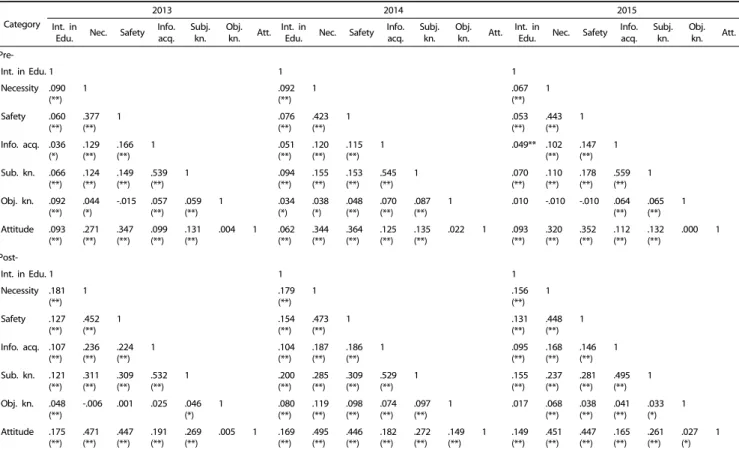
NB: In all three school years, all variables except for objective knowledge showed inter-variable correlations.
NB: *P< 0.05, **P< 0.01
Table 5. Correlation among major variables for three years
high school students after the education in 2015. This implies that the educational effect on safety perception and attitude towards the purchase and consumption of irradiated foods is greatest when the education is given in the elementary school years indeed, high school students scored significantly lower than elementary school students on these variables (Table 3).
However, there was no significant difference each year. In The Theory of Reasoned Action, Ajzen [20] argued that humans weigh the profits and losses of an action by means of maximum use of available information, prior to proceeding to that action.
In applying this view to the high school students in the present study, it can be understood that their low scores in safety perception and attitude arose from their judgment that the purchase and consumption of irradiated foods may have harmful effects. Van der Linden [21] stated that risk perception is influenced not merely by cognitive factors, but also by empirical (emotion, personal experience) and sociocultural (social norms, pursuit of values) factors. Viewed in this light, it can be assumed that the atmosphere created by negative media coverage of various irradiated foodstuffs exercised influence on the risk perception of high school students.
Educational effect trend analysis by gender
Throughout the three years of the program, boys scored higher than girls subjective knowledge. Additionally, compared to girls, boys showed higher post-education necessity perception toward irradiated foods and more positive attitudes toward the
purchase and consumption of irradiated foods. This implies that food irradiation education needs to put more focus on female students. This is consistent with the results of a study by Han
et al. [22] (Table 4).Inter-variable correlations
Throughout the three school years, all variables for perception and attitude, with the exception of objective knowledge, were shown to be positively correlated with one another. Before the education program, high correlations were demonstrated between levels of information acquisition and objective knowledge, safety perception and attitudes towards the purchase and consumption of irradiated foods, information acquisition and objective knowledge, and necessity perception and attitude.
Here, it is noteworthy that safety perception was closely associated with attitude towards the purchase and consumption of irradiated foods before receiving the education. However, there was no significant difference each year.
In a study conducted by Oh et al. [23], risk perception for nuclear power was found to be significantly associated with risk perceptions for radioactivity and radioactivity-based products, which is consistent with the finding of a study by Choi et al.
[12] that consumers show the greatest interest in safety as
opposed to other factors when buying food. This result reflects
the principle that risk perception is a determinant factor for
risk acceptability [24]. On the other hand, given that post-
education necessity perception and attitude change are closely
Category B St. error β t P-value F P-value R2
2013 Pre-education (Constant) 1.151 .104 11.013 <.001
96.236 <.001 .155
Interest in education .147 .043 .057 3.416 <.001
Perception Necessity .158 .018 .155 8.687 <.001
Safety .280 .018 .277 15.443 <.001
Info. acq. .004 .019 .004 .215 0.830
Subj. kn. .080 .021 .075 3.849 <.001
Objective knowledge .045 .039 .019 1.155 0.248
Post-education (Constant) .466 .106 4.377 <.001
214.936 <.001 .300
Interest in education .223 .044 .080 5.099 <.001
Perception Necessity .351 .020 .304 17.270 <.001
Safety .298 .019 .273 15.609 <.001
Info. acq. .007 .018 .007 .402 0.688
Subj. kn. .083 .020 .077 4.084 <.001
Objective knowledge .020 .036 .008 .548 0.583
2014 Pre-education (Constant) 1.064 .096 11.049 <.001
141.017 <.001 .180
Interest in education .044 .040 .016 1.079 0.280
Perception Necessity .226 .017 .220 13.538 <.001
Safety .272 .017 .260 16.053 <.001
Info. acq. .047 .017 .047 2.721 0.007
Subj. kn. .037 .020 .033 1.862 0.063
Objective knowledge .026 .036 .011 .717 0.474
Post-education (Constant) .382 .096 3.999 <.001
307.165 <.001 .325
Interest in education .147 .040 .050 3.671 <.001
Perception Necessity .398 .018 .341 22.194 <.001
Safety .272 .017 .248 16.123 <.001
Info. acq. .029 .017 .027 1.707 0.088
Subj. kn. .079 .019 .069 4.208 <.001
Objective knowledge .145 .028 .070 5.200 <.001
2015 Pre-education (Constant) .957 .076 12.661 <.001
191.970 <.001 .165
Interest in education .149 .030 .060 5.025 <.001
Perception Necessity .208 .014 .197 14.749 <.001
Safety .256 .014 .249 18.423 <.001
Info. acq. .029 .014 .029 2.011 0.044
Subj. kn. .048 .016 .043 2.958 0.003
Objective knowledge .008 .032 .003 .263 0.792
Post-education (Constant) .377 .083 4.522 <.001
386.931 <.001 .295
Interest in education .137 .032 .048 4.214 <.001
Perception Necessity .361 .016 .295 23.010 <.001
Safety .308 .014 .279 21.645 <.001
Info. acq. .027 .015 .024 1.881 0.060
Subj. kn. .111 .016 .095 7.036 <.001
Objective knowledge .017 .023 .009 .760 0.447
NB: In all three school years, the variable exerting the greatest influence on attitude towards purchase and consumption of irradiated foods was perception of safety before the education, but changed to perception of necessity after the education.
Table 6. Factors influencing the attitude towards purchase chose of irradiated foods
related, it seems that attitude change may be induced by providing information on the necessity of irradiated foods in materials for food irradiation education. This point is also reflected in the research finding that personal risk perception is not necessarily associated with the real severity of the risk [25,26]. Furthermore, cases where the level of objective knowledge is not correlated with the attitude towards the purchase and consumption of irradiated foods reflect the findings of evidence-based studies that the role of knowledge in the perception process is not as important as surmised, and
that a complex mixture of factors plays the more important role [27,28]. (Table 5).
Factors influencing attitudes toward the purchase and consumption of irradiated foods
Multiple linear regression was performed with attitudes
towards irradiated foods as a dependent variable and interest
in education, perception (necessity, safety, information acquisition,
and subjective knowledge), objective knowledge as independent
variables. In all three years of the program, safety perception
exerted the greatest influence among the variables influencing pre-education attitude towards the purchase and consumption of irradiated foods; post-education, the same position was taken by necessity perception. Further, post-education explanatory power was higher than the pre-education explanatory power (2013: from 15.5% to 30.0%, 2014: from 18.0% to 32.5%, 2015:
from 16.5% to 29.5%). Flynn et al. [29] evaluated health risks as perceived by the public from two dimensions: “dread risk”
and “unknown risk.” An unknown risk is a risk that is improperly understood, and the perception of irradiated foods may correspond to this category of risk (Table 6).
DISCUSSION
As the result of a 45-min education session given to elementary, middle, and high school students in schools across South Korea, with content covering the principles, state of application, and pros and cons of food irradiation, students’
post-education perceptions, knowledge, and attitudes regarding irradiated foods improved significantly compared to pre-education levels. Bruhn et al. [30] reported that even consumers with little knowledge or negative views of irradiation show favorable attitudes towards irradiated foodstuffs after being exposed to promotional materials or campaigns on processing techniques using food irradiation and their advantages. Furthermore, Fox
et al. [31] verified in a general sense that receivers of positiveinformation on a technology are motivated to purchase related products, while negative information leads to decrease in purchase intentions. This was also true for purchase intention for irradiated foods [32]. In the long run, positive change of attitudes towards the purchase and consumption of irradiated foods can be efficiently induced by providing education on their necessity and safety.
When a new technology for food production or processing becomes available, government, business, and food experts should make great efforts to provide the public with correct information so as to prevent the spread of unfounded concerns and anxiety. For its part, the public should view safety issues regarding novel technologies from a scientific, rational perspe- ctive instead of adopting an emotional approach [14]. In general, the public does not have sufficient scientific or technological knowledge to allow such a perspective, and thus rely more heavily on emotional perceptions and/or personal experiences instead of making rational decisions [33]. Therefore, change of attitude may be more efficiently induced by providing informa- tion on safety and necessity of irradiated foods that incorporates an emotionally affective perspective.
Based on the results of this study, we would like to put forward the following proposals with the intent to help future generations make adequate judgments concerning the choice and purchase of irradiated foods. First, given that post-education levels of perception, knowledge, and attitude concerning irradiated foods increased considerably compared to pre-education levels, behavior change should be induced by providing continuous education to enhance, these primary variables. Second, given the high correlations between irradiated food related necessity and safety perceptions and levels of information acquisition and attitude, improvement of attitude should be sought through
improvement of necessity and safety perception of irradiated foods. Third, elementary and middle school students are suitable as a target population for this kind of education because of the greater educational effects found among younger persons in this, also from the futurological point of view. Fourth, considering that necessity and safety perceptions are important variables influencing attitudes towards the purchase and consumption of irradiated foods, the content of education programs of this sorts should focus on the necessity and safety of irradiated foods so as to induce positive attitudes. In particular, perception of irradiated foods as safe exerts the greatest influence on attitude change and should be the main focus. In order to induce positive attitude change, which is the ultimate goal of the proposed educational program, it appears to be equally important to choose an optimal target population and to apply an appropriate strategy to the selection of educational contents.
REFERENCES
1. Health Canada, Health Products and Food Branch; Canadian Food Inspection Agency. Recommended Canadian Code of Practice for Food Irradiation. Ottawa: Canadian Food Inspection Agency; 2002 Nov 19.
2. Korea Food and Drug Administration. Guidebook on Food Labeling Standards. 1st ed. Cheongju: Korea Food and Drug Administration;
2010.
3. Korea Food and Drug Administration. Guidebook on Food Labeling Standards. 2nd ed. Cheongju: Korea Food and Drug Administration;
2012.
4. Lee JW. Application and prospect of food irradiation for providing the safe food materials. Food Ind Nutr 2006;11:12-20.
5. Nam HS, Kim KE, Yang JS, Ly SY. Effect of food irradiation education on food majoring college students’ knowledge and acceptance of irradiated food. Korean J Diet Cult 2000;15:279-85.
6. Yoon Y, Byun MW, Kim WJ, Kwon JH, Lee JW. Current status of food irradiation technology on quarantine of agricultural commodities.
Food Sci Ind 2009;42:19-26.
7. Han EO, Choi YS. Relation of self-efficacy and cognition of irradiated food among high school students. J Radiat Prot 2013;38:106-18.
8. Kim MR. Study on the Management Trend of Domestic and Foreign Countries toward Food Irradiation. Cheongju: Korea Food and Drug Administration; 2004.
9. Kim H, Kim M. Consumer attitudes towards irradiated foods. J Korean Home Econ Assoc 2003;41:119-30.
10. Malone JW Jr. Consumer willingness to purchase and to pay more for potential benefits of irradiated fresh food products. Agribusiness 1990;6:163-78.
11. Foster A. The impact of consumer acceptance on trade in irradiated foods. Br Food J 1990;92:28-34.
12. Choi MH, Youn SJ, Ahn YS, Seo KJ, Park KH, Kim GH. A survey on the consumer's recognition of food labeling in Seoul area. J Korean Soc Food Sci Nutr 2010;39:1555-64.
13. Lee JS. The effect of media modality and the valence of the risk messages on affective risk perception and behavioral intention.
Korean. J Cogn Sci 2012;23:457-85.
14. Lee JE, Lee CH. The effects of consumer compaign to boycott certain food produce on national economy and food security. Food
Sci Ind 2011;44:43-9.
15. Seo HJ. Fukushima nuclear accident and negative perceptions. J Gov Stud 2013;19:321-61.
16. Han E, Kim J, Choi Y. Using education on irradiated foods to change behavior of Korean elementary, middle, and high school students.
Nutr Res Pract 2014;8:595-601.
17. Park JW. The status and role of the precautionary principle in international environmental law. Hanyang Law Rev 2007;24:405-27.
18. Tomas G, Durant J. Why should we promote the public understan- ding of science? In: Shortland M, editor. Scientific Literacy Papers.
Oxford: Rewley House; 1987. p.1-14.
19. Lee TJ, Ki BJ, Kim IS. A national survey of the policy customers’
perceptions and beliefs of nuclear energy issues and agenda.
Korean J Advert 2015;26:299-323.
20. Ajzen I. The theory of planned behavior. Organ Behav Hum Decis Process 1991;50:179-211.
21. Van der Linden S. Towards a new model for communicating climate change. In: Cohen SA, Higham JE, Peeters P, Gössling S, editors.
Understanding and Governing Sustainable Tourism Mobility:
Psychological and Behavioural Approaches. New York (NY): Routledge;
2014. p.243-275.
22. Han EO, Kim JR, Choi YS. Different perceptions, knowledge, and attitudes of elementary, middle, and high school students regarding irradiated food, nuclear power generation, and medical Radiation.
J Radiat Prot 2014;39:118-26.
23. Oh MY, Choi JM, Kim HS. Stigma effect of technology with risk:
the impact of stigma on nuclear power on the perception and acceptance of products based on radiation technology. Korean J Journal Commun Stud 2008;52:467-500.
24. Cho SK, Oh SK. A theoretical approach to derive perception indicators influencing the acceptability on nuclear energy facilities
& policies. J Energy Eng 2002;11:332-41.
25. Weinstein N. Unrealistic optimism about future life events. J Pers Soc Psychol 1980;19:30-53.
26. Lee JS. The effect of media modality and the valence of risk messages on affective risk perception and behavioral intention.
Korean J Cogn Sci 2012;23:457-85.
27. Krimsky S. The role of theory in risk studies. In: Krimsky S, Golding D, editors. Social Theories of Risk. New York (NY): Praeger; 1992.
p.3-22.
28. Honkanen P, Verplanken B. Understanding attitudes towards genetically modified food: The role of values and attitude strength.
J Consum Policy 2004;27:401-20.
29. Flynn J, Perter E, Mertz CK, Slovic P. Risk, media, and stigma at rocky flats. In: Flynn J, Slovic P, Kunreuther H, editors. Risk, Media and Stigma: Understanding Public Challenges to Modern Science and Technology. London: Earthscan Publication Ltd; 2001. p.309-327.
30. Bruhn CM, Schutz HG, Sommer R. Attitude change toward food irradiation among conventional and alternative consumers. Food Technol 1986;40:86-91.
31. Fox JA, Hayes DJ, Shogren JF. Consumer preferences for food irradiation: how favorable and unfavorable descriptions affect preferences for irradiated pork in experimental auctions. J Risk Uncertain 2002;24:75-95.
32. Rodriguez L. The impact of risk communication on the acceptance of irradiated food. Sci Commun 2007;28:476-500.
33. Epstein S. Integration of the cognitive and the psychodynamic unconscious. Am Psychol 1994;49:709-24.