Bracket bonding to polymethylmethacrylate-based materials for computer-aided design/manufacture of temporary restorations: Influence of mechanical treatment and chemical treatment with universal adhesives
Objective: To assess shear bond strength and failure mode (Adhesive Remnant Index, ARI) of orthodontic brackets bonded to polymethylmethacrylate (PMMA) blocks for computer-aided design/manufacture (CAD/CAM) fabrication of temporary restorations, following substrate chemical or mechanical treatment.
Methods: Two types of PMMA blocks were tested: CAD-Temp
®(VITA) and Telio
®CAD (Ivoclar-Vivadent). The substrate was roughened with 320-grit sandpaper, simulating a fine-grit diamond bur. Two universal adhesives, Scotchbond Universal Adhesive (SU) and Assure Plus (AP), and a conventional adhesive, Transbond XT Primer (XTP; control), were used in combination with Transbond XT Paste to bond the brackets. Six experimental groups were formed: (1) CAD- Temp
®/SU; (2) CAD-Temp
®/AP; (3) CAD-Temp
®/XTP; (4) Telio
®CAD/SU; (5) Telio
®CAD/AP; (6) Telio
®CAD/XTP. Shear bond strength and ARI were assessed.
On 1 extra block for each PMMA-based material surfaces were roughened with 180-grit sandpaper, simulating a normal/medium-grit (100 µm) diamond bur, and brackets were bonded. Shear bond strengths and ARI scores were compared with those of groups 3, 6. Results: On CAD-Temp
®significantly higher bracket bond strengths than on Telio
®CAD were recorded. With XTP significantly lower levels of adhesion were reached than using SU or AP. Roughening with a coarser bur resulted in a significant increase in adhesion. Conclusions: Bracket bonding to CAD/CAM PMMA can be promoted by grinding the substrate with a normal/
medium-grit bur or by coating the intact surface with universal adhesives. With appropriate pretreatments, bracket adhesion to CAD/CAM PMMA temporary restorations can be enhanced to clinically satisfactory levels.
[Korean J Orthod 2019;49(6):404-412]
Key words: Bracket, Bonding, Adhesive, Prosthodontics Cecilia Goracci
aMutlu Özcan
bLorenzo Franchi
cGiuseppe Di Bello
aChris Louca
dAlessandro Vichi
da
Department of Medical
Biotechnologies, University of Siena, Siena, Italy
b
Dental Materials Unit, Center for Dental and Oral Medicine, Clinic for Fixed and Removable Prosthodontics and Dental Materials Science, University of Zurich, Zurich, Switzerland
c
Department of Surgery and Translational Medicine, University of Florence, Florence, Italy
d
University of Portsmouth Dental Academy, Portsmouth, United Kingdom
Received April 3, 2019; Revised September 3, 2019; Accepted September 9, 2019.
Corresponding author: Cecilia Goracci.
Professor, Department of Medical Biotechnologies, University of Siena, Policlinico Le Scotte, viale Bracci, Siena 53100, Italy.
Tel +39-339-5416717 e-mail [email protected]
How to cite this article: Goracci C, Özcan M, Franchi L, Di Bello G, Louca C, Vichi A.
Bracket bonding to polymethylmethacrylate-based materials for computer-aided design/
manufacture of temporary restorations: Influence of mechanical treatment and chemical treatment with universal adhesives. Korean J Orthod 2019;49:404-412.
© 2019 The Korean Association of Orthodontists.
This is an Open Access article distributed under the terms of the Creative Commons Attribution Non-Commercial License (http://creativecommons.org/licenses/by-nc/4.0) which permits unrestricted non-commercial use, distribution, and reproduction in any medium, provided the original work is properly cited.
pISSN 2234-7518 • eISSN 2005-372X
https://doi.org/10.4041/kjod.2019.49.6.404
INTRODUCTION
The growing interest in oral health and esthetic den- tistry has increased the demand for adult orthodontic treatment.
1-4In multidisciplinary treatments orthodon- tists are often required to bond brackets to teeth re- stored with temporary crowns.
2-5Several materials and techniques are currently available to clinicians for fabri- cating temporary restorations.
2-8However, if a patient is undergoing orthodontic therapy as a part of interdisci- plinary treatment, materials that can provide satisfactory properties for an extended period of time are preferable.
In recent years, highly cross-linked prefabricated poly- methylmethacrylate (PMMA) resin blocks have been marketed for use in computer-aided design/manufacture (CAD/CAM) systems. As they are industrially fabricated under standardized conditions, these CAD/CAM poly- mer materials exhibit improved mechanical and esthetic properties.
9-11Thus, PMMA-based milled temporary res- torations are particularly suitable for use in longer clini- cal services, such as interdisciplinary treatment strategies that involve an orthodontic phase. Nevertheless, the ad- hesive conditions offered in orthodontic bracket bond- ing by such a densely polymerized restorative substrate must be investigated. Industrially polymerized PMMA- based materials exhibit a high degree of conversion, and the amount of residual monomers or free radicals may be insufficient for co-polymerization with the monomers in the adhesive system.
The adhesion of a resin composite to highly cross- linked PMMA could benefit from chemically or mechani- cally pretreating the restorative substrate.
Regarding chemical treatment, universal adhesives have been claimed to successfully adhere to different restorative substrates,
12as well as dental tissues, and have recently been proposed for several applications in dentistry.
13,14In an in-vitro study, Hellak et al.
15reported that Scotchbond Universal Adhesive (3M ESPE, St. Paul, MN, USA) provided satisfactory retention of orthodontic brackets to metal, porcelain, and composite substrates.
Lately, Assure Plus (Reliance Orthodontic Products, Itasca, IL, USA), a one-step universal primer allegedly able to effectively bond orthodontic brackets to all in- traoral surfaces, including restorative substrates, entered the market.
16-18The bond strength of this new material to sound
16and fluorosed
17enamel, as well as to ceramic materials
18has been tested. A chemical component common to most universal adhesives is the 10-methac- ryloyloxydecyl dihydrogenphosphate (10-MDP) mono- mer. This monomer may promote adhesion to PMMA by chemically reacting with methacrylate groups. However, the potential for universal adhesives to bond orthodon- tic brackets to polymer materials for CAD/CAM tempo- rary restorations needs to be verified. Therefore, the aim
of the first part of this study was to assess the influ- ence of universal adhesives on bracket bond strength to PMMA-based CAD/CAM blocks. Specifically, the first tested null hypothesis was that two marketed universal adhesives did not significantly differ from each other or from a conventional orthodontic adhesive in their ability to bond metal brackets onto two types of PMMA-based CAD/CAM blocks.
Another issue worthy of evaluation is whether adhe- sion to densely polymerized PMMA can be enhanced by mechanically roughening the substrate. In a recent in- vitro study, Wiegand et al.
19measured the shear bond strength of a resin composite to different CAD/CAM polymer materials for the purpose of repairability. In the absence of any surface pretreatment, significantly weaker adhesion was established than when silica coat- ing/silanization, aluminum oxide sandblasting, and mechanical roughening for simulating diamond bur abrasion were performed.
19However, the influence of mechanically pre-treating PMMA blocks on the adhe- sion of orthodontic brackets has not yet been evaluated.
Therefore, the aim of the second part of this study was to assess the effect on bracket bond strength of rough- ening the PPMA substrate with different abrasives. Spe- cifically, the second formulated null hypothesis was that roughening the PMMA blocks surface with abrasives simulating a fine-grit or a normal/medium-grit diamond bur did not significantly change the adhesive conditions offered to orthodontic brackets. Throughout the study, the adhesive conditions were assessed by measuring the shear bond strength of bonded brackets, as well as the amount of adhesive remaining on the substrate after debonding.
MATERIALS AND METHODS
Chemical treatment of the substrate with universal adhesives
Two types of PMMA-based blocks for use in CAD/CAM systems were tested: CAD-Temp
®(VITA Zahnfabrik, Bad Säckingen, Germany) and Telio
®CAD (Ivoclar Vivadent AG, Schaan, Liechtenstein). The chemical composition of the two materials is presented in Table 1. The dimen- sions of the CAD-Temp
®and Telio
®CAD blocks were 15.5 × 19 × 39 mm and 15.4 × 19 × 39 mm, respec- tively. Up to 5 brackets could be bonded horizontally spaced on each longitudinal surface of the block (Figure 1). Thus, all the brackets in each experimental group (n
= 10) were bonded to one same block.
The bonding surface of each block was roughened
using wet 320-grit silicon carbide paper at 1.3 N for 8
seoonds,
19simulating the action of a fine-grit (40 µm)
diamond bur. After roughening, the bonding surface
was cleaned with ethanol and dried using an oil-free
air spray. The adhesives Scotchbond Universal Adhesive (3M ESPE), Assure Plus (Reliance Orthodontic Products), and Transbond XT Primer (3M Unitek, Monrovia, CA, USA), all in combination with Transbond XT Paste (3M Unitek), were used to bond the brackets to the PMMA- based materials. Transbond XT primer is considered to be a standard adhesive in orthodontics and served as the control material. The chemical compositions of the tested adhesives are reported in Table 2. Six experimen- tal groups were formed: group 1, CAD-Temp
®/Scotch- bond Universal Adhesive; group 2, CAD-Temp
®/Assure Plus; group 3, CAD-Temp
®/Transbond XT Primer; group 4, Telio
®CAD/Scotchbond Universal Adhesive; group 5, Telio
®CAD/Assure Plus; and group 6, Telio
®CAD/
Transbond XT Primer. Sixty stainless steel brackets for upper incisors (Victory Series; 3M Unitek) were randomly selected and assigned to the 6 experimental groups. The average bracket base surface area reported by the manu- facturer was verified by measuring with a digital caliper (Mitutoyo, Kawasaki, Japan). The area of 10 randomly chosen brackets was recorded and the mean value of the measured areas was calculated to be 11.02 mm
2. In the bonding procedure, the adhesive was applied to the substrate with a brush and thinned with a gentle stream of air. Photopolymerization of the adhesives As- sure Plus and Transbond XT Primer is not recommended by the respective manufacturers. As there were no spe- cific manufacturer’s guidelines for the use of Scotch- bond Universal Adhesive in bracket bonding, in order to standardize the bonding procedure for all experimental groups, light-curing was omitted also for this adhesive.
It should be noted that the manufacturer of Scotch- bond Universal Adhesive recommends avoiding light- curing when using this adhesive for veneer luting (http://
multimedia.3m.com/mws/media/754751O/scotchbond- universal-adhesive-technical-product-profile.pdf).
Thereafter, a small amount of Transbond XT Paste was applied to the bracket base, and the bracket was firmly seated to the substrate using a scaler instrument. Excess resin composite was removed from the periphery of the bracket base with the scaler, and light-curing was per- fomed with an LED curing light (Ortholux Luminous;
3M Unitek; output: 1,600 mW/cm
2), positioning the tip for 12 seconds on the mesial and 12 seconds on the distal side of the bracket. All brackets were placed by Table 2. Chemical compositions of the tested adhesives
Manufacturer Chemical composition
Scotchbond Universal Adhesive
3M ESPE, St. Paul, MN, USA 10-MDP phosphate monomer, Vitrebond copolymer, HEMA, Bis- GMA, dimethacrylate resins filler, silane, initiators, ethanol, water Assure Plus Reliance Orthodontic Products,
Itasca, IL, USA
Bis-GMA, ethanol, MDP, HEMA
Transbond XT Primer 3M Unitek, Monrovia, CA, USA Bis-GMA, TEGDMA, 4-(dimethylamino)-benzeneethanol, camphorquinone, hydroquinone
Transbond XT Paste 3M Unitek, Monrovia, CA, USA Silane treated quartz (70–80% in weight), bisphenol A diglycidyl ether dimethacrylate, bisphenol A bis(2-hydroxyethyl ether) dimethacrylate, silane treated silica, diphenyliodonium
10-MDP, 10-methacryloyloxydecyl dihydrogenphosphate; HEMA, hydroxyethyl methacrylate; Bis-GMA, bisphenol A diglycidyl methacrylate; TEGDMA, triethyleneglycol dimethacrylate.
Figure 1. Experimental set-up for bracket shear bond strength testing.
Table 1. Chemical compositions of the tested PMMA blocks
Manufacturer Chemical composition
CAD-Temp
®VITA Zahnfabrik, Bad Säckingen, Germany 83–86% wt% PMMA, 14% wt% microfiller (silica), pigments (< 0.1%) Telio
®CAD Ivoclar Vivadent, Schaan, Liechtenstein 99.5% wt% PMMA, no fillers, pigments (< 0.1%)
PMMA, Polymethylmethacrylate; wt%, percentage by weight.
the same operator (GDB). The bonded specimens then underwent thermocycling from 5–55°C for 2,000 cycles, with a dwell time of 30 seconds.
20For debonding, a steel rod with a flattened end was attached to the cross- head of a universal testing machine (Controls; Milano, Italy). Specimens were secured to the lower jaw of the machine to ensure that the bonded bracket base was parallel to the shear force direction. The flat-end steel rod acted on the bracket to apply a force at the bracket- substrate interface (Figure 1).
21Specimens were stressed in the occlusal-gingival direction at a crosshead speed of 1 mm/min. The load necessary to debond the bracket from the block was recorded in Newtons, and the bond strength was expressed in MegaPascals by dividing the load at failure in Newtons by the surface area of the bracket in mm
2. After debonding, the bracket bases and enamel surfaces were examined under an optical micro- scope at a magnification of 20×. The Modified Adhesive Remnant Index (ARI) proposed by Ostby et al.
21was used to assess the amount of adhesive remaining on the enamel surfaces. This index ranges from 0 to 5, and the scores are defined as follows: score 1, all of the adhesive remained on the tooth; score 2, over 90% of the adhe- sive remained on the tooth; score 3, 10% to 90% of the adhesive remained on the tooth; score 4, less than 10%
of the adhesive remained on the tooth; score 5, no ad- hesive remained on the tooth.
21Mechanical substrate treatment
To assess the influence of mechanical substrate treat- ment on bracket adhesion, the surface of one additional block per PMMA-based material was roughened with a wet 180-grit silicon carbide paper at 1.3 N for 8 sec- onds,
19simulating the action of a normal/medium-grit (100 µm) diamond bur. The bonding surface was then cleaned with ethanol and dried with an oil-free air spray.
Using Transbond XT Paste in the same way as described above, brackets were bonded to the substrates, 10 on a CAD-Temp
®block (group 7) and 10 on a Telio
®CAD block (group 8). Thermocycling, bracket debonding, and ARI assessment were conducted following the same protocol for testing the influence of chemical treat- ment. The collected data were compared with those of experimental groups 3 and 6, that had been recorded on blocks roughened with a finer-grit silicon carbide paper.
Statistical analysis
All statistical analyses were conducted using Sigma- Plot ver. 11.00 for Windows (Systat Software, Inc., San Jose, CA, USA).
Shear bond strength
Having excluded through a linear regression that the PMMA block per se was an influential factor for the
measured bond strengths, the bracket was considered as the statistical unit. Normality of the data distribution (Shapiro-Wilk test) and homogeneity of the group vari- ances (Levene test) were confirmed, then the Two-Way Analysis of Variance (ANOVA) was applied with bond strength as the dependent variable, substrate and adhe- sive type or substrate and substrate treatment as factors.
The Tukey test was utilized for post-hoc comparisons as needed. In all the analyses the statistical significance level was set at p < 0.05.
Adhesive Remnant Index score
To assess the statistical significance of the between- group differences in the amount of adhesive remaining on the substrate, the Kruskal–Wallis ANOVA was applied to the ARI scores, followed by the Dunn’s multiple range test for post-hoc comparisons. In all tests the level of statistical significance was set at p < 0.05.
RESULTS
Chemical treatment of the substrate with universal adhesives
Shear bond strength
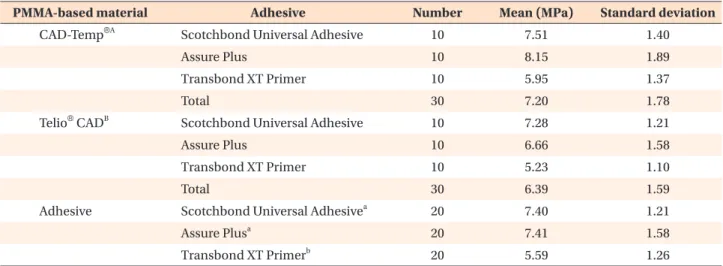
The descriptive statistics of the shear bond strength data are reported in Table 3. The Two-Way ANOVA demonstrated that the type of polymeric material for CAD/CAM fabrication of temporary restorations had a significant influence on bracket adhesion per se (p
= 0.02). Particularly, CAD-Temp
®offered significantly more favorable bonding conditions than Telio
®CAD.
Also, the type of adhesive proved to be a significant fac- tor for bracket retention (p < 0.001). Specifically, with the use of Transbond XT Primer, significantly weaker bonds were established than after the application of Scotchbond Universal Adhesive and Assure Plus (p <
0.05), which achieved comparable bond strengths (p >
0.05). The substrate-adhesive interaction was not statis- tically significant (p = 0.311).
Adhesive Remnant Index score
The descriptive statistics of the ARI scores are pre- sented in Table 4. The Kruskal–Wallis test demon- strated statistically significant differences in the ARI scores amongst the experimental groups (p < 0.001).
In particular, the Dunn’s multiple range test indicated that a significantly smaller amount of resin composite remained on the substrate in specimens that received Transbond XT Primer, in comparison with those treated with Scotchbond Universal Adhesive or in comparison with CAD-Temp
®blocks coated with Assure Plus (p <
0.05).
Table 3. Descriptive statistics of the shear bond strength data following the chemical treatment of the substrate
PMMA-based material Adhesive Number Mean (MPa) Standard deviation
CAD-Temp
®AScotchbond Universal Adhesive 10 7.51 1.40
Assure Plus 10 8.15 1.89
Transbond XT Primer 10 5.95 1.37
Total 30 7.20 1.78
Telio
®CAD
BScotchbond Universal Adhesive 10 7.28 1.21
Assure Plus 10 6.66 1.58
Transbond XT Primer 10 5.23 1.10
Total 30 6.39 1.59
Adhesive Scotchbond Universal Adhesive
a20 7.40 1.21
Assure Plus
a20 7.41 1.58
Transbond XT Primer
b20 5.59 1.26
Two-Way Analysis of Variance, Tukey test for post hoc comparisons.
A,B
The different upper-case superscript letters indicate a statistically significant difference in the bond strengths provided by the two polymethylmethacrylate (PMMA)-based materials, regardless of the adhesive used (p < 0.05).
a,bThe different lower-case superscript letters show the statistically significant differences in the bond strengths achieved by the adhesives, irrespective of the substrate (p < 0.001).
Table 4. Descriptive statistics of the Adhesive Remnant Index scores
Group Number Median Interquartile range
(25–75%) Significance p < 0.05
CAD-Temp
®/Scotchbond Universal Adhesive 10 3 1–3 A
CAD-Temp
®/Assure Plus 10 3 3–3 A
CAD-Temp
®/Transbond XT Primer 10 5 5–5 B
Telio
®CAD/Scotchbond Universal Adhesive 10 3 1–3 A
Telio
®CAD/Assure Plus 10 3 3–5 AB
Telio
®CAD/Transbond XT Primer 10 5 5–5 B
Kruskal–Wallis Analysis of Variance, Dunn’s multiple range test for post hoc comparisons. In the significance column, the different letters indicate the statistically significant differences amongst the experimental groups.
Table 5. Descriptive statistics of the shear bond strength data following the mechanical treatment of the substrate
PMMA-based material Abrasive Number Mean (MPa) Standard deviation
CAD-Temp
®180 grit
a10 7.98 1.21
320 grit
b10 5.95 1.37
Total 20 6.96 1.63
Telio
®CAD 180 grit
a10 8.99 0.95
320 grit
b10 5.23 1.10
Total 20 7.11 2.17
Total 180 grit
a20 8.48 1.18
320 grit
b20 5.59 1.26
Two-Way Analysis of Variance, Tukey test for post hoc comparisons.
a,b