1. INTRODUCTION
Cellulose is the most abundant natural poly- mer on earth, and its utilization has many envi- ronmental benefits. Cellulose microfibrils are bundles of stretched cellulose chain molecules, and are the smallest structural units of ligno- cellulosic bioresources. They exist in nature as nano-structured materials, called cellulose nano- fibrils (CNFs). CNFs can be produced from any kind of plant cell walls by chemical and me- chanical methods, or by a combination of both chemical and mechanical methods (Eichhorn et
al., 2010; Kalia et al., 2011; Lavoine et al., 2012; Siró and Plackett, 2010). Conventional mechanical treatments for CNF production in- clude cryocrushing, ultrasonication, disk-milling, high-pressure homogenizing, etc. (Chakraborty et al., 2005; Jang et al., 2013; Kondo, 2005;
Taniguchi and Okamura, 1998; Yano et al., 2005). The morphological properties of the re- sulting products are dependent upon the me- chanical treatments applied and the origin of bioresources.
It is important to be aware that the kind of lignocellulosic biomass can vary significantly
Original Article
Changes of Micro- and Nanoscopic Morphology of Various Bioresources by Different Milling Systems 1
Jae-Hyuk Jang 2,3 ⋅Seung-Hwan Lee 3 ⋅Min Lee 2 ⋅Sang-Min Lee 2 ⋅Nam-Hun Kim 3,†
ABSTRACT
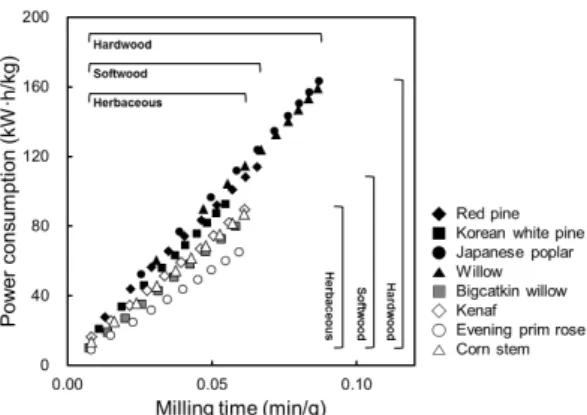
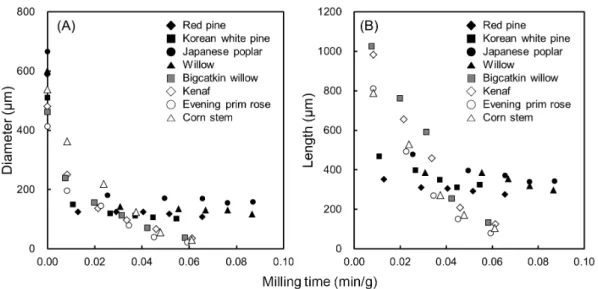
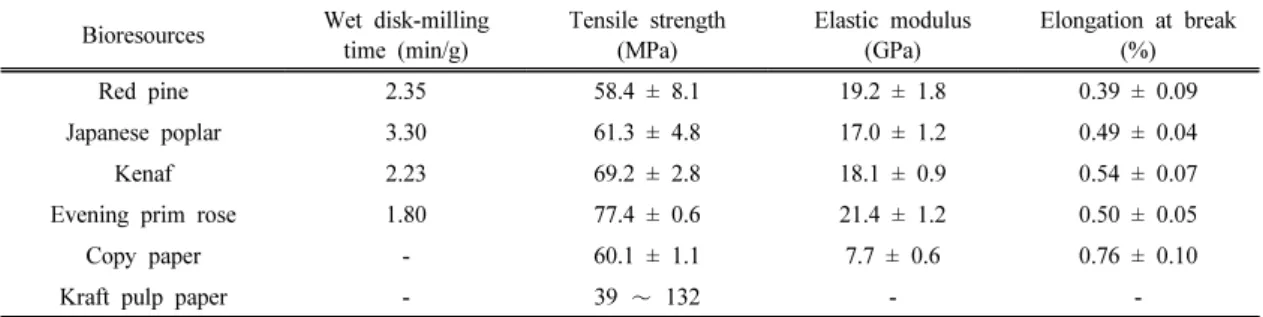
This study was carried out to investigate the changes in micro- and nanoscopic morphology of cellulose nano- fibrils (CNFs) from various bioresources by investigating various mechanical milling systems. Mechanical mill- ing in herbaceous bioresources was more effective than in woody bioresources, demonstrating lower energy con- sumption and finer morphology. The milling time to reach nanoscopic size was longer in woody bioresources than in herbaceous bioresources. Furthermore, at the same level of wet disk milling time, CNFs from herba- ceous bioresources showed more slender morphology than those from woody bioresources. Tensile properties of nanopaper prepared from CNFs of herbaceous bioresources were higher than those of woody bioresources. The highest tensile strength was found to be 77.4 MPa in the nanopaper from Evening prim rose.
Keywords : nanocellulose, cellulose nanofibril, microfibrillated cellulose, lignocellulose nanofibril, nanopaper
1 Date Received September 4, 2017, Date Accepted October 13, 2017
2 Department of Forest Products, National Institute of Forest Science, Seoul 02455, Republic of Korea
3 College of Forest and Environmental Sciences, Kangwon National University, Chuncheon 24341, Republic of Korea
†
Corresponding author: Nam-Hun Kim (e-mail: [email protected], ORCID: 0000-0002-4416-0554)
among softwoods, hardwoods, and herbaceous resources. As such, it can be affected a sig- nificant bearing on the mechanical fibrillation process as well as the final product. The Populus and Salix genus are major fast-growing species, which may have great potential for CNF production, in terms of economic feasibility. This is due to their adaptability and management of raw material supply. Red pines and Korean white pines are major planted soft- wood species in Korea. Herbaceous plant mate- rials are also an important source for CNF production. Kenaf and evening prim rose are fast-growing in temperate and sub-tropical areas (Jonoobi et al., 2009). Corn stover is readily available as this agricultural crop resides in bil- lions of tonnes throughout the world. As these herbaceous resources are abundant, inexpensive, and readily available, these sources may benefit for CNF production. Generally, woody bio- resorces have strong recalcitrant properties, re- sulting in difficulty to produce CNF. CNF in herbaceous bioreources has been known to be more easily separated, compared to woody bio-
reources (Alia et al., 2013).
The objective of this study is to investigate the micro- and nanoscopic morphological changes of eight different bioresources by dif- ferent milling systems. Red pine, Korean white pine, Japanese poplar, and Willows were used as woody sources. Kenaf, evening prim rose and corn stover were used as herbaceous sources. In this study, power consumption during milling, filtration time, and tensile prop- erties of nanopaper were also compared against different raw sources and milling systems.
2. MATERIALS and METHODS 2.1. Materials
Five woody and three herbaceous bio- resources were selected as raw materials.
Detailed information of these samples is given in Table 1.
2.2. Mechanical Grinding
The oven-dried bioresources were first passed
Bioresources Common name Scientific name Age (yrs.)
Density
*(g/cm
3) Location
Woody Red pine Pinus densiflora 48 0.47 Chuncheon, South Korea
bioresources Korean white pine Pinus koraiensis 29 0.45 Chuncheon, South Korea Japanese poplar Populus maximowiczii 34 0.56 Samcheok, South Korea Willows Salix pseudolasiogyne 31 0.58 Chuncheon, South Korea Bigcatkin willow Salix gracilistyla 1 0.15 Chuncheon, South Korea
Herbaceous Kenaf Hibiscus cannabinus 1 0.18 Buan, South Korea
bioresources Evening prim rose Oenothera odorata 1 0.11 Chuncheon, South Korea
Corn stover Zea mays 1 0.16 Chuncheon, South Korea
*