www.earticle.net
제주마 보존 및 개량을 위한 연구 동향 및 고찰(총설)
임병휘1# · 김상욱1# · 강다원1 · 박경도2 · 도경탁1*
제주대학교 생명공학부 동물생명공학과 말 과학 연구실1
전북대학교 동물생명공학과2
Research Trends and Implications for Preservation and Improvement of Jeju Ponies (Review)
Byeonghwi Lim1#, Sangwook Kim1#, Dawon Kang1, Kyung-Do Park2 and Kyoungtag Do1*
1Lab of Equine Science, Department of Animal Biotechnology, Faculty of Biotechnology, Jeju National University, Jeju 63243, Korea
2Department of Animal Biotechnology, Chonbuk National University, Jeonju 54896, Korea
ABSTRACT1)
Jeju pony, a natural monument no. 347 living in Jeju Island, Korea, has been conserved as a genetic resource and a racing pony. A total of 125 studies written about this breed have been published in various fields, primarily animal science (106), veterinary medicine (13), and others (6), from 1961 to 2018. Specifically, the majority of studies have been published in animal breeding and genetics (84), which are subcategories in the field of animal science. However, most of the research in breeding and genetics for Jeju pony were performed in the early 2000s, and studies using recently developed techniques are inferior to other breeds (thoroughbred etc.). Our current understanding of both the conservation and utilization of the breed is still incomplete. Thus, it is important to use recently developed technologies to improve management and breeding strategies for this pony breed. In this study, we review studies on Jeju ponies in the field of animal breeding and genetics and discuss problems that need to be addressed. Reviewed studies were divided into 6 categories: systematic classification, coat color, body measurement and growth, racing performance, behavior, and effective population size. Finally, we suggest ideas for future research projects that could potentially contribute to the Jeju pony industry.
(Key words: Jeju pony, Coat color, Racing performance, Behavior, Effective population size)
# These authors contributed equally to this work
* Corresponding authors: Kyoungtag Do, Department of Animal Biotechnology, Faculty of Biotechnology, Jeju National University, Jeju 63243, Korea. Tel: +82-64-754-3334, E-mail: [email protected]
This is an Open Access article distributed under the terms of the Creative Commons Attribution Non-Commercial License (http://creativecommons.org/licenses/by-nc-nd/3.0/deed.ko), which permits unrestricted non-commercial use, distribution, and reproduction in any medium, provided the original work is properly cited. The moral rights of the named author(s) have been asserted.
Ⅰ. INTRODUCTION
Jeju pony is a native pony breed that has been living in Jeju Island, a southern island of the Korea. As a result, this breed has developed unique characteristics in order to adapt to its geographical environment. The basic
features of this unique breed are an intermediate size with an average height of 120 cm and weight of 262 kg and 12 diverse coat colors. Jeju pony used to be involved in various industrial fields such as agriculture and transportation. The largest recorded population size was 22,500 ponies in 1931; however, the number of ponies
[Provider:earticle] Download by IP 118.70.52.165 at Monday, December 20, 2021 7:49 PM
www.earticle.net
decreased rapidly due to the development of agricultural machinery and new transportation. In fact, they were in danger of extinction in the 1980s. The government of the Korea designated Jeju pony as natural monument no.
347 on February in 1986 for preservation, and they have been managed by the Livestock Promotion Agency of the Jeju Special Self-Governing Province. In the 1990s, its racing began at the Jeju Race Park, Korea Racing Authority. In addition, systematic management of their pedigrees began in the 2000s and is currently ongoing (Yang, 2009).
Jeju pony breeding and racing methods are poor compared to the thoroughbred horses that are systematically managed for racing. Therefore, genetic improvement for racing through various research methods as well as management of systematic preservation is needed (Yang, 2009). A total of 125 research studies have been reported in various fields of animal science and veterinary medicine from 1961 to 2018. In this review, we discuss the systematic conservation, breeding for racing performance, and corrective improvement methods for Jeju ponies. We then suggest future research projects that could potentially contribute to the management and breeding
of Jeju ponies.
Ⅱ. RESEARCH CLASSIFICATION BY FIELD
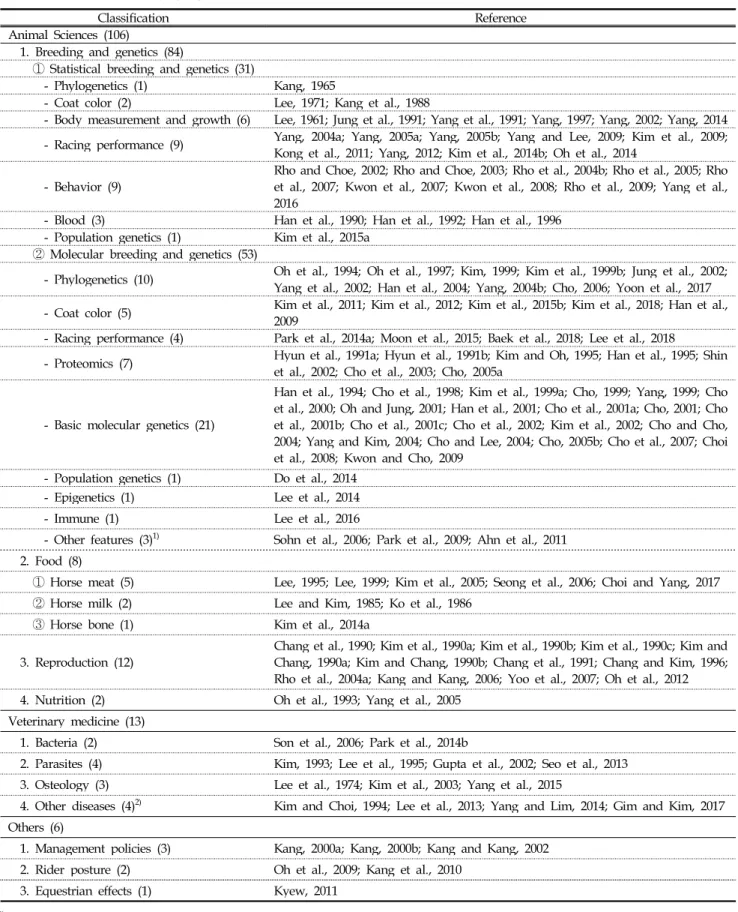
A total of 125 Jeju pony studies were divided into three major categories: animal science (106) and veterinary medicine (13) except for the others (6). First, in the animal science category, breeding and genetics (84) accounted for the largest portion, while the remaining studies were food (8), reproduction (12), and nutrition (2). Breeding and genetics also can be divided into two parts: statistical breeding and genetics (31) and molecular breeding and genetics (53).
Second, studies in the veterinary medicine category (13) were classified as bacteria (2), parasites (4), osteology (3), and other diseases (4; viruses, anemia, nerve disorder, and hyperparathyroidism). Finally, the others category (6) discussed management policies (3), rider posture (2), and equestrian effects (1), and were not included in animal sciences and veterinary medicine.
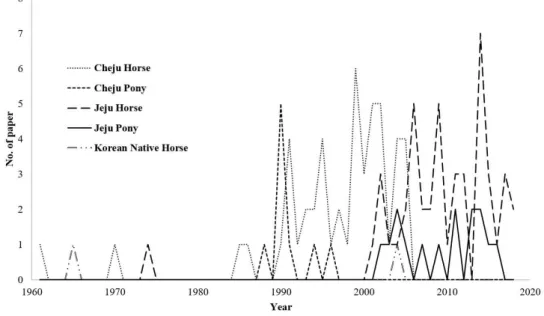
Further information on classification is provided in Table 1 and Fig. 1 shows the trend of research by year.
Fig. 1. The number of Jeju pony’s studies in each year.
[Provider:earticle] Download by IP 118.70.52.165 at Monday, December 20, 2021 7:49 PM
www.earticle.net
Table 1. Classification of Jeju pony’s studies
Classification Reference
Animal Sciences (106)
1. Breeding and genetics (84)
① Statistical breeding and genetics (31)
- Phylogenetics (1) Kang, 1965
- Coat color (2) Lee, 1971; Kang et al., 1988
- Body measurement and growth (6) Lee, 1961; Jung et al., 1991; Yang et al., 1991; Yang, 1997; Yang, 2002; Yang, 2014 - Racing performance (9) Yang, 2004a; Yang, 2005a; Yang, 2005b; Yang and Lee, 2009; Kim et al., 2009;
Kong et al., 2011; Yang, 2012; Kim et al., 2014b; Oh et al., 2014
- Behavior (9) Rho and Choe, 2002; Rho and Choe, 2003; Rho et al., 2004b; Rho et al., 2005; Rho et al., 2007; Kwon et al., 2007; Kwon et al., 2008; Rho et al., 2009; Yang et al., 2016
- Blood (3) Han et al., 1990; Han et al., 1992; Han et al., 1996 - Population genetics (1) Kim et al., 2015a
② Molecular breeding and genetics (53)
- Phylogenetics (10) Oh et al., 1994; Oh et al., 1997; Kim, 1999; Kim et al., 1999b; Jung et al., 2002;
Yang et al., 2002; Han et al., 2004; Yang, 2004b; Cho, 2006; Yoon et al., 2017 - Coat color (5) Kim et al., 2011; Kim et al., 2012; Kim et al., 2015b; Kim et al., 2018; Han et al.,
2009
- Racing performance (4) Park et al., 2014a; Moon et al., 2015; Baek et al., 2018; Lee et al., 2018
- Proteomics (7) Hyun et al., 1991a; Hyun et al., 1991b; Kim and Oh, 1995; Han et al., 1995; Shin et al., 2002; Cho et al., 2003; Cho, 2005a
- Basic molecular genetics (21)
Han et al., 1994; Cho et al., 1998; Kim et al., 1999a; Cho, 1999; Yang, 1999; Cho et al., 2000; Oh and Jung, 2001; Han et al., 2001; Cho et al., 2001a; Cho, 2001; Cho et al., 2001b; Cho et al., 2001c; Cho et al., 2002; Kim et al., 2002; Cho and Cho, 2004; Yang and Kim, 2004; Cho and Lee, 2004; Cho, 2005b; Cho et al., 2007; Choi et al., 2008; Kwon and Cho, 2009
- Population genetics (1) Do et al., 2014
- Epigenetics (1) Lee et al., 2014
- Immune (1) Lee et al., 2016
- Other features (3)1) Sohn et al., 2006; Park et al., 2009; Ahn et al., 2011 2. Food (8)
① Horse meat (5) Lee, 1995; Lee, 1999; Kim et al., 2005; Seong et al., 2006; Choi and Yang, 2017
② Horse milk (2) Lee and Kim, 1985; Ko et al., 1986
③ Horse bone (1) Kim et al., 2014a
3. Reproduction (12) Chang et al., 1990; Kim et al., 1990a; Kim et al., 1990b; Kim et al., 1990c; Kim and Chang, 1990a; Kim and Chang, 1990b; Chang et al., 1991; Chang and Kim, 1996;
Rho et al., 2004a; Kang and Kang, 2006; Yoo et al., 2007; Oh et al., 2012 4. Nutrition (2) Oh et al., 1993; Yang et al., 2005
Veterinary medicine (13)
1. Bacteria (2) Son et al., 2006; Park et al., 2014b
2. Parasites (4) Kim, 1993; Lee et al., 1995; Gupta et al., 2002; Seo et al., 2013 3. Osteology (3) Lee et al., 1974; Kim et al., 2003; Yang et al., 2015
4. Other diseases (4)2) Kim and Choi, 1994; Lee et al., 2013; Yang and Lim, 2014; Gim and Kim, 2017 Others (6)
1. Management policies (3) Kang, 2000a; Kang, 2000b; Kang and Kang, 2002 2. Rider posture (2) Oh et al., 2009; Kang et al., 2010
3. Equestrian effects (1) Kyew, 2011
1)Karyotype analyis and identification of reference genes.
2)Virus, anemia, nerve disorder, and hyperparathyroidism.
[Provider:earticle] Download by IP 118.70.52.165 at Monday, December 20, 2021 7:49 PM
www.earticle.net
Ⅲ. RESEARCH CATEGORIES
Breeding & genetics, which accounts for 67% of the Jeju pony studies, was divided into 6 research categories:
phylogenetics, coat color, body measurement and growth, racing performance, behavior, and effective population size.
1. PHYLOGENETICS
During the Goryo Dynasty in 1276, the Mongolians of the Yuan Dynasty in China set up ranches on Jeju Island to produce war horses using 160 horses. After adapting to Jeju Island’s unique natural environment for a long time, Jeju pony evolved into their distinct own form (Do et al., 2014).
The first study on the origin of the Jeju pony was reported by Kang (1965). In terms of biometrics, it is similar to the Tokara horse in the southern island of Japan or the Yunnan horse in southwestern China than the Mongolian horse in the northern Korean peninsula (Kang, 1965). However, mtDNA analysis has shown that Jeju ponies are most similar to E. przewalski, known as the ancestor of the horse (Oh et al., 1994). Additionally, close genetic relationships with multiple breeds were found by comparing haplotypes of mtDNA D-loop regions of Jeju ponies to other breeds. The ancestor of Jeju ponies is assumed to be a Mongolian horse and its some haplotypes had clear clusters with those of Mongolian horses. However, some research has shown that Jeju pony haplotypes cluster with other breeds, so it is believed that the breed descend from both Mongolian horses and Jeju Island’s unique ancestors (Kim et al., 1999b; Yang et al., 2002). In addition, mtDNA D-loop analysis of horse bones found in the Kwakji remains of Jeju Island do not show any relationship with Jeju ponies, suggesting that native horses already existed in Jeju Island before the influx of Mongolian horses (Jung et al., 2002). A recent study shows that Jeju ponies were involved in multiple clusters when mtDNA mutations were analyzed for 68 horse breeds, suggesting that it has several maternal ancestors (Yoon et al., 2017).
2. COAT COLOR
Jeju pony coat color was classified into 12 (black;
Ga-ra, bay; Yu-ma, chestnut; Jeok-da, fallow; Go-ra, gray;
Chong-ma, roan; Bu-ru, spotted; Geo-huel, speckled;
Ja-heul, pinto; Wal-la, sorrel; Gong-gol-mal, white;
Baek-ma, and brindle; Beom-ma) according to the past classification method (Fig. 2), 41 in detailed classification.
Jeju pony coat color was investigated in the 1960s, and the most frequently observed colors were bay (Yu-ma, 42.75%), chestnut (Jeok-da, 30.87%), gray (Chong-ma, 13.05%), and Black (Ga-ra, 7.28%), and the rest were reported to occupy a small proportion (fallow; Go-ra, roan; Bu-ru, speckled; Ja-heul, spotted; Geo-huel, and pinto; Wal-la) or not observed at all (sorrel;
Gong-gol-mal, white; Baek-ma, and brindle; Beom-ma) (Lee, 1971). Since then, bay coat color frequency decreased from 42.75% to 29.52%, chestnut and gray frequencies increased by 8%, and fallow did not change significantly (Fig. 3).
Genetic studies have examined bay (Yu-ma), chestnut (Jeok-da), gray (Chong-ma), black (Ga-ra), and pinto (Wal-la) coat colors in Jeju ponies. Results show that bay, chestnut, and black coat colors are mainly regulated and expressed by the interaction between g.901C>T single nucleotide polymorphism (SNP) of the Extension (E) loci located in melanocortin 1 receptor (MC1R) and exon2 11bp deletion mutation of the Agouti (A) loci in agouti signaling protein (ASIP) (Marklund et al., 1996;
Rieder et al., 2001). It was also confirmed that Jeju pony can be classified by black (interaction E+E+/E+Eeof E loci and AaAaof A loci), bay (interaction E+E+/E+Ee of E loci and AAAA/AAAaofA loci), and chestnut (interaction EeEe of E loci and AAAA/AAAa/AaAa of A loci) (Han et al., 2009; Kim et al., 2011).
Secondly, the gray coat color was reported to be regulated by the 4.6 kb duplication of STX17 intron6 (Pielberg et al., 2008) and is expressed as a dominant trait when GG or Gg has more than one duplication G allele (Han et al., 2009).
Finally, the pinto coat color has a tobiano type spotting pattern, and it is discovered that these horses
[Provider:earticle] Download by IP 118.70.52.165 at Monday, December 20, 2021 7:49 PM
www.earticle.net
(To/To, +/To) have an inversion of horse chromosome 3 (ECA3) in more than one strand (Brooks et al., 2007;
Haase et al., 2008; Kim et al., 2012). According to a genetic investigation of coat color in 1,462 Jeju pony, the proportion of genetic factors (To/To, +/To) for pinto coat color was 12%, which was higher than in the 1960s (0.34%), and the proportion of genetic factors (GG/Gg) for gray coat color was 68%, which was higher than in the 1960s (13%) and 1980s (22%) (Fig. 3). In addition, the frequency of white spotting genetic factors (To allele) significantly decreased and the G allele related to bay increased (Kim et al., 2015).
3. BODY MEASUREMENT AND GROWTH
In 1961, research was investigated on 30 body parts in order to identify the physical characteristics of Jeju pony (Lee, 1961). In 1986, when the breed were designated as a natural monument, 12 body parts (withers height, body length, back height, rump height, chest girth, chest depth, chest width, head length, back width, rump width, rump length, and shank circumference) were measured to determine pedigree grade according to the pedigree establishment and registration of Jeju pony and statistical analyses were performed by region, sex, age, and grade (Jung et al., 1991; Yang et al., 1991; Yang, 1997). In addition, standard growth performance was estimated using the Gompertz growth curve, showing that growth rates reached a maximum at 2-3 years of age and declined until growth stopped at 5 years of age (Yang, 2002). Recently, it has been reported that the additive genetic effects on body weight have greater variability than permanent environmental effects, suggesting that there is a possibility for genetic improvement (Yang, 2014).
4. RACING PERFORMANCE
Jeju pony racing began in the 1990s in the Jeju Race Park, and the Korea Racing Authority is now focusing on racing performance research. An analysis of 269 racing records for 25 Jeju pony at Lets Run Park showed that the mean finishing time in the 800 m race ranged
from 68.75±0.73 to 77.20±1.84 seconds, and repeatability of the trait was 0.52 (Yang, 2004). The heritability (h2) of racing performance was estimated to be 0.36, 0.60, 0.68 and 0.77 at 800, 900, 1000 and 1110 m distances, and the repeatability was 0.61, 0.78, 0.84 and 0.90, respectively, determined from genetic parameters using 10,870 racing records at Jeju Race Park from 2003 to 2011 (Yang, 2012).
This showed that repeatability for finishing time tended to be higher for long distance races. The effect of racing lane at start at 800 m was not significant (Yang, 2005a), and race track condition and season were most beneficial to racing speed when the air was humid (-0.49 sec) and during the spring (-0.40 sec), respectively (Yang, 2005b).
In addition, one study indicated that the regression coefficients for handicap weight, horse’s body weight, and weight change were highly significant in racing performance (p<0.01), and the weight change during the resting period in the consecutive race adversely affected racing performance (Yang and Lee, 2009). Another study showed that heritability decreased by 0.92% and 1.39%, respectively, as the loss and error of genetic information (pedigree information and parental misidentification) increased by 1% (Kim et al., 2014).
5. BEHAVIOR
Until now, most studies on Jeju pony behavior were based on statistical analyses. Jeju pony spend a large portion of their time grazing (83.7±29.7%) in a semi-natural herd during daylight hours, and this behavior tends to decrease slightly in the late winter and early spring (Rho and Choe, 2002). In addition, studies on dominance ranking of Jeju ponies have shown that at mare’s behavior of harassing foals is more frequent for low-grade than high-grade mares when they take show aggression; the result is that the early social experience of foals is associated with the mare’s rank (Rho and Choe, 2003). Aggressive behaviors of mares were more frequent as a foal’s birth approached. It has been reported that mares had more aggressive behaviors in order to protect young foals, and aggression was more frequent when mares were younger (Rho et al., 2004).
Another study found that mares that reproduced at an
[Provider:earticle] Download by IP 118.70.52.165 at Monday, December 20, 2021 7:49 PM
www.earticle.net
early age tended to have a higher number of offspring than those reproduced late, but these benefits were offset because foals born by young mare were harassed more than those born by an older mare due to the dominance hierarchy (Rho et al., 2009). It has been demonstrated that mares intervene in play-fighting of the foals, during which mares directly show their dominance rank and indirectly help foals to achieve a higher rank (Rho et al., 2005). Another study reported that male foals exchange grooming behaviors more frequently with yearling mares than their mother, while female foals exchange grooming behaviors more frequently with their mother than yearling mares, suggesting that social experiences of foals may affect their social cohesion when harems begin to form after separating from their mothers (Rho et al., 2007). A study comparing Jeju ponies and crossbred horses (Jeju pony×Thoroughbred) showed that only 16 (8.1%) out of 198 Jeju ponies had innate pacer occurring in some foreign breeds, not appeared in 349 crossbred (Yang et al., 2016).
6. EFFECTIVE POPULATION SIZE
In order to preserve Jeju pony, it is very important to estimate effective population size. According to Kim et al. (2015), the effective population size of the first generation (1,149) was estimated by the traditional breeding method using pedigree and registration data of 2,486 Jeju ponies. Results show that the population is 32 less than the minimum 50 required for stable population maintenance, suggesting that systematic management for the preservation of the breed is needed. In addition, results of molecular genetic analysis shows that the effective population size was estimated to be 41 by the 5th generation using the square of correlation coefficient (r2) among SNPs belonging to Equine 70 K BeadChip (Illumina, San Diego, CA, USA) (Do et al., 2014).
Ⅳ. DISCUSSION
A total of 125 studies have been written about Jeju
ponies so far, most of which are based on observations or statistical analyses. The majority of these studies (67%) are in the field of breeding and genetics, and most were published in the early 2000s with very few studies published after 2010. Therefore, it is important to continue conducting research on Jeju ponies using recently developed scientific technologies and analytical methods.
Comparisons among mtDNA mutations of multiple horse breeds revealed that Mongolian horses are likely to be strong maternal ancestors of Jeju ponies (Oh et al., 1994). However, another study found that Mongolian horses are not the only maternal ancestors of Jeju ponies (Kim et al., 1999b; Jung et al., 2002; Yang et al., 2002;
Yoon et al., 2017). When the Horse Genome Project was completed in 2009, mtDNA and genome analyses became possible (Wade et al., 2009). As a result, research has since been conducted on the genetic relationship among horse breed using SNPs distributed in whole genome (McCue et al., 2012; Petersen et al., 2013). Therefore, is now possible to study the origin of Jeju ponies by analyzing genetic relationships among multiple breeds using recently developed genome analyses. In addition, the diversity of coat colors among Jeju ponies has been gradually decreasing over time, so breeders should take coat color and genetic factors into account when developing selective breeding plans. Jeju ponies have recently been utilized for racing or riding, but this breed has limited capabilities due to their small body size. As a result, its breeding has been focused on attaining bigger body sizes to produce more capable racing or riding horses. Therefore, research on growth and body shape is necessary to improve breeding strategies for Jeju ponies.
The heritability and repeatability of finishing times for Jeju ponies were higher for long distance races, so a more accurate method to study using 1000 or 1110 m records as a phenotype among 400, 800, 1000, 1110 m.
However, studies using 800 m records were only performed before heritability estimates were reported in 2012, and no research currently exists on 1000 m records.
This is because research with 800 m records was
[Provider:earticle] Download by IP 118.70.52.165 at Monday, December 20, 2021 7:49 PM
www.earticle.net
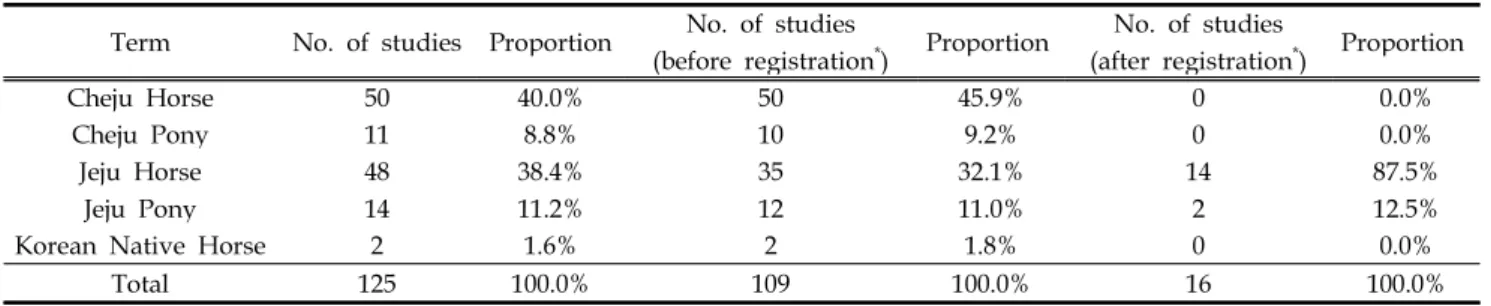
Table 2. Proportions based on English term notation of Jeju pony
Term No. of studies Proportion No. of studies Proportion No. of studies Proportion (before registration*) (after registration*)
Cheju Horse 50 40.0% 50 45.9% 0 0.0%
Cheju Pony 11 8.8% 10 9.2% 0 0.0%
Jeju Horse 48 38.4% 35 32.1% 14 87.5%
Jeju Pony 14 11.2% 12 11.0% 2 12.5%
Korean Native Horse 2 1.6% 2 1.8% 0 0.0%
Total 125 100.0% 109 100.0% 16 100.0%
*Term "Jeju Horse" was registered in Wikipedia on Aug 2014.
(A) Black (Ga-ra) (B) Bay (Yu-ma) (C) Chestnut (Jeok-da)
The overall coat color is black. The entire main coat color is chestnut or brown, but the color of mane, lower legs, and tail is black.
The overall coat color is chestnut or brown.
(D) Fallow (Go-ra) (E) Sorrel (Gong-gol-mal) (F) Gray (Chong-ma) The overall main coat color is
light brown while stretching line from mane to strunt and lower legs are black.
The entire coat color is
cream-colored with sorrel hair. The overall coat color is bay, chestnut, or black mixed with white hair.
(G) Roan (Bu-ru) (H) Pinto (Wal-la) The basic coat color is bay,
chestnut, or black with light white hair (less white than F) and the legs present the basic coat color without white hair.
The basic coat color is bay or black with big white spots.
Fig. 2. Jeju pony’s 12 coat colors. Pictures of white (Baek-ma), spotted (Ja-huel), speckled (Geo-huel), and brindle (Beom-ma) are not existed because their numbers are extremely rare. White (Baek-ma) has the entire white coat color. Spotted (Ja-huel) has the different small size of freckles (mainly white color) scattered over its overall body. Speckled (Geo-huel) has the colors around its eyes, bottom abdomen, and legs that show whiter or lighter than that of the overall coat color. Brindle (Beom-ma) has the entire subtle tiger-striped coat color with an irregular pattern. All pictures were referred from Jeju Horse Database System (http://jejuhorse.jeju.go.kr/main.do).
[Provider:earticle] Download by IP 118.70.52.165 at Monday, December 20, 2021 7:49 PM
www.earticle.net
continuously performed after the first report of repeatability estimation in 2004. After that, heritability was estimated using accumulated pedigree and racing records. The study showed that heritability was estimated to be lower for short distance finishing times, which is considered to be influenced more by the environment than genetic capacity. Thus, 800 m records are less suitable for studying racing improvement than
≥1000 m records. Therefore, it should be considered that research on the racing performance of Jeju pony using 1000 m records having large genetic gain and high frequency. Additional research is needed to improve preservation and pedigree management strategies for Jeju ponies. Specifically, behavioral research is needed to determine the cause of decreasing the number of offsprings caused by the behavioral influence of the their society. The effective population size of Jeju ponies should be carefully interpreted with sample size and analysis method, and the effective population size should be continuously estimated in order to preserve the population of the breed.
Additionally, Jeju Horses were referred to using five different names (Cheju horse, Cheju pony, Jeju horse,
Jeju pony, Korean native horse) in the literature. The terms ‘Cheju Horse’ and ‘Jeju Horse’ accounted for 40.0% (50) and 38.4% (48) of the studies, respectively.
‘Cheju Pony’ and ‘Jeju Pony’ were used in 8.8% (11) and 11.2% (14) of the studies, and only 1.6% (2) of the studies used the term ‘Korean Native Horse’. Since the term ‘Jeju Horse’ was registered in Wikipedia in August 2014, it was used more commonly in the literature, accounting for 87.5% (14) of the studies published after this data (Table 2). Research using DNA increased since genome research technologies were developed in the 1990s, and in early genetics studies the Jeju Horse was mostly referred to as ‘Cheju Horse’ or ‘Cheju Pony’.
However, ‘Jeju Horse’ or ‘Jeju Pony’ have been used more frequently since the 2000s, and ‘Cheju Horse’ and
‘Cheju Pony’ were not used after 2005 (Fig. 1). Recently, the number of research papers written as ‘Jeju Horse’
has increased. However, Jeju pony is considered to belong to pony type because many organizations define a pony that measures less than 147 cm at the withers.
Therefore, to prevent confusion the name ‘Jeju Pony’
should exclusively be used when referring to this breed.
Fig. 3. Distribution of Jeju pony’s coat color. (A) and (B) were referred to as Lee (1971) and Kang et al. (1988), respectively.
[Provider:earticle] Download by IP 118.70.52.165 at Monday, December 20, 2021 7:49 PM
www.earticle.net
Ⅴ. REFERENCES
1. Ahn, K., Bae, J. H., Nam, K. H., Lee, C. E., Park, K.
D., Lee, H. K., Cho, B. W. and Kim, H. S. 2011.
Identification of reference genes for normalization of gene expression in thoroughbred and Jeju native horse (Jeju pony) tissues. Genes Genom. 33:245-250.
2. Beak, K. W., Gim, J. A. and Park, J. J. 2018. Genetic analysis strategies for improving race performance of Thoroughbred racehorse and Jeju horse. J. Life Sci.
28(1):130-139.
3. Brooks, S. A., Lear, T. L., Adelson, D. L. and Bailey, E. 2007. A chromosome inversion near the KIT gene and the Tobiano spotting pattern in horses. Cytogenet.
Genome Res. 119:225-230.
4. Chang, D. G., Seo, M. H., Kim, Y. H., Ko, G. R. and Kim, J. K. 1991. Studies on the reproductive efficiency and cause of reproductive disorders in Cheju ponies and horses. Chuksannonchong 6:55-66.
5. Chang, D. G., Yang, K. C., Kim, J. K. and Suh, M. H.
1990. Therapeutic effect of prostaglandin F2alpha on anestrus in Cheju pony mares. Korean J. Vet. Res.
30(3):349-354.
6. Chang, D. J. and Kim, J. K. 1996. Studies on the progesterone level for early pregnency diagnosis of Cheju native mares. 11:85-91.
7. Cho, B. W. 1999. Fundamental studies on the development of horse pedigree system with genetic analysis of Che-ju horse. J. Agri. Tech. Dev. Inst.
3:249-254.
8. Cho, B. W. 2001. Cloning and sequencing of breed specific DNA fragment in horse. J. Agri. Tech. Dev.
Inst. 5:101-107.
9. Cho, B. W. 2005a. Development of sequence characterized amplified regions (SCAR) showing for Cheju native horse. J. Life Sci. 15(3):474-478.
10. Cho, B. W. and Lee, K. W. 2004. Genetic diversity analysis of the Cheju horse using random amplified polymorphic DNAs. J. Life Sci. 14(3):521-524.
11. Cho, B. W., Jung, J. H., Kim, S. W., Kim, H. S., Lee, H. K., Cho, G. J. and Song, K. D. 2007. Establishment of genetic characteristics and individual identification
system using microsatellite loci in Jeju native horse.
J. Life Sci. 17(10):1441-1446.
12. Cho, B. W., Lee, K. W., Kang, H. S., Kim, S. G., Park, M. H. and Kim, Y. J. 2000. Application of random amplified polymorphic DNAs methods to identify interbreed difference in horse. J. Agri. Tech. Dev.
Inst. 4:161-165.
13. Cho, B. W., Lee, K. W., Kang, H. S., Kim, S. G., Shin, T. S. and Jeon, H. Y. 1998. Development of RAPD marker specific for Cheju horse (Jorangmal). J. Agri.
Tech. Dev. Inst. 2:119-125.
14. Cho, B. W., Lee, K. W., Kang, H. S., Kim, S. K., Shin, T. S. and Kim, Y. G. 2001a. Application of polymerase chain reaction with short oligonucleotide primers of arbitrary sequence for the genetic analysis of Cheju native horse. J. Agri. Tech. Dev. Inst.
5:109-114.
15. Cho, B. W., Lee, K. W., Kang, H. S., Kim, S. K., Shin, T. S. and Kim, Y. G. 2001b. J. Agri. Tech. Dev. Inst.
5:93-99.
16. Cho, B. W., Lee, K. W., Kim, S. K. and Kim, Y. G.
2001c. Identification of DNA markers to characterize horse breed using random amplified polymorphic DNAs. J. Agri. Tech. Dev. Inst. 5:85-92.
17. Cho, G. J. 2005b. Analysis of genetic polymorphism by bloodtyping in Jeju horse. J. Life Sci. 15(6):972- 978.
18. Cho, G. J. 2006. Genetic relationship among the Korean native and alien horses estimated by microsatellite polymorphism. Asian-Australas. J.
Anim. Sci. 19(6):784-788.
19. Cho, G. J. and Cho, B. W. 2004. Microsatellite DNA typing using 16 markers for parentage verification of the Korean native horse. Asian-Australas. J. Anim.
Sci. 17(6):750-754.
20. Cho, G. J., Cho, B. W., Kang, H. S. and Kim, Y. K.
2003. Detection of silent allele at esterase(Es) locus in Jeju native horse. Korean J. Life Sci. 13(4):412-415.
21. Cho, G. J., Yang, Y. J., Kang, H. S. and Cho, B. W.
2002. Genetic diversity and validation of microsatellite markers for Jeju native horse parentage testing.
Korean J. Genetics 24(4):359-365.
[Provider:earticle] Download by IP 118.70.52.165 at Monday, December 20, 2021 7:49 PM
www.earticle.net
22. Choi, K. S. and Yang, T. S. 2017. A study on the menu quality of Jeju horse restaurants using revised IPA. JHTR. 31(9):233-246.
23. Choi, S. K., Cho, C. Y., Yeon, S. H., Cho, B. W. and Cho, G. J. 2008. Genetic characterization and polymorphisms for parentage testing of the Jeju horse using 20 microsatellite loci. J. Vet. Med. Sci.
70(10):1111-1115.
24. Do, K. T., Lee, J. H., Lee, H. K., Kim, J. and Park, K.
D. 2014. Estimation of effective population size using single-nucleotide polymorphism (SNP) data in Jeju horse. J. Anim. Sci. Technol. 56:28.
25. Gim, J. A. and Kim, H. S. 2017. Identification and expression analyses of equine endogenous retroviruses in horses. Mol. Cells 40(10):796-804.
26. Gupta, G. D., Lakritz, J., Kim, J. H., Kim, D. Y., Kim, J. K. and Marsh, A. E. 2002. Seroprevalence of Neospora, Toxoplasma gondii and Sarcocystis neurona antibodies in horses from Jeju island, South Korea. Vet. Parasitol. 106:193-201.
27. Haase, B., Jede, R., Brooks, S. A. and Leeb, T. 2008.
An equine chromosome 3 inversion is associated with the tobiano spotting pattern in German horse breeds. Anim. Genet. 39(3):306-309.
28. Han, B. K., Chang, D. G. and Hyun, H. S. 1990.
Effect of age, season and sex on the blood preperties in the Cheju horse. Korean J. Vet. Sci. 30(4):525-532.
29. Han, B. K., Chang, D. G., Kim, S. K. and Matsumoto, H. 1992. Classification of the blood group in Cheju native horses by the antiserum of isoimmunization.
Korean J. Vet. Res. 32(3):451-456.
30. Han, B. K., Chang, D. J., Tsuchida, S. and Ikemoto, S. 1994. Mitochondrial DNA polymorphism in the Cheju horses. Korean J. Vet. Res. 34(2):243-247.
31. Han, B. K., Han, H. J., Kim, J. B., Ko, M. S. and Matsumoto, H. 1996. Serum selenium and alpha- tocopherol concentration in Cheju mares. Korean J.
Vet. Res. 36(1): 51-56.
32. Han, S. H., Jung, Y. H., Oh, Y. S. and Oh, M. Y.
2001. Genetic polymorphism of mitochondrial cytochrome b gene in Jeju native horses inferred from PCR-RFLP. J. Basic Sci. 14(1):39-46.
33. Han, S. H., Kim, J. H., Song, J. H., Oh, J. H., Oh, Y.
S., Jung, Y. H., Kayano, H. and Oh, M. Y. 2004.
Polymorphism of the mtDNA cytochrome B and NADH dehydrogenase 6 genes in Tsushima and Jeju native horses. Korean J. Genetics 26(1):1-7.
34. Han, S. H., Lee, C. E., Kim, N. Y., Ko, M. S., Jeong, H. Y. and Lee, S. S. 2009. Genetic polymorphisms of candidate loci and inheritance patterns of gray coat color in Jeju Horses. J. Life Sci. 19(6):793-798.
35. Han, S. K., Chung, E. Y., Shin, Y. C. and Byun, H.
D. 1995. Studies on serum protein and enzyme polymorphisms for conservation of Cheju native horses. Korean J. Anim. Sci. 37(1):52-58.
36. Hyun, H. S., Kim, W. K. and Chang, D. G. 1991a.
Studies on catalase type in Cheju native horse.
Korean J. Vet. Res. 31(2):167-170.
37. Hyun, H. S., Kim, W. K. and Han, B. K. 1991b.
Studies on hemoglobin type in Cheju native horse.
Korean J. Vet. Res. 31(2):163-166.
38. Jung, C. J., Yang, Y. H., Kim, J. K. and Kang, M. S.
1991. Studies on the classification for the registration of the Cheju Native Horse I. Body measurements by location, sex and age. J. Anim. Sci. Technol. 33(6):
418-422.
39. Jung, Y. H., Han, S. H., Shin, T. and Oh, M. Y. 2002.
Genetic characterization of horse bone excavated from the Kwakji archaeological site, Jeju, Korea. Mol.
Cells 14:224-230.
40. Kang, K. B. and Kang, T. S. 2002. Analysis of management efficiency using data envelopment analysis in Cheju horse raising farms. Korea J. Agri.
Mangement Policy 29(2):265-282.
41. Kang, M. H. 1965. Systematic studies on the Korean Native Horse. J. Anim. Sci. Technol. 7:92-97.
42. Kang, M. S. 2000a. The present and future situation of native Cheju horse. J. Res. Ins. Anim. Sci. 15:81-87.
43. Kang, M. S., Choung, C. C., Kang, T. S. and Choung, J. J. 1988. Coat color frequencies in the Cheju Island Pony. Chuksannonchong 3:29-32.
44. Kang, O. D., Ryu, Y. C., Ryew, C. C., Oh, W. Y., Lee, C. E. and Kang, M. S. 2010. Comparative analyses of rider position according to skill levels during walk
[Provider:earticle] Download by IP 118.70.52.165 at Monday, December 20, 2021 7:49 PM
www.earticle.net
and trot in Jeju horse. Hum. Mov. Sci. 29:956-963.
45. Kang, T. S. 2000b. Use of Cheju horses for racing.
Korea J. Agri. Management Policy 27:103-115.
46. Kang, T. Y. and Kang, M. S. 2006. Assessment of Jeju horse semen using computer-assisted sperm analysis (CASA). Korean J. Emb. Trans. 21(1):69-75.
47. Kim, C. S., Won, C. K. and Suh, M. D. 2003. A case of fused lumbar vertebrae in Cheju native horse.
Korean J. Vet. Res. 43(1):1-3.
48. Kim, D., Kim, H. J., Chae, H. S., Park, N. G., Kim, Y.
B. and Jang, A. 2014a. Anti-exidation and anti- wrinkling effects of Jeju horse leg bone hydrolysates.
Korean J. Food Sci. An. 34(6):844-851.
49. Kim, G. O. and Oh, M. Y. 1995. Polymorphism of plasma proteins by two dimensional horizontal electrophoresis in Cheju native horse. Korean J.
Anim. Sci. 37(6):603-610.
50. Kim, G. O., Kim, S. J. and Oh, M. Y. 1999a.
PCR-RFLP of the cytochrome b genes in the Cheju native horses. Korean J. Genetics 21(1):29-34.
51. Kim, J. G. and Choi, H. I. 1994. Nutritional secondary hyperparathyroidism in Cheju pony racehorces. Korean J. Vet. Clin. Med. 11(1):347-358.
52. Kim, J. K. and Chang, D. G. 1990. Studies on the reproductive efficiency and causes of reproductive disorders in Cheju pony mares I. A study on the reproductive performance in Cheju pony mares.
Korean J. Anim. Sci. 32(8):438-444.
53. Kim, J. K. and Chang, D. G. 1990. Studies on the reproductive efficiency and causes of reproductive disorders in Cheju pony mares II. A study on the causes of reproductive disorders in Cheju pony mares. Korean J. Anim. Sci. 32(9):514-519.
54. Kim, J. K., Chang, D. G. and Seo, M. H. 1990a.
Studies on the blood steroid hormone levels during the reproductive stage in Cheju pony mares I. A study on the changes of estradiol-17beta and progesterone levels in the plasma. Koraen J. Anim.
Sci. 32(7):362-367.
55. Kim, J. K., Chang, D. G. and Seo, M. H. 1990b.
Studies on the blood steroid hormone levels during the reproductive stage in Cheju pony mares II. A
study on the changes of estradiol-17beta and progesterone levels in the plasma during gestation and parturition period. 1990. Korean J. Anim.
Reprod. 15(2):117-124.
56. Kim, J. K., Choung, C. C. and Chang, D. J. 1990c.
Studies on the progesterone level for early prognacy diagnosis of Cheju native mares. Chuksannonchong 5:3-9.
57. Kim, J., Lee, M. J., Oh, W. Y., Kim, D. H., Kim, S.
D., Choi, J. G. and Cho, B. W. 2015a. Estimation of effective population size of Jeju horse in Korea. J.
Agri. Life Sci. 49(2):67-73.
58. Kim, K. I. 1999. Cheju horses and their origin. J. Res.
Ins. Anim. Sci. 14:79-93.
59. Kim, K. I., Yang, Y. H., Lee, S. S., Park, C., Ma, R., Bouzat, J. L. and Lewin, H. A. 1999b. Phylogenetic relationship of Cheju horses to other horse breeds as determined by mtDNA D-loop sequence polymorphism.
Anim. Genet. 30:102-108.
60. Kim, N. Y., Chae, H. S., Baek, K. S., Cho, I. C., Jung, Y. H., Woo, J. H., Park, S. H., Kim, J. H., Lee, S. S.
and Yang, Y. H. 2015b. A study on the changes of coat color-related genes according to generational changes in Jeju Horses. J. Embryo Transf. 30(3):183- 188.
61. Kim, N. Y., Han, S. H., Lee, S. S., Lee, C. E., Park, N.
G., Ko, M. S. and Yang, Y. H. 2011. Relationship between MC1R and ASIP genotypes and basic coat colors in Jeju Horses. J. Anim. Sci. Technol. 53(2):
107-111.
62. Kim, N. Y., Lee, S. S. and Yang, Y. H. 2002.
Polymorphisms of the exons 13, 15 and 16 of transferrin gene in Cheju horses. J. Anim. Sci.
Technol. 44(4): 391-398.
63. Kim, N. Y., Lee, S. S. and Yang, Y. H. 2014b.
Influence of amount of pedigree information and parental misidentification of progeny on estimates of genetic parameters in Jeju race horses. J. Embryo Transf. 29(3):289-296.
64. Kim, N. Y., Shin, K. Y., Lee, C. E., Han, S. H., Lee, S. S., Park, Y. S., Ko, M. S., Hong, H. J., Yang, J. H., Jang, D. J. and Yang, Y. H. 2012. Genetic
[Provider:earticle] Download by IP 118.70.52.165 at Monday, December 20, 2021 7:49 PM
www.earticle.net
characterization of Wolla coat color in Jeju Horses. J.
Anim. Sci. Technol. 54(5):375-379.
65. Kim, N. Y., Yang, B. C., Son, J. K., Shin, S. M., Woo, J. H., Shin, M. C. and Yoo, J. H. 2018. The origin of Jeju horses and the coat color characteristics – A Review. J. Anim. Breed. Genomics 2(1):28-31.
66. Kim, S. H. 1993. On the classification and distribution of Gasterophilus spp in the gastrointestinal tract in Cheju horse. Korean J. Vet. Res. 33(1):109-117.
67. Kim, S. M., Kim, M. N., Lee, S. S., Kim, N. Y. and Yang, Y. H. 2009. Racing performance and preferences for the coat colors in Jeju horses. J.
Subtropical Agri. Biotech. 25(1):39-43.
68. Kim, Y. B., Jeon, K. H., Rho, J. H. and Kang, S. N.
2005. Physicochemical properties of loin and rump in the native horse meat from Jeju. Korean J. Food Sci.
An. 25(4):365-372.
69. Ko, C. W., Lee, H. J. and Park, H. S. 1986. Studies on electrophoresis characteristics of proteins in Cheju native mare’s milk. Chuksannonchong 1:83-94.
70. Kong, H. S., Lee, H. K., Park, K. D. and Cho, B. W.
2011. A breed comparison on the finishing times of racehorses. J. Anim. Sci. Technol. 53(1):23-27.
71. Kwon, D. Y. and Cho, G. J. 2009. Standardization and usefulness of ISAG microsatellite markers for individual identification and parentage verification in horse breeds. J. Vet. Clin. 26(3):220-225.
72. Kwon, T. J., Jung, J. W., Kang, O. D., Kim, G. G., Kang, D. G., Kim, J. H., Park, J. H., Kim, D. W., Ahn, S. M. and Kang, M. S. 2007. The study of the investigation for the behavioral pattern of grazing Jeju stallion(1). J. Cheju Studies 30:27-62.
73. Kwon, T. J., Jung, J. W., Kang, O. D., Kim, G. G., Kang, D. G., Kim, J. H., Park, J. H., Kim, D. W., Ahn, S. M. and Kang, M. S. 2008. The study of the investigation for the behavioral pattern of grazing Jeju stallion(2). J. Cheju Studies 31:29-51.
74. Lee, H. J. 1995. Studies on Cheju native horse’s meat.
J. Res. Ins. Anim. Sci. 10:31-42.
75. Lee, H. J. 1999. A study on practical use of an unnecessary cheju horse. J. Res. Ins. Anim. Sci.
14:103-114.
76. Lee, H. J. and Kim, H. K. 1985. Studies on protein of Cheju native horse I. properties of casein (I). Korean J. Anim. Sci. 27(6):413-415.
77. Lee, J. H., Song, K. D., Kim, J. M., Leem, H. K. and Park, K. D. 2016. Identification of genes with nonsynonymous SNP in Jeju horse by whole-genome resequencing reveals a functional role for immune response. J. Anim. Sci. 94(3):895-901.
78. Lee, J. R., Hong, C. P., Moon, J. W., Jung, Y. D., Kim, D. S., Kim, T. H., Gim, J. A., Bae, J. H., Choi, Y., Eo, J., Kwon, Y. J., Song, S., Ko, J., Yang, Y. M., Lee, H. K., Park, K. D., Ahn, K., Do, K. T., Ha, H. S., Han, K., Yi, J. M., Cha, H. J., Cho, B. W., Bhak, J.
and Kim, H. S. 2014. Genome-wde analysis of DNA methylation patterns in horse. BMC Genomics 15:598.
79. Lee, K. K., Cheong, J. T., Woo, H. C., Kim, H. S., Yang, K. C. and Kim, S. H. 1995. The studies on the mobility and the parasitic infection rate in Cheju horse. J. Res. Ins. Anim. Sci. 10:77-83.
80. Lee, K. M. 1961. Biostatistic study on the type of the Cheju Horses in Quelpart. J. Anim. Sci. Technol.
3:63-73.
81. Lee, K. M. 1971. Studies on the old name and distribution of coat color in the Cheju Horse.
Konkuk University 12:893-909.
82. Lee, S. K., Han, J. I. and Kang, H. G. 2013. Equine motor neuron disease in a Jeju pony. J. Vet. Clin.
30(2):142-145.
83. Lee, W. C., Kim, H. J. and Shin, T. H. 1974. A biometric study on hardness of bone in race horse and Jeju horse. Korean J. Vet. Res. 14(2):185-189.
84. Lee, W., Park, K. D., Taye, M., Lee, C., Kim, H., Lee, H. K. and Shin, D. H. 2018. Analysis of cross- population differentiation between Thoroughbred and Jeju horses. Asian-Australas. J. Anim. Sci. 31(8):1110- 1118.
85. Marklund, L., Moller, M. J., Sandberg, K. and Andersson, L. 1996. A missense mutation in the gene for melanocyte-stimulating hormone receptor (MC1R) is associated with the chestnut coat color in horses.
Mamm. Genome 7:895-899.
86. Moon, S., Lee, J. W., Shin, D., Shin, K. Y., Kim, J.,
[Provider:earticle] Download by IP 118.70.52.165 at Monday, December 20, 2021 7:49 PM
www.earticle.net
Choi, I. Y., Kim, J. and Kim, H. 2015. A genome- wide scan for selective sweeps in racing horses.
Asian-Australas. J. Anim. Sci. 28(11): 1525-1531.
87. Oh, M. Y. and Jung, Y. H. 2001. Mitochondrial DNA polymorphism in Cheju and Tsushima native horses using SSCP analysis. Korean J. Genetics 23(1):35-43.
88. Oh, M. Y., Ko, M. H., Kim, G. O., Oh, Y. S., Jung, Y.
H., Kim, S. J., Hong, S. S. and Kayano, H. 1997.
Restriction enzyme analysis of mitochondrial DNA in Cheju and Tsushima native horses and evolutionary releationships. Korean J. Anim. Sci. 39(4):327-334.
89. Oh, M. Y., Ko, M. H., Kim, G. O., Oh, Y. S., Kim, S.
J. and Hong, S. S. 1994. Phylogenetic relationship of Cheju Native Horses by mitochondrial DNA analysis. Mol. Cells 4:13-20.
90. Oh, S. A., Ko, M. H., Ko, M. S., Lee, C. E., Park, Y.
S., Kang, T. Y., Ko, J. H. and Cho, W. M. 2012. Effect of glycerol and ethylene glycol on post-thawed sperm function in Jeju horse. Reprod. Dev. Biol.
36(3):199-206.
91. Oh, W. Y., Kang, T. H., Kim, D. C., Jin, S. H., Hong, S. K., Yang, S. J. and Jung, J. H. 1993. Effect of feeding method on growth performance and carcass characteristics of Cheju native horses. Korean J.
Anim. Sci. 35(6):505-509.
92. Oh, W. Y., Kim, B. W., Cho, H. W., Shin, T. S., Cho, S. K. and Cho, B. W. 2014. Analysis of associated race performance and functional characterization of conformation in Jeju horse. J. Agri. Life Sci. 48(1):
99-106.
93. Oh, W. Y., Ryew, C. C., Kim, J. H. and Hyun, S. H.
2009. Kinematic analysis of horse-riding posture according to skill levels during rising trot with Jeju-horse. Korean J. Sport Biomechanics 19(3):
467-479.
94. Park, J. S., Cho, B. W. and Sohn, S. H. 2009.
Karyotype of Jeju horse; G-, C- and NOR-banding. J.
Anim. Sci. Technol. 51(5):361-368.
95. Park, W., Kim, J., Kim, H. J., Choi, J. Y., Park, J. W., Cho, H. W., Kim, B. W., Park, M. H., Shin, T. S., Cho, S. K., Park, J. K., Kim, H., Hwang, J. Y., Lee, C.
K., Lee, H. K., Cho, S. and Cho, B. W. 2014a.
Investigation of De Novo unique differentially expressed genes related to evolution in exercise response during domestication in Thoroughbred race horses. PLoS One 9(3):e91418.
96. Park, Y. S., Kim, N. Y., Han, S. H., Park, N. G., Ko, M. S., Cho, W. M., Chae, H. S., Cho, I. C., Cho, S.
R., Woo, J. H. and Kang, T. Y. 2014b. Identification of bacteria by sequence analysis of 16S rRNA in testes of Jeju horses. J. Vet. Clin. 31(1):36-39.
97. Pielberg, G. R., Golovko, A., Sundström, E., Curik, I., Lennartsson, J., Seltenhammer, M. H., Druml, T., Binns, M., Fitzsimmons, C., Lindgren, G., Snadberg, K., Baumung, R., Vetterlein, M., Strömberg, S., Grabherr, M., Wade, C., Lindblad-Toh, K., Pontén, F., Heldin, C. H., Sölkner, J. and Andersson, L. 2008. A cis-acting regulatory mutation causes premature hair graying and susceptibility to melanoma in the horse.
Nat. Genet. 40:1004-1009.
98. Rho, J. R. and Choe, J. C. 2002. Diurnal activity patterns of Jeju ponies (Equus caballus). Korean J.
Biol. Sci. 6:293-299.
99. Rho, J. R. and Choe, J. C. 2003. Difference of early experience of foals according to dominance ranks of their mothers in the Jeju pony (Equus caballus).
Korean J. Biol. Sci. 7:119-122.
100. Rho, J. R., Srygley, R. B. and Choe, J. C. 2004a.
Age-specific fertility rates of the Jeju pony (Equus caballus). J. Ethol. 22:113-117.
101. Rho, J. R., Srygley, R. B. and Choe, J. C. 2004b.
Behavioral ecology of the Jeju pony (Equus caballus): effects of maternal age, maternal dominance hierarchy and foal age on mare aggression. Ecol. Res. 19:55-63.
102. Rho, J. R., Srygley, R. B. and Choe, J. C. 2005.
Gender differences in maternal intervention in Jeju ponies (Equus caballus). Korean J. Ecology 28(5):
225-260.
103. Rho, J. R., Srygley, R. B. and Choe, J. C. 2007. Sex preferences in Jeju pony foals (Equus caballus) for mutual grooming and play-fighting behaviors. Zool.
Sci. 24:769-773.
104. Rho, J. R., Srygley, R. B. and Choe, J. C. 2009. Age
[Provider:earticle] Download by IP 118.70.52.165 at Monday, December 20, 2021 7:49 PM
www.earticle.net
of the Jeju pony (Equus caballus) at first reproduction: potential costs for foals and mothers that first reproduce early in life. J. Ethol. 27:483-488.
105. Rieder, S., Taourit, S., Mariat, D., Langlois, B. and Guerin, G. 2001. Mutations in the agouti (ASIP), the extenstion (MC1R), and the brown (TYRP1) loci and their association to coat color phenotypes in horses (Equus caballus). Mamm. Genome 12:450-455.
106. Ryew, C. C. 2011. Verification on effectiveness of horse-riding as a mean of health and rehabilitation therapy by Jeju-native horse. J. Mar. Sport Studies 1(2):43-54.
107. Seo, M. G., Yun, S. H., Choi, S. K., Cho, G. J., Park, Y. S., Cho, K. H., Kwon, O. D. and Kwak, D. 2013.
Molecular and phylogenetic analysis of equine piroplasms in the Republic of Korea. Res. Vet. Sci.
94:579-583.
108. Seong, P. N., Lee, C. E., Park, B. Y., Hah, K. H. and Ko, M. S. 2006. Meat quality and sensory characteristics in Longissimus muscle of Jeju horse as influenced by ageing. J. Anim. Sci. Technol.
48(2):287-292.
109. Shin, J. A., Yang, Y. H., Kim, H. S., Yun, Y. M. and Lee, K. K. 2002. Genetic polymorphism of the serum proteins of horses in Jeju. J. Vet. Sci.
3(4):255-263.
110. Sohn, S. H., Cho, E. J. and Park, J. S. 2006.
Chromosome patterns and karyotype of the Jeju horse (Equus caballus). J. Agri. Tech. Res. Inst.
19:61-69.
111. Son, W. G., Lee, D. S., Yamatoda, N., Hatori, F., Shimizu, N., Kakuda, T., Sasaki, Y., Tsubaki, S. and Takai, S. 2006. Molecular typing of VapA-positive Rhodococcus equi isolates from Jeju native horses, Korea. J. Vet. Med. Sci. 68(3):249-253.
112. Wade, C. M., Giulotto, E., Sigurdsson, S., Zoli, M., Gnerre, S., Imsland, F., Lear, T. L., Adelson, D. L., Bailey, E., Bellone, R. R., Blöcker, H., Distl, O., Edgar, R. C., Garber, M., Leeb, T., Mauceli, E., MacLeod, J. N., Penedo, M. C. T., Raison, J. M., Sharpe, T., Vogel, J., Andersson, L., Antczak, D. F., Biagi, T., Binns, M. M., Chowdhary, B. P., Coleman,
S. J., Della Valle, G., Fryc, S., Guérin, G., Hasegawa, T., Hill, E. W., Jurka, J., Kiialainen, A., Lindgren, G., Liu, J., Magnani, E., Mickelson, J. R., Murray, J., Nergadze, S. G., Onofrio, R., Pedroni, S., Piras, M.
F., Raudsepp, T., Rocchi, M., Røed, K. H., Ryder, O.
A., Searle, S., Skow, L., Swinburne, J. E., Syvänen, A. C., Tozaki, T., Valberg, S. J., Vaudin, M., White, J. R., Zody, M. C., Broad Institute Genome Sequencing Platform, Broad Institute Whole Genome Assembly Team, Lander, E. S. and Lindblad-Toh, K. 2009. Genome sequence, comparative analysis, and population genetics of the domestic horse. Science 326:865-867.
113. Yang, J. and Lim, Y. K. 2014. Surveillance for equine infectious anemia in Jeju island. J. Vet. Clin.
31(4):357-359.
114. Yang, J., Han, J., Hwang, K. K. and Lim, Y. K. 2015.
Incidence of wolf teeth in Jeju ponies and Jeju pony crossbreds. J. Vet. Clin. 32(3):285-287.
115. Yang, J., Moon, K. H. and Lim, Y. K. 2016.
Comparison of hippological differences between Jeju ponies and Jeju pony crossbreds: II. The incidence of innate pacers in the Jeju raceresource. J. Vet.
Clin. 33(6):400-401.
116. Yang, Y. H. 1997. Study on the registration grades of Cheju Horses by discriminant analysis with various body measurements. J. Res. Inst. Anim.
Biotechnol. 12(1):89-98.
117. Yang, Y. H. 1999. Characteristics of Cheju horses with body measurement blood protein and DNA polymorphism. J. Res. Ins. Anim. Sci. 14:1-11.
118. Yang, Y. H. 2002. Estimates of standard growth performance of Cheju horse by Gompertz growth curve function. J. Subtropical Agri. Biotech.
18(2):53-60.
119. Yang, Y. H. 2004a. Estimation of performance and repeatability for racing speed in Cheju horse. J.
Subtropical Agri. Biotech. 20(2):33-37.
120. Yang, Y. H. 2004b. Genetic diversity of the various conserved mtDNA control regions of Cheju Horses.
J. Subtropical Agri. Biotech. 20(1):61-67.
121. Yang, Y. H. 2005a. Effect of racing lane at start on
[Provider:earticle] Download by IP 118.70.52.165 at Monday, December 20, 2021 7:49 PM
www.earticle.net
the racing performance in Cheju horses. J.
Subtropical Agri. Biotech. 21(2):23-27.
122. Yang, Y. H. 2005b. Fixed effects of the condition of race track and season on racing performance in Cheju horse. J. Subtropical Agri. Biotech. 21(1):55-60.
123. Yang, Y. H. 2009. Basics of Genetic and Breeding in Jeju Horse. Gyeongminsa, Jeju, Korea.
124. Yang, Y. H. 2012. Estimation of genetic parameters for racing performance of Jeju horses. J. Subtropical Agri. Biotech. 28(1):45-51.
125. Yang, Y. H. 2014. Permanent environmental and additive genetic variability of body weight in Jeju Horse. J. Subtropical Agri. Biotech. 30(1):39-43.
126. Yang, Y. H. and Kim, N. Y. 2004. Genetic features of Cheju horses based on transferrin gene frequency. J. Anim. Sci. Technol. 46(1):15-22.
127. Yang, Y. H. and Lee, S. S. 2009. Effects of handicap weight, horse’s body weight and weight change on racing performance in Jeju horses. J. Subtropical Agri. Biotech. 25(1):33-38.
128. Yang, Y. H., Jung, C. J., Lee, H. J. and Kang, T. S.
1991. Studies on the classification for the registration of the Cheju Native Horse II. The effect of the registration grade on the body measurements.
J. Anim. Sci. Technol. 33(6):438-443.
129. Yang, Y. H., Kim, K. I. and Jung, C. J. 2005. Study on the development of feeding program for horse meat production. J. Subtropical. Agri. Biotech.
21:35-41.
130. Yang, Y. H., Kim, K. I., Cothran, E. G. and Flannery, A. R. 2002. Genetic diversity of Cheju Horses (Equus caballus) determined by using mitochondrial DNA D-loop polymorphism.
Biochem. Genet. 40:5-6.
131. Yoo, J. G., Kang, M. S., Son, W. J., Yun, Y. M., Lee, J. M. and Kang, T. Y. 2007. Measurement of size of ovaries, follicles, and corpus lutea by ultrasonography with Jeju horse. Emb. Trans.
22(3):191-194.
132. Yoon, S. H., Kim, J., Shin, D., Cho, S., Kwak, W., Lee, H. K., Park, K. D. and Kim, H. 2017. Complete mitochondrial genome sequences of Korean native horse from Jeju Island: uncovering the spatio- temporal dynamics. Mol. Biol. Rep. 44(2):233-242.
(Received 12 November 2018, Revised 20 February 2019, Accepted 26 February 2019)
[Provider:earticle] Download by IP 118.70.52.165 at Monday, December 20, 2021 7:49 PM