• 검색 결과가 없습니다.

Enhanced Durability Performance of Rock-Filled-Dam Face-Slab Concrete using Fly Ash and Blended PVA Fiber

N/A
N/A
Protected

Academic year: 2021

Share "Enhanced Durability Performance of Rock-Filled-Dam Face-Slab Concrete using Fly Ash and Blended PVA Fiber"

Copied!
9
0
0

로드 중.... (전체 텍스트 보기)

전체 글

(1)

1. Introduction

Dams are permanent structures that must be made from highly durable concrete. Because they are mass concrete structures that are constructed in one continuous build using large amounts of concrete, they have a high risk of cracking from both the effects of hydration heat produced while the concrete hardens and the very large surface area of the structures. Examination of the causes of cracks in dam concrete has revealed that plastic shrinkage cracking results from rapid evaporation of moisture from hydration heat in the initial stage of hardening. Plastic shrinkage cracking in concrete is affected by environmental conditions such as temperature, relative humidity and wind speed, as well as factors such as the internal concrete temperature and bleeding. At the time of concrete pouring, loss of moisture due to foundational or moulding material and the internal loss of water due to surface evaporation during the hydration period

provide, to a certain degree, the initial stage of binding of the concrete surface, and thereby make the occurrence of plastic shrinkage cracking possible. When a crack, either internal or external, occurs in dam concrete, water permeability increases and causes the durability of the structure to deteriorate. This may have a serious impact on the safety of dams. Durability rapidly deteriorates under environmental conditions such as repeated freezing and thawing in winter, abrasions from flowing water and repeated drying and wetting from increases and decreases of water volume in the summer(Woo et al., 2009). Table 1 lists the causes of damage to concrete dams in the USA, Canada, Japan and Korea(An, 1998).

The major causes of damage are freezing, water penetration, degradation and erosion. Therefore, the durability of dam concrete must be enhanced.

One method for reducing crack occurrence and maintaining the durability of a concrete dam is to use fly ash, a pozzolan material that can retard hydration heat production and add fiber as a reinforcing material for the concrete(Lee et al., 1998; Neville, 1995; Naik et al., 1995; Naik, Singh and Mohammad, 1995;

Malhotra et al., 1994; Naik and Singh, 1997). The use of fly ash retards the hydration reaction in mass concrete and thus inhibits temperature cracks from hydration heat production. In the long term, the use of fly ash makes the interior of the concrete very

Journal of the Korea Institute for Structural Maintenance and Inspection Vol. 20, No. 3, May 2016, pp.140-148

http://dx.doi.org/10.11112/jksmi.2016.20.3.140 pISSN 2234-6937

eISSN 2287-6979

플라이애시와 PVA 섬유를 혼입한 댐 표면 차수벽 콘크리트의 내구성능 평가

우상균1, 원종필2, 배두산3, 추인엽4*

Enhanced Durability Performance of Rock-Filled-Dam Face-Slab Concrete using Fly Ash and Blended PVA Fiber

Sang-Kyun Woo

1

, Jong-Pil Won

2

, Doo-San Bae

3

, In-Yeop Chu

4

*

Abstract:

This study examined the durability of face-slab concrete in Concrete-Faced Rock-filled Dams(CFRDs). The durability of face-slab concrete can be improved by optimizing the amount of fly ash in the cement mixture. Durability tests including plastic shrinkage, permeability, abrasion resistance, and repeated freezing and thawing were done on face-slab concrete specimens with different amounts of fly ash and blended PVA(Poly Vinyl Alcohol) fibre. When the effect of the fly ash content on concrete durability was evaluated, the results showed that a 15% fly ash content and 0.1%

blended PVA fiber yielded the optimum durability level for concrete-faced rock-filled dams.

Keywords:

CFRD, Face-slab concrete, Durability, Fly ash, Poly vinyl alcohol fiber

1정회원, 한국전력공사 전력연구원 책임연구원

2정회원, 건국대학교 사회환경시스템공학과 교수

3학생회원, 한국전력공사 전력연구원 일반연구원

4정회원, 한국전력공사 전력연구원 선임연구원, 교신저자

*Corresponding author: [email protected]

KEPCO(Korea Electric Power Corporation) Research Institute

∙본 논문에 대한 토의를 2016년 6월 1일까지 학회로 보내주시면 2016년 7월 호에 토론결과를 게재하겠습니다.

Copyright Ⓒ 2016 by The Korea Institute for Structural Maintenance and Inspection. This is an Open Access article distributed under the terms of the Creative Commons Attribution Non-Commercial License (http://creativecommons.org/licenses/by-nc/3.0)which permits unrestricted non-commercial use, distribution, and reproduction in any medium,


(2)

dense, thus decreasing the water permeability and improving the long-term durability of the structure. As a substitute for cement, fly ash also improves the economic efficiency of the structure.

The addition of fiber significantly reduces the width of cracks by inhibiting fiber bridging, debonding, pullout, destruction and fracture, and affects other factors that would lead to the occurrence and development of various cracks. Fiber therefore provides superior resistance against increases in water permeability and decreases in durability caused by fine cracks in the concrete.

A method to improve the durability of concrete-faced rock-filled dams(CFRDs) is to add poly vinyl alcohol fiber and pozzolan fly ash to the face-slab concrete. These materials provide superior economic efficiency and crack control and are used widely in concrete structures such as bridge deck slabs, road pavements and hydraulic structures. In general, fly ash should be used as a substitute for a given amount of cement by weight, and an appropriate amount of fly ash improves the durability of concrete.

Gopalan(1993) studied the change in strength resulting from the addition of fly ash. He showed that as the amount of fly ash increased, the initial stage strength of the concrete decreased from the delay in the hydration reaction due to the pozzolanic reaction, but the long-term strength of the concrete improved compared with ordinary concrete. Sivasundaram et al.(1991) measured the water permeability characteristics of concrete with fly ash using an electric charge quantity measurement test based on chloride ion penetration. Their results showed that the quantity of electric charge passed decreased as the amount of fly ash increased. Such a phenomenon is due to an increase in

resistance to water permeability from the fine powder of the fly ash filling the micro-crevices of the concrete. Alhozaimy et al.(1996) performed tests on mortar with fly ash added and their results showed that resistance to water permeability improved as the amount of fly ash increased. Nasser et al.(1992) tested the freezing and thawing resistance of fly ash concrete after fixing the amount of air at 4-6%. According to their test results, 20% fly ash content produced the optimal outcome, while 35-50%

fly ash content lowered the resistance of the concrete to freezing and thawing. Yoon et al.(2002) performed durability tests of face slab concrete in CFRDS, and their results showed that 15% fly ash was the optimal level with excellent performance in durability. Woo et al.(2009) examined the durability of face slab concrete in CFRDs. According to their test results, 20% fly ash content produced an optimal outcome in the durability and economic efficiency of dam concrete. Woo et al.(2011) also tested the durability of face slab concrete in CFRDs. According to their test results, 15% fly ash content and a 0.1% PVA Fiber provided the most effective outcome for CFRDs.

Thus, polypropylene fiber improves the durability of concrete.

Arshad et al.(1996) studied the change in tensile strength of low, medium and high strength concrete at early ages resulting from the addition of polypropylene fiber. They showed that the addition of polypropylene fiber increased the tensile strength of low, medium and high strength concrete at early ages. Parviz et al.(1998) studied the control of plastic shrinkage cracking with specialty cellulose fibers. They showed that the addition of cellulose fiber increased the resistance to crack occurrence in concrete. Won et al.(1999) also studied the shrinkage cracking and durability characteristics of polypropylene fiber reinforced concrete. According to their test results, a 0.1% polypropylene fiber content produced the optimal outcome in durability and shrinkage cracking of polypropylene fiber reinforced concrete.

Woo et al.(2004) studied the improvement of concrete durability for concrete faced rockfill dams using poly vinyl alcohol fiber which has a hydrophilic property. They showed that a 0.1%

poly vinyl alcohol fiber content produced better results in durability and crack control than that of ordinary Portland cement(OPC) concrete and fly ash concrete. During the initial stage of hardening, the compressive strength of fly ash concrete is lower than that of ordinary Portland cement(OPC) concrete because the strength of fly ash concrete develops slowly. There is a need to determine the appropriate amount of fly ash to be added to face-slab concrete to improve the durability of CFRDs.

Table 1 Cause of damage in concrete dams

Classification America [%]

Canada [%]

Japan [%]

Korea [%]

Overflow 23.7 - 5.3 9.7

Penetration - 6.7 2.6 3.1

Leakage 50 - 10.5 13.1

Erosion 7.9 - 18.4 8.8

Sliding 5.3 13.3 - 6.2

Freezing - 53.3 23.7 25.7

Earthquake - - - -

Degradation and

Deformation 21.1 - 26.3 15.8

Defect of Execution 5.3 - 2.6 2.6

Damage of Spillway 7.9 26.7 - 11.5

Others - - 10.5 3.5

Total 100 100 100 100

(3)

Because face slab concrete is mass concrete with large sectional areas, pouring the slab all at once is, however, impossible. One must ensure that the initial strength of the previously poured concrete is sufficient to support the new concrete. Therefore, the constructability of a dam must be considered along with its durability. The primary goal of this study was to establish the most effective mixing ratio of fly ash that provides the best economic efficiency and long-term durability for face-slab concrete used in CFRDs. The studies described above suggest that the appropriate level of fly ash was in the range of 0-25%. In addition, they also suggest that the poly vinyl alcohol fiber has a hydrophilic property and good resistance to crack occurrence as well as a number of good results in durability tests of concrete. Thus, this study also evaluated the improved crack control and durability as a result of adding poly vinyl alcohol fibers to fly ash concrete.

2. Experiment

2.1 Material Properties

Type 1 OPC produced in Korea satisfying the KS L 5201

standard was used in this study. The physical and chemical properties of the cement are listed in Table 2.

River sand and gravel obtained from Kyeonggin-ri, Kyeonbuk, were used as the fine and coarse aggregates, respectively; their physical properties are listed in Table 3.

The fly ash was produced in Samchunpo and satisfied the KS L 5405 standard. Its physical properties are shown in Table 4.

The physical properties of the poly vinyl alcohol fiber, which was also produced in Korea, are listed in Table 5.

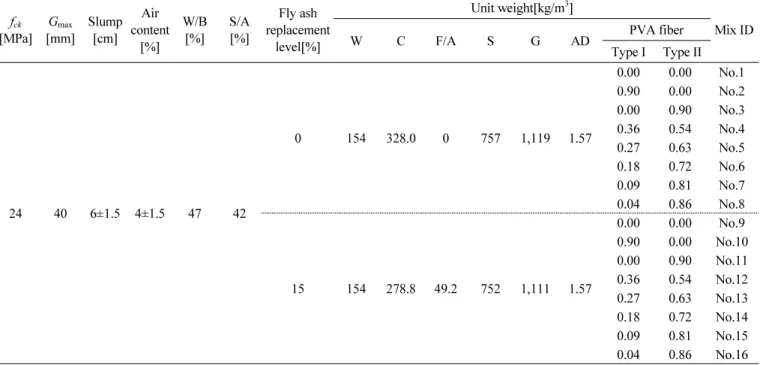
A high-performance, air-entraining(AE), water-reducing agent was used to obtain the target slump and the target air content in the concrete. A total of sixteen different mixtures were produced.

Table 6 shows the mixing ratios of fly ash and blended poly vinyl alcohol fiber in the concrete mixtures that were considered in the tests. The fly ash was used to retard hydration heat and thereby control heat-induced temperature cracks. The amount of fly ash ranged from 0 to 15% of the cement by weight. This range was selected by considering the required initial-stage work strength of the face concrete and the desired economic efficiency and constructability of the face slab. A 0.1% blended poly vinyl alcohol fiber mixture was used to control plastic shrinkage cracking.

Table 2 Physical and chemical properties of cement

Classification Specific gravitty

Fineness [cm

2

/g]

SiO

2

[%]

Al

2

O

3

[%]

Fe

2

O

3

[%]

CaO [%]

MgO [%]

SO

3

[%]

Loss on ignition

Cement 3.05 2,900 21.1 6.5 2.9 62.5 3.3 2.2 1.0

Table 3 Physical properties of aggregates

Type Maximum Size Fineness Modulus Specific Gravity Water Absorption [%]

Unit Weight [kg/cm

3

]

Abration [%]

Soundness [%]

Fine Aggregates - 2.84 2.57 1.76 1.74 - 2.1

Coarse Aggregates 40 - 2.75 0.78 1.77 29.0 2.7

Table 4 Physical properties of fly ash

Classification Loss on ignition [%]

Unit quantity of water [%]

Fineness [cm

2

/g]

Specific gravity [%]

SiO

2

[%]

Water content [%]

ASTM Standard Less than 6

Less than 105

Less than 2,400

Less than 1.95

Less than 45

Less than 1

Fly ash produced in Samchunpo 3.60 101 3,960 2.25 55 0.20

Table 5 Physical properties of poly vinyl alcohol fiber

Classification Tensile strength [MPa]

Elastic modulus

[GPa] Specific gravity Elongation at Break [%]

Length [mm]

Thickness [denier]

Type I 1,180 28.4 1.3 9.2 6.0 30

Type II 1,300 32.0 1.3 12.0 12.0 300

(4)

2.2 Test Methods and Procedure

The main objective of this research was to assess and improve the long-term durability of face slab concrete in CFRD. To evaluate the long-term durability of face-slab concrete, accelerated aging tests were conducted in a laboratory to simulate long-term field exposure conditions. The accelerated aging conditions were examined through compressive strength, flexural strength, plastic shrinkage, drying shrinkage, chloride ion resistance, abrasion resistance, and repeated freezing and thawing tests.

2.3 Compressive Strength Test

Compressive strength tests were performed to evaluate the dam concrete in accordance with the KS F 2405 standard.

Cylindrical specimens with a diameter of 150 mm and height of 300 mm were initially cured for one day and then cured in water at 23± 2 ℃. Each test was performed on three specimens after 28 and 91 days of curing, and repeated twice.

2.4 Flexural Strength Test

Flexural strength tests were carried out according to the KS F 2408 standard. These were repeated twice for two samples taken from dam concrete after 28 and 91 days of curing.

2.5 Plastic Shrinkage Test

The conventional experimental method for measuring the

plastic shrinkage of concrete is to observe the process followed by any cracks formed due to plastic shrinkage by providing a constraint so that the restraint stress in the concrete is affected by any variation in the constraint, configuration, material or environment when the concrete is actually cast. We therefore conducted tests in accordance with the experimental method used in existing studies to evaluate the plastic shrinkage of dam concrete(Fig. 1).

The tests were conducted by observing the crack area when a Table 6 Mixing ratio of dam concrete

f

ck

[MPa]

G

max

[mm]

Slump [cm]

Air content

[%]

W/B [%]

S/A [%]

Fly ash replacement

level[%]

Unit weight[kg/m

3

]

Mix ID

W C F/A S G AD PVA fiber

Type I Type II

24 40 6±1.5 4±1.5 47 42

0 154 328.0 0 757 1,119 1.57

0.00 0.00 No.1 0.90 0.00 No.2 0.00 0.90 No.3 0.36 0.54 No.4 0.27 0.63 No.5 0.18 0.72 No.6 0.09 0.81 No.7 0.04 0.86 No.8

15 154 278.8 49.2 752 1,111 1.57

0.00 0.00 No.9 0.90 0.00 No.10 0.00 0.90 No.11 0.36 0.54 No.12 0.27 0.63 No.13 0.18 0.72 No.14 0.09 0.81 No.15 0.04 0.86 No.16

(Plan View) (Side View)

Fig. 1 Experimental apparatus for crack due to plastic shrinkage

(5)

specimen surface was exposed to wind at 4.0-4.6 m/s at a temperature of 28 ℃ and a relative humidity of 35%. Each test was repeated twice.

2.6 Drying Shrinkage Test

Many studies have used the specimen shown in Fig. 2 to evaluate crack resistance due to drying shrinkage. The crack width was examined 42 days after curing at a temperature of 2 8 ℃ and a relative humidity of 45%.

2.7 Chloride Ion Penetration

This test was carried out according to the KS F 2711 standard to measure the quantity of chloride ion penetration. The amount of chloride ions that penetrated the specimen after 6 h was measured using an electrical indicator. The specimens were water-cured for 28 and 91 days. Each test was performed on two specimens and repeated twice.

2.8 Abrasion Resistance

This test was used to evaluate the change in abrasion resistance caused by adding fly ash and blended poly vinyl alcohol fiber to the cement mixture. The tests were performed according to the ASTM C 779-95 standard, following Procedure B using dressing wheels. The 300 mm × 300 mm × 150 mm specimens were water-cured for 28 and 91 days. The revolutions of the dressing wheels were 56 rpm. The depth of abrasion in each specimen was measured after exposure to an abrasive force for 30 and 60 min. Each test was performed on two specimens and repeated twice.

2.9 Repeated Freezing and Thawing

This test was used to investigate any possible degradation of

the cement-based material exposed to repeated freezing and thawing cycles. The freezing of water in mortar capillary pores causes an internal pressure that leads to the cracking and deterioration of concrete. This is because the water volume increases when it turns to ice, creating an expansion pressure which can exceed the tensile strength of the concrete. This test was used to analyze the effect of fly ash and blended poly vinyl alcohol fiber on the resistance of concrete to specific cycles of freezing and thawing. It was carried out according to the KS F 2456 standard. The dynamic modulus of elasticity of each specimen after 300 cycles was used as the durability factor.

3. Experimental Results and Discussion

3.1 Compressive Strength Test

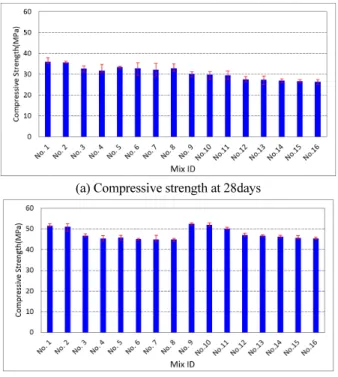
The compressive strengths measured in specimens cured for 28 and 91 days are shown Fig. 3. The test results shows that in the case of the 28-day cured specimens, the compressive strength tended to decrease in all mixture combinations when fly ash and fiber were added. Additionally, in the mixture using 100%

structural fiber, the addition of fly ash did not have any effect with respect to reducing to the compressive strength; however, when blended fiber or 100% non-structural fiber was used, the

(Plan View) (Side View)

Fig. 2 Experimental apparatus for crack due to drying shrinkage

(a) Compressive strength at 28days

(b) Compressive strength at 91days

Fig. 3 Results of compressive strength test

(6)

compressive strength decreased regardless of the addition of fly ash. On the other hand, mixing in fly ash and fiber did affect the compressive strength in the 91-day cured samples. The analysis results shows that the addition of fly ash increased the compressive strength, while the addition of fiber slightly reduced the compressive strength, but this effect was not substantial.

3.2 Flexural Strength Test

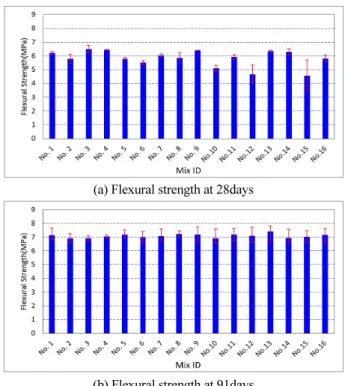
The results of the flexural strength test are shown in Fig. 4.

From the test results, it is difficult to predict the tendency of flexural strength change from the addition of fly ash and fiber in the 28-day cured specimens; however, based on the measured

values of the 91-day cured samples, the addition of fly ash and fiber was found to have practically no effect on the flexural strength.

3.3 Plastic Shrinkage Test

The results of the plastic shrinkage test are shown in Fig. 5.

From the test result mixtures, when fly ash was not added, the No. 7 and No. 8 mixtures showed the best resistance against plastic shrinkage cracks; however, when fly ash was added, the No. 11 and No. 15 mixtures showed the best resistance.

3.4 Drying Shrinkage Test

The results of the drying shrinkage test are shown in Fig. 6.

A drying shrinkage test of surface curtain wall concrete in terms of the added quantity of fly ash and the blended fiber mixture ratio was performed over 91 days; however, the results showed no occurrence of drying shrinkage cracks. The reason for this is that the addition of fly ash and hydrophilic blended fiber significantly suppressed the occurrence of dry shrinkage cracks, and cracks did not occur because the use of a constant temperature and humidity room in the dry shrinkage test prevented any effect from temperature changes during the test.

In this test, shown in Fig. 6, a small amount of dry shrinkage occurred in the mixture using structural fiber, and as the non-structural fiber mixture ratio increased, the dry shrinkage amount tended to increase slightly.

3.5 Chloride Ion Penetration

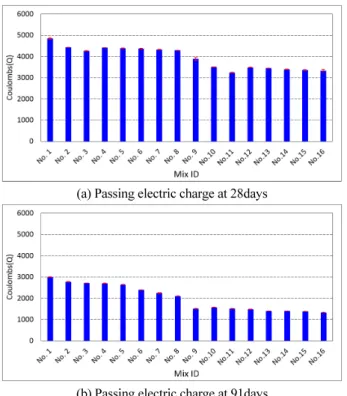
The quantity of electric charge passing through the concrete was used to estimate its permeability characteristics, but not to obtain an exact coefficient of permeability. Specimens were water cured for 28 and 91 days. The results are shown in Fig. 7.

(a) Flexural strength at 28days

(b) Flexural strength at 91days Fig. 4 Results of flexural strength test

Fig. 5 Results of plastic shrinkage test Fig. 6 Results of drying shrinkage test

(7)

From the test results, a much higher resistance against chloride ion penetration was seen in the fly ash concrete compared with ordinary concrete. Moreover, the fly ash and blended fiber mixed concrete showed greater resistance than ordinary concrete

with the No. 15 and No. 16 mixtures having the best results in this study.

3.6 Abrasion Resistance

The results of the abrasion resistance test are shown in Fig. 8.

Fly ash concrete showed better abrasion resistance than ordinary concrete in the 28-day and 91-day cured specimens. In addition, the fly ash and blended fiber mixed concrete exhibited greater resistance than that of ordinary concrete with the No. 15 and No. 16 mixtures having the best abrasion resistance in this study.

3.7 Repeated Freezing and Thawing

The repeated freezing and thawing test was conducted for 300 cycles. The average relative dynamic moduli of elasticity of the specimens during the test are shown in Fig. 9. The results obtained after the 300th cycle were taken as the durability factors.

From the test results, fly ash concrete exhibited superior freezing and thawing resistance compared to ordinary concrete, and concrete with blended fiber added exhibited better resistance to freezing and thawing than concrete with no blended fiber added. Among the mixtures, the No. 15 mixture concrete had the best result in this study.

3.8 Discussions

Based on the above experimental results, it was found that the fly ash concrete reinforced by with blended poly vinyl alcohol fiber has better cracking resistance and durability performance (a) Passing electric charge at 28days

(b) Passing electric charge at 91days Fig. 7 Results of chloride ion penetration

(a) Abrasion resistance at 28days

(b) Abrasion resistance at 91days Fig. 8 Results of abrasion resistance

Fig. 9 Results of repeated freezing and thawing test

(8)

results than those of OPC concrete and fly ash concrete in cracking resistance and durability performance. Therefore, the fly ash concrete with blended PVA fiber is recommended as the most effective material for the construction of face slab concrete in CFRDs.

4. Conclusions

The following conclusions were obtained from this study:

1) The amount of plastic shrinkage was the least when the fly ash content was 15%. The addition of blended poly vinyl alcohol fiber reduced the plastic shrinkage considerably.

2) The chloride penetration test showed that specimens with 15% fly ash had the best long-term permeability resistance.

The addition of blended poly vinyl alcohol fiber improved the permeability resistance slightly.

3) The abrasion resistance of the specimens was greatest when the fly ash content was 15%. The abrasion resistance of the blended poly vinyl alcohol fiber-reinforced concrete was better than that of concrete without fiber.

4) The freezing and thawing resistance improved slightly as the amount of fly ash increased. The addition of blended poly vinyl alcohol fiber also increased the resistance. In this test, the freezing and thawing resistance was the greatest when 15% fly ash was added to the concrete with blended fiber.

Based on the results of this study, we conclude that the optimal durability and economic efficiency of dam concrete can be obtained when the fly ash and blended poly vinyl alcohol fiber content in concrete is 15 and 0.1%, respectively, and is, therefore, recommended as the optimum mixing ratio for face-slab concrete in CFRDs.

Acknowledgments

This work was supported by the Power Generation & Electricity Delivery of the Korea Institute of Energy Technology Evaluation and Planning(KETEP) grant funded by the Korea government Ministry of Trade, industry & Energy(No. 20131010501790).

References

1. A. M. Neville (1995), Properties of Concrete, 4th edition, Addison Wesley Longman Limited.

2. Alhozaimy, A., Soroushian, P. and Mirza, F. (1996), Effects of curing conditions and age on chloride permeability of fly ash mortar, ACI Materials Journal, 93(1), 87-95.

3. An, S. L. (1998), The maintenance and measurement of dam, Journal of Korean Society of Civil Engineer, 46(11), 35-42.

4. Arshad, A., William, D. and Denis, M. (1996), Tensile Strength of Low, Medium, and High-Strength Concrete at Early Ages, ACI Materials Journal, 93(5), 487-493.

5. Gopalan, M.K. (1993), Nucleation and Pozzolanic Factors in Strength Development of Class F Fly Ash Concrete, ACI Materials Journal, 90(2), 117-120.

6. Lee, C. Y., Lee, I. D., Kim, K. W., Bae, S. Y. (1998), Resistance of freeze-thaw and strength development of recycled concrete, Journal of Korea Concrete Institute, 10(04), 163-169.

7. Naik, Tarun R. and Singh, Shiw S. (1997), Influence of fly ash on setting and hardening characteristics of concrete systems, ACI Materials Journal, 94(5), 355-360.

8. Naik, Tarun R., Singh, Shiw and Mohammad M. Hossain (1995), Abrasion resistance of high-strength concrete made with class C fly ash, ACI Materials Journal, 92(6), 649-659.

9. Naik, Tarun R., Singh, Shiw, and Bruce Ramme (1995), Mechanical properties and durability of concrete made with blended fly ash, ACI Materials Journal, 95(4), 454-462.

10. Nasser, K. W. and Lai, P. S. H. (1992), Resistance of fly ash concrete to freezing and thawing, Proceedings of the 4th International conference on the use of fly ash, silica fume, slag and natural pozzolans in concrete, American Concrete Institute, 205-226.

11. Parviz, S. and Iavosh, R. (1998), Control of Plastic Shrinkage Cracking with Specialty Cellulose Fibers, ACI Materials Journal, 95(4), 429-435.

12. Sivasundaram, V., Carette, G.G. and Malhotra, V.M. (1991), Mechanical properties and resistance to diffusion of chloride ions of concretes incorporating high volumes of ASTM class F-fly ashes from seven different sources, ACI Materials Journal, 88(4), 12-28.

13. V. M. Malhotra, G. G. Carette, and A. Bilodeau (1994), Mechanical properties and durability of polypropylene fiber reinforced high- volume fly ash concrete for shotcrete application, ACI Material Journal, 91(5), 478-486.

14. Won, J. P., Park, C. G., Ahn, T. S. (1999), Shrinkage Cracking and Durability Characteristics of Polypropylene Fiber Reinforced Concrete, Journal of The Korean Society of Civil Engineers, 19(1-5), 783-790.

15. Woo, S. K., Song, Y. C. (2004), Improvement of Concrete Durability for Concrete Faced Rockfill Dam, Korea Electric Power Research Institute.

16. Woo, S. K., Song, Y. C., Won, J. P. (2011), Enhanced Durability Performance of Face Slab Concrete in Concrete-Faced Rock-Filled Dam Using Fly Ash and PVA Fibre, KSCE Journal of Civil Engineering, 15(5), 875-882.

17. Woo, S. K., Song, Y. C., Won, J. P.(2009), Durability of rock-

(9)

filled-dam face-slab concrete, Proceedings of the Institution of Civil Engineers - Construction Materials, 162(CM2), 73-79.

18. Yoon, Y. S., Won, J. P., Woo, S. K., Song, Y. C. (2002), Enhanced durability performance of fly ash concrete for concrete-faced rockfill dam application, Cement and Concrete Research, 32(1), 23-30.

Received : 03/14/2016 Revised : 04/04/2016 Accepted : 04/27/2016

요 지 : 이 논문은 표면 차수벽형 석괴댐(Concrete-Faced Rock-Filled Dam) 콘크리트의 내구성능 개선에 관한 것이다. 댐은 영구 구조물이 며 그 중요성을 감안할 때 충분한 내구성능이 확보되어야 한다. 이 논문에서는 플라이애시와 PVA 섬유를 혼입함으로써 차수벽 콘크리트의 내 구성능을 개선하고자 하였으며, 플라이애시와 PVA 섬유 혼입율에 따른 내구성능 향상 검증을 위하여 기본물성 (강도, 소성수축, 자기수축)을 포함한 내구성능 검증 실험(염소이온 침투, 마모 저항성, 동결융해 저항성)을 수행하였다. 실험 결과, 플라이애시 15%와 PVA 섬유 0.1%를 혼 입하였을 때 내구성능 개선 효과가 뛰어난 것으로 나타났다. 검증된 차수벽 콘크리트의 현장 적용을 통해 표면 차수벽형 석괴댐의 안전성 및 내 구성 개선에 기여할 수 있을 것으로 판단된다.

핵심용어 : 표면 차수벽형 석괴댐, 차수벽 콘크리트, 내구성, 플라이애시, PVA 섬유

수치

Table 1 Cause of damage in concrete dams
Table 4 Physical properties of fly ash
Fig. 1 Experimental apparatus for crack due to plastic shrinkage
Fig. 2 Experimental apparatus for crack due to drying shrinkage
+3

참조

관련 문서